
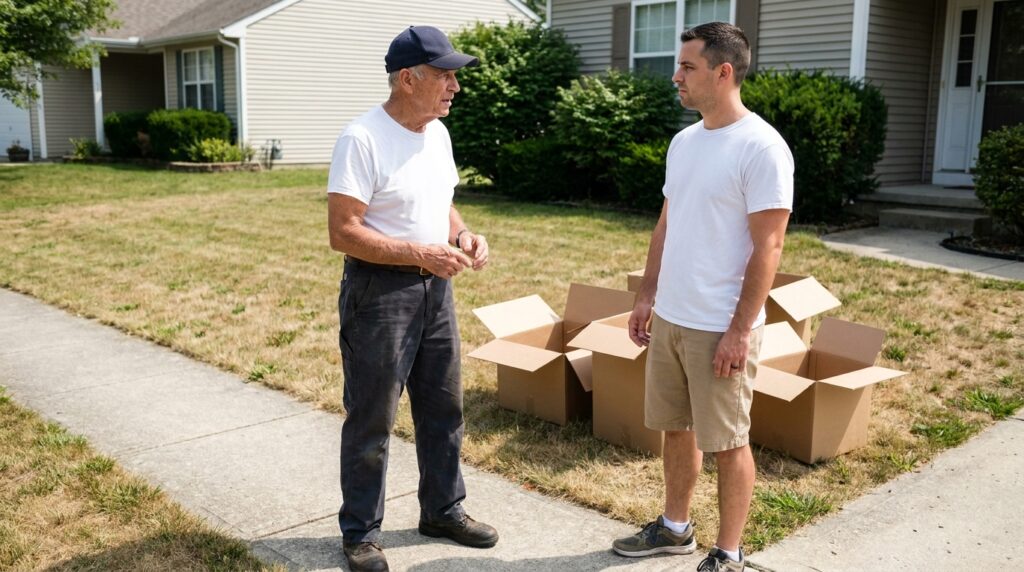
The Silent Friction of Iron Beneath the Bleached Concrete of a Fading American Dream

CHAPTER 1: THE WEIGHT OF DEBRIS

The heat came off the asphalt in dry, invisible waves, carrying the bitter scent of scorched fescue and the chemical tang of cheap packing tape. Arthur didn’t move from the third step of his porch. His thumbs were tucked into the waist of his dark work pants, his fingers flat against the canvas. Below him, the concrete walkway was split by an old frost heave—a gray, jagged line that he had watched widen by fractions of an inch every winter since 1984.

Mark didn’t look at the crack. He didn’t look at Arthur’s face, either. He kept his eyes on the heavy, double-walled cardboard carton cradled against his ribs. With a short, jerky heave of his shoulders, Mark dropped the box. It hit the edge of Arthur’s walkway with a hollow, heavy thud, the bottom corner collapsing where it struck the concrete. A handful of brass plumbing fittings slid across the smooth gray stones, stopping an inch from the toe of Arthur’s left boot.

“The line is six inches past the gravel, Mark,” Arthur said. His voice didn’t rise above the drone of a distant lawnmower three blocks over. It was a flat, dry sound, worn smooth by decades of marine diesel and salt air. He didn’t look down at the brass.

“The line is wherever the truck fits,” Mark spat, wiping his forehead with the meat of his forearm. His face was a dark, blotchy red, his white T-shirt stained gray around the collar with grease from a tailpipe. He stepped closer, his heavy sneakers treading down a patch of Arthur’s rye grass until the stems snapped under the rubber. “I’m sick of the looking, Art. Every time I pull the rig in, you’re sitting behind that screen door like a county clerk with a tape measure. I’ve got three tons of freight to sort before the bank closes on Friday, and I’m not walking it up the lane because your grass is sensitive.”

Arthur’s hand didn’t leave his waist, but his weight shifted backward into his heels, just enough to feel the solid pine of the riser beneath his boot. He could smell the sour beer on the younger man’s breath from five feet away—a midday stale that smelled of panic more than malice. Through the worn fabric of his navy service cap, the sun beat a steady, heavy pulse against the crown of his skull.

Near the corner of the fence, where the rusted iron surveyor’s stake was supposed to be buried under three inches of topsoil, a single white plastic dry-cleaning bag lay caught in the brambles, snapping like a broken flag in the hot draft. Mark took another step, his heavy build crowding the narrow stone path until his shadow completely swallowed Arthur’s boots. He was breathing through his mouth, his jaw thrust forward, the posture of a man who had spent his life using mass to clear a path through rooms that didn’t want him.

“You don’t want to do this out here,” Arthur murmured, his eyes tracking the slight tremor in Mark’s right hand as it hovered near the box.

“I’m doing it right here,” Mark said, his fingers curling into a fist against his khaki shorts. “And you’re going to watch.”

At the edge of the adjoining driveway, fifty yards away, Mrs. Gable’s aluminum storm door clicked open, the small, high squeak of the spring cutting through the suburban silence like a wire.


CHAPTER 2: THE CRUSHED GRASS

“You left your gate unlatched, Mark,” Arthur said. He didn’t turn his head toward Mrs. Gable’s porch, but his ears tracked the rhythmic, metallic slap of her aluminum storm door settling back into its frame. In the heat, every sound carried a sharp, dry edge, like dry kindling snapping under a boot.

Mark didn’t look back at the street. His shoulders remained hunched, his heavy frame blocking the light as he leaned into Arthur’s space. A drop of sweat cut a clean, pale line through the grey grit on his neck. “My gate isn’t your business, old man. This driveway is. My boxes are. You’ve been dragging your feet on this corner since my old man sold the lot, and I’m done asking nicely. The lumber for the new shed comes tomorrow. It goes right here.” He tapped the toe of his sneaker against the cracked concrete of Arthur’s walkway, a dull, rubbery thud that sent a tiny puff of grey dust into the air.

Arthur looked down at the shoe. The rubber rand was peeling away from the canvas, held together by a smear of dried yellow wood glue. A working man’s shoe, but lazy. The kind of fix that lasted three days before the grit worked its way back into the seam. Arthur knew that grit; it was the same fine, alkaline powder that blew off the dry flats behind the naval yards, the stuff that chewed through bearings and pitted steel if you didn’t grease the fittings every twelve hours on the watch.

“The stakes from seventy-two are still down there,” Arthur said, his voice flat, level, locked into the same low register he used when the generators failed in forty-knot seas. He pointed a single, calloused finger toward the base of the overgrown fescue where the plastic dry-cleaning bag was still shivering against the wire fence. “Six inches into that patch of crabgrass. If you drop the skids for that lumber on this side of the rusted post, the city inspector won’t even let you unhook the trailer.”

Mark let out a short, wet laugh that smelled of stale tobacco and warm soda. He took a half-step sideways, his heavy hip bumping against one of the stacked cardboard cartons. The box shifted, its taped seam groaning under the pressure of whatever density was packed inside. Through the split paper, Arthur caught the glint of oxidized iron—not plumbing fittings, but heavy, flat-headed tie-rods used for securing industrial concrete forms.

“The city inspector doesn’t come down this lane unless someone calls him,” Mark muttered. He lowered his voice, the pitch dropping into a granular, throat-deep gravel that carried the specific weight of a threat meant for an old man who lived alone. “And if someone calls him, Art, I’m going to know exactly which house the call came from. My family’s been on this block forty years. We don’t need papers to tell us where the dirt belongs.”

Arthur didn’t blink. He kept his gaze fixed on the small V-shaped notch where Mark’s collarbone met his throat. A man’s center of gravity was always lower than he thought, especially when he carried thirty pounds of soft lard around his middle. If Mark leaned forward another two inches, his heels would lift off the concrete. It was simple physics—the same balance math Arthur had used when he had to brace himself against the bulkhead of a destroyer while the deck rolled thirty degrees into the trough of a black Atlantic swell. You didn’t fight the roll; you let the steel find your bone.

“Your father knew where the iron was,” Arthur said softly. He reached down, his fingers closing around the cold, brass sleeve of the plumbing coupling that had rolled near his boot. The metal was pitted, the threads clogged with dried white pipe dope that had turned to chalk twenty years ago. “He helped me drive the pipe into the corner when we put the cedar posts in. He used a five-pound sledge, and we hit a limestone ledge four feet down. That pipe isn’t going anywhere, Mark. Even if you pile ten tons of pine on top of it.”

Mark’s face tightened, the skin around his eyes twitching as he looked down at the brass in Arthur’s hand. For a second, the heat seemed to stop moving between them. The air was thick with the smell of sun-baked tar from the roof shingles behind them and the sweet, rotting odor of grass clippings turning sour in the black plastic bin by the garage.

“He’s dead, Art,” Mark said, his voice losing its gravel, turning thin and sharp like a sheet of ungreased tin. “And his name isn’t on the tax roll anymore. Mine is.”

He reached out then, his heavy hand coming up fast, his fingers curling into a thick hook aimed directly at the loose fabric of Arthur’s work shirt. It wasn’t a punch; it was the clumsy, heavy-handed grab of a man used to clearing brush or hauling crates, an assertion of weight meant to rattle an old man’s teeth and make him look at the ground.

Arthur didn’t pull back. His boots stayed flat against the concrete, his heels locked into the frost heave. He watched the hand come, noting the yellow smear of wood glue on the thumb, the ragged edge of the fingernail, the raw, red skin around the knuckles where the grease had been scrubbed away with kerosene. The hand was slow. To Arthur, whose mind still measured time in the clean, mechanical clicks of a engine-room telegraph, Mark’s arm looked like it was moving through old grease.

The space between them closed, the heat of Mark’s body arriving a fraction of a second before his fingers touched the cloth. Arthur didn’t raise his hands to defend his face. He simply dropped his left shoulder three inches, his frame settling into the pine step behind him until his spine was as straight and rigid as a stanchion on a main deck.

CHAPTER 3: THE APPROACHING RADIUS

Mark’s hand didn’t strike like a weapon; it pushed through the heavy air with the dead, blind momentum of an unlatched cargo door in a heavy sea. The grease beneath his fingernails was dark, almost black against the pale underbelly of his forearm. Arthur didn’t watch the hand itself. He watched the subtle tightening of Mark’s left shoulder, the way the younger man’s weight pooled into his forward knee, forcing his center of gravity past the point of recovery.

The world contracted down to the small, predictable physics of a narrow concrete walkway. A grasshopper kicked off from a split blade of fescue near the gravel line, its wings clicking once before it vanished into the shadow of the dropped cardboard carton. To a man who had spent three years in the vibrating steel belly of a fleet destroyer, listening to the microscopic groan of high-pressure steam lines through a stethoscope, the mechanical signals of an angry neighbor were loud enough to shake the floorboards.

“You’re leaning,” Arthur murmured. The words were small, dry grains dropped into the furnace of the afternoon heat.

Mark didn’t stop. His fingers caught the coarse, faded linen of Arthur’s work shirt just below the collar line. The fabric groaned, the old threads tightening against Arthur’s chest with a sharp, dry rasp. Mark’s breath came out in a hot, sour cloud that smelled of iron-heavy well water and burnt onions. “I’m standing where I belong, old man,” he snarled, his knuckles bunching as he twisted the cloth, trying to find leverage to drag Arthur off the pine step. “You’ve been looking down your nose at my family since the day we poured our driveway. You think that hat makes you special? You think anyone on this street gives a damn about a box of old papers in your attic?”

The pull was heavy, but it was linear. Mark was relying on forty pounds of excess grease and bone to do the work that discipline should have handled. He didn’t understand that concrete didn’t give under a boot, and he didn’t understand that an old man whose legs had been trained by thirty-two thousand miles of gray water didn’t have any lean left in him.

Arthur kept his feet flat. His boots were old black leather, the soles hard-vulcanized rubber that had outlasted three different county road commissioners. He felt the cold pressure of the brass coupling still gripped tightly in his right palm—a small, solid cylinder of dead weight that gave his forearm an anchor. He didn’t lift the metal. He didn’t swing it. He simply kept his right elbow tucked close to his ribs, his humerus acting as a short, unyielding strut against the pull.

“Your dad had a five-pound sledge,” Arthur said, his eyes perfectly level with the small, sweating notch above Mark’s collar. “He knew how to drive a line straight because he’d spent four years in the Seabees clearing coral off Tinian. When he hit that limestone ledge under the crabgrass, he didn’t quit. He took an iron bar and he worked it until the hole was four feet deep. He didn’t guess, Mark. He followed the bronze pin the state surveyor set in forty-eight.”

Mark’s left arm went rigid, his shoulder twisting as he poured more weight into the linen. “Shut up about my father. He’s six feet under the sod at St. Jude’s, and he’s not paying the taxes on this lot. I am. The lumber delivery is coming from the yard at seven tomorrow morning. Two skids of green pressure-treated four-by-fours. It’s sitting right on this walkway if I say so, and you’re going to step over it until the roof is on.”

The sun hit the metal siding of Mark’s garage across the lane, casting a hot, blinding sheet of silver light across the grass. The glare caught the edges of the scattered cardboard cartons between them, revealing the dark, oily smudge of old industrial sealer weeping through the bottom corners of the paper. There was a label on the third box down—a faded, blue-ink stamp from the county zoning office that had been crossed out twice with a heavy grease pencil.

Arthur’s gaze dropped to the stamp for a single millisecond. The ink was old, but the paper underneath wasn’t waterlogged like the rest; it had the crisp, flat edges of something pulled from a filing cabinet within the last forty-eight hours.

“You’ve been to the courthouse, Mark,” Arthur said. The tone wasn’t an accusation; it was the simple statement of a chief checking a oil-level sight glass before a shift change.

Mark’s hand jerked on the shirt. The linen tore at the seam near the second button, a tiny, clean sound like dry grass snapping under a heel. His face didn’t just turn red; it went a dark, dull purple around the jawline, the skin tight and shiny under the layer of grease. “I said shut your mouth, Art. You don’t know anything about my business.”

He didn’t just pull then; he shoved. He threw his left shoulder forward, using his entire upper body as a ram to force Arthur back through the screen door behind him. It was the moment of complete commitment—the point where weight becomes momentum and momentum can’t be turned back by an ungreased brake shoe.

Arthur’s left foot slid back exactly two inches, his heel finding the firm, unyielding vertical lip of the second porch riser. His knees bent by three degrees, his thighs locking into the pine structure until his body was part of the house foundation. He felt the heat vibration from the concrete path rise through his boots, a steady, dry hum that met the downward pressure of Mark’s arm halfway.

The neighbor’s storm door across the lane didn’t rattle this time, but the shadow of Mrs. Gable’s sun hat appeared in the narrow gap between her hydrangeas, her small, pale hand resting against the white paint of her porch rail. She didn’t call out. No one called out on this lane. The air was too heavy for noise, too thick with the iron smell of things that had been buried too long under the sod.

Arthur let his breath out in a slow, even stream through his teeth, his jaw relaxing as he watched Mark’s second foot leave the safety of the dry grass and settle onto the cracked concrete of the primary lane.

CHAPTER 4: THE LEVERAGE OF IRON

The full weight of Mark’s thirty-eight years came forward in a single, unguided rush. The split seam of Arthur’s shirt gave way entirely with a dry hiss of cotton threads, but the skin beneath stayed stone-still. Arthur felt the kinetic line traveler up Mark’s arm—clumsy, top-heavy, leaning thin on a base of soft gravel. To Arthur, a man who had calibrated the hydraulic governors on twin-propeller shafts while thirty-foot walls of winter seawater pounded the bulkheads, weight was just an equation waiting for a fulcrum.

He didn’t swing his arm. He didn’t reach for Mark’s face. Arthur simply dropped his right hip two inches, sinking his center into the pine step until his bones stacked neat and dead like iron pillars. His left hand came up under the mass of Mark’s extended wrist, his thumb finding the small, shallow depression between the younger man’s radius and ulna. It wasn’t a strike; it was a simple, short torque—the exact mechanical rotation a mechanic used to break the corrosion on a frozen valve stem.

The friction was brief and dry. When Mark’s weight hit the fixed strut of Arthur’s frame, the momentum had nowhere to go but down. Arthur’s right thumb pressed into the tendon, twisting the wrist outward by forty-five degrees. The physical frame that Mark had built his intimidation on suddenly buckled at the hinge. His sneakers lost their bite on the smooth concrete of the walkway, the yellow glue at the seam tearing open as his heel drifted off the line and caught the soft, rotting lip of the turf.

Mark stumbled. His heavy arms flailed once, cutting a wide, ragged circle through the hot air before his hip struck the stack of cardboard cartons behind him. The top box gave way with a wet, heavy crunch, the dry-cleaned plastic bag caught in the wire fence snapping violently as Mark’s shoulder dragged it down into the dirt. A dozen long, rusted iron concrete tie-rods spilled across the gravel, clinking together like dead bells.

Arthur stood exactly where he had been three seconds ago. His feet hadn’t cleared the concrete heave. The faded navy cap sat square on his head, the brim casting a sharp, gray wedge of shadow across his eyes. His breathing remained long and steady, a rhythmic draw of dry air that tasted of road tar and parched earth.

“Don’t underestimate me,” Arthur said. His voice didn’t carry the raw throat-scrape of an old man’s anger. It was low, dense, and flat, the sound of a cold diesel block settling into its mounts after a twelve-hour run. “Back off now.”

Mark lay sprawled across the broken cardboard, his palms flat against the gravel lane. The red color had left his face, replaced by a greasy, pale sweat that made the dirt on his forehead look like wet ash. He looked down at his left wrist, where the red mark of Arthur’s thumb was already turning a deep, iron-bruise purple under the sun. His breath came in ragged, shallow gasps, his chest heaving under his sweat-ringed shirt like a landed carp.

“You broke my arm,” Mark whispered, his voice thin and high, stripped of its gravel. He looked around the yard, his eyes darting toward Mrs. Gable’s driveway as if searching for a line of retreat that didn’t involve the old man standing on the porch step.

“It’s not broken,” Arthur said, his hand lowering until his fingers rested against the cold seam of his dark work pants. “The joint is stiff because you don’t grease the hinges. Get your things off my stone, Mark.”

Through the split side of the carton Mark had crushed, a thick, white packet of legal-sized documents had slid out onto the dry grass. The top page was stamped with a heavy, blue-ink seal from the county recorder’s office, dated three days prior. The heading wasn’t a standard property deed; it was a formal notice of systemic variance, marked with three separate red ink lines that ran straight through the schematic of Lot 4—Mark’s lot.

Arthur’s gaze locked onto the document. Even from five feet away, his eyes, trained by thousands of hours of reading micrometer markings under dim bulkhead lamps, caught the thin, dashed line that indicated the official county survey boundary. It didn’t stop at the fence lane. It didn’t stop at the gravel. The line cut directly through the graphic layout of Mark’s home, splitting the foundation of his garage and his living room into two unequal halves of disputed dirt.

Mark saw Arthur looking. With a frantic, jerky scramble, he pulled his knees under his chest and grabbed the paper, cramming the waterlogged corners back into the torn cardboard with his good hand. His knuckles were shaking, the raw skin bleeding slightly where he had scraped them against the iron tie-rods.

Across the lane, the shadow behind Mrs. Gable’s hydrangeas moved back three inches into the porch recess. Her pale hand didn’t leave the rail, but her head bowed down, her eyes fixed on her own neat concrete path as if the heat had suddenly become too bright to look at directly.

Arthur didn’t step down from the pine riser. He watched Mark gather the loose brass couplings, his fingers tracking the way the younger man’s heavy frame had shrunk under the sudden weight of the silence.

CHAPTER 5: THE SETTLING SILENCE

“Alright,” Mark muttered, his throat clicking as he forced the word out. He remained on one knee in the sharp gravel, his fingers bunching the wet, torn edge of the white legal packet. “Alright, I’m done.”

Arthur didn’t lower his gaze to match the younger man’s posture. He kept his head flat, his chin parallel to the concrete path, watching the light tremble over the hot hood of Mark’s pickup truck across the lane. The vehicle’s exhaust pipe let out a final, ticking pop as the steel began to cool under the heavy afternoon glare.

“The paper goes back into the dry carton, Mark,” Arthur said. The statement was dry, sparse, devoid of any small spike of victory. He reached up with his left thumb, checking the alignment of his navy service cap where the torn linen of his collar pressed against his neck. The skin was hot but dry.

Mark didn’t argue. He shoved the white packet deeper into the crushed paper core of the third box, his clumsy, thick fingers tearing a fresh three-inch split across the side panel. He didn’t look at Arthur’s face while he worked; his movements were small, hurried, and short, the frantic packing of an operator who had lost his pressure and knew the watch was watching. He dragged the heavy box back across the sod line, his sneakers leaving two dark, bruised channels through the dry rye grass.

“The trailer comes at seven,” Mark said over his shoulder, his voice thin, stripped of its weight. He didn’t lift his chest until he reached the concrete skirt of his own driveway. “I can’t stop the delivery, Art. The yard already charged the card.”

“The driver can drop the skids on the gravel by your garage,” Arthur replied, his voice an even, unyielding drone. “If he drops them six inches past the fence posts, I’ll have the county truck out here before he unhooks his safety chains. Your dad knew the width of the turn, Mark. He never brought anything larger than a flatbed six-wheeler down this lane.”

Mark didn’t answer. He turned his back, his heavy shoulders dropping as he hauled the broken box into the shade of his open garage bay. The heavy wooden door didn’t slam; it dropped down onto the greasy slab with a dull, hollow rumble that sounded like empty oil drums rolling in a cargo hold.

Arthur stayed on the second step until the echo cleared the lane. The silence that came back was thicker than the heat, full of the dry, hot smell of old creosote from the utility poles and the bitter tang of flaking zinc from the wire fence.

He stepped down onto the walkway then. His boots felt heavy, the thick rubber soles crunching into the loose grit that Mark’s struggle had scattered across the stone path. He didn’t go inside. He walked slow, his thumbs returning to his waist, his eyes tracking the jagged frost heave until he reached the corner where the plastic dry-cleaning bag was caught in the briars.

The bag was ruined, the thin film shredded into gray ribbons by the thorny stems of the blackberry bushes. Arthur reached into the thicket, his skin unbothered by the dry barbs as his fingers searched the base of the sod. Four inches down, beneath a tight knot of dried crabgrass roots, his knuckles struck something flat and cold.

It wasn’t the surveyor’s stake. It was a secondary marker—a three-inch disc of corroded iron plate, pinned to the limestone ledge by a heavy, square-headed railroad spike. Arthur cleared the dry soil with his thumb until the stamped numbers on the iron face became visible under the white glare of the sun.

The plate didn’t have the standard county registry stamp from seventy-two. The markings were older, deeper, hand-chiseled into the iron with a cold punch: 1954 – SEC 12 – VAR 04.

Arthur knelt in the grass, his knee pressing down onto a sharp piece of crushed aggregate until the bone ached. He knew the numbers. He had seen them once before, on an old navy blue blueprint blueprint that his own father had left in a cedar chest behind the water heater in sixty-seven. That blueprint hadn’t been drawn by a city clerk; it had been signed by an engineer from the regional railway authority before the state highway had cut the old farm lot into four narrow suburban strips.

He looked across the boundary line toward Mark’s living room window. The glass was dark, reflecting only the gray, shimmering line of the asphalt and the unpainted lower trim of the garage door. The iron disc beneath his hand wasn’t six inches from Mark’s driveway. It was eight feet inside it. If the chiseled marker from fifty-four was the true bronze pin, the legal line didn’t just trim the edge of the boxes—it ran straight through the center of Mark’s foundation, cutting the younger man’s kitchen and front porch completely off the municipal map.

Arthur’s fingers stayed on the rusted iron plate, feeling the cold, deep mass of the limestone ledge beneath the dirt. A bluebottle fly landed on the flaking brim of the iron disc, its wings twitching once before the heat drove it back into the shadow of the briars.

From behind the screen door of his own dark hallway, the telephone began to ring—a sharp, mechanical brass double-chime that had been wired into the wall box when the house was built. It rang four times before Arthur stood up, his joints popping like dry pine twigs in the stillness of the yard.

CHAPTER 6: THE UNSEALED RECORD

The black bakelite receiver felt heavy and cold against Arthur’s ear, a stark contrast to the thick, zinc-flavored air of the front walkway. The mechanical double-chime inside the wall box cut off with a small, metallic click that left a high-pitched ring in the narrow hallway. Outside, the world was still shaking under the silver glare of the three-o’clock sun, but inside the house, the air smelled of floor wax and sixty years of quiet containment.

“Arthur? It’s Gable.” The voice on the wire was thin, dry, and punctuated by the hollow scratching of an old telephone line. Mrs. Gable didn’t look through her window when she spoke; she kept her eyes on the small notepad she kept by her kitchen sink. “I saw Mark hauling those boxes back toward his garage. Is he going to clear that path before the evening mail comes through?”

Arthur leaned his shoulder against the wood trim of the doorframe. His thumb traced the rough, sand-cast edge of the telephone mount. “The path is clear, Clara. He’s keeping his lumber on the gravel side.”

“He’s got no business running his mouth at you on that stone,” she said, her voice dropping into a flat, level frequency that carried the memory of three generations of neighborhood births and deaths. “His father wouldn’t have permitted that kind of noise. His father knew how to keep a line clean. But Mark’s been carrying something heavy since January, Arthur. He’s got men in gray sedans parking by his mailbox twice a week. They don’t leave notes. They just sit there with the engines idling until the sun goes down.”

Arthur didn’t answer right away. He looked through the screen door toward the driveway across the lane. The heavy wooden door to Mark’s garage stayed down, but the small, rectangular window near the top was gray with dust, blocking any view of what was happening near the workbench.

“He’s sorting freight,” Arthur said softly.

“He’s sorting more than pipe fittings,” Clara Gable spat. “The bank put a orange card on his utility box this morning, Arthur. I saw the girl from the water district driving away before you even came out on your porch. You watch your fence line. A man with a dry well doesn’t care whose grass he treads on.”

The line went dead with a sharp, heavy pop as she hung up her receiver. Arthur stayed still for a moment, listening to the dry, rhythmic hum of the empty wire before he set the bakelite back into its cradle. His hand felt dry, the palm stiff from the pressure of the brass coupling he had carried inside.

He didn’t return to the porch step. Instead, he walked down the narrow basement stairs, his boots finding the exact center of each worn oak tread. The cellar was cool, the stone walls sweating a fine, white powder of saltpeter that tasted of lime and old rain. In the far corner, behind the galvanized tank of the water heater, sat the green cedar chest his father had hauled home from the shipyard in forty-six. The brass corners were green with verdigris, the lock mechanism frozen into a single block of oxidized iron.

Arthur didn’t use a key. He took a heavy, flat-headed cabinet screwdriver from the ledge and pried the latch up until the ancient pine wood split with a short, wet crack. Inside, beneath two wool utility blankets that had turned the color of dry moss, lay a roll of heavy, blue-ink linen drawings—the regional railway variance maps from 1954.

He unrolled the linen across the top of a dusty washing machine, his calloused palms pressing the curling edges flat against the enameled tin. The paper was cold, the smell of ammonia and stale starch rising off the surface like a draft from an old well. His eyes tracked the white chiseled lines past the marsh lane, past the old culvert, straight to the small square marked Lot 4.

The red ink lines he had seen through the split carton in Mark’s yard weren’t a county mistake. They matched the chiseled hand-mark on the iron plate exactly. The state highway department in fifty-four hadn’t used the municipal reference pin; they had driven their own heavy spike into the limestone ledge four feet below the sod, creating a legal gap that had been buried under forty years of tax assessments and neighborly handshakes.

The error was systematic, a clean, mechanical split that ran six degrees off the true North alignment. According to the linen drawing beneath his thumbs, Arthur didn’t just own the six inches of crabgrass where the boxes had fallen. He owned the entire eastern half of Mark’s driveway, the concrete apron, and the load-bearing brick wall that supported the roof of Mark’s front porch. The mortgage company that had issued the foreclosure notice on Lot 4 hadn’t checked the 1954 variance; they had relied on the seventy-two plat map—a document that was worth less than the split paper it was printed on.

Arthur’s thumbs left two gray smudges on the clean white border of the map. If he brought the linen to the county building on Monday morning, the zoning board would have no choice but to freeze the deed. The bank wouldn’t just foreclose on Mark; they would invalidate the entire parcel, stripping the property of its legal title and leaving Mark’s family with nothing but a debt on a house that didn’t legally exist on any state line.

He heard a dull, scraping sound from the yard above—the heavy, ungreased rattle of Mark’s garage door rising two feet off the slab. Arthur slowly rolled the linen back into its cylinder, his movements deliberate, his mind calculating the exact cost of the friction that was waiting for them at the boundary stake.

CHAPTER 7: THE INCINERATION OF THE STAKE

The match head left a sudden, brilliant streak of sulfur-yellow against the rusted face of the 1954 iron plate. The sharp, chemical stink of the ignition cut straight through the heavy, stagnant smell of the parched turf and the hot, ungreased metal of Mark’s truck across the lane. Arthur didn’t watch the flame itself; he kept his eyes on the small, square-headed railroad spike that held the iron disc to the limestone ledge below.

The afternoon sun had begun its drop, casting long, lean shadows that stretched like dark girders across the narrow suburban walkways. A single car went by on the main road, its tires giving off a high, sticky whine against the soft asphalt. Arthur knelt in the weeds, his dark work pants collecting the grey, powdery dust of the dry soil. In his left hand, he held the thin, blue-ink linen drawing he had hauled up from the cedar trunk in the cellar.

“Art.”

The voice came from the edge of the gravel drive. Mark was standing three feet back from the fence line, his heavy frame hunched forward, his hands buried deep inside his khaki pockets. His face wasn’t dark purple anymore; the skin around his nose was an ash-grey, dry and flaking from the heat. He didn’t look at the match. He kept his eyes on the cylinder of paper in Arthur’s grip, his jaw working slowly on a dry piece of toothpick.

“The yard called,” Mark said, his tone flat, empty of the gravel that had driven his threats an hour ago. “The skids are already on the flatbed. They won’t take the cancellation without a fifty-percent restock fee. My wife’s down at her mother’s with the kids because the district clerk told her the water meter line was under review. She thinks we’re losing the lot, Art.”

Arthur didn’t look up from the spike. He held the small, white flame to the edge of the linen drawing. The starch-stiff paper didn’t catch fast; it sizzled once, a tiny drop of old ammonia steam weeping from the blue border before the corner turned a deep, carbon black and began to curl into a grey ribbon of ash.

“Your father spent four years in the western Pacific, Mark,” Arthur said. His voice was an even, unyielding drum, the rhythm locked into the steady, mechanical beat of a cold piston block. “He didn’t build things with paper. He built them with five-inch timber and iron tie-rods because he knew that when the salt air gets into a joint, the only thing that holds is the weight of the frame itself.”

“The mortgage man has a copy of the seventy-two map,” Mark muttered, his sneaker kicking a loose clump of dead fescue into the ditch. He took his hands out of his pockets, the fingers twitching against his sides. “He says if the city inspector marks a variance on the garage foundation, the title company pulls the insurance by Friday. We can’t stay here without the insurance, Art. The state bank won’t carry the note on an uncertified slab.”

The fire caught the main grid of the map now, the yellow flames consuming the thin white lines that indicated the 1954 state highway boundary. The smoke rose straight up in a thin, grey wire that smelled of old basements and burnt glue. Arthur watched the fire eat the section marker—the specific chiseled variance that put half of Mark’s living room and the entire structural support of his front porch on the wrong side of the municipal line.

“There is no variance,” Arthur said. He dropped the last burning scrap of linen onto the corroded face of the iron plate, using the hard vulcanized rubber sole of his boot to grind the black ash into the grey grit of the stone.

Mark took a half-step forward, his heavy build freezing at the edge of the walkway. His eyes went wide as he looked at the black smudge where the 1954 record had been. “What did you just do?”

“The seventy-two map is what the county clerk has on the counter,” Arthur said, standing up slow, his joints making three short, sharp clicks in the hot silence of the yard. He tucked his thumbs back into his canvas waist, his navy service cap sitting straight and low over his brow. “The seventy-two map says the line runs six inches past my concrete path. It says your driveway is yours and my walkway is mine. That’s the record the title company carries. That’s the record your father paid his taxes on for forty years.”

Mark looked from the blackened iron plate to Arthur’s face, his lips parting slightly as the weight of the silence settled between them. The panic in his eyes didn’t vanish, but it shifted, the raw terror of the foreclosure notice meeting the hard, unyielding wall of the old man’s restraint. “The county spike under the grass… if they bring the transit out here—”

“They won’t bring a transit out here unless someone asks for a full sector review,” Arthur said, his gaze locking onto the younger man’s throat with the flat authority of a master-at-arms checking a berth before inspection. “And no one is asking. You drop your skids on the gravel tomorrow morning at seven. You build your shed three feet back from the wire fence, the way your dad built the old tool crib in sixty-eight. And you keep your boxes off my stone.”

Across the lane, the shadow behind Mrs. Gable’s hydrangeas vanished entirely. The aluminum storm door let out a final, soft squeak as she walked back into her kitchen, leaving the street completely clear under the wide, white eye of the afternoon sky.

Mark stood still on the concrete skirt of his driveway, his heavy chest rising and falling in a long, shuddering draw of the dry air. He didn’t offer his hand. He didn’t say the word thank you. A working man on this lane didn’t have the words for an act of mercy that felt like a sentence of hard labor, but his head bowed down three inches, his fingers curling into his palms as he turned back toward his closed garage bay.

Arthur didn’t watch him walk away. He turned his face toward his own dark porch, his boots finding the split heave in the concrete walkway with the absolute familiarity of a man who knew exactly how much weight the ground could bear before it broke.

CHAPTER 8: THE BOUNDARY OF SILENCE

The cold iron blade of the spade sliced through the damp fescue with a short, metallic chunk. It was seven-fifteen in the morning, and the air still carried a faint, watery chill from the dew, though the eastern horizon was already bleached with the first white glare of the coming heat. Arthur drove his boot down onto the flat collar of the shovel, his weight settling into the tool with the rhythm of an engineer who had spent half a life maintaining the lower-deck auxiliary pumps.

Three feet away, across the frost heave in the concrete walkway, Mark was kneeling in the loose gravel of his own drive. His heavy forearms were coated in a fine, grey powder of limestone dust. He was holding the lower rail of the wire fence, his fingers curled tight around the rusted zinc mesh as he cleared a space for the first timber skid. The flatbed truck from the lumber yard had already come and gone, its diesel rumble fading into the morning traffic three blocks north, leaving behind two heavy pallets of green, pressure-treated four-by-fours sitting neat and square on the gravel.

Neither man spoke. The lane was completely empty, the small, clean houses on either side locked behind their drawn blinds.

Arthur lifted a heavy spadeful of dark, wet topsoil and turned it over into the shallow trench he was clearing near the base of the blackberry bushes. The earth was thick, full of old limestone aggregate that clinked against the iron blade like spent brass casings. With every stroke, his movements were precise, slow, and measured, his mind tracking the physical resistance of the soil down to the stone ledge four feet below. The rusted railroad spike and the chiseled鐵 plate from 1954 were completely buried now, covered by six inches of freshly packed sod that showed nothing but the uniform gray of the morning shadow.

Mark stood up slow, his knee joints making a dull, wet pop that sounded like green wood splitting under a wedge. He took a heavy iron crowbar from the bed of his pickup and set the tip against the corner of the first lumber skid, his shoulder muscles bunching as he heaved the mass of green pine three inches closer to the garage slab. The wood groaned against the metal strapping, releasing a sharp, sour scent of chemical preservative that mixed with the smell of the damp earth.

Arthur watched the movement, his eyes catching the dark, swollen line of the bruise on Mark’s left wrist where his thumb had locked twenty hours ago. The swelling had settled into a hard, dark knot under the skin, a silent indicator of a physical limit that didn’t need to be discussed. Mark didn’t reach for the wrist; he kept his fingers wrapped around the cold iron of the crowbar, using his weight to adjust the alignment until the wood skid sat perfectly parallel to the gravel edge.

“The post holes need to be three feet deep if you’re using six-by-sixes for the frame,” Arthur said. His voice was a flat, low hum that didn’t carry past the fence line. It had the same granular density as the limestone dust on the drive.

Mark stopped heaving. He wiped his palms on his dark shorts, his face staying low, his eyes fixed on the narrow gap between his concrete apron and Arthur’s stones. “The auger rental is for twenty-four hours. I’ll have the concrete poured before the afternoon heat hits the garage wall.”

“Use the gravel at the bottom for drainage,” Arthur said, leaning his hands flat against the top of the wooden spade handle. “If you don’t clear the lime out of the hole before you mix the sack, the water from the ditch will turn the base into mush before the winter frost clears.”

Mark gave a short, single nod. He didn’t look up at the porch step where the torn linen of Arthur’s work shirt had been replaced by a fresh, unwashed blue chambray coat. He simply picked up his spade and began to clear the loose stone away from his first layout stake, his movements matching the slow, mechanical pace that the older man had established across the line.

The truth of the 1954 boundary stayed exactly where it belonged—four feet beneath the compacted dirt, locked under a limestone shelf that didn’t care about municipal titles or bank foreclosures. The seventy-two plat map on the county counter remained the law of the street because two men were willing to work the line with their hands until the dirt looked clean. It was a pragmatic peace, paid for with a torn shirt and a handful of sulfur ash, but it had the weight of an iron frame that had been driven straight into the stone until it couldn’t be turned by the wind.

Arthur turned his back on the lane then, his boots finding the split in his concrete path as he walked toward his screen door. Behind him, the rhythmic, metallic scrape of Mark’s shovel against the gravel continued—a steady, unvarnished friction that would outlast the sun.

Similar Posts

Leave a Reply

Your email address will not be published. Required fields are marked *






