
The Hard Edge of a Quiet Floor and the Heavy Price of Unearned Pride
CHAPTER 1: THE FRICTION OF INTENT
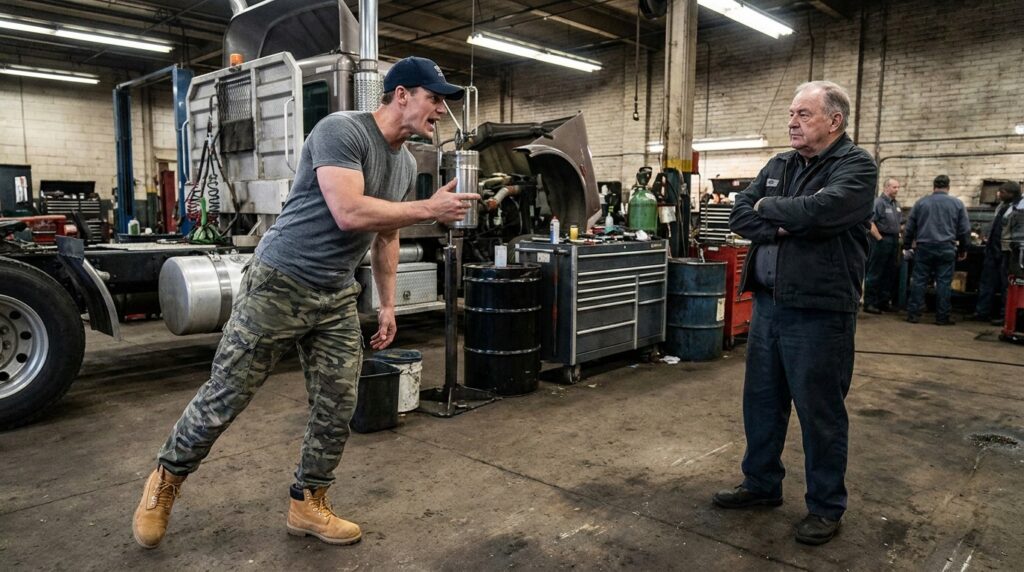
“You think strength wins, you’ve never faced real experience,” Miller spat, his shadow completely blotting out the faded gray work shirt of the old man standing by the center hoist.
The industrial air compressor kicked off in the high rafters of the bay, leaving a heavy, vibrating hum in the concrete. Around the perimeter of the service floor, three junior technicians stopped their impact wrenches. The silence spread fast, smelling of diesel oil, sulfur-heavy gear fluid, and the sharp, hot scent of scorched iron plates.
The old man did not shift his feet. His boots, dark leather with heels worn flat by decades of deliberate strides, stayed perfectly parallel along the yellow safety line bordering the truck pit. He looked at Miller’s chin, then up to the tilted brim of the navy cap. There was no sweat on the elder’s face, only the deep-set lines around his mouth that looked less like wrinkles and more like old scoring marks on an engine block. He held a weathered steel wrench in his left hand, his fingers loose around the oily handle.
“The digital readout says the pressure seal on the secondary reservoir is holding,” Miller said, taking another half-step forward. His gray fitted T-shirt was taut across his chest, the camouflage fabric of his trousers rustling against the stiff leather of his new tan work boots. He wanted the room to look. He needed the apprentices at the back benches to see how easily seventy-odd years of old-school stubbornness could be pushed out of a modern shop floor. “We don’t need a hand-check on the line. We don’t need someone listening to the casing with a rod like it’s 1974. The contract changes next month, old man. Clear the lane.”
The old man looked at the semi-truck behind Miller—a massive, tri-axle freight mover with its chrome grille reflecting the cold, desaturated light filtering through the high, unwashed clerestory windows. A single drop of amber oil fell from the oil pan, striking the floor between them with a faint, metallic ping.
“The digital gauge reads the pressure at the sensor,” the old man said. His voice was low, devoid of the gravelly anger Miller had been trying to provoke for three days. It had the dry, rhythmic clarity of an instructional manual read aloud in an unheated room. “The sensor is clean. The line three feet back from the block is restricted. It’s starving the rear actuators.”
Miller laughed, a quick, sharp bark that didn’t reach his eyes. He reached out, his hand open, intending to grab the greasy shoulder of the old man’s coveralls to pivot him toward the exit door. “I said, out of the lane.”
The old man didn’t pull back. He simply lowered his center of gravity by an inch, his shoulders settling as his weight transferred entirely into his rear heel. A small scar, shaped like a notched gear tooth just beneath his left collarbone, twitched beneath the dark cloth.
Miller’s fingers closed on air as the elder moved slightly off the axis of approach. The young mechanic’s own forward lean, built entirely on the assumption of a soft resistance that never came, pulled his balance over the yellow line. His tan boot slipped on a thin film of industrial degreaser, his shoulder tilting toward the concrete as the old man watched him go down.

CHAPTER 2: THE METRIC OF FRICTION
The slap of Miller’s heavy, muscular frame hitting the degreaser-filmed concrete sounded like a wet sandbag dropped from the rafters. It wasn’t a clean sound. It carried the gritty, scraping vibration of a man whose center of gravity had been stolen by his own momentum.
Miller stayed down for two full seconds, his left palm splayed flat against the damp stone, his navy cap skittering three feet away into the dark puddle beneath the semi-truck’s steering axle. His breath came out in a ragged, whistling grunt—the sound of an engine drawing air through a cracked manifold.
The old man didn’t look down at him. He kept his eyes fixed at shoulder-height, his dark leather boots still perfectly parallel along the yellow safety line. His fingers remained loose around the oily handle of the chrome-vanadium adjustable wrench. To the junior technicians watching from the perimeter benches, it looked as though the elder hadn’t even moved; he had simply occupied a different pocket of space a millisecond before the air where he used to be was occupied by a failing fist.
“Get up,” the old man said. The words weren’t loud. They had the dry, metric weight of iron tools hitting a wooden bench. “The differential housing is still dripping. You haven’t cleared the line.”
Miller’s shoulders bunched under his gray T-shirt, the fabric dark with a crescent moon of wet grease where his shoulder check had failed against the truck’s frame. His tan boots kicked once against the floor, seeking purchase on the slick concrete before he managed to lever himself into a seated position. His clean-shaven face was dark with blood, the flush of sudden, public failure crawling up his throat. He looked at his own open palm, then up at the dark civilian clothes of the elder standing over him. There was no mockery in the old man’s face, which made the silence in the garage burn worse.
The three apprentices at the back benches hadn’t breathed. One of them still held an air-impact gun three inches from a wheel nut, his finger frozen on the trigger without pulling it. The continuous, low-frequency hum of the main shop compressor was the only thing filling the void between the bays.
“You slipped,” the old man remarked, his voice flat, completely devoid of the satisfaction a smaller man might have used as leverage. He adjusted his grip on the heavy wrench, his thumb sliding over the rusted knurled screw that set the jaw width. “Your footing was wide. When you throw your weight behind an open palm, you don’t leave your rear heel off the deck. That’s basic leverage. Any boy on a farm learns that before he’s twelve.”
Miller pushed himself further back, his spine coming up against the cold, massive rubber of the semi-truck’s front tire. He didn’t reach for his cap. His fingers found the edge of his steel toolkit, his knuckles whitening against the red painted metal. For a second, the muscles in his jaw locked so hard the bone showed white beneath his tanned skin, but the discipline of the floor—the primal reality of a man who had just been dismantled by an inch of movement—kept his hands down.
“The line isn’t restricted,” Miller growled, though the volume was gone from his throat, replaced by a raw, defensive rasp. He spat a thread of gray grit onto the floor. “The digital diagnostics ran a full cycle before you walked into my bay. I checked the logs myself. The pressure curves are inside the fleet standard.”
The old man stepped forward, his boot sole making a sharp, clean click against the dry stone just outside the grease slick. He didn’t look like a warrior; he looked like a piece of structural timber that had survived three floods. He reached down with his free hand, his thick, scarred fingers closing around the handle of Miller’s modern diagnostic interface—a blue plastic ruggedized tablet resting on top of the rolling tool cabinet.
Miller didn’t move to stop him. He couldn’t. The room was still watching, and every eye in the bay was waiting to see if the old man would smash it or read it.
The old man turned the screen toward the gray light of the clerestory windows. The display showed green bars, rows of precise digital telemetry claiming the hydraulic fluid was moving at forty-four gallons per minute through the rear lines. But the elder’s thumb wasn’t looking at the glass. His nail caught on the seam of the plastic housing near the base sensor connector.
Wedged into the diagnostic port was a small, notched piece of carbon-steel—a hand-ground calibration shim, its surface scratched with the telltale cross-hatch marks of an illegal workshop file. It was a mechanical cheat. By forcing the shim into the sensor housing, the physical pressure on the internal diaphragm was manually locked at a standard value, regardless of what was actually happening inside the steel lines three feet back. The tablet wasn’t reading the truck; it was reading the shim.
The old man’s face didn’t change. He didn’t accuse the younger man. He simply let his thumb press against the shim, feeling the crude burr on its edge—the unmistakable texture of a deliberate, hurried modification.
“The log says what you told it to say,” the old man murmured, his gaze shifting back down to Miller, who was still leaned against the heavy tire. “But the iron doesn’t lie. When the rear actuators go dry on the turnpike under thirty tons of steel, the digital log isn’t the thing that’s going to keep the rig inside the lane.”
Miller’s eyes dropped from the old man’s face to the blue tablet. The defensive anger in his posture vanished, replaced by a sudden, rigid stillness that had nothing to do with physical fear and everything to do with exposure. He didn’t deny it. He didn’t reach for the device. He just sat there, his tall frame suddenly looking hollowed out against the massive backdrop of the logistics fleet.
“Stand up,” the old man said, setting the tablet back down on the grease-filmed metal of the tool chest with a small, deliberate click. “And finish the job right.”
CHAPTER 3: THE FRICTION OF THE BAY
Miller rose slowly, the textured rubber of the semi-truck’s front tire bracing his spine until his knees locked into place. The tall mechanic didn’t dust off his trousers. His jaw muscle twitched, a tight lump forming along the bone as he kept his stare leveled downward, fixed on the grease-filmed metal base of the tool cabinet rather than meeting the old man’s gaze. Across the floor, the low hum of the stationary compressor cycled off, leaving only the dripping rhythm of differential oil hitting a metal drip pan three bays down.
“The replacement springs came out of the regional depot on Tuesday,” Miller muttered, his throat dry, his hand dropping to the heavy steel latch of the drawer beneath his diagnostic array. “They were stamped and logged. If the line is starved, it’s an installation fault from the night shift. Not my build.”
The old man did not offer a contradiction. He turned his heavy frame toward the side tool locker, his dark leather work boots crunching softly on the scattering of iron filings and dry grit near the hoist. He reached down, his scarred fingers selecting a long-reach mechanical inspection mirror and a hand-cracked flashlight whose aluminum casing was pitted with grey oxidation.
“The night shift doesn’t file the calibration shims, Miller,” the elder said. He didn’t drop his voice to hide the words from the apprentices, but he didn’t raise it either. The tone remained level, flat, carrying the cold, programmatic authority of an inspector who had measured clearance tolerances before Miller’s father had entered an apprenticeship. “The night shift handles the grease-packing and the shackle pins. They don’t touch the telemetry boards unless someone leaves a signed work order on the spindle.”
He knelt by the rear tandem axle, his movements unhurried, lacking the fluid spring of youth but possessing a absolute certainty of balance that left his weight perfectly centered over his heels. The floor was cold here, the raw concrete absorbing the northern draft from the open bay doors. He slid the inspection mirror beneath the main frame rail, angling the glass past the heavy brake chambers toward the hidden shoulder where the leaf spring nested into the main hanger.
The flashlight beam cut through the hanging particulate of aerosol degreaser and diesel exhaust. Underneath the fresh black chassis paint, the steel of the spring leaf didn’t show the uniform gray of a new forge. It was pitted. The edges were uneven, showing the heavy, layered scaling of a component that had sat in a salvage yard or a salt-air storage depot for five winters before being ground smooth and coated with quick-drying acrylic.
The old man’s thumb traced the outer face of the spring retainer. His nail caught on a stamped serial number—US-441-B.
He didn’t speak for a full minute. He simply held the light on those five characters, his eyes measuring the depth of the stamp. The regional depot invoice sitting on the clipboard by the supervisor’s desk didn’t carry that prefix. The contract for the county logistics fleet explicitly specified US-500-Heavy Duty spec iron, forged in Ohio, certified for thirty-ton cross-state hauls. The 441 series was retired surplus from an old military supply line—brittle steel, prone to micro-fractures when subject to rapid thermal shifts under heavy loads.
Miller had stepped closer, his boots clicking in a hesitant, irregular pattern on the concrete until he stood just behind the elder’s left shoulder. His muscular frame cast a long shadow over the wheel well, but the aggressive posture from ten minutes ago was entirely gone, replaced by a rigid, guarded vigilance.
“They’re within the weight tolerance,” Miller said, his voice dropping to a whisper that barely cleared the rumble of an idling utility truck outside the main gate. “The hardness test was verified on the depot floor. The digital sheet came down from the main office with the manifest.”
“The sheet came down because you plugged the shim into the reader to pass the safety audit,” the old man said, his voice remaining low, filtered through the dark space beneath the trailer bed. He didn’t rise from his knees yet. He kept the mirror focused on the leaf spring’s throat, where a hair-thin line of orange rust was already beginning to weep through the fresh black paint—a stress fracture under the initial tension of the empty chassis. “The sheet doesn’t hold the frame together when the driver hits the frost heaves on Route 9. You’re running old salvage iron under a high-priority logistics line, son. That isn’t shortcutting. That’s structural fraud.”
“I don’t buy the parts,” Miller hissed, his hand tightening on the rim of the semi-truck’s steel wheel. “I handle the turnarounds. The shop manager says we use what’s on the pallet or we lose the maintenance bonus from the county. If the rigs don’t roll by Monday at six, the whole facility goes into default. You think the holding company cares about a serial prefix? They care about the schedule.”
The old man slowly stood up, his spine making a series of dry, clicking pops that sounded like small sticks snapping under leather. He didn’t look at Miller. He took the inspection mirror and laid it exactly parallel to the blue diagnostic tablet on the metal tool chest. The small, hand-filed calibration shim still sat there between them, a cold sliver of compromised iron reflecting the gray light from the ceiling windows.
“The holding company cares about what’s signed for in the ledger,” the old man said. He pulled a grease-stained cotton rag from his pocket and began wiping the thin film of oil from his fingers, his movements methodical, rhythmic, unchanging. “And they care about who takes the fall when thirty tons of freight crosses the median into oncoming traffic.”
He turned his side-profile toward the main office stairs at the back of the garage, where a shadow had just moved behind the wired-glass window of the supervisor’s deck.
CHAPTER 4: THE CHASSIS LINE LOCK
“You’re tracking more than just the leaf springs,” Miller muttered, his throat clicking as he swallowed. He reached out to steady his balance against the massive tire rim, his muscular forearm trembling slightly under the cold neon glare of the bay lights. “You knew what was on that manifest before the transport driver even dropped the tail-gate.”
The old man did not confirm or deny the guess. He let the grease-stained cotton rag drop into the lower pocket of his dark coveralls, his movements following the same mechanical economy that had kept him upright when Miller had lunged. He stepped closer to the center hoist, his eyes tracing the thick hydraulic cylinder that held thirty tons of iron suspended four feet above the pit.
The silence from the surrounding service bays had turned heavy, dense with the realization that the lead mechanic had lost his room. The three apprentices remained frozen at their benches, their tools heavy in their hands, heads angled toward the floor to avoid meeting Miller’s eyes.
“The kingpin assembly on the driver’s side has a three-millimeter play,” the old man said, his voice level and flat against the background thrum of the building’s main breaker. He tapped the heavy steel spindle with the nose of his aluminum flashlight. The sound was a dull, dead thud instead of the sharp ring of solid casting. “The stamp on the knuckle says it was reamed at the central shop three weeks ago. But the tool marks are circular. Someone used a handheld lathe to clear the lip because the sleeve didn’t sit flush.”
“The service orders came down marked priority one,” Miller said, his boots shifting back an inch into the shadow of the chassis frame. His voice lacked its previous volume, reduced to a dry rattle. “We had forty-eight hours to clear twenty rigs for the state line run. If we pulled the steering knuckles to wait for the certified castings, the bay lines would have backed up into the yard. The manager signed off on the tolerance override.”
“The manager doesn’t sit behind the wheel when the steering column binds on a six-percent grade,” the old man remarked. He reached up, his thick fingers grasping the edge of the tool cabinet to pull himself onto the raised steel walkway that bordered the pit. His joints made a sharp, dry click under the weight, a sound that mirrored the friction of the iron parts beneath the rig. “An override on a ledger doesn’t change the shearing threshold of a cold-rolled steel pin. You know the physics, Miller. You just chose to trust the digital log because the screen didn’t argue back.”
He reached into the cabinet, his hand bypassing the modern plastic-encased torque guns to pull out an old manual click-style beam wrench. The tool was six feet long, its chrome finish scarred by decades of heavy leverage, the numbers on its dial stamped deep into the underlying iron. He laid it across the top of the axle housing with a resounding metallic clatter that made the nearest apprentice flinch.
Miller looked at the heavy wrench, then up at the glass-fronted office box at the top of the metal stairs. The supervisor’s silhouette remained static against the yellowish window, a dark shape holding a telephone receiver to its ear. The door to the balcony hadn’t opened, but the pressure in the room was rising with every minute the old man spent checking the physical steel.
“We have three more transports coming in from the northern depot at midnight,” Miller said, his fingers tightening against the seam of his camouflage trousers. “Same build. Same replacement components from the surplus pallet. If I stop the line now, the automated tracking system registers a structural hold. The regional dispatch drops the facility score before dawn.”
“Let it drop,” the old man said. He didn’t look up from the axle line. He fitted the socket of the beam wrench over the primary shackle bolt, his boots bracing against the concrete floor with absolute parallel symmetry. He didn’t use sudden force; he simply leaned his heavy frame into the long steel handle, using the natural leverage of his weight to test the resistance of the threads.
The wrench didn’t click. The needle on the old mechanical scale swung past the two-hundred-foot-pound marker, then paused. The bolt wasn’t tightening—it was stripping. The threads inside the recycled housing had already been pulled smooth by an over-torqued pneumatic gun during Miller’s rushed afternoon shift. The metal was giving way, a silent, unyielding failure that would have remained invisible until the first heavy bump on the highway tore the hanger completely free from the frame rail.
Miller took a step forward, his hand dropping away from the tire as he saw the needle stall on the rusted face of the gauge. His mouth opened slightly, his clean-shaven jaw dropping into the gray light of the bay. The realization didn’t come from a digital warning or an audit report; it came from the physical behavior of the iron beneath the wrench.
“The log said it was locked,” Miller whispered, his tall build suddenly losing its tension, his shoulders rounding as if the weight of the semi-truck had transferred onto his own back. “The telemetry interface verified the torque limit on the main panel.”
“The panel reads the pressure at the air line,” the old man said, releasing his grip on the long handle and letting the wrench settle against the steel hoist with a dull ring. “It doesn’t feel the iron strip. When you skip the hand-check because you’re running against a digital clock, you aren’t a mechanic anymore. You’re just an operator waiting for the wreck.”
He turned his side-profile toward the younger man, his unblinking gaze catching the reflection of the high clerestory windows. In the corner of the tool chest, the small, hand-ground calibration shim lay exactly where he had left it, its file marks gray and distinct against the blue plastic of Miller’s ruggedized tablet.
From the top of the metal stairs, the office door finally clicked open, the sound of leather soles hitting the iron grating of the balcony cutting through the low vibration of the service bays.
CHAPTER 5: THE CEASEFIRE BOUNDARY
“That’s enough manual checking on bay three,” a sharp voice cut down from the iron steps.
Vance, the shop supervisor, didn’t use the handrail as he descended. His heavy, flat-bottomed work shoes struck each grated riser with a distinct, ringing clack that echoed through the high corrugated ceiling. His canvas jacket was unbuttoned, exposing a company lanyard that swung like a pendulum across his stomach. In his right hand, he held a stack of yellow carbon work orders, their edges curled and grease-smudged from his fingers.
The three apprentices immediately dropped their eyes, their hands moving with sudden, unearned urgency to pick up oil rags or rearrange socket sets on their mobile trays. The dead silence that had held the room since Miller’s fall evaporated into an artificial atmosphere of busy, performative labor.
The old man did not spin around to face the approach. He kept his boots planted parallel along the pit margin, his thick shoulder remaining propped against the heavy iron frame of the hoist cylinder. He pulled the oily rag back from his belt loop, slowly clearing a fresh layer of charcoal-colored grease from the beam wrench’s digital scale before setting the tool down on the locker top.
“The shackle bolt on the primary side didn’t hold two hundred pounds, Vance,” the old man said. His voice was low, flat, carrying no more anger than a parts catalog entry. “The internal threads are gone. The hanger is floating on three points instead of four.”
Vance stopped five feet back, his boots crunching on the layer of dry sand scattered over an old transmission fluid spill. He didn’t look at the stripped bolt. He didn’t look at the blue diagnostic interface where the hand-filed calibration shim still gleamed like a coin under the high neon bars. His eyes fixed on the old man’s faded work shirt, his chin lifting just enough to expose the graying bristle along his jaw.
“The unit was cleared by regional logistics at noon, old man,” Vance said, his fingers tightening on the yellow pages until the carbon paper made a dry, rustling hiss. “The automated system doesn’t record thread slippage on a sub-assembly that isn’t due for a full teardown until October. Miller ran the cycle. The board in the main office shows green across the line. If you’re here to do unauthorized inspections on state-contract iron, you can take your book out to the front gate.”
Miller didn’t speak. He had moved three steps back into the dark recess between the dual rear tires, his muscular frame hidden by the massive overhang of the trailer bed. His navy cap remained on the floor, its brim catching a steady drip of water from the air-conditioning condenser above. He looked at Vance, then at the old man’s profile, his jaw locked into a hard, silent line that offered no support to either side.
“The automated system reads the digital signature on the port,” the old man murmured. He didn’t lift his head, but his thumb moved half an inch, pointing toward the blue tablet. “It doesn’t feel the iron give. You’ve got six more tri-axles coming through that gate before the morning shift hits the clock, Vance. If they’re carrying the same surplus leaves out of the depot, you’re putting twenty thousand tons of moving steel on a public road with brittle pins.”
Vance took a rapid step forward, his shadow cutting across the metal tool chest, his hand coming down hard on the clipboard resting near the tablet. The impact made a sharp, plastic snap that caused the nearest apprentice to freeze mid-stride.
“The parts are depot-certified,” Vance hissed, his voice dropping into a low, transactional rumble that barely carried past the hoist line. His eyes narrowed, the skin around his temples tightening as he glanced toward the open bay doors where the night air was turning fog-heavy. “The state contract doesn’t pay for hand-honed tolerances. It pays for volume and it pays for speed. We drop three units behind schedule, and the holding company terminates the maintenance lease before the month is out. You think these boys keep their wrenches if the bay goes dark? You think Miller has a job tomorrow if the yard score goes red?”
He reached past the clipboard, his fingers closing around the blue tablet. As he yanked the device toward himself, his sleeve caught the small, notched calibration shim, sending the silver sliver of iron skittering across the concrete floor until it struck the rim of the old man’s boot with a dry, metallic ping.
The old man looked down at the shim. He didn’t kick it away. He didn’t reach down to retrieve it. He simply kept his weight centered over his flat heels, his unblinking stare moving from the concrete up to Vance’s face.
In the open slot of the blue tablet’s auxiliary diagnostic bay, a small gold security fob remained inserted—the supervisor’s high-level access key, used to bypass the automated safety overrides on the central database. It was scratched, the gold plating worn down to the underlying brass by daily contact with the terminal slots up in the office. It shouldn’t have been down on the shop floor. It shouldn’t have been plugged into a mechanic’s field unit while an active repair log was being updated.
Vance saw where the old man was looking. A sudden, rigid stillness hit his shoulders, his fingers locking around the edges of the plastic ruggedized frame as he pulled the tablet close against his chest, his canvas coat folding over the screen to hide the gold reflection.
“The bay is closed for the night shift,” Vance said, his voice losing its previous edge, replaced by a cold, transactional stiffness that seemed to hollow out his chest. “Put the tools back in the racks, Miller. Clear the pit.”
He turned on his heel, his heavy work shoes scraping hard on the concrete as he headed back toward the metal stairs, his hand keeping the blue tablet tucked deep inside the fold of his jacket like a stolen tool.
CHAPTER 6: THE RETRACTED ANCHOR
The iron door at the top of the office stairs banged shut, the latch rattling inside its frame with a loose, tinny sound. Down on the floor, the yellow carbon work orders Vance had left behind lay strewn across the corner of the greasy tool cart, their corners fluttering each time the overhead heater kicked its draft into the bay.
Miller stepped out from the gap between the dual tires. He didn’t look tall anymore; his shoulders were drawn inward, the gray T-shirt damp with sweat that had turned dark from the grease scaling along the semi-truck’s undercarriage. He looked down at his navy cap, still resting in the puddle of water by the front axle, then reached down and picked it up by the brim, wringing the moisture out with a single, brutal twist of his wrist.
“He won’t stop those northern rigs,” Miller said, his voice dropping into a flat, exhausted register that matched the grey masonry of the walls. “They’re already past the state checkpoint. The automated dispatch logs them at forty-mile intervals. If I refuse to sign off on the shackle pins when they hit the hoist, he’ll just pull my credentials from the terminal and run the cycle under his own supervisor code.”
The old man did not move to follow Vance’s path. He reached into his pocket, his thick, scarred fingers closing around the notched steel calibration shim that had skittered against his boot. He picked it up, feeling the crude, fresh file marks along its edge with the ball of his thumb.
“A supervisor’s code doesn’t change the yield point of the metal, son,” the old man said. He laid the shim exactly on top of the blank signature line of the nearest work order. It sat there like a weight, holding down the yellow paper against the cold air. “The holding company doesn’t look at the name on the terminal until the chassis cracks. They look at the stamp on the knuckle.”
“You don’t understand how the contract is built,” Miller said, his fingers tightening around the damp fabric of his navy cap until his knuckles showed white beneath the grease stains. He leaned his hips against the cold iron of the lift frame, his boots sliding an inch through the dry grit. “Vance isn’t shorting the parts because he wants a bonus. He’s shorting them because the depot hasn’t shipped proper spec iron to this district in six months. They’ve been routing the Ohio steel to the urban lines down south to keep the priority transit contract solvent. We get the salvage pallets or we get empty hoists. If the bays go empty for forty-eight hours, the regional board pulls the facility certificate. The whole shop goes into default.”
The old man listened, his head tilted slightly toward the open bay doors. From the outer yard, past the chain-link perimeter fence, the low, multi-toned rumble of a multi-axle commercial transport began to grow, its transmission whining as it dropped gears to make the turn off the county route. The headlights cut through the heavy ground fog, throwing two long, white bars of light across the grease-slicked concrete of bay three.
“The facility doesn’t go into default because the iron is late,” the old man murmured, his voice maintaining that dry, historical clarity that had kept the room silent since the first hour. “The facility goes into default because the men inside it stopped measuring the clearance with their fingers.”
He reached down, his heavy hand closing around the handle of the old manual beam wrench he had left on the locker. He didn’t lift it to use it again; he simply turned the dial back to zero, his thumb feeling the click of each detent as the spring inside settled into its housing.
“The log is already updating,” Miller said, pointing a thumb toward the wall-mounted terminal behind the tool chest. The green indicator light had begun to pulse in a rhythmic, rapid sequence, signaling that the northern transport was being entered into the active bay queue by Vance’s remote terminal upstairs. “He’s clearing the bay three manifest from the desk. According to the board, this rig is already on the highway.”
The old man didn’t look at the screen. He turned his side-profile toward the approaching headlights, his solid frame completely blocking the white beams as the front bumper of the incoming truck cleared the threshold of the outer gate.
“Let him sign it,” the old man said, his unblinking gaze fixed on the driver’s cab as it air-braked to a halt outside the bay line. “The signature only works as long as the ledger stays in the office.”
He stepped off the walkway, his dark leather boots making a final, flat click against the yellow line before he stepped into the shadow of the incoming chassis.
CHAPTER 7: THE RECOVERY LEDGER
The driver’s side door of the white regional authority transport didn’t swing wide; it popped open with the stiff, synchronized click of industrial latches maintained under high depot funding. The idling engine, a six-cylinder diesel running with a clean, muffled rhythm that completely embarrassed the uncalibrated thrum of the shop’s older compressors, filled the main bay with a high-density purr.
Vance was halfway down the stairs before the tires had stopped rotating against the grit. His canvas coat was bunched under his arms, his face white beneath the slick neon tubes as he scrambled to clear the yellow copies off his desk balcony. He still held the ruggedized tablet pressed flat against his ribs, but the gold security key plugged into its base was no longer catching the light—he had thrown an oily mechanic’s rag over the port to deaden the gleam.
“The gate logs were locked, driver,” Vance shouted, his shoes skittering on the loose sand at the base of the risers. He didn’t look at Miller, who remained planted like a rusted jack stand between the semi-truck’s dual tires. “The shift manifest was transmitted forty minutes ago. We aren’t scheduled for a physical courier hand-off until the morning ledger update.”
The driver didn’t answer him. He was a younger man, his uniform trousers pressed with sharp, military-style creases that showed no traces of the grease or lithium film that coated every surface of bay three. He stepped down onto the concrete floor, his polished black low-quarters making a succession of rapid, disciplined snaps against the gray stone. In his right hand, he carried a heavy, reinforced aluminum brief box stamped with the crimson seal of the state logistics commission.
He bypassed Vance without a side glance, his shoulder checking the supervisor’s unbuttoned jacket out of his line of march as his eyes searched the dim, desaturated interior of the hoist lane.
When his gaze found the old man standing by the center hoist frame, the driver’s heels came together with a sharp, dry crack that sounded like a dry branch snapping under a heavy boot. His spine went perfectly vertical, his chin tucking into his high collar as his right hand rose to the brim of his campaign cap in an absolute, unmoving salute.
“Sir,” the driver said. His voice was loud, disciplined, lacking any of the hesitant blue-collar cadence that defined the garage. “The regional board has completed the verification loop on the holding company assets. The full corporate oversight transition papers are signed. We have the ledger lock keys in the container.”
The three apprentices at the back benches didn’t move. One of them let an iron socket slip from his fingers; it struck the edge of the pit with a ringing clatter that seemed to linger in the rafters for ten seconds before dying out.
Miller stepped forward out of the shadow of the trailer, his cap still squeezed flat between his massive hands. He looked at the driver’s rigid stance, then at the faded, grease-scored gray shirt of the older man who had just dismantled his pride with an inch of spatial leverage. The lines on the old man’s face didn’t look old anymore; they looked permanent, like the forge marks on an armor plate that had survived the testing block.
“You’re late, corporal,” the old man said. His voice had the dry, programmatic flatness it had carried since he first walked into the lane, but the room seemed to contract around it now. He didn’t return the salute. He simply reached down and took the heavy aluminum brief box by its steel handle, his thick, scarred thumb sliding across the combination tumbler without looking at the numbers. “The northern rigs have already cleared the state line on brittle leaf pins. The supervisor code was updated from the balcony five minutes ago.”
Vance stopped three feet back, his knees shaking slightly within his wide trousers as the tablet in his arms gave a sharp, electronic chirp—the automatic notification that his remote administrative access had just been quarantined by the central holding network.
“Mr. Garrett,” Vance stammered, the name catching in his throat like dry grit. He tried to pull the canvas coat over the blue ruggedized casing, but his fingers were too loose to manage the fabric. “The county turnaround bonus… we were only matching the delivery schedule the main office pushed down through the terminal. If we held the line for the Ohio iron, the district score—”
“The district score belongs to the parent company, Vance,” the old man said, turning his side-profile toward the stairs. He set the aluminum box down on top of the mobile tool locker, right next to the hand-filed calibration shim and the manual beam wrench. “And the parent company doesn’t hire operators who use shims to cheat the iron. Miller.”
The tall mechanic looked up, his jaw tightening as he met the elder’s unblinking stare.
“Get the long-reach mirrors back under the rear tandem,” the old man commanded, his fingers loose around the handle of his old chrome-vanadium adjustable wrench. “We have twenty-four steering knuckles to ream before the morning drivers take the keys. Leverage always beats brute force, son. Remember that next time you look at a machine—or a man.”
He didn’t wait for an answer. He turned his heavy frame toward the open bay doors, where the ground fog was beginning to lift under the cold, early light of the northern dawn, leaving the concrete floor wet, gray, and completely clear of excuses.
CHAPTER 8: THE AUDIT GATE
The office door didn’t just close; the frosted wire-glass rattled inside its rusted steel frame as the latch dropped into the striker plate. Up here, fifteen feet above the concrete floor of bay three, the air was different. It didn’t have the clean, cold draft of the open bays; it was thick with the smell of stale tobacco, dried ink ribbons, and the sharp, chemical tang of an old electric space heater drawing dust through its copper coils.
Mr. Garrett didn’t take the supervisor’s swivel chair. He stood by the edge of the green linoleum desk, his dark civilian work coat still buttoned to the throat, his heavy frame casting a wide, unyielding shadow across the rows of metal filing cabinets lined up against the cinderblock wall. He laid the aluminum brief box flat on the desk surface, its polished corners leaving two clean tracks in the gray film of diesel soot that coated the wood.
Vance stood by the window, his hands tucked deep into the pockets of his canvas jacket to hide the erratic tremor in his fingers. Through the wired glass behind him, the white authority courier truck could be seen idling in the yard below, its clean exhaust plume rising straight up into the early morning fog. Down in the center bay, the rhythmic, metallic clink-clack of Miller’s manual long-reach mirror echoed up through the floorboards—a steady, deliberate cadence that sounded like a clock ticking down.
“The encryption key on the regional ledger isn’t a shop-level code, Mr. Garrett,” Vance said, his voice scraping low against the hum of the desk bulb. He didn’t look at the aluminum box. He looked at the old man’s boots, which were still gray with the dust of the service pit. “The district coordinator from the southern hub set that terminal up himself. It runs on a twenty-four-hour rotating cipher. If I try to force the manifest logs from a local keyboard, the central server flags the IP address and locks the depot gate before the first line compiles.”
The old man did not look up. He reached down, his thick, scarred thumb pressing the twin steel latches of the brief box. They popped with a sharp, synchronized clank that made Vance’s jaw tighten. From inside the velvet-lined tray, Garrett pulled a single, unadorned black flash drive—its casing machined from raw aluminum, devoid of any company logos or serial numbers, showing only a small, hand-stamped letter G near the terminal connector.
“The central server reads what the holding company allows it to read, Vance,” Garrett said. His voice carried that same dry, metric weight that had held the garage floor silent. He didn’t use the computer’s mouse. He slid the black drive into the side slot of the master terminal with a single, precise movement of his index finger. “The southern hub doesn’t own the infrastructure. They own the lease on the software. And the lease has an override clause written in iron.”
The monitor screen flickered once, the green database bars that Vance had used to run the shop’s overrides suddenly rolling upward in a rapid, vertical blur. The names of the twenty-four northern transports didn’t show as green anymore. As the aluminum drive bypassed the regional encryption, the text turned a sharp, desaturated amber—the system color code for an unverified safety manifest.
Beside the terminal, in an open plastic tray where Vance kept his spare grease grease-charts, a small, blue-and-white USB drive lay half-buried under a stack of receipts. It wasn’t standard company issue. It carried the stamped, stylized emblem of Mid-Atlantic Transit Corp—the primary private competitor currently bidding against Garrett’s holding company for the state logistics renewal contract.
Garrett’s eyes shifted to the blue drive. He didn’t pick it up. He simply let his thumb settle on the edge of the desk, his gaze moving from the plastic casing up to Vance’s face with the slow, geometric certainty of a machine checking a part alignment.
“The Ohio steel didn’t get routed south because of a supply shortage, Vance,” the old man murmured, his voice dropping into a register that felt as cold as the iron railings outside the door. “The Ohio steel never left the manufacturer’s floor. The invoices were cleared here under your supervisor fob, but the weight tickets at the delivery gate were stamped from a salvage yard three counties over. You weren’t shortcutting the turnaround to save the schedule. You were clearing the ledger for a second set of books.”
Vance’s back came up against the glass, his canvas coat rustling against the wire grid as his breath shortened. “The competitor… they offered to absorb the facility default if the contract lapsed. The holding company was going to squeeze the smaller bays out anyway, Garrett. I have twelve men down there who don’t have pensions if the state pulls the maintenance lease. I did what I had to do to keep the hoists moving.”
“You did what you had to do to cover the margin,” Garrett said, his hand remaining steady on the edge of the desk as the monitor began to print a long row of red cross-reference serial numbers—each one matching a brittle, surplus leaf spring currently rolling toward the bay doors.
Down below, the air brakes of the second northern transport hissed open in the yard, the heavy vibration of its failing suspension rattling the frame of the office window like a warning.
CHAPTER 9: THE LEVERAGE CRITICAL
The six-foot beam wrench rattled against the truck’s heavy steel rim as a fresh blast of frozen rain hit the high corrugated siding of bay three. Down in the overhaul trench, Miller’s muscular back was slick with black water and pulverized road salt. His gray T-shirt was torn at the left shoulder blade where he had scraped against a jagged chassis bracket, the fabric stiffening from the freezing draft cutting under the heavy rolling doors.
“Hold the jack saddle steady!” Miller roared, his voice bouncing hoarsely off the unyielding iron underside of the northern transport. He jammed his boot heel into the floor grid, his thigh muscles locking as he wrestled the heavy, sixty-pound mechanical shackle assembly into alignment with the frame rail. “If that hydraulic ram slips before the pin clears the knuckle, the whole hanger is going to shear.”
The two apprentices above him didn’t look up. They were leaning over the fender wells, their hands numb inside their frayed split-leather gloves, pushing their full weight against a manual pry bar to counteract the twisted tilt of the trailer frame. The continuous, ear-splitting drone of the main shop hoist filled the floor—not the usual smooth operation, but a high-pitched, straining scream that signaled the internal pneumatic seals were blowing past their structural tolerance.
The old man stood on the raised steel walkway, his dark civilian coveralls buttoned to the throat, a heavy oil rag tucked into his leather belt. He didn’t pick up a pneumatic impact gun. He kept his hands flat against the cold iron railing, his unblinking stare fixed on the lower manifold of the primary lift where a thick, high-pressure line was beginning to bulge near the main control valve.
“The pump pressure is sitting at four hundred over the line limit, Miller,” Garrett said. His voice didn’t cut through the noise; it seemed to travel beneath it, flat and metric, carrying the unhurried authority of a man who knew the breaking point of every valve in the building. “Vance didn’t just clear the manifest ledger from the office terminal. Before he went up those steps, he over-torqued the safety return line to force the hoists to hold the extra tonnage without cycling the cooling valves.”
Miller didn’t drop the beam wrench. He reached up, his grease-blackened fingers catching the knurled locking collar of the dial scale, his thumb feeling the gritty drag of iron shavings inside the adjustment threads. “The next four trucks are already stacked up outside the chain-link gate, Mr. Garrett. If we pull the air lines to bleed the manifold now, the yard gridlocks. The state transport inspectors will be at the perimeter line in twenty minutes. If they see four trucks sitting on dead jacks with uncertified shackle pins, the facility certificate is done before the sun clears the tree line.”
“The certificate is already done, son,” Garrett said, his boots making a single, crisp click as he moved down the steel steps toward the pit margin. He didn’t look at the office window where Vance’s desk light was still casting a yellow square through the wire-glass. He looked at the mechanical tracking dial on the side of the lift. “The blue drive in the office desk didn’t just carry a second set of invoice codes. It carried the routing tables for every salvage pallet shipped out of the southern hub since last November. The steel you’re trying to bolt into that frame wasn’t rejected by the depot. It was paid for as new premium Ohio stock, and the difference in the ledger went into a private account across the line.”
Miller’s shoulders went rigid beneath the truck’s mass. His clean-shaven face was drawn, his skin gray from tactical exhaustion as he looked from the stripped threads of the shackle bolt up to the old man’s steady profile. The realization didn’t hit him like an administrative notice; it hit him like a cracked iron casting—the understanding that his entire shop, his speed records, and his modern digital telemetry had been used as a screen for an international asset drain.
“They used my turnarounds,” Miller muttered, his throat clicking as he spat a mouthful of grit onto the wet concrete. His fingers slipped twice on the heavy handle of the beam wrench before he could lock his grip. “They ran the numbers through my login because the system flags an old-timer’s code if the timeline moves too fast.”
“They used your pride, Miller,” Garrett said, his voice level and dry as he reached down into the tool chest to retrieve a manual brass pressure gauge whose casing was green with oxidation. “They gave you a digital clock to watch so you’d stop feeling the friction under your feet. Now get out of the pit.”
Before Miller could shift his heels, the bulging pneumatic line near the primary valve split with a sound like a rifle shot. A high-density spray of atomized hydraulic oil and frozen condensation erupted from the manifold, obscuring the service bay in a grey, whistling fog that smelled of scorched rubber and sulfurous gear oil. The heavy semi-truck chassis dropped three inches with a terrifying, metal-on-metal groan as the main lift cylinder lost its holding pressure, the massive iron frame settling directly toward Miller’s pinned shoulder.
Garrett didn’t lunge. He stepped marginally inside the line of the hydraulic control arm, his weight transferring entirely into his heels as his thick, scarred fingers caught the auxiliary manual override lever—a rusted iron bar that Vance had painted over to keep it locked in place. With a single, disciplined balance shift, the old man threw his entire frame against the iron lever, using pure mechanical advantage to drop the secondary safety dogs into the teeth of the hoist rack just as the primary cylinder failed completely.
The steel teeth caught with a deafening, echoing shatter that shook the concrete floor from bay three to the back parts room. The truck stopped an inch from Miller’s chest, its massive frame vibrating against the iron stops while the severed air line continued to whip and hiss against the stone.
Miller scrambled out of the trench, his knees shaking within his heavy camouflage trousers as he reached the safety line. He looked back at the unmoving figure of the old man, who still held the iron override lever down with one hand, his posture completely unyielding against the grey, whistling cloud of the ruptured bay.
From the front gate of the yard, the sharp, rhythmic wail of a dual-tone siren cut through the fog as the first state transit investigator’s unit cleared the outer perimeter.
CHAPTER 10: THE STRIPLINE WARRANT
The red and blue strobe lights of the state transit utility cruiser tore through the low-hanging oil smoke of bay three, turning the grease-slicked walls into a flashing, high-contrast mirror. Rain-wet asphalt drafts swept inside as the driver’s side door slammed against its rubber bumpers out in the yard.
Investigator Kincaid didn’t wait for the facility gate to slide fully into its housing. His heavy leather trench coat was slick with grease-tinted rain, the brass eyelets of his badge catching the rhythmic pulse of the emergency lights as his heavy, steel-toed boots cleared the threshold. In his left hand, he carried a high-impact plastic tactical case marked with the reflective white lettering of the State Transportation Enforcement Division.
He stopped at the foot of the office stairs, his heels crunching on the layer of oil-dry sand. He didn’t look at Miller, who stood shivering by the secondary lift frame with his torn gray T-shirt clinging to his ribs. He looked up at the glass box where Vance was already backing away from the window.
“Turn the central terminal off, Vance,” Kincaid shouted, his voice a flat, unyielding roar that cut through the dying whistle of the ruptured air line. He unlatched the top seal of his plastic case, revealing a thick stack of state-issued impound placards. “The regional board has frozen the fleet identification codes for this sector. Every tri-axle registered under the county logistics contract is subject to an immediate structural seizure order. Step away from the keyboard.”
Vance’s shadow didn’t move behind the wire glass. He stayed pinned against the back locker, the blue ruggedized tablet still tucked under his arm like a piece of stolen inventory while the yellow light from his desk bulb flickered and died under a sudden voltage drop.
The old man, Mr. Garrett, did not drop his hands from the mechanical override lever until the safety dogs clicked three times into the final locking notch. He stepped off the hoist platform, his dark leather work boots making a slow, parallel sequence of clicks on the concrete as he crossed the safety line toward Kincaid’s position. His fingers were black with hydraulic fluid, the old gear-tooth scar on his collarbone showing dark through the frayed seam of his coveralls.
“The warrant doesn’t cover the local yard files, investigator,” Garrett said. His voice was lower than Kincaid’s, but it carried the unhurried weight of an iron casting dropping onto an anvil. He didn’t look at the state badge. He looked at the serial sequence printed on the bottom edge of Kincaid’s plastic clipboard—ST-990-X. It was a high-level administrative freeze, an executive order that required a direct signature from the regional director before the physical ledgers could be removed from the premises.
Kincaid turned his profile toward the elder, his jaw tightening under his rain-streaked cap. He didn’t lift his arm to salute, but his eyes narrowed as they registered the absolute stillness of the old man’s stance—the total economy of movement that belonged only to men who had directed heavy vehicle columns before the state had automated its tracking networks.
“The yard files are corporate property, sir,” Kincaid said, his tone dropping into a guarded, transactional register. He didn’t advance another step into the bay lane. He let the case rest against his knee, his fingers remaining locked around its handle. “The holding company submitted a formal asset protection filing two hours ago down at the state capital. If the physical manifests aren’t verified against the depot invoices before the morning freight line rolls, the entire district maintenance ledger is sealed by the court. I have an administrative execution mandate to secure the blue database drive from Vance’s desk.”
“The blue drive belongs to Mid-Atlantic Transit, investigator,” Garrett said, his voice remaining dry and metric. He pulled the grease-smeared cotton rag from his pocket and began wiping the charcoal-colored oil from his palms, his movements slow and rhythmic. “The holding company didn’t file for asset protection. They filed for an immediate forensic audit of the southern hub. The digital ledger you’re trying to secure isn’t a state record; it’s a private clearing system used to shift certified Ohio iron onto the commercial scrap market.”
Miller stepped out into the strobe light, his boots sliding softly through the grit until he stood beside the old man’s shoulder. His face was gray from tactical exhaustion, his fingers twitching against the seam of his camouflage pants as he looked at Kincaid’s high-impact case.
“The invoices match the manifest,” Miller said, his teeth clicking slightly from the cold draft. “I verified the digital signatures myself on the master terminal before the shift split. The green tracking bars were authorized by the central node.”
“The central node was reading a calibration shim, son,” Garrett murmured, without looking at the younger mechanic. He held out his open palm toward Kincaid, exposing the small, hand-ground sliver of carbon steel he had retrieved from the floor of bay three. The file marks were distinct under the blue flashing strobes. “The signature is a decoy. It covers the weight discrepancy so the state investigators don’t look at the serial stamps on the kingpins. If you take that blue drive out of this yard before the local ledger is uncoupled from the regional network, the physical evidence of the structural fraud is erased by the rotating cipher.”
Kincaid looked down at the shim in the old man’s hand. The rigid confidence in his shoulders seemed to settle, his trench coat rustling as he lowered his clipboard onto the metal tool cabinet. He didn’t reach for his radio. He looked past Garrett’s shoulder toward the back bays where the third northern transport was already slowing down at the perimeter gate, its uncalibrated leaf springs screeching in the cold rain.
“If I leave the drive in the terminal for another ten minutes, Garrett,” Kincaid whispered, his voice barely clearing the continuous idle of his utility cruiser outside, “the automated network executes a remote wipe. Vance’s supervisor fob is already locked out. The whole facility goes black at dawn.”
“The facility stays gray,” Garrett said, his unblinking gaze shifting toward the iron stairs as the office door finally clicked open from above.
CHAPTER 11: THE TERMINAL CLEARANCE
“The uplink is dead, Garrett,” Vance said, his shoe soles dragging heavily down the iron steps until he reached the concrete of the bay floor. His canvas jacket was completely unbuttoned, the company lanyard hanging slack against his shirt like a broken hoist chain. He laid the blue ruggedized tablet flat on the metal top of Miller’s rolling tool chest, right next to the hand-filed calibration shim and the brass pressure gauge. The screen was no longer flashing amber or green; it had settled into a solid, desaturated white—the final system lock code of a remote corporate purge.
The emergency strobes from Kincaid’s utility unit continued to wash across the rusted surfaces of the center bay, throwing a rhythmic red and blue pulse over the massive frame of the third northern transport idling outside.
Mr. Garrett did not shift his feet from the yellow pit margin. He kept his hands loose at his sides, his dark leather work boots staying perfectly parallel along the concrete edge. He looked at Vance’s open collar, then down at the white glass of the locked tablet. There was no victory in the old man’s gaze, only the flat, metric observation of a mechanic looking at a stripped gear that could no longer hold its torque.
“The uplink didn’t clear the localized cache, Vance,” the old man said. His voice carried the same programmatic weight that had held the entire shop silent since the first hour. He reached into his dark coveralls and pulled out a heavy leather-bound inspector’s logbook—the thick, hand-ruled ledger that had sat inside his aluminum brief box. He laid it flat across the white screen of the dead tablet, the thick paper fibers striking the plastic casing with a solid thud. “The central database reads the signal from your supervisor fob, but the physical yard manifest doesn’t uncouple from the iron until I sign the release block.”
Kincaid stepped closer, his heavy trench coat rustling as he set his tact case down beside the locker. His fingers remained loose near the latch of his clipboard, his eyes tracking the rows of handwritten serial codes filling the open pages of Garrett’s ledger. Every entry carried a three-state cross-reference stamp—the master logistics seal of the parent holding network, dated five years before Vance had even applied for the supervisor lease.
“The state line run is frozen, Mr. Garrett,” Kincaid said, his voice dropping into a level, transactional rumble that barely carried to the back benches where the apprentices stood. He pointed a finger at the red serial prefix US-441-B ground into the leaf spring beneath the tri-axle chassis. “If these codes match the salvage manifest from the southern hub, the embezzlement case crosses the jurisdiction boundary before noon. The federal transit division takes the ledger.”
“Let them take the ledger,” Garrett said, his unblinking profile catching the sharp glare of the flashing strobes. “The ledger is already duplicated on the central transit terminal in Ohio. The blue drive you were looking for wasn’t a shortcut to save the facility score, investigator. It was the verification loop for the third-party distributor’s accounts. Vance wasn’t working for the competitor. He was working for the board members who signed the lease.”
Miller took a slow step forward out of the shadow of the tire frame, his muscles stiff under his torn gray T-shirt, his face dark with grease and cold rain. He looked at Vance, then at the old man’s heavy frame, his hands tightening around the handle of the six-foot manual beam wrench he still carried like a standard. The bravado that had driven his forward advance three hours ago was entirely gone, replaced by a raw, somatic exhaustion that showed in the line of his shoulders.
“The northern transport lines,” Miller muttered, his throat clicking as he looked out toward the headlights in the yard. “If the parent company owns the salvage pallets, then the fleet was never meant to pass the state safety audit. They were forcing the district into default to clear the maintenance contract for a private sale.”
“They were clearing the liabilities, son,” Garrett said, his voice level and dry as he reached down to pick up the manual wrench from the locker top. He didn’t lift it to threaten; he simply set the jaw width back to the standard spec with a single, practiced click of his thumb against the knurled adjustment screw. “They forgot that the iron remains on the floor after the ledger is burned. When you skip the hand-check because you think the system is too big to feel the friction, you’re the one who ends up underneath the frame.”
He turned his heavy body toward the open bay doors, where the cold dawn light was finally turning the ground fog into a thin, gray mist across the yard asphalt. The third transport engine dropped its idle, its driver waiting for the yellow light on the gate post to shift from hold to clear.
“Put the long-reach mirrors back in the racks, Miller,” the old man commanded, his boots making a clean, parallel sequence of strides as he headed toward the office steps, his hand keeping the leather ledger tucked deep against his side like a tool that had survived thirty winters. “And tell the morning shift to change the pins by hand. We’ve got twenty-four rigs to make honest before the road opens.”
He didn’t look back to see if they followed. He just climbed the iron risers one step at a time, his weight balanced perfectly over his heels, while the sound of his boots echoed through the high corrugated rafters of the bay until the room was completely quiet.







