
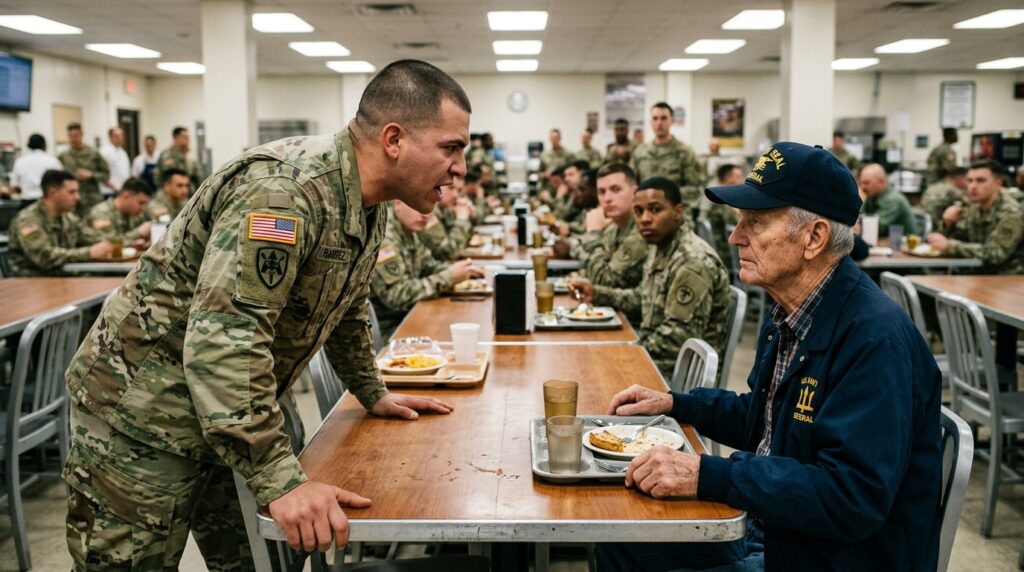
The Old Veteran’s Shadow: When a Spec-Ops Legend Teaches a Cocky Young Soldier an Unforgettable Lesson
CHAPTER 1: THE WEIGHT OF THE TRAILER
The formica was cold under Mac’s palms, the gray surface patterned with tiny, faux-granite speckles that had been scrubbed down with industrial bleach until the top layer of laminate had begun to yellow near the seams. He kept his right thumb pressed hard against the rim of his plastic tray, using the small ridge of molded plastic to steady the slight, rhythmic tremor that always crept into his hands when the weather turned damp. Outside, the North Carolina fog was thick enough to taste like iron, clinging to the brick barracks and the low, flat roofs of the supply depots. Inside, the mess hall smelled of burned lard, wet canvas, and the sharp, chemical ozone of a failing ventilation fan somewhere in the ceiling.
Mac didn’t look up when the double doors rattled on their hinges. He didn’t need to. The sound of forty young men moving in unison had a specific weight to it—a heavy, syncopated thud of standard-issue Vibram soles that vibrating through the floorboards and died against the steel legs of the tables. They brought the outside with them: the smell of damp pine needles, the grease of weapons oil, and the loud, unedited noise of people who hadn’t yet learned that the world could break them in half without noticing.
“Take the end, Miller,” someone said, a voice rough from early morning formations. “Sergeant’s checking the motor pool before the nine-o’clock.”
A tray slammed down three feet away. The vibration traveled through the formica, causing Mac’s paper cup of black coffee to ripple in neat, concentric circles. Mac kept his eyes on his plate—two cold pieces of dry toast and a small mound of scrambled eggs that had the pale, uniform consistency of yellow chalk. He picked up a piece of toast, his calloused skin rasping against the crust with a dry, papery sound.
“Look at this,” a new voice muttered, closer now. It was lower, thicker, carrying the distinct edge of someone who spent five days a week lifting weights until his neck grew wider than his ears. “They’re letting the historical society eat before the main line now? I thought the annex was closed to civilians during the cycle.”
Mac chewed slowly. The bread was stale, but it gave him something to focus on besides the slow, hot pressure building behind his left temple. He could see the reflection of Specialist Miller in the stainless-steel side of the condiment dispenser—a blocky outline of digital camouflage, a crisp unit patch on the shoulder that still had the stiff, sharp edges of new issue, and a face that was still too smooth to have ever seen the underside of a listing hull in a black sea.
“Hey. Old man,” Miller said. The words weren’t loud, but they had that deliberate, carrying quality designed to pull the eyes of every third-year private within twenty feet. “You’re in the deployment lane. The auxiliary passes are supposed to stick to the back wall by the vending machines. Some of us actually have a clock running today.”
The surrounding tables went quiet. It wasn’t a sudden drop in noise, but rather a greasy, sliding cessation of forks hitting plastic, a row of green-clad backs turning rigid as people looked over their shoulders to see how far the young man would push the line. Mac didn’t move his head. He reached down with his left hand, his fingers heavy and slow, and adjusted the brim of his black cap. The gold stitching of the trident was frayed at the lower left fluke, the thread grayed by decades of salt air and dresser drawers, but under the harsh glare of the fluorescent tubes, the metal tips still caught the light like three small, blunt teeth.
Miller didn’t take his tray. He stepped into the gap between the benches, his shadow blocking out the light from the side window, his large, square hands coming down flat on the formica with a sound like a rifle shot.

CHAPTER 2: THE LINE UPON THE TILE
“You’re three inches outside your window, son,” Mac said. His voice didn’t rise above the persistent, wet rattle of the ventilation fan, but it had the dry, scraping texture of iron pipe dragging over concrete. He didn’t look up at the mass of digital camouflage or the thick, tendon-strained neck crowding his vision. Instead, his eyes remained fixed on the third button of Miller’s uniform blouse—the threads were tight, machine-stitched, unweathered by anything more severe than a laundry press.
“My window is wherever I set my boots down, old man,” Miller spat. The young soldier leaned harder into his palms. The gray formica groaned under the shifting distribution of his mass. His face was close enough that Mac could smell the chemical sweetness of energy drinks mixed with the stale tang of cold grease. “And right now, your pass says you belong in the administrative queue. You’re cluttering up a tactical rotation table. Move the tray, or I’ll clear it for you.”
A low, collective shifting occurred along the parallel benches. To Mac’s left, two privates with fresh, sunburned ears slowly slid their forearms off the table, their utensils clicking softly against plastic as they withdrew from the immediate blast radius. Nobody stood up. In the institutional hierarchy of a base dining facility, authority was a fluid, ugly thing—usually dictated by the shine on a collar or the current thickness of a man’s bicep. Right now, the room was betting on the bicep.
Mac felt the old, deep ache in his right femur—a souvenir from a shallow-water extraction in a gulf that didn’t officially exist on any map in the logistics office. He kept his palms flat, his left hand pinning the edge of the plastic tray against the yellowed laminate seam. Near his right index finger, a deep, jagged notch had been gouged into the aluminum trim of the condiment dispenser. It looked like the mark of a heavy, non-regulation blade—an old scar in the metal that had been scrubbed clean so many times its edges were bright and pitted with gray oxide.
“The tray stays where it is,” Mac murmured. His internal clock was tracking the pulse in Miller’s throat—one hundred and ten beats per minute, shallow, driven by the cheap adrenaline of an unearned secondary status. “And your sergeant is forty seconds late for that motor pool inspection.”
Miller’s jaw tightened, the skin over his cheekbones turning the color of wet sand. “You think you’re the first relic to come back here looking for a handout? Hanging onto a piece of gold thread like it makes you something besides a ghost?” His hand shifted, fingers curling into a thick, calloused hook as he reached out toward the edge of Mac’s brown plastic tray. The movement was fast, careless, born of the absolute certainty that old bones didn’t have the leverage to stop a hundred and ninety pounds of active-duty muscle.
Mac didn’t flinch. He didn’t shift his feet under the bench. He simply let his right hand slide off the formica, his fingers uncurling from the table’s edge as his center of gravity settled into the lower iron frame of the seat. The air between them felt heavy, thick with the smell of scorched lard and the dry, metallic dust of a base that had buried more men than it currently housed.
“Don’t do that,” Mac said, his thumb catching the edge of his own cuff, his joints popping with a small, brittle click that was entirely lost beneath the hum of the lights.
CHAPTER 3: THE BOAST OF THE YOUNG LINE
Miller’s square fingers dropped toward the brown composite material of the tray. The movement was a calculated insult, a slow-motion assertion of spatial dominance that relied on the quiet compliance of everyone wearing a faded windbreaker on a Tuesday morning. The dull, blackened steel ring on his left index finger—scarred across its perimeter with three sharp, parallel machine grooves—glinted under the low-hanging fluorescent banks. The light inside the mess hall didn’t dance; it died against the unwashed grease traps and the grease-filmed surfaces of the condiments.
Mac didn’t track the hand with his eyes. He tracked the left shoulder. The seam where the uniform sleeve met the yoke was strained, the nylon-threaded stitching pulled taut by the bulk of an active-duty frame that spent its deployments hauling crates and securing perimeters. The young man’s weight was still centered over his toes, a common structural error among soldiers who had only fought on level concrete or inside armored hulls. They forgot that the earth itself was always shifting, always offering a friction point to the man who knew how to sink his heels into the rust.
“You like the sound of your own jaw, kid,” Mac said, his voice level, dropping into the space between the rattle of plates. He didn’t pull the tray back. He didn’t lean away from the smell of old coffee and high-fructose energy drinks that accompanied Miller’s lean. “But you’re spending currency you haven’t earned yet. This table was anchored before your father had his draft card.”
A short, dry chuckle erupted from the far end of the bench—a corporal with a grease-stained thumb paused mid-bite, his eyes flickering toward the large unit insignia on the wall before returning to the spectacle. Miller didn’t look back at his squad. The skin around his ears darkened, a dull crimson creeping up from his high, stiff collar until it met the close-cropped line of his hair. His fingers tightened into a hard, rigid claw, his palm coming into direct contact with the rim of Mac’s breakfast plate.
The grease on the formica provided a slick, micro-thin barrier between their spaces. Mac felt the vibrations of the entire room—the distant clatter of the scullery, the rhythmic thud of the industrial dishwasher, the heavy, metallic sigh of the boiler behind the bulkhead. The world was built on these small, mechanical tolerances, pieces of iron grinding against pieces of iron until one of them turned to dust.
“You’ve got a lot of mouth for a man carrying a dead pass,” Miller muttered. He didn’t yank the plate; he pushed it, a deliberate four-inch slide that sent the stale toast tilting toward the edge of the laminate. His forearm muscles bunched under the digital camouflage fabric, the heavy cloth scraping against the metal trim of the salt shaker with a sound like sandpaper on a dry hull. “The admin pool is down the road, grandpas. This section belongs to the rotation. If you can’t walk it off, I’ll have the MP at the gate check that souvenir cap for a registration date.”
Mac’s fingers remained loosely curled near the base of his coffee cup. He was looking at the third button again, but his peripheral vision had already mapped the three inches of clearance between the bench and the steel leg of the table. A tactical landscape didn’t change just because the uniform colors did; the leverage points remained identical. A shoulder stayed a hinge. A throat stayed a soft target. A forward-leaning mass stayed an invitation from the gravity that eventually collected every soldier who stayed in the field too long.
“Forty seconds are up,” Mac whispered. His thumb felt the cold, pitted iron of the seat bracket behind his thigh. “Your sergeant just cleared the motor pool gate.”
Miller didn’t take the warning. He took the space instead, his upper body dropping another two inches into the interaction lane, his left shoulder dropping as he prepared to lift the tray by its corner. The movement was heavy, arrogant, and entirely devoid of balance.
CHAPTER 4: THE FADED BLUE ARCHIVE
“You talk about dead passes like you’ve seen a real logbook, Specialist,” Mac said. His hand didn’t tremble as he spoke, though the dampness from the fog was working its way deeper into his lower back, finding the jagged silver seam of an old exit wound near his hip. He let his left arm drop slightly, his cuff brushing against the thick, fibrous edge of the manila envelope tucked into his inner pocket. The top corner of the paper was frayed, the fiber swollen by the coastal humidity, showing a faint streak of faded blue ink—a departmental serial number that ended in a double zero.
Miller’s gaze flicked down toward the bulge in the blue windbreaker. His eyes narrowed, the arrogance in his face hardening into a suspicious, professional calculation. A soldier who spent his days in modern rotations knew the shape of standard ordnance or administrative forms; he recognized the weight of a legal file even if he didn’t understand the clearances required to pull it from the subterranean archives behind the main garrison.
“The only logbook that matters is the one at the gate, old man,” Miller said, though his voice lacked the easy, sweeping weight it had carried ten seconds ago. He kept his palms pinned to the table, but the skin over his knuckles had gone from a aggressive red to a bloodless white. “And right now, the division doesn’t have an asset named MacInerney on the active manifest. I know every name on the roster from the third brigade down to the logistics auxiliary. You’re a ghost occupying space that belongs to people who actually have grease under their nails.”
The silence in the immediate lane had thickened, turning into that heavy, unyielding air that precedes a lightning strike over a salt flat. The two privates who had slid away were now sitting perfectly still three tables over, their mouths slightly open, their eyes darting between the clean digital camouflage of the specialist and the salt-whitened seams of Mac’s Navy cap. The industrial fans above them continued their low, rhythmic grinding, a mechanical clicking that sounded like a dry cylinder spinning in an empty chamber.
Mac took a small, deliberate breath through his nose. He could smell the parched oil from the motor pool outside, a scent that never changed, whether it was 1989 or 2026. It was the same crude petroleum that coated every landing craft from the Subic Bay berths to the piers down at Little Creek. He knew the taste of that iron before Miller’s mother had her high school physical.
“You think the world started when they handed you that digital pattern,” Mac murmured, his fingers remaining perfectly loose on the gray laminate. “You think because the computer doesn’t show a flag, there wasn’t a line drawn here before they laid this tile. Your commander was a lieutenant when we cleared the bilge on the Kittiwake. He didn’t look at rosters to see who was standing watch.”
Miller’s left eye twitched, the tiny muscle beneath the lower lid jumping twice. “Don’t talk about the Colonel like you sat at his table. You don’t know anything about the operations this unit has sustained while you were sitting on a porch somewhere collecting a pension.”
“I don’t collect a pension, son,” Mac said. He didn’t explain the lack of a monthly check. He didn’t tell the boy about the specific statutory omissions that occur when an operation is scrubbed from the federal register by a joint-service memorandum that remains classified under three separate maritime exclusions. He simply let his thumb rest against the cold, pitted iron of the seat bracket, feeling the structural resonance of the room through the steel. “The state doesn’t pay people who aren’t legally finished with their deployment.”
Miller didn’t take the cue. His ignorance was like a heavy armor plate—thick enough to stop a direct question, but entirely too heavy to let him pivot when the ground began to give way beneath his boots. He shifted his hips, his right knee catching the underside of the formica table with a loud, wooden clatter that made the salt shakers jump on their tracks.
“I’m clearing this table,” Miller whispered, his face darkening until the skin across his jaw looked like raw leather. “And if that file doesn’t have an MP signature on it by nine-fifteen, I’m personally escorting you to the perimeter fence.”
He reached out, his hand no longer aiming for the edge of the plastic tray, but swinging low toward the lapel of Mac’s blue windbreaker, his fingers open and rigid like a pair of iron pliers.
CHAPTER 5: THE COLD HARDWARE LINE
Miller’s fingers closed on the faded blue canvas of Mac’s left lapel. The starched, rigid fabric of the younger soldier’s sleeve scraped hard against the edge of the gray metal condiment dispenser, generating a sharp, abrasive hiss that was instantly buried by the low, industrial thrumming of the mess hall. The black-ringed hand clenched, bunching the worn cotton of the windbreaker into a tight knot, dragging Mac’s upper torso an inch forward over the yellowed laminate seam.
Mac didn’t move his feet. His center of gravity remained locked four inches deep into the cast-iron lower support frame of the bench. His eyes didn’t rise to meet Miller’s glare; instead, they tracked the rapid, frantic pulsing of the lateral jugular vein beneath the boy’s collar—one hundred and twenty beats now, the erratic rhythm of an operative who had substituted tactical mass for actual balance.
Through the sudden tension of the cloth, the split seam of Mac’s inner pocket gaped open. The thick manila envelope shifted against his ribcage, revealing the heavy blue-ink notation along its spine and a distinct, angular red stamp beneath it that read: RET-NON-DIS. The ink was old, dried into a flaky crust that resembled rust on iron plating, but the block lettering remained perfectly clear, a specialized administrative marker reserved for long-range reconnaissance teams whose names were never removed from the payroll because their final operational logs had never been legally returned to the maritime registry.
“You’re leaning into the iron, kid,” Mac said. His voice was lower now, a flat, dry rasp that stayed entirely below the clatter of the scullery plates across the room. He didn’t reach for Miller’s wrist. He didn’t try to pull back against the forward pressure of the grip. “A man who reaches across a wet table should make sure his heels are anchored first.”
“I told you to clear the lane, old man,” Miller muttered, his breathing shallow, his thick chest rising until the pristine unit patch on his right shoulder touched the edge of Mac’s vision. He pulled back slightly, intending to lift Mac entirely out of the bench by his collar, using his shoulder mass to demonstrate the simple, brutal arithmetic of forty years of age difference.
The surrounding tables had gone entirely motionless. Three rows of uniform-clad backs had turned stone-rigid under the pale fluorescent tubes. A fork dropped onto a plastic tray four benches over, the clean, metallic ring bouncing off the linoleum floor tiles with an echoing tick that sounded like a firing pin striking an empty primer cup. Nobody spoke. The base memory was old enough to recognize that the line had been crossed, but it was still too young to understand which man was standing on the dangerous side of the grid.
Mac felt the cold air from the open administrative bay doors hitting the back of his neck, carrying the heavy scent of unwashed diesel tanks and wet pine bark. The friction between Miller’s palm and the canvas of the windbreaker was the only real variable left in the space. It was a mechanical problem—a basic question of fulcrums, weight distribution, and the unyielding resistance of sixty pounds of iron pipe bolted directly into a structural slab.
“Your left heel is two inches off the tile,” Mac whispered. His right hand remained perfectly still against the iron seat bracket, his thumb tracking the pitted oxide on the old casting. “That means your weight belongs to me whenever I want to collect it.”
Miller didn’t answer with words. He tightened his fist until the copper rivets on his ring scraped against Mac’s collarbone, his shoulder dropping into the classic, heavy pocket of a civilian street-fighter preparing to haul a lighter weight across a barrier. He didn’t notice that Mac’s left shoulder had already shifted a half-inch lower than his right, or that the old Navy cap remained perfectly level in the gray, industrial light, its gold trident pointing directly at the center of the boy’s chest like a blunt iron sight.
CHAPTER 6: THE POINT OF IMPACT
“You’re checking the room for backing, son,” Mac said. His face remained so steady that the frayed brim of his Navy cap didn’t tremble against the wash of the overhead fluorescent tubes. “But nobody’s coming over the tile to help you lift sixty pounds of dead weight.”
Miller didn’t answer with a boast this time. The skin around his nostrils had turned the color of dry tallow, his chest rising in a heavy, frustrated hitch as he tried to find a purchase on the slick blue windbreaker fabric. He pulled upward, his boots grinding against the salt-filmed linoleum floor with a dry, screeching rasp. The table frame shuddered—six legs of hollow tubular iron, bolted directly into the structural slab—but it didn’t give way. The friction between his thick palm and the starched canvas of Mac’s collar was the only thing holding the space together.
Mac’s left hand remained flat on the yellowed laminate seam of the tray. He wasn’t looking at the specialist’s face; he was watching the small, triangular space between Miller’s collarbone and the edge of his combat gear. A man who leans forward that far has already surrendered his center to the floor plates. He has forgotten that the human body is nothing more than a series of levers, and when the bottom lever is unlocked, the rest of the iron follows the weight of the boots.
Through the gap in Mac’s unzipped jacket, the thick manila envelope slid another half-inch out of the cotton lining. The red stamp RET-NON-DIS caught the glare of a failing light tube three tables over, the red letters appearing dark, almost black, like an old oil stain on an engine block. Miller’s eyes flicked down toward it for a fraction of a second, his grip loosening just enough for the canvas to slip between his calloused fingers with a sound like a dry hemp rope dragging over a cleat.
The low chatter from the back of the scullery had ceased completely now. The entire dining facility had become a single, hollow gray box, filled with nothing but the wet, rhythmic hum of the industrial exhaust and the heavy, sour smell of parched lard. A row of active-duty soldiers at the adjacent bench sat with their forks poised inches above their green plastic plates, their backs straight, their shoulders squared as if they were waiting for an incoming mortar round to clear the wood-line. They recognized the geometry of the stance; they knew what a man looked like when his balance belonged to someone else.
“The Colonel’s name is on page four of that file,” Mac murmured, his fingers remaining perfectly loose against the iron rim of the condiment dispenser. He didn’t point toward his chest. He didn’t move his arm. “He was nineteen years old when the Kittiwake took that plate through the starboard auxiliary room. He didn’t have three stripes on his shoulder then. He had two gallons of bilge water in his lungs and a broken arm that was pinned under an eight-hundred-pound boiler hatch.”
Miller’s jaw muscle jumped, a thick knot of tissue swelling beneath his smooth cheekbone. “You don’t know the Colonel,” he whispered, but his shoulder had dropped another half-inch, his body weight tilting forward until his belt buckle was nearly touching the edge of the gray laminate table trim. “You’re just an administrative stray who found an old folder in the annex boxes.”
“I was the man holding the torch that cut the hinge off that hatch,” Mac said. He didn’t look up to see if the boy believed him. He simply shifted his right heel two inches to the left, his boot heel finding the small, circular depression in the tile where the old table bolts had been sheared off decades ago. The metal was dark with rust, the edges sharp and packed with dry gray wax. “Your left knee is locked, Specialist. If I sink three inches right now, your face hits the salt shaker before you can clear your hands from my jacket.”
The young soldier didn’t retreat. His pride was too thick, too heavy, like an unissued armor vest that didn’t fit the contours of his frame. He tightened his fist again, his copper ring digging into the soft skin beneath Mac’s collarbone, his knuckles turning white against the blue canvas as he prepared to shove the old man back onto the bench by his throat.
CHAPTER 7: THE BREAKING BOUNDARY
The fabric tore with a clean, explosive snap. When Miller’s shoulder dropped to commit his entire hundred and ninety pounds into a downward heave, he didn’t encounter the soft, yielding resistance of an old man’s brittle skeletal frame. He found iron.
Mac didn’t pull back. He didn’t push away. He moved with the vacuum of Miller’s forward over-commitment, his left hand snapping off the breakfast tray like a coiled mainspring. His fingers, rough as sixty-grit emery cloth, intercepted Miller’s thick right wrist from the inside out, his calloused thumb pinning the radial nerve against the boy’s own bone. It wasn’t a strike; it was an intersection of geometry. The pale, circular scar tissue twisting around Mac’s right knuckle caught the light under the humming fluorescent tubes as he stood up, his spine straightening with the slow, terrifying mechanics of a hydraulic crane lifting a dead weight from a harbor floor.
The floor plates didn’t slip. Mac’s right heel, anchored deep into the pitted, rusty depression where the old mess hall benches had been sheared off twenty years ago, provided the exact pivot point the kinetic sequence demanded. He rotated his left hip back three inches. That micro-adjustment stripped Miller of his remaining leverage, converting the specialist’s aggressive forward lunge into a helpless, accelerating descent toward the formica.
Miller’s eyes widened, the small veins in his white sclera bulging as his center of gravity left his boots entirely. He tried to disengage his fingers from Mac’s lapel, but the canvas was bunched too tight, locked under the crushing clamping force of Mac’s thumb. The young soldier’s bulk became his own executioner. The physical laws of momentum took the starched digital camouflage, the pristine brigade unit patch, and the heavy leather boots, tilting them over the shared centerline of the table.
The impact was a massive, dead sound that shook the industrial grease traps beneath the floorboards. Miller didn’t slide; his torso hit the center of the formica table flat, his ribs cracking against the yellowed laminate seam with a hollow, booming thud that sent Mac’s paper coffee cup launching into the air. The plastic tray buckled, the stale toast and yellow chalk eggs scattering across the gray granite-patterned surface as Miller’s legs flipped cleanly over his head, driven by the unchecked torque of the throw.
The stainless-steel condiment dispenser sheared off its bracket with a sharp, metallic screech. The heavy iron salt shaker, caught in the wake of Miller’s flying sleeve, rolled violently along the edge before spinning into the dark gap between the benches, leaving a white, gritty trail of coarse crystals across the floor like salt on an ice-locked deck. Miller’s entire mass carried over the opposite side of the table, his shoulders clearing the outer bench before he slammed flat onto his back against the industrial linoleum.
The wind left his chest in a single, wet gasp—a choked, metallic rattle that sounded like a pump sucking air out of an empty ballast tank. He lay perfectly flat, his arms splayed out like a broken mannequin, his close-cropped head bouncing once against the hard gray tile. The pristine unit patch on his shoulder was now smeared with cold grease and gray salt crystals, the crisp edge of the nylon thread fraying against the abrasive floor grit.
Mac remained standing on his side of the table lane. He hadn’t lost his footing by an inch. His breathing stayed even, his chest rising and falling behind the faded blue windbreaker with the slow, rhythmic cadence of a man who had timed his heart to the rise and fall of deep-water swells. He reached down with his right hand, his fingers unhurried and precise, and pulled the front of his jacket straight, smoothing the wrinkled canvas over the thick manila envelope hidden inside his pocket. The gold trident on his weathered cap remained perfectly level, catching the cold glare of the lights like a dull, metallic eye that had seen forty years of modern infrastructure rot into the dirt.
The mess hall was completely dead. The distant clatter of the scullery had vanished as if someone had pulled the main breaker on the entire installation. Fifty active-duty soldiers sat frozen on their benches, their forks suspended in the stale air, their mouths slightly open as they stared at the space where an active-duty specialist had been converted into a grounded casualty in less than two seconds of mechanical work. The silence was an absolute, physical weight—the institutional memory of the military facility recognizing, with absolute clarity, the distinct and unmitigable hallmark of high-tier special operations discipline executed by an asset who didn’t exist on their computers.
Miller didn’t move. His fingers twitched once against the gray linoleum, his blackened steel ring clicking softly against the concrete beneath the tile as he looked up into the unyielding face of the ghost standing over his table.







