
The Weight of the Metal and the Salt of the Gray Earth
CHAPTER 1: THE ACCURACY OF RESIDUAL MASS
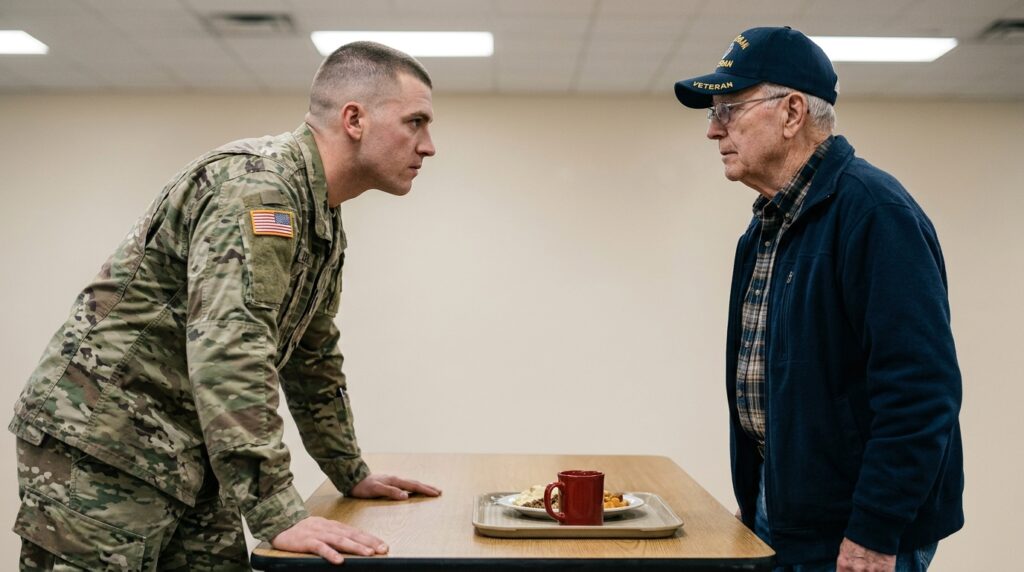
“This booth is for people who actually have a modern mission, old man,” Specialist Miller said, his palm hitting the Formica with the heavy, dead thud of wet sandbags.
Frank Vance did not look up from the scratch on the rim of his brown plastic tray. The line was raw, showing the pale, fibrous polymer beneath the dark laminate—the result of a serrated steak knife wielded by someone who had been gone from this town for five years. The diner smelled of old fat, damp rags, and the faint, cold scent of iron filing that drifted from the railyard across Highway 24.
He didn’t move his fingers from the handle of the red ceramic mug. The heat was shifting out of the porcelain now, settling into the rough skin of his palm, a slow, transactional bleed against the air conditioning that whistled through the rusty overhead vent.
“You’re tracking dirt into the aisle, Specialist,” Frank said. His voice didn’t carry the rasp of the old men who sat near the register discussing weather. It was flat, leveled like a straightedge over concrete. “And you’re leaning on my bread.”
Miller didn’t recede. Instead, the camouflage material of his sleeve ground against the edge of the booth, the stiff, unwashed cotton of the OCP uniform crackling like dry brush. He was twenty-eight, maybe nine. He had the hard, clean jaw of someone who believed the state owned his muscle and that the muscle gave him the right to select his own square footage. His boots were caked with the red, sulfurous clay of the training ranges down by the creek, a thin crust breaking off onto the linoleum with every micro-shift of his weight.
“The whole county’s short on seats today, Pop,” Miller said, his teeth catching the low light from the grease-filmed window. “We’ve got a four-hundred series detail moving out of Gate 3 at eleven. You’ve been sitting on this same corner since the Carter administration. Move the cap. Let the people who work the line have the table.”
Through his silver-framed glasses, Frank watched the young man’s knuckles turn the color of salt. Miller’s hand was braced three inches from the red mug, his thumb hooked over a heavy black tactical watch. The watch ticked with a small, dry click that Frank could feel through the vibration of the table leg.
The two younger privates behind Miller had stopped laughing. They stood by the pie case, their forks balanced over plates of cold eggs, their eyes darting toward the counter where the waitress had stopped her glass coffee pot mid-air. The silence in the room wasn’t polite; it was the rusted, heavy silence that falls over an old engine right before the belt snaps.
Frank didn’t shift his spine against the bench. He felt the cold iron pin through the wool of his black veteran cap—the tiny, sharp point of the bronze infantry clasp pressing into his thumb as he reached up and adjusted the brim by a fraction of an inch. Beneath his shirt, tucked into the narrow seam of his plaid pocket, a small, hand-filed brass key shifted against his ribs. It was an old key, notched with three irregular teeth that didn’t match any modern ordnance lock on the base three miles north. Miller’s gaze dropped to that pocket for a split second, his eyes narrowing as he caught the faint, metallic outline of the edge.
“The table stays exactly as it is, son,” Frank whispered.
He didn’t lift his eyes to meet Miller’s until the young man shifted his shoulder forward, preparing the leverage to shove the plastic tray aside. When Frank finally looked up, his pupils were perfectly still behind the glass, cold and dark as river stones beneath an inch of ice.

CHAPTER 2: THE COLD IRON BOUNDARY
“You’ve got five seconds to take your hands off my table, Specialist,” Frank said, his thumb remaining flat against the bronze infantry pin of his cap.
The silence in the booth didn’t shatter; it simply tightened, drawing down like an old steel cable under a winch. Miller didn’t pull back. The younger man’s chest remained pitched forward, his green camouflage uniform casting a heavy, split-shadow across the Formica that completely swallowed the pale scratch on the laminate. His athletic build gave him the leverage of mass, but his knuckles were vibrating now, a subtle, high-frequency tremor that spoke of adrenaline turning sour in the blood.
“Or what, Pop?” Miller’s voice dropped an octave, losing its performative loudness for the benefit of the privates by the pie case. It became sharp, transactional, a tool meant to probe for weakness. “You going to write a letter to the editor? You going to call the sheriff? The county’s under active transport orders until midnight. Every square inch of civilian concrete within five miles of Gate 3 is base property if we need it for staging. Read the municipal code.”
“I don’t need to read the code,” Frank said. He didn’t blink. His eyes remained locked behind the thick, silver-framed lenses of his glasses, tracking the slight twitch in Miller’s left eyelid. “I helped lay the gravel for the staging lane behind Gate 3 forty-two years ago, back when your father was still trying to clear his lungs of the salt in the recruit depot. Your sleeves are rolled past the third knuckle, Miller. Your platoon sergeant hasn’t looked at your profile since Tuesday, has he?”
Miller’s jaw went hard. The reference to his uniform wasn’t a casual insult; it was an institutional strike, delivered with the dry precision of an inspection report. The two privates near the counter shifted their boots, the leather squeaking against the linoleum. One of them lowered his fork, his eyes tracking the dark blue windbreaker Frank wore. They were starting to notice the architecture of the old man’s spine—the way his shoulders didn’t slouch, the way his breath was timed to the rhythmic clink-clink of the loose metal ventilation grille overhead.
“You think you know my command, old man?” Miller leaned an inch lower, his face close enough that Frank could smell the sour tobacco and commercial mints on his breath. Then his eyes drifted. They didn’t go to the red ceramic mug or the brown plastic tray. They fixed on the small, tight line beneath the plaid fabric of Frank’s chest pocket—the sharp, unmistakable contour of the hand-filed brass key.
To a civilian, it was a house key or an old padlock anchor. To a soldier trained in logistics and security sweeps at the base perimeter, the length of the bit and the three irregular, hand-filed teeth suggested something else entirely: a Master-Level override pass for the older, heavy-iron lockers in the subterranean concrete bunkers beneath the old artillery ridge.
“Where’d you get that?” Miller asked. The arrogance vanished from his tone, replaced by the flat, suspicious gravity of an MP at a checkpoint. His hand moved, his fingers hooking into a tight, defensive claw an inch above the Formica. “That’s an un-serialized master blank. Those were turned in during the ’98 inventory cycle when they sealed the old munitions storage. You’re carrying base property, civilian.”
“It’s my key,” Frank said, his voice remaining level, an unmovable layer of gray shale. “It’s been in this pocket since before your uniform pattern was drawn on a drafting board.”
“That’s a Class-Four security marker,” Miller muttered, his eyes narrowing as he calculated the risk. In his mind, the old man wasn’t just a stubborn civilian anymore; he was a soft-target soft-security leak, an old timer who had walked away with an active military asset that belonged to the logistical chain he was currently sweating to protect. “You give that across the table right now, or we’re going to have three sedans from the provost marshal’s office sitting in this gravel lot before your coffee goes cold.”
“The coffee’s already cold, Specialist,” Frank whispered. He slowly let his left hand fall from his veteran cap, placing his palm flat against the brown plastic tray, his fingers bridging the gap between his chest and the red mug. He felt the coarse, pitted surface of the tray—the grease-resistant texture that had been scrubbed down with cheap ammonia until the gloss was entirely gone. “And you’re still standing in my light.”
Miller’s hand dropped. His fingers didn’t touch Frank’s shirt, but they clipped the edge of the brown plastic tray, the impact causing the remaining black liquid in the red mug to slosh against the porcelain rim. A single dark drop rolled down the side, pooling in the small, circular indentation meant for a bowl.
“I’m not asking you again, old man,” Miller said, his body weight shifting into his heels as he prepared to reach across the boundary. “The pass goes on the tray.”
Frank didn’t pull back his chest. He didn’t reach for the key. He simply tightened his core, his old muscles remembering the exact physics of a counter-brace, his center of gravity dropping six inches into the booth’s bench. He knew the friction of the floor; he knew the exact distance between Miller’s boots and the iron pedestal of the table. If the boy lunged, he wouldn’t hit a frail old civilian; he would hit eighty-two kilograms of dense, unyielding salt and iron that had survived three decades of gray earth.
Behind them, the front door of the diner gave a sharp, metallic rattle as the heavy iron latch cleared the frame, allowing a sudden gust of humid, diesel-heavy air to cut through the smell of grease.
CHAPTER 3: THE FRICTION LINE AT THE BOOTH
The blast of thick, August heat from the open doorway carried the grit of unwashed gravel and the bitter tang of raw JP-8 fuel from the transport idling near the highway. It sheared through the air conditioning’s cold film, causing the grease-filmed window beside Frank’s shoulder to break into a sudden, weeping sweat.
Miller didn’t turn his head toward the door. His weight remained braced, his boots dug into the linoleum with the heavy, stubborn intent of a machine designed for simple displacement. His hand hovered directly over the tray, the shadow of his thick fingers falling across the dark drop of coffee that had rolled into the plastic molding.
“The pass,” Miller repeated, his voice dropping below the rattle of the exhaust fans. His knuckles didn’t yield an inch. “Un-serialized brass. You don’t get to walk out of the line with ordnance property, Pop. My detail is short two transport blocks for the subterranean lockers on Ridge Six. If that’s what’s sitting in your flannel pocket, it’s going back to the base. With or without the provost marshal.”
Frank let his hand slide down the rough, pitted edge of the plastic tray, his fingertips tracking the worn texture where thousands of thumbs had rubbed the synthetic surface smooth over forty years. He didn’t defend his shirt pocket. He didn’t lean away from the sour smell of mints and adrenaline coming off the specialist. Every piece of his old long-range reconnaissance training—the parts that had survived the damp earth of foreign valleys and the long, silent winters of the Cold War—remained frozen in his lower spine.
“You’re missing two blocks for Ridge Six because your logistics clerk doesn’t know how to read the old manual ledger,” Frank said. His tongue didn’t stumble on the nomenclature. He kept his gaze flat against Miller’s left collarbone, where the fabric was slightly frayed from a heavy pack strap. “The locks on Ridge Six were re-keyed in October of eighty-four. This tooth arrangement isn’t a transport block pass, Specialist. It’s an original field master for the dry-storage cells behind the old battery.”
Miller’s fingers twitched. The specific mention of Ridge Six’s dry-storage history was a piece of base geography that didn’t exist on the modern digital layout sheets his platoon used. It was old dust—the kind of information that survived only in the yellowed paper manifests kept in the lower crawlspaces where the rats nested.
“The battery was filled with concrete after the deployment shift,” Miller said, though his shoulder dropped by a fraction of a millimeter, the muscle losing its hard, initial lock. His eyes darted to the two privates by the pie case. They hadn’t moved. They stood with their thumbs hooked into their gear belts, their faces blank with the specific, survivalist caution of low-ranking enlistees who could smell a senior tactical error developing before them. “It’s cold storage. Dead space.”
“The space is only dead if you think the earth doesn’t remember who dug it,” Frank muttered. He slowly shifted his left heel back against the iron base of the table leg, his boot heel finding the exact point where the metal met the floorbolt. He wasn’t preparation-killing; he was setting his anchor. If the specialist attempted a wrist-lock or a collar-grab across the Formica, Frank’s center of mass would stay down, pulling the younger man’s balance across the table until his chest hit the sharp plastic edge of the tray. “Your sergeant didn’t send you here for a table, Miller. He sent you out here to find the old log blocks because the convoy manifest didn’t match the weight on the scale at Gate 3.”
The realization hit the young soldier’s face like a physical blow. The skin around his high-and-tight haircut tightened, turning a mottled, sun-scorched red that spread down into his collar. He hadn’t told his men why they were stopping at the Highway 24 Diner during a deployment cycle; he had told them it was for the ham and eggs. But Frank had watched the way Miller’s eyes had scanned the parking lot before he crossed the threshold—the way his fingers had kept touching the heavy leather ledger-folder tucked under his arm.
“You’ve been talking to someone on the inside,” Miller whispered. The arrogance was completely gone now, replaced by the dangerous, narrow focus of a junior NCO who believed he was standing over a leak. “That’s base intelligence business. You’re eighty years old, sitting in a grease trap, and you’re tracking the convoy weight?”
“I don’t need to track the weight,” Frank said, his hand remaining motionless on the brown plastic. “I can hear the springs on the transport trucks when they slow down for the railyard crossing. They’re heavy by four tons. That means you’re hauling the old wet-cell batteries out of the lower vault, the ones that were supposed to be decommissioned when Reynolds’ father was still a first lieutenant.”
Behind Miller, the shadow from the doorway suddenly grew wide, blocking out the glare of the highway asphalt. The sound of heavy, spit-shined leather boots struck the linoleum—not the quick, light scuff of a low-ranking soldier, but the measured, rhythmic thud of a man who carried forty pounds of institutional authority in his stride.
The two privates near the pie case didn’t just drop their forks; their heels snapped together with a sharp, dry clack that rattled the glass shelves of the pastry display. Their arms went rigid at their sides, their chins tilting upward toward the water-stained ceiling tiles.
Miller froze. His hand remained hooked over the red mug, his fingers still locked in the middle of his aggressive lean, his body caught between the old man’s table and the sudden, freezing drop in the room’s pressure. He didn’t turn around yet, but his neck muscles went stiff, the veins along his throat pulsing against the camouflage fabric of his collar.
“Specialist Miller,” a voice barked from the aisle. It wasn’t loud, but it had the hollow, metallic ring of a heavy spade hitting frozen sod. “Explain to me why your detail is out of the vehicle lane while the transport engines are burning fuel on state time.”
CHAPTER 4: THE ERUPTION OF OLD IRON
“Specialist Miller,” the voice cut down the central aisle like a cold chisel hitting sheet metal.
Miller did not turn. The momentum of his lean—the aggressive forward weight he had thrown across the Formica table—hung suspended in the damp, air-conditioned draft of the diner. His knuckles, still jammed against the pitted rim of the plastic tray, went white, then a gray, bloodless yellow. His tactical watch gave three tiny, frantic clicks against the laminate before his arm went perfectly rigid, locking his elbow into a hard, trembling pillar of defense.
“Command Sergeant Major,” Miller whispered. The words didn’t come from his chest; they leaked from the side of his mouth, flat and dried out by the sudden, massive drop in the room’s air pressure.
Behind him, Command Sergeant Major Reynolds did not stop. His heavy, low-quarter leather shoes met the linoleum with the measured, hydraulic cadence of an inspection officer clearing a barracks floor. He was fifty-eight, short-cropped iron-gray hair visible beneath his campaign cap, his summer-weight khakis pressed with sharp, razor-like creases that didn’t yield to the heavy August humidity. He carried a leather-bound logistical folder under his left arm, his right hand swinging in a short, deliberate five-inch arc that stopped the moment his chest cleared the back of Miller’s shoulder.
“Stand down, Specialist,” Reynolds barks, his voice dropping into the lower registry where commands become structural vibrations. “You aren’t fit to clear this man’s tray.”
Miller snapped backward. The movement was purely kinetic—a survivalist recoil that pulled his boots through the thin crust of red range clay he had deposited on the floor. His spine hit the vertical iron support pillar of the neighboring booth with a hard, hollow thump that rattled the sugar dispensers three rows over. He brought his hands down to his sides, his chest swelling as he tried to find the formal alignment of attention while trapped in the narrow space between the laminate tables.
The diner had lost all civilian sound. The young waitress with the coffee pot remained frozen by the pie case, the dark brew dripping from the spout onto her apron in slow, rhythmic thuds. The two junior enlistees behind Reynolds stood like stone monuments, their eyes drilled into the water-stained acoustic tiles above the register.
Reynolds didn’t look at Miller. He didn’t look at the two privates who had abandoned their breakfast. His gaze dropped to the center of the booth, tracking the pale scratch on the brown plastic tray, then moved to the red ceramic mug, and finally lifted to the silver-framed glasses resting beneath Frank’s black veteran cap.
For three seconds, the old NCO’s face remained a mask of hardened leather and deep, historical scar tissue. Then, with a slow, heavy deliberation that seemed to draw all the mass out of the room, Reynolds brought his right hand up to the brim of his cap. His fingers were perfectly flat, his palm turned inward by the exact degree required by the 1984 field manual, his forearm forming a rigid, horizontal bar of unyielding brass across his chest.
He saluted. He held it while the loose ventilation grille overhead gave two metallic clicks.
“Master Sergeant Vance,” Reynolds said, the rasp in his throat softening into something dense, historical, and heavy with the salt of old campaigns. “The regiment didn’t track your arrival on the morning log.”
Frank didn’t rise. He didn’t return the salute with his hand; he simply tilted his head forward by a fraction of an inch, his fingers remaining flat against the pitted surface of the plastic tray. The bronze pin on his cap caught the cold glare of the fluorescent tube above them, casting a long, narrow shadow across his forehead that touched the rim of his glasses.
“I don’t register with the base anymore, Thomas,” Frank said, his voice flat as river slate. “I just came for the coffee. Your boy here thinks my key belongs to his detail.”
Reynolds’ arm came down. His hand didn’t drop; it snapped to his seam with a dry, leather-on-cloth strike. He turned his head forty-five degrees to the left, his eyes locking onto Miller’s face with the crushing weight of a hydraulic press.
“You’ve been clearing Ridge Six, Specialist?” Reynolds asked.
“Sir, yes, sir,” Miller stammered, his chin tucked into his throat until the skin went white. “The logistics ledger showed a manifest discrepancy at Gate 3. Four tons over-scale on the wet-cell haul. We were told to sweep the local perimeter for old master keys or un-serialized blanks that could clear the old munitions cells.”
“You were told to check the digital registry at the transport office,” Reynolds said, his voice rising by a fraction of a decibel—a shift that caused the two privates by the counter to draw their shoulder blades even closer together. “You were not told to enter a civilian establishment and attempt to extract property from a retired command figure who was running reconnaissance details before your mother was clearing high school. Hand over the ledger.”
Miller’s fingers shook as he reached for the leather-folder tucked under his arm. He held it out, his arm trembling under the weight of his own sudden, absolute ruin.
Reynolds took the folder, but he didn’t open it. He kept his eyes on Frank’s plaid pocket, where the hand-filed brass teeth of the key were still visible through the thin flannel. A strange, dark complication passed across the Command Sergeant Major’s eyes—a sudden look of recognition that wasn’t structural, but personal. He knew the notches on that key. He had seen the same three-toothed pattern in his own father’s old footlocker down in the cellar of the family home in Salina.
“Master Sergeant,” Reynolds said, his voice dropping into a quiet, guarded vulnerability that Miller wasn’t meant to hear. “The logs from seventy-two… they aren’t in the transport office. We’ve been looking for the original battery manifests for six months. The base command wants them burned before the environmental audit on Friday.”
Frank’s hand tightened on the tray. He looked at the leather folder in Reynolds’ hand, then back to the key in his own pocket. The victory over Miller was a false flag; the real pressure wasn’t the booth or the young soldier’s arrogance. The real danger had just walked through the door with an iron salute, carrying the weight of a seventy-year-old secret that was about to be turned into ash.
“They won’t burn, Thomas,” Frank whispered, his eyes narrowing behind his lenses. “Not while I’m sitting at this table.”
CHAPTER 5: THE SHATTERING OF THE DECOY
“A fire doesn’t care about the registry, Thomas,” Frank said. His palm stayed flat on the brown plastic tray, his fingers bridging the gap between his chest and the cold rim of the red mug. “And an audit only looks at the columns that are currently open. Your father didn’t spend three weeks down in the limestone damp just so a civilian sub-contractor could check a clean box on a Friday afternoon.”
Reynolds’ boots didn’t shift, but his chest went rigid under his starch-stiffened khakis. The leather folder under his arm gave a short, dry crease against his ribs.
“The order came down from the logistics center at Fort Liberty, Master Sergeant,” Reynolds said. He didn’t drop his chin, but his voice lost its public bark, settling into the flat, heavy timbre of a man who knew every line he spoke was being measured by the three young soldiers still pinned against the diner walls. “The dry-storage units on Ridge Six are designated as toxic ground now. Anything with a seventy-two stamp is classified as unstable ordinance residue. We clear it, or the county closes the road down to the railyard.”
“The ground isn’t toxic, son. The record is,” Frank whispered.
He slowly reached his right hand toward his flannel shirt pocket. Specialist Miller’s shoulders gave a small, reactive twitch, his boots sliding back half an inch through the dry range clay. He was still waiting for the old man to produce an identity card or a base pass, some standard piece of plastic that would justify the Command Sergeant Major’s salute and restore the universe to a structure he understood.
Instead, Frank pulled out the hand-filed brass key. He laid it flat on the center of the brown plastic tray, right next to the dried circle of black coffee. The three irregular teeth pointed directly at Reynolds’ leather folder.
“Take a look at the bit, Thomas,” Frank said, his voice flat as zinc sheeting. “The third ridge isn’t a locker notch. It’s an old ordnance stencil index. Your father filed that himself in the winter of seventy-three when the third battery leak started coming through the floorboards. He didn’t turn his logbook over to the company clerk. He locked it in the battery vault because he knew if the division saw the chemical counts on the water lines, they’d bury the whole grid under six feet of gravel and forget the names of the men who were holding the pumps.”
Reynolds looked down at the brass piece. His gray eyebrows came together, the skin between his lenses turning the pale, granular color of old salt. He recognized the specific, rough file-marks on the base of the key’s eye—the two tiny, parallel scores that matched his father’s old bench-vise down in the Kansas shop.
Miller cleared his throat, his youth and his panic leaking out in a sudden, sharp rasp. “Sir… if that’s an active battery key, it belongs in the transport block manifest. If the old man won’t hand over the entry pass—”
“Shut your mouth, Specialist,” Reynolds said without turning his eyes from the tray. The words were quiet, but they carried the heavy, crushing mass of a hydraulic ram. “Get your men out to the transport truck. You’ve got five minutes to check the straps on the four-ton container. If I see a single drop of condensation on those battery cases when you hit Gate 3, I’ll have your platoon clearing the grease traps at the motor pool until your contract expires.”
Miller didn’t stand on ceremony. He snapped a frantic, uncoordinated salute that nearly clipped his own cap brim, spun on his heel, and moved down the aisle with a quick, desperate scuffle of rubber soles. The two privates by the pie case followed him out like shadows caught in a sudden draft, their forks clinking against the plates as they abandoned their breakfast. The heavy iron latch of the diner door cleared the frame with a loud, dry clack, leaving the interior entirely to the old master sergeant and the man who had been a boy when the secrets were still fresh.
Reynolds slowly dropped his logistical folder onto the Formica table, his fingers remaining on the leather trim. He looked at the empty seats across the aisle, then slid his heavy frame into the booth opposite Frank, his knees knocking against the rusted iron pedestal beneath the laminate.
“My father died with the salt in his skin, Frank,” Reynolds said, the formal ‘Master Sergeant’ disappearing into the low hum of the refrigerator unit behind the counter. “The VA wouldn’t look at his charts because the seventy-two logs were marked as missing during the divisional transfer. If you’ve had the master index in this diner for thirty years, you let him sit in that hospital room in Salina without the paperwork.”
“I didn’t have the logbooks, Thomas,” Frank said, his silver-framed glasses reflecting the yellow light of the pastry case. He reached down, his old fingers picking up the hand-filed brass key, his thumb tracing the score-marks. “Your father didn’t leave them in the battery vault. He gave them to the logistics colonel—your current base commander’s predecessor. The decoy secret was the key, son. Everyone thought the keys opened the vault. But the vault’s been empty since the day they poured the concrete.”
Reynolds froze, his hand tightening on the edge of his folder until the leather groaned. “If the vault is empty… what’s Miller hauling in the four-ton container right now?”
Frank looked out the grease-filmed window, watching the heavy transport truck roar as its diesel engine caught the gear line for the highway. “They aren’t hauling batteries, Thomas. They’re hauling the original soil boxes from the ridge. The current base command is moving the evidence out to the commercial dump before the EPA inspector sets foot on Gate 3 tomorrow morning. And your father’s signature is on every manifest they’re using to clear the yard.”
The information gap opened beneath Reynolds like a dry well. The institutional salute, the pride of the uniform, the discipline of the regiment—it all cracked under the weight of a seventy-year-old operational fraud that was still active, still moving down Highway 24 at fifty miles an hour.
CHAPTER 6: THE SETTLING OF THE SHALE
“They’re using his name to clear the dirt,” Reynolds said. His leather folder slipped an inch against the laminate table, the plastic grain scraping against his knuckles with a sound like gravel rolling under an incoming tide. The iron discipline that had kept his shoulders square for thirty years didn’t shatter; it slowed down, dilating into a cold, heavy precision as the true weight of the manifest settled behind his eyes.
Frank didn’t shift his hand away from the cold rim of the red ceramic mug. Outside the window, the blue-gray plume of Miller’s transport truck had already thinned into the heat shimmer over Highway 24, leaving nothing but the smell of burnt sulfur and the steady, dry vibrations of the railyard switchers a mile south.
“They’ve used his name since seventy-two, Thomas,” Frank said, his voice flat as the limestone shelves under Ridge Six. “When the old logistics colonel realized the sulfur water was reaching the civilian wells by the creek, he didn’t sign the excavation block. He had your father do it under a special ordnance voucher. If the EPA checks the mud tomorrow, the digital trail stops at a dead man’s pension file in Salina.”
The Command Sergeant Major looked at the hand-filed brass key lying between them on the brown plastic tray. The three irregular, hand-filed teeth caught the raw glare of the fluorescent tube overhead, their edges showing the faint, yellow sheen of exposed alloy beneath the decades of pocket oil and zinc dust. It was an object that had no function in a modern, digitized army, yet it carried the exact spatial geometry of his father’s lifetime of labor—the slow, unseen poison that had settled into his skin long before the state ever granted him a retirement medal.
Reynolds slowly reached out, his thumb covering the parallel file marks on the eye of the key. “If the boxes are already on the highway, Frank… the command won’t let the transport log clear Gate 3 without a signature from my office. They sent Miller out here to find the baseline pass so they could seal the ledger before the auditors sit down.”
“Then you don’t sign it,” Frank whispered. He didn’t lean across the table. He didn’t offer a tactical suggestion. He simply sat perfectly upright behind his silver-framed glasses, his old spine anchored against the vinyl bench with the unblinking mass of a man who had watched five base commanders come and go through the same gate. “The key isn’t for the vault, son. It never was. It fits the lock on the master cabinet inside the old railyard station—the one the logistics office abandoned when they built the new concrete siding in ninety-eight. The original log sheets are still in the bottom drawer, rolled in paraffin paper behind the track schedules. Your father didn’t hide them to save the army. He hid them to save you.”
The silence that followed was different from the tight friction of Miller’s confrontation. It was the vast, hollow space that opens up when an old machine finally comes to a dead stop after years of grinding its own gears. Reynolds looked up, his iron-gray eyes finding Frank’s face behind the lenses. In that look, the entire hierarchy of the base—the crisp creases of the khakis, the unblemished camouflage sleeves, the unearned authority of the active deployment detail—shrank into a handful of salt and dry earth.
“They’ll close the road if the audit fails, Frank,” Reynolds said quietly.
“The road’s been closed to the people who built it for forty years,” Frank replied, his fingers finally dropping from the handle of the mug. He reached down and took his black veteran cap from the bench, placing it back onto his head with a slow, measured movement that pulled the brim low over his forehead. The bronze infantry pin caught the low daylight through the grease-filmed glass, casting a solid, unmoving bar of shadow across his eyes. “Let them walk the gravel.”
Reynolds stood up. He didn’t salute this time; he simply took his leather logistical folder from the table, tucked it under his arm, and picked up the hand-filed brass key from the center of the brown tray. He didn’t look back at the aisle or at the two privates who were still lingering by the gravel lot outside. He walked toward the diner door, his heavy boots striking the linoleum with the flat, unhurried cadence of a man who was no longer measuring his life by the base clock.
Frank Vance remained in the booth. He picked up his cold red mug, tilted it slightly to clear the residual grounds from the rim, and took a slow, deliberate sip. The plastic tray beneath his hand was still pitted, the raw white scratch still visible where the knife had slipped five years ago, but the boundary line was clear. The town was exactly as it had been at sunrise—gray, salted, and entirely unmoved by the young men who thought they owned the dirt.







