
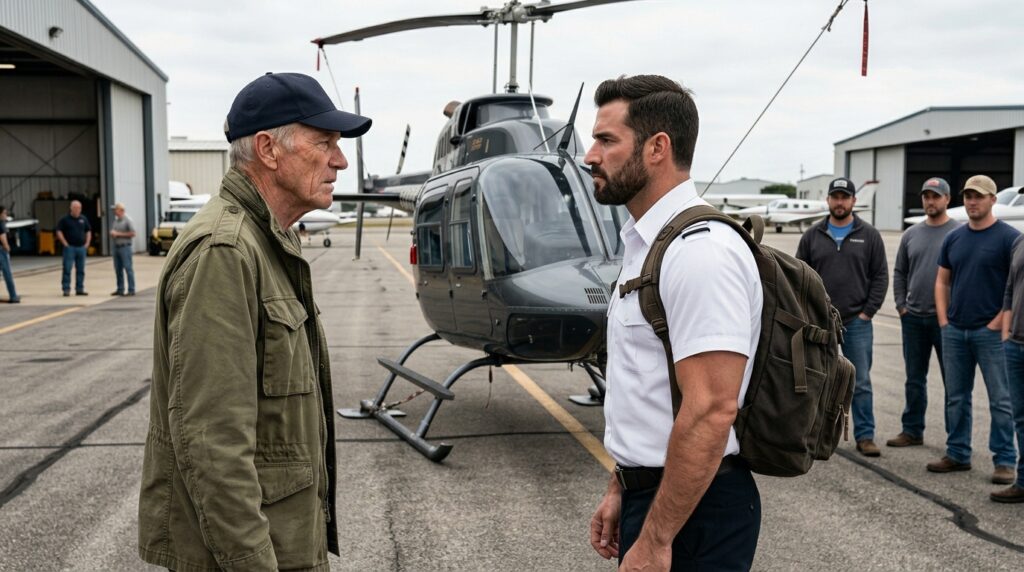
CHAPTER 1: THE TARMAC LINE
The heat on the concrete did not rise in waves; it sat flat and heavy, smelling of burnt kerosene and iron filings. Every step onto the runway line felt like pressing a boot into dry leather. Underneath the dark bill of his veteran cap, the old man kept his chin tucked, his eyes fixed on the gray tail rotor of the Bell 206 idling sixty yards out. His fingers, stiffened by old weather and the permanent ache of salt-mine labor, clamped around the edges of a worn leather ledger. The binding was split down the middle, revealing white threads like exposed tendons. He did not look at the perimeter fence behind him or the warning signs that had lost their yellow paint to the high desert wind. He only looked at the machine.
A shadow broke the glare from the aluminum hangar doors to his right.
“Hey! Old man! You’re in the path of the rotor wash!”
The voice was clean, amplified by the flat expanse of the tarmac. The younger man didn’t run; he marched with the heavy, deliberate stride of someone whose boots were brand new and heavily cushioned. He wore a crisp white uniform shirt, the seams sharp enough to cut grease, and a heavy tactical backpack strapped tightly across his chest like armor. His trimmed beard didn’t show a single gray hair, and his hands were already clear of his sides, fingers hooked slightly as if waiting for a whistle.
The veteran didn’t stop. He didn’t speed up. His boots, split at the welt and covered in a fine layer of alkaline dust, kept their rhythmic click-clack against the aggregate concrete. He could feel the vibration of the helicopter through the soles of his feet—a low, rhythmic thrumming that matched a pulse he had spent forty years trying to forget.
“I said halt,” the younger man called out again, his shadow now stretching long enough to touch the old man’s boots. He stepped directly into the lane, his muscular frame cutting off the view of the cockpit. He smelled of laundry detergent and synthetic gun oil. “This area is restricted under Section Four. Turn around and take the gate back to the access road.”
The old man stopped. He didn’t drop the ledger. He stood with his shoulders slightly rounded, the olive jacket hanging loose over a frame that had lost its meat but kept its bone.
“The logs are for Miller,” the old man said. His voice was like two gravel bags rubbing together in the back of a truck. “Tell him the book from the canyon is here.”
“There’s no Miller on this flight manifest,” the contractor said, stepping closer until his chest gear nearly brushed the frayed zipper of the olive jacket. His hand rose—a thick, pale hand with reinforced composite knuckles on the glove. He reached out and grabbed the veteran by the meat of his chest, fingers locking into the fabric to shove him back toward the gravel. “You need to turn around right now, old man—this area is restricted.”
The old man’s feet didn’t slide. They stayed rooted into the concrete, his weight shifting forward into the contractor’s palm just enough to kill the momentum of the push.
“Take your hands off me,” the old man said, his eyes rising to lock onto the contractor’s blue irises, “and show some respect.”
The contractor didn’t let go; his jaw clenched, his knuckles tightening on the olive cloth. In the reflection of the helicopter’s canopy behind them, a dark silhouette was moving inside the cockpit, but the old man didn’t look. He didn’t have to. His left hand dropped the ledger three inches, catching it by the split binding with his fingertips, while his right hand moved up the contractor’s forearm with the smooth, frictionless velocity of an iron piston that had been oiled every morning for fifty years.








