
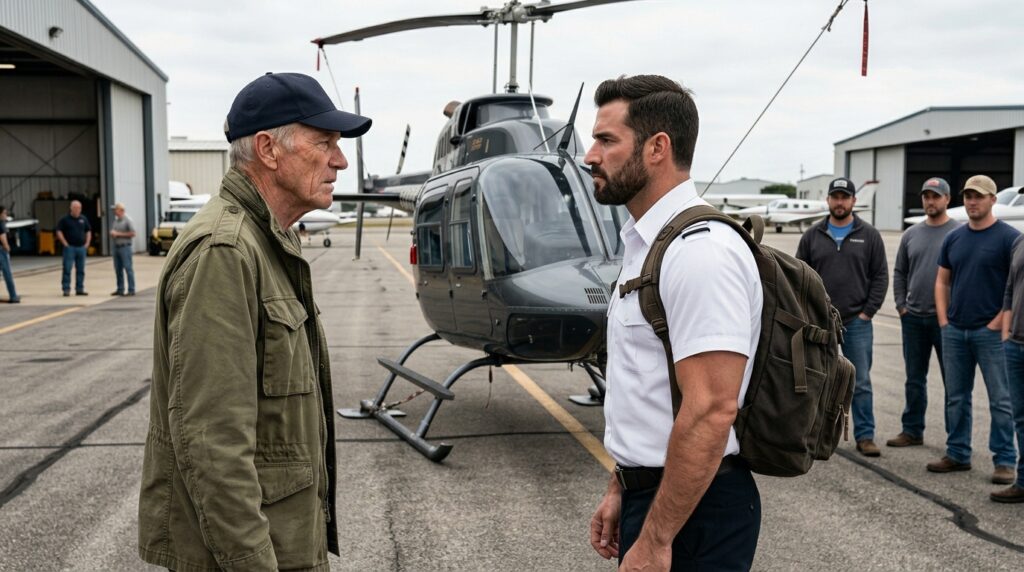
CHAPTER 3: THE TURNING LINE
The wash from the rotor blades lessened slightly as the old man drew closer to the cavernous opening of the hangar, but the air here carried a different kind of friction. Inside the threshold, the light changed from the white glare of the desert floor to a deep, oil-stained twilight. The concrete underfoot was no longer raw aggregate; it was smooth, decades-old slab, crosshatched with hairline cracks that had filled with black grease and fine silica over forty seasons of heavy maintenance.
He didn’t look back to check the contractor’s position. He could hear the heavy, rubberized slap of the younger man’s boots trailing five paces behind, the synthetic fabric of his chest rig whistling with each stride. That was the distance of compliance, but it was also the distance of execution. The old man kept his stride deliberate, each step pulling his olive jacket tight across his shoulder blades, the leather folder anchored hard against his ribs.
As his eyes adjusted to the shade, the massive interior of Hangar 3 revealed its true geometry. This wasn’t a standard corporate logistics bay. Against the back wall sat three olive-drab tool cabinets, their drawers locked with thick, brass padlocks that bore the anchor stamp of the old Navy procurement boards. Overhead, a steel gantry crane hung stationary on its tracks, its hoist chains rusted to a dark cocoa brown, frozen above an empty workspace where a heavy radial engine had once leaked its weight into the floor.
The figure standing in the shadows didn’t move as the old man crossed the light line.
“You haven’t changed the boots, Frank,” the man said.
The voice didn’t carry the contractor’s aggressive volume. It was thin, reedy, worn down by forty years of air-conditioned offices and dry valley drafts. Miller stepped forward into the gray illumination cast by the high clerestory windows. He was eighty now, his frame slightly more stooped than the old man’s, wearing a loose-fitting khaki flight jacket with the patches cut away, leaving only the dark squares of adhesive residue where his name and rank had once been stitched.
“The soles are still good,” Frank said, stopping exactly four feet from the khaki jacket. He didn’t drop his left hand from the folder. “The topcoat out there is getting thin, though. You can see the old bedrock coming through near the tie-downs.”
Miller looked down at Frank’s boots, his faded eyes tracking the alkaline line along the leather welts before rising to the dark bill of the veteran cap. He let out a dry, clicking breath through his teeth. “I told the boy out there to take the cap. He doesn’t know what it means, but the logistics team from the capital has a satellite link active in the office. They see that emblem, they start checking the deactivated files. We don’t want them looking at eighty-four, Frank.”
“Then you shouldn’t have authorized the grease-pencil on his cuff,” Frank said, his voice flat, deadened by the vast corrugated tin walls around them. “He’s running manifests for the canyon route. I saw the three-digit marker on the belly of that machine out there before the paint dried. That’s not a civilian registration number, Miller. That’s the tail from the old salt flats detachment.”
Behind them, the contractor stepped up to the threshold, his bulk blocking a portion of the midday light. “Mr. Miller, he broke my grip on the line. He has a non-standard classification document.”
Miller didn’t look at the contractor. He kept his eyes fixed on the cracked leather binding under Frank’s arm. “Go back to the fuel truck, son. Secure the perimeter ropes. If the three-o’clock bird doesn’t have its clearance papers signed by the time the wind shifts, nobody’s leaving this valley.”
The contractor hesitated, his fingers twitching against the straps of his tactical backpack. For a second, his jaw set as if he wanted to argue the logic of leaving a civilian inside the primary bay, but the absolute stillness of the two older men seemed to press against him like physical mass. He dropped his hand, turned on his heel, and let his boots scrape back across the concrete toward the idling engine outside.
When the sound of the contractor’s footsteps faded into the steady thrum of the rotor blades, Miller reached into his khaki pocket and pulled out a small, nickel-plated penknife. He didn’t open the blade; he just rolled the cold metal between his palms, the click-clack of his knuckles matching the distant sound of the repair crew across the field.
“The funding line was dissolved six months ago, Frank,” Miller said softly, his voice dropping into the confidential rhythm of an old tactical briefing. “The capital closed the account. They called it a ‘recollection of legacy resources.’ That contractor out there thinks he’s guarding a scrap contract for old titanium casing. That’s what the firm told him. That’s what the regional ledger says.”
“But the logs inside this book say something else,” Frank said. He didn’t offer the folder yet; he held it like an shield against his ribs. “The fuel consumption columns from seventy-nine through eighty-three don’t match the weight of titanium. They match the payload of the heavy transport runs into the border sector. The runs we signed for with the violet ink.”
Miller stopped rolling the knife. His thumb pressed into the nickel plating until his skin went white. He looked toward the deep rear of the hangar, where a stack of old canvas-covered crates lay beneath a layer of gray dust so thick it resembled felt.
“We buried those flight coordinates forty years ago, Frank,” Miller muttered, his eyes narrowing as a draft from the runway rattled the loose tin sheets near the roof line. “If that log gets entered into the digital manifest for the three-o’clock flight, the recovery fund gets audited by the civilian oversight committee. Every name on those old crew sheets gets pulled out of retirement. My name. Your name. The ones we left out in the salt.”
Frank looked down at the frayed edge of his own cuff, where the thread was unraveling against his wrist. He could smell the old canvas from the rear crates—a musty, vinegar scent that brought back the memory of the long nights under the camouflage netting, watching the blacked-out transport planes drop their bellies into the dry lakes.
“The oversight committee isn’t what’s coming on that plane, Miller,” Frank said, his voice dropping into a gravelly whisper that barely carried across the four feet between them. “I saw the cargo list at the canyon checkpoint before I walked the line. They aren’t auditing the funds. They’re clearing the physical archive before the field lease expires tonight.”
A shadow crossed the high windows of the hangar as a larger cloud moved over the desert sun, plunging the interior into a sudden, deep twilight. From the office at the far end of the bay, a blue digital line flickered behind the glass—the active terminal connection to the capital, waiting for the upload that would either erase the line forever or pull the old operations back into the light.








