
CHAPTER 5: THE PRESSURE RAMP
“The boy didn’t do this alone,” Frank said. His fingers remained wrapped around the cold brass shape of the open padlock. He didn’t pull the transponder key from the shelf; to touch the key was to trigger a countdown he wasn’t ready to time. “The smudges on this shelf aren’t from a contractor’s supply kit. They’re from standard-issue logistics boxes. The ones with the three-digit tracking stamps.”
Miller didn’t answer right away. His boots made a short, heavy scraping sound against the concrete as he turned back toward the open office door. The light from the terminal was still flashing blue behind the partition, but the speed of the blinking text had accelerated. “The digital upload has reached ninety percent, Frank. The handshakes are completing. If that transponder key is sitting there, it means the system has already registered the pilot’s clearance code from the tower. We aren’t looking at an audit. We’re looking at a handoff.”
Frank turned his head slowly, his eyes narrowing beneath the bill of his veteran cap. “A handoff to who, Miller? You built the fund. You set up the routing numbers in eighty-four. Who has the secondary keys?”
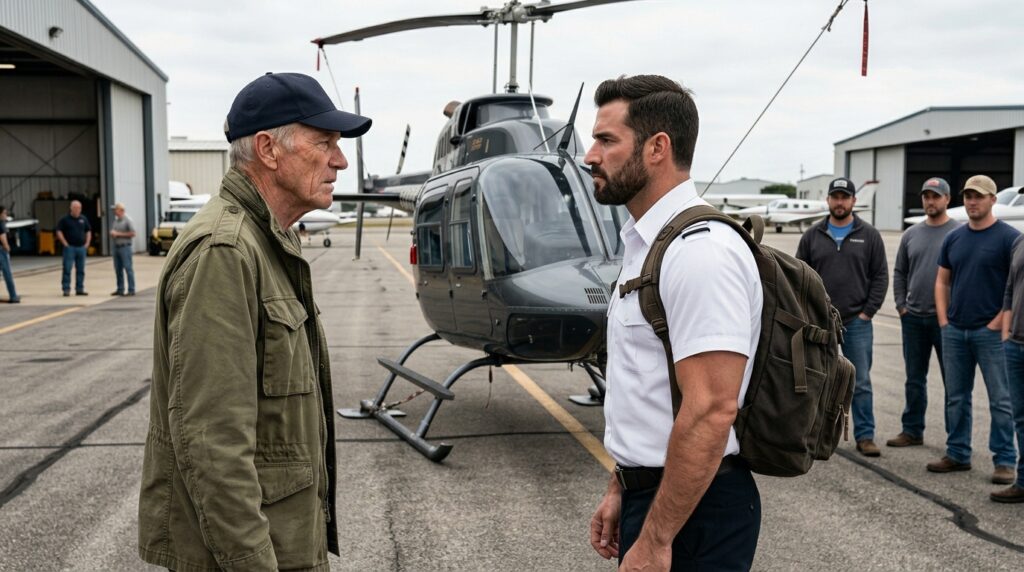
“The people who bought the field lease,” Miller muttered. He reached into his pocket, his knuckles rapping against the nickel-plated knife. He looked out across the open tarmac where the Bell 206 was still thrumming, its rotor wash sending a thin line of gray sand across the hangar’s threshold. “The firm that hired the boy outside isn’t a private contractor company from the capital. It’s a holding name. I thought it was ours. I thought the numbers were routed to keep the old crew quiet. But someone changed the destination index three weeks ago.”
Before Frank could reach into the cabinet to inspect the tactical gloves, a heavy thud vibrated through the metal roof of the hangar. It wasn’t the sound of a tool dropping. It was the distinct structural shudder of a secondary aircraft entering the local airspace—a low, twin-rotor rumble that shook the rusted chains of the overhead gantry crane until they began to chime against the iron tracks.
Frank stepped away from the tool cabinet, his split-welt boots clicking hard as his pace quickened. He didn’t run, but his posture shifted, his shoulders dropping low as his center of gravity aligned with the stone floor. He moved back to the foreman’s office, his hand reaching out to grab the worn leather ledger from the green desk.
“The three-o’clock bird just arrived early,” Frank said, his voice dropping into the hard, rhythmic tone he had used when the perimeters went red in the salt flats. He pointed the corner of the leather book toward the monitor. “Look at the terminal line. The upload didn’t finish. It was interrupted by an external command string.”
The blue screen had gone flat gray. A single line of yellow text was blinking across the center: GATEWAY TERMINATED VIA REMOTE CARRIER.
Miller stepped into the office behind him, his breath coming faster now, the thin, dry wheeze of his lungs audible over the cooling fan of the server. “That’s a command override from an airborne transponder. The helicopter outside isn’t the one taking the crates. It was the beacon.”
Through the grease-stained glass of the partition, the open runway came into view. The small Bell 206 was no longer alone. A massive, dual-rotor transport helicopter, painted a matte, desaturated gray with no registration markings or national flags, was hovering ten feet above the aggregate concrete. Its rotor wash was immense, a miniature hurricane of alkaline dust and loose gravel that smashed against the hangar doors, rattling the corrugated tin until the sound resembled a heavy machine-gun barrage.
The younger contractor in the white shirt was out on the tarmac, his hands raised to shield his eyes from the blinding storm of stone and dust. His tactical backpack shifted as he staggered backward, his boots losing their purchase on the aggregate. He was shouting into his earbud, his jaw working furiously, but the roaring scream of the twin turbines drowned out everything within two hundred yards.
Frank watched the contractor through the glass. He noticed the man’s left hand move toward his belt—not for a radio, but for the sidearm tucked into his utility rig.
“The boy thinks he’s still in charge of the gate,” Frank said, his gravelly voice cutting through the office silence. He tucked the ledger under his left arm and moved toward the doorway. “He’s about to find out how much a private contract is worth when the company changes the asset list.”
“Frank, stay inside the frame,” Miller shouted, his hand finally pulling the nickel knife from his jacket pocket, though the blade remained closed. “You don’t have the clearance for a grey-market transport team. If they see the ledger in your hand, they’ll clean the whole bay.”
“They’re going to clean it anyway,” Frank said without looking back. “The padlock was clean, Miller. That means someone from the ground crew has been feeding them the inventory list since morning. The keys are already gone.”
He stepped past the iron cylinder head holding the door and into the main bay. The wind from the tarmac was pouring into the hangar now, cold and sharp, smelling of scorched turbine blades and unwashed sand. The dust was a thick, gray curtain that reduced the light line to a hazy smudge.
As Frank reached the midpoint of the hangar floor, two figures broke through the gray curtain at the threshold. They weren’t wearing the white uniform shirts of the local field contractors. They were dressed in heavy, desaturated flight suits, their faces completely obscured by dark, high-altitude helmets and ballistic visors. Neither man carried a clipboard or a manifest sheet. In their hands were short, black carbines, held at the low-ready position, their muzzles pointed directly at the aggregate concrete between Frank’s boots.
The younger contractor was behind them, his arm pinned behind his back by a third man in a flight suit. His white shirt was already torn across the shoulder, the tactical backpack ripped away and lying in the dust behind him. His overconfident jaw was slack, his trimmed beard covered in a layer of gray sand as he was shoved hard onto his knees at the threshold line.
The first visitor didn’t speak. He lifted his left arm, revealing a heavy, digital pad strapped to his wrist. A purple light flickered across the screen, casting a brief, violet glow onto the dust between them. He looked from the pad to the leather ledger tucked beneath Frank’s olive sleeve.
The muzzle of the carbine rose three inches.








