
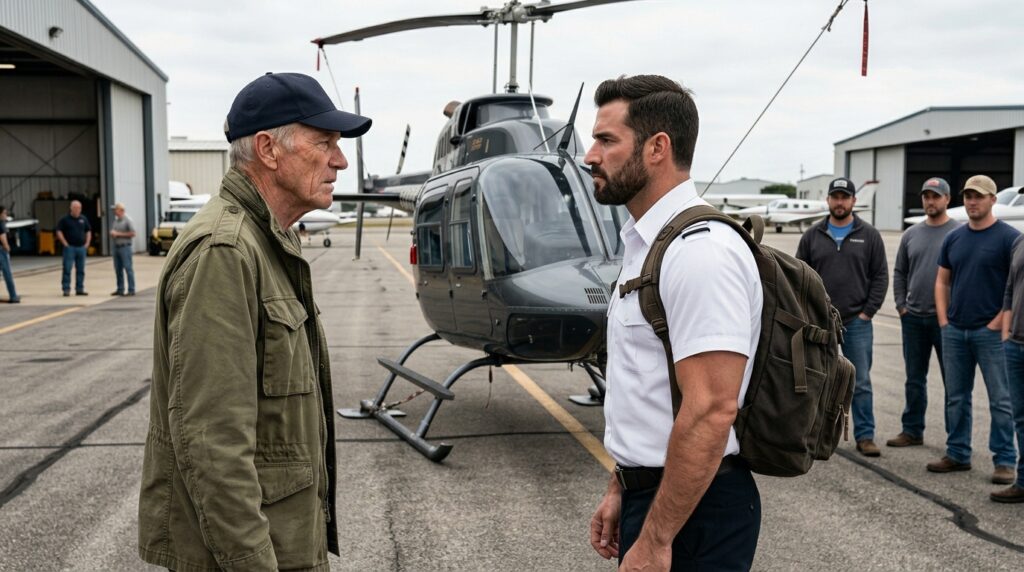
CHAPTER 2: THE LEVERAGE POINT
The old man didn’t pull back. Pulling back was an admission that the other man’s weight belonged where it was. Instead, he drove his right thumb directly into the soft gap between the contractor’s carpal bones—the small, unarmored valley just behind the reinforced composite knuckles of the glove. It was a precise, localized pressure, the kind learned in the hold of gray transport hulls where space was small and noise had to be kept to a minimum.
The contractor’s breath left him in a sharp, wet hiss. His fingers uncurled from the olive jacket like old iron cooling in water.
Before the younger man could calculate the failure of his grip, the old man pivoted his left heel into the concrete aggregate, his boot heel grinding a small circle of white dust into the tarmac. He didn’t lift his arms in a theatrical display of force. He simply dropped his center of gravity three inches, allowing the contractor’s forward momentum to slide off his shoulder like rain off a tin roof. With a short, tight rotation of his forearm, he cleared the lane entirely, stepping three inches into the younger man’s perimeter.
The contractor stumbled, his boots scraping heavily against the grit of the runway before his knees locked to find their balance. His heavy tactical backpack shifted with a dull clatter of plastic clips, the white uniform shirt wrinkling across his shoulder blades as his arms went wide to catch the air.
The old man stood exactly where he had ended the motion. The split leather ledger was still tucked against his side, his left fingers hooked into the binding. His breath didn’t rattle. His pulse stayed slow, a rhythmic tick against his jawline that had survived three separate desert deployments before the contractor had even learned to tie his first standard issue laces.
“You’ve got grease-pencil on your cuff,” the old man said, his gravelly voice flat against the thrum of the idling Bell 206. He pointed with his chin toward the younger man’s left wrist, where a faint purple mark crossed the starched fabric just above the watch line. “Sector Three logistics mark. Miller’s mark. Don’t tell me he’s not on the manifest when you’re carrying his ink.”
The contractor’s face went from the dark red of sudden exertion to a tight, gray pallor. His eyes dropped to his own wrist for a fraction of a second, his jaw clenching until the muscle beneath his trimmed beard twitched. He didn’t reach for his belt. The initial instinct to dominate through bulk had been replaced by something older and much more dangerous: caution. He looked at the old man’s cap, then at the stable, wide-rooted stance of the split-welt boots. The arrogance had drained out of his posture, leaving only the hard, professional posture of a man who had realized the parameters of the room had changed without his permission.
Behind them, the helicopter’s turbine whined higher, the blades cutting the high desert air into rhythmic, slicing thuds that kicked up tiny pebbles from the runway line. The heat shimmer between them grew thicker, smelling of hot hydraulic fluid and parched earth.
“You’re Miller’s hand,” the old man continued, his eyes remaining unblinking beneath the dark bill of his cap. “He always did like them big. Thought it kept people from looking at the numbers in the book. But you don’t know how to carry your weight on concrete. You’re all top, no foundation.”
The contractor let his arms drop slowly to his sides, his fingers no longer hooked. He took a single step back, not in retreat, but to re-establish the dynamic distance he should have kept from the beginning. His eyes remained fixed on the veteran’s hands, watching for the slightest shift in the leather folder.
“The manifest is locked from the tower,” the contractor said, his voice dropping an octave, the institutional clip gone from his delivery. It was the tone of one operator talking to another across a perimeter line. “I don’t look at the names. I look at the clearances. And your name isn’t on the gate log.”
“My name was on this concrete before they poured the topcoat,” the old man said. He lifted the ledger slightly, the cracked leather catching the harsh glare of the midday sun. “And Miller knows exactly what happens if this book stays out in the canyon after the three-o’clock bird leaves.”
The contractor looked from the ledger back to the old man’s weathered face. A mechanic across the tarmac dropped a heavy socket wrench, the metallic clank echoing off the side of the aluminum hangar like a rifle shot. Neither man flinched. The distance between them remained three feet—the exact range of a knife-hand strike or a short, liver-seeking thrust.
“The three-o’clock bird isn’t for corporate,” the contractor muttered, his eyes darting toward the cockpit silhouette where the pilot was adjusting the overhead toggles. “They told us it was a recovery run for the old ordnance dump.”
“They lied to you,” the old man said softly. “They wanted to make sure you’d stand here and take a punch for a pile of rusted iron. But this isn’t iron.”
He turned the ledger over in his hand, revealing a small, brass-rimmed eyelet set into the lower corner of the back cover—a naval classification marker that hadn’t been used since the old operations along the salt flats were closed down by executive order in eighty-four. The purple grease-pencil mark on the contractor’s cuff matched the faded violet ink stamped into the margin of the ledger’s first visible page.
The contractor took a deep breath, his chest gear rising and falling against his white shirt. He looked at the helicopter, then back at the veteran, his hand rising not to strike, but to touch the small communication bud hooked behind his ear. His fingers hovered over the plastic switch for three long seconds while the wind from the rotor blades began to pull at the collar of his uniform.
“Miller,” the contractor said into the small microphone, his eyes never leaving the old man’s face. “We have an anomaly at the Sector Four line. He’s holding the purple ledger.”
A long pause followed, filled only by the rising scream of the turbine. The contractor’s face tightened as the response came through the earplug, his shoulder blades dropping as the tension left them, replaced by a sudden, chilling clarity. He looked at the old man with a new kind of attention—the kind reserved for a ghost that had suddenly materialized on a live firing range.
“He wants you in the hangar,” the contractor said, dropping his hand from his headset. He stepped out of the physical lane, his body pivoting to clear the path toward the idling machine. “But he said to leave the cap outside.”
The old man didn’t move immediately. He looked down at the concrete between them, where the dust was swirling in the wind from the blades, then looked straight into the darker shadows of the open hangar bay forty yards away. A figure was standing there, just beyond the light line, hands behind its back.
“The cap stays on,” the old man said. He tucked the ledger deeper under his arm and stepped into the cleared lane, his boots clicking in a steady, unbroken rhythm against the hot stone.








