
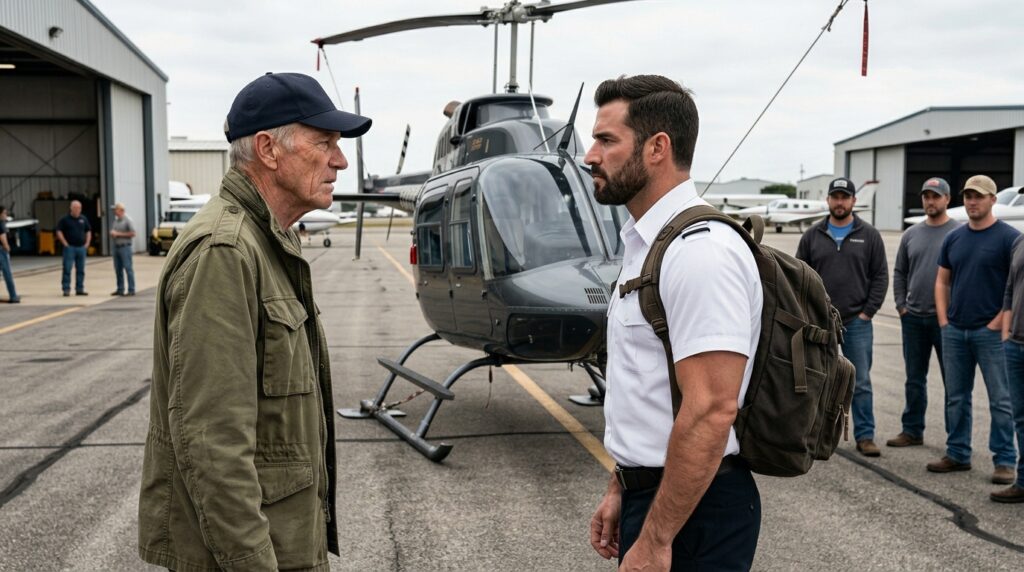
CHAPTER 8: THE LAST COMFORTABLE LIE
“Get out of the cab, Miller.”
Frank’s hand didn’t tremble as he reached across the split-vinyl bench. He didn’t pull the door latch again. He clamped his fingers onto the khaki sleeve of Miller’s flight jacket, his thumb pressing right into the old nerve line above the elbow until Miller’s boot fell away from the useless, dead clutch. The inline-six was still screaming beneath the lavender-painted hood, its ungreased bearings throwing off a hot, sulfurous stink that rose straight through the rusted rust-holes in the floorboards.
Through the dust-caked windshield, the two helmeted operatives came on at a slow, systematic march. Their boots didn’t scuff; they planted with the rhythmic, mathematical weight of men who had been paid by the hour out of the very account numbers tucked beneath Frank’s bicep. The carbine muzzles remained dead-level, tracking the center of the truck’s windshield where the spiderweb cracks converged.
Frank kicked his passenger door open, the hinge screaming as it tore away the remaining lower pin. He didn’t drop into the open space; he rolled low, using the heavy steel running board of the Dodge to break his fall against the slab. The concrete here was cold, buried in forty years of shade behind the massive timber frame supporting the rear wall.
“Frank!” Miller scrambled through the driver’s side, his boots hitting the aggregate with a dry, wooden clatter. He wasn’t looking at the guns; he was looking down at the concrete between the truck’s tires.
Frank didn’t look at the operatives either. He looked at the base of the timber frame.
There was a three-foot iron crowbar resting against the masonry anchor—the heavy, hexagonal tool he had used to check the structural bolts during the final inspection of eighty-four. It was rusted to a deep, dark orange, its prying edge pitted by ancient lime dust. He didn’t pick it up to swing it. He slid his hand down the rough iron shaft, his raw fingers absorbing the cold sting of the metal, and jammed the wedged tip directly into the split seam of the concrete directly below Miller’s tanker desk.
He didn’t pull back. He threw the whole weight of his hip against the iron.
The topcoat didn’t shatter; it peeled back in a long, dry slab of gray cement that had been poured over a hidden zinc sub-floor. With a sharp, metallic ring that cut through the roaring turbine thuds from the tarmac, the floor beneath the desk collapsed three inches. A heavy, iron-bound locker, stenciled with the same three-digit marker as the helicopter outside, rose an inch out of its subterranean cradle as the concrete shifted.
The lead operative stopped five paces from the front bumper. His ballistic visor tilted down, the red metrics on his wrist pad flickering back to life as the physical proximity to the locker triggered a local transponder ping.
“The logbook isn’t the archive,” Frank said, his gravelly voice rising from the floorboards like an unburied truth. He didn’t stand up. He remained on his knees, his right hand still locked onto the iron crowbar, his left forearm anchoring the leather ledger against the zinc rim. “The logbook was just the index for the boxes under the floor. The boxes we filled with the border clearance files before the executive order went live.”
Miller stood paralyzed against the lavender fender, his face completely bloodless beneath his cut-away flight jacket. He looked from Frank to the iron-bound locker, his teeth clicking together in a short, dry rhythm. “They… they weren’t clearing the titanium, Frank. They were looking for the coordinates we didn’t put in the book.”
“They already had the coordinates,” Frank said softly. He reached out with his thumb and pressed the brass-rimmed eyelet on the back of the ledger into a matching indentation on the locker’s locking plate. “They wanted to make sure the men who wrote them down stayed inside the valley when the lease expired.”
A heavy, dual-click echoed through the hollow steel base of the truck as the locker’s internal tumblers fell away. The lid didn’t swing open; it split down the middle, revealing three stacks of microfiche reels and a single, ungreased brass cylinder containing the original, unredacted border logs from seventy-nine. Stamped across the copper cap of the cylinder, in fresh, bright purple grease-pencil, was Miller’s personal signature.
The operative with the carbine didn’t fire. He lowered his muzzle two inches, his helmet visor tracking the motion of the brass cylinder.
“The transaction is complete,” the synthesized helmet voice reported, no longer sounding like a broadcast, but a final settlement. “The physical repository is verified. The loose assets are accounted for.”
Frank looked at Miller. He saw the way Miller’s fingers had closed tightly around the nickel-plated knife in his pocket—not to fight the men with the guns, but to keep the knife from falling onto the floor where the numbers could see it. The pragmatism hadn’t been an accident; Miller hadn’t been sold a decoy secret by the capital. He had been the one who sold the lease.
“You signed the reallocation three weeks ago,” Frank said, his voice flat, devoid of anger, carrying only the absolute weight of forty years of unwashed stone.
Miller didn’t look away from the brass cylinder. “They were going to open the files anyway, Frank. If the oversight committee found the canyon sheets, we wouldn’t have a fence to stand behind. I used the fund to ensure the bird came for us. Both of us.”
“The bird didn’t come for us,” Frank said. He let go of the iron crowbar. The tool stayed upright, wedged into the cracked concrete like a marker on a dry lake bed. “It came for the iron.”
The lead operative reached down, his gray Nomex glove lifting the brass cylinder from the zinc tray with a single, frictionless movement. He didn’t look at Frank; he didn’t look at Miller. He turned on his heel, his low-profile lugs catching the aggregate with perfect alignment as he marched back toward the blinding white glare of the threshold storm.
Behind him, the second visitor stepped backward, his carbine remaining at the low-ready until his flight suit disappeared into the thick curtain of gray silica dust.
The ancient inline-six engine beneath the Dodge’s hood gave a final, wet cough and died, leaving the interior of the hangar in a sudden, absolute silence that was broken only by the fading scream of the twin transport rotors lifting off from the tarmac line. The blue light from the foreman’s terminal didn’t come back on. The room stayed gray, desaturated, the color of old masonry left out in the wind after the money had gone down the road.
Frank stood up slowly, his split-welt boots making a short, dry scrape against the zinc rim of the empty locker. He pulled the dark veteran cap lower over his eyes, tucking the split leather ledger back beneath his olive sleeve. He didn’t look at Miller, who still leaned against the lavender primer of the dead truck, his hands empty, his nickel knife clicked shut inside his pocket.
The lane was clear. The gate was open. But there was nothing left to guard.








