
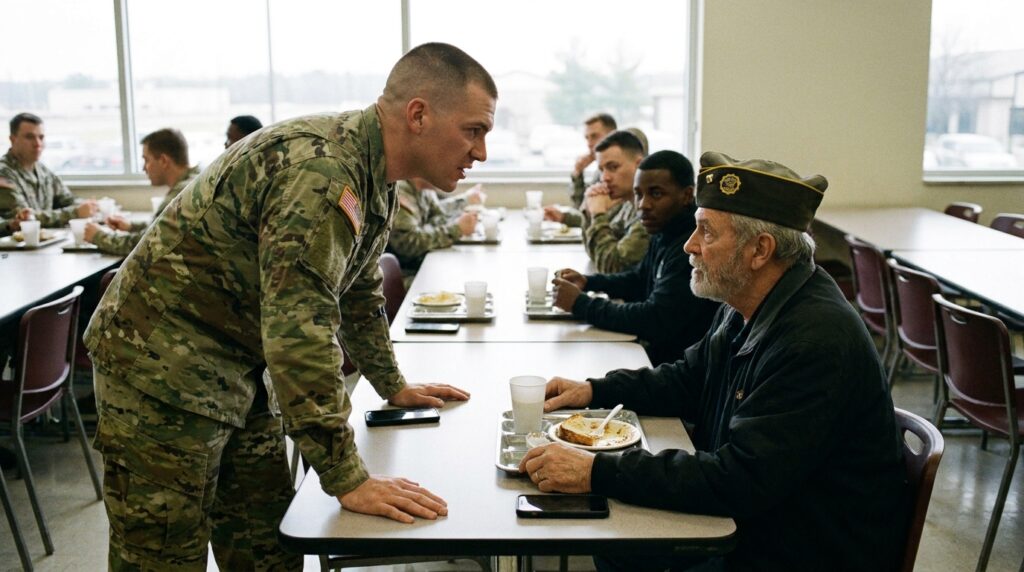
The Cold Leverage of a Forgotten Man Who Refused to Break Under Modern Arrogance
CHAPTER 1: CALCULATED SILENCE
“You think you can sit here and ignore me, old man?”
The words cut clean through the dull roar of the base cafeteria, sharp and loaded with the cheap grease of a twenty-year-old’s bravado. Specialist Miller didn’t move his hand from the laminate edge of the table. He leaned lower, his broad shoulders stretching the stiff fabric of his digital camouflage uniform, intentionally casting a shadow over the plastic tray where the soft, gray light of the midday fluorescent tubes died. He smelled of cold sweat, starch, and the aggressive certainty of an active-duty deployment order.
I didn’t answer. I didn’t shift my spine against the hard contour of the plastic chair.
My fingers remained loosely curled around the small brass ring of my keychain inside my jacket pocket, my thumb pressing the small, blunt edge of the P-38 can opener. It was a grounding point—a piece of cold metal older than the kid’s father. Across the surface of the Formica table, my lunch tray sat perfectly centered: a lukewarm bowl of institutional chili, two slices of white bread, and a small carton of milk. Miller’s shadow covered the bread.
Around us, the low clatter of silverware and the high-pitched drone of younger trainees arguing about physical training scores began to drop off, table by table. The silence rippled outward from our corner like grease on water. They were watching. In an active military facility, the uniform is a legal skin, and Miller’s skin was brand new, stiffly pressed, and backed by the immediate authority of the current command. Mine was a faded dark canvas jacket and a black structured cap with three rows of tarnished silver thread across the peak. To the room, I looked like an inventory error. A ghost that had wandered through the main gate because the security guard was too tired to check an expired blue card.
Miller took another half-inch of my space. His knuckles turned white against the table’s edge. “I asked you a question. This section is reserved for the active transit rotation. You want to stare at the wall, you do it out by the bus line.”
He wanted a flinch. He wanted the dry, rattling cough of an old man apologizing for taking up air. I watched the pulse point ticking just beneath his close-cropped jawline—too fast, shallow, driven by the cheap adrenaline of an easy target. He hadn’t seen a trench. He hadn’t seen the iron floor of a transport vehicle buckle upward from a pressure plate. He was simply a heavy weight trying to lean into an unyielding corner.
My lungs drew in the dry, recirculated air of the facility, steady and deep. My forearms flatlined against the cold lip of the table, my palms sliding beneath the underside of the heavy composite board, feeling for the iron welds where the frame met the pedestal. The center of mass was right under the chili bowl.
“You’re in my lane, son,” I said. My voice didn’t have the volume of the drill field, but it had the gravel of thirty winters on concrete.
Miller’s mouth twitched, a small, ugly smirk forming at the corner of his lips as he prepares to reach for the edge of my tray. He thought the conversation was still a game of rank. He thought the table between us was a permanent boundary.
Underneath the laminate, my fingers locked into the cold steel groove of the support bar.

CHAPTER 2: THE UPENDED AXIS
The iron welds underneath the laminate didn’t give way; they became a lever. I didn’t pull back—I drove my hips forward, using the rigid frame of the plastic chair as a brace, and slammed the palms of my hands upward into the steel ribs of the pedestal.
Physics is a clean, unblinking ledger. When a hundred and eighty pounds of modern muscle leans sixty percent of its mass over a counterweight, it doesn’t take a miracle to tip the scale. It takes four inches of pure vertical torque.
The heavy composite top exploded upward.
Miller’s smirk wasn’t even gone before the front edge of the table caught him beneath the low curve of his breastplate. The sound was a dull, hollow thud—the impact of wood-grain laminate meeting a tactical vest filled with synthetic fiber and small ceramic inserts. His white knuckles lost their grip on the rim, his fingers slipping across the polished surface as his center of gravity was violently deleted.
The single meal tray pinned near my left forearm went airborne first. The small carton of milk burst against the metal zipper of his uniform, a white streak cutting through the digital camouflage pattern before the heavy ceramic bowl of chili followed it, splashing dark, thick grease across his throat and the sharp line of his collar.
But the table didn’t stop at his chest. I kept my weight behind the lift, my boots digging into the salt-stained linoleum floor until the pedestal cleared its vertical axis. The entire structure went over like a collapsing bulkheads. Trays, plastic cups, and cheap metal forks cascaded outward, clattering against the concrete floor like a handful of gravel thrown into a turbine.
Miller didn’t fall clean. His athletic frame tried to compensate—his boots skittered back, his heels catching the edge of a plastic gear bag left by one of the trainees behind him. He went down hard, his spine hitting the lower crossbar of an adjacent row of seats before his shoulders met the floor. The sound of his descent was loud, wet, and thoroughly public.
The cafeteria stopped breathing.
The drone of three hundred voices—the arguments about physical training scores, the logistics of the third-shift motor pool, the casual laughter of people who thought they were safe behind military wire—shattered into absolute, vacuum-sealed silence. Somewhere near the tray return line, a plastic cup rolled across the floor, its rhythmic clack-clack-clack the only clock left running in the room.
I didn’t stand up. I remained right where I was, my spine settled into the contours of the plastic seat, my hands returning to my thighs. My right hand slid back into the canvas pocket of my jacket, my thumb finding the notched edge of the brass P-38 can opener on my keychain. My breath was slow, a single, deliberate draw through my nose that didn’t rattle.
Miller lay in the center of the debris field. The modern digital pattern of his uniform was ruined—soaked through with lukewarm brown grease and the dripping white film of the base-commissary dairy. His buzz cut was dusted with crumbs from the white bread. For three seconds, his eyes were wide, staring up at the white-hot glare of the fluorescent tubes overhead as if trying to locate the mortar tube that had just registered his coordinates.
Then the shock turned into something narrow and dark. His jaw tightened, the veins in his thick neck bulging against the wet collar of his jacket as his palms flat-lined against the floor to push his weight back up. He was a specialist. He had two years in the division and a physical fitness badge on his chest, and he had just been put on his back by a man whose retirement papers were older than his enlistment contract.
“You old son of a—”
“You should have left well enough alone, son,” I said.
The words didn’t carry the weight of a shout. They didn’t need to. In that specific kind of quiet—the kind that settles over a platoon when the first trip-flare goes off in the wire—a whisper carries better than a command. My voice was a dead level, stripped of any anger, stripped of any defensive heat. It was the tone of an inspector marking an unserviceable vehicle for the scrap heap.
Miller froze, his elbows locked half-way through his rise. His eyes met mine across the ruined space where the table had been. He was looking for the senile confusion he’d tried to exploit two minutes ago. He was looking for the trembling fingers of an old-timer who had wandered off the civilian bus line.
He didn’t find them. He found thirty years of concrete. He found the unblinking, gray focus of a man who had cleared supply lines through Hue when the current active-duty command was still in elementary school.
Beneath the wet camouflage fabric of his right shoulder, a small, dark red stain was beginning to spread—not from the chili, but from a sharp, metallic edge beneath the table’s edge that had caught his sleeve during the flip. A tiny, square piece of paper had dislodged from the interior pocket of his tactical vest during the tumble, its white corner sticking out from beneath a crushed plastic cup near his left boot. It was an official printout, bearing the gray watermarked seal of the Department of the Army, and the top line of the text contained a single word in bold stenciled print: MOVEMENT.
Miller’s eyes flicked down to the paper, then back up to my face. The unearned arrogance in his expression was completely gone, replaced by the sudden, sickening realization that every single person in the room—including three junior lieutenants from his own battalion—was currently recording the exact measurement of his failure.
His mouth moved, but the volume was gone. His boots scraped against the linoleum as he gathered his legs under him, his hands rising slightly in a short, defensive gesture that didn’t look like a soldier preparing for a fight. It looked like an apology.
CHAPTER 3: THE YIELDED LANE
The tactical vest did not possess an defense against gravity. Specialist Miller remained frozen on his side for three full beats of the wall clock, his breathing rattling against the floorboards like a loose belt in an engine block. The pool of spilled commissary milk was already graying as it drew the fine dust of the linoleum into its margins, creating an oil-slick halo around his modern boots.
“All right,” he muttered. The unearned brass in his voice had vanished, replaced by the thin, flat tone of a man who had suddenly found the edge of a cliff in the dark. “All right, I get it.”
He didn’t look at the junior lieutenants from his battalion who were backed against the beverage dispensers. He didn’t look at the thirty trainees whose plastic forks were suspended mid-air like rows of small teeth. His focus was locked entirely on my right sleeve, tracking the slow, unhurried rhythm of my arm as it settled back onto my knee. He was looking for the twitch—the residual vibration that remains in a muscle after an amateur throws an unauthorized strike.
He didn’t see one. A proper lever doesn’t shake after the weight is moved; it simply returns to the shelf.
I leaned slightly forward, the stiff canvas of my jacket creaking in the silence. The scent of the spilled chili was sharp, heavy with iron and old salt, rising from the broken composite board between us. “Pick up your trash, Specialist.”
My delivery didn’t rise to meet the cavernous ceiling of the hall. It stayed down in the grease with him, cold and level.
Miller’s left palm skidded once on the wet floor before he found his purchase against the leg of an adjacent bench. He dragged his athletic frame upward, his boots making a soft, sucking sound as he cleared the mess. The arrogance had been thoroughly scraped from his posture, replaced by a rigid, mechanical haste. He didn’t look me in the eye as he bent down, his fingers catching the corner of the watermarked stenciled paper—the movement tracking order—that had slipped from his protective vest. His thumb deliberately covered the bold stenciled word at the top, folding the sheet twice into a tight, hard square before stuffing it deep into his lower cargo pocket.
The room didn’t thaw. The three hundred men and women in the facility remained pinned to their positions, their attention focused on the slow, heavy cadence of Miller’s retreat. He didn’t salvage his gear bag; he left the olive-drab nylon strap tangled under the frame of the neighboring table, stepping backward into the blue-tinted shadows near the exit doors with his chin tucked into his collar. He was a small man now, regardless of the athletic build or the modern digital pattern on his chest. He had been measured against an older scale, and the deficit was visible to every private in the room.
My fingers remained inside my pocket, resting against the key ring. The small brass P-38 was warm from my body heat, the notch of its tiny blade smooth under my index finger.
The immediate threat had vanished through the double doors, but the air in the cafeteria remained heavy, charged with the subtext of an unresolved intrusion. I could feel the eyes of the civilian contractors at the far counter—men who wore the gray utility uniforms of the base maintenance crew—shifting from the overturned pedestal to the old unit patch sewn onto the right shoulder of my canvas jacket. They knew the three rows of silver thread on my cap weren’t surplus store acquisitions. They knew what kind of outfit used that specific weight of iron for its field equipment forty years ago.
A door behind the serving line clicked open, the sound of an iron latch dropping into place. The smell of floor cleaner and institutional bleach began to slide across the room, cutting through the heavy grease of the chili.
I didn’t turn my head to track the sound. In my line, you don’t look for the next move with your eyes first; you listen for the change in the room’s resonance. The soft, rhythmic click of low-quarter leather shoes—not tactical boots—was moving down the center aisle from the administrative corridor. It wasn’t the stride of a trainee or a clerk. The spacing of the heels was exact, measured, and perfectly timed to a standard forty-inch regulation step.
I reached out with my left hand and drew the single untouched item from the debris near my boot: the small, white carton of commissary milk. It was cold, the cardboard damp with sweat, the seal unbroken. I set it on the edge of the adjacent bench, my thumb tracing the square blue stamp on the top flap. The expiration date was listed as June 1986—an old stock code from the reserve vaults that the base supply system still used for its non-perishable distribution lines.
The leather shoes stopped exactly two paces from the edge of my ruined station. A pair of pressed trousers, dark blue with a gold officer’s stripe running down the seam, entered my peripheral vision. The fabric was immaculate, free of the red clay dust that coated every active-duty boot on the base.
“Sir,” a voice said from above the blue trousers. It was a clean, dry cadence, the tone of a man who spent his mornings reviewing asset ledgers rather than drilling platoons in the heat. “The commanding general has been informed that your blue identification card was logged at the main gate two hours ago. We’ve been waiting for you in the logistics office.”
I looked up. The man standing there was a colonel, his silver eagles catching the harsh overhead light like small, cold mirrors. His face was pale, lined with the specific exhaustion of a staff officer who had spent the last twenty-four hours trying to reconcile a missing freight manifest before the inspection teams arrived from Washington. Behind him, two master sergeants stood with their hands clasped behind their backs, their eyes fixed not on the overturned table, but on the small brass keys protruding from my jacket pocket.
“The transit line is running behind schedule, Colonel,” I said. My hand didn’t move from the milk carton. “I was told the cafeteria was the only station with an open ledger.”
The colonel didn’t look at the three junior lieutenants who were still frozen near the beverage bar. He didn’t acknowledge the mess or the grease that was slowly seeping into the grain of the linoleum. He simply reached into his leather briefcase and pulled out a thin, manila folder secured with a length of red security tape.
“The ledger isn’t open anymore, sir,” the colonel said, his voice dropping into a tight, transactional murmur that didn’t travel past the edge of my bench. “The deployment schedules for the Ninth Battalion were altered at midnight. The coordinates Miller had in his vest—they aren’t active. We need the old logs from the transit vault. The ones you took with you when the regiment was deactivated.”
He held the folder out, the red tape catching the blue reflection of the cafeteria window. The room remained perfectly quiet, but the silence had changed its color. It wasn’t about a young soldier’s arrogance anymore. It was about the weight of what was buried underneath the concrete of the base perimeter.
CHAPTER 4: THE INSTITUTIONAL SHIFT
“The Ninth Battalion doesn’t move without a clear manifest, Colonel.”
I didn’t reach for the manila folder. My left hand remained draped over the edge of the adjacent bench, one finger pinned to the cold, wet rim of the milk carton. The red security tape across the folder’s flap was thick, the kind that left a structural diamond pattern behind if someone tried to dissolve the adhesive with a heated razor.
The colonel didn’t lower his arm. His silver eagles remained perfectly level, catching the blue reflection of the cafeteria window like two small, cold eyes. Behind his shoulder, the elder of the two master sergeants shifted his boots, the leather creaking against the unwashed linoleum. The sergeant wasn’t looking at the folder or at his superior officer. His gaze was fixed on the peak of my cap, tracing the tarnished silver thread with the narrow, calculating focus of a man who spent his life measuring the distance between an order and an execution.
“The Ninth isn’t moving under standard logistics anymore,” the colonel said. His tone was clipped, the syllables dry and short. He took one step closer, his thigh pressing against the edge of the upended pedestal, his pristine trousers instantly catching a smear of red chili grease. He didn’t blink. He didn’t look down at the stain. “We have forty-eight hours before the tracking network goes active at the perimeter gate. If the transit vaults aren’t verified by an officer with prior clearance, the entire manifest drops into the gray lane.”
“Then let it drop,” I said. My thumb slid down the side of the cardboard milk carton, leaving a clean trail through the condensation. “The gray lane is where the old regiment kept its errors anyway. Your people shouldn’t be digging around the foundation.”
A sharp intake of breath came from one of the junior lieutenants near the beverage bar. To a three-month officer, speaking to a colonel without a formal preface was a court-martial offense; to me, it was simply an exchange between two men who knew exactly how many tons of concrete it took to hide a bad logistics report.
The older master sergeant finally broke his stance. He took a single, heavy stride forward, his hand rising to touch the colonel’s elbow—a gesture that broke every rule in the manual, yet went completely unpunished. He leaned into the narrow space between the staff officer and my bench, his shoulder blocking the view of the remaining trainees who were still watching from the middle rows.
“Sir,” the sergeant said. He wasn’t addressing the colonel. He was looking at the small brass key ring protruding from my canvas jacket pocket. “He isn’t from the transit pool. Look at the patch on the collar line, Colonel. That’s the old Seventh Supply Depot. The ones who ran the logistics for the classified storage before the eighty-six drawdown.”
The colonel’s arm went rigid. His eyes flicked from my face down to the faded olive-drab canvas beneath my chin, where the small, blackened brass pins of a long-deactivated supply command were tucked into the wool lining. The metal was pitted, ruined by decades of damp air and basement storage, but the outline—the crossed keys beneath an anvil—was still readable to anyone who had studied the institutional history of the base.
“The Seventh was erased from the ledger forty years ago,” the colonel whispered.
“The paper was erased,” I corrected him. My voice remained low, a dead level that stayed below the hum of the fluorescent lights. “The concrete didn’t go anywhere. You built the modern cafeteria right over the top of the old ventilation shafts. I can hear the air hum under my boots every time the motor pool starts their trucks.”
The master sergeant didn’t answer. He slowly brought his right hand up to his brow, his fingers locking into a rigid, textbook salute that had nothing to do with the current base administration. It was a salute for the dead unit—the one that had held the line when the supply chain failed during the winter of seventy-four.
The three junior lieutenants near the beverage dispenser went pale. The spectacle of a master sergeant with thirty years of service stripes saluting an old man in a stained canvas jacket was a complete inversion of everything the base manual taught them about the nature of authority.
“Drop your hand, Sergeant,” I said, my thumb still tracing the cold cardboard of the milk carton. “I don’t have a ledger for you to sign.”
The sergeant lowered his arm, his fingers curling into a tight fist against his seam. “The specialist didn’t know who he was crowding, Colonel. He’s with the new rotation. They think anything without an electronic bar code doesn’t exist.”
“The specialist is an idiot,” the colonel said, his voice sharpening as he finally withdrew the manila folder and tucked it back beneath his arm. He looked at the three junior officers, his expression turning cold. “Clear this room. Every trainee on this shift is to be logged at their barracks within ten minutes. If I see a single phone out of a pocket, the entire company stays on the wash rack until the deployment order expires.”
The room moved instantly. The silence broke into a frantic, mechanical scuffle as the trainees gathered their gear bags and backed toward the exits, their eyes darting back toward my seat as if trying to memorize the silhouette of an unclassified weapon. Within ninety seconds, the only sounds left in the cavernous hall were the low, rhythmic clank of the tray return line and the slow, wet dripping of the milk from the upended table onto the floor cleaner below.
The colonel turned back to me, his pale face tight under the glare. “We’re going to the back office, sir. And you’re bringing those keys.”
CHAPTER 5: THE PRIVATE RECKONING
“Throw your papers on the steel, old man. Let’s see what kind of ghost we let through the gate.”
The colonel didn’t drop his leather briefcase onto the desk; he placed it precisely parallel to the modular gray partitioning. The back office of the logistics center smelled of fifty years of carbon copies, dead air, and the specific bitter tang of a heating unit that hadn’t been cleaned since the Panama mobilization. A single industrial desk, fabricated from olive-drab sheet metal with zinc-plated corners, occupied the dead center of the room beneath a caged inspection lamp.
I didn’t reach for my pocket immediately. I stood by the doorframe, my boots planted on the exposed concrete where the green floor enamel had long since flaked away into fine dust. “The gate guards check what they’re paid to check, Colonel. A blue card doesn’t expire in the system just because the names on the list get short.”
“Your card didn’t just flag a gate log,” the colonel said, his fingers working the brass tumblers of his briefcase locks with three sharp, rhythmic clicks. He swung the lid up, revealing the manila folder with the red security tape resting alongside a stack of modern digital manifests. “It triggered a silent alert in the command network. The Seventh Supply Depot hasn’t had an authorized signature in the active routing registry since the winter of nineteen eighty-six. Every logistics lane we’re currently spooling up for the Ninth Battalion’s transit is pulling structural data from a ledger that shouldn’t exist.”
The older master sergeant stayed by the door, his shoulder pressed against the painted cinder block wall. His arms were crossed, his broad chest tightening the fabric of his service shirt until the silver thread on his long-service stripes gleamed under the zinc lamp. His gray eyes stayed locked on my right pocket. He knew what the weight of three brass keys sounded like when they hit an iron desk.
I pulled my hand from the canvas pocket, the key ring clicking against the zinc surface as I let it slide across the green lacquer. The small brass P-38 can opener spun once, its dull edge catching the light before pointing like a compass needle toward the colonel’s briefcase. Beside it lay my old service identification—the laminated paper brittle, the edges yellowed and frayed, bearing the stamp of the long-deactivated Seventh Supply Depot.
The colonel didn’t touch the keys. He picked up the faded identification card by its plastic corner, squinting through his low-profile reading glasses at the ink signature across the bottom.
“Forty years,” the colonel muttered, his voice dropping into a flat, transactional drone. “According to the archival purge, the subterranean vaults under the maintenance bays were cleared and backfilled with gravel when the old regiment dissolved. But the current electrical draw on the lower sub-station says otherwise. Someone is maintaining the terminal links down there. The logs are still updating.”
“Gravel doesn’t stop a data line if the conduit was wrapped in lead,” I said. My voice was low, carrying the hard edge of a man who had personally poured the concrete over the main junction boxes in seventy-six. “Your modern engineers think everything runs on a glass wire through the air. They don’t know how to look for a three-inch iron pipe buried twelve feet deep under the motor pool.”
The master sergeant shifted his weight, his leather shoes scraping the flaked floor enamel. “I told you, sir. The old guard didn’t use electronic clearance codes. If you wanted into the storage grid, you needed the physical registry. The specialist thought he was dealing with a civilian loiterer because he doesn’t understand that the infrastructure under his boots is older than the division.”
“The specialist is currently being written out of the deployment manifest,” the colonel said, his jaw tightening as he slid the manila folder across the zinc desk toward me. The red security tape had been sliced clean with a desk knife, its edges curling like dead skin. “Look at the coordinate grid on page three. That’s the target zone for the Ninth’s vehicle staging next week. The staging area is designated as Area K-Fourteen.”
I didn’t open the folder. I didn’t need to. The designation K-Fourteen hit my ears with the physical weight of a closing steel bulkhead. It was the exact coordinate of the remote valley where my old recovery team had been deployed during the final month of the eighty-six drawdown—the location where four hundred tons of unclassified equipment had vanished from the system during a forty-eight-hour communications blackout.
“Area K-Fourteen isn’t a staging zone, Colonel,” I said, my palms settling onto the cold edge of the zinc desk, feeling the faint, deep vibration of the sub-floor transformers humming beneath the building’s foundation. “It’s a burial ground. If you send the Ninth’s heavy armor into that valley, the ground isn’t going to hold the weight.”
The colonel leaned over the desk, his eyes narrowing into two sharp points of gray light behind his lenses. “The modern geological scans say the bedrock is stable, sir. The engineers cleared it last Tuesday.”
“The modern scans are reading the top sixty feet of shale,” I countered, my thumb tapping the brass ring of my keychain. “They aren’t reading the three tiers of reinforced storage vaults we built out of surplus steel plating after the treaty was signed. Layer One is the decoy—your people think it’s an old cold-war fuel bunker. But if you break that seal to set up your radar arrays, you’re going to drop twenty-four active-duty vehicles straight into the true baseline.”
The room went completely silent again, the air thickening with the sudden realization that the conflict in the cafeteria wasn’t a random dispute over a seat. The young specialist’s movement orders were a direct line into an ancient, structural trap—and the only man who held the physical index to the baseline was currently sitting under their inspection lamp.
The master sergeant stepped away from the door, his hand rising toward the small, triple-notched silver rivet that held the backing of the office security safe against the wall. His fingers didn’t touch the metal; they hovered there, his face turning pale as he noticed a faint, fresh scratch across the lacquer of the vault door—the signature mark of an unredacted logbook that had been moved within the last twenty-four hours.
CHAPTER 6: THE FRACTURED MANIFEST
The colonel’s finger didn’t move from the crisp edge of the manila folder. It stayed there, pressed tight against the cheap fiber, while the dull, subterranean thump of a heavy-vehicle engine filtered up through the floorboards, causing the zinc lamp above us to cast a series of short, shivering shadows across the stenciled map.
“Area K-Fourteen was cleared by the core engineering staff,” he repeated, but the clipped cadence of his delivery had dropped a fraction. His silver eagles didn’t catch the light with the same cold authority; they looked small, gray, and heavy under the yellow glare of the cage lamp. “The satellite metrics show nothing but limestone shelving down to eighty feet.”
“Scans don’t log what isn’t registered in the active server,” I said. I reached out, my thick index finger pinning the lower corner of the deployment sheet. My skin was dark against the paper, rough with old grease scars that had turned into hard white ridges over forty winters. “Look at the western margin of your grid. See that purple ink smudge along the coordinates? That’s not a printing error. That’s a manual override mark from the eighty-six drawdown. It means the tier beneath that shelf was sealed under an emergency command mandate.”
The master sergeant stepped forward, his boots making no sound on the flaking lacquer this time. He didn’t look at the colonel for permission. He reached down and drew a small, silver mechanical pencil from his pocket, using the blunt metal tip to trace a line across the stenciled grid where the purple ink had blurred.
“He’s right, sir,” the sergeant whispered. His voice had the dry, rattling texture of paper left in an ammunition box. “Look at the variance in the contour lines. The elevation drops six inches every forty yards along the old drainage line. Scans wouldn’t flag that as structural failure—they’d read it as natural erosion. But if you park an entire armored company on top of that slope, the friction alone will shear the vertical retaining wall we poured during the drawdown.”
The colonel’s mouth opened, then snapped shut into a thin, white line. He pulled the tracking sheet toward himself, his glasses slipping down the bridge of his nose as he scanned the old override marks. He wasn’t looking at a tactical problem anymore; he was looking at an institutional collapse. If the ground gave way beneath twenty-four Stryker vehicles, the logistics failure wouldn’t just stay in the valley—it would destroy the entire deployment schedule for the European transit corridor.
“Why wasn’t this entered into the master registry when the depot was deactivated?” the colonel asked. His eyes were wide behind his lenses, looking at me as if I had personally dug the hole under his feet.
“Because the regiment didn’t want your people finding what was stored in Tier Three,” I said, my hands returning to my thighs, my spine remaining perfectly straight against the doorframe. “You think we left empty boxes down there? We buried the unredacted logbooks because the division command in eighty-six was running the exact same supply-chain circle you’re trying to spin up today. They were billing the department for fuel that didn’t exist, and they used Area K-Fourteen to balance the inventory.”
The colonel’s breath became shallow, a soft hiss through his teeth. He looked down at the manila folder, his fingers trembling slightly as he realized the decoy secret—the idea that the valley was just a forgotten cold-war fuel bunker—was completely dead. The reality was a structural lie that went all the way down to the base’s financial marrow.
“This manifest has already been signed off by the oversight board in Washington,” the colonel said, his voice dropping so low it barely cleared the edge of the zinc desk. “If I halt the rotation now based on an unverified logbook from an unclassified veteran, the entire command group is going to come down on this office before the morning shift.”
“Then don’t halt it,” I said, my thumb brushing the tiny blade of the brass P-38 in my pocket. “Let them roll the first two trucks onto the shelf. Let them watch the front axles drop six inches into the sod when the concrete underneath starts to crack. Once they see the hydraulic fluid leaking into the limestone, they’ll stop the line themselves.”
The master sergeant let out a short, grim laugh that sounded like dry gravel shifting under a boot. “They won’t get the recovery vehicles in there fast enough to save the gear, sir. If that retaining wall sheers, the whole valley turns into a funnel. We’ll lose the manifest and the transponders in the same hour.”
He turned back toward the wall safe, his hand finally dropping onto the cold iron locking bars. His gray eyes were dark, filled with the sudden, heavy realization that the base command hadn’t been tracking my blue card to protect a secret repository. They had been tracking it because they were terrified that someone from the old Seventh would walk into the light before the deployment could clear the perimeter gate.
The room grew colder as the sub-floor transformers beneath us took on a high, whistling pitch—the signal that the motor pool on the far side of the base was beginning to spin up the heavy transport engines for the evening rehearsal. The shadows on the wall lengthened, cutting across the colonel’s pale face until he looked like just another ghost waiting for his papers to be cleared.
“We have twelve hours before the first vehicle enters the approach lane,” the colonel said, his fingers locking into a fist against the manila folder. “If you don’t give us the index codes for the Tier Three vault locks, we can’t reinforce the shelf from underneath.”
“The codes aren’t on paper, Colonel,” I said, moving my boots away from the doorframe as I took my first step toward the desk. “And they aren’t in a computer. If you want those vaults opened before the concrete shears, you’re going to have to walk down into the ditch with me.”







