
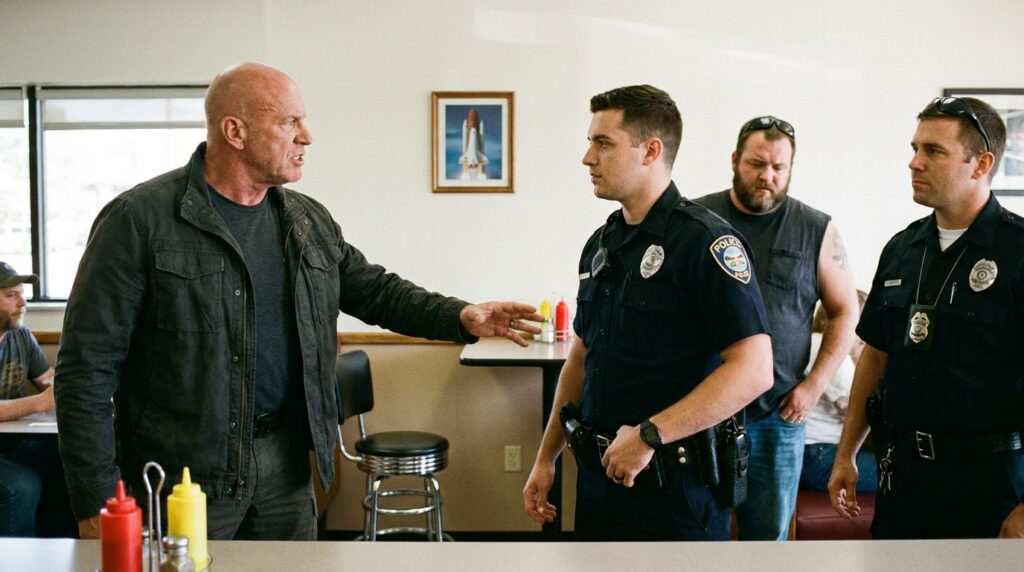
The Iron Rusts but the Edge Remains Razor Sharp Against the Ignorance of Youth
CHAPTER 1: THE TASTE OF DECK LUBRICANT
The grease on the Formica table had the same rancid, industrial tang as the grease on a littoral combat ship three hundred miles off the coast of nowhere. It clung to the small valleys of the faux-wood grain, resisting the yellow rags of the mess attendants. He sat with his palms flat against the laminate, letting the steady, high-frequency hum of the ventilation fans vibrate through his thumb joints.
A shadow cut the glare from the overhead fluorescent tubes. It wasn’t the fluid, soft-footed shadow of someone who had cleared rooms in the dark; it was the heavy, flat-heeled stomp of a modern infantryman who believed his body armor made him invisible to gravity.
“Hey look,” a voice muttered from behind, thick with the wet, unearned confidence of a second-enlistment private who spent his weekends filming for an audience of digital ghosts. “Some civilian wandered into the wrong house. Let’s see how tough he is when he gets wet.”
The water hit him with the force of an unsealed hydraulic line. It was grey, lukewarm, and tasted faintly of pine-scented industrial floor stripper. It filled his collar instantly, turning the heavy cotton of his gray T-shirt into a cold, leaden weight that glued itself to his shoulder blades. The room—a cavernous, desaturated expanse of stainless-steel warming trays, scuffed vinyl tile, and plastic pitchers of powdered lemonade—dropped into a greasy, expectant silence.
Fork tines stopped scraping against aluminum trays. Somewhere down the row, a cheap smartphone camera lens gave a tiny, metallic click as it switched to high-definition video mode.
He didn’t twitch. He didn’t wipe the gray moisture from his eyelashes. His gaze remained fixed on his plastic tray, where his personal history had been reduced to a single laminated civilian access pass and a blue-inked DD-214 form, both now bubbling under three ounces of dirty water. His thumb shifted exactly three millimeters to the left, touching the serrated bezel of his stainless-steel watch. It ticked against his skin—a cold, rhythmic scratching that had survived two separate mortar fragments in Helmand.
“Get up, old man,” the uniform said. The private was leaning in now, his camouflage fatigues smelling of fresh laundry detergent and stale energy drinks. A young hand, thick-knuckled and unscarred, reached out toward the veteran’s shoulder, intending to rotate him for the camera’s benefit. “You’re in the wrong seat.”
The veteran rose. He didn’t jump; he simply allowed his spine to straighten along its natural axis, his weight sinking into the heels of his boots until his center was lower than the young soldier’s ribs. When the private’s palm made contact with the gray cotton, the veteran didn’t strike back. He merely turned his torso twenty degrees to the left, pocketing the private’s extending wrist between his forearm and his ribcage.
It was a small, dusty movement—the kind used by men who had to control uncooperative human weight inside the narrow, rusted confines of a broken transport vehicle.
The private’s balance vanished into the space where the veteran’s shoulder had been a microsecond before. The young soldier’s boots slid across the soapy film on the floor tiles, his knees buckling as the veteran applied a three-pound downward leverage onto the radius bone of his right wrist. There was no theatrical display of force—just the simple, unyielding physics of a machine that had been oiled too many times.
The private hit the deck with a hollow, wet thud that vibrated through the legs of the adjacent benches. The blue bucket clattered against the iron base of a stanchion, spinning until it came to rest between them.
The veteran stood over him, his gray T-shirt dripping dirty water onto the private’s clean, starched chest. The silence in the mess hall was absolute now, thick with the smell of scorched gravy and the sudden, sharp realization that the rules of the room had changed.
The veteran looked down at the wide, pale eyes of the active-duty soldier, his own face as flat and expressionless as a stone wall in winter. From the wet folder on his tray, a piece of official red-tinted paper began to float to the surface, its bold black lettering spelling out a single word: RESTRICTED.

CHAPTER 2: THE ANGLE OF THE COLLAR
“Get your hands where I can see them,” the private groaned from the floor. The cockiness was entirely gone, replaced by the thready, defensive wheeze of a man who had forgotten that concrete didn’t respect a starched camouflage collar. His boots kicked out blindly, scuffing against the rusted iron bases of the fixed dining stools, searching for leverage he had thrown away the moment he initiated the shove.
The veteran didn’t drop his hands into a fighting guard. He left them hanging loose at his hips, palms open, fingers curved slightly like old iron hooks. The dirty water from the bucket was already cooling against his chest, turning the gray fabric of his shirt into a stiff, salt-rimed shell that smelled of the base’s ancient boiler pipes.
“You’re down,” the veteran said, his voice flat, retaining the level cadence of an instructor monitoring a dull mechanical repetition. “Stay there until you understand where your weight went.”
Around them, the perimeter of the mess hall seemed to contract. The clatter of aluminum forks against divided trays had entirely ceased, replaced by the low, multi-layered rustle of two hundred bodies shifting simultaneously against vinyl cushions. A pair of junior corporals near the tray-return window slowly lowered their phones, their thumbs hovering over screens that were still recording the damp, grey stain spreading across the private’s starched chest. The illusion of the viral prank had cracked, leaving behind only the cold, unyielding reality of an unauthorized physical displacement on a secure installation.
The veteran turned his back on the fallen soldier. It wasn’t a gesture of contempt; it was a calculated assessment of threat priority. The private on the deck was no longer a factor, but the three young men who had been holding the camera phones at the end of the table were already stepping into the gap between the benches. Their faces had hardened into that particular, aggressive brand of tribal defensiveness that occurs when a unit’s collective pride is punctured in front of outsiders.
“He’s a civilian,” one of them said, his fingers twitching toward the heavy nylon webbing of his empty utility belt. “Hey! You don’t lay hands on an active-duty soldier in this house. Who the hell authorized your gate pass?”
The veteran didn’t answer. He reached down toward the puddle on his Formica table, his thick fingers bypassing his dead smartphone to pick up the wet, manila folder that contained his transition documents. The water had already soaked through the cardboard, turning the corners into grey pulp. As he lifted it, the laminate cover peeled back, exposing the topmost sheet—a heavy, non-standard stock paper dominated by a violent, red-inked stamp that ran diagonally across his name.
The first word of the stamp was clear: RESTRICTED. But beneath it, the standard identification prefixes—the codes that usually designated an ordinary medical discharge or an administrative separation—were replaced by an irregular sequence of alphanumeric characters that ended in a double zero.
The corporal who had spoken stepped closer, his eyes dropping to the wet paper in the veteran’s hand. For a fraction of a second, his aggressive posture faltered, his gaze sticking to that irregular red seal. On a standard base, every clerk and gate guard knew the shapes of ordinary bureaucracy by heart. They knew the blue stamps of finance, the black ink of medical, and the green seals of logistics. They did not know this specific shade of red—the deep, iron-oxide hue that looked less like ink and more like dried blood on old machinery.
“That’s a lock-out notice,” the corporal muttered, his voice losing its confrontational edge, replaced by the narrow, suspicious focus of a guard who had just spotted an unlisted vehicle at the perimeter fence. “That’s a Department of Defense administrative exclusion. You’re barred from the installation.”
“The folder stays closed,” the veteran said, his hand flattening over the paper, his thumb covering the irregular double-zero prefix. The skin of his palm was rough, crosshatched with the small, pale lines of old rope burns and chemical blisters that didn’t match the clean, unblemished record of a standard administrative clerk.
The private on the floor was finally scrambling to his feet, his breath coming in ragged, humiliated gasps as he wiped the pine-scented floor water from his face. His right sleeve was dark and saturated where it had taken the brunt of the redirection, the fabric clinging to his forearm in a way that revealed the slight tremor in his muscles. He looked at his comrades, then at the veteran, his mouth twisting into a tight, defensive line as his pride struggled against the cold physical metric of the floor.
“He’s a fraud,” the private spat, his voice rising to carry across the silent rows of tables. “He’s got no rank. He’s got no unit patch. Look at him—he’s a trespasser trying to play tough because he picked up some defensive tactics at a strip-mall gym. Call the MP shack. Get this piece of garbage off our deck.”
The veteran didn’t look at the private. He looked past him, toward the heavy double doors at the rear of the dining facility. Through the wired safety glass of the portals, a pair of white-painted security vehicles had already pulled onto the gravel apron outside, their red and blue strobe lights casting long, desaturated pulses through the grease-filmed windows of the mess hall. The tires crunched against the dry gravel, a sound that the veteran’s ears registered three seconds before anyone else in the room shifted their gaze.
He picked up his olive-drab baseball cap from the bench, shaking the loose droplets from the brim before pulling it low over his eyes. The wet fabric was cold against his forehead, but his face remained entirely stationary, his mind already mapping the three corridors between the dining facility and the provost marshal’s office. He knew the weight of the handcuffs they would use; he knew the specific iron smell of the holding cells near the back gate. To him, it wasn’t a disaster—it was simply the next necessary friction in a sequence that had been set in motion the moment his retirement order had been stamped with the wrong ink.
“Keep your hands away from the folder,” the veteran murmured to the corporal who was still staring at the red stamp.
The heavy doors at the back of the room swung open with a sharp, metallic rattle, and the first pair of black-booted security personnel stepped into the grey light of the kitchen lane.
CHAPTER 3: THE WEIGHT OF THE RESTRAINT
The corridor walls were painted that standard federal seafoam green, but the salt air from the coast had blistered the plaster near the baseboards, leaving white, powdery trails of mineral rot that looked like dried bone. The young security officer didn’t look at the veteran. He kept his hand steady on the reinforced nylon handle of his baton, his boots squeaking rhythmically on the desaturated linoleum floor.
“Keep moving,” the officer said, his breath hitching slightly every time their shoulders neared the narrow, cold iron pipes of the fire suppression line. “Left at the bulkhead.”
The veteran didn’t answer. He adjusted his grip on the wet manila folder, his fingers tracing the disintegrating seam where the moisture had eaten through the cheap paper. The cold pine-scented floor stripper from the mess hall had begun to dry on his skin, leaving a stiff, irritating residue that felt like fine sand ground into his collar. He didn’t check his watch, but the internal cadence—the sixty-cycle hum of his blood that had kept him alive through seven non-permissive border crossings—told him they were moving away from the standard processing sectors. They were descending into the basement levels of the old administrative block, where the masonry was reinforced with iron plating from the late fifties.
The security officer pulled out an electronic log pad to clear the door locks, but when he swiped his credential, the screen flickered a dull, unformatted amber. The veteran’s eyes dipped to the glass interface. There was no base entry log. No routing number. The device was pulling raw encrypted telemetry directly from a non-standard subnet, bypass-coding the entire base provost marshal’s network.
“The order on that sheet,” the veteran said, his voice flat, matching the dull scrape of his boots on the concrete stairwell. “It didn’t come through the garrison clerk.”
“Shut up,” the officer snapped, though his fingers fumbled with the key override, his skin pale against the matte black composite of the lock casing. “You don’t ask questions about flag codes. You broke the perimeter restriction. That’s all the paperwork needs to say.”
A secondary guard, older, with the thick neck and broken nose of a career master-at-arms, stepped out from the shadows of the lower landing. He smelled of cold tobacco and the pungent, sulfurous grease used to clean heavy-caliber machine guns. He didn’t draw a weapon, but his eyes went straight to the veteran’s wrists, evaluating the distance between the civilian’s thumbs and the seams of his jeans.
“This the one from the dining facility?” the older guard asked, his voice a low, gravelly rasp that sounded like gravel shifting under a tank tread.
“The civilian who dropped Private Miller,” the young officer said, handing over the wet, red-stamped folder. “He’s carrying a level-four lockout order. Gate security missed the flag when he checked in at zero-six-hundred.”
The older guard took the paper, his rough thumb splitting the remaining fiber of the folder until the crimson-inked RESTRICTED block was fully visible under the yellow cage light of the stairwell. He didn’t look angry; he looked tired, his eyes narrowing as he read the specific paragraph code beneath the signature line. He reached out and tapped the edge of the sheet against the iron railing, leaving a small streak of red ink on the rusted metal.
“Miller is an idiot,” the older guard muttered, turning his back to lead them down a narrower corridor where the air grew heavy with the scent of damp wool and basement mold. “But this paper doesn’t exist in the local system. I ran the name when the gate alarm chimed. The terminal didn’t give me an infraction log. It just gave me a blank screen and a routing number for an annex in Alexandria.”
“It’s a DOD administrative bar,” the young officer insisted, his voice rising slightly, the thin bravado of his rank wearing thin against the heavy silence of the lower deck. “The signature is validated by the regional commander’s office.”
The veteran stopped walking. The young officer shoved his shoulder, but it was like pushing against an anchor chain; the veteran’s weight didn’t shift an inch. He turned his face slightly toward the older guard, his eyes shadowed by the brim of his olive cap.
“The private in the mess hall,” the veteran said, his words dropping into the space between them like heavy iron weights. “He had a non-standard brass clasp on his load-bearing vest. No serial number. Clean finish. That’s not garrison gear.”
The older guard paused, his hand on the heavy iron latch of the interrogation cell door. He looked at the veteran for three long seconds, his jaw tightening until the old scar across his chin turned white. He didn’t answer the question, but his fingers gripped the red-stamped paper a little harder, the wet paper tearing further under his callused palm.
“In the room,” the older guard said, gesturing toward the dark, unpainted concrete cubicle ahead. “The provost marshal’s investigator is already on his way down from the main terminal. He can look at your watch, he can look at your shirt, and he can decide if you’re a trespasser or a ghost. Move.”
The door groaned as it swung open, revealing a single steel table bolted to the deck and two matching chairs that showed the pitted, oxidized tracks of decades of salt-air corrosion. The veteran walked in, his wet clothes heavy against his skin, his mind already calculating the structural load of the iron hinges behind him.
CHAPTER 4: THE GRIND OF THE INTERROGATION
The legs of the steel chair didn’t have rubber tips. When the man in the charcoal civilian suit pulled the seat away from the bolted iron table, the raw metal ground against the grit of the concrete floor, generating a high, thin screech that hung in the corners of the small basement room.
The veteran sat motionless, his wet denim jeans cold against his thighs, his hands restfully clasped on his lap. He didn’t look up immediately. He watched the small puddle of grey mess-hall water that had dripped from his olive cap slowly collect in a shallow depression in the floor.
The investigator sat down, placing a black leather folder on the iron surface. He wasn’t dressed like a base provost marshal. His suit was dark, durable, and unadorned, lacking the typical security badge, name tape, or credential clip common to installation authorities. His fingers were thin and dry, the skin around the nails split into small, white fissures from long exposure to industrial air conditioning.
“The signature on this restriction notice belongs to a regional coordinator who retired thirty-six months ago,” the investigator said. His voice was low, rhythmic, and deadened by the thick, unpainted masonry walls. He pulled the sodden manila sheet from the leather folder, flattening it out against the cold iron table with the back of his hand. “You’ve been carrying this in your jacket pocket for six hours. You checked through the commercial transit lane at the north gate with it.”
“I was told to bring it to the clearing clerk,” the veteran said. His tone remained perfectly flat, matching the mechanical thrum of a large electrical transformer buried somewhere behind the reinforced concrete bulkhead.
“The clearing clerk doesn’t handle restricted flag codes,” the investigator replied. He leaned forward, his torso casting a sharp, hard shadow across the wet document. He didn’t reach for a weapon, but his shoulder muscles remained locked under the charcoal wool of his jacket, an analytical posture that expected a counter-movement at any given millisecond. “You were flagged because your service identification number triggered a total systemic lockout on the garrison mainframe. The terminal at the gate didn’t just tell the guards to turn you around. It locked the terminal screen and sent an encrypted diagnostic burst to an unlisted facility in northern Virginia. Why are you on this base?”
“My medical retirement signature logs are missing two quarterly verifications,” the veteran said. He shifted his thumb slightly, his rough skin catching on the serrated bezel of his steel watch. It ticked under his sleeve—a dry, metallic scrape. “If the signatures aren’t manually entered by a command sergeant major before the end of the fiscal period, the transition allowance freezes. I have a house thirty miles west of the wire that requires an irrigation pump replacement. I need the allowance.”
The investigator didn’t blink. He reached down and opened his leather folder further, revealing a secondary sheet of clean, dry paper that didn’t come from the veteran’s wet manila packet. It was a printout of the dining hall’s surveillance log, captured less than forty minutes prior.
“You dropped Private Miller with a three-pound downward leverage on the radius bone,” the investigator said, pointing to the pixelated image of the camouflage uniform hitting the concrete benches. “The base record says you were a logistics clerk at an ordnance depot in Georgia before your medical separation. A logistics clerk doesn’t redirect a seventy-pound forward rush without lifting his heels off the floor. They don’t trap a wrist-lock inside their own ribcage to prevent a secondary strike.”
“He was slippery,” the veteran murmured. He looked at the investigator’s lapel. The fabric showed two small, pierced holes where an official identification pin had been violently ripped away rather than unclipped, leaving fraying threads of gray synthetic thread. “The floor cleaner has a heavy pine oil base. Anyone would have lost their footing if they pushed too hard.”
“Miller isn’t a regular garrison private,” the investigator said, his voice dropping an octave, the anti-expository weight of his words crowding the narrow space between them. “He belongs to a specialized test detachment currently operating out of the eastern hangars. The gear he wears doesn’t pass through the base quartermaster. The serial numbers on his load-bearing clasps are ground down because the manufacturer is restricted under a maritime technology treaty.”
The veteran remained silent. He didn’t defend his action, nor did he look away from the red-inked RESTRICTED notice sitting between them like a small patch of dried blood on the iron table. He knew exactly what Private Miller was; he had seen the same serial-stripped brass clasps on the vests of seventy-two dead men outside a compound in the western valley of the Helmand three winters ago.
“You’re going to stay in this room until the regional office confirms who generated this administrative cover,” the investigator said, closing the leather folder with a soft, definitive snap. “Because right now, the local system says you don’t exist, your unit doesn’t exist, and the man who signed your discharge died in a helicopter crash over the Persian Gulf six years ago. You aren’t just a civilian contractor who wandered into a mess hall, soldier. You’re an administrative error that someone spent a lot of money trying to bury.”
The investigator rose, the iron chair scraping again as he pushed it back into the shadows of the concrete bulkhead. He didn’t call for the guards, but as he reached the heavy iron door latch, the overhead fluorescent tube gave a loud, violent pop, the light flickering once before dying completely, leaving the room plunged into the desaturated, gray dusk of the basement’s backup generator circuit.
CHAPTER 5: THE COLD SILENCE OF THE CELL
The dark didn’t come all at once. It leaked out from the dead corners of the cell like soot from an old furnace, clinging to the exposed iron conduits and the cold, unpainted cinder blocks. The rhythmic hum of the basement transformer died with a dry, metallic rattle, followed by the high, sizzling snap of failing copper filaments in the overhead security assembly.
The veteran didn’t lift his head. He sat in the low-wattage amber glow of the emergency circuit, his eyes fixed on the wet manila folder where the red-stamped administrative lock-out order was beginning to curl at the corners. The dampness had turned the high-density paper into something soft and gray, resembling a wet bandage scraped from an old wound.
The investigator didn’t move either. His shadow remained pinned across the iron table, static and sharp, his thin hand still resting near the edge of his leather folder. The lack of an identification clip on his dark lapel seemed more deliberate now—not a detail left behind in a hurry, but a blank space where an identity had been stripped away by an industrial machine that didn’t tolerate records.
“The backup loop isn’t routing through the garrison command,” the investigator said. His voice was a thin, dry scratch in the deadened air of the basement. He didn’t reach for his electronic pad; the screen had gone black, its battery cell failing the moment the secondary terminal dropped its connection. “A standard transformer failure at this level triggers a secondary line from the hangar substation within four seconds. It’s been twenty.”
“The hangars are running an unlisted diagnostic loop,” the veteran said. His voice didn’t carry the resonance of a man locked in a concrete vault. It was low, mechanical, and heavy, like iron links dropping into an anchor locker. “If the terminal drops below twelve volts, the primary memory core in the administrative block overrides its own cache. It doesn’t look for an local operator. It purges the registry.”
The investigator leaned down, his face entirely gray under the faint amber light. “How do you know the voltage protocol for a restricted garrison terminal?”
“I built the foundation codes for the logistics bunker at Fort Meade twelve winters ago,” the veteran murmured. He turned his wrist exactly four millimeters, letting the scuffed steel bezel of his watch brush against the iron edge of the table. The internal ticking continued—a dry, rhythmic scraping that didn’t care about the darkness or the failing circuits. “Before the unit was deactivated. Before the name tape was removed from the logs.”
The heavy iron door latch gave a sharp, unlubricated groan. It wasn’t the clean, mechanical click of a guard clearing a pass code; it was the slow, dragging scrape of a crowbar or a heavy security key being turned against frozen brass tumblers. The door opened three inches, revealing a vertical slice of the desaturated corridor outside. The older guard with the broken nose was standing there, but he wasn’t holding his baton. His hand was pressed flat against his utility belt, his fingers hooked around the retaining strap of his service sidearm.
“The terminal room went dark,” the older guard said, his voice a low, gravelly vibration that barely reached the table. “The main console didn’t throw an error log. It threw an automated administrative override code from nineteen-eighty-four. A code from the old project at the salt flats.”
The investigator stood up, his chair grinding hard against the concrete floor tile, leaving a white, powdery track in the gray dust. “Get the auxiliary light from the watch station. Secure the upper landing.”
“The upper landing is already locked,” the guard replied, his jaw tightening until the old scar across his chin puckered into a hard, pale knot. “The garrison clerks were cleared out of the building ten minutes ago by order of the installation commander. There’s an armored vehicle sitting on the apron outside the main gate. No unit markings. No base pass. Just a red clearance card on the dashboard.”
The veteran reached out and touched the wet piece of paper sitting between them. The red ink of the RESTRICTED stamp had dissolved completely, bleeding across the page until the word LOCK-OUT looked like a thick, dark smudge across his service number.
The decoy secret was breaking. The administrative order wasn’t an exile from a local command for a misconduct charge; it was a physical barrier designed to keep him in a low-priority processing cell until a specific vehicle arrived to collect the pieces of an old operation that the base records couldn’t account for. The young private in the mess hall, with his serial-stripped gear, hadn’t been an arrogant kid filming a viral video; he had been the physical anchor to ensure the veteran stayed in one spot until the lights went out.
“They aren’t coming for the private,” the veteran said softly, his fingers flattening the wet paper until the cold iron of the table showed through the tears. He stood up, his height filling the narrow space under the low concrete ceiling, his muscular frame silhouetted by the faint amber glow of the failing backup line. “They’re coming for the log cache from the western valley. And they think the file is still inside this folder.”
The investigator stepped back into the shadows of the bulkhead, his dry hands tightening into hard, pale fists. He didn’t call the guards, but his eyes stayed fixed on the veteran’s scuffed steel watch, realizing too late that the man in the gray T-shirt hadn’t been trapped by the garrison—he had been waiting for the installation to isolate itself.
CHAPTER 6: THE COMMAND OF THE ASHES
“Clear the threshold, Private,” a voice commanded from the dark.
It wasn’t the investigator’s sharp, thin bark, nor was it the gravelly rasp of the older guard. It was a cold, dense weight that flattened the remaining noise in the corridor instantly. The heavy iron door didn’t just open; it was thrown back against the masonry with a blunt, metallic crack that sent flecks of rusted scale down into the grey water on the floor.
The Base Command Sergeant Major stepped into the cell. He didn’t carry a flashlight, and he wasn’t accompanied by a security detail. He was a broad, iron-jawed man whose standard camouflage fatigues looked like they had been scrubbed with wire brushes until the patterns were faded to an oil-stained gray. On his right hand, a massive silver ring caught the dull amber light of the emergency circuit; the insignia engraved on its surface had been ground down until only the jagged outline of a broken arrow remained—the unlisted mark of a unit that had been deleted from the federal ledger before the turn of the decade.
The investigator stepped back into the corner, his suit jacket scraping against the unpainted concrete. “Sergeant Major, this cell is under an active regional flag restriction. You don’t have authorization to clear this space.”
“I own the concrete on this installation, civilian,” the Command Sergeant Major said. He didn’t look at the investigator. He walked directly to the iron table, his heavy leather boots crunching on the wet scraps of the manila folder. He reached down, took a stainless-steel lighter from his utility pocket, and flicked the wheel. A steady, blue-yellow flame illuminated the deep, pitted lines around his jaw.
He didn’t hesitate. He held the flame to the corner of the wet, red-stamped administrative lock-out notice.
The wet paper hissed, then caught, the fire burning slow and thick through the chemical pulp until the crimson-inked RESTRICTED block began to blacken and curl into grease-slicked ash. The Sergeant Major dropped the burning document into a shallow iron tray bolted to the deck, watching the flames consume the registration number that had flagged the veteran at the gate six hours ago.
“The lock-out order is a dummy link,” the Sergeant Major said, his eyes reflecting the small fire in the tray as the paper reduced to black flakes. “The garrison clerks think it’s a disciplinary bar because the registry system is built to lie to anyone who doesn’t carry a tier-1 credential. It keeps the local provost marshal from asking why an ordnance clerk has a retirement signature block that requires a departmental sign-off.”
The veteran remained standing, his posture straight, his thumbs hooked loosely in the pockets of his wet jeans. His scuffed steel watch ticked against his skin—a cold, mechanical scratch. “The private in the mess hall was carrying a regional tracking array in his vest clasp. They knew the signature file wasn’t at Fort Meade.”
“They knew it was coming here to be archived,” the Sergeant Major replied. He reached into his pocket, pulled out a fresh, dry signature card made of heavy gray polymer, and laid it flat on the iron table where the wet folder had been. “The unit in the western valley didn’t leave a paper trail, but the transition log requires a physical hand-off before the system clears the medical allowance. If you don’t sign this card, the state says you were never in the valley. It says the ninety-two men who didn’t come back were never on the transport manifest.”
The investigator stepped out from the shadow of the bulkhead, his dry fingers reaching toward his leather folder. “Sergeant Major, that document contains non-garrison metadata. If that card is signed outside the presence of a regional coordinator, the entire registry in Alexandria throws a systemic alert.”
“The registry in Alexandria is currently burning its own drive arrays,” the Sergeant Major said, his voice flat, devoid of theatricality. “The armored vehicle at the main gate isn’t from the regional coordinator’s office. It’s an unflagged transport from the technology division. They’ve been waiting at the perimeter fence since the transformer dropped its load.”
The veteran looked down at the gray polymer card. The fields for rank, unit, and location were entirely blank, replaced by a sixteen-character hexadecimal string that matched the tracking sequence engraved on the back of his scuffed steel watch. The decoy secret had broken completely—there was no misconduct charge, no administrative error, and no civilian transition protocol. His entire medical retirement process was a controlled isolation mechanism designed to pull him out of the civilian population and trap his physical signature in a basement vault before the records of the western deployment could be permanently erased by the division.
“The pump on my irrigation system is broken,” the veteran said softly, his thumb touching the serrated edge of his watch bezel. “The allowance is four thousand dollars short.”
“The allowance doesn’t exist,” the Sergeant Major said, handing him a heavy, unpolished iron pen from his utility pocket. “The money comes from an unlisted account in Delaware, and it stops the moment the signature is registered in the vault. If you sign this card, you aren’t clearing your retirement, soldier. You’re signing the burial detail for the unit.”
The door to the cell rattled again, the iron hinges groaning as a heavy vibration shook the concrete floor from the corridor above. The smell of burning lithium batteries began to drift down through the ventilation slats—the distinct, acrid odor of a data terminal being platform-purged by an automated chemical fire block.
CHAPTER 7: THE BREAKING OF THE STONE
The iron door didn’t open cleanly. The older master-at-arms kicked it back against the masonry, his thick boot heel leaving a black scuff on the wet seafoam-green plaster. He dragged Private Miller into the amber dusk of the basement cell by the starched collar of his camouflage fatigues, forcing the young soldier down onto the rusted bench with a heavy, single-handed shove that sent the boy’s knees buckling against the concrete deck.
Miller didn’t have his blue maintenance bucket anymore. His uniform was still damp, but the smug, clout-chasing grin he had carried across the dining facility forty minutes ago had been completely erased, replaced by the pale, hyperventilating sweat of a junior enlisted man who had suddenly realized he had stepped across an invisible baseline into a dark room where the regulations didn’t apply. His tactical vest was gone, but his chest showed the pristine, unmarred fabric where a set of standard-issue ribbons had been pinned—their cold metallic edges sharp, straight, and completely free of the field dust that accumulated on an actual operational uniform.
The veteran didn’t change his position. He sat with his hands flat on the iron table, the scuffed steel bezel of his watch scratching against the zinc plating. The gray polymer signature card lay between his palms, its blank hexadecimal string catching the low flicker of the emergency light.
“Look at him, Private,” the Base Command Sergeant Major commanded, his voice a low, heavy iron bar dropping into the silent room. He didn’t point a finger; his sheer proximity to the bench seemed to push Miller’s chin upward by force of gravity alone. “You wanted a civilian target for your phone camera. You wanted to show your friends how an active warrior handles an outsider who doesn’t belong in your mess hall. Look at the man’s wrists.”
Miller’s gaze flicked down, his chest heaving under his wet shirt. He didn’t see the scars immediately—only the rough, thickened skin around the veteran’s thumbs where heavy plastic flex-cuffs had been tightened to the bone during twenty-four hours of interrogation behind an abandoned water treatment facility outside Kandahar.
“He’s listed as an ordnance clerk, Sergeant Major,” the investigator muttered from the dark corner, his charcoal suit jacket smelling of the electrical soot drifting down through the ventilation slats. His dry hands were tucked into his pockets, but his shoulders remained locked in that hyper-analytical posture. “The garrison registry validates the medical discharge under a standard logistics tier. If he doesn’t sign that card, the regional commander’s office is legally required to flag the base for an unlisted civilian presence.”
“The regional commander’s office doesn’t know the coordinates of the valley,” the Sergeant Major said, his silver ring glinting as he rested his broad palm on the back of the iron chair. The broken-arrow engraving was black with carbon soot from the burned manila folder. “And neither does this boy. Miller, who gave you the blue bucket?”
The private’s jaw worked, but no sound came out—just a dry, subvocal click of his teeth against his lip. He looked at the investigator, then back at the veteran’s immovable gray T-shirt, his eyes wide and trembling.
“The maintenance supervisor,” Miller finally whispered, his voice thin and cracking like dry pine twigs under a boot. “The civilian clerk at the hangar annex. He told me there was an unverified contractor eating at the active tables. He said it would look good on the unit thread if we smoked him out before the noon formation. He gave me twenty dollars to buy the bucket from the exchange.”
“The maintenance supervisor at the hangar annex died three weeks ago in an engine fire at the salt flats,” the older guard rasping from the landing, his fingers still hooked around the retaining strap of his service sidearm. “The terminal log shows an access request under his credential at zero-five-hundred this morning, but the terminal wasn’t in the hangar. It was an unlisted satellite uplink routed through the technology vehicle outside the perimeter fence.”
The veteran reached down and picked up the heavy, unpolished iron pen the Sergeant Major had provided. The cold metal felt familiar—the exact same weight as the tool he had used to clear the chamber of a jammed squad automatic weapon while the transport vehicle burned around him in the dark. He didn’t look at Miller with anger; he didn’t look at him with empathy. He viewed the private the same way he viewed a rusted, stripped bolt on a piece of field gear: an inefficiency that had to be accounted for before the system could be moved.
“If I sign the card,” the veteran said, his words dropping into the small room with the slow, mechanical cadence of a clock ticking toward zero. “The ninety-two names are locked in the vault. The transition allowance stays short by four thousand dollars. The pump stays broken.”
“If you don’t sign it,” the Sergeant Major replied, his blue-yellow lighter flame dying as he closed the casing with a soft, definitive click. “The technology division uses the tracking array in Miller’s gear to clear the entire building. They don’t need a signature if there’s no one left in the room to claim the registry. The vehicle outside isn’t waiting for a piece of paper, soldier. It’s waiting for the light to turn green.”
The concrete floor beneath their boots shuddered again, followed by the heavy, muffled thud of a low-frequency sonic breach from the upper security gates—the unmistakable sound of a high-pressure pneumatic cutter tearing through the main facility locks.
CHAPTER 8: THE HORIZON OF THE DUSTY GRAY
The concrete didn’t hold. When the high-pressure pneumatic cutter at the upper bulkhead finished its final rotation, the reinforced steel door frame tore free from the masonry with a high, crystalline shriek that vibrated through the iron table legs and up into the soles of the veteran’s boots. White, chalky dust pulverized by the kinetic breach cascaded through the ventilation slats, turning the amber emergency dusk into a thick, desaturated fog that smelled of ancient cement and dry earth.
The veteran didn’t flinch. Time dilated down into a slow, mechanical crawl, each tick of his scuffed steel watch scratching against his skin with the absolute weight of an operational countdown. He didn’t sign the gray polymer card. Instead, his thumb pressed down firmly on the cap of the heavy iron pen the Command Sergeant Major had given him.
The pen didn’t click. It gave a minute, internal hiss as a pressurized thermite filament within the casing ignited, instantly melting the internal chamber. He dropped the tool directly onto the center of the grey card. The polymer flared white-hot, sizzling against the zinc plating of the table as the sixteen-character hexadecimal string—the last physical link to the ninety-two men left in the western valley—turned into a silent, blackened puddle of liquid carbon.
The investigator lunged forward from the corner, his dry hands extending toward the table, but the Command Sergeant Major moved his broad shoulder exactly three inches to the left, blocking the civilian’s path with the density of an armored bulkhead.
“The cache is cold,” the Sergeant Major said. His voice was a flat, unyielding rumble that didn’t register the chaos above. He reached out, took the veteran by the shoulder of his damp gray shirt, and pulled him toward the narrow secondary egress hatch behind the old transformer housing. “The registry is empty, soldier. Move.”
The veteran didn’t look back at Private Miller, who was curled on the floor with his hands covering his ears, or at the investigator, whose face had gone completely hollow as the gray smoke filled the cell. He stepped through the iron hatch into the unlit utility corridor, his wet denim heavy against his skin, his mind operating with the cold, pragmatic survival logic that had outlasted every uniform he had ever been assigned.
The corridor ran narrow and rough, choked with rusted water pipes and the oily condensation of old turbine lines. They moved fast, their boots crunching on dropped industrial washers and bits of deteriorated drywall until the salt air of the coast began to replace the sulfurous tang of the burning circuits. At the end of the line, a heavy iron grate opened onto the eastern perimeter fence, where the desaturated twilight of the coastal flats stretched out toward the gray horizon.
An unmarked transport vehicle was idling sixty yards past the wire, its diesel exhaust rising in dark, rhythmic plumes against the desaturated sky. But it wasn’t the technology division’s interceptor; the red clearance card on its dashboard had been replaced by a simple, hand-written logistics manifest carrying a standard garrison stamp.
The Sergeant Major stopped at the threshold of the wire, his broad hand dropping from the veteran’s shoulder. The silver ring on his finger was dark with soot, the broken-arrow engraving completely filled with gray ash.
“The transition allowance won’t show up on the automated ledger tomorrow,” the Sergeant Major said, his jaw tightening until the old scar turned bone-white against his skin. “The division will spend the next seventy-two hours auditing the terminal fire. But the regional clerk’s office in the valley has a manual petty-cash voucher for the irrigation pump. It’s sitting in a gray metal box under the counter at the county line.”
The veteran nodded once. He pulled his damp tactical baseball cap low over his eyes, shielding his face from the cold wind that was beginning to blow in from the salt marshes. “The pump takes a two-inch pipe thread. Standard iron.”
“The uniform doesn’t make the man, Private,” the veteran murmured to the empty air behind him, quoting his own cold truth as he stepped through the breached chain-link wire into the open sand. “The discipline does.”
He walked away from the base, his heavy boots sinking into the dry, grimy earth of the flats. Behind him, the administrative block remained dark, its green paint flaking under the salt breeze, a rusted monument to an unacknowledged history that had been buried so deep the soil itself had forgotten the weight of the bodies. His scuffed steel watch continued to tick against his wrist—a steady, unpitying pulse that didn’t care about the labels on a manila folder or the red ink of a restriction notice. The iron had rusted, the unit was gone, but the edge remained razor-sharp against the gray horizon.







