
The Cold Geometry of Steel and Silence Whispering from a Forgotten Frontier

CHAPTER 1: THE COLD GEOMETRY OF PERIMETERS

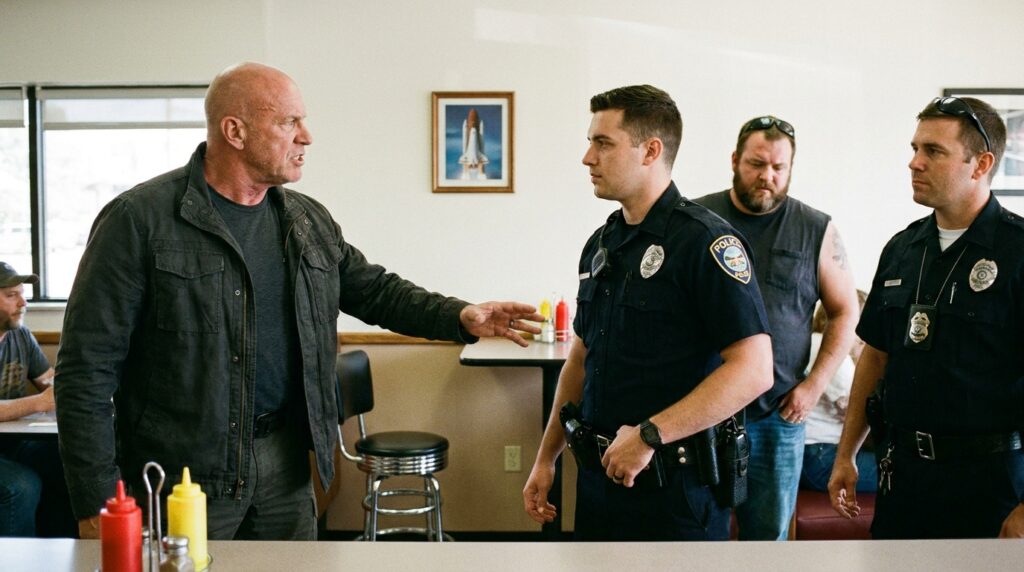
The air inside the museum tavern tasted faintly of pressurized grease, stale draft beer, and the cold, metallic ozone bleeding down from the rafters where the massive replica of the shuttle wing hung suspended. Marcus kept his back to the brick pillar, his fingers lightly resting against the scratched bezel of his watch. The dial was dead, the tritium paint long since decayed into a useless gray paste, but the mechanical ticking remained a steady vibration against his wrist. He didn’t need to look at it to know the contact was four minutes late.

To his left, the bar counter stretched out like an iron-faced shoreline, slicked with spilled liquor and cluttered with glass condiment bottles that caught the low, orange glow of the hanging industrial lights. The tavern was loud—a dense, American chorus of clinking glass, high-status laughter, and the sharp, territorial posture of people who believed their money bought them safety.

Then the shadow cut off the light.

The bouncer was wide, pushing thirty-eight with a beard trimmed to make his jawline look sharper than the soft flesh beneath allowed. His dark, sleeveless shirt exposed arms covered in faded tribal ink, the muscles corded but loose—the build of a man who relied on weight rather than speed. He closed the distance until he was within sixteen inches of Marcus’s chest, his boots clicking heavily against the concrete floor.

“You’re standing in the wrong sector, old man,” the bouncer said, his voice dropping into a performative growl meant for the nearby diners at the counter. He slammed his palm onto the wood right next to Marcus’s hip, his bulk crowding the narrow lane between the bar stools. “This section is reserved for the private reception. You don’t have a wristband. Move.”

Marcus observed the man’s stance. The bouncer’s weight was shifted entirely to his front foot, his chin exposed, his balance completely compromised by his own arrogance. It was an amateur’s leverage, designed to intimidate civilians who feared the mere proximity of mass. Marcus kept his hands low, his fingers curled loosely near the pockets of his dark tactical jacket. He didn’t speak. In the field, speech was noise, and noise was a signature.

“I stood there,” Marcus said softly, his voice dry, level, and entirely devoid of the defensive tremor the bouncer was waiting for. “Because the exit lane is clear from here. I don’t need a wristband to read a fire path.”

The bouncer’s eyes narrowed, a flash of genuine irritation replacing the professional mask. He didn’t like the lack of blinking. He didn’t like the way Marcus’s shoulders remained perfectly squared, unyielding against the brick. The younger man took a half-step closer, his chest rising as he prepared to use actual physical displacement.

“You think you’re funny?” the bouncer muttered, his hand leaving the counter to reach for the collar of Marcus’s jacket.

Marcus didn’t strike. He simply pivoted on his heel, his left hand rising in a brief, circular sweep that caught the bouncer’s wrist from the inside, shifting the man’s incoming momentum down into the hard edge of the bar counter. The movement was a clean, non-graphic redirection of weight—a kinetic equation solved in a single second. The bouncer’s hip slammed into the wood, and the glass condiment bottles rattled violently against the surface, their red contents sloshing behind the glass.

Before the larger man could register the transition, Marcus’s palm was set firmly against the base of the bouncer’s elbow, pinning the arm flat against the slick wood with a cold, unyielding pressure.

“You really thought that move was going to stop me?” Marcus asked quietly, his face inches from the bouncer’s ear.

From behind them, the sharp click of a polymer holster sounded against the concrete, and a junior security guard in a crisp, dark blue service uniform stepped into the lane, his face pale but determined as he drew a short black baton. But Marcus didn’t look at the baton; his eyes were fixed on a small, distinct metallic pin fastened to the young officer’s lapel—a specific insignia from the 160th Special Operations Aviation Regiment, the exact unit Marcus had commanded twenty years before the museum was ever built.


CHAPTER 2: THE REGIMENT PIN

The polymer baton didn’t move. It hovered four inches above Marcus’s right shoulder, a matte-black wedge of high-impact plastic vibrating slightly under the junior officer’s white-knuckled grip.

Marcus kept his left palm welded to the bouncer’s elbow. The bouncer was breathing in short, ragged wheezes, his face pressed flat against the sticky oak counter next to a puddle of spilled rye. Every small twitch the large man made sent a ripple through the condiment bottles, a minor friction that Marcus absorbed easily through his hips. He didn’t look up at the baton. He looked directly at the small, stamped eagle clutching a dagger pinned precisely two millimeters beneath the guard’s silver nameplate.

“Night Stalkers don’t work private security for a middle-tier museum tavern, son,” Marcus said. His voice was too quiet for the surrounding diners to hear, but it had the flat, percussive weight of a command bunker at three in the morning. “Not unless they got thrown out of Fort Campbell, or they’re tracking something that doesn’t belong in a display case.”

The junior guard’s eyes went small. The surname on his tag read Vance. His jaw worked, the muscle bunching under pale, razor-burned skin. The tip of the baton lowered by a fraction of an inch, the aggressive tilt of his stance suddenly hollowed out by a cold draft of recognition. He glanced down at Marcus’s jacket—at the dark, unbranded canvas, the tactical seam lines that didn’t catch the light, and the heavy steel bezel watch tracking the dead seconds between them.

“Who the hell are you?” Vance whispered.

“Release the arm,” a new voice commanded from the earpiece inside Vance’s left ear. The bleed-through was sharp enough for Marcus to catch the high-frequency click of a high-end encrypted local net. “Vance, drop the stick. Now. Director’s order.”

Marcus didn’t wait for the guard to process the audio. He loosened his grip on the bouncer’s elbow, using a single fluid push to slide the large man six inches down the polished wood, restoring the spatial perimeter between them. The bouncer pulled his arm back against his chest, his breath coming in ragged gasps as he staggered into the neighboring bar stool, his sleeveless arms instantly slick with defensive sweat. The crowd around them—the high-status patrons holding heavy crystal glasses—backed away by two full steps, their phones rising like a wall of small, black mirrors.

Vance slipped the baton back into its polymer housing with a hollow thwack. He didn’t look at the bouncer. He stayed locked onto Marcus, his hand hovering near his utility belt, not out of aggression now, but out of pure structural uncertainty.

“You’re Marcus Vance,” Marcus said, reading the nameplate again, his voice dropping an octave. “Your father was third battalion. Grenada. He had the same hitch in his left shoulder when the weather turned.”

The guard went completely still. The historical weight of the statement hit him harder than a physical strike. In the United States, military lineage wasn’t just a record; in certain circles, it was a geographic coordinate. Before Vance could answer, the air behind them shifted. The ambient heat of the tavern’s kitchen line dropped as the heavy glass doors to the main museum lobby swung open.

The senior Security Observer moved into the lane. He didn’t look like the guards. He wore an unbuttoned charcoal blazer over a black polo, his chest marked only by a heavy, gold-rimmed visitor supervisor badge that sat perfectly level above his heart. His eyes were entirely hidden behind dark tactical sunglasses, despite the low, amber illumination of the bar. He didn’t draw a weapon. He simply walked between Marcus and the junior officer, his boots silent on the concrete.

“The director wants you in the North Gallery, Mr. Marcus,” the supervisor said. His tone was transactional, dry, and clean of the standard security theater. He didn’t look at the bouncer who was currently nursing a bruised radius against the taps. “He suggests you don’t keep the appointment waiting. The floor closes to the public in seven minutes.”

Marcus checked the dead dial of his watch by habit. The mechanical tick was still there, a tiny iron pulse against his skin. “The director wasn’t on my schedule.”

“He is now,” the supervisor replied, stepping slightly to the right, his body subtly blocking the view of the tavern patrons who were still filming the interaction. “Vance, take the back stairs. Reset the perimeter at the airlock threshold. And take off the lapel pin. You know the regulation regarding non-standard attachments on the floor.”

The junior guard didn’t move for a second. His eyes flicked from the supervisor’s hidden face back to Marcus, a silent, disciplined acknowledgment passing through his jaw before he turned on his heel. His boots made no sound as he vanished into the dark service hallway behind the liquor racks.

Marcus looked at the supervisor’s profile. The man’s skin was weathered, lined with the distinctive salt-and-iron texture of someone who had spent a decade inside high-altitude cockpits. There was a faint, white crescent scar running from the edge of his right ear down into his collar—a thermal burn from a high-pressure line failure.

“The space-shuttle in the center depth,” Marcus said, his eyes tracking the dark, massive silhouette of the wing visible through the glass partition separating the tavern from the main hall. “The tiles on the leading edge aren’t standard silica. They’re reinforced carbon-carbon with an active cooling channel. That design was classified until forty-eight hours ago.”

The supervisor didn’t turn his head. He merely extended his right hand toward the lobby doors, the gold-rimmed badge catching the orange light like a warning light on a runway.

“The director will explain the inventory, sir,” the supervisor said, his voice flat as iron. “Assuming you survive the walk across the floor.”

Marcus stepped away from the brick pillar, his dark jacket settling back into its neutral hang. He could feel the weight of thirty eyes on his back as he crossed the threshold out of the wood-paneled warmth of the tavern and into the vast, desaturated gray of the museum’s main exhibition hall, where the shadows of old wings stretched out like long, black knives across the concrete.

CHAPTER 3: THE STRATEGIC ULTIMATUM

The transition from the wood-paneled warmth of the tavern to the main exhibition hall felt like stepping onto a frozen concrete pier at midnight. The ceiling arched eighty feet overhead, a skeletal grid of black steel framework holding back the vast darkness of the museum’s upper reaches. The desaturated gray floor stretched toward the far walls, reflecting the pale, clinical downlights like an ice sheet. In the center of the floor sat the shuttle, its immense delta-wing silhouette casting a long, jagged wedge of shadow that split the room completely in half.

Marcus didn’t check the perimeter by sweeping his neck. He adjusted his stride, slowing his pace by three inches to let the senior Security Observer’s footsteps define themselves behind him. The supervisor was disciplined; his tread was even, rhythmic, and stayed exactly five feet to Marcus’s right rear flank—a standard containment escort vector.

“The director doesn’t usually monitor bar fights,” Marcus noted, his eyes remaining fixed on the leading edge of the shuttle’s fuselage fifty yards ahead. The thermal insulation tiles were dark, matte-black blocks that seemed to absorb the ambient light rather than reflect it.

“The director monitors everything that crosses the facility’s external grid,” the supervisor said behind his dark glasses. He reached up, his fingers brushing the volume toggle of his earpiece. The unit gave a short, metallic squawk. “He specifically monitors assets that have a historical overlap with his current inventory.”

Marcus stopped. They were standing directly beneath the massive overhang of the starboard wing. Up close, the physical reality of the machine was visceral. The skin wasn’t the smooth, polished composite of a civilian aerospace display; it was heavily textured, scarred with tiny pits from atmospheric friction, and bordered by thick, industrial seams sealed with gray compound.

Marcus looked up at the main landing gear well. Three inches above the hydraulic linkage pressure line, a small rectangular patch of steel was bolted over the frame where the original military manufacturer’s serial plaque should have been. The bolts were clean, unoxidized, and lacked the standard inspection stamping used by the civilian museum registry.

“This isn’t a replica, Vance,” Marcus said softly, his voice echoing flatly against the concrete underbelly of the craft. He turned to face the supervisor, his hands remaining tucked into the shallow pockets of his dark jacket. “A replica doesn’t use triple-redundant hydraulic loops with titanium braiding. And a museum doesn’t hire combat-trained pilots to watch an empty room.”

The supervisor stood perfectly still, his squared stance matching Marcus’s geometry line for line. He didn’t deny the assertion. He didn’t validate it either. The silence between them grew heavy, filled only by the distant, rhythmic hum of the building’s primary air filtration system.

“Vance is the kid’s name,” the supervisor replied, his voice dropping into a dry, defensive register. “My name is Miller. And I don’t fly anymore, Mr. Marcus. I manage risk. Right now, the risk parameter is sitting right where you’re standing.”

Miller reached into his charcoal blazer, but his fingers didn’t move toward a weapon. He pulled out a small, encrypted handheld tablet, its screen illuminating his weathered jaw with a sharp blue glow. He tapped the surface once, sliding a digital file toward Marcus’s view.

The screen displayed a high-resolution scan of an old military logistics manifest from 2004—the exact year Marcus’s black-budget reconnaissance squadron was officially erased from the Department of Defense registry. At the bottom of the document, the signature authorization line didn’t contain a name. It was stamped with a unique, seven-digit alphanumeric code that matched the precise engravings on the back of Marcus’s dead tactical watch.

“The director didn’t call the police because he wanted to keep this conversation inside the fence,” Miller said, his eyes still hidden behind the dark lenses. “But he drew a hard line. You have exactly ninety seconds to explain how you obtained the coordinates for this specific delivery node before the junior team comes through the airlock with something heavier than plastic batons.”

Marcus didn’t look at the tablet. He looked past Miller’s shoulder toward the glass elevator shaft at the far end of the gallery. The carriage was descending, its internal light amber, cutting through the desaturated gray of the floor. Inside the glass box stood a short, thin man in a bespoke gray suit, his hands clasped tightly behind his back as he watched Marcus through the glass.

The digital file on the tablet wasn’t the true asset Marcus was looking for; it was a carefully constructed decoy—a legitimate manifest designed to satisfy a low-level inquiry while covering the real operational log hidden inside the shuttle’s main data storage core. Marcus shifted his weight, his boots grinding slightly against the concrete floor as he prepared his next step.

“Tell your director that his manifest is missing the three supplemental addendums from the Groom Lake hangar,” Marcus said, his voice cutting through the chill of the hall like a blade. He took a deliberate step toward the descending elevator, breaking Miller’s containment lane entirely. “And tell him he’s running out of time before the senior team realizes he’s trying to sell their plane.”

Miller’s hand tightened on the tablet, his jaw tightening as his earpiece gave another sharp, urgent click. From the shadows of the North Gallery entry port behind them, the sound of heavy, rhythmic boot-heels began to accelerate across the floor.

CHAPTER 4: THE COUNTERENGAGEMENT LINE

“Stand down, Miller,” a sharp, reedy voice cut through the cavernous space. The glass elevator door bounced open with a pneumatic hiss, and the director stepped onto the desaturated gray concrete, his leather soles snapping aggressively against the floor. “Mr. Marcus has simply lost his orientation. We are going to help him find it.”

Marcus didn’t turn to face the director. He kept his heels planted, his weight balanced perfectly over the balls of his feet as the heavy, rhythmic boot-heels he had tracked from the North Gallery accelerated into operational velocity. The sound wasn’t civilian private security. It was the synchronized, aggressive stride of a three-man interception team moving in a staggered wedge formation.

Before the director could take a third step, the massive bouncer from the tavern burst through the side airlock door. His face was a mottled purple, his sleeveless arm taped tightly with a white compression wrap where Marcus had pinned it. Fuelled by public humiliation and the sudden presence of his superiors, the large man didn’t call out a warning. He simply lunged across the concrete lane, his good arm extended like a battering ram, targeting Marcus’s blind flank beneath the immense overhang of the shuttle wing.

Miller shifted his stance to intervene, his hand darting into his jacket, but the three-man team from the North Gallery arrived at the exact same microsecond. The lead interceptor, clad in unbadged tactical black nylon, didn’t draw a weapon; he used his momentum to shove Miller backward, isolating Marcus completely in the center of the lane.

The bouncer’s shadow expanded across the pale concrete underbelly of the craft.

Marcus dropped six inches into his center of gravity, his dark jacket snapping against the cold draft as he pivoted inward, directly into the path of the lunge. He didn’t throw a strike. As the bouncer’s massive weight bore down, Marcus caught the extended wrist with his right hand, his left palm slamming violently into the bouncer’s armpit to redirect the sheer kinetic force. The physics were unyielding—friction, momentum, and mass colliding over a two-inch patch of polished stone.

The bouncer’s boots lost contact with the floor. The forward rush was completely hijacked, the trajectory altered from a tackle into a violent, airborne spin. With a hollow, concussive boom that echoed through the skeletal rafters eighty feet above, the large man slammed horizontally into the reinforced brick support pillar. Glass condiment jars inside the tavern wall rattled a hundred yards away. The bouncer slithered down the brickwork, his breathing reduced to a wet, defensive rattle, entirely contained.

Marcus didn’t check the body. He was already rotating his torso to face the three tactical interceptors, but his heel slipped.

A slick patch of pressurized hydraulic fluid, venting silently from the landing gear well above, compromised his footing by a fraction of an inch. It was the single variable he hadn’t calculated. The lead tactical interceptor capitalized instantly, his boot checking Marcus’s ankle while a second operator threw a heavy, nylon-insulated shoulder into Marcus’s chest, driving him back against the cold, unyielding steel struts of the main landing gear.

The impact knocked the breath from Marcus’s lungs, a sharp, metallic taste filling the back of his throat as his tactical watch scraped harshly against the structural framework. He was pinned, his arms locked by two men while the third stepped forward, holding a high-frequency digital scanner directly over Marcus’s face.

“The biometric signature matches,” the third man said, his voice entirely devoid of emotion. He didn’t look at the director. He looked down at the tablet. “He has the original command keys encrypted in the watch mechanism. But he doesn’t know what’s inside the payload bay.”

The director walked slowly into the light of the landing gear bay, a thin, superior smile fracturing his pale face. He stopped exactly three feet out, his bespoke gray suit looking entirely out of place beneath the scarred, heat-shielded belly of the reconnaissance craft.

“You thought I was trying to sell the hull to a foreign buyer, didn’t you, Marcus?” the director murmured, his voice echoing flatly within the steel confines of the gear well. He reached down, his fingers snapping sharply to command the interceptors to tighten their grip. “That is the story we put on the network. A neat little piece of corporate espionage to keep the regulators looking at the bank accounts instead of the manifest. You bit the hook perfectly.”

Marcus didn’t struggle against the nylon straps now binding his forearms. His gray eyes looked past the director’s tailored shoulder, tracking the massive, matte-black underbelly of the vehicle. The decoy secret had just shattered into worthless dust. The director wasn’t a corrupt administrator skimming assets for a payday; he was a custodian for something far larger, an active node in a continuity-of-government protocol that was currently warming up its systems right beneath the public’s feet.

Deep within the structural core of the shuttle, a low, sub-audible hum began to vibrate through the steel struts, a rhythmic, high-pressure thermal pulse that Marcus recognized from a lifetime spent in the dark. The ship wasn’t an exhibit. It was alive, and the countdown had already passed the primary threshold.

CHAPTER 5: THE CORE RESTRAINT COMPOSURE

“You missed a variable in the manifest, Director,” Marcus said. His voice was a flat bar of iron, resisting the constricting pressure of the heavy nylon straps locking his forearms against the hydraulic strut. The air within the landing gear housing was growing rapidly thick, tainted with the bitter, sharp scent of ancient, ionized lubricant vaporizing under sudden systemic heat.

The director’s reedy laugh was cut short as the concrete beneath his expensive leather soles gave a sudden, deep-register shudder. A low, seismic frequency traveled upward through the floor anchors, rattling the heavy tools in Miller’s abandoned utility kit across the bay lane. The three tactical interceptors tightened their grip instinctively, their knuckles turning white against Marcus’s dark canvas jacket, but their eyes drifted upward toward the black belly of the vehicle.

“The command keys in my watch don’t just open the payload bay,” Marcus continued, his pulse steady, matching the clockwork rhythm against his skin. He didn’t look at the digital scanner the third interceptor held. He focused on the tiny green diagnostic LED blinking on the hull’s primary junction box. “They clear the fuel lines for static engine purge. You turned the facility into a live hot-pad the second you ran that biometric trace.”

The director’s face lost its thin, superior configuration. He flicked his gaze to the third interceptor. “Is the data transfer isolated?”

“Sir, the trace didn’t download an export log,” the technician muttered, his thumbs clicking frantically against the glass interface of the tablet. The screen was flashing a sequence of amber warnings, the text scrolling too fast to read under the low amber lights. “It’s… it’s sending an uplink command. The ship’s internal inertial guidance grid is resetting to the last recorded deployment coordinates.”

Marcus calculated the geometry of the restraint. The two men holding his arms had shifted their center of mass forward, distracted by the structural vibration. Their balance was top-heavy, leaning into him rather than maintaining a secure, defensive frame.

Marcus didn’t strain against the nylon wraps. He waited for the next seismic pulse. When the shuttle’s secondary auxiliary power unit kicked over with a high-pitched, screaming whine that echoed off the eighty-foot ceiling, the floor lurched. The interceptor on Marcus’s left stumbled by three inches, his heel catching a dry seam in the concrete.

It was the single line of vulnerability Marcus required.

Exhaling entirely to hollow his chest, Marcus pivoted his torso three degrees inward, using the unyielding steel strut behind him as a fulcrum. The sudden compression broke the technician’s levered grip. Marcus’s right hand whipped out of the nylon strap, his fingers locking onto the lead interceptor’s wrist with a clean, non-graphic rotational release. He didn’t strike a blow; he shifted his weight back into his center of gravity, leveraging the interceptor’s own forward momentum to drive the man’s shoulder into the primary hydraulic linkage.

The interceptor went down hard, his nylon gear scraping across the concrete with a loud hiss of friction. The second man rushed, attempting a tight, collar-level containment hold, but Marcus was already below his sightline. He stepped deep into the opponent’s stance, caught the rim of the tactical vest, and executed a brief, controlled balance sweep that sent the second operator crashing heavily into the first. Both men remained tangled, their operational momentum completely neutralized by their own weight.

The third interceptor, the technician, dropped the tablet and reached for a sidearm, his fingers fumbling with the polymer retention hood of his holster.

Marcus didn’t advance on him. He simply stepped between the technician and the director, his dark jacket settling back into its characteristically rigid, squared lines. He raised his left hand, exposing the scratched steel bezel watch to the low-frequency light.

“Miller,” Marcus called out into the shadows of the starboard wing, ignoring the director entirely. “The automated pre-start sequence takes ninety seconds to clear the hypergolic isolation valves. If those valves open while the facility airlocks are sealed, the nitrogen tetroxide will vent directly into the tavern’s ventilation loop. Your kid, Vance, is sitting right in that line.”

Miller stepped out of the darkness beneath the fuselage, his dark sunglasses gone, revealing eyes lined with deep, tactical exhaustion. His hand was resting firmly on the handle of a manual manual bypass lever fixed to the wall—the old mechanical cutoff that the museum’s architects had built over but never disconnected.

The director backed away by two steps, his hand darting to his earpiece, his voice breaking into a high, panicking register. “Miller, secure the asset! Shut him down! That is a direct command from the board—”

“The board doesn’t know the difference between an exhibit and an engine, Director,” Miller said quietly. He didn’t look at the suit. He locked his eyes onto Marcus, a silent, disciplined understanding passing between the two old pilots as the hum in the floor escalated into a tooth-jarring roar. “Vance is out of the loop. I moved him to the perimeter three minutes ago. But the valves are still going to cycle.”

The technician froze, his hand remaining locked on his unholstered weapon, his gaze shifting from the vibrating hull of the reconnaissance craft to the manual bypass lever in Miller’s grip. The ultimate reality was no longer locked behind a digital wall; the machine was reclaiming its history, and the structural safety of the entire facility was dissolving into the screaming geometry of an unguided launch.

CHAPTER 6: THE COMMAND RECOGNITION DEESCALATION

“Pull the lever, Miller,” Marcus commanded. His words didn’t cut through the ear-splitting shriek of the secondary turbine; they rode under it, carrying the flat, low-frequency weight of a flight deck officer ordering a final abort sequence.

The air within the gear bay had passed the threshold of civilian tolerance. It was a suffocating pocket of friction-cooked dust, electrical smoke, and the sharp, sour tang of localized hydraulic fluid vaporizing against hot carbon composite. The floor beneath them was no longer shifting with distinct seismic pulses; it was vibrating continuously, a violent, high-frequency shudder that turned the desaturated gray concrete into a blur. The massive framework of the shuttle struts screamed under the strain as the landing gear attempted to cycle against the locked mechanical floor anchors.

The director screamed something incomprehensible, his hands clawing at the air as he lunged toward Miller, trying to yank the old supervisor’s arm away from the bypass box. His tailored gray sleeves caught the light, instantly stained black by a spray of venting grease.

Marcus didn’t waste kinetic energy on a broad movement. He stepped into the director’s lane, his arm extending in a single, rigid defensive line that met the smaller man’s collarbone like an iron bar. There was no theatrical strike. The physics of the interception were absolute—the director’s frantic forward momentum collided with Marcus’s grounded center of gravity, and the executive was thrown backward, his leather shoes slipping through a puddle of hydraulic fluid before he crashed hard against the base of the rear wheel housing.

The technician, still fumbling with his polymer holster, froze as Miller’s shoulder dropped.

With a heavy, grinding crunch of unlubricated iron, Miller threw his full weight against the rusted handle of the manual bypass. The lever traveled six inches through its tracking slot, shearing off a civilian inspection padlock with a sharp ping that bounced off the steel hull.

Instantly, the high-pitched shriek of the turbines dropped into a guttural, choked growl. Inside the fuselage, the primary hypergolic isolation valves slammed shut with a sequence of three deep, pneumatic thuds that shook the landing gear well. The green diagnostic LED on the primary junction box flickered once, turned a solid, dead amber, and died. The seismic vibration under their feet decayed into a low, rumbling hum before flattening into absolute, dead silence.

The sudden absence of sound was violent. The cavernous hangar floor felt twice as large, filled only by the ragged, wheezing breath of the bouncer recovering near the brick pillar and the dripping sound of hot oil hitting the stone.

The glass doors at the far end of the gallery clicked open. Junior guard Vance stepped through the airlock lane, his uniform hat missing, his short hair damp with sweat. He wasn’t carrying a weapon. He held a high-grade military field telephone, its thick cord trailing back into the secure museum offices.

“Miller,” Vance called out, his voice cracking slightly across the eighty-foot expanse of the room. “Command line from Fort Meade. They just intercepted the uplink signal. They’re demanding to speak with the senior pilot on record.”

The director sat on the oil-slicked concrete, his suit ruined, his fingers shaking as he looked up at the immense, black underbelly of the craft. The decoy of corporate espionage had entirely vanished, leaving only the cold, unyielding reality of a black-budget reconnaissance lineage that could no longer be hidden behind a civilian display plaque.

Miller didn’t answer his phone. He slowly turned his head, his face pale under the harsh halogen glare as he looked at Marcus. The dark sunglasses were gone, and for the first time, Marcus could see the permanent, rhythmic twitch in the supervisor’s left eyelid—the lasting neurological cost of flying the upper atmosphere under five atmospheres of pressure.

“They aren’t calling for me, kid,” Miller said quietly into the silence of the gallery. He reached into his blazer, pulled out a clean linen handkerchief, and wiped the black grease from his palm before extending it toward Marcus. “They’re calling for the man who signed the delivery manifest in twenty-four.”

Marcus looked at the mechanical watch on his wrist. The ticking had stopped, the internal gears finally jammed by the heavy vibration of the struts, but the alphanumeric engraving on the backing remained pressed against his skin like a brand. He didn’t take the field telephone from Vance. He simply adjusted the collar of his dark jacket, his shoulders remaining perfectly squared against the geometry of the machine behind him.

The young officer, Vance, stood by the glass door, his posture snapping into a sudden, instinctive salute as Marcus walked out from beneath the shadow of the wing. The disrespect that had opened the night in the warm tavern had collapsed into the cold, silent reverence of a room that finally understood who was standing in the lane.

“Tell them the manifest is closed,” Marcus said as he passed the junior guard, his voice level, dry, and clean of any emotional baggage. “And tell them I’m leaving now.”

The director remained on the floor, a silent observer to the total collapse of his authority, while the shadow of the shuttle wing stretched out behind Marcus like a long, black horizon that was finally open.

Similar Posts

Leave a Reply

Your email address will not be published. Required fields are marked *






