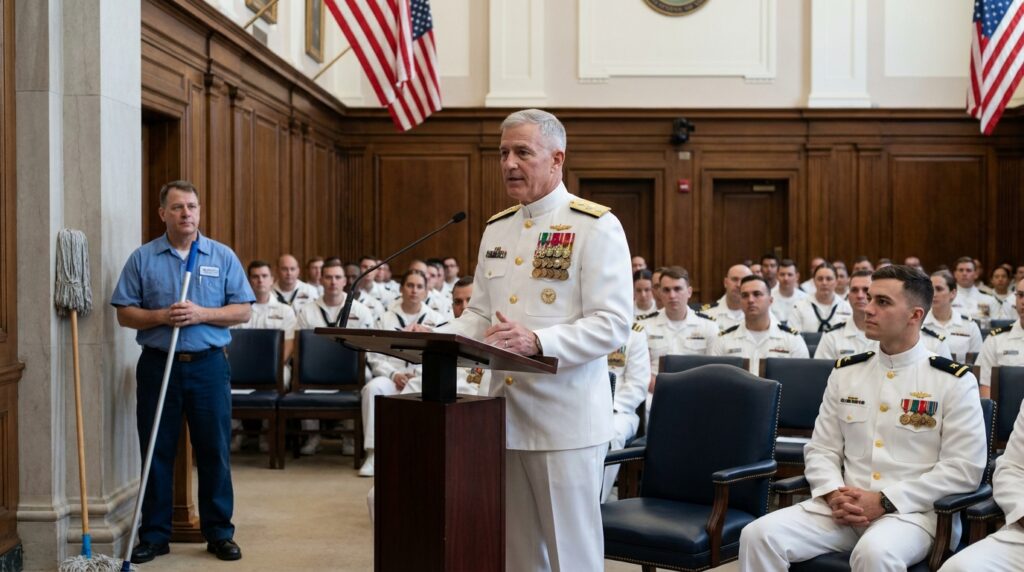
The Measured Grace of Men Who Serve in the Shadows of Giants

CHAPTER 1: THE DUST ON THE HEEL

The gray slush from the drainage grate had already ruined the mirror-finish on his left heel before Ensign Miller even noticed the old man standing there. The east corridor of the logistics wing always smelled of damp concrete and low-grade floor wax, a texture that didn’t belong in the same Navy as the sun-bleached flight decks Miller had dreamed about at the Academy. He stopped, his wool trousers stiff against his shins, and looked down at the dark, widening ring of water spreading across the gray linoleum.

“You’re tracking that grease right into the transit lane,” Miller said. His voice was sharp, a practiced instrument he had spent the last three months refining. He didn’t look at the man’s face; he looked at the faded cotton of the blue utility shirt, the frayed hem near the waist, and the plastic bucket that sat between them like an insult to the morning inspection.

The custodian didn’t drop his shoulder or shift his weight. He was middle-aged, his hair trimmed into a short, coarse bristle that had gone salt-and-pepper at the ears. He held the wooden handle of the mop perfectly vertical, his calloused palms resting over the top knob like an old infantryman holding a staff. He looked at the water, then up at Miller’s gold-trimmed shoulder boards. There was no defiance in his eyes, but there was no apology either—just the flat, unblinking clarity of a stone wall.

“The seal on the hydraulic conduit broke an hour ago, sir,” the man replied. His tone was low, dry as dust, dropping into the humid air without a ripple. “It’ll take twenty minutes to draw the oil out of the seams.”

“Then you should have cordoned off the sector before the shift change,” Miller said, stepping closer until the clean, starched lines of his white uniform jacket nearly brushed the dirty water. He felt the heat rising under his collar, the small, sharp frustration of an orderly world slipping out of alignment because someone couldn’t manage a bucket. “The command staff uses this transit. If the Admiral slips on this deck because you’re behind schedule, it’s your log that gets pulled. Do you understand me, janitor?”

The old man didn’t flinch. A slow, rhythmic drop of water fell from the corner of the ceiling pipe, striking the side of the plastic bucket with a clear, metallic click. For a second, the custodian’s hand tightened slightly against the worn grain of the mop handle, his knuckles whitening just enough to catch the flickering fluorescent light from above. He looked at Miller’s boots, then back up to his eyes, measuring something that wasn’t written in the regulations.

“Understood, Ensign,” the man said quietly. He dipped the mop back into the gray water, the heavy fiber threads swirling like oil. He didn’t offer a salute. He simply bent his back and went back to work, drawing a clean, wet crescent across the linoleum that forced Miller to step backward into the dark, greasy shadow of the bulkhead.

Behind the high frosted glass of the adjutant’s office twenty feet down the hall, a shadow shifted against the light. A door handle clicked, the brass sound small but distinct in the long corridor, and the sudden scent of fresh wool and heavy starch cut through the smell of the pine disinfectant.


CHAPTER 2: The Adjutants Mirror

The heavy door handle of the adjutant’s office didn’t just turn; it dropped with a heavy, institutional thud that seemed to suck the remaining air out of the long corridor. Ensign Miller didn’t move his boot from the dry boundary of the grease ring. His posture remained locked, a product of four years of parade-ground drilling that instructed him to treat every sudden noise as a test of structural composure.

Through the opening came the scent of stale tobacco and high-grade wool—the specific olfactory signature of Captain Vance’s immediate circle. It wasn’t the captain himself who stepped into the dim, flickering light of the transit lane, but Master Chief Halloway, a man whose skin looked like it had been cured in the salt flats of San Diego and whose uniform creases were sharp enough to cut paper. Halloway didn’t look at the wet crescent Garret was drawing across the floor. He didn’t look at the smudge of gray grease that had permanently dulled the mirror-finish on Miller’s left heel. He kept his eyes fixed entirely on the polished brass of Miller’s belt buckle.

“Ensign,” Halloway said. The word was flat, lacking the sharp bite of a typical disciplinary note, which made it infinitely worse. It had the dry, rhythmic cadence of a machine issuing a low-priority error log. “The administrative terminal in the secondary quartermaster’s office is experiencing a line-drop. You were assigned the morning reconciliation log for the station’s civilian service allocations.”

“I was processing the inventory on the lower pier, Master Chief,” Miller said, keeping his chin level, his eyes tracking a small water stain on the bulkhead just over Halloway’s left shoulder. “The civilian staff here has been… non-compliant with the standard clearing schedule. I was adjusting the transit boundaries to ensure the morning detail isn’t disrupted by logistics lag.”

“Is that what you call it?” Halloway shifted his feet slightly, the leather of his shoes making a low, dry rasp against the dry linoleum. He turned his head by a fraction of an inch, his gaze finally dropping down to the middle-aged man in blue denim who was currently wringing out his mop into the plastic bucket. The sound of dirty water hitting the strainer was loud—a wet, heavy crunch that filled the space between the three men like an uninvited witness. “Garret. You behind on the bulkhead seals again?”

John Garret didn’t look up from the bucket. He gripped the iron lever of the ringer, his forearm muscles knotting beneath the faded denim sleeve. A small, pale white scar ran across his wrist, disappearring under the cuff—a thin, puckered line that didn’t look like an industrial accident. “The pressure valve on three-alpha is weeping, Master Chief. It’s taking more time to pull the grease out of the seams than the log allowed.”

“The log is the log,” Miller interrupted, his voice hardening as he felt the subtle, unwritten shift in the room’s gravity. Halloway wasn’t correcting the janitor; he was listening to him. That wasn’t how the chain worked. Not according to the textbooks Miller had memorized until his eyes bled. “If the civilian workforce cannot maintain the timeline, the maintenance contract needs to be re-evaluated by the district office. I’ve already noted the delay in the auxiliary log.”

Halloway didn’t answer right away. He reached into his breast pocket and pulled out a small, lint-covered terminal, its glass screen scratched at the margins from years of desk friction. His thumb slid across the casing with a faint scritch. “The auxiliary log is locked, Ensign. Captain Vance pulled the primary terminal data fifteen minutes ago. He didn’t like the way the numbers were matching up against the port authority’s arrival manifest.”

Miller felt a cold, metallic prickle start at the base of his neck. “The Admiral?”

“The Captain,” Halloway corrected instantly, his tone dropping an octave. “And when the Captain overrides a logistics log, he usually wants to see the person who signed the bottom line. He’s in the ceremonial hall. They’re setting up for the mid-month inspection brief. He wants you there five minutes before the bell.”

The old custodian let go of the ringer lever. It snapped back into place with a dull, echoing clack that sounded like a small firearm discharging in an empty cistern. Garret didn’t say a word, but as he moved his bucket back toward the wall, his shoulder brushed against Miller’s white sleeve. It wasn’t a hard impact—just the heavy, coarse friction of work-worn denim against premium military wool—but it left a faint, gray streak of industrial dust across the pristine white cloth of the Ensign’s arm.

Miller’s hand twitched toward his hip, his fingers curling into a tight, white-knuckled fist. “Watch your clearance,” he snapped, the words slipping out before he could check the rhythm of his breathing.

Garret stopped, the wooden handle of his mop tilted slightly backward. He looked at the gray streak on Miller’s arm, then up at the Ensign’s face. For the briefest second, the old man’s mouth twitched at the corner—not a smile, but a tiny, muscle-deep contraction of absolute, weary recognition. He didn’t apologize. He simply turned back to his bucket and continued down the corridor, his boots leaving a faint, damp trail of gray pine oil behind him.

“Ensign,” Halloway said, his voice cutting through the smell of the disinfectant like a dull knife. “The hall doesn’t wait for a brush-down. Move.”

Miller turned on his heel, his ruined left shoe catching the light as he moved away from the frosted glass of the office window. He could feel Halloway’s eyes on his back, a weight that felt remarkably like the pressure of a small, unseen lens tracking his every step through the concrete maze of the base.

CHAPTER 3: Under the High Rafters

The concrete maze of the logistics wing gave way to the vaulted silence of the ceremonial hall with a suddenness that made the ears ring. Pale morning sunlight cut through the high, salt-encrusted glass panels near the roof, casting long, dusty beams across the rows of dark wooden auditorium seating. The air here was different—less thick with the damp oil of the lower piers, but still carrying that sharp, underlying bite of industrial pine disinfectant that had been scrubbed into the terrazzo floors for forty years.

Ensign Miller slowed his pace, adjusting his cuffs with short, precise tugs as he stepped into the rear aisle. His left boot still left a faint, gray smudge where the grease had killed the polish, but under these high rafters, the small imperfection felt magnified, a dark blemish on an otherwise spotless sheet of paper. He could see the early arrivals from the mid-month inspection detail already scattered throughout the middle rows—mostly junior officers and logistics coordinators, their white dress uniforms gleaming like teeth in the dim, shadowed corners of the hall.

At the far end of the central aisle, the stage was framed by the crisp drapes of the national colors. Standing center stage was Captain Vance.

Even from fifty feet away, Vance’s posture possessed a density that seemed to pull the lines of the room toward him. His white uniform jacket was a heavy canvas of history, weighted down by rows of silver campaign ribbons and heavy medals that clinked softly whenever he shifted his gaze. His gray hair was cut into a regulation skin-fade that left his ears completely bare, emphasizing the hard, unyielding line of his jaw. He was looking down at a ruggedized command terminal mounted on the speaker’s lectern, his thumb tapping the bezel with a slow, deliberate rhythm that Master Chief Halloway copied perfectly from two paces behind.

Miller made his way down the side aisle, keeping his spine rigid, his fingers brushed flat against the seams of his trousers. Every row he passed seemed to bring a subtle decrease in temperature. The casual murmurs of the logistics staff drifted away as he drew closer to the stage, replaced by the heavy, dry rustle of starched wool as eyes began to track his approach. They weren’t looking at his face; they were looking at the left sleeve of his jacket. The faint, gray streak of industrial dust left by John Garret’s shoulder was broad and distinct against the immaculate white fabric.

“Ensign Miller,” Vance said without looking up from the terminal screen. The voice didn’t carry the raw volume of a drill instructor, but it had a deep, resonant friction that traveled through the wooden floorboards under Miller’s feet. “You’re late for the reconciliation assembly.”

“The pier inventory required an extended authorization check, sir,” Miller said, halting at the base of the stage steps and snapping his heels together. The impact made a hollow, flat thud against the terrazzo. “I had to ensure the terminal data was logged before the morning shift cleared the transit lines.”

Vance slowly raised his eyes. They were a pale, faded blue, matching the quality of the light coming through the salt-bitten glass above. His gaze traveled down Miller’s frame, pausing briefly on the ruined finish of his left heel before tracking up to the gray smudge on his sleeve. “The data is already logged, Ensign. In fact, it was logged twice. Once by your terminal at the lower pier, and once by a high-level manual override from the quartermaster’s central node.”

Miller felt the skin across his cheekbones tighten. “An override, sir?”

“A manual entry,” Vance continued, his tone remaining perfectly level, almost conversational. He stepped around the lectern, his heavy leather shoes making no sound against the thick rubber matting of the stage. He reached out, his thumb and forefinger catching the edge of Miller’s sleeve, turning the gray streak toward the light. “A clean, old-fashioned correction made by someone who didn’t need a terminal interface to know the pressure variances on the third-alpha line. Tell me, Miller, do you know what kind of fabric this jacket is made of?”

The shift in topic felt like a missing step on a dark staircase. Miller blinked, his gaze locked on the silver eagles on Vance’s shoulders. “Standard issue wool blend, Captain.”

“It’s twenty-ounce tropical serge,” Vance said softly, letting go of the sleeve. The fabric fell back into place with a faint rustle. “It holds a line beautifully. It resists moisture. But it takes grease like a sponge. It remembers every dirty surface it comes into contact with. Master Chief Halloway, did the custodian finish clearing the east corridor?”

Halloway stepped forward, his face a shadow behind the captain’s shoulder. “He’s standing by at the flank, sir. As ordered.”

Miller turned his head slightly, his eyes tracking Vance’s gaze toward the far left of the ceremonial hall. Standing in the deep shadow beneath the lower projection booth, completely removed from the rows of white uniforms, was John Garret. He was still wearing the faded blue denim utility shirt, his hands resting over the top knob of the vertical wooden mop handle. He stood as motionless as a piece of old timber, his face caught in the pale, dim light filtering through the side exit door. He looked entirely separate from the ceremony, a gray shadow against the white walls, yet his presence felt anchored to the floorboards with the same heavy permanence as the stage itself.

“He doesn’t belong in the assembly, sir,” Miller muttered, the words leaving his mouth before the calculation could stop them. “The civilian maintenance staff is restricted to the service wings during formal reviews.”

Vance let out a short, dry breath that might have been a chuckle if there had been any warmth in it. He turned back toward the lectern, his fingers tapping the glass screen of the terminal one last time. “The civilian staff goes where the command requires them to go, Ensign. And right now, this room requires a very specific kind of cleaning.”

The digital clock on the rear wall of the hall shifted to 0800 with a faint, electronic chirp. The heavy double doors at the back of the auditorium clicked shut, the sound locking the air inside the high rafters as the remaining seats were filled with the sudden, breathless silence of a formal correction in progress.

CHAPTER 4: The Anchor and the Line

Captain Vance did not move his feet from the center of the rubber stage matting, but his shoulders shifted, causing the dense clusters of silver ribbons on his chest to clink with a cold, metallic sharpness. The sound traveled across the polished terrazzo floor, slicing cleanly through the thick silence that had settled under the high rafters of the ceremonial hall. Every junior officer in the front rows sat completely rigid, their hands pressed flat against the crisp wool of their thighs, their breathing shallow.

“Ensign Miller,” Vance began, his voice dropping into the lower registers of the room like a sounding weight. “Read the inscription on the lintel behind you.”

Miller did not turn his back on the commander. His jaw remained locked, a faint muscle twitching beneath the pale skin of his cheek. He had walked past the bronze letters a hundred times since arriving at the station, their edges dulled by years of coastal humidity and layers of industrial cleaner. “Integrity is the bedrock of command, sir.”

“Integrity,” Vance repeated. The word left his mouth without force, yet it felt heavy, a brick dropped onto a glass table. He stepped closer to the lip of the stage, his pale blue eyes reflecting the cold sunlight cutting through the salt-encrusted overhead panels. “A clean word. Easy to print on a ledger. Very easy to memorize for a final exam at Annapolis. But a ledger is just paper, Ensign, and paper doesn’t have to carry the weight of a hull when the seams begin to weep.”

Vance reached down to the terminal screen on the lectern, his thumb sliding over the side casing. With a dry tap, he brought up a single document, projecting its data onto the broad white wall behind the stage. It wasn’t the logistics manifest Miller had filed an hour ago. It was an archival personnel log from twelve years past, its columns marked with high-level encryption stamps that had been stripped away by an administrative override. The name at the top of the file was Garret, J., but the title beside it was not civilian maintenance staff. It read: Master Chief Petty Officer, Subsurface Reconnaissance Division.

A low, collective rustle passed through the auditorium rows—the sound of forty starched white uniforms shifting against wooden seats. Miller’s gaze darted from the wall back to the captain’s face. The coldness at the base of his neck turned into a sharp, localized heat. He looked toward the flank of the room, where John Garret stood in the deep shadow of the projection booth. The old man hadn’t dropped his chin. He remained perfectly still, his calloused palms still resting over the wooden knob of his vertical mop handle, his faded blue utility shirt looking like an old ink stain against the pristine white of the hall.

“You told Master Chief Halloway that the civilian workforce was non-compliant with the standard clearing schedule,” Vance said, his voice dropping an octave, becoming a hard, flat glare. He didn’t look at the projected screen; his eyes were fixed entirely on the gray smudge of dust on Miller’s left sleeve. “You signed a micro-infraction log accusing a station worker of causing a logistics lag because he was wringing out a bucket in your transit lane.”

“He was obstructing the passage during a command shift change, Captain,” Miller said, his voice tightening as he fought to keep his posture from collapsing under the weight of forty pairs of eyes. “The regulations state that service lines must remain clear of debris to ensure operational velocity.”

“The regulations were written by men who expected you to have the intelligence to look at a deck and see the difference between grease and rust, Ensign,” Vance snapped. The sharpness in his tone was sudden, a clean fracture in his composed authority. He pointed a finger toward the projected file on the wall. “Look at the log, Miller. Look at the date of the line-drop on that subsurface reconnaissance unit. Twelve years ago, a master chief with twenty-four years of active-duty sea time was stripped of his command and re-rated because of an administrative failure during a deep-sea recovery operation. The record says he failed to maintain logistics velocity. It says he was non-compliant with the schedule.”

Miller’s tongue felt thick, dry against the roof of his mouth. He could feel the eyes of his peers burning into his profile. “Sir, I wasn’t aware of the custodian’s prior service record.”

“That is exactly your failure, Ensign,” Vance said, his voice returning to that low, terrifying calm. He stepped off the stage matting, descending the three wooden steps until he stood on the terrazzo, less than two feet from Miller’s rigid frame. The smell of high-grade wool and stale tobacco was overwhelming. “You looked at a man in blue denim and assumed his visibility was limited to the width of his bucket. You thought the uniform was what gave you the right to draw a line across the floor. You still have a responsibility to uphold the standards everyone expects from you, Miller. Character matters most, your next decision will define what happens now.”

Vance stopped, his gaze dropping to Miller’s left boot, where the gray grease from the east corridor had dried into a dull, white crust over the leather finish.

“Master Chief Garret didn’t break that hydraulic seal this morning,” Vance whispered, the words intended only for the space between them, yet carrying across the silent hall like an iron chain sliding through a hawsepipe. “He spent three hours in the crawlspace holding the backup bypass valve with his bare hands so the command terminal wouldn’t lose its link to the coastal radar grid. He did it while you were checking the inventory on the lower pier with a digital pencil.”

Miller felt the floorboards seem to tilt beneath him. The pristine, orderly structure of the base, the sharp hierarchy he had trusted to protect his authority, had suddenly turned into a mirror that showed every raw edge of his own entitlement. He looked back toward the shadow at the flank of the room, but the old man wasn’t watching him. Garret was looking down at the terrazzo, his expression completely blank, his fingers motionless on the worn wood of the handle.

“Halloway,” Vance called out, his eyes never leaving Miller’s face. “Bring the station log.”

CHAPTER 5: The Red Ink of the Ledger

The station log didn’t arrive on a digital screen. Master Chief Halloway stepped across the stage with a thick, leather-bound binder, its corners reinforced with tarnished brass plates that had turned a dull, greenish-brown from years of exposure to salt fog. When he set it down on the speaker’s lectern, the heavy thud of the paper sounded like a hatch slamming shut in a flooded compartment.

“Open it, Ensign,” Captain Vance said. His hand remained at his side, his fingers brushed flat against the seam of his white trousers, completely motionless. His voice had lost its conversational edge; it was now a hard, mechanical command that left no room for hesitation.

Miller’s fingers felt stiff, almost wooden, as he reached toward the stage. The starch in his cuffs scraped against his wrists, a small, irritating friction that matched the burning heat climbing up his neck. He pulled the heavy cover back. The pages within were written by hand, a dense column of black ink records detailing every engine repair, every fuel transfer, and every midnight shift change across the lower sectors for the last fifteen years.

But halfway down the projected section of the log, the ink changed. A thick line of crimson water-resistant dye had been drawn across an entry dated twelve years ago. Beneath the red marker, the handwriting changed from the precise, geometric characters of a log clerk to a rough, sprawling script that Miller recognized instantly from the manual override file.

“Look at the entry for the third-alpha line recovery,” Vance said, his eyes drilling into the top of Miller’s cap. “Read the notation under the red line.”

Miller cleared his throat, but the sound was thin, swallowed instantly by the high, vaulted ceiling. “The system experienced a secondary pressure drop during the retrieval phase. Command authority re-routed to logistics wing to prevent structural failure of the main terminal block. The active commander accepted the administrative re-rating to clear the operational line.”

“To clear the operational line,” Vance repeated, his tone dropping into a dangerous whisper that reached the furthest rows of the auditorium. “Do you know what that line was carrying, Miller? It wasn’t oil. It wasn’t fuel. It was a fiber-optic telemetry loop from an experimental towed array three hundred feet below the shelf. A loop that had wrapped itself around a localized sea-valve because a junior officer on the bridge had miscalculated the drift vector by forty yards.”

Miller felt the breath catch in his throat. He looked up from the ledger, his gaze involuntarily tracking toward the deep shadow beneath the lower projection booth. John Garret hadn’t shifted his posture. He was still holding the mop handle vertical, his eyes fixed on the floorboards, his face caught in that same flat, unreadable calm that had broken Miller’s composure in the east corridor. The old man looked small in the massive hall, but the weight of the red ink on the page seemed to radiate from his position like a physical force.

“The junior officer on the bridge didn’t see his name in that log,” Vance continued, stepping back until his medals caught the direct glare of the morning light through the high windows. The silver campaign stars glinted like ice. “He didn’t see his career dismantled because the active master chief went down into the flooded pump room himself, manually decoupled the telemetry loop from the valve body, and took the administrative hit for the scheduling lag so the district office wouldn’t line-dry the entire unit. The master chief buried his own commendations under a civilian service contract so the station could keep its radar link active during the transition.”

The silence in the rows behind Miller was absolute. Nobody shifted their weight; nobody checked their terminal screens. The unearned entitlement that had carried Miller through the morning inspection—the crisp pride of his unblemished white uniform, the sharp polish of his shoes, the belief that authority was something bought with gold thread—was being systematically peeled away like wet paper.

“You thought he was an obstacle in your transit lane,” Vance said, his hand finally dropping to the leather spine of the ledger. “You thought he was an old man with a bucket who didn’t understand the speed of a modern command. But he was maintaining the foundations of this station while your father was still writing checks for your academy tuition.”

Miller’s hand dropped from the edge of the stage. He stood in the center aisle, his chest heaving slightly beneath the stiff wool of his jacket, his left shoe still caked in the white crust of the dried grease. The world had become very simple, and very cold. He was no longer an officer directing the velocity of a base; he was a boy who had used his newly polished heel to draw a line between himself and a giant.

“The auxiliary log remains open, Ensign,” Vance said, his voice returning to that flat, institutional register that signified the end of a formal review. “And you still have a line to sign before the inspection detail leaves the sector.”

CHAPTER 6: The Echo on the Terrazzo

The leather casing of the station log remained open under the pale morning sun, its heavy, hand-pressed pages vibrating slightly as a low-frequency hum from the lower dock generators traveled up through the foundation. Ensign Miller didn’t look back at the rows of seated personnel. He could feel the collective weight of their breath—a silent, suffocating pressure that seemed to dry the sweat on the back of his neck into a stiff crust. His fingers, still stained with a faint trace of the carbon dust from the pier terminal, touched the cold brass trim of the ledger sleeve.

As his hand moved, the edge of his starched cuff caught on an unsealed flap of the inner lining. A small, stiff scrap of silk slipped from the pocket, tumbling face-up onto the open page. It wasn’t a document. It was a single, faded campaign ribbon—the dark blue and white stripes of the Navy Cross, its edges so heavily frayed by years of salt air that the silver threads were pulling loose from the backing.

Miller froze. He looked at the ribbon, then at the sprawling signature beneath the crimson ink line: Vance, R., Lieutenant, Commanding.

The realization didn’t come with a sharp crack; it descended like a heavy valve sealing a flooded pipe. The junior officer who had miscalculated the drift vector twelve years ago—the one who had wrapped the telemetry loop around the sea-valve and threatened a classified reconnaissance project—hadn’t been an anonymous name on a casualty list. It had been Captain Vance’s younger brother. John Garret hadn’t just saved a radar link or cleared a schedule; he had broken his own career to keep a field commander’s bloodline intact, burying the truth so deep that even the station logs required an Admiral’s personal authority to breathe.

Miller raised his chin slowly, his throat dry, his lungs burning against the tight wool of his white jacket. He looked across the twenty feet of gray, sunlit space separating him from the stage. Captain Vance stood perfectly motionless, his pale blue eyes fixed not on the junior officer, but on the old man standing beneath the projection booth. The clink of the medals on Vance’s chest had stopped. There was only the vast, heavy quiet of two old men who shared a burden so heavy it had turned their active-duty service into a lifelong silence.

Miller turned away from the stage. His boots, once the pride of his morning routine, felt heavy as iron casing as he adjusted his direction toward the left flank of the hall. The gray crust of dried grease on his left heel made a flat, irregular scrape against the terrazzo with every step. He didn’t look at his peers. He didn’t look at Master Chief Halloway. He walked until he stood exactly three paces from the small, rubber-matted square where the custodian stood.

John Garret looked up. His face remained a weathered sheet of cedar, his eyes flat and clear, containing neither victory nor malice. He looked at the gray smudge of dust on Miller’s white sleeve—the mark his own shoulder had left in the dark corridor—and then his gaze dropped to the frayed ribbon resting on the ledger behind them.

Miller brought his right hand up.

The movement was slow, deliberate, lacking the snappy, mechanical speed of the Academy drills. It was the heavy, intentional lift of a man who finally understood what the uniform was meant to cover. His fingers flattened against the brim of his cap, his forearm forming a perfect, rigid angle in the pale glare of the morning light. He didn’t speak. He didn’t offer an explanation. He held the salute, his eyes locked on the faded denim of Garret’s collar, his posture offering a full, public submission to the man who had spent twelve years holding a wooden handle to keep the station from remembering his sacrifice.

The silence in the grand hall dilated, stretching until the sound of the distant harbor whistles seemed to fade into the salt air.

Slowly, without a word, John Garret let go of the wooden mop knob with his right hand. His calloused fingers, marked by the old, puckered scar at the wrist, rose to his temple. The movement was stiff, his shoulder clicking slightly from decades of bilge work, but the salute he returned was immaculate—a clean, old-guard form that had been forged in the deep subsurface long before Miller had ever put on a pair of boots.

Vance watched them from the stage, his hand resting flat against the leather spine of the ledger. “Very well,” the captain said softly, his voice dropping into the rafters like a final, closing seal. “Carry on.”

Garret nodded once, his hand dropping back to the worn grain of the wooden handle. He turned his bucket toward the side exit, the wheels making a low, rhythmic rumble against the terrazzo as he moved back toward the shadow of the service wings. Miller stayed in his prints, his hand falling to his side, his eyes tracking the wet, clean trail the mop had left behind on the floor. The line had been drawn, but for the first time since he had arrived at the station, Miller knew exactly which side of it he belonged on.

Similar Posts

Leave a Reply

Your email address will not be published. Required fields are marked *