The Iron Choke and the Granite Line: A Story of Rusted Truth

CHAPTER 1: THE COLD IRON KICK

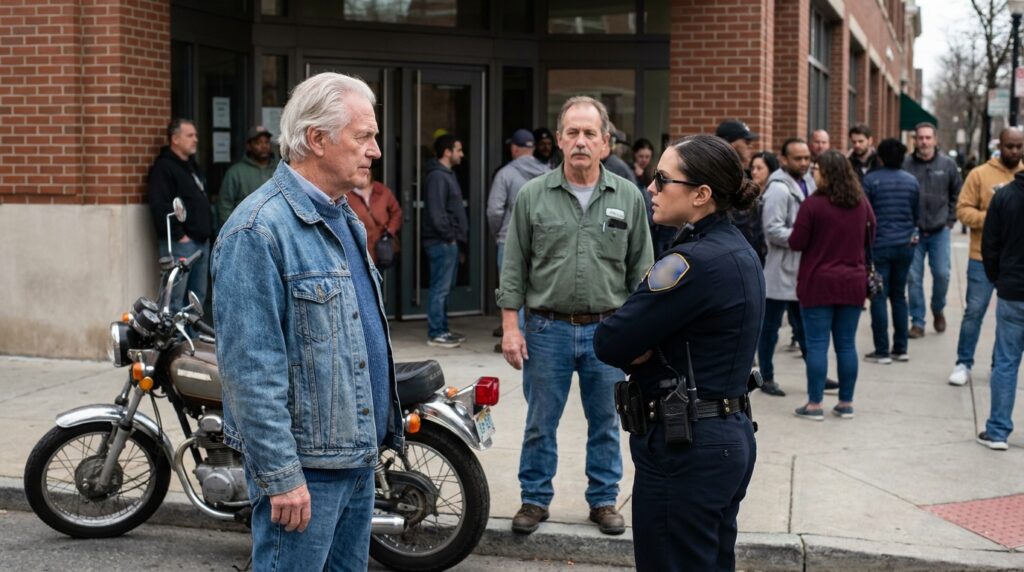
The choke knob was pitted with salt from an Atlantic crossing fifty years ago, its brass tarnished down to the color of wet river silt. Marcus Vance didn’t clean it. He liked the friction under his thumb. It took three heavy kicks to wake the 1974 Shovelhead, each thrust of his boot sending a dull vibration through the dry timber of the garage floor and up into his knees. The exhaust didn’t roar; it coughed—a wet, metallic bark that smelled of stale leaded fuel and scorched gaskets.

“The city’s got cameras on that whole grid now, Mac,” David said. He was leaning against the rusted frame of an old drill press, his olive work shirt already damp at the armpits from the early July heat. He didn’t look at Marcus; he looked at the floor, watching a thin thread of black oil crawl toward a crack in the foundation. “They aren’t looking for guys who remember where the old armory used to stand. They’re looking for things that don’t look like the brochure.”

Marcus didn’t throttle up. He kept his gloved hand flat against the leather of the seat, feeling the erratic pulse of the old iron between his thighs. His denim jacket was stiff, the cuffs grayed with grease from a dozen roadside top-offs. Beneath the denim, the blue wool of his sweater felt like an extra skin he’d forgotten to shed when the treaty was signed.

“The registry is public,” Marcus said. His voice had the dry, raspy scrape of sand moving through an iron pipe. “The concrete belongs to whoever paid the tax.”

“The tax was fifty years ago,” David muttered, finally looking up. His mustache twitched as he squinted through the bluish haze of the exhaust. “The people inside that building don’t even use paper anymore. You go down there with that leak under your primary drive, and they’re going to treat you like a grease fire.”

Marcus reached down and turned the petcock off, letting the engine die on its own terms. The sudden silence in the garage was heavy, filled only with the ticking of hot metal cooling against the damp morning air. He didn’t answer his brother. He didn’t need to. He reached into his internal breast pocket, his calloused fingers brushing past the cold, heavy edge of a Silver Star challenge coin that stayed tucked away like an old tooth, and pulled out a small, yellowed piece of cardstock—a parking voucher from the county clerk’s office dated three months before the first excavator touched the dirt.

As he went to slide the card back, his finger caught on a jagged split in the interior lining of his jacket. There was something hard taped behind the wool, something small and flat that shouldn’t have been there. It wasn’t the coin. It was too long, too cold. But before his thumb could trace the shape, the distant whine of a municipal siren cut through the valley breeze from the direction of the highway, sharp and clinical.

Marcus pulled his helmet on, the strap snapping against his throat with a dry, leather click. He didn’t look at David as he rolled the heavy machine back into the light.


CHAPTER 2: THE GRANITE GATE

“You’re dripping on the sand-blasted quartz, sir. Turn it off or roll it back behind the yellow line.”

The voice didn’t come from a soldier or an officer. It belonged to a kid who looked twenty-four, wearing a tailored navy suit that had never seen a rainstorm and an administrative lanyard that swung like a pendulum against his belt. He was holding a sleek glass tablet, his thumb hovering over a digital field with the casual arrogance of a minor gatekeeper who believed the world was run by permissions.

Marcus Vance didn’t kill the ignition. He kept his boots planted on the pristine granite pavers of the plaza, his knuckles white inside his grease-stained leather gloves as the Shovelhead’s raw idle vibrated through the polished stones beneath them. The exhaust note was thick, laden with the heavy scent of unburned zinc and hot oil, throwing small, gray smoke rings against the glass-fronted facade of the new County Veterans Affairs Complex.

“The card says Lot A,” Marcus said. His voice was lower than the mechanical rattle of the engine, a slow, gravelly rasp that required the kid to lean forward slightly to catch it over the din of the machine. He didn’t offer the card. He held it flat against his thigh, his thumb covering the modern bar code but exposing the faded, stamped signature of the county clerk from three months back.

“Lot A is reserved for the corporate sponsors and the Governor’s logistics team,” the coordinator said, his fingers making a fast, dismissive swipe across the glass screen. He didn’t look at Marcus’s face; he looked at the denim jacket, tracking the gray grease smears along the seam of the arm and the salt-crusted edges of the blue wool sweater underneath. “The vintage vehicles—the exhibition pieces—are supposed to be at the lower staging area near the service road. Two miles down, by the gravel pits. Security won’t clear an unmapped fuel system within forty yards of the podium.”

“This isn’t an exhibition,” Marcus muttered. His right hand remained on the throttle, his index finger tracing the edge of the old rubber grip where the sun had cracked the synthetic compound down to the core iron.

He looked past the kid’s shoulder. The building was massive, a monolithic wedge of tinted glass and white limestone that looked more like an aerospace headquarters than a home for old soldiers. The light off the plaza was blinding, the midday sun reflecting off thousands of square feet of poured concrete and polished granite until the air itself seemed to vibrate with a dry, chemical heat. In the center depth, behind a pair of velvet crowd ropes, a dozen local politicians were already standing in a loose circle, their teeth flashing white in the glare as photographers adjusted lenses on aluminum tripods.

“Look, mister,” the coordinator said, his tone dropping into that specific, practiced patience used by low-level administrators dealing with the non-compliant. “We have three separate defense tech firms arriving in ten minutes. Their security detail is checking the tire treads on every vehicle entering this circle. If I let an oil-leaking Shovelhead sit on the main entrance path, it flags the automated grid. I’m trying to save you a citation.”

Marcus didn’t move. He felt the small, irregular ridge of the challenge coin pressing against his ribs through the internal pocket of his jacket, but it was the other object—the long, cold piece of flat iron he’d discovered behind the lining—that felt heavier now. His brother David’s words from the garage were still ringing in his ears, a low, persistent warning about what happens when an old name gets caught in a new machine.

He looked down at the yellowed cardstock voucher. In the harsh, overhead glare of the July sun, he noticed something he’d missed back in the dim light of his shop. The county clerk’s stamp was there, but beneath the purple ink, embedded directly into the fiber of the paper, was a faint, translucent watermark—an interlocking diamond logo that didn’t belong to any state agency. It was the corporate mark of Vanguard Tactical Solutions, the multi-state contractor that had built the building’s new digital server wing.

The kid stepped closer, his polished leather shoes clicking against the granite with an aggressive, short stride. He reached out an arm, not quite touching Marcus’s handlebars but cutting off the left-hand mirror’s line of sight. “Sir. I’m not asking again. Move the bike to the gravel pits, or I’ll have the municipal tow unit clear it as an abandoned hazard.”

Marcus felt his thumb slide down the clutch lever, his muscles locking into the deliberate, static discipline of a man who had spent three winters holding a mud-filled trench line outside Da Nang while everything around him turned to ash. He didn’t shift into gear. He didn’t turn the wheel. He simply leaned his weight slightly to the left, letting the heavy steel edge of his primary drive cover click against the coordinator’s neat leather shoe line.

“I’ve got the permit,” Marcus said softly. “And the pavement’s wide enough for both of us.”

Across the plaza, near the glass double doors that led to the security checkpoint, a dark blue uniform shifted. A female officer, her dark hair pulled into a severe, wind-resistant bun under her campaign hat, turned her head toward the sound of the idling engine. Her sunglasses reflected the white light of the concrete like two black discs as she adjusted the heavy leather utility belt at her waist and began walking toward the curb.

CHAPTER 3: THE GRANITE LINE

The heavy steel kickstand dropped with an uncompromising, un-greased clank, its raw point scraping an explicit gray line into the face of the million-dollar plaza. The Shovelhead leaned left, its massive weight settling down with a low, mechanical groan that forced the young coordinator to take a sharp, frantic step back. Marcus Vance didn’t look at where the metal bit into the quartz; his eyes remained fixed straight ahead, watching the dark blue form of Officer Elena Gomez close the distance between the security line and his front tire.

“Sir, you cannot deploy a stand here,” the coordinator hissed, his voice tightening into a high, thin pitch as he gestured wildly at the floor. His glass tablet tapped rhythmically against his thigh like a panicked heart. “This is a designated security corridor. Look at the flagstones—you’re scratching the literal foundation of the memorial wing!”

Marcus didn’t lift his boot from the footpeg. He reached down slowly with his left hand, his coarse leather glove brushing against the primary drive housing, and twisted the heavy brass-rimmed ignition switch until the violent rattle of the two cylinders died down to a heavy, ticking silence. The heat coming off the cooling fins was instantaneous, a wave of dry, oil-tinged air that shimmered across the crisp lines of the coordinator’s navy suit.

“The foundation was paid for by men who didn’t care about quartz,” Marcus said. He pulled his hands from the handlebars and let them rest on his thighs, his posture straight, his chin up, the sweeping white fringe of his hair catching the hot breeze off the highway.

Officer Gomez stopped exactly three feet from the motorcycle’s front wheel. Her boots were immaculate, polished down to a black obsidian finish that reflected the white glare of the concrete plaza. She didn’t draw a weapon, but her hands were tucked firmly behind her back, her fingers resting near the heavy black composite housing of her radio. Through the dark sheen of her sunglasses, Marcus could see the tight, analytical set of her jaw. She was sizing up the machine, the oil-smeared blue wool sweater under his jacket, and the small yellowed card stock still held flat against his left knee.

“Problem here, Mr. Vance?” she asked. her voice didn’t carry the coordinator’s administrative panic; it was flat, professional, and weighted with the authority of someone who managed perimeters for a living.

“Officer, this individual is in direct violation of the event logistics blueprint,” the coordinator cut in, stepping up beside her shoulder. He tapped his screen with an aggressive index finger. “He’s unmapped. The VIP arrivals begin in less than five minutes, and he refuses to relocate his vehicle to the gravel staging zone. We have an executive directive from Vanguard Systems to keep this specific approach path completely sterile.”

Marcus watched Gomez’s reflection in her own lenses. She didn’t immediately look at the coordinator’s tablet. Instead, her eyes dropped to the small, yellowed parking cardstock in Marcus’s hand. Her gaze lingered on the translucent interlocking diamond logo hidden beneath the purple ink—the Vanguard corporate watermark. A subtle, almost imperceptible twitch occurred at the corner of her mouth.

“Let me see the voucher, sir,” Gomez said, extending a gloved hand toward him.

Marcus handed it over without shifting his weight. As he reached out, the rough movement of his denim jacket pulled the interior lining open by an inch, exposing the deep, ragged split where the hard, cold object was taped against the inner fabric. The brass-rimmed key didn’t slide out, but its heavy, serialized edge glinted under the high noon sun. Gomez’s eyes tracked the movement instantly. She didn’t mention the key, but her fingers tightened slightly on the edge of the paper voucher as she pulled it into her workspace.

The silence on the plaza grew dense, filled only with the faint, metallic ticking of the cooling engine and the distant, muffled hum of the high-end audio check from inside the auditorium. Passing citizens—older men with faded caps and families dressed in their Sunday best—were beginning to slow down as they approached the velvet ropes, their eyes drifting from the political stage toward the older man sitting like an iron statue on an oily motorcycle.

Gomez turned the voucher over, her thumb rubbing against the grain of the paper where the tracking chip was embedded. “This is an official county clerk registration, Mr. Vance. It looks like it was issued before the perimeter layout was modified by the private logistics committee.”

“It’s outdated,” the coordinator insisted, his face reddening under the midday heat. “The new contract nullifies all previous general access codes for this zone. The digital ledger is the only active authority today, Officer. You know the protocols for a level-one clearance event.”

Marcus reached up and slowly unbuckled the leather strap of his helmet, letting it hang from the left handlebar grip. He looked past Gomez, toward the glass double doors of the main building. Through the dark tint, he could see the shapes of several high-ranking officers in dress uniforms standing near the entrance corridor, their silver and gold insignias catching the interior fluorescent light. They were waiting for someone.

His right hand drifted back down to his jacket pocket, his thumb sliding inside the ragged seam to feel the cold, pitted iron of the key. The numbers stamped into its barrel were five digits long—the exact format of the old regimental storage units that used to sit on the north side of the valley before the county sold the acreage to Vanguard Tactical Solutions for fifty cents on the dollar.

“I’m not looking for an argument, Officer,” Marcus said, his voice dropping into a rhythmic, steady cadence that seemed to quiet the coordinator’s shifting feet. “But I’m not moving the machine to the gravel pits. This machine has a right to park on the ground it helped dig.”

Gomez looked up from the cardstock, her sunglasses turning back toward Marcus’s lined face. She handed the card back to him, her fingers brushing against his leather glove. Her touch was firm, deliberate. “Hold your position for a moment, sir. I need to run this serial number through the administrative desk before we clear the tow unit.”

She stepped back, her hand already moving toward the microphone clipped to her shoulder epaulet, her eyes never leaving the old Marine’s unyielding gaze.

CHAPTER 4: THE FACETOFACE STANDOFF

“Unit Four to Control, check an historical paper validation for voucher identifier seven-seven-echo,” Officer Gomez said, her thumb depressing the side button of her shoulder mic with a sharp leather click. She didn’t look away from Marcus. Her sunglasses remained two frozen, black pools reflecting the stark glare of the concrete plaza.

The coordinator took a half-step forward, his glossy tablet clicking rapidly as he tilted the screen toward her line of sight. “Officer, the general dispatch log already flagged this sector as clear. Vanguard security is performing the automated sweep from the perimeter gate up to the main stage. Any analog document not indexed in the modern registry is an unverified logistical hazard.”

Marcus stayed perfectly still on the leather seat of the Shovelhead. He didn’t drop his feet, and his gloved left hand remained resting calmly near the primary drive housing. The heat radiating from the cylinders rose in visible, oily waves between him and the uniform, blurring the sharp white edges of the limestone monument facade behind her.

“Control copies, Four,” the radio barked back, the encrypted transmission coming through with a harsh, digital hiss that sounded like sand sliding down a metal chute. “Identifier seven-seven-echo is outside the automated system. It doesn’t exist on the current VIP list. Clear the lane for the primary convoy.”

The coordinator let out a short, triumphant breath. “There it is. Sir, the stand has to come up right now. If we have to summon the flatbed to drag this iron down to the gravel pits, the recovery fee is going to hit your county record before the ribbon is cut.”

Marcus didn’t touch the kickstand. His thumb slowly traced the rusted perimeter of the brass choke knob on his machine. “The record was fixed before you learned how to write on glass, son,” he murmured, his voice maintaining that low, even scrape. “The county clerk signed that card because the ground under these stones was registered to the Third Battalion logistics trust. It isn’t a parking space. It’s an easement.”

Gomez’s fingers stilled against the edge of her radio casing. Her eyes drifted back down to the small split in Marcus’s denim jacket, where the cold, five-digit serial number of the regimental key remained partially visible against the gray wool of his sweater. She shifted her weight, the heavy leather of her utility belt creaking with a slow, rhythmic friction that drew the attention of the nearest bystanders.

The circle of onlookers had grown wider now. A group of older men in faded olive caps had stopped near the velvet ropes, their quiet murmurs rippling through the crowd as they watched the young coordinator crowd the vintage motorcycle. One of them pulled out an older flip phone, his weathered hand shading the low-resolution screen from the intense noon light. The slick, corporate atmosphere of the VIP gala was beginning to fray at the edges, replaced by the coarse, unpredictable tension of a public street.

“Officer,” the coordinator said, his tone dropping its administrative mask and hardening into an explicit order. “The Vanguard detail is at the lower gate. If this vehicle isn’t moved in sixty seconds, I’m logging a formal complaint regarding perimeter enforcement failures.”

Gomez didn’t look at the coordinator. She took a single, measured step closer to the Shovelhead, her boot heel stopping inches from the primary drive cover Marcus had dropped onto the granite. Her shadow fell over the hot chrome pipes, cooling the polished surface for a brief micro-second.

“Sir,” she said to Marcus, her voice dropping below the volume of the crowd’s rising murmur. “The serial number on that key in your lining. Does it match the old ordnance lockers on the north line?”

Marcus didn’t blink. His blue eyes stayed locked on her dark lenses. “It matches the storage facility that sat where that server room is currently drawing power. The one they told the county was empty when they poured the new foundation.”

The coordinator froze, his thumb hovering inches above his tablet screen as he caught the numbers Marcus spoke. For the first time, his administrative composure cracked, his eyes darting from the officer’s rigid back to the weathered face of the old Marine sitting in front of him. The plaza seemed to shrink down to the narrow concrete line between the front tire and the polished obsidian of Gomez’s boots, the dry air smelling heavily of hot zinc and the impending collapse of a carefully managed system.

CHAPTER 5: THE EYE OF THE CROWD

A calloused hand cracked the silence, David Vance’s palm slapping down onto the weathered brown leather of Marcus’s rear fender bag with a dry, coarse thud. He didn’t look at Officer Gomez or the young coordinator whose tailored sleeve was now shaking against his digital slate. David stepped right into the narrow gap between the front tire and the law, his boots grinding a handful of loose granite dust into the gray quartz surface.

“Everyone’s watching now,” David said, his voice dropping into a low, flat warning that wasn’t meant for his brother alone. His mustache was stiff with sweat, his eyes darting across the wider perimeter where the passive circle of onlookers had begun to lock into a rigid, permanent wall. “Let’s keep this under control. Respect goes both ways, that’s all we’re asking today.”

The coordinator didn’t look up from his screen, but his thumb made a sharp, jerky swipe that accidentally cleared his terminal’s active interface. “This isn’t about respect, Vance. It’s an un-indexed asset on an active corporate deployment field. The security algorithms don’t have a variable for sentimentality.”

Marcus didn’t shift his boots from the pegs. He let his fingers loosen from the pitted brass choke knob, his hand coming down to rest flat against his thigh. The metal of the engine continued to tick, a slow, dying pulse that sounded like an old watch spring winding down in an empty room. He looked at the faces behind the velvet ropes—the older men whose caps carried the names of ships that had gone to the scrap yards thirty years ago, the county workers whose lanyards matched his own faded voucher, the kids holding cell phones at chest height, their lenses catching the high noon glare like rows of tiny glass eyes.

The pressure wasn’t moving down from the building anymore; it was rising from the plaza floor. The administrative sterile zone the coordinator had promised his corporate handlers was gone, replaced by a dense, un-moving crowd that smelled of grease, old wool, and damp earth. Every phone that rose into the air became an unmanaged terminal, an open circuit the city’s media team couldn’t clear with a software patch.

Gomez stood her ground, but her chin dropped a quarter-inch, her eyes tracking the precise shift in the crowd’s configuration. She could feel the friction change under her heels. A group of four older veterans in matching blue blazers had moved past the first security marker, their steps slow but deliberate, their eyes fixed on her duty belt. They weren’t making threats; they were simply occupying space, turning the concrete path into a shared trench.

“Officer,” the coordinator hissed, his voice dropping to a sharp whisper as he leaned toward Gomez’s shoulder. “The automated gate report just flagged the Vanguard executive lead. They’re at the lower circle. If this lane isn’t clear when the private convoy hits the steps, the entire municipal tech transition loses its validation status.”

Gomez didn’t acknowledge him. Her hand left her radio casing and came down to her side, her fingers uncurling from the leather loop of her baton. She looked back at Marcus, her sunglasses catching the sharp white line of the building’s cornerstone behind him—the stone that bore the name of the very logistics trust Marcus had claimed five minutes before.

“The registry is accurate, Vance,” she said, her voice carrying a rare, raw grain of hesitation. “But the system won’t let me enter a manual override for a physical asset that isn’t mapped to a digital server node. If I don’t sign the removal log, the automated system defaults to a public hazard alert. The tow trucks are already rolling from the yard.”

Marcus looked down at his jacket lining, his thumb hooking into the split fabric where the serialized iron key was taped. He could feel the cold edge of the metal heating up against his body, a single, hidden piece of evidence that didn’t exist in the coordinator’s cloud network but was currently sending an unmapped signal through the entire history of the valley.

“Then let them roll, Officer,” Marcus said softly. “The steel on this bike has been buried before. It always comes back up.”

Before Gomez could answer, a loud, sharp whine cut through the plaza from the roof of the complex—the sound of the building’s heavy-duty emergency ventilation systems kicking into manual overdrive. The air coming out of the massive stainless steel grates above the doors didn’t smell like offices; it smelled like hot copper, burnt plastic, and the deep, chemical ozone of old storage units being cleared under a midnight deadline.

David’s hand tightened on the leather bag, his knuckles turning white as a sudden, hard shadow fell over the plaza from the grand glass entrance. The heavy double doors didn’t slide open this time; they were thrown back by a pair of active-duty Marines in full dress blues, their polished white belts gleaming against the dark interior wood as an order echoed down the granite steps.

CHAPTER 6: THE COMMAND SHADOW

“Stand down that perimeter team, coordinator.”

The voice didn’t carry the clinical scratch of a police radio or the thin, frantic register of the digital ledger. It was a block-hollowed rumble that bounced off the polished limestone and glass facade like an old mortar round hitting wet sand.

The young coordinator froze, his knuckles turning a stark, bloodless white where they clamped against the sides of his tablet. Officer Gomez went instantly rigid, her shoulders dropping three degrees as her fingers drifted clean away from her utility belt, pinning themselves flush down against the seam of her trousers. Marcus Vance didn’t lift his head, but his gaze tracked the sudden, synchronized pivot of the twin Marine guards standing on the threshold steps.

Major General Raymond Vance stepped into the blinding glare of the July sun, the multiple gold-rimmed campaign stars on his shoulders catching the light like small mirrors. Behind him, three municipal aides and the city mayor shuffled out into the heat, their faces instantly losing their high-status corporate smiles as they took in the dense, silent circle of veterans occupying the plaza floor.

“General, we are currently mitigating an un-indexed safety risk on the primary approach,” the coordinator stammered, his boots performing a small, nervous shuffle backward until his heel clicked against the newly laid quartz curb. “Vanguard security protocols mandate a sterile path for the acquisition team’s transport. This civilian has refused three separate orders to relocate his vintage assembly to the lower gravel zone.”

The General didn’t look at the tablet or the coordinator’s outstretched arm. He marched down the granite steps with the heavy, un-hurried stride of a man who had spent forty years giving orders that people died to execute. His eyes—the exact steel-gray color of the cooling fins on Marcus’s Shovelhead—were locked entirely on the old denim jacket and the white swept-back hair of the biker sitting on the iron machine.

“You’re sixty seconds behind schedule, Colonel,” General Vance said as he reached the front tire of the motorcycle, his voice dropping into a low, transactional rhythm that completely ignored the city officials hovering at his flank.

“The starter pin was cold, Ray,” Marcus muttered back, his raspy scrape cutting through the sudden hush that had fallen over the hundreds of onlookers. “And your boy here says my registration didn’t make the transfer into the clouds.”

The mayor stepped forward, his hand extending automatically toward Marcus with a practiced, vote-seeking grin. “Colonel Vance! We had no idea you were arriving by motorcycle. The staging staff was simply ensuring the VIP lane remained secure for our technical benefactors from Vanguard Solutions.”

“The lane was secure when we dug it out in ’72, Thomas,” Marcus said, his hands remaining flat against his thighs, refusing the mayor’s open palm. He reached down slowly, his calloused thumb hooking the interior split of his jacket and pulling the cold, five-digit serial key out into the light. He threw it. It didn’t bounce; it landed with a heavy, dead iron clink right at the base of the General’s polished boots. “Your technology partners are currently running their servers inside the old ordnance bunker. The one where my regiment’s trust records were supposed to be locked.”

The General looked down at the iron key, then turned his gaze back to the city coordinator, whose face had gone from red to the gray color of wet ash. The crowd behind the ropes had gone completely silent, the only sound being the fluttering of the large American flag hanging from the center portal.

“Officer Gomez,” the General said, his voice quiet but carrying a sharp edge that made the young cop’s jaw tighten. “Pick up that key. It belongs to the master lock of the Third Battalion logistics archive—the section this county administration claimed was lost during the municipal restructuring.”

Gomez stepped forward, her leather belt creaking as she knelt to lift the heavy iron piece. When she rose, she didn’t hand it back to the coordinator or the mayor; she held it flat in her palm, looking directly at the interlocking diamond watermark on Marcus’s parking cardstock. The false bottom of the city’s neat administrative narrative had just cracked open, revealing a dark, structural truth that no digital ledger could erase.

The General took a single step closer to the machine, his right hand moving upward toward the stiff brim of his dress cap as he prepared to deliver the institutional checkmate Marcus had sat three hours in the sun to collect.

CHAPTER 7: THE RIGID CHECKMATE

The General’s hand snapped upward, the stiff, wool-blend brim of his dress cap catching the brutal glare of the noon sun as his arm locked into an unyielding forty-five-degree angle. It was a formal hand salute, held with the precise, mechanical rigidity of a man who had spent forty winters honoring the dead. The white fabric of his dress glove stayed perfectly motionless against his temple, cutting through the humid, stagnant air of the plaza like an iron wedge.

Behind him, the two Marine guards adjusted their footing on the granite steps, the synchronous click of their leather heels sending a sharp, metallic echo rippling across the concrete floor. The silence that followed was heavy, absolute, and total. The crowd of onlookers—the older men in faded blazers, the local citizens with their phones frozen at chest height—stopped shifting. The low-level murmurs died away instantly, leaving only the slow, rhythmic ticking of Marcus Vance’s cooling motorcycle engine to count the passing seconds.

The city coordinator’s tablet slipped three inches down his thigh, his fingers losing their frantic grip on the glass screen as his gaze darted from the General’s stars to the oil-smeared sleeve of Marcus’s denim jacket. The administrative mask he had worn all morning was gone, his mouth half-open as he looked at the brass-rimmed key resting flat in Officer Gomez’s hand. The mayor’s hand stayed extended in the air, his slick, political smile hardening into a brittle, gray mask as the reality of the floor layout shifted beneath his leather shoes.

“General,” the mayor muttered, his voice dropping into a tight, transactional whisper that barely reached past the curb. “The Vanguard executives are at the gate. The digital ribbon-cutting is synchronized with the live stream. If we don’t clear the access path, the automated municipal registry flags the delay.”

“The registry can wait, Thomas,” General Vance said, his hand remaining locked at his brow, his eyes never leaving Marcus’s weathered, unblinking face. His voice didn’t rise, but it carried the weight of four decades of undisputed command—a slow, iron-shod rumble that made the young coordinator take another short step back into the shadow of the pillars. “The man sitting on this motorcycle isn’t an un-mapped hazard. He’s the keynote speaker. And his name is already etched into the bronze behind your podium.”

Marcus sat perfectly straight on the worn leather seat of the Shovelhead, his upright frame mirroring the discipline of the uniform in front of him. He didn’t return the salute; he simply reached down with his gloved left hand and touched the pitted brass choke knob of his machine, his thumb tracing the rough, salt-crusted edges where the metal had survived five decades of grit and exposure. The internal struggle that had kept his jaw locked all morning began to ease, replaced by the cold, heavy realization that the ground he had come to defend was finally holding its own.

He looked past the General toward the massive bronze dedication plaque bolted into the white limestone facade of the entrance wing. In the harsh, vertical light of the midday sun, the raised, cast-metal letters stood out with an explicit, un-polished clarity. Beneath the names of the local civic committees and the corporate sponsors, stamped deep into the foundational alloy where no software update could scratch it away, were the words: Colonel Marcus Vance, Third Battalion Logistics Trust.

Officer Gomez stepped into the center of the path, her boots grinding a handful of loose granite dust into the quartz as she held the dual-notched iron key out toward the General. Her sunglasses reflected the long row of older veterans who had now pressed past the velvet ropes, their bodies forming a solid, silent line behind Marcus’s rear tire. They weren’t moving, but their presence had effectively closed the plaza to any corporate vehicle attempting to clear the approach.

“Officer,” the General said, his arm finally dropping down to his side with a single, clean motion that signaled the end of the standoff. “Escort the Colonel’s machine directly to the main plaza platform. If the coordinator has an issue with the automated logistics log, he can file a manual discrepancy report with my staff at the gate.”

The coordinator didn’t answer. His thumb made one final, useless swipe across his tablet before the screen defaulted to a critical error flag, the digital ledger locking up as the automated system failed to process the physical presence of a legendary asset. He watched in silence as Gomez nodded, her professional posture relaxed for the first time as she stepped to the side of Marcus’s front tire and offered a short, respectful nod of compliance.

Marcus reached down and turned the fuel petcock back to the open position, his fingers moving with the slow, deliberate familiarity of a mechanic who knew every tolerances of the iron between his thighs. He didn’t look at the mayor or the coordinator as he lifted his right boot and prepared to kick the Shovelhead back into life. The crowd behind the ropes began to move, their hands coming down from their phones to strike together in a low, rhythmic clap that filled the plaza with the coarse, heavy sound of earned respect.

“Let’s get it inside, Mac,” David said softly from the rear fender, his hand dropping away from the leather bag as the path to the glass double doors opened wide. “The room’s waiting.”

Marcus brought his weight down on the kick-starter, the engine catching on the first stroke with a loud, metallic bark that blew a small cloud of zinc-scented smoke across the polished granite steps, sealing the line he had drawn in the stone.

Similar Posts

Leave a Reply

Your email address will not be published. Required fields are marked *