
The Iron Law of Gravity and Grease on a Broken Asphalt Horizon
CHAPTER 1: A QUIET MANS MEAL
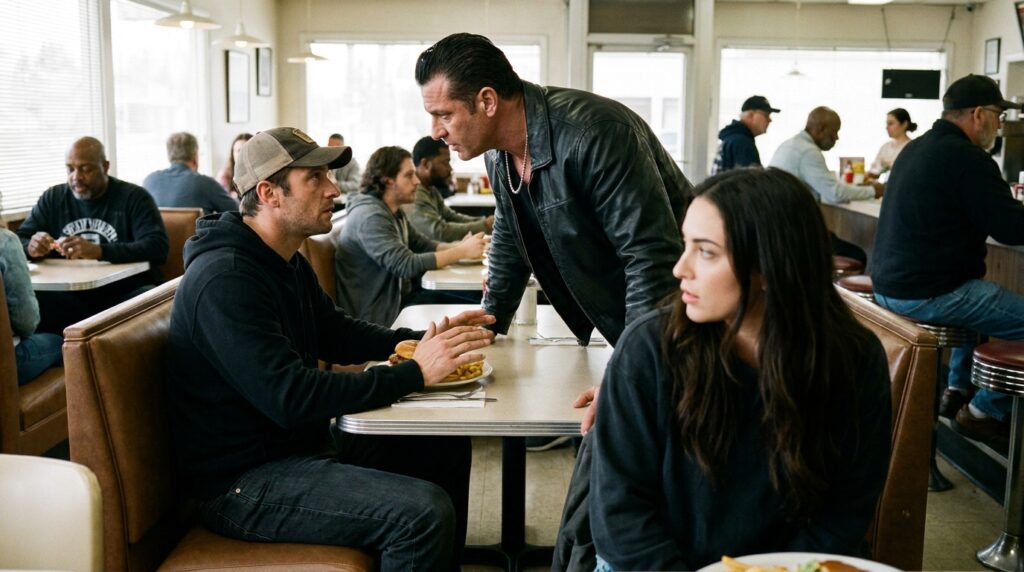
“You’re in my seat, old man,” the voice said. It didn’t invite an answer; it simply occupied the air above the laminate table like the exhaust of an idling diesel truck.
The leather of the challenger’s jacket creaked as he leaned into the booth lane. He didn’t touch the wood yet, but his shadow cut through the low, buzzing amber of the neon sign vibrating against the window pane. The smell came with him—stale tobacco, heavy pomade, and the sharp, chemical tang of cheap metal chains. A heavy silver link swung slightly from his neck, ticking against the zipper of his jacket.
I didn’t look up from the plate. The fork remained steady between my fingers, hovering an inch above the eggs. The grease on the white ceramic had already begun to coagulate into a dull, opaque film. The yolk was broken. A thumb—thick, calloused, with grease ground deep into the whorls of the print—pressed into the very edge of the table, right next to my paper napkin.
“You ruined my meal,” I said. My voice stayed low, vibrating against the inside of my teeth. “Now back off and leave it alone.”
Across the aisle, the subtle clinking of a heavy ceramic mug against a saucer stopped instantly. The silence didn’t spread; it dropped like an iron gate. A young woman three booths down froze, her hand pinned to the handle of her cup, her eyes locking onto the leather shoulder crowding my space. The low hum of the kitchen’s refrigerator unit seemed to grow louder, filling the sudden vacuum.
The challenger let out a dry, short breath through his nose. His knuckles turned white against the edge of the wood as he shifted his weight forward, his broad chest blocking the remaining light from the counter. “You think I give a damn about your breakfast? Get up before I move you myself.”
Internal calculations ran without my permission. Six inches of clearance between my shoulder and the window frame. Three feet of table surface to the edge of his belt. His balance was entirely forward, resting on his heels, his center of gravity compromised by the arrogant tilt of his torso. It was a common posture for men who used bulk to solve logic problems.
My left hand remained flat on the table, the silver ring on my ring finger pressing hard into the cold, sticky laminate. The jagged, chipped rim of my coffee mug sat just to the right of my thumb—a small, familiar fracture in the gray porcelain.
“I’ve had enough,” I said, my voice dropping an octave, flat and transactional. “Don’t make me put you down.”
The challenger didn’t answer with words. His shoulder hitched backward—the classic micro-telegraph of a man about to reach down and tear a body out of a seat. His fingers hooked into claws, descending toward the collar of my black hoodie.
The movement was loud, heavy, and full of friction. My fork went down, hitting the ceramic with a sharp, metallic ping that signaled the end of the negotiation.

CHAPTER 2: The Iron Law of Momentum
The challenger’s fingers never made it to my collar.
His forward lean was his undoing, a textbook error born of thirty years of clearing rooms through sheer mass rather than geometry. As his right hand lunged into the space above my plate, my left hand—the one resting flat against the sticky laminate—pivoted. I didn’t strike. A strike creates noise, a visible fracture that witnesses can categorize. Instead, I simply caught the meat of his thumb with my palm, shifting my torso exactly three inches to the left, inside the dead space of his reach.
Physics took the room’s oxygen. His momentum, built on two hundred and forty pounds of muscle and arrogance, met the immovable vector of a low center of gravity. My right hand left the chipped ceramic mug, slid beneath his extended armpit, and hooked the stiff leather of his jacket sleeve, pulling down and inward toward the booth’s edge.
It wasn’t a fight; it was a deployment of mass.
The scrape of his boots against the linoleum was loud, a screech of rubber on grease-slicked synthetic tile. Then came the sudden, heavy thud that rattled the diner’s framework. The challenger hit the floor face-first, his chin catching the metal molding of the lower booth frame before his torso slammed flat against the grime-crusted ground. The silver chain around his neck snapped, its links scattering across the floor like teeth.
The clinking of silverware in the back kitchen cut off cleanly, replaced by the low, rhythmic rattle of the exhaust fan.
I rose from the seat before his breath could return to him. The transition was smooth, my boots finding traction on the dry patches of the floorboards, my hands returning to my sides, fingers loose, palms open. I didn’t drop into a stance. A stance is an admission of intent; a stance tells the room you are willing to negotiate with violence. I stood simply, a shadow in a faded black hoodie, holding the lane between his prone ribcage and the table where my cold eggs still sat.
On the floor, the challenger gasped—a short, wet sound as the air was forced from his lungs through a mouth that had tasted the iron edge of the molding. He rolled onto his side, his face dark with a mix of blood and gray floor dust. His left hand clawed at the air, trying to find purchase against the leg of the table. I noticed then that the tip of his ring finger was missing, a clean, scarred truncation right above the first joint. It wasn’t an industrial accident; that was a surgical removal, the kind they do in field hospitals when the bone splits under a door frame.
“I told you,” I said, my voice remaining flat, devoid of the high-register vibration that comes with adrenaline. “I’ve had enough. Don’t make me put you down again.”
The young woman three booths down didn’t move. Her coffee cup remained suspended two inches above her saucer, her knuckles white, her jaw slightly unhinged as she stared at the bulk of the town’s enforcer lying beneath the boots of a man who looked like he belonged behind a warehouse loading dock. Beyond her, a pair of truckers in oil-stained hats slowly withdrew their hands from the counter, their eyes scanning the distance between the door and my shoulders. They weren’t looking for a fight; they were checking the exit vectors.
The challenger didn’t get up. He stayed on one hip, his breath coming in ragged, whistling gasps as his fingers found the broken chain on the floor. His eyes, small and red-rimmed under his slicked dark hair, looked up at me with something that wasn’t rage anymore. It was the sharp, cold clarity of a man who had suddenly run into a wall he didn’t know was built there.
“You’re… you’re from the third section,” he wheezed, his voice thick with saliva and gray dust. His right hand went to his ribs, checking the structural integrity of his cage. “You’ve got the ring.”
I didn’t look down at the silver band on my left hand, though the weight of it felt suddenly immense, an anchor pulling my hand down toward the floorboards. Instead, I kept my gaze fixed on the center of his forehead, the point where the skull is thickest and easiest to control.
“You have five seconds to get your feet under you,” I said, the words measured by the low, vibrating click of the neon sign behind me. “Then I’m going to consider your presence an active threat to my personal space.”
He didn’t use the table to climb this time. He rolled away, his leather jacket dragging against the grease-film of the floor, creating a dull, scraping sound that seemed to echo in the absolute silence of the diner. He reached into his pocket, his fingers fumbling with a cracked leather wallet that had slipped halfway out during the fall. As he pulled his hand away to press against his bleeding lip, a small laminated card slid from the billfold, landing face-up on the dirty linoleum right between my boots.
The light from the window was poor, filtered through layers of grime and cheap venetian blinds, but the blue seal at the top of the card was unmistakable. It was a standard Department of Defense Form 2, an active-duty identification card.
And beneath the plastic laminate, the faded digital photograph stared back at me with the severe, unblinking eyes of Colonel Marcus Vance—the man I had watched disappear into a burning command tent in the valleys outside Jalalabad ten years ago. The man whose flag I had helped fold.
The challenger saw where my eyes were fixed. He didn’t reach for the card. His hand froze, his missing finger joint twitching against his knee as he stayed pinned between the floor and my shadow.
“Stay down,” I murmured, my voice losing its transactional edge, replaced by something cold and rusted. “And walk away.”
CHAPTER 3: The Room Changes Tone
The laminated card didn’t move, but it seemed to pull the remaining warmth straight out of the diner’s floorboards.
Marcus Vance had been buried in Section 60 at Arlington. I had touched the brass handles of the casket myself, watching the rain pit the dark Virginia clay while a secondary lieutenant stumbled through a prepared citation about sacrifice and structural integrity. Yet here, three feet from a grease-filmed table leg in western Pennsylvania, his digital signature caught the flickering blue glare of a faulty lottery sign in the window.
The challenger didn’t scramble for it. His breath came in heavy, liquid rattles, his boots making a dry, scratching noise against the base of the booth divider as he dragged himself six inches backward. The missing joint of his ring finger twitched, a raw pink stub of scar tissue clicking against the zinc lining of the floor rail. He was waiting for a executioner’s follow-up that wasn’t coming.
My right boot moved first. The leather of my sole rasped against the floor, stepping over his outstretched forearm with a deliberate lack of haste. I came down directly beside the card, my shadow swallowing the digital face of a dead man. I bent at the knees, my spine remaining straight, my weight centered over my heels so that if he lunged, his forehead would meet the point of my kneecap before his hands reached my laces.
My fingers took the plastic. The laminate was cold, stiff, and carried the faint, bitter smell of industrial cleaning fluid. When I flipped it over, the magnetic strip on the back was raw—scratched through with three parallel lines made by a safety pin or a diamond scribe, obliterating the verification sequence. A standard trick for clean field disposal, but whoever did this had left the signature block untouched.
“Where did you pull this?” I asked. My voice didn’t rise above the low hum of the pie cooler by the counter.
The challenger spat a dark string of saliva onto the linoleum. His leather jacket bunched around his neck as he pressed his back into the partition, trying to make himself smaller than the space allowed. “It’s none of your business, operator. You’re out. The registry says you’ve been dry for two years.”
Across the aisle, the young woman had lowered her coffee cup, but she hadn’t released the handle. The ceramic was cold now; the steam had died two minutes ago. Her eyes traveled from the blood on the man’s lip to the tiny piece of plastic between my fingers, trying to read a language she hadn’t been trained to see. Beyond her, the two truckers had slid three dollar bills onto the counter, their stools creaking with a slow, agonizing groan as they stood up, their bodies lowered to avoid drawing focus. They moved toward the exit like men walking through a minefield.
“The registry is six months behind on everything,” I muttered, my thumb finding the rough edge where the laminate had begun to peel near the seal. “Who gave you the billfold?”
He didn’t answer. His teeth clicked together, a sharp, nervous vibration that he tried to hide by biting his lower lip. His eyes flicked past my shoulder, toward the kitchen doors where the smell of burnt grease had turned sour and heavy.
A shadow broke the light from the small glass window in the swinging door. The metal handle rattled, a slow, deliberate sound of iron sliding against an oiled latch.
The diner owner—a thin man named Miller with skin like yellow parchment and an old grease apron tied tight around his hollow middle—stepped out onto the floor. He didn’t have a spatula or a rag in his hands. His right arm was tucked low, hidden beneath the stained canvas of the apron, his elbow pinned to his ribs in a configuration that suggested four inches of steel or five rounds of low-grain lead.
He didn’t look at the challenger on the floor. He looked at the card in my left hand, then at the chipped rim of the coffee mug still sitting on my table.
“The truckers left through the side entrance,” Miller said. His voice was thin, dry, like paper being dragged across sand. “They won’t call the county sheriff. They know what kind of county this is.”
“What kind is that, Miller?” I kept my eyes on the challenger, but my left heel shifted half an inch to face the apron.
“The kind where people stay in their seats until the food is cold,” Miller said. He stepped three inches closer, his boots making no sound at all on the linoleum. The grease on his apron was old, layered like the bark of a pine tree. “Give him his wallet back, son. He’s just the delivery boy.”
The challenger let out a long, shuddering sigh, his body relaxing against the wood as if the cook’s presence had adjusted the atmospheric pressure in the room. He reached out with his left hand—the one with the missing joint—and held his palm open, waiting for the plastic.
I didn’t give it to him. I slid the card inside the pocket of my black hoodie, my fingers curling around the stiff edges until the plastic bent slightly against my knuckles. The weight of the silver ring on my finger felt solid, cold, a permanent piece of ballast in an unstable room.
“He ruined my eggs,” I said, my voice flat, looking directly at the old cook. “And Marcus Vance doesn’t have a delivery service.”
Miller’s elbow moved half an inch under the canvas apron. The sound of a spring-loaded cylinder clicking into place was distinct, a small, metallic snap that everyone in that room understood.
“He does now,” Miller said. “And you’re the one who just signed for the package.”
CHAPTER 4: The Hidden Layer Reveals Itself
The sound of that cylinder shifting beneath the canvas was a precise, high-density metallic click. It wasn’t the sloppy snap of a cheap commercial revolver. It had the tight, dry tolerance of a military-issued weapon—the kind of tool meant to work when submerged in gray swamp water or buried under six inches of silt.
Old Miller stood three feet away, his yellowed apron hanging like a funeral shroud over his thin knees. He didn’t raise his hand, but the shape beneath the cloth remained perfectly level with my sternum. The smell of burnt lard coming from his skin was suddenly colder, sharp as zinc.
“Drop the billfold on the formica,” Miller said. His jaw barely moved. The light from the ceiling fixture caught the deep, vertical seams beside his mouth, turning his face into an ancient piece of carved pine. “The card stays where it is. In your pocket. But the boy gets his leather back.”
The challenger on the floor let out a ragged, wheezing breath. His good hand clawed at his chest, his fingers leaving red, sticky smears across the zinc rail as he dragged his heavy frame upright against the wood of the booth partition. The pink stub of his missing finger joint vibrated against his knee like an engine piston running out of oil. He didn’t look at me anymore; he kept his eyes on Miller’s apron, his posture shifting from aggressive dominance to the miserable compliance of an animal that knew the exact length of its chain.
My right hand remained deep in the pocket of my hoodie, my fingers locked around the plastic edge of Marcus Vance’s identification card. The thin, sharp corner pressed into the meat of my palm, a steady reminder of physical reality. My left hand stayed on the table, an inch from the chipped rim of my cold coffee mug.
“You’ve been holding this transit lane a long time, Miller,” I said. The words were flat, heavy, dragging against the low rattle of the pie cooler. “Since before the valleys went red in ’16.”
Miller didn’t blink. A fly landed on the greasy brim of his paper cap, stayed for three seconds, and flew away toward the dead neon sign. “I don’t keep records of the years, son. I keep records of the weight. And right now, you’re making the floorboards groan.”
He took one slow step forward. The leather of his work boots had been oiled so many times the surface looked like wet coal, but they didn’t squeak. He used his left hand—the free one—to reach down and grab the challenger by the shoulder of his black leather jacket. With a single, dry hitch of his back, the old man hoisted the two hundred and forty pounds of muscle off the linoleum as if he were pulling a sack of grain out of a truck bed. It wasn’t brute force; it was the practiced leverage of a man who spent his life handling carcasses.
The challenger stood unsteadily, his boots slipping once on his own blood before he found traction. His hand fumbled along the edge of the booth, his fingers catching a heavy brass key ring that had fallen from his pocket during the drop. I noticed the key ring wasn’t standard commercial steel—it was a heavy, milled piece of aircraft aluminum, stamped with a seven-digit numerical sequence that had been filled in with black epoxy. A field-grade equipment locker lock.
“Get in the back,” Miller told him without turning his head. “The truck’s idling behind the ice machine. Take the timber road until you hit the blacktop.”
The challenger didn’t speak. He didn’t even look back at his dropped chain. He simply grabbed his keys, his boots making a heavy, wet clicking sound as he retreated toward the swinging kitchen doors. The wood slammed shut behind him, the small wire-glass window vibrating within its iron frame until the silence returned, thicker than before.
I didn’t move from the booth. My spine remained pressed against the hard timber of the seatback, my weight distributed evenly across my thighs. The room felt empty now, but the air was still tight, compressed by the invisible cylinder beneath Miller’s apron.
“He’s a loud boy for this kind of work,” I said.
“He’s local,” Miller replied, his hand finally relaxing an inch beneath the canvas. The shape of the barrel tilted down toward the floorboards, though his elbow stayed pinned to his hip. “Locals are stupid, but they don’t draw the state troopers. An outsider like you stays in a diner forty minutes too long, and people start wondering why the coffee tastes like iron.”
He walked over to the counter, his apron dragging against the stools. He reached behind the cash register—an old mechanical National model with brass keys—and pulled out a fresh ceramic mug. He didn’t fill it from the glass pot on the burner. He reached down into the lower cabinet, where the cleaning buckets were kept, and brought up a dark, unlabeled thermos bottle.
The liquid he poured was black, thick, and smelled of nothing but chicory and scorched tin. He slid the mug across the laminate toward my hand. It stopped exactly an inch from my chipped cup.
“Drink your coffee,” Miller said, his voice dropping into a dry, rhythmic register that sounded like a command from an old manual. “Then we’re going to talk about why the flag on Marcus Vance’s box was three inches short on the left-hand fold.”
My fingers froze against the cold porcelain of my original cup. The room seemed to tilt slightly, the desaturated gray light from the window catching the grease-film on the table until the world looked like an old tin photograph.
“The fold was perfect,” I whispered. “I held the corner.”
“The fold was an inch short because the man inside wasn’t six feet two,” Miller said. He leaned his hips against the counter, his thin arms crossing over the canvas apron, the weapon hidden completely beneath the folds of his past. “He was five feet ten. And he’s currently sitting in a concrete bunker three miles north of the toll gate, waiting for a clearance number you don’t have.”
The paradigm shifted beneath my boots, a silent, sickening drop. The card in my pocket felt heavier now, an active tracking beacon hidden in the cloth. I had spent two years running from the memory of a burial, only to find that the grave was empty and the country I was standing in wasn’t a home at all—it was just the perimeter.
Miller’s eyes locked onto mine, completely devoid of empathy, filled with the cold, pragmatic survival of the gray road. “You think you’re the driver here, son? You’re just the roadblock.”
The kitchen door behind him didn’t swing this time. It rattled once, a sharp, violent vibration as a heavy iron bolt was thrown from the outside, locking us both inside the grease-scented box.
CHAPTER 5: The Dynamic Deepens
The double-strike slam of the iron bolt outside the door didn’t vibrate through the air; it traveled through the structural steel of the floor, vibrating straight into the soles of my boots. A deadbolt thrown from the exterior didn’t mean a simple lockdown. It was an extraction seal. I had used the exact same sequence three times in Helmand to isolate contaminated extraction zones before the sweeps began.
Miller didn’t turn around to look at the door. He didn’t even adjust his posture against the counter. His thin arms remained crossed over his grease-stained canvas apron, his right hand still resting like a lead weight over the hidden barrel beneath the cloth. The desaturated gray light from the window pane caught the silver bristles on his jaw, making him look like part of the machinery he worked behind.
“The bolt is five-eighths hardened steel,” Miller said, his dry voice dragging against the low hum of the pie cooler. “It’s welded straight into the channel frame. A shoulder check will just crack your collarbone, son.”
My hand left my old ceramic cup, my fingers sliding across the cold formica until my palm flat-lined against the wood grain edge of the booth partition. My right hand remained deep inside my hoodie pocket, the laminated corner of Marcus Vance’s card biting into the meat of my thumb. The ring—my silver band—felt heavy, a cold ring of zinc around a finger that hadn’t pulled a trigger in twenty-four months.
“You’ve got a black network hub running under a truck-stop kitchen, Miller,” I said. The subtext wasn’t subtle anymore; it was an inventory. “The aircraft aluminum key ring the boy dropped. The Form 2 with the scraped mag strip. This isn’t a retirement community. It’s an unlisted staging lane.”
Miller reached down, his left hand grasping the dark thermos he had pulled from the lower cabinet. He didn’t lift it to pour; he simply held the base against the scarred laminate, his thumb tracing a horizontal notch ground into the steel casing—a field marking used to identify equipment containing encryption variables.
“The country doesn’t stop being a grid just because you hand in your kit,” Miller murmured, his eyes locking onto mine with the flat, unblinking clarity of an old logistics sergeant. “Vance didn’t fake the tent fire to save his skin. He faked it because the names on the third-section registry were being sold by the regional office before the ink was even dry. If he stays dead in Virginia, forty men stay alive in the timber.”
The room seemed to shrink, the sticky menus, the smell of chicory, and the ancient grease on the grill plates turning into a perimeter wall. Every interaction since I crossed the county line hadn’t been an accident of civilian friction; it had been a systematic drift toward a filter. The bully hadn’t chosen me out of arrogance; he had been the sweep, testing the threshold to see if the stranger in the black hoodie still carried the reflexive torque of the section.
“He’s three miles north,” I said, calculating the distance through the broken asphalt maps ground into my memory. “The old limestone quarry behind the toll gate. The extraction tunnel with the zinc vent pipes.”
Miller’s elbow twitched beneath the apron. The fabric bunched, a raw geometric fold revealing the clean, blued steel slide of an issue sidearm. “You always were too quick with the vectors. That’s why your file has three parallel strikes across the clearance block.”
He didn’t raise the weapon, but the tension between his hip and my sternum tightened until the air between us felt like solid iron. Beyond the glass window of the swinging door, a low, rhythmic thud began—the heavy, ungreased compression stroke of an old diesel generator kicking over in the crawlspace beneath the kitchen. The lights in the diner flickered once, the yellow neon lottery sign in the window dying completely, leaving only the dull, overcast winter light to illuminate the dust motes rising from the floor.
“The boy with the missing finger didn’t go to the truck,” I said, my body staying low in the booth, my thighs ready to take the weight of a sudden lateral break toward the kitchen lane. “He went to the breaker box.”
“He went to set the seal,” Miller corrected. He took his hand out from beneath the apron, leaving the weapon cold against his hip, and tossed a small, heavy object across the table. It slid through the grease-film, striking my cold egg plate with a dull, ceramic chime.
It was a standard military-issue earplug container—the small, olive-drab plastic capsule used during high-decibel ordnance disposal. Inside the clear plastic top, instead of foam, sat a tightly folded strip of yellow field paper, marked with three hand-drawn lines of grease pencil.
“That’s the clearance number for the gate,” Miller said, his voice dropping into a dry whisper as the generator’s vibration began to rattle the spoons inside their metal canisters. “But it only works if you’re the one delivering the boy’s leather jacket. And right now, the boy is waiting outside that door with an iron pipe and three cousins who think you’re a state witness.”
The victory of dropping the challenger two chapters ago wasn’t a win; it had been the trigger for an escalation I hadn’t prepared to fight. Every piece of data I had gathered was a false flag designed to lock me into a transit line I had spent two years trying to forget. I was the active driver, but the road had been built before I even bought my cap.
I reached out with my left hand, my fingers wrapping around the small plastic capsule, my thumb feeling the rough, unground seam of the injection-molded plastic.
“I didn’t come here for a registry, Miller,” I said, my voice flat against the growing roar of the generator beneath the floorboards. “I just wanted to finish my coffee.”
“There isn’t any coffee left, son,” Miller said, looking toward the side window as the first heavy shadow crossed the frosted glass from the timber lane. “There’s just the perimeter.”
CHAPTER 6: The Ultimate Baseline Resolution
The frosted glass didn’t shatter; it caved inward under the weight of an iron prybar, sending long, crystalline spears of ice-crusted laminate across the booth seat.
Time didn’t rush. Under the high-decibel hum of the basement generator, the physics of the room slowed down to the single, heavy stroke of an engine cylinder. A shadow crossed the broken sill—one of the challenger’s cousins, a large, thick-necked man in a grease-stained canvas jacket, his knuckles white around a lengths of two-inch galvanized plumbing pipe. The scale on the metal was rusted, flaky, and smelled of oxidized iron.
My left hand didn’t go for a weapon. It reached across the formica, my fingers hooking into the handle of my old chipped mug. The cold porcelain felt heavy, an extension of my forearm bone. As the pipe swung inward, a wide, clumsy horizontal vector meant to clear the table line, I didn’t back away. I drove my mass forward, sliding off the sticky vinyl seat into the dead space beneath his arc.
The mug met the bridge of his nose with a dry, hollow crack. The ceramic shattered into three clean pieces, but the weight of my step carried the remainder of the porcelain base straight into his collarbone, driving him back through the window frame into the wet gravel of the timber lane. Transmission fluid from an old crane idling behind the ice machine pooled in the ruts outside, its sharp, purple chemical odor cutting through the smell of lard.
Miller didn’t fire. He stood by the brass cash register, his arm remaining rock-solid under the apron, his eyes tracking the second shadow passing the roadside door. “The extraction tunnel isn’t going to wait for your lungs, son,” the old man said, his dry throat barely clicking over the noise of the generator. “The toll gate drops in twelve minutes.”
My boots found the floorboards. I didn’t trace the path toward the back kitchen where the iron bolt had been thrown. I took three fast, short steps toward the front entryway, my shoulder striking the reinforced center post of the double doors. The wood was old, its grain split by fifty years of mountain winters, but the hinges had been greased with heavy military molybdenum.
A single lateral torque of my right hip against the latch rail sheared the secondary brass screws from the molding. The door flew outward, the desaturated gray light of the Pennsylvania hills hitting my eyes like a flash charge.
The world outside was a study in rust and lime. The parking lot was filled with the gray, broken ballast of abandoned railway beds. Two hundred yards up the slope, where the timber line died against the sheer face of the limestone quarry, the zinc vent pipes of the old transit bunker rose through the weeds like rusted periscopes.
The challenger was there, his leather jacket dark with the grease of the floor, standing beside a rusted flatbed truck with his three remaining kin. They weren’t moving down the hill; they were locking the chain on the main approach gate, their eyes fixed on the ridge where the blue strobe of a state cruiser was already cutting through the winter mist two miles out.
They had trapped themselves in the entrance lane, thinking the perimeter was designed to keep me inside the box. They didn’t see the structural flow of the valley.
I reached down into the pocket of my hoodie, my thumb sliding over the small plastic earplug capsule Miller had tossed. The yellow field paper inside was cold, dry, and contained the three grease-pencil coordinates that would override the concrete lock north of the toll gate. Marcus Vance was up there, five feet ten inches of a dead man’s legacy, waiting in the dark for a third-section signature that had been erased from the official archives two years ago.
“Hey,” a voice called from the broken window behind me.
I looked back over my shoulder. Miller had stepped through the ruptured frame, his canvas apron now hanging loose over his belt, his old service pistol held down against the seam of his dark jeans. His parchment skin looked transparent under the gray sky, but his grip was steady, the muzzle pointing toward the limestone gravel between my feet.
“You left your cap,” the old cook said.
I didn’t reach for the bill. The cold wind from the ridge was already lifting the hair from my forehead, carrying the smell of coal smoke and frozen mud down from the summits. The simple black cloth cap remained sitting on the table next to my broken egg plate—a marker left behind for the state troopers to file away in an empty drawer.
“Keep it,” I said, my voice flat against the whistle of the valley air. “I’m out of the registry.”
I turned my back to the diner and began to climb the slope, my boots catching the sharp edges of the fractured stone, my fingers tightening around the clearance capsule. The generator beneath the kitchen floorboards gave one last, heavy shudder and died, leaving the mountain silence to reclaim the road. Behind me, the blue light on the highway grew closer, but the path into the timber was already dark, gray, and completely unmapped.
CHAPTER 7: The Limestone Quarry Threshold
The frost on the limestone ballast didn’t crunch; it sheared away like slate under the heavy tread of my boots.
The ascent was thirty degrees of loose, fractured stone, the remains of an old railway spur that had dead-ended into the mountain forty years ago. Every three paces, the scree slipped six inches backward, dragging against my ankles and forcing my thighs to carry the full, dead weight of the climb. My lungs tasted like iron—the sharp, cold sting of sub-zero altitude air mixed with the distant, sweet stink of unrefined diesel oil drifting up from the flatbed truck below.
Behind me, the main approach gate was a quarter-mile down the ridge. Through the skeletal mountain laurel bushes, the blue strobe of the state cruiser had reached the diner parking lot, its light reflecting off the chrome of Miller’s ice machine in rhythmic, silent pulses. They were looking for a body inside the box. They didn’t have their eyes on the timber line yet.
The challenger’s crew did.
A high, sharp yell cut through the wind from the eastern lip of the quarry. A hundred yards to my left, where the old wash-plant conveyor frame rusted into the clay, two figures in heavy orange hunting coats broke through the brush. One of them had a long, double-bit clearing axe held low by his thigh; the other carried a short, heavy iron breaker bar meant for unjamming stone crushers. They weren’t moving with the tactical precision of a team—they were scrambling, their boots sliding across the wet limestone as they tried to cut off the angle to the lower transit tunnel.
Internal calculations ticked behind my teeth. The distance to the vent pipes was eighty yards. My angle was cleaner, but the grade was steeper. My right hand remained stuffed inside the pouch of my hoodie, my fingers squeezing the olive-drab plastic container until the plastic seam creaked against my thumb. The yellow paper inside was my only currency.
I didn’t slow down to check their intervals. I dropped my center of gravity two inches, my torso leaning forward until my hands almost touched the frozen gravel of the bank, turning the climb into a low, four-point crawl. The skin on my knuckles caught the razor edges of the limestone flakes, leaving small, dark smears of rust-colored blood on the white stone.
The first cousin reached the lower housing of the conveyor belt thirty seconds before I did. He was winded, his breath coming in giant, white plumes that tore apart in the ridge wind. He didn’t use words; he simply raised the iron breaker bar with both hands, his shoulders bunching beneath his canvas coat as he stepped into the path, his boots planted on a flat slab of ancient grout.
The strike was vertical—clumsy, heavy, and reliant entirely on gravity.
I didn’t attempt a block. A block against forty pounds of solid iron will shatter a forearm regardless of discipline. I waited for the apex of his hitch, the split-second where his weight shifted from his hips to his wrists, then drove my left boot hard into the loose gravel at his feet. The scree gave way instantly. His base dissolved beneath his boots, his forward momentum carrying the iron bar inches past my right ear, where it buried itself four into the frozen clay with a dull, hollow thud.
My right elbow didn’t swing; it followed the straight line of my ribcage, driving upward into the soft meat beneath his chin.
The impact was short, dead, and carried the full force of my uphill lean. His teeth came together with a sound like dry twigs snapping. He went down sideways, his canvas coat catching on the rusted cotter pins of the conveyor frame, his legs sliding down the thirty-degree slope until he wedged against the lower roller assembly like a discarded tire.
The second man—the one with the clearing axe—stopped fifteen paces up the trail. He stood on a ridge of dark shale, the axe held across his chest, his red-rimmed eyes traveling from his cousin’s wedged boots back to my face. The wind caught his orange coat, making the fabric snap like a flag.
He didn’t advance. He saw my hands return to my pockets, my posture returning to that flat, unbothered stance he had misread in the diner booth.
“He’s inside,” the man with the axe said, his voice cracking under the cold. He didn’t point with the tool; he nodded toward the dark, rectangular mouth of the limestone adit twenty yards behind him. The opening was framed with rotting hemlock timbers, its lintel marked with a single, heavy cross drawn in black grease-pencil. “But you don’t have the log-code, outsider. Miller doesn’t give it to anyone who isn’t kin.”
I took the plastic capsule out of my hoodie, holding it between my index and middle finger so the grease-pencil markings on the interior paper were visible through the clear top. Three parallel lines.
The man with the axe lowered the blade two inches, his jaw tightening until the scar tissue on his throat turned gray. He didn’t say another word. He stepped off the shale path, his boots sinking into the deep mud of the drainage ditch as he ceded the threshold to the section.
The air inside the adit smelled different. It didn’t have the clean, frozen sting of the ridge; it was warm, thick, and carried the heavy, unmistakable alkaline weight of wet concrete, old copper wiring, and the bitter, chemical musk of ten men living on stored air.
CHAPTER 8: The Ghost of Section Three
The dark inside the hemlock framing was absolute for the first ten paces.
The warmth of the adit tunnel didn’t rise from heating elements; it bled directly from the earth, thick with the wet, chalky musk of crushed calcium carbonate and the sharp chemical decay of old copper wiring. My boots sank an inch into a soft trench of silt and grey drainage water that ran along the left-hand rail. A single line of standard-issue field telephone wire—unspooled from a canvas reel and held to the timber props by bent framing nails—brushed against the shoulder of my hoodie like a damp wire finger.
I didn’t turn on a light. A light inside an underground gallery is a target marker that travels five hundred yards before the beam disperses against the lime dust. I counted the strides by the rhythmic drip of condensation coming off the overhead rock face, my left hand extended until my knuckles dragged against the rough, split grain of the wet hemlock lagging.
At the eleventh stride, the tunnel curved sharp to the right, narrowing until the raw limestone ribs of the mountain squeezed the clearance down to four feet. The air changed here—the low, vibrating thud of the kitchen generator from the valley below was gone, replaced by a much heavier, subterranean frequency. A steady, rhythmic click-shove that signaled the cycle of a closed-circuit carbon dioxide scrubber, the kind they weld into the hulls of diesel-electric vessels or deep-tier strategic storage vaults.
The light appeared as a dull orange seam beneath an insulated field door thirty yards ahead. It wasn’t standard commercial timber; it was a salvaged hatch from a command van, its zinc handles polished smooth by the oil of human palms.
I stopped ten feet from the seal. The silence in the gallery was solid enough to hold a weight, but beneath the mechanical scrape of the scrubber, there was another friction—the precise, dry slide of an iron bolt being pulled back inside a well-oiled receiver.
“The grease-pencil mark on the lintel was changed six hours ago,” a voice said from the dark side of the orange seam.
The tone was level, thin, and carried the specific, clipped cadence of an instructor who spent twenty years speaking over the noise of tank engines. It wasn’t the voice from the grave at Arlington. It was older, the edges worn down by a decade of breathing the exhaust of underground ventilation units, but the structural rhythm remained identical.
“The boy with the missing finger joint was sloppy with his billing,” I said, my back shifting until my shoulder blades found a flat notch in the limestone rib. My right hand stayed inside the pocket, my thumb pinning the plastic capsule against my thigh. “He left his ID card on the linoleum down at Miller’s.”
The orange seam under the door widened. The zinc latch turned with a single, heavy metallic clunk that rattled the conduit pipe running along the overhead stone.
The man who stood in the hatchway didn’t look like a colonel. He wore a grease-stained wool sweater with frayed elbows and a pair of faded fatigue trousers that had been cut down at the cuffs to keep from dragging in the drainage water. His hair was completely white, cropped close to the skull, but his shoulders still held the rigid, vertical geometry of a man who viewed his spine as a structural column. His right hand was tucked into the pocket of his sweater, but the fabric was pulled taut, the shape of a short-barreled automatic weapon tracking my chest through the wool.
Colonel Marcus Vance looked down at the mud on my boots, his gray eyes unblinking behind a thin pair of wire-rimmed reading glasses that looked out of place against his scarred jaw.
“Miller told me you were dry,” Vance said. His voice didn’t rise. “He said you were sitting in a warehouse lot in Ohio, watching the trucks rust.”
“The trucks were clean,” I said. “The paperwork here isn’t. Your flag was three inches short on the left-hand fold, Colonel.”
Vance’s mouth twitched—a tiny, mechanical movement that might have been a smile ten years ago, before the command tent outside Jalalabad went into the clay. He stepped back from the hatch, leaving the zinc door swinging open into a small, concrete-lined chamber that looked like a signal bunker from the old cold war network. The walls were unpainted, sweating with gray condensation, and lined with iron equipment lockers that bore the same seven-digit stamped sequences as the challenger’s keys.
“The fold was short because we didn’t have time to measure the wood,” Vance said, turning his back to me as he walked toward a small iron field desk. He didn’t drop his hand from his sweater pocket. An equal intellect doesn’t surrender the angle just because the face is familiar. “The regional office sold the registry to a private clearance firm before our boots even cleared the tarmac. If I don’t go into the ground in Virginia, the whole section becomes a collection project for the treasury.”
The room was heavy with the smell of scorched kerosene from a small utility heater in the corner. On the desk sat three heavy ledger books with canvas bindings, their spines marked with the same black grease-pencil lines that I had seen on the quarry entrance.
“You’ve been running an unlisted transit lane for forty men,” I said, stepping through the hatch and letting my heels find the solid, dry concrete of the floor.
“Forty-three,” Vance corrected. He stopped by the desk, his left hand reaching out to touch a small, chipped ceramic coffee mug that looked exactly like the one I had shattered down at Miller’s. The handle had been reattached with dark, ugly industrial epoxy. “And every one of them is currently listed as a casualty of structural failure. You’re the first one who came back to check the measurements.”
He turned around, the wire glasses catching the orange glare of the kerosene wick, his eyes narrowing as he looked at my black hoodie. “The boy on the floor wasn’t trying to clear you out of the booth because he was stupid. He was testing the clearance blocks. He wanted to see if you still had the torque.”
“He found out,” I said.
“He found out you’re still an active driver,” Vance said, his right hand finally leaving his pocket, though his fingers stayed within three inches of the weapon on his hip. “Which means the registry is no longer contained. The state troopers down at the crossroads are only the first layer, son. The collection firm has two agents sitting at the toll gate right now, and they aren’t waiting for a clearance number.”
The false flag of the diner confrontation was gone, replaced by a much larger, colder grid. The man I had buried wasn’t a memory; he was the logistics manager of an off-grid prison, and the door behind me was the only exit left on the mountain.
CHAPTER 9: The Registry Sale
The epoxy binding the handle of the colonel’s mug was dark, uneven, and smelled faintly of vinegar and cured polymer. It was an unglamorous fix, the kind executed with a cold flashlight blade between shifts, meant only to keep the fluid from leaking onto the logistics desk.
I didn’t reach for the cup. My left hand moved to the edge of the iron desk, my fingertips tracing the coarse, rough canvas covering the three ledger books. The fibers were stiff, treated with paraffin wax to resist the damp limestone seepage that ran down the gray concrete wall five feet behind the colonel’s shoulder. When I drew the top volume toward me, the iron hinges of the cabinet behind us gave a low, dry whine—the sound of ungreased metal under pressure.
“Open it to the green separator,” Vance said. He didn’t drop his right hand from his side, but his weight shifted slightly off his heels, his wire-rimmed glasses catching the greasy amber light of the utility heater. “You’ll find your own allocation code next to the logistics stamp for Fort Meade. Two hundred thousand dollars, cleared through a holding firm registered in Delaware.”
The paper inside was heavy, double-weight ledger stock with vertical ink lines that had faded from purple to a dull, rusted gray. The columns were written entirely by hand—not in Vance’s standard left-leaning scrawl, but in the small, round, characterless script of an administrative clerk from the regional payroll depot.
My thumb caught the edge of the green cardboard divider. The sequence was there. My full name, my old deployment serial number, and a five-character alphanumeric routing block that ended in three parallel grease-pencil strikes. The exact same mark ground into the lintel above the tunnel mouth outside.
“That’s the disposal log,” I said. The words didn’t bounce off the concrete; they were absorbed instantly by the heavy, moisture-laden air of the cell. “This isn’t a transit registry, Marcus. It’s an invoice.”
Vance didn’t flinch at the use of his name. His white hair remained perfectly level beneath the low clearance of the structural ceiling beams. “A transit lane doesn’t run on air and well-wishes, son. Every mile of asphalt between here and the Ohio border costs four hundred dollars in fuel, blind eyes, and local enforcers who don’t ask why a black hoodie has blood on the cuff. The collection firm didn’t steal the list. They bought it from the man who gave you your retirement citation.”
The room seemed to rotate an inch on its axis, the chemical smell of the burning kerosene wick turning rancid against the back of my throat. The entire structure of my two-year exile—the quiet warehouse lot, the cold coffee in lonely diners, the belief that I was simply a piece of discarded military surplus left to rust—was an illusion. The section hadn’t been abandoned. We had been liquidated, item by item, to pay for the maintenance of the very grid we thought we were escaping.
“Miller knew,” I murmured, my thumb flattening against the dry paper till the ink left a gray shadow on my skin.
“Miller’s the one who negotiated the margin,” Vance said, his hand finally coming out of his sweater pocket, revealing the dull matte finish of a compact automatic pistol. He didn’t level the barrel; he simply rested the frame against the edge of the desk, his thumb pinned to the safety catch with professional casualness. “He stays in that kitchen because the state police don’t check the grease traps for serial numbers. But the buyers aren’t satisfied with the ledger anymore. They want the inventory cleared before the fiscal audit next month.”
A sudden, sharp vibration rattled the iron equipment lockers against the partition. It wasn’t the rhythmic thud of the crawlspace generator this time. It was a single, high-frequency impact from the primary adit tunnel—the distinct clink-shatter of a hemlock roof prop splitting under an external torque.
The second cousin hadn’t stayed in the drainage ditch with his axe. He had used the tool on the timber supports.
Vance’s eyes flicked to the orange seam under the door, his glasses slipping half an inch down his nose. The level of his voice didn’t rise, but the skin around his jaw turned the color of dry lime. “The collection crew just breached the wash-plant line. They aren’t looking for the registry, operator. They’re here to close the account.”
My right hand came out of my pocket, leaving the plastic capsule on the formica desk next to the epoxy-mended mug. My fingers were loose, my boots finding an even grip on the dry patch of concrete between the iron desk legs. The equal intellect opposite me didn’t move the weapon, but his shoulder hitched backward an inch—the identical micro-telegraph his enforcer had used down in the diner booth.
“The toll gate is three miles north,” I said, my voice dropping into the low, transactional flatline of the section. “And the flatbed truck doesn’t have the clearance numbers for the limestone track.”
“The flatbed is gone,” Vance said, his left hand reaching down to slide the top ledger into a coarse canvas sea bag. “And the only vehicle left with grease in the differential is the cook’s station wagon behind the coal bunker. You’ve got six minutes to decide if you’re a line item or a driver.”
The lock outside the steel hatch groaned—a long, agonizing shriek of rusted iron hinges being forced past their stop pins by a hydraulic spreader. The gray winter fog from the quarry began to pour beneath the orange seam, carrying the scent of wet shale and heavy machinery into the bunker.
CHAPTER 10: The Toll Gate Extraction
The steel hatch tore open with a sound like a small mortar detonation, the structural casing splitting along the old weld seams.
Fog didn’t crawl into the bunker; it erupted, a gray wall of cloud smelling of wet sulfur and unburnt premium gasoline. My boots hit the floorboards before Vance’s sea bag could clear the iron desk. I didn’t stop to verify the positioning of the collection crew. An entry team utilizing a hydraulic spreader doesn’t split their perimeter; they stack their files thick and fast along the primary center lane.
My mass went lateral. My shoulder took the lower wooden panel of a structural utility door hidden behind the iron filing lockers, the soft, rotting pine timber collapsing into a narrow coal chute that sloped thirty degrees down toward the subterranean drainage ditch.
The drop was raw friction—wet slate, stone coal dust, and the jagged edges of rusted iron reinforcement bars tearing at the sleeves of my black hoodie. I didn’t look back for Vance. The rhythmic, mechanical pop-pop-pop of an unsuppressed automatic weapon echoed through the concrete space behind me, the sound flattened and swallowed instantly by the heavy mud of the floor. He was an equal intellect; he had calculated his own exit vectors before he ever filled the first page of the ledger.
I broke out into the mountain air behind the coal bunker. The light was almost dead now, the desaturated winter sky turning the color of wet zinc. The cook’s station wagon—an old, salt-rusted Ford with wood-grain panels peeling away from the wheel wells—sat idling in a nest of frozen weeds. The exhaust was white, heavy, and smelled of bad valve seals and ancient fuel.
The door handle was cold, the latch mechanism stiff with frozen grease. I threw my mass behind the steering column, my left hand finding the gear lever while my right boot slammed the throttle down to the rusted floorboards. The differential didn’t catch immediately; the gears groaned, a dry, grinding shriek of unlubricated iron spinning through the slush before the bald rear tires bit the packed shale of the limestone track.
The track was three miles of broken mountain vertebrae. The wagon bounced violently, the suspension bottoming out against the stone axles with every ridge, the steering wheel kicking against my palms like a live wire. Through the cracked rearview mirror, the quarry was shrinking into a gray mist, but two separate sets of high-beam halogen lights had already cleared the wash-plant line, tracking my path down the mountain side with the steady, unblinking speed of a professional recovery squad.
They weren’t trying to box me in anymore. They were pushing the pace, forcing the station wagon to destroy its own oil pan against the rocks before we hit the concrete barrier at the highway junction.
The toll gate appeared through the pine branches two minutes later. It wasn’t a standard highway booth; it was an abandoned state forestry check station, blocked by an old counter-weighted iron pipe gate that had been locked down with a heavy logging chain. Beside the concrete island, where the old toll house rotted beneath the hemlocks, two men in identical gray storm coats stood waiting. They didn’t have rifles out; they had their hands stuffed deep into their pockets, their silhouettes completely motionless against the headlights of an idling black utility vehicle.
The physical reality of the section came down to an inch of steel.
My left hand went to the pocket of my hoodie, pulling out the olive-drab plastic container Miller had tossed across the diner table. I didn’t drop the wheel. I used my teeth to rip the clear cap off, letting the tightly folded strip of yellow field paper fall onto the oil-stained vinyl passenger seat. The grease-pencil lines were clear, but I didn’t look at them. I knew the sequence. Every regional block used the same base configuration—three numbers that correlated to the physical balance weights hanging from the gate’s rear lever.
I didn’t stop the wagon. I accelerated, the speedo needle vibrating wildly around fifty as the station wagon hit the flat concrete of the toll lane. The two men in the gray coats didn’t run; they stepped back exactly six inches, their hands remaining in their pockets as the rusted front bumper of the Ford missed their knees by the width of a finger.
I threw my weight to the right, sliding across the bench seat while my left hand jammed the transmission into park. The gears sheared with a sound like a buzzsaw hitting an iron spike, the entire vehicle fish-tailing across the concrete before slamming sideways into the rotted base of the toll house.
The impact threw my head against the passenger glass, the world fracturing into a brilliant, crystalline grid of pain, but my boots were already out the door before the glass could hit the floorboards.
The chain on the counterweight was five-eighths iron, scaled with orange rust that bit into the palms of my hands as I reached the gear assembly behind the tool shed. The lock housing was a solid block of zinc, stamped with the old Department of Transportation seal. Beneath the grime, three mechanical dial plates were ground into the metal—the old manual override for forestry blockades.
I spun the plates with my thumb, the skin on my print tearing against the cold iron notches. Four. One. Seven.
The heavy brass internal tumblers dropped with a single, clear clank that echoed over the roar of the oncoming halogen lights down the track. The massive iron pipe gate swung upward, its counterweights dropping into the pit with the slow, crushing dignity of an old guillotine.
The station wagon was dead, smoke pouring from the ruptured radiator grid in thick, oily plumes, but the highway lane was open. Beyond the gate, the empty asphalt of Route 6 ran straight and desaturated into the gray winter horizon, entirely devoid of traffic, completely unmapped.
I didn’t look back at the men in the gray coats. I didn’t look at the ledgers Vance had buried in the canvas sack. I stepped over the shattered links of the logging chain, pulled my black hoodie tight against the rising wind from the summits, and walked out past the perimeter into the open country.







