
The Architecture of Fading Echoes and the Belated Forgiveness Buried in the Quiet Places of the Heart
CHAPTER 1: THE WEIGHT OF THE REVERBERATION
“Sign the registry on line fourteen, Mr. Vance, and then the container is legally yours to touch.”
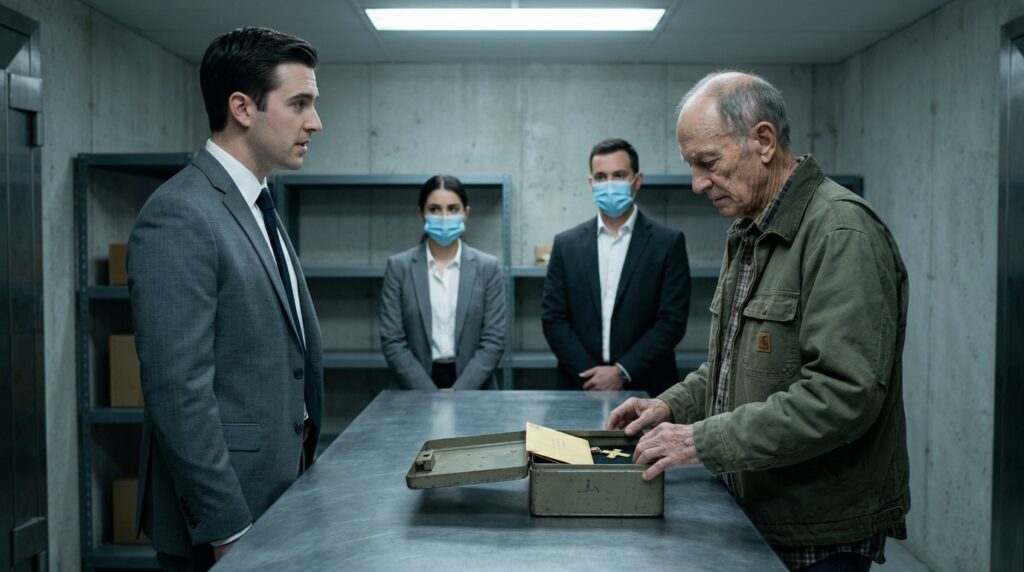
The young presenter didn’t look up from his pristine fountain pen. His grey suit was so stiff it didn’t seem to wrinkle when he breathed. Across the cold steel table, Thomas Vance let his hand rest on the worn olive canvas of his work jacket, his thumb tracing the deep, familiar crack in the bone handle of the pocketknife tucked inside his pocket. The air in the vault room smelled of dead air conditioning and frozen paper—a specific, preservationist chill that felt designed to keep things from rotting, or perhaps from living.
“I’ve spent fifty years waiting on your lawyers,” Thomas said, his voice a low, gravelly rasp that sounded like boots dragging over gravel. “Line fourteen can wait another ten seconds.”
Behind the presenter, two masked witnesses stood like granite statues against the white tile wall, their faces hidden behind identical blue cloth, their eyes unblinking. They weren’t here for comfort; they were here to ensure the gears of the probate court turned without grease.
The presenter finally lifted his chin, his posture perfectly upright. “The protocol requires verification of physical custody. We have established your identity through the discovery process. Please, open the box.”
Thomas looked down at the weathered metal lockbox resting between them. The green paint was flaking at the corners, revealing a dark, oxidized iron underneath. It was small—no bigger than a loaf of bread—but it held the exact shape of an anchor that had kept him dragged down in the mud of his own resentment since the winter of 1976. The brass latches were dull, coated in a fine gray dust that didn’t belong to this clean room.
His old fingers, scarred across the knuckles from forty years at the foundry, caught the edge of the clasp. The metal was freezing. When he lifted the lid, the hinge gave a sharp, dry shriek that cut through the silence like a razor.
The presenter leaned forward a fraction of an inch.
Inside, resting on a bed of dry, disintegrating purple velvet, lay two things: a thick, yellowed envelope sealed with a thumbprint of red wax, and a gold cross medal attached to a frayed blue ribbon. The gold wasn’t bright; it had the soft, oil-slick patina of a thing that had spent decades absorbing the dark.
The breath caught in Thomas’s throat, thick and metallic. His hand trembled, dropping back onto the table with a heavy thud. “She kept it.”
“The deceased specified this exact container remain sealed until the statutory limitation on the estate expired,” the presenter said, his tone softening by a microscopic degree, the formal edge catching on Thomas’s sudden fragility. “The letter is verified. It was written for you, Mr. Vance.”
Thomas didn’t touch the paper. He couldn’t. His mind was suddenly miles away, lost in the memory of a screen door slamming in the rain, of a suitcase hitting the dirt path, and the absolute certainty that he had been discarded like refuse. He had built his entire life—every bitter morning, every silent meal—on the foundation of that hatred. It was a sturdy house, hatred. It kept out the cold.
But looking at the cross, the way the ribbon was folded with precise, lingering care, the corners of his sturdy house began to rot. The room seemed to lose its sharp edges, the cold fluorescent light melting into a strange, heavy twilight that pressed against his chest.
“She told me she threw it in the river,” Thomas whispered. He wasn’t talking to the presenter. “She sat on the porch and told me there was nothing left.”
“People lie to protect what they cannot keep,” the presenter said quietly, reaching out with a gloved hand to slide the box an inch closer to the old man.
Thomas reached into the box, his rough skin snagging on the delicate, brittle paper of the envelope. As his fingers lifted it, the weight shifted unnaturally. The envelope was heavy, yes, but the bottom of the tin box didn’t sound hollow when his knuckle brushed the velvet. It gave a dull, solid click—the unmistakable sound of a double floor.
Thomas froze, his thumb pressing into the red wax seal. He looked up, his eyes meeting the presenter’s neutral gaze, realizing that the story hadn’t just opened; the floor beneath his feet had just dropped away.

CHAPTER 2: THE SUNSET IN THE REARVIEW
The heater in Thomas’s twenty-year-old sedan didn’t warm the cabin so much as it blew the smell of scorching dust and old oil directly into his face. He held the steering wheel with both hands, his knuckles white against the cracked black vinyl wrapper. On the passenger seat, resting on a frayed flannel blanket he kept for hauling tools, the green metal lockbox sat like an unexploded shell.
Every time the car bounced over a pothole on the interstate, the box shifted. And every time it shifted, Thomas heard it—not just the light rattle of the yellowed envelope against the tin sides, but that low, heavy thud from beneath the velvet lining. The sound of a secret with a basement.
The sky outside the mud-splattered windshield was the color of a bruised plum, the last bleeding edge of a November sunset fading into a cold, flat gray. The streetlights of the valley were just flickering awake, distant and dim through the haze of industrial exhaust. Thomas glanced at the box, then back to the road. His thumb automatically sought the split in the bone handle of the pocketknife in his jacket pocket, pressing until the edge bit into his skin.
He didn’t go straight back to the trailer. He couldn’t. Instead, he pulled into the gravel lot of the diner near the old foundry—a place where the coffee tasted like copper and nobody asked why your hands were shaking.
He left the box wrapped in the blanket, tucked beneath the seat, locking the rusted door with a heavy twist of the key. Inside the diner, the air was thick with grease and the soft, rhythmic sigh of the pie case compressor. He took a booth in the back corner, where the vinyl was patched with silver duct tape that caught the glare of the neon sign outside.
When the waitress dropped a thick ceramic mug in front of him, the steam rose in a lazy, curling spiral. He wrapped his palms around the porcelain, letting the heat seep into his stiff joints. His skin was dry, crosshatched with the fine gray lines of embedded iron dust that fifty years of soap hadn’t been able to wash away.
“You look like you saw a ghost, Tom,” she said, wiping the laminate table with a rag that smelled faintly of bleach.
“Just bureaucratic nonsense down at the county seat, Martha,” he murmured, his voice flat. He didn’t look up from the dark surface of his coffee. “Just paperwork.”
“The kind that keeps a man from breathing?” She paused, the rag hovering. She’d known him since his wife passed, since the foundry downsized him, since he became a fixture of the back booth. She knew the exact cadence of his silence.
“The kind that rewrites thirty years of dinner conversations,” Thomas said.
He didn’t touch the coffee. He waited until she moved down the counter to refill a trucker’s mug, then he reached into his breast pocket. He pulled out the yellowed envelope. He hadn’t opened it in the vault—he hadn’t given that sharp-suited boy the satisfaction of watching him break—but here, under the buzzing fluorescent tube, the red wax seal looked less like a legal boundary and more like a scab.
His fingers were clumsy as he broke the wax. It didn’t snap cleanly; it crumbled into tiny, dark red flakes that scattered across the laminate table like dried blood.
Inside the envelope were three pages of heavy linen paper, the edges soft and fibrous with age. The handwriting was elegant but hurried, the ink faded from black to a sepia brown that looked like it would dissolve if he breathed too hard on it. He smoothed the first page flat with the palm of his hand, his rough skin rasping against the texture of the past.
Thomas, the letter began. There was no greeting. No ‘my dear boy.’ Just his name, written with a sharp downward stroke that he remembered from the margins of old schoolbooks.
If you are reading this, the state has finally run out of reasons to keep my iron under lock and key. They will tell you this is an inheritance. They will tell you it is your right. I am writing this to tell you that it is a ledger of what I had to tear down so you could build something that didn’t smell like soot.
Thomas leaned back, the vinyl of the booth groaning beneath his weight. His breath came short. The subtext of his life had always been that she had left because he wasn’t enough—because the foundry wasn’t enough, because the valley was too small for her ambitions.
He forced his eyes down to the next paragraph, his heart hammering against his ribs like a trapped bird.
You will find the cross. It belonged to your grandfather before the war took his mind. But more importantly, you will find the record from the state registry dated October 12, 1976. I signed the absolute waiver of maternal relation. I stripped your name from my ledger. I told the court, and I told you, that I wanted no part of the life you were making.
Thomas dropped the paper. The words seemed to vibrate on the page. It was exactly what he had believed, but seeing it in her ink—seeing the confirmation that she had legally, purposefully severed the cord—felt like a second eviction. The diner around him seemed to recede, the clatter of silverware turning into a distant, underwater roar.
But then his eyes caught the final line of the first page.
The man who came to the house that night wasn’t an auditor, Thomas. And the debt wasn’t mine.
He picked up the page again, his hands shaking so violently the linen rattled. He turned to the second sheet, but the text there was fragmented, lines crossed out with heavy, angry strokes of the pen.
Thomas swallowed hard, a cold sweat breaking out along his hairline. He stood up abruptly, leaving a five-dollar bill on the table next to the untouched coffee. He stuffed the letter back into his jacket, his fingers brushing against the pocketknife.
He needed to get back to the car. He needed to get to the tool shed behind his trailer. The letter was a shield, but the box—the box had a double floor, and whatever was clicking underneath that velvet wasn’t a legal waiver. It was the real weight.
As he pushed through the diner’s glass door into the biting November air, the gravel crunching beneath his boots, he didn’t notice the dark sedan parked at the far edge of the lot, its headlights dark, its exhaust turning into white plumes in the cold. He only saw the green metal box waiting for him under the seat, a cold iron anchor demanding to be hauled to the surface.
CHAPTER 3: THE FRAGMENTED LINE
The gravel yard outside the trailer was choked with the skeletal remains of old machinery, their rusted gears half-buried in dead weeds. Thomas didn’t lock the sedan’s door this time; he simply grabbed the green metal box by its flaking handle and marched toward the porch. The cold night air lunged into his lungs, but the sweat on his neck remained hot. Behind him, the country road was silent, yet the phantom weight of that dark sedan from the diner lot seemed to linger at the edge of his vision like a smudge on a lens.
He kicked the screen door open. The interior of the trailer smelled of old newsprint and the winter squash he’d left on the counter to cure. It was a space designed for one man to grow old in without bothering anyone else—small, wood-paneled, and quiet.
He slammed the box down onto the Formica kitchen table, right beside an unwashed plate and an empty tin of tobacco. His breath came in ragged, uneven spurts.
“October twelfth,” he muttered, pulling the three pages of heavy linen paper from his jacket pocket. His fingers left gray grease smudges on the margins as he unfolded them under the low-wattage bulb of the ceiling fixture.
He bypassed the first page entirely, his mind rejecting the cold reality of the legal waiver, and focused his gaze on the second sheet. Here, the elegant penmanship deteriorated into a jagged scrawl, choked by thick, aggressive lines of India ink that completely obliterated entire sentences. It looked like someone had tried to drown the words after writing them.
Thomas held the paper directly up to the bulb, trying to bleed light through the black ink blocks.
…they came to the forge before the morning shift… he managed to decipher, his eyes straining against the yellow glare. …said the audit was just the beginning. If the boy stays on the deed, the liabilities will transfer. They don’t want the land, Thomas, they want…
The rest of the line was a solid bar of black.
He moved his thumb down, the split handle of his pocketknife pressing hard against his thigh through his trousers. The subtext of his life—the solid, concrete wall of hatred he had maintained against his mother for half a century—was fracturing. This wasn’t a story of a woman running away to the city because she hated the grime of the valley. This was a ledger of terms.
…I signed the waiver because a mother who hates you is a mother who cannot be leveraged, the scrawl continued near the bottom of the page. The court clerk took the bribe to file it under the closed probate archive. If you ever find this, it means the clock has run out on their paper. Do not look for me. Look at what is left in the iron.
Thomas dropped the paper back onto the Formica. The silence of the trailer was suddenly too loud, filled with the hum of the old refrigerator and the distant whistle of a train cutting through the valley floor. “Look at what is left in the iron,” he whispered.
He turned his attention back to the green box.
The yellowed envelope and the gold cross medal with its frayed blue ribbon were gone from the main compartment, left on the table. The interior of the box was empty now, save for the purple velvet lining that looked faded and threadbare under the light.
Thomas reached inside, his calloused fingertips pressing into the corners of the tin. He pushed downward, then laterally. Nothing moved. He leaned his weight into it, his knuckles popping.
With a dull, solid click, the right corner of the lining gave way.
The false bottom didn’t slide open smoothly; it was stuck with decades of accumulated grime and structural warp. Thomas pulled his pocketknife from his jacket, flicked the worn blade open with his thumb, and wedged the steel into the seam. He pried upward, the metal of the box groaning in protest until the velvet-covered tin plate popped loose with a sharp snap.
A small cloud of gray dust and dry rot escaped into the air.
Beneath the plate lay a secondary floor, barely half an inch deep. It didn’t contain money, nor did it contain land deeds. Nestled in the shallow dark was a folded piece of official government stationary, crisp and white compared to the linen pages, and a small, tarnished iron key with a square head.
Thomas didn’t touch the key yet. He reached for the paper, his heart hammering a frantic, uneven rhythm against his ribs. The letter had given him a decoy—the agonizing truth that she had intentionally disowned him to cut a deal with unnamed auditors. It was a devastating failure of everything he thought he knew, a revelation that made her look like a coward who traded her son for a clean ledger.
But as he unfolded the crisp white stationary, the heading at the top made his breath stop completely.
DEPARTMENT OF REHABILITATION AND CORRECTIONS – STATE ASYLUM NO. 3.
DATE OF ENTRY: OCTOBER 14, 1976.
Thomas’s eyes flew down the page, skimming past the clinical jargon until they locked onto the patient name and the diagnosis section. It wasn’t an audit. It wasn’t a financial liability.
Before his brain could fully process the words on the medical discharge form, the window behind him shattered.
A brick wrapped in heavy packing paper crashed through the glass, showering the Formica table and the old letters in a spray of glittering shards. The sudden blast of cold night air cut through the room, spinning the loose flakes of red wax across the floor.
Thomas instinctively dropped to his knees, his boots crunching on the glass, his hand gripping the bone handle of his knife as he stared up at the dark, broken square of the window, where the low hum of an idling engine could be heard out in the driveway.
CHAPTER 4: THE KINTSUGI EMBRACE
The glass didn’t stop singing as it settled into the floorboards. Outside, the engine roar didn’t accelerate; it simply remained a low, diesel growl in the dark, a shadow waiting to see if the warning had landed. Thomas lay pressed against the linoleum, the cold wind howling through the broken pane and biting through his work jacket. Beneath his chest, the white stationary from State Asylum No. 3 rattled against the floor.
He didn’t run. He didn’t hide. His old fingers reached out, sliding over the sharp shards, ignoring the slight prick of glass until his thumb locked onto the small, tarnished iron key with the square head. He pulled it close, alongside the medical papers.
The diesel engine outside suddenly engaged, tires spitting gravel as it pulled away into the valley night. They weren’t coming in. It was a parting threat—a reminder that the past had teeth. But looking down at the white paper under the glare of the swinging bulb, Thomas realized they were fifty years too late.
He crawled back to his knees, his joints popping like dry twigs. He ignored the wind. He ignored the blood on his knuckle. He smoothed the institutional form on the Formica table, right next to the scattered red wax.
The document was a forced commitment and an immediate medical discharge. Attached to it was an administrative addendum signed by the state conservator. It wasn’t a transaction of debt. His mother hadn’t sold him out. The corporate entity that had acquired the valley’s local foundries in 1976 had sought to claim the hereditary land rights tied to their family name. They had threatened to use her history of postpartum melancholy to declare her legally incompetent, which would have automatically transferred Thomas’s guardianship—and his inherited land signature—to a state-appointed trustee.
To save him from becoming a ward of an extraction machine, she had done the only thing that could sever the legal wire. She had voluntarily committed herself to the state facility, signed the absolute waiver of maternal relation to strip her name from his ledger, and vanished into the gray infrastructure of the state. She made herself a ghost so he could remain a person.
The waiver wasn’t an act of abandonment. It was a bunker.
Thomas sat back into the wooden kitchen chair, the paper shaking in his hand. The great, solid house of hatred he had lived in for fifty years didn’t just fall; it evaporated. The silence that followed was heavy, vast, and laced with a profound, terrifying grief. Every memory of her face—the stern lines, the sudden departure, the cold words on the porch—realigned. The coldness wasn’t indifference. It was the absolute, agonizing discipline of a woman trying to make a lie look permanent enough to fool a judge.
His gaze fell to the iron key. He knew what it fit. In the corner of the trailer sat his old tool trunk, an iron-bound chest he had carried from the foundry floor on the day he was laid off. It had belonged to her family before the foundries took over the valley.
He walked over to the corner, his boots crunching loudly on the broken window glass. He knelt before the trunk, his hands steady now. He inserted the square-headed key into the heavy, rusted padlock. It turned with a thick, greasy click that felt like a lock opening inside his own ribs.
Inside the chest, beneath the heavy wrenches and the grease rags, was a small wooden drawer. He pulled it out. Resting inside was a single, faded photograph of a young woman holding a child on a porch that no longer existed, her eyes tired but fierce, looking directly into the lens. Next to it was an old ledger tracking small, monthly payments made from a state asylum work program into an anonymous trust fund—a fund that had quietly paid off the taxes on Thomas’s trailer for three decades without ever bearing a name.
She had never stopped paying the price for his coordinates.
Thomas picked up the gold cross medal from the kitchen table, carrying it over to the chest. The blue ribbon was frayed, the gold tarnished and soft. He didn’t see the edges of a broken life anymore. He saw the seams where the break had been held together by sheer, silent will. He laid the medal beside the photograph, the gold catching the dim light of the trailer.
The wind still blew through the shattered window, scattering the old newsprint, but the chill didn’t reach his chest. The narrative of abandonment he had wrapped around himself like armor was gone, replaced by a devastating, beautiful reality. He was not the boy who had been discarded. He was the boy who had been defended at the cost of everything.
He sat on the floor, his fingers touching the faded texture of the photograph, finally allowing the decades of held breath to leave him in the quiet dark.
CHAPTER 5: THE COLD IRON RUN
The tail-lights of the dark sedan didn’t vanish down the state highway; they lingered at the junction where the gravel road dissolved into the river marsh, two bleeding pinpricks in the low hanging fog.
Thomas didn’t stay on the floor. The grief was there, heavy and raw behind his ribs, but forty years of working the floor at the foundry had taught him that when an iron pipe bursts, you don’t look at the flood—you find the valve. He shoved the crisp white asylum document deep into his olive work jacket, his fingers brushing the cool, reassuring bone handle of his pocketknife. He grabbed the heavy flashlight from the counter, its aluminum casing dented and cold, and stepped through the ruined kitchen frame into the night.
The November wind hit him like a wet sheet. The gravel yard was a desaturated maze of grey and iron, the shapes of old engine blocks looking like hunks of fallen stone in the twilight. His boots crunched hard against the stone as he walked toward the front gate.
He didn’t go to the highway. He stopped near the mailbox, where the brick had been hurled.
The packing paper that had been wrapped around the stone was caught in the brambles of a wild blackberry bush, flapping softly like a wet wing. Thomas lunged his hand into the thorns, ignoring the sharp scrape against his forearm, and tore the paper free. He shone the flashlight’s yellow beam across the wet surface.
It wasn’t newsprint. It was a page from a county land registry index, dated three weeks ago. Stamped across the top in a faded, purple ink was a corporate registration number: V-76-ASSET-MGMT. Below it, a single line of text was highlighted with an old grease pencil—the legal description of the five-acre parcel his trailer sat on. The land his mother had broken herself to keep out of their ledger.
A low, scraping sound from the ditch across the road made him drop the beam.
The light caught the wet weeds, then the chrome trim of an old fender half-buried in the mud. A figure was standing by the culvert. It wasn’t the slick young presenter from the vault, and it wasn’t a corporate suit. It was an old man—perhaps five years younger than Thomas—wearing a grease-stained mechanic’s uniform with the name GREG stitched over the pocket in faded red thread. His face was gray, his skin hanging loose around a jaw that looked like it had been broken and set wrong decades ago.
“You shouldn’t have signed for that box, Tom,” the man said. His voice was wet, rattling with a smoker’s cough that ended in a sharp wheeze.
Thomas kept the yellow beam fixed directly on the man’s eyes, forcing him to squint. “Who sent that sedan, Greg? You’ve been running the service station at the crossroads since my mother left. You knew what was in that vault.”
Greg didn’t look away from the light. He spat a dark stream of tobacco juice into the mud at his feet, his fingers twitching against the seams of his trousers. “The vault was dead paper until the probate clerk cleared the archive last month. The people who bought the foundry assets back in seventy-six… they didn’t disappear, Tom. They just changed their name on the letterhead. They’ve been waiting for the statutory lien to expire. If you keep that box, they’ll file for the reversionary title by Monday morning.”
“She went to the asylum to stop them,” Thomas said, his rasp dropping an octave, the hard iron of his voice cutting through the wind.
“She went there to hide the signature,” Greg snapped, taking one step out of the ditch, his rubber soles slipping slightly on the wet clay. “But she left a ledger, didn’t she? The trust fund. The tax receipts. If those papers show they used the state facility to force her incompetence, the whole county acquisition from seventy-six comes unglued. They don’t want the land, Tom. They want the burn.”
“The burn?”
“They want the papers in that box turned to ash before the court opens on Monday,” Greg whispered, his eyes shifting toward the highway where the sedan’s lights had finally gone dark. “The boy from the vault… he wasn’t just an administrator. He was the scout.”
Thomas didn’t answer. He turned the flashlight off, plunging the yard into a sudden, suffocating dark. In the distance, the low hum of the idling sedan engine began to move again, turning around at the crossroads, its high beams catching the mist as it pointed back toward the trailer.
He had forty-eight hours before the county court opened. He had an iron key, a photograph of a woman he had hated for fifty years for all the wrong reasons, and a corporate entity coming down the asphalt to finish a foreclosure that had started before he had grey hair.
He turned back toward the trailer, his mind calculating the weight of the iron tools in his trunk. He wasn’t going to hide in the bunker anymore.
CHAPTER 6: THE SHADOW INTERSECTION
The twin cones of light from the highway didn’t just illuminate the road; they sliced through the hanging fog, throwing long, skeletal shadows of the junked machinery across the trailer’s aluminum siding. Thomas moved in the dark, his boots knowing every uneven hummock of frozen earth, every buried tire rim. He slipped through the screen door frame just as the sedan’s high beams washed over the front gate, turning the shards of his broken window into a constellation of cold, glittering points.
Inside, the wind was still whistling through the glass. Thomas didn’t turn on the kitchen light. He navigated by the pale gray glare filtering through the broken window, approaching the Formica table where the green lockbox lay open like an empty ribcage.
His fingers found the tarnished iron key with the square head, then the white asylum document, and finally the old ledger sheets he had recovered from his tool trunk. He stuffed them all down into the lining of his olive work jacket, zipping it up to his throat. The fabric was stiff, smelling of grease and the cedar chest where it had spent the summer. It felt like armor, but it was thin against the freezing draft.
“Greg’s wrong,” he whispered into the dark.
He pulled the pocketknife from his trousers, running his thumb over the split handle. Greg had said they wanted a burn. He had said the company wanted the records of the trust fund destroyed before Monday morning to protect the county land acquisitions. But the ledger pages Thomas had pulled from the tool chest didn’t just show money moving; they showed a series of signatures from the local notary public in 1976—signatures that authorized the transfer of the foundry assets while his mother was locked inside State Asylum No. 3.
And one of those witness signatures belonged to a younger shop steward named Gregory Miller.
The realization didn’t come with anger; it came with a dull, sickening weight, like a blow to the solar plexus. The shared burden of the valley’s decay wasn’t just a matter of corporate greed. It was a network of small betrayals, executed by tired men in laborers’ clothes who had been offered a way out while others were buried in the gray infrastructure of the state. Greg wasn’t standing in the ditch to give a friendly warning. He was standing there to see if the brick had done its work.
The sound of car doors clicking shut outside cut through his thoughts. Two distinct thuds. Not slammed, but closed with the quiet, heavy precision of expensive metal.
Thomas knelt behind the kitchen counter, his vision adjusted to the desaturated gloom. Through the broken window pane, he watched two figures advance up the gravel path. One was the young presenter from the vault, his sharp grey suit now covered by a dark wool overcoat that absorbed the light. The other was taller, broader, his face obscured by a low-brimmed hat. They walked slowly, their feet crunching methodically on the stones.
“Mr. Vance,” the presenter’s voice called out, perfectly modulated, carrying easily over the sigh of the wind. It lacked the cold bureaucracy of the vault room; it was conversational now, almost warm. “We know you’re inside. We left our vehicle at the crossroads to avoid causing an unnecessary disturbance in the neighborhood.”
Thomas didn’t move. He pressed his back against the lower cabinets, the bone handle of his knife digging into his palm.
“Gregory tells us you’ve opened the lower compartment,” the presenter continued, his footsteps stopping at the edge of the porch. The floorboards groaned—a familiar, dry protest that Thomas heard every morning. “The state probate office is a complicated machine, Mr. Vance. Mistakes are made in the archiving of old corporate liabilities. We are prepared to offer a private settlement that addresses the oversight regarding your mother’s care. Substantially more than the land itself is worth.”
The subtext was clear as a bell. The decoy was the land title; the real threat was the exposure of a fifty-year-old institutional conspiracy that could bankrupt the holding company if the state registry was forced to audit the 1976 acquisitions. They thought he was a pragmatist. They thought forty years at the foundry had left him tired enough to take a check and buy a warmer house somewhere else.
“I have the ledger,” Thomas called out, his gravelly rasp cutting through the broken windowpane. He didn’t rise. He kept his head below the level of the Formica counter. “I see the witness lines from October seventy-six, son. I see Greg’s name.”
A brief silence descended on the porch, thicker than the fog.
When the presenter spoke again, the professional warmth had completely vanished, replaced by the flat, indifferent tone of a machine that had encountered an obstruction. “Gregory was a young man with a family to feed during the layoffs, Mr. Vance. Most people in this valley made choices they aren’t proud of. But a ledger without an official certification from the state archive is just an old book. If you don’t return to the vault office with us tonight to complete the formal verification, the estate will simply be tied up in litigation until neither of us is alive to see the conclusion.”
The shadow of the broader man shifted, the silhouette of an iron crowbar catching the faint neon glare from the highway down the road. They weren’t waiting until Monday. They were going to take the box, the paper, and the ledger right now, and the valley would simply record another old trailer fire caused by a faulty space heater in November.
Thomas gripped the knife tight, his eyes tracking the line of the floorboards toward the back door. The primary action wasn’t here in the kitchen anymore; the narrative had evolved into a calculation of endurance. He had to reach his car, but the keys were on the hook by the front door—exactly three feet from the broken window where the presenter stood.
CHAPTER 7: THE REVERBERATING END
The shadow with the crowbar moved first, its boots crunching heavily into the gravel directly beneath the window frame. Thomas didn’t look up to track the silhouette. He didn’t need to. In the foundry, if you watch the slag instead of feeling the heat on your skin, you’re already burned.
He didn’t reach for the keys on the hook. That was the choice they expected—the predictable scurry of a cornered animal. Instead, Thomas rolled his weight backward, his spine scraping the rough pine veneer of the lower cabinet until his boots found purchase against the steel frame of the propane stove. He kicked out with his right heel, hard, driving the base of the old appliance directly into the copper gas line behind it.
The pipe didn’t snap—he didn’t want a spark—but the old brass valve hissed, a sharp, cold plume of pressurized gas venting straight through the floorboards toward the porch.
“Miller!” Thomas shouted, his voice a gravelly roar that rattled the broken glass remaining in the frame. “You tell this suit what happens when a match hits the floorboards of an uninsulated single-wide! You tell him if he wants to burn the ledger, we can do it while we’re all standing on the pile!”
The footsteps on the porch stopped instantly. A muffled oath came from the broad man with the iron bar. Through the gap beneath the Formica counter, Thomas saw the presenter take two steps back, his pristine leather shoes slipping on the wet wood of the steps.
“Mr. Vance, let’s not be foolish,” the presenter called out, though his cadence had shifted up, the professional ice cracking under the immediate, kinetic threat of an explosion. “There is no profit in mutual destruction.”
“I’ve spent fifty years living in the destruction you people left behind,” Thomas said. He didn’t look at the window; he kept his eyes on the small wooden drawer from his tool chest, which he had dragged into the narrow space between the counter and the stove. His hands were steady as he reached inside, sliding his thumb over the frayed blue ribbon of the gold cross medal, then wrapping his fingers completely around the tarnished iron key with the square head.
He wasn’t going to run to the car. He didn’t have to leave the yard to win the Monday morning deadline.
Outside, Greg’s voice rose from the dark of the ditch, cracking with a wet, ragged cough. “He’s not bluffing, kid! The old man’s worked the furnaces since before your father had a desk! He knows exactly how much iron it takes to crush a room!”
“Gregory, quiet,” the presenter snapped, but the authority was gone from his tone. The subtext had fully dissolved. They were no longer representatives of a slow, indifferent legal probate; they were predators who had realized the prey had dug into a bunker lined with black powder.
Thomas used the distraction to slide toward the narrow hallway that led to the utility closet at the back of the trailer. He didn’t break line of sight with the front window until he was clear of the kitchen. The floorboards here were soft, the carpet fraying at the edges where thirty years of tracking grease had rotted the fiber. He reached the heavy iron door of the old cast-iron floor safe—the one his grandfather had sunk into the chassis of the trailer when the county first re-zoned the valley.
The lock was stiff, its tumblers dry and clogged with lint. Thomas inserted the square-headed iron key into the slot. It didn’t turn at first. He braced his shoulder against the particle-board wall, his rough palm pressing into the cold iron handle until the mechanism gave a deep, metallic thud that resonated through the steel frame of the entire structure.
Inside the safe wasn’t a weapon. It was an old, land-grant deed box, sealed with the official ribbon of the state circuit court from 1974.
He pulled the ledger from his jacket, along with the white stationary from State Asylum No. 3. He didn’t try to hide them again. He placed them directly inside the open deed box, right next to the original registry page that bore Gregory Miller’s young, compromised signature. Then, he didn’t turn the key to lock it. He left the safe wide open, the yellow beam of his flashlight illuminating the documents clearly for anyone standing in the hallway.
He walked back to the kitchen, his posture no longer stooped. He stood up straight, his head and shoulders visible through the broken window frame, looking out into the misty twilight.
The presenter was standing at the bottom of the steps, his hands raised slightly away from his dark wool overcoat, his face pale under the neon glare from the highway. Behind him, the broader man had lowered the crowbar, his shoulders slumped in the posture of a laborer who had realized the foreman was no longer looking.
“It’s already filed,” Thomas said, lying with the absolute, unblinking precision of a man who had spent forty years validating structural tolerances. “The court clerk didn’t bribe just one person in seventy-six. My mother kept duplicate copies of the asylum admissions log in the parish registry. The notary verified the signature match three hours before I ever went to your vault room.”
The presenter stared at him, trying to read the micro-expressions on Thomas’s scarred face. But there was nothing to read. The old man’s face was like the iron plates at the bottom of the forge—calcified, dark, and marked by fires that had gone out decades ago.
“You’re bluffing,” the presenter whispered.
“Try me on Monday morning, son,” Thomas said softly. “But until then, you’re trespassing on a parcel that’s under an active probate injunction. Gregory knows the sheriff’s name. He knows how long it takes for the county cruiser to get from the crossroads when an old worker calls in a break-in.”
Gregory didn’t move from the ditch. He just looked down at his boots, his hands buried deep in his grease-stained uniform pockets, his shoulders shaking with another silent, defeated cough. He knew the paper was real. He knew that once the light got into the iron, there wasn’t enough grease in the valley to slide the door shut again.
The presenter looked at Thomas for five long seconds. Then, without another word, he turned on his heel, his leather shoes crunching sharply as he walked back toward the dark sedan waiting at the crossroads. The broad man followed him, the iron crowbar trailing in the dirt behind him like a broken wing.
Thomas stayed at the window until the red tail-lights disappeared into the valley fog for the final time. The wind was still cold, the smell of pressurized propane faint but clearing as the draft carried it away through the shattered pane.
He reached into his pocket, his fingers finding the photograph of the young woman on the porch. The textures were faded, the edges fraying, but the internal architecture of his life was finally solid. The house of hatred had been torn down, and in its place, the quiet, golden echo of a sacrifice had taken root in the iron.
He turned back to the kitchen table, picked up his cold coffee, and took a long, slow sip.







