
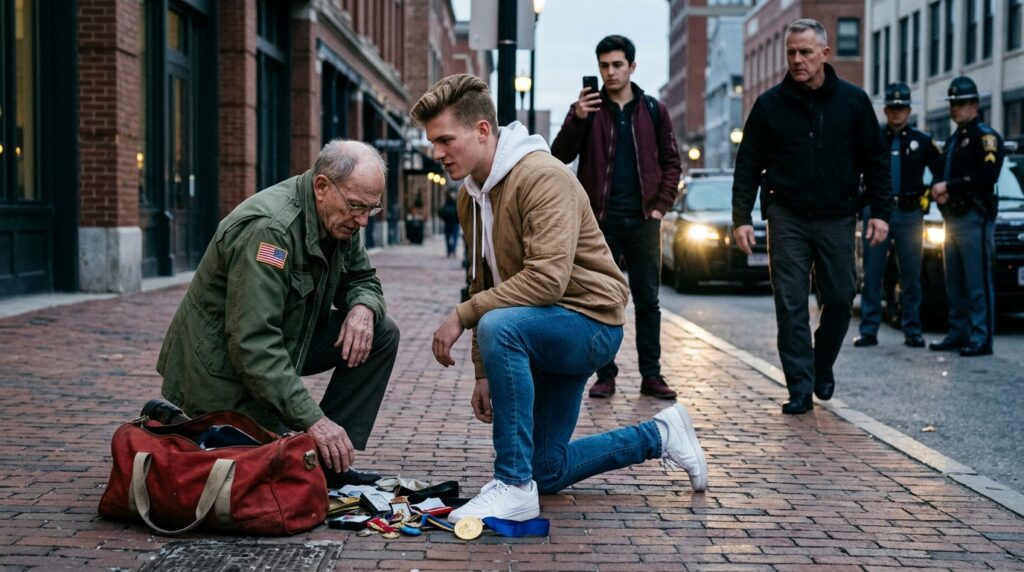
The Weary Threshold of Honor and the Heavy Friction of a Forgotten Generation

CHAPTER 1: THE GRAVITY OF COLD BRICK

The edge of the white sneaker was close enough for Arthur to smell the chemical sting of new rubber over the scent of damp exhaust. Dusk was flattening the city into shades of iron and slate, and the brick sidewalk beneath his knees felt like dry ice eating through the worn fabric of his trousers. His fingers, stiffened by age and the creeping chill of a November evening, fumbled against the rough canvas of the ruptured red duffel. The split seam gaped like a mouth, spilling yellowed envelopes, a plastic comb, and the heavy brass medal that gleamed dully under the oncoming glare of a delivery truck’s high beams.

“Move the junk, old man,” the voice above him dropped down, thick with the easy, unearned weight of twenty years and a full stomach.

Arthur didn’t look up. To look up was to acknowledge the vertical scale of the street, the towering presence of the tan bomber jacket, and the small, rectangular glass eye of the phone held steady a few paces behind them. He focused instead on the blue ribbon. It was frayed at the edges, the silk stiffened by decades of dust and drawer liner. He reached for it, his thumb catching on a loose thread.

The sole of the white shoe shifted, the shadow of it blotting out the metal. “I said, you’re blocking the right of way. Some of us actually have places to be.”

A low rumble cut through the ambient rattle of the city—the synchronized idle of three dark utility vehicles pulling hard against the curb. The blue-and-red strobes didn’t flash with cinematic brightness; they cut through the heavy gray air in sharp, rhythmic pulses, painting the rusted fire escapes above in bruised colors.

The click of a heavy car door latching shut was the only warning. Then came the boots—not the hurried stride of a pedestrian, but the measured, deliberate cadence of leather soles with institutional momentum behind them.

“Step away from the medal.”

The command wasn’t shouted, but it possessed a cold, metallic resonance that made the air feel instantly thinner. The young man in the tan jacket didn’t move at first, his smirk hanging onto his face by a thread of stubborn habit, but his shoulders went rigid.

Captain Miller stepped into the perimeter of the headlights. His dark zip jacket was pulled tight against the wind, the clean line of his jaw shadowed by the blue strobe light. Behind him, four state troopers formed a silent, gray wall, their hands resting naturally near their belts, their faces empty of expression. They didn’t look at the crowd; they looked at the spaces between the people.

“I didn’t hear a license to loiter, Captain,” the young man muttered, though his foot drifted back an inch, the rubber scraping against the brick with a sharp hiss. “We’re just talking.”

“You’re done talking,” Miller said. He didn’t look at the boy. His eyes were locked on the gold star lying on the pavement between them. A strange, sharp crease formed between Miller’s brows—a look that wasn’t just professional anger, but something old and bitter, like iron left out in the rain. “Pick it up, sir.”

Arthur’s hand closed around the cold brass. The weight of it was familiar, but the texture was wrong against the gritty sidewalk. As his fingers lifted the ribbon, his eyes caught the small, engraved serial number on the reverse side—a sequence of numbers that didn’t match the regiment he had served with, a detail hidden beneath the tarnished eagle that he had never intended for the light of a city street to hit.


CHAPTER 2: THE PERIMETER OF RUSTED IRON

The brass eagle felt like a shard of river ice pressed into Arthur’s palm. He slid it deep into the flannel lining of his field jacket pocket, his thumb dragging across the sharp, raised edges of the engraved serial number. It wasn’t his number. The weight of that difference felt heavier than the metal itself, a small, jagged lie hidden in a pocket full of fraying history.

Around them, the city street had grown small. The four state troopers didn’t push the gathering crowd back with loud commands; they simply widened their stance, their heavy boots grinding the salt and grit against the frozen brick sidewalk. Their presence was a wall of gray wool and dull leather that smelled of gun oil and wet pavement. The idling engines of the utility vehicles rumbled in the background, a low-frequency vibration that rattled the loose glass in the storefronts and vibrated through the soles of Arthur’s boots.

Captain Miller remained motionless, a silhouette carved from the oncoming glare of the high beams. His eyes didn’t follow the young man in the tan bomber jacket, who was now stepping backward, his clean white sneakers scuffing the dirtied curb. Miller’s gaze stayed fixed on Arthur’s hand—or rather, the pocket where the medal had vanished.

“Sir,” Miller said, his voice dropping into a register meant only for the space between them. “The bag.”

Arthur didn’t answer immediately. He reached down to gather the split nylon handles of the red duffel. The cheap material groaned under the strain, the torn seam widening to reveal the corner of a grease-stained logbook and three bundles of letters tied with rotting green twine. The friction of the coarse canvas rasped against his calloused skin, leaving thin, white tracks on his knuckles. He didn’t want the state’s help. He didn’t want this clean-shaven officer looking into the grease and iron of a life that had been dismantled thirty years ago.

“I can carry my own gear,” Arthur muttered. He braced his weight against the iron lamp post, the cold metal biting through his sleeve as he hoisted himself up. His knees clicked—a dry, acoustic reminder of rain-soaked trenches and concrete floors.

The young man in the tan jacket had reached the edge of the trooper line, his casual arrogance souring into something sharper as he realized the crowd wasn’t backing him up. The boy in the burgundy jacket was still there, his hands steady as the smartphone screen flickered, capturing the precise geometry of the encounter: the stooped veteran, the unyielding captain, the blue-and-red strobes painting the brickwork in shades of emergency.

“Hey,” the tan jacket barked, his voice cracking slightly against the cold air. “He was blocking the path. We’ve got rights to the walkway. You can’t just park three rigs on a city curb because some old guy dropped his groceries.”

One of the troopers shifted his weight, his shoulder turning just enough to block the boy’s view of Miller. The movement was silent, practiced, and absolute.

Miller didn’t look back. He took half a step forward, his boot coming down on a discarded metal bottle cap, crushing it into the grit with a dry crunch. “Get him into the transport,” he told the trooper nearest to him. He wasn’t referring to Arthur. He was looking at the boy with the phone.

“Whoa, hold on,” the recording bystander said, his hands dropping an inch as the shadow of a trooper fell over his screen. “This is public space. I’m allowed to film.”

“You are,” Miller said, his tone perfectly flat, devoid of anger or empathy. It was the voice of a machine that had been running on the same gears for thirty years. “And the Commonwealth is allowed to secure evidence of an administrative obstruction during a transit detail. Take the device.”

The transition was fast—no shouting, no cinematic struggle, just the heavy lever-action of authority. A trooper’s hand closed over the top of the phone. The boy in the burgundy jacket pulled back, but his boots slipped on the wet brick. For a second, the scene was nothing but the sound of hard plastic scraping against leather gloves and the low hiss of the truck exhaust.

Arthur watched from the shadow of the lamp post, his hand still clamped over the medal in his pocket. He knew that look on Miller’s face. It wasn’t the look of a man enforcing a city ordinance. It was the look of a hunter who had found a familiar footprint in the mud. Miller wasn’t looking at a random street hassle; he was looking at an ignition point.

“Captain,” Arthur said, his voice thin but clear enough to cut through the idle of the diesels. “Let the kids go. It’s just an old sack. It happens every winter.”

Miller finally turned his head. The blue strobe light caught the side of his face, highlighting a small, pale scar near his earlobe—the kind left by flying glass or an old piece of wire. His eyes were entirely desaturated, the color of wet slate.

“The bag isn’t the problem, Sergeant,” Miller said, using a rank Arthur hadn’t heard applied to himself since the helicopters stopped running. “The problem is where that video is going before the screen even goes dark.”

Miller turned back toward the lead utility vehicle, his fingers hooking into the front of his jacket. “Bring them both to the barracks. Not the local precinct. The county line.”

The trooper pushed the two young men toward the rear doors of the second truck. The tan jacket was silent now, his jaw clenched, his eyes darting toward the side streets as if calculating the distance between the curb and the dark alleyways between the brick tenements. But the perimeter was locked. The gray wool uniforms closed the gaps, and the heavy iron latches of the transport door dropped into place with a sound that signaled the end of the street and the beginning of the grid.

Arthur didn’t move as the trooper held the door of the lead vehicle open for him. He looked down at his shoes, then back at the sidewalk where the red duffel had ruptured. A single brass washer lay there in the dirt, missed in the scramble. It was rusted around the rim, turning the brick beneath it a faint, bleeding orange. He left it there, stepped up into the cab, and let the smell of old vinyl and stale coffee swallow him whole.

CHAPTER 3: THE PRECINCT CONTAINMENT

“You aren’t supposed to have that sequence, Arthur.”

The interior of the utility transport smelled of stale coffee, burnt wiring, and the bitter, chemical tang of industrial cleaner used to scrub down rubber floor mats. The vehicle bounced heavily over the city’s frost-heaved asphalt, a rhythmic shuddering that caused the loose metal mesh separating the front cab from the rear benches to rattle relentlessly.

Arthur leaned his shoulder against the reinforcement bar, his thumb pressed flat against his field jacket pocket, feeling the cold contour of the brass eagle through the lining. He didn’t look at Captain Miller, who sat across the narrow corridor, his dark jacket unzipped just enough to reveal a tarnished silver buckle beneath.

“A lot of things happen in forty years, Captain,” Arthur said, his voice flat, matching the vibration of the floorboards. “Medals get mixed up in lockers. Boxes get traded. The brass doesn’t look at the back of the star when they pass it down the line.”

“The Commonwealth doesn’t issue duplicates of that specific production run,” Miller said. He reached up, his leather glove rasped against the metal grab handle as the truck veered sharply left, entering the secure subterranean ramp of the county precinct. The light changed instantly from the bruised purple of city dusk to the harsh, vibrating hum of bare fluorescent tubes bouncing off unfinished concrete. “That run belonged to the Third Battalion. My brother’s unit. They went into the valley in ’84 and three of them didn’t come back out. The logistics office logged every citation as destroyed by fire.”

The truck ground to a halt, the pneumatic brakes releasing with a long, mechanical hiss that filled the confined bay.

“Maybe the logistics office lied,” Arthur muttered, keeping his hand deep in his pocket. He dragged his feet across the grated step as the trooper opened the rear door, his boots finding the wet, oil-slicked floor of the basement garage.

The two young men from the sidewalk were already being led toward the processing elevator. The boy in the tan bomber jacket had lost his swagger; his white sneakers were smeared with gray grease from the bay floor, and he kept his head down, avoiding the eyes of the two troopers flanking him. But the boy in the burgundy jacket—the one who had held the phone—wasn’t looking at the ground. He was watching the security cameras mounted in the corners of the concrete ceiling, his jaw set in a hard, calculating line that didn’t belong to a casual street instigator.

Miller intercepted the trooper holding the secured smartphone. “Get the tech unit down here. I want the transmission logs before we clear the intake log.”

“Already tried, Captain,” the trooper replied, his voice dropping into the low, transactional murmur of a precinct basement. He handed Miller a printed technical slip, the paper stiff and cold. “The device went dark thirty seconds after we closed the doors. It didn’t just stop recording. It executed a remote wipe sequence. But the data didn’t go to a local cloud.”

Miller squinted at the paper under the flickering fluorescent bulb. “Where did it route?”

“A secure proxy server registered to the Vanguard Development Trust,” the trooper said. He nodded toward the boy in the burgundy jacket. “The kid’s name is Julian Vance. His father sits on the regional zoning board. That trust has been trying to buy out the old veterans’ housing block on Fourth Street for eighteen months. The block where the sergeant here lives.”

Arthur froze, his hand tightening around the medal until the metal edges cut into his palm. The cold geometry of the room seemed to contract. The sidewalk confrontation hadn’t been an accident of youth or a random spark of modern arrogance. It was a calculated provocation, designed to create a public spectacle of institutional overreaction right on the border of a contested piece of real estate.

“They wanted the footage,” Arthur said, the realization settling into his chest like dry sediment. “They wanted your troopers to put hands on a civilian on camera. To make the precinct look like a hammer looking for a nail.”

Miller turned the paper over in his hand, the clean edge of his jaw tightening until a muscle pulsed near his scar. He looked at Julian Vance, then back at Arthur. For the first time, the machine-like certainty in the captain’s eyes flickered, replaced by the grim calculation of a man who realized he had walked into an ambush while trying to break up a fistfight.

“They wanted a witness, Arthur,” Miller said softly, his voice cutting through the damp chill of the garage. “But they didn’t count on you having that specific piece of brass in your bag. If that serial number gets into the public record, it doesn’t just damage a property deal. It reopens the registry for the valley.”

He stepped closer to Arthur, the smell of damp wool between them thick and suffocating. “My brother didn’t die in an accident, Sergeant. And you weren’t supposed to be the one carrying his tracking tag. Who gave you the red duffel?”

Arthur looked past Miller’s shoulder at the concrete wall, where the salt from the winter roads had dried into white, glittering crusts that looked like frost but never melted. The decoy was simple: a real estate play wrapped in a digital scandal. But the weight in his pocket was older, rooted in a deeper structure that Miller was blindly tearing toward.

“An old friend,” Arthur said, his voice dropping into the silent, guarded rhythm of a man who knew exactly how much weight a single beam could hold before the roof came down. “And he told me to keep it away from the family.”

CHAPTER 4: THE VIRAL NET

The metal table in the center of the briefing room had a long, rusted scratch slicing diagonally across its gray enamel surface. Miller threw the printout onto that scratch. The paper slid, its edge catching on a loose rivet before coming to rest under the pale glare of the overhead lights. Outside the narrow window, the subterranean exhaust fans of the precinct hummed with a heavy, vibrating drone that felt like a low fever behind Arthur’s temples.

“It’s already live,” Miller said. He didn’t sit down. His hands braced against the rim of the table, his knuckles turning the color of dry tallow. “The remote wipe on the boy’s device didn’t delete the file. It verified the upload protocol. Six regional news aggregates picked up the stream twenty minutes ago. They aren’t running it as a sidewalk dispute, Arthur. They’re running it as state troopers executing an illegal asset seizure against a resident of the Fourth Street block.”

Arthur sat on the low iron stool, his knees locked to keep from shaking. His field jacket felt stiff, the heavy red duffel bag resting between his boots like a dead weight. The smell of the damp canvas was different now—warmer, sourer, mixing with the sharp copper scent of the rusted table hinges.

“The trust,” Arthur muttered, his thumb tracing the brass star still tucked into his pocket. “They didn’t want the land. They wanted the noise.”

“They wanted a federal civil injunction to freeze the precinct’s jurisdictional clearance over the Fourth Street district,” Miller said, his teeth clicking together on the final syllable. He leaned across the table, his slate-gray eyes boring into Arthur’s wrinkled face. “With my units tied up in an internal affairs review over that footage, the state compliance team can’t enforce the structural preservation order on your building. The demolition crews can roll in at dawn, and by the time the courts sort out the video, your housing block is nothing but crushed concrete and iron rebar.”

Arthur didn’t look away from the rusted scratch on the table. He reached down, his fingers catching the rough zipper of the red duffel. Slowly, without asking for permission, he pulled the split material further apart. The grease-stained logbook he had shielded on the sidewalk lay inside, its cardboard cover frayed into soft, gray pulp at the corners.

“They aren’t tearing down that block because of the real estate, Captain,” Arthur said softly. He pulled the logbook out, the spine dropping copper dust onto the gray enamel table. “They’re tearing it down because thirty years ago, the logistics office wasn’t the only thing that handled the files from the valley.”

Miller’s hands didn’t move from the table, but his posture changed, going entirely rigid, like a guard dog catching an unfamiliar scent in the dark. “What is that?”

“It’s the ledger from the maintenance depot at the perimeter,” Arthur said. His voice was steady now, the low, mechanical rhythm of a man who had spent his life watching parts wear down until they snapped. “Every vehicle that came back out of the valley had to clear the wash rack here. Every piece of salvaged iron. Every personal effect that didn’t burn. Your brother’s unit didn’t get caught in an accidental ordnance cook-off, Miller. The registry says their transport was logged back into the yard three days after the logistics office issued the casualty notices.”

The room went completely silent, save for the heavy, industrial thudding of the ventilation shaft three floors above.

Miller reached out, his leather glove off now, his bare hand trembling slightly as his fingers touched the stained edge of the logbook. The skin of his palm rasped against the old paper with a dry, papery hiss. He turned the first three pages, his eyes tracking the faded purple ink of the old military stamps. His face didn’t pale; it seemed to harden, the small scar near his earlobe turning a dull, angry red against his skin.

“The serial number on that star,” Miller whispered, his eyes still fixed on the ledger. “The one you picked up off the brick.”

“It matches the frame assembly number of the command car that came back into the yard,” Arthur said. He didn’t take the medal out. He didn’t need to. The truth was already sitting on the table between them, a cold, rusted wedge that split the decoy secret wide open. The real estate trust wasn’t a bunch of greedy developers looking for a cheap urban flip; they were a front organization funded by the same legacy holding firm that had signed off on the valley liquidation vouchers in ’84. They needed the Fourth Street block gone because the old storage cellar beneath the boiler room held the unwashed engine blocks of the Third Battalion—the physical proof that the fire had never happened.

The heavy iron door of the briefing room clicked. A trooper stood in the frame, his face shadowed by the dim corridor light behind him.

“Captain,” the trooper said, his voice clipped and dry. “Counsel for the Vance family just cleared the security gate. They brought a county magistrate with an expedited release order for Julian. And they brought an administrative suspension notice for your detail.”

Miller didn’t look up from the logbook. He carefully closed the frayed cardboard cover, his hand resting flat on top of the grease stains as if he could keep the history from leaking out through the seams.

“Tell them to wait,” Miller said.

“The magistrate isn’t waiting, sir,” the trooper replied, his eyes shifting toward Arthur and the red bag. “They have a media crew from the aggregate site sitting in a van right outside the exit ramp. If we don’t turn over the device and the civilians in five minutes, they’re going live with a secondary feed from the precinct steps.”

Arthur stood up, the old canvas bag heavy in his grip. The consequence loop was closing around them, driven not by the arrogant boys on the street, but by an old system that used digital algorithms and legal leverage with the same cold precision it had once used to bury an infantry platoon. He looked at Miller, the clean-shaven captain who was now caught between the memory of his brother and the rigid weight of the uniform he had spent his life maintaining.

“You can’t keep them here, Captain,” Arthur said, his voice dropping into the quiet pragmatism of the dusty gray. “And you can’t keep me here either. If that media crew sees an old man with a torn red bag coming out of your basement, the story stays exactly where they want it.”

Miller looked up, his slate eyes empty of everything but the hard, dark calculation of a survivor. “The demolition crews have a permit for six hundred hours, Arthur. If you go back to that block, you’re sitting on top of a grave.”

“I’ve been sitting on one for thirty years, son,” Arthur said, turning toward the secondary exit that led to the utility tunnels. “The only difference is now I know whose name is on the marker.”

CHAPTER 5: THE SCALE OF LEVERAGE

“The suspension order is signed by the administrative judge, Captain. It took effect twenty minutes ago when the video crossed forty thousand views.”

The representative for the Vance family didn’t look like a lawyer from the central district. He wore a heavy wool overcoat that smelled of wet asphalt and tobacco, and his briefcase was scuffed down to the gray fiberboard at the corners. He stood behind the scuffed linoleum counter of the secure intake area, his palm resting flat over a single sheet of paper. Behind him, Julian Vance stood under the flicker of the precinct lights, his hands deep in his pockets, his chin lifted just enough to catch the attention of the media van visible through the heavy glass doors of the garage ramp.

Miller didn’t take the pen. He stood on the opposite side of the counter, his shoulders square, his dark zip jacket pulled taut over his chest. His right hand remained near his belt, not out of aggression, but with the steady, heavy stillness of a gatepost that had settled into the earth over decades.

“The video was routed through a server owned by your client’s development group,” Miller said. His voice was too quiet for the wide room, but it carried the low, mechanical rattle of a heavy engine idling down. “That isn’t a civil recording. That’s an orchestrated disruption of a state convoy.”

“The court doesn’t look at routing logs when a uniformed officer is seen confiscating civilian property without an inventory voucher,” the representative said. He didn’t raise his voice; he spoke with the flat, professional indifference of a clerk reading a tax roll. “The injunction covers the Fourth Street perimeter. Any state presence within three blocks of that housing facility is a violation of the civil liberty complaint filed by the Vance Trust. Your troopers are done there, Miller. If you step onto that brick before the administrative review board convenes on Monday, you’re acting without color of law.”

Arthur watched from the shadow of the utility alcove, his fingers pressed against the canvas strap of the red duffel. The cold air from the open garage bay rolled across his boots, bringing with it the smell of diesel and damp soot. The logic of the room was simple, efficient, and entirely desaturated of anything resembling human value. The young man on the sidewalk hadn’t been acting out of simple malice; he had been an asset deployed to a specific grid coordinate to force a specific institutional counter-move.

“And the old man?” Miller asked, his eyes moving toward the alcove where Arthur stood. “The duffel was dropped on a public walkway. The contents are part of a pending registry identification.”

“The old man isn’t our concern,” the lawyer replied, snapping the latch of his briefcase with a sound like a small pistol shot. “He can take his rags wherever he likes. But if any of those objects are listed on a state evidence locker receipt before Monday, we add a tampering charge to the federal filing. The boy goes out the front door, Captain. Now.”

Julian Vance grinned then—a sharp, quick flash of teeth that didn’t reach his eyes. He didn’t look at Miller; he looked at the glass partition where the blue strobe lights of the idling transports were dying out one by one as the troopers shut down the engines. He knew the machine had worked. The algorithm had met the state’s rigid protocol and ground it to a halt in less than an hour.

“Move out,” Miller told the trooper at the gate.

The iron latch clicked open. The lawyer turned toward the exit, his heavy overcoat swinging against the linoleum. Julian followed three paces behind, his white sneakers squeaking against the wet stone of the ramp as they headed toward the waiting media van.

Miller didn’t move until the heavy glass doors rumbled shut behind them. The room seemed to grow larger then, colder, the clanking of a rusted iron radiator in the corner the only sound left in the administrative hub. He turned his head slowly toward the shadow where Arthur stood.

“They’re going to clear that basement by midnight, Arthur,” Miller said. His jaw was set so tight the skin around his scar looked translucent. “The administrative order takes away my authority, but it doesn’t change the schedule for the local code enforcement crew. They don’t need troopers to pull a structural lever. They have their own paper.”

Arthur pulled the red bag out of the shadow, the frayed strap dropping over his forearm like a length of old rope. He reached into his pocket and took out the brass eagle, setting it down on the linoleum counter between them. Under the bare fluorescent bulb, the unmatching serial number on the reverse looked deep, the metal around the engraving gray with ancient grease.

“This belonged to your brother, Captain,” Arthur said, his voice flat, stripped of the fatigue that had been building since dusk. “He didn’t give it to me. I found it in the grease trap under the maintenance rack three days after they cleared his car out of the yard. The logistics office didn’t burn his files. They just changed the name on the box so the pension board wouldn’t have to look at the frame damage.”

Miller looked down at the star, but he didn’t reach for it. His hand stayed clamped on the edge of the linoleum, his fingers digging into the old plastic trim until it groaned. “Why keep it in the bag? Why bring it out now?”

“Because the man who told me to watch the boiler room under the Fourth Street block died last week,” Arthur said, turning his face toward the dark secondary exit that led to the utility tunnels beneath the city grid. “He said if the trust ever came for the foundation, it wouldn’t be for the brick. It’d be for what’s under the floorboards. I was bringing it to your sector because I thought you were the only one left who’d recognize the stamp.”

He didn’t wait for Miller to answer. He picked up the heavy red duffel, the canvas dragging against his trousers with a dry, coarse rasp, and stepped into the dark mouth of the service corridor before the captain could call for a trooper to open the gate.

CHAPTER 6: THE VANISHING GRID

The cellar floor beneath the Fourth Street block didn’t feel like stone; it felt like frozen lard. For three decades, the moisture had dripped down the exposed structural iron pillars, leaving weeping trails of orange rust that smelled of sulfur and old tallow. Arthur stood by the ancient coal hopper, his left hand hooked into the torn strap of the red duffel, his right hand holding a heavy, iron-handled wrench he had pulled from the maintenance cage before the power died.

Above him, through forty inches of unreinforced masonry, the city was moving. It wasn’t the sound of traffic. It was the synchronized, rhythmic thudding of low-boy trailers backing onto the brick curb—the heavy, mechanical gait of thirty-ton hydraulic excavators taking up their positions before the light broke.

The air in the basement was thick with coal dust and the bitter tang of battery corrosion. Arthur walked toward the rear alcove, where the concrete wall met the foundation of the old boiler room. He didn’t use a flashlight. He knew the spacing of the floor beams by the way the damp cold changed against his forehead as he moved through the gloom.

A shadow broke the faint gray light spilling down the coal chute.

Arthur didn’t raise the wrench. He simply stood still, letting his body merge with the rusted framework of the hopper. The boots coming down the wooden stairs were light—too light for a demolition crew. They moved with the short, clipped cadence of someone who knew how to balance on slippery iron.

“The gate keepers are already signing the perimeter logs, Arthur.”

Captain Miller stepped into the light of the furnace opening. He wasn’t wearing his uniform cap, and his dark jacket was streaked with gray grease from the precinct garage. In his right hand, he carried a small, military-issue battery lamp, its beam hooded with black electrical tape until it was nothing but a narrow sliver of yellow slicing through the suspended soot.

“You’re outside your jurisdiction, Captain,” Arthur said, his voice a low rattle that barely carried across the coal bins.

“I don’t have a jurisdiction,” Miller said, setting the hooded lamp onto the rim of an empty oil drum. The light caught the brass eagle Arthur had left on the linoleum counter two hours ago. Miller had brought it back. He slid it across the rusted metal top of the drum until it rested against an old grease gun. “The administrative board filed the preliminary suspension at five-thirty. They’re running an audit on my logistics line right now. They want to know why a state transport detail was tracking a civilian resident on a city block.”

He walked toward the concrete foundation wall, his bare fingers tracing the long, jagged fracture line where the settlement had cracked the lime mortar. “The command car wasn’t in the yard when the registry was closed, Arthur. My father signed the demolition vouchers for the Third Battalion equipment in ’85. He was the regional supervisor for the ordnance depot.”

Arthur took a slow step out of the shadow, the red canvas bag heavy against his knee. The final layer of the structure wasn’t a corporate takeover or a municipal land grab; it was a familial ledger that had been balanced with institutional lies before the boy on the sidewalk had even been born.

“He didn’t sign the vouchers to save the holding firm, son,” Arthur said softly, his boot crunching into a layer of dried soot. “He signed them because your brother wasn’t inside that transport when it hit the line. He was inside this cellar. The battalion didn’t burn in the valley. They mutinied at the perimeter when the liquidation order came down from the logistics desk.”

Miller turned around slowly, his slate eyes catching the reflected yellow of the hooded lamp. The pale scar near his earlobe seemed to deepen, casting a small, hooked shadow across his jaw line. “My mother has a plot in the national cemetery with his name on the stone.”

“The stone is empty,” Arthur said. He reached down and kicked the bottom of the old wooden coal chute. The rotten pine splinters gave way with a dry crack, revealing the heavy, oil-streaked casting of an old cast-iron engine manifold tucked into the structural hollow behind the masonry. The serial number stamped into the metal was a perfect match for the eagle lying on the oil drum. “They buried the gear here because they couldn’t risk the scrap processors finding the internal damage from our own ordnance. Your father didn’t protect the state, Miller. He protected you from knowing what the line did to people who said no.”

A sudden, sharp vibration shook the ceiling joists. A shower of dried mortar dust dropped down, whitening the shoulders of Miller’s dark jacket like early frost. The excavator above had dropped its tooth-bucket onto the sidewalk, the iron teeth tearing through the very bricks where Arthur had knelt at dusk.

“They’re starting with the facade,” Miller said, his voice dropping into that flat, mechanical cadence that signaled the machine was running out of road. “The civil injunction doesn’t cover the emergency safety order the city inspectors issued twenty minutes ago. They claimed the foundation was failing.”

“The foundation is fine,” Arthur said, hoisting the red duffel onto his shoulder. The weight felt different now—no longer a burden of shame, but a hard, physical counter-weight to the gray grid outside. “But the paperwork says it’s gone, so it’s gone. That’s how the gray mask works.”

He walked toward the low drainage tunnel at the back of the boiler pit—the old overflow conduit that ran two miles south to the river mud beneath the abandoned rail yards. It was a dark, wet hole that smelled of river rot and old iron, but it was outside the cameras, outside the aggregate streams, and completely invisible to the zoning board’s ledger.

“What do you do with the book?” Miller asked, looking at the grease-stained logbook sticking out of the red nylon seam.

“I keep walking,” Arthur said. He reached out and picked up the brass eagle from the oil drum, dropping it into Miller’s palm. The metal was warm now, heated by the lamp bulb. “Give it back to your mother, Captain. Tell her the registry is closed.”

Miller’s fingers closed around the medal, his leather-less palm pressing the sharp serial number into his skin until his knuckles went white. He didn’t follow the veteran toward the tunnel mouth. He stood by the oil drum, a silent, dark shape under the vibration of the hydraulic shears above, watching the red duffel vanish into the gray horizontal silt of the city’s underbelly.

The first iron beam above them groaned, a long, acoustic scream of metal giving way to weight, but by the time the dust hit the floorboards, the cellar was empty of everything but the rust.

CHAPTER 7: THE COLD SILT GATE

The water at the tunnel mouth didn’t flow; it oozed. It was a thick, black slurry of river silt and ancient coal dust that coated Arthur’s boots up to the laces, making every step sound like wet leather tearing away from cardboard. The air out here by the flats was wider, but it wasn’t cleaner. The smell of rotting marsh grass mixed with the sharp, acidic burn of diesel exhaust from the switching yard half a mile down the spur line.

Arthur braced his shoulder against the slimy brick of the conduit arch, the heavy red duffel bag hanging from his arm like a waterlogged anchor. His fingers were numb, the skin split across the knuckles where the coarse canvas had been sawing into his grip for two miles. Through the dark, horizontal reeds of the riverbank, the dawn was coming up the color of a wet slate shingle.

There was no one waiting by the rusted switching locker.

The man who was supposed to meet him—old Thomas, who had run the boiler maintenance detail at the yard since the locomotives went diesel—wasn’t there. Instead, twenty yards down the weed-choked gravel berm, a low, gray utility sedan sat with its nose pointed toward the water. Its headlights were turned off, but the exhaust was pluming in the freezing morning air, a steady, white cloud that rose and vanished into the gray willow branches above.

Arthur stopped, his boot sinking an inch deeper into the cold mud. The mechanism of the dusty gray had taught him forty years ago that an unmapped engine didn’t park in a dead yard without a purpose. He slid his hand into his field jacket, his fingers searching for the heavy iron wrench he’d tucked into his waistband.

The driver’s side door of the gray sedan clicked open. The sound was crisp, clean, the latch well-greased—not the rusted rattle of a rail worker’s truck.

A man stepped out into the frost-bitten weeds. He didn’t wear a uniform, and he didn’t wear the heavy wool of a city lawyer. He wore a dark, oil-resistant canvas field coat with an orange logistical tracking tag clipped to the zipper. His face was thin, his eyes covered by clear, industrial safety lenses that caught the faint, gray light of the river.

“The Sergeant didn’t come out of the front gate,” the man said. He didn’t look at Arthur’s face; his eyes went straight to the shape of the red duffel. “The site foreman said you were buried under the brick on Fourth Street.”

“The site foreman doesn’t know how the sewers drain,” Arthur said, his voice cracking against the salt air. “Where’s Thomas?”

“Thomas took an early retirement package at midnight,” the man replied. He took two steps forward, his boots crunching methodically on the wet slag of the ballast. He didn’t reach into his pockets, but his hands stayed loose at his sides, his fingers slightly curled. “The Vanguard Trust took over the rail spur registry when the city council signed the emergency safety order. This isn’t public ground anymore, sir. It’s an active asset containment zone.”

The consequence loop had moved faster than the water in the tunnel. The developers hadn’t just used Julian Vance to freeze the troopers; they had already lined up the logistics on the escape route. They knew where the pipes went because they owned the maps that had been filed with the demolition permits.

“I’ve got nothing in the sack but old clothes, son,” Arthur said, his thumb tightening against the iron handle of the wrench under his coat.

“The logbook from the maintenance yard isn’t clothes,” the man said, his voice flat, devoid of anger or personal interest. He was just a clerk checking an inventory sheet at the end of a shift. “The trust needs the purple stamps, Arthur. If those stamps aren’t in the incinerator by eight hundred hours, the administrative injunction doesn’t hold. The captain’s review board will look at the registry numbers.”

He took another step, his white safety lenses reflecting the cold, pale line of the river. “Give me the bag, and you can catch the morning freight out of the southern junction. Nobody looks for an old soldier once the building is down.”

Arthur looked past the man’s shoulder at the gray sedan. Through the tinted rear glass, he could see the silhouette of a heavy mobile computer terminal mounted to the dashboard, its green screen pulsing with the same digital sync line he had seen on Julian Vance’s smartphone in the precinct garage. They weren’t fighting for land or history; they were fighting to keep the machine from spitting out a single unvouched name.

“I spent three years in the mud waiting for a freight car that never came,” Arthur said, his boots shifting in the silt as he turned his shoulder toward the willow line. “I’m not starting today.”

From the switching yard behind them, the long, metallic shriek of a coupling iron cutting through the frost shattered the silence of the flats. Arthur didn’t run; his knees wouldn’t allow it. He simply dropped his weight into the low brush, the red duffel dragging behind him like a wounded dog as the first stone from the ballast kicked up against the sedan’s bumper.

Similar Posts

Leave a Reply

Your email address will not be published. Required fields are marked *






