
The Weight of Brass and Breath: How an Old Man’s Scars Rewrote the Modern Rifle Line
CHAPTER 1: THE GRAIN OF THE WALNUT
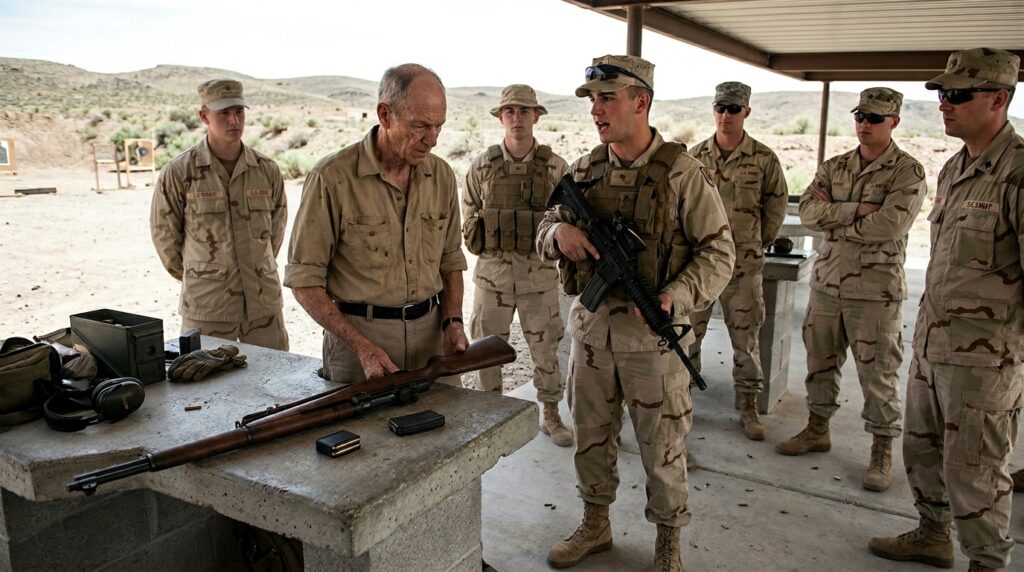
“Show us what that old rifle can still do, sir.”
The words didn’t bounce off the concrete overhead shield; they sort of died in the heavy, grease-thick air of Lane Four. Specialist Miller didn’t lower his M4. He kept it slung across his crisp, digital-pattern chest like a badge of ownership. His boots were clean. The polymer on his weapon didn’t have a single scratch to show for three tours of base security.
Thomas didn’t look up immediately. He kept his thumbs pressed against the walnut stock of the M1 Garand, feeling the microscopic ridges where some long-dead armorer had scraped the wood smooth sixty years ago. The heat off the tarmac was rising, making the targets at three hundred yards look like small, black beetles drowning in oil.
“I carried one like this long before you learned to stand,” Thomas said. His voice wasn’t loud. It had the dry, raspy scrape of sand moving across a porch.
A couple of the guys behind Miller shifted their weight, their nylon gear squeaking like a nest of mice. Someone cleared their throat. The casual, noon-hour smugness that had hung over the firing line since the old civilian truck pulled up was beginning to sour.
Thomas unhurriedly reached down. His knuckles were large, distorted by time, resembling the knots in the oak trees outside his kitchen window. He unlatched the internal clip mechanism. The metal didn’t click; it slid with a heavy, oiled thud that sounded entirely different from the light, tinny snap of the aluminum magazines the boys were swapping at the cleaning benches. He laid his modern, black-bodied magazine down on the green canvas mat.
Miller took half a step back. His chin went up, just an inch, his eyes narrowing as he tried to find the joke again. “Sights are probably drifted, old-timer. The wind out past the berm is pulling five knots from the east. You want me to get you a spotter with some glass?”
“I have eyes,” Thomas murmured.
He lifted the nine-pound rifle. To the young men watching, the movement should have looked clumsy—the man was thin enough that the desert wind seemed to blow through his tan work shirt—but the rifle didn’t shake. The iron buttplate settled into the hollow of his shoulder with the familiar, magnetic thud of a key turning in a lock he’d owned for fifty years.
The world narrowed to the small, dark circle of the rear aperture.
The front sight blade came up, cutting through the heat shimmer. Thomas didn’t squeeze. He didn’t look at Miller. He smelled the old Cosmoline grease cooking out of the handguards under the noon sun, a smell that instantly dissolved the concrete lane and the clean uniforms behind him, replacing them with the memory of frozen mud and the wet wool of trousers that hadn’t been dry for three months.
His finger found the wide, cold curve of the trigger. His left hand, liver-spotted and scarred near the thumb, clamped onto the forearm. The slight tremor that had plagued him while driving the truck out here disappeared. His heart slowed, dropping into the gap between breaths.
Then he noticed the small notch carved into the steel of the receiver right below the bolt—a mark that shouldn’t have been on an ordinary state-issued rifle. It was three small, hand-filed lines.
Thomas’s chest tightened, his breath catching in his throat before the shot could break. He knew those lines. He had carved them himself in the winter of 1951, on a mountain that didn’t have a name.

CHAPTER 2: THE THREE NOTCHES
The finger didn’t pull.
Thomas froze, his knuckle locked around the curve of the steel trigger, holding the nine-pound weapon perfectly steady against his shoulder while his mind spun backward into a vortex of cold grease and gray snow. The three hand-filed lines on the receiver burned against the periphery of his vision. They weren’t an armorer’s mark. They were crude, uneven, scratched into the parkerized finish with the edge of a broken bayonet on a ridge line where the air smelled like cordite and frozen blood.
Behind him, the silence of the firing lane grew heavy, weighted by the collective expectation of the young soldiers waiting for the report. The desert wind rattled the edge of the corrugated roofing overhead, a dry, rhythmic sound that felt entirely distinct from the sudden stillness holding Thomas in its grip.
“Problem, sir?” Specialist Miller’s voice cut through the heat shimmer. The smirk hadn’t entirely left his face, but the casual edge had turned into something sharper, a little more probing. He stepped a fraction closer, the nylon of his tactical vest scraping against the concrete lane separator. “Sights went blurry on you? We can get you some reader glasses from the range box if the iron’s too small.”
Thomas didn’t lower the rifle. He kept his cheek welded to the faded, oil-darkened walnut of the stock, but his lungs refused to expand. He knew every grain of this wood, not because he had bought it at an estate sale or found it surplus, but because his fingers had bled into these exact grooves when the temperature dropped below zero and the grease turned to ice.
“The wind,” Thomas lied softly, his voice a dry rasp that barely cleared his teeth. “The wind is shifting at the hundred-yard berm.”
“Ain’t no wind down there that’ll stop a thirty-niner bullet from hitting paper, sir,” Miller said, taking another half-step forward. He leaned down slightly, his young, unblemished face coming into Thomas’s peripheral view. He was trying to see what the old man was looking at. His eyes scanned the concrete bench, then the rifle, his gaze lingering on the worn canvas sling that hung slack beneath the barrel. “If the weapon’s unsafe, you shouldn’t be firing it. Institutional safety regulations are pretty clear about vintage hardware on an active line.”
Thomas slowly let his breath out, a long, controlled exhalation that tasted of the range’s dust and the faint bitter tang of sulfur. He didn’t drop the weapon from his shoulder; instead, he smoothly rotated the receiver toward himself, just enough to bring the hand-carved notches into the direct light of the midday sun.
Miller’s eyes dropped to the steel. The young soldier frowned, his eyebrows knitting together as he noticed the deliberate, crude disfigurement of the military finish. “What is that? A tracking mark?”
“An accounting,” Thomas murmured. He finally lowered the rifle, resting the buttplate on the concrete bench but keeping his left hand firmly wrapped around the forearm, shielding the wood as if it were fragile. His skin looked like old parchment against the dark grain, thin and spotted with age, yet his grip didn’t waiver. “This wasn’t bought out of a crate, son. This was left in the tree line near Chosin. I didn’t think there were any left in the state inventory.”
The witnesses behind them stopped shifting. The small group of active-duty men leaned forward, their attention entirely pulled from their own high-tech gear toward the scratched piece of metal on the bench. The arrogance in the lane was beginning to fray, replaced by the uncomfortable curiosity of men who realized they were standing in front of a ghost.
Miller looked from the three notches up to Thomas’s weathered face, his confident posture losing a fraction of its rigidity. “Chosin? That’s… that’s a long time to keep a rifle clean.”
“I didn’t keep it,” Thomas said, his voice dropping into a register that made the young specialist look down at his own polished boots. “It was taken from a boy who didn’t need it anymore. A boy who was waiting for an artillery support order that never came because some colonel in an office three hundred miles away thought the ridge was already lost.”
Thomas reached into his tan work shirt pocket, his fingers searching for the small, hard shape he had carried all morning, but he stopped himself before drawing it out. The time wasn’t right. Not yet. He looked back at Miller, noticing for the first time the small, faded tattoo on the young man’s forearm—a stylized set of crossed rifles over an old division patch that matched the engraving on the back of the pocket watch hidden against Thomas’s ribs.
“Let me see the bolt,” Miller said suddenly, his tone shifting from a challenge to an unbidden professional interest. He reached out a hand, his fingers hovering just an inch above the walnut stock before he caught himself and waited for permission. “The serial number on the receiver looks like a non-standard run. If this came out of a depot supply line, it shouldn’t have these markings. Government property doesn’t get reissued with personal modifications unless it was salvaged through a dynamic recovery unit.”
“It was salvaged,” Thomas said, his hand remaining stationary over the forearm. “But not by the government.”
He slid the bolt back with a smooth, heavy pull of his palm, the brass cartridge within the chamber glinting briefly in the harsh sunlight before settling into the feeding tray. As the mechanism opened, a tiny piece of folded, yellowed paper that had been wedged into the recess behind the follower clip dislodged, tumbling silently onto the green canvas mat between them. It was frayed at the edges, dark with old oil, and bore a faded stamp that Miller recognized instantly as an old field-casualty tag.
Miller reached down and picked up the paper before Thomas could move his swollen fingers. The young specialist’s face drained of its color as his eyes scanned the blurred typewriter ink on the fragment.
CHAPTER 3: THE DECOY REVEAL
Miller didn’t read the paper out loud. His thumb merely pressed against the soft, disintegrating fiber of the casualty tag, flattening the crease against his palm. The ink was faded to the color of dried veins, but the stamped heading was unmistakable: 8th Joint Logistics Depot – Tactical Asset Quarantine. Beneath it, a single line of purple ink cataloged the wood-stock rifle not as surplus, but as a weapon recovered from a dark sector where an entire defensive perimeter had ceased to broadcast.
“This serial number,” Miller said, his tone dropping an octave, his gaze locked onto the blurred characters. “It isn’t in the active database. It was flagged as destroyed during an evacuation protocol in the mountain passes. My grandfather used to talk about these logistics logs. The brass wiped them from the master records to cover up an ammunition delivery failure that left an entire sector dry.”
He looked up at Thomas, his chest rising and falling beneath his pristine nylon vest. The small group of active-duty soldiers behind him had completely stopped talking. The distant sound of another lane firing—a dull, rhythmic pop-pop-pop—felt miles away from the small bubble of absolute silence that had settled over Lane Four.
“You didn’t buy this,” Miller whispered, his fingers tightening slightly on the edge of the yellowed paper. “This is a ghost gun. A battlefield recovery that shouldn’t exist. If range control looks too closely at this receiver, they’ll confiscate the whole platform. It’s technically stolen federal property from a sealed investigation.”
Thomas reached out and gently took the paper back from the young specialist’s fingers. The touch was soft, almost reverent, the frayed edge of the tag disappearing into his rough, liver-spotted palm. “The boy who held it didn’t steal it, son. He died holding it. The system wanted the failure forgotten, so they buried the paper. I just unburied the iron.”
“Why bring it here?” Miller’s gaze was sharp now, the professional arrogance returning but completely transformed into a defensive wall. His brow furrowed as he stared at the old marksman’s work shirt. “You brought an unrecorded, classified piece of failure onto a modern range to make a point? To prove our optics don’t matter compared to a dead squad’s weapon?”
“No,” Thomas said, his voice entirely devoid of anger. He turned back toward the shooting bench, his eyes following the grain of the walnut stock down to the iron buttplate. “I brought it because a rifle isn’t the only thing that gets left behind when a logistics report is rewritten. People get left behind, too. Their names get smudged out by the same ink.”
He lifted the weapon once more. This time, the physical weight of the timber seemed to pull at his thin shoulders, but he adjusted his stance, his worn khaki trousers catching the dry breeze. The target three hundred yards away was still shivering in the desert heat, a tiny black speck that seemed entirely unreachable without a modern ballistic calculator or a red-dot sight.
Miller stepped back, but his hand stayed near his own slung weapon, his eyes tracking every movement of the old man’s frame. “If you drop that hammer, sir, the firing pin might fracture. The metal fatigue on an unverified salvage receiver is unpredictable. The internal pressure could shatter the receiver face.”
“It won’t shatter,” Thomas said. His finger settled onto the cold curve of the trigger again. “The boy who cleaned this weapon before the cold took him knew how to dress the sear. He spent three hours in the dark with a piece of oil-cloth making sure it would break clean when the line was crossed. He wasn’t thinking about safety regulations. He was thinking about the man next to him.”
He didn’t wait for Miller to reply. He didn’t check the five-knot wind from the east. He allowed his eyes to find the tiny aperture, the front blade rising up to bisect the black target sticker through the haze of the range. The three lines carved into the steel were right beneath his nose, a crude physical reminder of an old promise that had outlived the records, the colonels, and the war itself.
The hammer fell.
The report wasn’t a sharp crack like the modern rifles; it was a deep, resonant boom that vibrated through the concrete floor of the lane, hitting Thomas’s chest with a familiar, heavy punch. A single, hot brass casing flew upward, spinning into the bright noon light before bouncing off the lane separator with a clear, metallic ring.
Miller immediately raised his spotting scope to his eye, his posture turning rigid as he focused on the paper three hundred yards downrange. The target was clean. There was no hole in the black center circle. There was no white mark on the outer rings.
“Miss,” Miller said, a strange mix of relief and lingering tension in his voice. “The round didn’t even register on the backing board, sir. The sights must be completely drifted out of alignment, just like I said.”
Thomas slowly cycled the bolt, catching the next round before it chambered, his face remaining entirely expressionless. He didn’t look at the target. He looked down at the empty brass casing resting on the mat, then reached into his shirt pocket again, his hand wrapping around the heavy, silver pocket watch that had been ticking against his chest all morning.
“I wasn’t aiming at the center,” Thomas said quietly, his eyes meeting Miller’s. “I was checking the drift. The front sight blade isn’t original to the weapon. It was taken from a spotter’s kit.”
He pulled the watch from his pocket, the silver chain clinking against the brass casing on the table. The back of the watch case was engraved with the exact same stylized crossed rifles and division patch that was tattooed on Miller’s young arm, but beneath the emblem, a name was scratched into the metal—a name that matched the signature on the casualty tag Miller had just held.
Miller’s breath caught in his throat, his hand dropping away from the spotting scope as his eyes locked onto the tarnished silver disc in the old man’s hand.
CHAPTER 4: THE DELAYED HANDOFF
The heat coming off the concrete shooting bench felt like an iron weight pressing against the space between them. Specialist Miller didn’t look back down the scope. His eyes remained fixed on the tarnished silver disc resting in Thomas’s palm, his breathing flattening until the tactical vest across his chest stopped its rhythmic squeaking entirely. The silver chain dangled down, its links darkened by decades of sweat and oil, swinging with a micro-movement that seemed to match the low, steady vibration of the desert wind.
“Where did you get that?” Miller’s voice lost its modern, sharp edge. It was thin, bare, stripped of the institutional veneer he had worn like armor since the morning began.
“Your grandfather didn’t drop it,” Thomas said softly, his fingers shifting to turn the case over. The worn metal gave off a faint, dull reflection of the noon sun. “He gave it to me when the third line broke. He told me the main springs were broken anyway, but the glass was still clear enough to see the face. He wanted someone to carry it out who had a chance of seeing the valley again.”
The surrounding soldiers in the lane didn’t move. The silence stretched out, fragile and heavy, breaking only when Thomas reached out and placed the silver watch directly onto the green canvas mat, right next to the empty brass cartridge casing that was still ticking as it cooled.
Miller looked at the watch, then down at the crossed rifles tattooed into his own flesh. The ink on his arm was dark, sharp, and new—a tribute to a man he had only known through framed photographs and stories told in quiet living rooms. To see the actual silver, scratched and dented by the frozen gravel of a ridge line he’d only read about in tactical manuals, seemed to dissolve the distance between the pristine range and the old world.
“He told us he lost it in the withdrawal,” Miller muttered, his fingers twitching toward the chain but hesitating, as if touching it would validate the reality of the failure the records had tried to hide. “He always said he left everything behind in the mud except his boots.”
“He left his boots too,” Thomas replied, his voice dropping into a gentle, unhurried rhythm. He reached down and smoothed the frayed canvas strap of the M1 Garand, his thumb lingering over a small patch where the fabric had been stitched back together with heavy fishing line. “But he gave me this because he knew my memory would hold onto the serial numbers long after the logistics offices cleared the ledger. He didn’t want you growing up thinking he ran.”
The young specialist slowly lowered his hands to his sides, his rigid, athletic posture collapsing into something softer, older. The small gallery of witnesses behind them began to stir, their eyes dropping to the concrete floor as the true weight of the confrontation settled into the lane. It wasn’t a challenge about marksmanship anymore; it was an inheritance.
Thomas smoothly picked up the rifle from the bench. He didn’t offer a dramatic farewell or wait for range control to log the weapon’s non-standard receiver. He moved with the quiet, practiced economy of a man who spent his life carrying things that didn’t belong in inventories. The heavy timber settled against his side, the iron buttplate clicking softly against his belt buckle.
“The sight doesn’t need glass, son,” Thomas said, looking back at Miller one last time. “It just needs you to remember the drift.”
He turned and walked down the shaded concrete lane, his boots kicking up small puffs of dry desert dust as he moved toward the sun-baked parking lot where his old civilian truck was waiting. The young soldiers parted for him without a word, their caps tipping slightly in the glare, their modern rifles held loosely against their chests like toys that hadn’t yet been paid for.
Miller remained at the bench, his hand finally closing around the tarnished silver casing of the watch. The metal was still warm from Thomas’s pocket, retaining the heat of a body that had survived the frost. Behind him, the targets at three hundred yards remained still in the shimmer, the black circles untouched by lead but completely altered by the truth that had just cleared the line.







