
The Quiet Weight of Living Brass: A Veteran’s Reckoning with the Fading Stains of Time
CHAPTER 1: THE WEIGHT OF POLISH
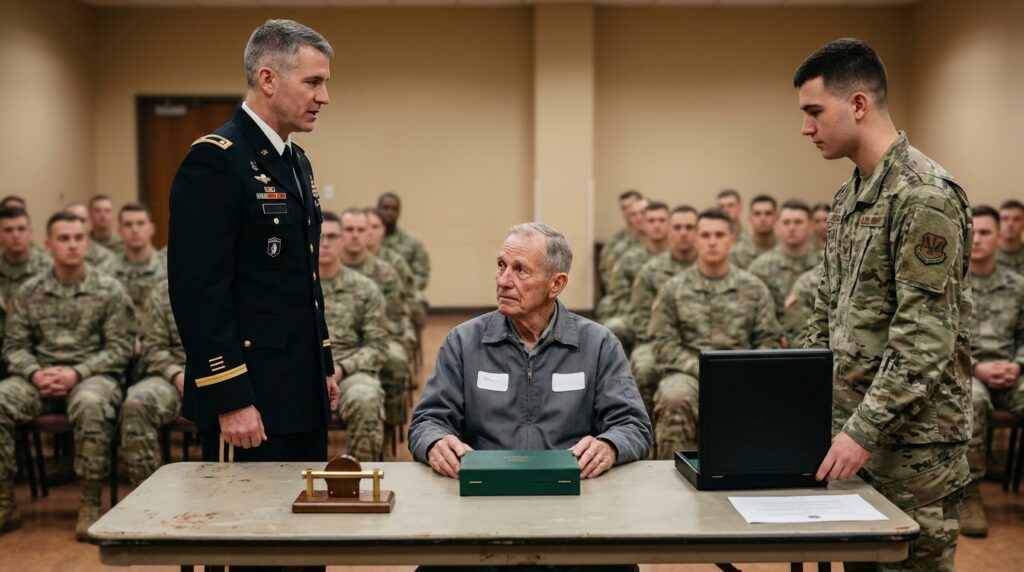
“He kept it in the bottom drawer of a grease-stained rolling cabinet for thirty-four years,” the presenter’s voice cut through the stagnant air of the recognition room, devoid of the usual theatricality of a formal commendation. It was sharp, clear, and weighted with the gravity of a man who had dug through too many layers of dead ink to find a single living name.
Arthur did not look up at the badges or the immaculate dark wool of the presenter’s dress uniform. His focus remained fixed on the table edge, where his own thumb—calloused from decades of tightening structural bolts and wiping hydraulic fluid off the base generators—was pressed against the veneer. The wood grain under his fingernail felt reassuringly rough, a sharp contrast to the absolute, suffocating stillness of the two hundred service members sitting in the tiered seats behind him.
To his right, the young camouflage-clad assistant didn’t blink. The black case in her hands was lined with velvet that looked too clean, the kind of material that swallowed light. Inside it sat the small wooden box, its brass fittings dull despite what must have been hours of careful polishing by someone who didn’t understand that the tarnish was the only thing holding the wood together.
“We brought it here today,” the presenter said, leaning down slightly, his posture breaking just enough to narrow the world down to the old man sitting at the table, “so everyone could see what you carried, Arthur.”
Arthur’s breath caught, a dry, rattling sound in the back of his throat that felt loud enough to echo off the high concrete rafters. His grey zip-front work jacket felt heavy, the faded name tag over his left breast pocket pulling down like lead. For forty years, that grey fabric had been a shield. If you wore the jacket, you were just the man who fixed the heating vents or cleared the gravel after a storm. You didn’t have a history. You didn’t have a shadow.
“I never thought…” Arthur’s voice was a thin rasp, a low murmur that barely carried past the table. He lifted his hand from the veneer, the skin cross-hatched with old scars and white lines from winters spent working with cold iron. “I never thought I’d see that little box again. I told them to burn it.”
“They didn’t,” the presenter replied. He straightened his back, his shoulders squaring as he turned his face toward the darkened rows of the audience. The private space between them vanished, replaced by the heavy, demanding mantle of institutional memory. “Every person in this room knows exactly why it belongs with you. They know what it took to keep the logs clean when the tracking lines went dark.”
A collective shift went through the rows behind them—the subtle rustle of heavy starched fabric and the dull thud of combat boots adjusting on the floorboards. They didn’t know the whole truth, Arthur realized with a sudden, cold clarity. They knew a name and a date on a plaque, a sanitized version of a night when the sky over the ridge had turned the color of bruised plums. They didn’t know about the three clerks who had been sent home without papers, or the way the grease smelled when they burned the cargo manifests in the back of the maintenance shed.
The pressure in the room grew, thick and demanding, pressing against his chest until his lungs felt small. They wanted the gesture. They needed the old man to validate the history they were building around him.
Arthur’s hand hovered over the open velvet case. The brass corner of the keepsake device had a small, deep pit near the hinge—the exact spot where he had dropped it against the bumper of a flatbed truck while running for the perimeter fence. His skin was trembling, the small muscles in his forearm twitching under the frayed cuff of his grey sleeve.
He dropped his hand. His index finger made contact with the cold, hard brass. He didn’t lift it, didn’t hold it like a trophy. He gave the metal one slow, deliberate, steadying tap, the dull thunk of his nail against the plate acting as a silent seal on a contract he had tried to break for half his life.
The presenter exhaled, a tiny movement of his chest, and began to reach for the document folder on the podium.
But as Arthur’s finger slipped off the brass edge, his nail caught on the small seam where the lining met the wood. The velvet inside the keepsake box didn’t just sit flat; it shifted slightly, revealing a small, stiff corner of white cardstock tucked beneath the padded bottom—a piece of an old, red-striped non-commissioned officer’s identification card that had been cut in half, showing only the distinct, hand-inked signature of a commander who had supposedly died in an airfield fire three years before Arthur ever took the maintenance job.

CHAPTER 2: FRAYING ARMOR
The edge of the cardstock was stiff, a tiny sliver of rigid white slicing against the meat of Arthur’s thumb. He didn’t pull his hand away. To the two hundred service members watching from the dim tiers of the auditorium, he was merely lingering over the brass box, a weathered man caught in the heavy current of old memories. Only the presenter, standing close enough to catch the sudden, rhythmic hitch in Arthur’s breathing, noticed the slight shift in the old man’s posture.
Arthur’s thumb rubbed the frayed velvet lining back just a millimeter more. The faded red stripes of a non-commissioned officer’s ID card peered out from the false bottom. And there, written in the unmistakable, left-leaning cursive of Captain Miller—a man whose lungs had supposedly filled with ash at the Kilo-Pier airfield forty years ago—was a signature that looked as fresh as if the ink had dried yesterday.
“Arthur?” the presenter murmured, the voice low, meant only for the square meter of space around the table. The immaculate dark wool of his dress uniform brushed against the edge of the table as he leaned in. “Is there something else?”
Arthur snapped his fingers back, his hand retreating into the deep, grease-stained pocket of his grey zip-front work jacket. The fabric felt thin now, the fraying edges around the cuffs scratching his wrists like wire brush. “No,” Arthur lied, his voice a dry scraping sound. “Just… the brass. It’s colder than I remember.”
The presenter studied him, the sharp lines around his eyes tightening with a quiet, analytical scrutiny. He didn’t look like a man who believed in ghosts, but he looked like a man who knew how to read a ledger. He nodded once, a brief, functional movement, and turned back to the crowd to signal the conclusion of the formal presentation.
The rows of young service members rose in unison, a synchronized thunder of starched fabric and heavy leather boots that made the floorboards vibrate beneath Arthur’s sneakers. They didn’t see the man; they saw the myth the presenter had constructed over the last twenty minutes. As the formation dissolved into a sea of camouflage uniforms moving toward the rear exits, Arthur grabbed the handle of the green presentation box, his knuckles turning a pale, bloodless white. He needed to get out of the light. He needed the specific, dim silence of the maintenance corridors where the air smelled of floor wax and old copper pipes.
He turned toward the backstage exit, his steps short and heavy, the weight of the keepsake box pulling at his shoulder.
“Mr. Vance,” a voice called out from the side doors. It wasn’t the presenter. It was one of the younger logistics clerks from the rear rows, a kid with a fresh haircut and a uniform that still smelled of the base laundry. He stood in the doorway, blocking the path to the quiet outer hallway, his eyes wide with a mixture of reverence and curiosity that felt like a physical barrier. “Sir, I just… we didn’t know. The records from the Kilo-Pier incident are mostly redacted in the base library. Did you really pull the manifests out before the fire reached the fuel line?”
Arthur stopped. He could feel the small piece of cut cardstock burning a hole in his mind, the ghost of Miller’s handwriting hovering in the air between them. The kid wanted a story about a hero. He wanted a clean piece of history to polish, something to write home about.
“The manifests were already gone when the fire started, son,” Arthur said. His voice was sparse, guarded, the subtext heavy with a warning the young clerk was too green to understand. “The only thing left in that shed was smoke.”
“But the presenter said—”
“The presenter reads paper,” Arthur interrupted, his tone sharpening into the transactional edge he used when a private tried to tell him how to fix a compressor. “I clean the floors. If you want to know about the manifests, ask the archives. I’ve got a boiler in Sector 4 that needs a gasket before the shift change.”
He didn’t wait for the boy to move. Arthur used the bulk of his shoulder to guide his way past the frame, the rough texture of his grey jacket brushing against the clerk’s crisp sleeve. The contrast was total—the faded, oil-spotted fabric of a laborer scraping against the bright, unblemished future of the institution.
He hurried down the concrete corridor, the sound of his rubber-soled shoes a hollow rhythm against the walls. The air grew cooler here, losing the warmth of the auditorium’s crowd and taking on the familiar, damp chill of the subterranean passages. He found his way to the small breakroom behind the generator pool—a room with a single flickering fluorescent bulb, two plastic chairs, and a sink that dripped with a steady, metallic clink.
Arthur set the green presentation box on the laminate table. His hands were shaking violently now, the adrenaline of the stage fading into a cold, hollow exhaustion. He reached into the velvet interior of the keepsake, his fingers finding the split seam. He pried the velvet up, his breath rattling in his throat as he pulled the half-card out into the dim light.
It wasn’t just a signature. On the reverse side of the red-striped card, written in the same precise, faded ink, was a string of six-digit maintenance codes—the specific inventory numbers for the underground storage vaults beneath the old administration building, vaults that had been welded shut and declared structurally unstable the exact week Arthur had transition from active duty to a civilian maintenance contract.
The door behind him creaked open, the rusted hinges grooving into the quiet. Arthur didn’t turn around. He didn’t need to. The scent of starch and heavy wool filled the small room.
“You left before the reception, Arthur,” the presenter said softly, his shadow stretching across the laminate table, touching the edge of the brass box. “The commander wanted to shake your hand.”
Arthur slid his thumb over the handwritten codes, hiding them against his palm. “The commander has a base to run. And I have forty years of dust to keep track of.” He turned slowly, his eyes locking onto the younger man’s face. “Where did you really get this box, Captain?”
The presenter didn’t blink. He stepped further into the room, the light from the dying fluorescent tube catching the polished badges on his chest, casting a pale, fragmented glow over his features. “I told you. The central repository at the state capital. It took four months of requests.”
“You’re a good officer,” Arthur said, his voice dropping into a low, dangerous register of guarded vulnerability. He took his hand out of his pocket, holding the half-card up between two fingers, the white paper stark against the dim room. “But you’re a terrible liar. This didn’t come from a state repository. This was in a desk on this base. Who gave it to you?”
CHAPTER 3: THE SHADOW ARCHIVE
“You shouldn’t have that,” the presenter said. The formal composure that had carried him through the ceremony in the auditorium didn’t shatter, but it frayed at the margins. He took a single step closer to the laminate table, his boots clicking sharply against the damp concrete. The sharp light from the flickering tube overhead highlighted the slight dampness at his temples. “Arthur, give me the card.”
“I asked you a question, Captain,” Arthur said. He didn’t lower his hand. His fingers, stiff from decades of working the base’s oldest machinery, remained locked around the fragment of paper. The faded red ink of the NCO stripes looked like dried blood in the sickly yellow illumination of the breakroom. “This card didn’t come from a capital archive. The central repository doesn’t hold personal property from an officer who died in a structural fire forty years ago. This was saved. Locally.”
The presenter let out a slow, measured breath, the starched fabric of his shirt tightening across his chest. He looked at the old green box, then back at Arthur’s eyes, finding the hard, unyielding baseline of a man who had survived by noticing every loose bolt in the institution.
“It was Master Sergeant Miller’s personal locker,” the presenter said, his voice dropping into a quiet, transactional register. “Your old supervisor. Before he passed away last winter, he didn’t clear his station. He left a locked green footlocker in the maintenance annex under a manifest for obsolete plumbing fixtures. He knew the logistics division wouldn’t audit a pile of rusted pipes.”
Arthur felt a dull, familiar ache flare in his shoulder. Miller. The man who had given him the grey zip-front work jacket on his first day as a civilian laborer. The man who had told him to keep his head down and his mouth shut whenever the officers from the upper tiers came down to check the fuel lines.
“He left a paper trail,” Arthur murmured, the realization settling into his chest like cold water. “He didn’t just leave the box. He left the ledger.”
“He left everything,” the presenter confirmed. He reached inside his dress uniform jacket, drawing out a small, pocket-sized logbook with a frayed canvas cover. The edges were soft, rounded by years of friction against a utility belt. “He tracked every shipment that came through the Kilo-Pier airfield during the month of the incident. He tracked the names of the three logistics clerks who were assigned to the fuel depot—the ones who disappeared from the morning rosters without a transfer order.”
Arthur’s thumb tightened against the card in his palm. The world was narrowing down to the hum of the generator behind the wall and the smell of old paper. “They didn’t disappear, Captain. They were sent home. On a midnight bus with clean discharges and enough severance to buy their silence.”
“Because of an operational failure?” the presenter asked, his eyes leaning hard into Arthur’s face. He was hunting for the narrative that made sense to a modern officer—a story of a cover-up, of institutional negligence that could be corrected with a public plaque and a formal apology. “Miller’s notes say the fuel lines were compromised before the fire started. He wrote that the command structure ordered the manifests destroyed to hide a multi-million-dollar supply discrepancy.”
Arthur let out a low, humorless sound that was half-cough, half-laugh. He looked down at the six-digit maintenance codes written on the back of the cut ID card. Layer 1. The decoy was beautiful. It was exactly what a young, idealistic investigator would look for—a story of greed, of bureaucrats burning a warehouse to cover a broken budget. It was a truth that could be managed. It was a secret that had a category in the regulations.
“Is that what you think happened?” Arthur asked, his voice softening into a guarded, melancholic vulnerability. “You think we burned the Kilo-Pier depot to hide a deficit in the logistics ledger?”
“The documents point to it, Arthur. The paper trail Miller left leads directly to Vault 4 beneath the old administration building. The inventory numbers on the back of that card match the sealed storage crates that were moved the night before the fire.” The presenter reached out, his hand open, waiting for the fragment of paper. “If we open that vault, we can clear your name completely. We can show the whole base that you weren’t a clerk who ran from a fire—you were the man who saved the institutional integrity of this command.”
“You don’t know what you’re asking for,” Arthur said softly. He looked at the presenter’s immaculate dark dress uniform, the bright silver badges that hadn’t ever been scratched by the gravel of a real deployment. The presenter believed that the light could heal anything. He believed that if you brought a secret out into the sun, the rot would stop.
“I’m trying to give you your life back, Arthur,” the presenter said, his voice rising slightly, carrying the heavy weight of a moral obligation that was becoming a burden. “Forty years in a grey jacket. Wiping oil off machines that should have been decommissioned before I was born. You paid the price for their mistake.”
“We all paid,” Arthur said. He turned his back to the presenter, his eyes fixed on the dripping sink. The small, rhythmic clink of the water felt like a countdown. He knew what was in Vault 4. He knew why Miller had kept the card hidden in the false bottom of the box rather than using it to clear his own conscience before he died. The decoy secret—the missing supply crates, the financial fraud—was a shield. It was a protective wall built to keep people from looking at the second layer. The layer that didn’t have any paper left to track it.
He slid the card back into his pocket, his hand remaining inside the fabric, his fingers feeling the frayed lining where the stitches had given way. “The codes don’t open a supply vault, Captain. They open a grave.”
Before the presenter could answer, the red emergency light above the breakroom door flared to life, its silent, rotating beam casting long, bloody arcs across the yellowing laminate of the walls. A low, rhythmic horn began to sound from the upper corridor—the base security override.
The presenter’s hand went instantly to the radio unit clipped to his formal belt, his posture snapping back into the rigid lines of an active officer. “This is Captain Vance. What’s the status on the lower tier?”
The radio sputtered, a blast of static filling the small room before a frantic voice broke through the noise. “Sir, we have an unauthorized breach in the old administration annex. Someone used a maintenance override code on the old service elevator. They’re moving toward the sealed vaults.”
Arthur didn’t move. He looked down at the green presentation box on the table, the polished brass reflecting the rotating red light of the alarm. The past wasn’t waiting for the presenter’s archive to finish opening. It was already moving in the dark.
CHAPTER 4: THE HORIZON CHECK
The concrete tunnel felt tighter under the rhythmic pulse of the emergency lamps. Each sweep of red light stained the peeling paint of the corridor like fresh ink on old parchment, then pulled back to plunge the space into a suffocating, desaturated gray.
The presenter moved with a sharp, practiced velocity, his polished leather boots striking the floor in an aggressive cadence that echoed far ahead. His immaculate dark uniform jacket was already losing its rigid, ceremonial perfection, the shoulder fabric wrinkling under the weight of his rapid stride. He checked his service sidearm with a short, metallic snap that cut cleanly through the low, weeping moan of the base security siren.
“Stay here, Arthur,” the presenter commanded without looking back. His voice was taut, hard, stripped entirely of the reverent warmth he had projected on the auditorium stage. “The security detail is pulling up from the main gate. I need to secure the vault entrance before whoever is down there breaches the primary pressure seal.”
Arthur didn’t stop. The green presentation box was clutched against his ribs, the heavy wooden corners digging through the thin fabric of his grey zip-front work jacket. His sneakers made almost no sound on the grit-strewn floor—a phantom cadence trailing the officer’s heavy boots. For forty years, he had known every hairline fracture in these lower foundations, every unmapped bypass where the steam pipes ran parallel to the old communications wiring.
“You don’t know how to open that elevator shaft if the electronic grid locks down, Captain,” Arthur rasped, his lungs burning with the damp, chill air of the sub-basement. “The administrative annex doesn’t run on modern relays. It runs on rusted iron and old levers. If the breaker blows, you’ll be trapped in the dark with a door you can’t blast through.”
The presenter reached the iron-grated checkpoint at the end of the corridor and slid his keycard through the terminal slot. The machine buzzed, a harsh red negative tone chiming over the radio static. The indicator light remained dead. The override had already taken effect from the main terminal downstairs.
“Damn it,” the presenter muttered, his gloved hand striking the steel housing of the gate. He turned, his eyes catching Arthur’s under the sweeping red glare. There was a raw, unfiltered frustration in his face now—the look of a man who realized the institution he trusted was an unmanageable beast with too many hearts. “The logic gate is closed from the inside. Someone is systematically cutting off the access corridors.”
“Give me the logbook,” Arthur said, stepping forward. He didn’t ask; his voice carried the quiet, absolute authority of the senior craftsman who had built the very walls they were standing within. He held out his lined hand, the frayed fabric of his cuff brushing against the silver insignia on the presenter’s sleeve.
The presenter hesitated for a fraction of a second, his gaze dropping to the old man’s steady fingers, before drawing the canvas-bound journal from his jacket and placing it in Arthur’s palm.
Arthur opened the soft, rounded cover. He didn’t look at the lists of cargo manifests or the redacted names of the three logistics clerks whose futures he had bought with a box of ashes forty years ago. Instead, he flipped to the very back page, where the texture of the paper changed from rough utility stock to a thin, yellowed vellum.
There, stamped in blue ink that had faded until it was barely visible against the grain, was a second set of maintenance numbers—codes that matched the ones on the cut NCO card in his pocket, but with an additional prefix: OM-00-CLR.
“The intruder isn’t trying to steal anything, Captain,” Arthur whispered, the world slowing down around him as the true architecture of the trap became clear. Time dilated; he could see the individual flakes of rust vibrating on the security gate hinges with every pulse of the siren. He could smell the sharp, metallic tang of the generator pool mingling with the scent of forty-year-old dust. “They aren’t pulling a file. They’re triggering the automated decontamination purge for the lower vaults. The system thinks there’s a structural breach from the old fuel line leak.”
The presenter’s face went pale. “The purge resets the atmosphere in the sealed compartments to zero oxygen. If there’s anyone down there—”
“If there’s anyone down there, they’re turning the ledger into dust,” Arthur finished. “And they’re doing it using Miller’s old supervisor key. The person downstairs isn’t a thief. It’s the archive itself cleaning its own teeth.”
He stepped up to the bypass junction box hidden behind a rusted ventilation panel, his fingers moving through the dark interior by touch alone, feeling for the cold, greasy wire that ran to the manual release valve. He didn’t need a map. He didn’t need the light. His hand knew the shape of the mistake they had all agreed to protect.
With a hard, rhythmic pull, he disengaged the manual lever. The iron gate clicked, the heavy locking pins sliding back into the frame with a hollow, metallic groan that sounded like an old man sighing in his sleep.
The path down to the deepest vault was open, but the final truth remained locked beneath a layer of suffocating gray. Arthur looked down at the green box in his arms, then at the young officer who wanted so badly to believe in a clean history.
“Stay here and hold the line for the gate guard, Captain,” Arthur said softly, his voice full of a tired, humanistic grace that offered no victory, only endurance. “Some things don’t belong in a museum. Some things just need to stay in the dark until the wood rots away.”
He stepped through the open grate, his grey jacket swallowed instantly by the long, red-tinted shadows of the descending stairwell, leaving the presenter standing alone beneath the flashing warning lights.
CHAPTER 5: THE VACUUM CHAMBER
The air in the utility shaft didn’t vanish all at once; it thinned with a steady, high-pitched whistle that sounded like steam escaping a cracked boiler. With every ten steps Arthur took down the narrow iron rungs, the atmospheric pressure dropped a fraction of a millibar, pulling the moisture from his tongue and leaving the taste of old zinc and scorched copper behind.
His grey zip-front work jacket pressed tight against his chest, holding the green keepsake box flat against his ribs. His ribs felt brittle now, a cage of old bones resisting the massive suction of the primary intake fans three levels below. Above him, the grated hatch he had bypassed remained a square of dull, strobing red; below him, there was only the desaturated gray of unpainted structural concrete.
“Think, Artie,” he muttered to himself, his voice coming out as a flat, reedy whisper that the thinning atmosphere immediately swallowed. “The intake dampers in Sector 4 always leaked at the seals. There’s twenty minutes of breathable air in the dead space behind the main transformer if the pressure valves hold.”
His sneakers hit the bottom landing with a dull, rubbery thud that vibrated through his knee joints. The floor here was cold, coated in a fine, undisturbed silt of pulverized stone and disintegrated insulation that hadn’t seen a broom since the Berlin Wall was still standing. A lone emergency lantern on the bulkhead flickered with a dying, amber pulse—not connected to the modern base security grid, but tied to an ancient lead-acid battery bank hidden in the crawlspaces.
He reached into his pocket, his fingers tracking the stiff edge of the cut NCO card. The six-digit maintenance codes on the reverse side weren’t just inventory tags; they were a physical coordinates map for the pneumatic control lines.
To his left, a massive steel conduit pipe ran along the ceiling, stenciled with the faded lettering: SYS-ANX-4. He placed his palm against the iron surface. The metal was dead cold, but he could feel the faint, rhythmic shuddering of a hydraulic piston deep within the wall—the mechanical hand of the automation system systematically sealing the heavy fire doors of Vault 4.
The system wasn’t hunting him. It didn’t know he was there. It was simply executing an old piece of logic, a forty-year-old protocol written to ensure that if the Kilo-Pier incident ever leaked into the lower sub-levels, the evidence would be quarantined until the air ran out and the ink on the documents turned to dust.
A heavy clack-whump echoed through the corridor ahead.
Arthur froze, his hand dropping to the brass latch of the keepsake box. The sound hadn’t come from the automated valves. It was too uneven, too heavy—the unmistakable drag of a physical weight being hauled across a steel deck plate.
He moved forward, his back scraped against the rough concrete wall, his grey sleeve picking up white streaks of old lime wash. The corridor turned a sharp forty-five degrees, opening into the secondary transformer vault. There, under the sickly yellow glow of a secondary circuit board, sat the automated control terminal for the lower tier.
A small, matte-black console had been spliced directly into the ancient terminal housing, its modern fiber-optic cables contrasting sharply against the thick, cloth-insulated wiring of the original structure. In the center of the panel, plugged directly into the mechanical override slot, was a heavy brass key with a triangular head—the exact shape of the supervisor keys Master Sergeant Miller had carried on his heavy ring until the day he died.
The terminal screen was scrolling through lines of pale green phosphor text, listing the sealed storage compartments one by one. Each entry ended with the same three-letter designation: PRG. Purged.
Arthur’s chest tightened, a sharp pain blooming behind his breastbone as his lungs struggled to find oxygen in the thinning air. He stepped toward the console, his hand reaching for the triangular key, when a small, low-pressure hiss released from the maintenance duct behind him.
The air didn’t blow out; it sucked inward. The canvas-bound logbook slipped from his fingers, its pages turning frantically in the sudden draft, revealing the hand-inked signature of Captain Miller over and over until the paper caught against the edge of the terminal framework, tearing a clean white strip through the center of the old ledger.
Arthur didn’t look at the paper. He looked at the base of the terminal, where a single, fresh footprint had cleared a circle in the forty years of dust—a small, narrow print from a standard civilian utility boot, identical to the ones Arthur wore every single morning.
CHAPTER 6: THE GHOST AT THE WHEEL
The footprint in the silt didn’t belong to a phantom. It was sharp around the heel, the distinct cross-hatched pattern of standard-issue civilian work boots pressing deep into forty years of accumulated dust. Arthur looked down at his own feet. The wear on his own left sole was slightly heavier at the arch, a carbon copy of the indentation staring back at him beneath the flickering amber light of the terminal.
“Miller,” Arthur murmured, the name catching in his throat like broken glass. But Miller was dead. He had sat in the front row of Miller’s small, unpretentious funeral just eight months ago, watching the flag get folded into a tight, crisp triangle by two kids who didn’t even know how to march properly.
A shadow shifted at the far edge of the transformer bank. It wasn’t the fast, aggressive silhouette of an intruder fleeing a crime scene. It was slow, heavy, moving with the rhythmic, favoring hitch of a bad right knee—the exact stride of a man who had spent forty years walking the hard concrete corridors of the lower maintenance tiers.
“You always were too smart for your own good, Artie,” a voice rasped from the darkness behind the coolant lines.
The voice didn’t belong to a ghost, either. It belonged to the presenter.
Captain Vance stepped out from behind the heavy steel frame of the primary transformer, his immaculate dark uniform jacket now discarded, hanging loosely from an iron pipe nearby. He wore a simple, faded grey undershirt, his shoulders bowed, his posture stripped entirely of the rigid, institutional authority he had displayed on the auditorium stage. In his right hand, he held a heavy copper grounding rod, its tip coated in a dark, greasy smudge where he had manually shorted out the electronic logic gates of the security panel.
“You,” Arthur said, his hand tightening around the green presentation box until the brass corner bit deep into his calloused palm. “You used Miller’s key.”
“Miller gave it to my father thirty years ago, Arthur,” Vance said, his voice dropping into a soft, melancholic resonance that filled the narrow space between the concrete pillars. He didn’t look like a predator; he looked like a man carrying an old heirloom that had grown too heavy to hold. He pointed the copper rod toward the terminal screen, where the pale green phosphor continued its relentless scroll. PRG… PRG… PRG. “My father was one of those three logistics clerks you sent away on that midnight bus.”
The air in the room seemed to drop another three degrees. Arthur’s chest burned, the lack of oxygen making his vision fray at the margins, turning the yellow light into a soft, vibrating blur. The shared burden of the past wasn’t a secret held by dead men; it was a living cord tied around the neck of the next generation.
“Your father was a good kid,” Arthur whispered, his voice sparse, guarded with forty years of protective silence. “He had a family back in Ohio. If his name had stayed on those cargo manifests after the fuel depot went up, the command would have broken him. They were looking for a scapegoat to cover the structural failure of the main line.”
“I know,” Vance said, taking a step closer, his utility boots crunching softly on the grit. The desaturated gray of the basement walls seemed to close in around them, casting long, heavy shadows that met at the base of the terminal. “He spent the rest of his life waiting for the other shoe to drop. Every time a military vehicle drove past our house, his hands would shake. He died believing he was a thief because he thought he ran from a fire to hide a budget deficit.”
“He didn’t run,” Arthur said, the subtext heavy with a deep, aching empathy. He reached into his pocket and pulled out the cut NCO card, holding it out between them like a shield. “We cut the cards to prove we were all in it together. Me, Miller, your father, and the other two. We burned the manifests because the manifests were the only thing keeping the upper echelons from blaming the crew for a faulty valve the base engineers refused to fix.”
“Then why open the vault now?” Vance’s voice cracked, the cool veneer of the investigating officer completely gone, replaced by the raw pain of a son trying to clean a stained legacy. “Why leave the logbook for me to find? Why let me build this whole ceremony just to drag you into the light?”
“Because Miller didn’t think you’d come looking for revenge,” Arthur said softly, his finger giving the card one steadying tap before lowering his hand. “He thought you’d look for the truth. But you didn’t look deep enough, son. You stopped at the first layer. You thought you could open Vault 4, show the missing crates, and prove your father was innocent of fraud.”
“He was innocent,” Vance insisted, his knuckles turning white around the copper rod.
“There are no crates in Vault 4, Captain,” Arthur said, his voice dropping into an absolute, chilling stillness that cut through the low whine of the secondary purge fans. “The crates never existed. The supply deficit was a lie we invented to give the investigators something simple to find. If they thought it was a robbery, they stopped looking for the real failure.”
The terminal behind them gave a long, continuous chime. The green text stopped scrolling. A single, amber notification flashed in the center of the phosphor screen: CRITICAL SYSTEM PURGE FAILURE: SECTOR 4 MANIFESTS QUARANTINED.
The override hadn’t destroyed the records. It had locked them into an automated loop, trapped between an ancient mechanical lever and a modern fiber-optic cable. The decoy secret had broken under the weight of Vance’s intervention, leaving both men standing on the precipice of a much deeper, colder dark.
CHAPTER 7: THE UNBROKEN PACT
“What do you mean, the crates never existed?” Vance’s voice shook, the copper grounding rod slipping slightly against his sweating palm. He stepped away from the terminal, the yellow light catching the hard, unmoving lines of his jaw. “The records Miller left detailed structural manifests. He had numbers, Arthur. Serial numbers for equipment that went dark.”
Arthur looked at the screen, where the amber indicator CRITICAL SYSTEM PURGE FAILURE cast a pale, geometric shadow across the dust-covered desk. The air was thin, each breath requiring a conscious, calculated effort that made his ribs ache under his faded grey jacket.
“They were numbers for empty casings, son,” Arthur said softly. He reached down and scooped the torn piece of canvas-bound ledger from the floorboards, carefully folding the fraying fibers back over the split spine. He treated it like a piece of broken glass that could still hold water. “Your father, Miller, and the others didn’t lose any supplies. There was an engineering defect in the underground fuel distribution ring. A valve cracked beneath the concrete floor of the main hangar. It had been leaking thousands of gallons into the shale below the base for six months before that fire ever started.”
Vance’s hand dropped entirely, the copper rod striking the floor with a hollow, metallic ring that drifted away down the long concrete tunnels. “A leak.”
“An unrecorded structural disaster,” Arthur explained, his voice rich with the quiet, crushing empathy of a man who had carried the structural secrets of the base like a second skin. “If the inspectors found out the ground under the runway was soaked in volatile fuel, the entire installation would have been closed, and the logistics division—the kids who signed the weekly facility safety logs—would have faced criminal negligence charges. The command structure didn’t burn the depot to hide a theft, Vance. They burned it because an explosion was the only way to sanitize the ground without revealing the failure of the infrastructure.”
He moved toward the younger man, his sneakers dragging slightly over the cross-hatched pattern of the footprint in the dust. The world seemed to slow to a crawl, the low, rhythmic groan of the locked ventilation system sounding less like an alarm and more like a heartbeat.
“Your father didn’t run from his duty,” Arthur continued, putting his calloused hand gently on Vance’s shoulder. The rough fabric of his sleeve met the soft, unblemished skin of the young captain’s arm, a bridge built over forty years of institutional dust. “He stayed behind with me and Miller to manually bleed the pressure lines so the fire wouldn’t track back to the primary base reservoirs. We made a choice. We let them call it a supply error. We let them call it a logistics failure. We took the blame for a phantom theft because a missing crate doesn’t put twenty-year-old clerks in a federal penitentiary.”
Vance looked up, his eyes glassy under the amber glow of the terminal. The rigid posture he had worn during the ceremony was entirely gone, his shoulders dropping into the same heavy, defensive curve that Arthur remembered his father wearing on that midnight bus four decades ago.
“He never told me,” Vance whispered. “He let me think he was just an ordinary worker who survived an ordinary accident.”
“He was protecting you from the weight of it,” Arthur said. He turned back to the terminal, his fingers finding the triangular head of Miller’s old supervisor key. With one slow, deliberate pull, he disengaged the key from the slot. The screen flickered once, the pale green phosphor fading into an empty black mirror that reflected only the faint outline of two men standing together in the dark. “Just like I spent forty years protecting this base by wearing this grey jacket. You don’t fix the machines because you want a medal, Captain. You fix them so the people living over them don’t have to look at the cracks in the floor.”
The red emergency lamps in the upper corridor suddenly stopped their rotating sweep, replaced by the steady, white glare of the auxiliary backup generators kicking in. The low-pressure whine of the alarm ceased, leaving only the profound, dripping silence of the sub-basement.
Arthur slid the green presentation box into Vance’s hands, his thumbs lingering for one last second on the polished brass corner. The keepsake device was empty now, its secrets stripped away down to the raw wood and the faded velvet lining.
“Take it,” Arthur murmured, his voice transactional but soft, a final settlement of accounts. “The ceremony is over. Go back upstairs and tell the commander that the lower levels are secure. Tell them the old infrastructure held.”
Vance looked down at the box, his fingers tracing the small, deep pit near the hinge where his father’s old crew had once dropped it. He didn’t ask another question. He didn’t need to. The subtext between them was clear, an unbroken pact passed from a dead supervisor to an old civilian worker, and finally to the officer who would keep the ledger clean for the next generation.
Arthur didn’t wait for him to move. He turned toward the service elevator shaft, his hands deep within the pockets of his frayed jacket, his small, quiet steps carrying him back into the shadows of the maintenance corridors where he could fade into the background once more.







