
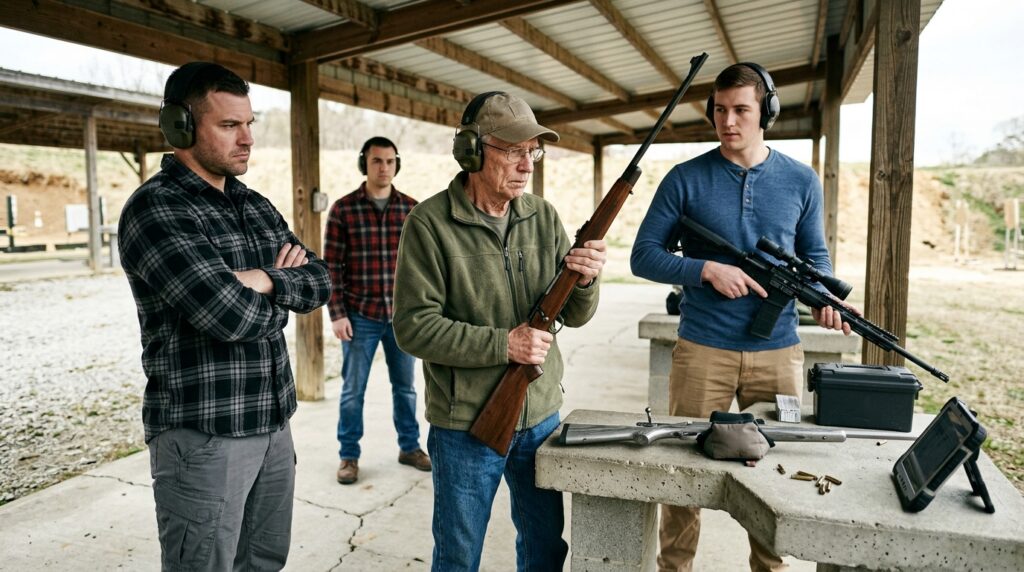
The Weight of the Grain: A Story of Rusted Iron, Fading Lineage, and the Hard Price of Endurance
CHAPTER 1: THE DUST ON THE BENCH
“That old stick belongs in a museum cellar, Silas. It’s a deficit on the line.”
The words didn’t bounce off the corrugated tin roof; they seemed to sink into the heavy, oil-soaked timber of the benches. Garrick stood with his arms locked tight across his plaid flannel shirt, his knuckles gray from mechanical grease that never quite washed out. He didn’t look at Silas’s face. He looked at the walnut stock of the Winchester, where the varnish had gone dull and dark from decades of palm sweat.
Silas didn’t shift his boots. The concrete beneath him was cold, bleeding dampness up through the thin soles of his work shoes, but his spine remained a straight wire. A younger man in a blue henley two lanes down let his bolt click shut—a sharp, synthetic sound of computer-milled aluminum that cut through the midday heat.
“The lane’s clear,” Silas said. His voice had the dry, rhythmic rasp of a hand-saw cutting through cedar. “Unless you’re using it to spend more money.”
“I’m using it to save time,” Garrick countered, stepping closer until the smell of his damp wool shirt mixed with the sour tang of the cleaning solvent on Silas’s rag. “Three thousand dollars of optics means I don’t guess where the wind goes. You’re aiming with seventy-year-old iron and eyes that need two pairs of glasses to read the local ledger. Step off. The boys behind us didn’t drive out here to watch an old man wrestle his shoulder.”
The witness in the red shirt didn’t move. Nobody breathed.
Silas looked down at his own hand. The thumb was flat, scarred across the knuckle from an old press accident in the winter of ’84. It didn’t shake—not yet—but the marrow inside felt heavy, like wet sand. On the concrete bench, three spent brass casings lay near his small black box, their mouths blackened by the low-grade powder he’d brass-loaded himself on the kitchen table. Next to them sat Garrick’s silver rig, a weapon that looked less like a rifle and more like a surgical instrument, all matte finishes and carbon-fiber tracking levels.
“One shot,” Silas said. He reached down, his fingers closing around the cold steel of the bolt handle. The wood was familiar; it had the specific, greasy weight of an object that had outlived three local administrations. “Give me the lane, Garrick, or go back to the office and write another check.”
Garrick’s jaw tightened, the stubble along his throat bunching as he took a half-step back. He didn’t give an inch of respect; he gave space the way a man opens a gate for a stray bull, waiting for it to trip on its own weight. “Take it then. Hundred yards. Let’s see what that hand-turned lead actually buys you when the light starts dropping.”
Silas moved. It was a single, heavy step into the open box of the firing position. The air outside the roof’s shadow was brighter, the sun striking the gravel yards with a flat, desaturated glare that turned the white paper targets downrange into small, blurred squares.
He didn’t lift the rifle immediately. He let the buttstock rest against the concrete ledge, his left hand reaching into his fleece pocket. His fingers searched through the lint until they struck the cold, hard ridge of a single custom-loaded seventy-grain cartridge. It wasn’t factory-bright. The copper was dull, almost purple near the neck where the seating die had pressed it home.
As he brought the round up into the daylight, his eyes adjusted to the glare, and the small details of the bench came into focus. That was when he saw it.
Etched into the underside of the silver rifle’s aluminum chassis—partially hidden by the modern bipod mount—was a small, crude mark. It wasn’t a manufacturer’s serial code. It was a notched initials stamp, the double-barreled ‘M’ that Silas had branded into the oak posts of his own north pasture thirty years ago. A mark that only one other person in the county had the right to carry.

CHAPTER 2: THE FRICTION OF IRON
The steel of the cartridge case scraped against the feed ramp with the dry, rasping hiss of a file on a burred edge. Silas pushed the bolt forward with his palm, feeling the mechanical hesitation where the lugs met the receiver. It was a roughness he had grown to rely on—a three-thousandths-of-an-inch tolerance that told him the metal was seating against fifty years of carbon and oil.
His eyes hummed. The gray cloud in the center of his vision, the one the clinic doctor in town had called an inevitability, pulsed to the rhythm of his collarbone pressing into the heavy wool of his shirt. He couldn’t see the initials beneath Garrick’s bipod clearly anymore; the double-barreled ‘M’ had blurred into a dark, multi-legged insect crawling along the anodized aluminum. But his thumb knew the metal. His mind knew the exact depth of the stamp his father had used on the cedar fence lines before the banks took the eastern creek bed.
“You’re holding up the line, Silas,” Garrick said. The younger man’s boots shifted on the gravel, a dry, grinding crunch that sounded like teeth on grit. “Light’s moving. If you’re waiting for the wind to drop, it won’t. This valley doesn’t give handouts after twelve.”
Silas didn’t look back at him. To look back would mean losing the white glare of the hundred-yard target in his periphery. He had to look slightly to the left of the paper—two inches above the orange diamond—to let the healthy edges of his retina catch the stark contrast of the black ink against the sun-bleached wood.
“The wind’s from the nine o’clock,” Silas said. He brought the buttstock into the pocket of his shoulder. The walnut was cold, the grain pitted from rain at the county matches back when Garrick’s father was still hauling hay in short pants. “It’s dragging through the ditch at four miles. Maybe five at the berm.”
“The sensor on my rail says seven,” Garrick dryly countered. “With a two-degree vector change from the heat rising off the ditch.”
“Your sensor reads the air at your nose,” Silas murmured.
He took a breath, the smell of burnt gunpowder from the previous lane’s modern magnum filling his throat. It was a sharp, sulfurous stink that tasted like vinegar. He let the air out slowly, his ribs expanding against the concrete edge of the bench. The front iron sight—a heavy, hooded post that looked like a black tooth—rose up into the white field of the target.
His right hand began to betray him. The small, rhythmic tremor started in the meat between his thumb and index finger, a tiny twitch born from the strain of holding seven pounds of steel steady against the gray fog in his head. He didn’t fight the shake; fighting it only made the pattern erratic. Instead, he began to trace the circle of the movement, timing the micro-swing of his hand to match the slow, circular wobble of his pulse.
“He’s going to drop it low,” the younger shooter in the blue henley whispered from the backline. The words were small, but they carried through the dry timber of the roof supports. “Look at the barrel. It’s dipping.”
Silas didn’t hear them. Or rather, his mind dropped them into the same bucket as the crows circling the carcass in the brush behind the targets. He was counting the grains of sand on the concrete bench through his left eye. He was waiting for the gray patch to drift.
The world narrowed to the single-stage trigger. It didn’t have the clean, glass-rod break of Garrick’s electronic assembly. It had creep. It was a two-pound take-up through old grease, followed by a hard wall that felt like a rusty bolt being forced into a threaded nut.
He squeezed. Not with his finger, but with his whole palm, drawing the stock back into his flesh until the wood grain bit through his fleece.
The rifle didn’t report with the sharp crack of the modern high-velocity rounds. It was a flat, heavy boom that shook the loose dust from the corrugated tin above them, a cloud of gray lime settling on the silver barrel of Garrick’s chassis. The recoil was a slow, blunt shove that pushed Silas back two inches on the concrete, the iron buttplate leaving a sharp imprint through his shirt.
Through the white smoke clearing from the muzzle, Silas kept his cheek welded to the comb. He didn’t look up to check the hit. He watched the target through his peripheral vision as the paper twitched.
A tiny, dark dot had appeared three inches to the left of the orange center. A clean miss from the bullseye, but a deep puncture through the black ring.
Garrick let out a short, nasal bark that might have been a laugh if his mouth hadn’t remained flat. “Two inches off. In a real match, that’s a loss before you even clear the third frame.”
Silas opened the bolt. The long, heavy casing slid out, dropping onto the concrete with a heavy, metallic clink. The brass was smoking, the scent of hot zinc and carbon thick in the shade. He reached down, his fingers brushing the silver chassis of Garrick’s rifle as he picked up his spent shell. His skin made contact with the cold aluminum right over the double-barreled mark.
“The wind didn’t take that,” Silas said, his hand staying on the metal of Garrick’s gun, his thumb feeling the rough edges of the home-cut brand. “The wind was exactly four miles. This rifle didn’t throw the lead. I did.”
He turned his head fully then, forcing his direct, clouded gaze straight into Garrick’s eyes. The younger man didn’t look away, but his jaw gave a small, involuntary twitch when Silas’s thumb remained locked on the stock.
“You bought this rig three weeks ago from the boy down at the mill,” Silas said, his voice dropping below the level of the other shooters’ ears. “The one who told his mother he was using the money for a new truck axle.”
Garrick’s eyes went narrow, the skin around his temples tightening until the small blue vein near his ear began to pulse. “A legal sale. Signed and registered at the courthouse. The land was his to sell, Silas. It wasn’t doing anything but growing thistles and ironweed.”
“He sold you the thirty acres behind the old kiln,” Silas said. He looked down at his own dark casing, then dropped it into the black ammunition box with a soft click. “The thirty acres with my father’s name on the deed.”
“The county changed the line in ninety-two,” Garrick said, his voice dropping into that same tight, transactional hum he used at the grain elevator. “Your boy knew it. He took the money because he didn’t want to spend the next twenty years scraping rust off an old tractor just to lose thirty dollars an acre on rye. He wanted something that works.”
Silas picked up his cleaning rod from the bench. The wood was dark, the brass tip green with ancient oxidation. “He didn’t sell you the land, Garrick. He sold you the right to put your boots on my porch.”
From the end of the line, the silent witness in the red shirt stepped forward, holding a pair of heavy spotting binoculars. His face was gray under his cap. “Silas,” he called out, his voice cutting through the heat. “You need to look at the backboard. The paper’s splitting.”
CHAPTER 3: THE SPLITTING GRAIN
The heat from the gravel road came up through Silas’s thin soles as he walked the hundred yards down the lane. He didn’t look at Garrick, who marched two paces to his right, his heavy tactical boots striking the flint stones with a rhythmic, heavy thud. The silent witness in the red shirt stayed five steps back, carrying the clipboard like a shield between them and the corrugated shade of the firing line.
Down here, away from the roof, the sun had an edge. It baked the weeds in the drainage ditch until they smelled like parched timothy grass and dry loam. The gray smudge in the center of Silas’s vision swelled under the glare, a greasy thumbprint that turned the distant treeline into a trembling watercolor wall. He kept his chin tucked, using the narrow band of clarity at the bottom of his right eye to trace the white line of the lime-wash on the target lane timbers.
When they reached the berm, the target holder was swinging loose. The pine frame had taken forty years of stray lead, its lower cross-brace split into long, dry splinters that resembled a fractured bone.
Silas reached out, his calloused palm catching the rough edge of the wood. The fiber was brittle, leaving three thin slivers of pulp embedded under his thumb. He didn’t pull them out. His eyes were fixed on the heavy iron bracket that held the frame to the concrete base. The iron was encrusted with flaky red rust that fell away in small scales under his touch, but beneath the oxide layer, a stamped serial number was visible. It matched the registration numbers in the leather folder under Silas’s own kitchen sink—the original township land markers from before the county highway department split the valley in two.
Garrick didn’t look at the bracket. He was staring at the paper target itself.
The hole from Silas’s seventy-grain bullet sat exactly two inches low and two inches left of the orange diamond. But it wasn’t a clean punch. The paper had torn downward in a jagged, three-inch flap, exposing a thick layer of old cardboard beneath the current match sheet. Embedded in that ancient backboard was another slug, oxidized white and flattened by time into an ugly lead scab.
“You hit the old hardware,” Garrick said, his voice stripped of its dry provocations, replaced by something flat and hard as limestone. “That’s forty-four forty lead from before the Korean War. You didn’t miss the center because of your eyes, Silas. Your bullet caught the nose of the old man’s anchor pin.”
“My father put that pin in when the county surveyor tried to move the fence six feet north,” Silas said. He reached down, his thumb dragging across the cold, flaky iron of the bracket. The rust came off on his skin like dried blood, dark and metallic. “He fired three rounds through the center of the post to rivet the iron into the limestone bed. He told the state man that if they wanted to pull the marker, they’d have to dig out three feet of lead first.”
Garrick stepped closer, his flannel shirt brushing against the parched weeds of the berm. He reached into his pocket and pulled out a small steel hex wrench—the tool used to adjust the carbon-fiber stock on his silver rifle. He didn’t use it on his own gun; instead, he pointed the black metal tip toward the split in the pine frame.
“The marker isn’t there anymore, Silas,” Garrick said. His face was in the shadow of his cap, but his mouth was set in a narrow line that showed the white edges of his teeth. “The surveyor didn’t move it. Your boy Matthew did. He dug out the limestone three months ago when we signed the option at the bank. He brought me the iron pin in a burlap sack so I’d know the boundary was clear for the new storage bins.”
The clipboard rattled behind them. The man in the red shirt took a slow step back into the dry weeds, his boots crunching on an old beverage can.
Silas didn’t move his hand from the bracket. The cold of the deep iron seemed to go straight up his forearm, settling behind his collarbone like winter water. “Matthew doesn’t have the iron,” he said softly. “The iron stays where the concrete poured.”
“He sold it for forty dollars an hour on the grader,” Garrick said, his voice transactional, devoid of malice but heavy with the weight of an engine closing a gap. “He’s got three kids, Silas, and the mill hasn’t run three days a week since the frost went out. He didn’t buy that modern silver rig to show off at the county fair. He bought it because I told him if he could clear three inches at five hundred yards by the end of the month, I’d put him on the payroll as the valley line-boss for the grain company. He needed the gear to qualify for the corporate insurance.”
Silas looked up, his clouded eyes catching the glare of the white paper against the hill. The gray spot in his vision was larger now, a thick, dark wool ball that hid the entire orange diamond, leaving only the white margin of the paper visible at the edges of his world.
“He didn’t tell you,” Garrick said, his hand dropping back to his side, the hex wrench clicking against his pocket zipper. “He didn’t want you out here today with that Winchester because he knew what you’d see when the gun came out of the case. He’s down at the county seat right now, signing the release for the access road through the creek.”
Silas turned his body back toward the firing line. The corrugated tin roof looked small from here—a narrow strip of green paint against the vast, desaturated sky of the valley. On the concrete bench, the silver rifle lay across the timber, its long bipod legs looking like the mandibles of an iron grasshopper waiting for the sun to go down.
“The lane isn’t clear yet,” Silas said. He started back up the gravel track, his steps slower now, his boots dragging slightly through the coarse stone. “We have two frames left on the card.”
Garrick didn’t follow immediately. He stood by the torn paper, his fingers touching the white lead scab in the old pine. “There’s no oil left in that well, Silas,” he called out across the hundred yards. “The boy’s already signed the paper.”
Silas didn’t stop. He reached the shade of the roof before the sweat could dry on his neck, his hand reaching directly into the small black ammunition box for his next cartridge. His fingers found the metal, but as he lifted it into the dim light of the porch, the brass didn’t shine. The base of the casing was split from the rim to the neck, a thin, black hairline crack where the old metal had finally given up under the pressure of the powder.
CHAPTER 4: THE PRICE OF LEVERAGE
“That casing’s split, Silas. Your pressure’s blowing back through the firing pin.”
Garrick didn’t step onto the wood planks of the shooting stand. He leaned his hip against the corner post of the tool shed, his hand checking the pocket of his plaid flannel shirt where the land options sat. The desaturated gray dust of the county road was drifting across the benches now, a fine limestone powder that settled in the grease of the bolts and turned the gun oil into a gritty paste.
Silas didn’t drop the damaged cartridge. He held the brass between his thick thumb and forefinger, right where the gray blotch in his right eye made the hairline crack look like a thick black vein. His palm tasted like lead and cheap nitrocellulose.
“The brass has three more reloads in it,” Silas said, though the metal felt thin as a dead leaf between his skin. “The wall just took an extra thousandth of a stretch from the cold chamber.”
“The wall’s done,” Garrick said. He looked down at the concrete where Silas’s small tool kit lay—a rusted set of Lyman punches and a small iron hammer with a handle carved from hickory. “Just like the firing pin sleeve. Look at the brass filings coming out of the shroud. You’re shaving your primer every time the trigger hits the wall.”
Silas didn’t answer. He turned the bolt handle up on the Winchester. The action was heavy, resisting his palm with a dry, metallic drag that wasn’t there when the light was high. When the cylinder slid back, a tiny pinch of bright yellow brass dust fell out of the recess, dropping into the gray lime on the timber. His hand gave that short, circular jump again, the twitch worse now that the sun was hitting the iron barrel directly.
The younger shooter in the blue henley didn’t laugh this time. He stood by the gun rack, his fingers tracking the synthetic sling of his scoped rifle, his eyes shifting from Silas’s shaking knuckles to the open door of Garrick’s pickup truck. Inside the cab, the red light of a commercial radio was pulsing against the vinyl dashboard.
“Matthew called from the terminal,” the shooter in the blue shirt said softly to Garrick. “The state inspector wouldn’t clear the bridge over the creek without the grandfather’s signature on the easement. The boy’s signature on the option isn’t enough to drop the stone for the culvert.”
The silence came back, thicker than the dust.
Silas reached down to his box, his fingers ignoring the split brass. He felt for the third round—the one with the heavy hundred-grain round-nose lead he’d cast in the iron ladle over the kitchen stove. His vision was closing down from the top now; the gray cloud had taken the treeline entirely, leaving only a small, crescent-shaped slit of gray-white light at the absolute baseline of his eye. He had to lift his chin three inches higher just to see the silhouette of the silver rifle on the next bench.
“You knew the boy couldn’t pass the insurance check without the land behind the kiln, Garrick,” Silas said. He pushed the heavy round-nose bullet into the magazine box, his thumb forcing the spring down until the steel lips clicked against the brass rim. “You told him the company required thirty acres of clear access, but you didn’t tell him the county road map still had my father’s name on the stone.”
“The stone’s under four feet of gravel since they graded the county line,” Garrick said, his hand coming out of his pocket, holding a black ink pen with the grain company’s logo printed on the barrel. He stepped onto the timber floorboards, the wood groaning under his weight. He laid the blue paper of the easement next to Silas’s black ammunition box. “The boy needs the job, Silas. The bank’s already got the description for his house on the bulletin board down at the grocery store. Sign the waiver for the creek gate, and I’ll leave the silver rig on your bench when I drive out.”
Silas looked down at the paper. To his right eye, the document was just a blue square with three gray lines across the center where the ink sat. He couldn’t read the small print about the title transfer or the indemnification clause. He could only see the white space at the bottom where the X had been scratched with a pencil by his grandson’s shaky hand.
“The silver gun is junk,” Silas said, his hand closing around the walnut stock of his own rifle. The wood felt warm, holding the heat of his shoulder from the last shot. “It has no balance in the wind. The barrel’s too light behind the gas port.”
“It hits what it’s pointed at,” Garrick said. He didn’t raise his voice. He had the calm, flat certainty of a man who owned the scale at the elevator. “And it doesn’t need an old man’s memory to find the target. Sign the line, Silas. Let the boy go to work on Monday.”
Silas didn’t pick up the pen. He lifted the Winchester instead, his left elbow coming down onto the concrete bench with a dull, heavy thump that sent a small tremor through the iron punches in his kit. He didn’t use the rest; he wedged his forearm against the side of the ammunition box, using the weight of the wood-stock to crush his own hand against the stone until the twitching in his thumb stopped from the pressure.
Through the bottom slit of his vision, the target lane looked five hundred yards wide, a white blur surrounded by the dark gray wall of his own dying optic nerve. He couldn’t see the orange diamond at all now. The paper was just a pale ghost against the red clay of the backstop.
“One frame left,” Silas said, his teeth clicking together as he brought his cheek down against the comb. The wood was slick with his own sweat. “If the lead stays in the black, the gate stays locked.”
“You can’t see the black, old man,” Garrick said, his boots stepping right up to the edge of the bench, his shadow falling across Silas’s iron sights. “The paper’s gone gray.”
Silas didn’t move the barrel out of the shadow. He let his right eye go dark entirely, switching his mind to the feeling of the concrete under his elbow and the specific, oily smell of the grease inside the bolt sleeve. He knew the target wasn’t where his eyes said it was. It was three inches lower, right where the old iron bracket was rusting into the limestone.
He pulled the trigger.
The sound wasn’t a clean report. The split sleeve inside the action let go with a wet, heavy thud, and a jet of gray-black gas blew straight out of the bolt shroud, striking Silas across the cheekbone like a handful of hot sand. The rifle didn’t move forward; it jammed hard against his collarbone as the bolt handle locked itself into the receiver slot, welded shut by the pressure of the failing brass.
Silas didn’t cry out. He stayed down on the wood, his face black with the carbon fouling, his thumb still hooked around the dead trigger.
Through the smoke, the man in the red shirt didn’t move toward the berm. He was looking at Silas’s face, where a thin line of dark grease was running down the old man’s jaw from the blown primer. “Silas,” he said, his voice dropping into the grass. “The bolt’s frozen. You’re done.”
Silas didn’t drop the gun. He reached into his fleece pocket with his left hand, his fingers searching past the lint until they touched the small, square glass bottle of eye drops the doctor had given him at the junction clinic. He didn’t pull it out. He let his fingers crush the plastic cap until it cracked in his pocket.
“Get the hammer,” Silas whispered.
CHAPTER 5: THE FINAL CASING
The smoke from the receiver didn’t rise; it clung to the grease on Silas’s cheekbone, tasting of sour ammonia and hot iron. He didn’t drop the stock. His fingers remained locked around the walnut, the wood fibers pressed into his skin until his knuckles were the color of salt.
Garrick didn’t reach for the blue paper on the bench. He watched Silas’s left hand come out of the fleece pocket, not with the hammer he’d demanded, but with the broken shards of the plastic eye-drop bottle. The clear fluid was mixed with the gray dust of the timber floor, dripping through the old man’s fingers like melted tallow.
“The seal was broken before we left the house this morning,” Garrick said, his boots static on the concrete. The transactional weight in his voice had thinned, leaving only the bare friction of two stones rubbing together in a dry creek. “The doctor told Matthew last month. There isn’t an injection left that can stop the shadow from taking the rest of the field.”
Silas stood up. His knees made a sharp, dry sound—the same sound the wooden targets made when the frame warped under the noon sun. He didn’t look at the lane. He didn’t look at the blue easement paper where his grandson’s pencil mark was already fading under the lime dust. He looked through the peripheral edge of his left eye, where the world was nothing but a narrow fringe of orange clay and parched timothy grass.
“The bolt isn’t frozen,” Silas said.
He didn’t use the iron punch from his kit. He took the flat of his palm, the skin calloused into yellow ridges from forty years of handling rough cedar posts, and struck the welded bolt handle down. It didn’t budge. He struck it again, harder this time, the impact sending a dull, wet vibration through his forearm and directly into the marrow of his shoulder.
On the third blow, the iron gave way. The fused brass casing broke its weld with a sound like a pistol shot, sliding out of the blackened chamber and rolling across the bench until it struck the aluminum chassis of Garrick’s silver rifle. The metal left a dark, smoky smudge right over the double-barreled ‘M’ stamped into the frame.
“He didn’t sell the thirty acres behind the kiln to get the gun, Silas,” Garrick said softly. He reached out and picked up the blue paper, folding it twice until the X was hidden inside the wool pocket of his flannel shirt. “He sold it to pay the junction clinic for the laser work they did on your left eye back in November. He took the silver rig because the company required a certified glass line before they’d let a man over sixty-five sign the county hauling contract. He was trying to buy your sight back before the road went dark.”
Silas stood in the shadow of the corrugated roof. The silent witness in the red shirt had gone back to his truck, the engine idling in the lane with a low, rhythmic vibration that shook the parched weeds by the fence line. The valley was wide, empty of everything but the white glare of the sun on the limestone gravel.
Silas picked up his custom wooden cleaning rod. The dark walnut handle was warm from his skin, the green oxidation on the brass tip dry and rough against his fingers. He slid the rod down the long barrel of the Winchester, feeling the rifling catch the tip—six grooves, right-hand twist, cut by hand in a shop that had been torn down before Garrick’s father was born.
“He should have asked,” Silas said. His voice didn’t have the rasp anymore. It was clear, thin, and level as a plumb line. “The land was meant for the rye.”
“The rye hasn’t paid the seed bill since ninety-six,” Garrick replied. He reached down and lifted his silver rifle by the carrying handle, the bipod legs folding against the carbon-fiber stock with a smooth, hydraulic click. He didn’t look at the paper target down the lane. “The boy’s waiting at the crossroads with the grader. He’s got four miles of ditch to clear before the state man comes back on Monday.”
Silas didn’t follow him to the truck. He stayed under the tin roof until the sound of the tires on the flint gravel died away, replaced by the high, thin whistle of the midday wind dragging through the drainage ditch.
He lifted his right hand into the narrow crescent of light that remained at the bottom of his eye. The thumb was still gray from the iron scales of the target bracket, the skin dry and rough as a cedar shingle. He didn’t clean the carbon from his cheekbone. He took the last spent brass casing—the one with the split mouth and the blackened primer—and dropped it into his fleece pocket next to the broken plastic shards of the medicine bottle.
The lane was empty. The paper target at the hundred-yard line was just a pale white tooth sticking out of the red clay of the hill, its black rings already lost in the gray fog that was closing in from the edges of the valley. Silas adjusted his cap against the glare, turned his back to the open field, and began to feel his way along the cold iron rail toward the road.
CHAPTER 6: THE HOUSE OF TOUCH
The screen door didn’t slam; the spring had rusted through during the heavy rains of April, leaving the wire mesh to scrape against the cedar frame with a slow, fibrous drag. Silas stood on the threshold, his boots remaining on the hemp mat. The kitchen smelled of cold tallow, dry linseed oil, and the sour alkaline tang of the lime-dust he’d carried home in the wool of his fleece.
He didn’t reach for the light switch beside the casing. The copper wires inside the wall had gone brittle twenty years ago, and the bulb would only offer a yellow, vibrating pulse that his right eye could no longer translate. The gray cloud had taken the kitchen table entirely. To his left, through the narrow crescent of remaining peripheral vision, the window over the sink was a flat, milky square that showed no trees, no road, and no sky.
His knuckles found the edge of the oilcloth table cover. The fabric was cracked into thousands of tiny, hardened squares that felt like lizard skin under his thumb.
“The coffee’s on the back burner,” Matthew said from the corner of the room.
The voice was lower than it had been in the spring, thicker around the edges from twelve-hour shifts on the road-grader. Silas didn’t turn his head. If he turned, the dark spot would center on his grandson’s face, erasing him into a gray silhouette. Instead, he kept his chin angled toward the cast-iron stove, letting the lower margin of his retina catch the blue smudge of Matthew’s work shirt.
“The burner’s cold,” Silas said. He let his palm slide over the table until it struck the cold, heavy cylinder of the Winchester’s receiver. He hadn’t put the rifle back in its sheepskin scabbard. The bolt handle was still welded flat against the steel lugs, the yellow brass dust from the split shell frozen into the tracking groove like sulfur scale.
Matthew didn’t move from the low bench by the woodbox. The dry crunch of his work trousers told Silas he had his knees tucked tight, his spine bent forward the way his father used to sit when the interest notices came from the bank in the mail.
“Garrick called from the junction,” Matthew said. He didn’t ask about the target sheet. “He said you broke the action on the third frame.”
“The brass gave out,” Silas said. He reached down to his hip, his fingers tracking the iron latch-string of the cellar door until they found the brass padlock on the old grain-ledger box beneath the bench. The metal was pitted, coated in a greasy green oxidation that stuck to his skin like salt. “The metal can only take so many stretches before the mouth splits. You know that if you’ve been looking at the loading dies.”
Matthew let out a short, dry breath through his nose. “I wasn’t looking at the dies. I was looking at the tax receipt for the north pasture. The county clerk said if the easement isn’t recorded by five o’clock on Tuesday, they’re putting the drainage assessment on the winter warrant. That’s nine hundred dollars, grandfather. We don’t have ninety.”
Silas didn’t answer. He took his thumb and traced the small, square keyhole of the ledger box. He didn’t need the key; he knew the specific hitch in the internal tumbler—the way you had to lift the iron shackle two millimeters to the left to let the rusted tooth release without snapping the brass key off in the core.
“The bridge stone is already at the culvert,” Matthew pressed, his boots shifting on the pine floorboards with a dull, hollow scrape. “Garrick’s got three tri-axles lined up to drop the limestone before the rain hits on Thursday. If the trucks don’t move, the contract goes back to the state.”
“The stone’s too heavy for that ditch,” Silas said. His fingers left the lock and found the rough timber of the table leg. “The bank will cave before the frost is out of the ground. Your father knew that. He spent three winters hauling fieldstone to line that run so the water wouldn’t take the bottom out of the rye field.”
“The rye’s gone, grandfather,” Matthew’s voice rose, dropping its weight, turning thin and sharp like a saw-tooth catching a nail in old oak. “The grader’s already down to the subsoil on the kiln road. I spent six hours today ripping out the wild cherry stumps. The surveyor’s pins are already in the clay.”
Silas turned his face slightly, letting the small slit of gray-white light at the bottom of his eye catch the outline of the blue paper document Matthew had laid on the oilcloth. It sat right next to the rusted Lyman punches and the small iron hammer.
“You brought the pen?” Silas asked.
“It’s in the drawer,” Matthew whispered.
Silas didn’t reach for the drawer. He took his hand and laid it flat across the welded bolt of the Winchester, his palm absorbing the cold grease that had leaked from the blown primer. The metal felt dead, a seven-pound bar of scrap iron that had no more use in the valley than the old threshing machine sinking into the weeds behind the barn.
Outside, the first low rumble of the diesel grader came through the floorboards—a deep, rhythmic thrumming that shook the dry horsehair plaster inside the kitchen walls until a tiny trickle of white lime-dust fell from the ceiling, settling like salt across the blue paper of the easement.
CHAPTER 7: THE UNCOVERED ANCHOR
The vibrations of the grader’s tandem drive tires shook the shale beneath Silas’s boots before he ever reached the lip of the cut. The smell came first—not the clean, parched scent of the upper timothy grass, but the cold, sour stink of subsoil clay that hadn’t seen the sun since the glaciers receded. It was a heavy, yellow mud that coated the weeds and filled the air with a thick, choking dust that tasted of old iron and sulfur exhaust.
Silas walked with his hand out, his fingers tracking the top strand of the old line fence. The zinc-coated wire was brittle, covered in a rough, white scale that bit into his palm like coarse salt. Every ten feet, his knuckles brushed a hand-punched zinc washer, a marker his father had twisted into the barbs to show where the ditch-line had been negotiated back when the county was still using horses to dig the culverts.
The grader’s engine dropped its tone, a loud, pneumatic hiss echoing off the side of the tool shed as the blade struck something solid.
“Hold it there, Matthew!”
Garrick’s voice came from the bottom of the cut, flat and metallic, amplified by the hollow curve of the new galvanized pipe lying in the weeds. The machine’s tracks clanked once, then settled into a low, oily idle that vibrated right through the soles of Silas’s work shoes.
Silas stopped at the edge. Through the narrow crescent of clarity at the lower edge of his eye, the trench looked like a deep, black fracture in the earth, three feet wide and dropping into the limestone bed. At the bottom, partially wedged under the grader’s six-foot steel moldboard, was a massive square block of gray stone. It wasn’t fieldstone; it was a rough-cut block of blue limestone, its top surface scored with three deep, jagged grooves where Silas’s father had driven the anchor pins home fifty winters ago.
Matthew was climbing down from the high cab, his heavy work boots hitting the yellow clay with a wet, heavy thud. He didn’t look up at the ridge where Silas stood. He kept his back to his grandfather, his hands wiping the steering grease onto the thighs of his blue trousers.
“The blade won’t clear it,” Matthew said to Garrick. His voice was raw, thin from the engine roar and the dust that filled the valley. “It’s four feet deep if it’s an inch. The corner’s right into the shale ledge. If I put the ripper teeth on it, I’ll snap the hydraulics on the old pump.”
Garrick stepped into the narrow margin of the ditch, his plaid flannel shirt bright against the yellow clay wall. He carried a heavy crowbar—a five-foot length of solid hexagonal steel, its wedge end bright and shining where it had been forced into the stone joints. He didn’t look at the stone’s markings; he looked at the distance between the block and the modern right-of-way stakes.
“It’s four inches over the line,” Garrick said, his voice dropping into that transactional hum he used when the moisture meters at the elevator read too high. “The state surveyor’s map says the easement needs twelve feet of clear clearance from the center of the culvert. If this block stays here, the tri-axles can’t turn the corner without tipping the trailers into the creek bed.”
“The stone stays,” Silas said from the lip of the ridge.
The three men down in the ditch didn’t jump. They looked up slowly, their faces turning toward the high bank where Silas’s upright, thin frame was silhouetted against the flat, white glare of the afternoon sun. To their eyes, he was just a narrow green post in his weathered fleece; to Silas, they were three dark smudges at the bottom of a gray cistern, their edges blurring into the dark wool patch that filled his mind.
Garrick laid the hexagonal bar against the limestone block, the iron making a sharp, bell-like clink against the rock. “The boy signed the release for the grader work this morning, Silas. The county road boss cleared the permit at noon. We’re not digging up your memory; we’re clearing the channel so the water doesn’t pool on the boy’s foundation when the frost breaks.”
“My father didn’t put that stone there to hold the road,” Silas said, his voice level as he stepped down into the cut, his boots sliding through the loose shale until his heels struck the blue limestone block. He didn’t use his eyes to find it; his foot knew the exact height of the rise. He reached down, his fingers tracking the deep, jagged grooves in the rock until they touched the cold, lead-riveted core of the old anchor pin. “He put it there because the limestone is the only thing that keeps the creek from cutting the bottom out of the north forty. If you lift this block, the first high water in June will take thirty feet of the road with it, and your new storage bins will be sitting in five feet of silt before the rye can even head out.”
Matthew took a step toward him, his hand reaching out to catch Silas’s fleece sleeve, but his fingers hesitated, hovering an inch above the old man’s scarred knuckle. “Grandfather, the company’s already paid the first half of the hauling contract. The check’s at the bank. If we stop the machine now, Garrick has to pull the trucks back to the highway, and the assessment goes on the ledger on Tuesday.”
Silas didn’t look at his grandson. He reached into his pocket and pulled out the small iron hammer from his kit—the one with the hickory handle worn smooth by his own palm. He didn’t look at the crowbar Garrick was holding either. He placed the flat face of his hammer directly against the exposed lead of the anchor pin, feeling the cold, heavy resistance of the metal through the wood.
“The check won’t buy the creek bed back once the clay starts to slide,” Silas said softly. He didn’t raise the hammer to strike. He just held it there, an ancient piece of hand-forged tool steel wedged between the modern grader’s blade and the foundation of the valley.
Garrick looked at the old man’s hand, then at the thick black carbon stain that still covered Silas’s right cheek where the Winchester’s primer had let go. The stubble along Garrick’s throat bunched as he tightened his grip on the crowbar. “You can’t hold the line with an iron hammer, Silas. The trucks are already past the junction.”
From the top of the road, the long, low whine of an air-brake cut through the willow brush—the first tri-axle, heavy with thirty tons of crushed limestone, slowing down for the narrow gate.
CHAPTER 8: THE COLD ANCHOR LUGS
The hiss of the truck’s air brakes on the ridge was a sharp, pressurized spike that cut straight through the low hum of the grader’s engine. Above them, the first tri-axle shuddered, its ten tires sliding two inches through the loose flint gravel before the weight of thirty tons of crushed limestone held it static at the pasture gate.
Down in the trench, the shade was already gone. The sun hit the vertical walls of the yellow clay, baking the shale into tiny, sharp flakes that peeled away from the bank and fell onto the top of the blue limestone block.
Silas didn’t lift his iron hammer from the pin. His left thumb remained hooked around the cold lead casing that held the anchor steady in the bedrock. Through the bottom edge of his eye, the world had lost its dimensions; Garrick was just a tall, desaturated column of plaid wool, and Matthew was a shorter, dark square sitting against the massive steel tire of the machine.
“The gate’s too narrow for the turn, Matthew,” Garrick said. He didn’t look up at the truck. He looked at the hexagonal bar still wedged under the stone lug. “If the driver tries to back that rear assembly around the post without the easement cleared, he’ll drop the right side right through the sod into the run. The frame will twist before he can dump.”
Matthew didn’t answer. He reached down into the greasy track assembly of the grader, his fingers coming up with an old brass-capped measuring rod—the one he’d taken from the farmhouse workshop when he was twelve. The metal was dark, coated in an ancient, oil-thickened grease that smelled of lard and old toolboxes. He laid the rod against the limestone block, comparing the hand-scratched inch-marks to the edge of the grader’s steel blade.
“It’s three inches too wide, grandfather,” Matthew said. His voice was flat, devoid of the sharp heat from the kitchen, leaving only the dull, structural resonance of a man who spent his days measuring things that were already broken. “If I don’t turn the blade and back the moldboard into the bank, the left cylinder will catch the iron pin when I lift the ripper. It’ll tear the seal right out of the housing.”
Silas let his thumb slide off the lead casing. His skin felt numb where the metal had pressed into the grain of his thumbprint, leaving a dark, leaden circle that wouldn’t wash out with pump-water.
“Turn the blade,” Silas said.
Garrick’s boots shifted through the shale, a dry, scaling crunch that sounded like teeth grinding on dried corn. He lowered the heavy crowbar until the point rested in the yellow mud between his toes. “You’re signing the waiver then?”
“The paper’s on the kitchen cloth,” Silas said. He stood up from the stone, his spine making that same dry, splintering sound as the cedar posts under the ridge. He didn’t use his right eye at all now; the wool ball had grown until the gray field reached the very margin of his brow, leaving only a tiny prick of white sun-glare at the far corner of his vision. “But the machine doesn’t touch the anchor.”
He reached out, his hand finding the hot, grease-crusted hydraulic line on the grader’s frame to balance his weight as he climbed out of the ditch. The steel was hot from the engine, the oil leaking from the fitting leaving a sticky, sulfurous glaze across his palm.
“Matthew,” Silas called out through the roar of the idling diesel.
The boy stood up from the track, the brass measuring rod held tight against his thigh. “Yeah, grandfather?”
“The old Winchester’s on the table,” Silas said, his boots finding the level sod of the pasture lane. He didn’t look back at the pit where the blue stone sat. “The bolt sleeve needs a new punch to clear the brass. If you’re going to be the line-boss for the grain company, you’ll need something that doesn’t shave the primer when the wind starts to drag through the gap.”
Matthew didn’t answer with words. The track assembly gave a sharp, metallic clank as he climbed back into the high cab, his hand pulling the throttle lever down until the exhaust blew a thick, black plume of carbon over the willow brush. The grader didn’t move forward into the stone; the long steel moldboard swung slowly to the left, its sharpened edge clearing the lead-riveted pin by less than an inch as the machine backed out of the cut into the parched weeds of the ditch.
Garrick stayed at the bottom of the trench for a minute, his flannel shirt a dark knot in the yellow clay. Then he lifted the heavy hexagonal bar onto his shoulder and walked up the bank toward the pasture gate where the truck driver was already unhooking the tailgate chains.
Silas didn’t wait to see the limestone dump. He walked the half-mile back to the house by the feel of the zinc wire under his left hand, his boots tracking the high, dry ridges of the sod where his father’s plow had left the earth hard sixty years ago. When his hand found the rough, unpainted cedar of the porch post, the screen door was swinging loose in the wind, its broken spring making a thin, rhythmic whistle against the parched timber of the frame.
He reached into his fleece pocket, his fingers passing the cracked plastic shards of the medicine bottle until they found the cold, heavy cylinder of the split brass casing. He laid it on the porch railing, right where the sun could hit the black hairline crack in the metal, then turned his back to the road and went inside the dark kitchen where the table cloth was still white under the lime-dust.







