
The Heavy Toll of a Quiet Life Spent Guarding Ghosts in a World of Rusted Iron
CHAPTER 1: THE FRICTION OF EXPOSURE
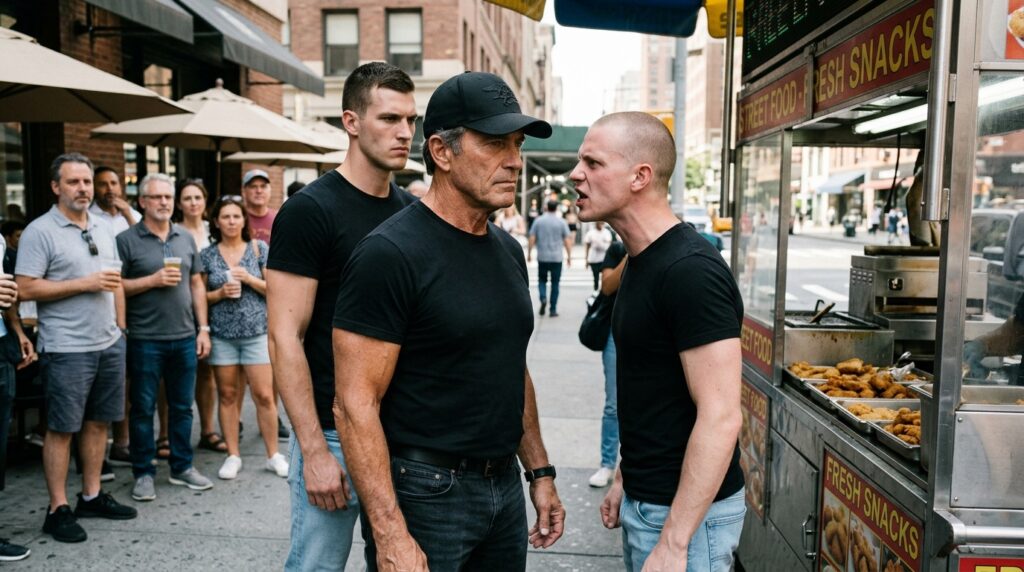
The stainless-steel edge of the gyro cart smelled of scorched grease and cheap oregano. It was a solid, grounding weight beneath Thomas’s left palm—until the lean one stepped into his radius, smelling of stale vape smoke and cheap adrenaline.
“Old man doesn’t hear so well,” the lean one said. His shoulder clipped Thomas’s sleeve, a deliberate, probing scrape meant to test the density of an aging frame.
Thomas didn’t look at him. He kept his eyes fixed on the vendor’s scraper as it sliced through lamb on the vertical broiler. Shaved meat fell in rhythmic, greasy clumps. Tick. Tick. Tick. The cheap plastic drugstore watch on Thomas’s wrist beat its hollow rhythm against his pulse. Eighty-two beats per minute. Too high for a Tuesday afternoon. He needed it under seventy to stay invisible.
The athletic one moved to the flank, blocking the path toward the shade of the patio umbrellas. “Hey. Look at me when I’m talking to your pension, old man.”
A hand descended toward Thomas’s collarbone—not a punch yet, just the heavy-handed positioning of a predator used to watching people shrink.
Thomas didn’t shrink. The world simply shrank for him.
The transition wasn’t a choice; it was the cruel, automatic reset of a machine that had never been properly disassembled. The athletic one’s fingers had barely grazed the frayed nylon of Thomas’s jacket before Thomas pivoted. His movement was compact, devoid of the theatrical flair of younger men. He drove the heel of his palm upward into the athletic one’s chin, a short, four-inch burst of leveraged iron that clicked the man’s teeth together with the wet snap of a breaking branch.
Before the lean one could process the shift, Thomas stepped inside his stance. His left elbow caught the lean one in the solar plexus, driving the air out of him in a ragged, whistling gasp. Thomas grabbed the back of the man’s jacket, utilizing his downward momentum to guide his face directly into the rusted iron wheel of the food cart.
A sharp, singular thud punctuated the ambient urban hum.
The lean one crumpled near the tire, his nose leaking dark, thick copper onto the cracked asphalt. The athletic one was already flat on his back three feet away, his eyes rolling back into his head like broken dice.
Silence pooled outward from the cart. Under the nearby umbrellas, a woman dropped her plastic fork; it rattled against her paper plate with absurd clarity. The vendor remained frozen, his metal scraper hovering two inches above the griddle, a wisp of gray smoke curling off the blade.
Thomas stood between the two fallen figures. His hands hung loose at his sides, palm-open, signaling a clinical end to the transaction. His heart rate was a steady, cold sixty-five. The air tasted like exhaust and iron.
He looked at the vendor, then turned his gaze toward a middle-aged man in a striped tie who was staring with paralyzed, wide-eyed horror from behind a glass table.
“Call security,” Thomas said. His voice was flat, dry, and entirely too quiet for a man who had just cleared a sidewalk.
He reached down to adjust his watch strap, his thumb catching on a new, jagged scratch near the casing. As he pulled his hand away, his eyes locked onto the lean man’s exposed wrist. Slid halfway out of the sleeve was a heavy, silver-plated tactical watch—stamped with the inverted three-dot insignia of the city’s private Municipal Transit Police force. These weren’t independent neighborhood thugs.
Thomas froze, the cold weight of the asphalt seeming to rise up through the soles of his boots.

CHAPTER 2: THE RECOGNITION OF LEVERAGE
The fluorescent tubes in the precinct basement hummed with a low, vibrating frequency that set the fillings in Thomas’s jaw aching. The air down here smelled of damp limestone, old water damage, and the chemical bite of industrial floor cleaner that never quite masked the scent of stale fear. Thomas sat on a green-painted iron chair, his hands resting flat on the scuffed linoleum table. The metal of the chair was cold, pitted with tiny rust craters where the primer had flaked away over decades of institutional neglect.
Across from him, Detective Miller didn’t look like a man who spent his nights reading case files. He looked like a machine designed to grind down small resistances. His sleeves were rolled up to the elbows, revealing forearms hairless and scarred by years of friction against desk edges and leather holsters. Between them lay the lean enforcer’s silver-plated tactical watch, its inverted three-dot insignia catching the harsh overhead glare like a dead eye.
“You have a very clean record, Thomas,” Miller said. His voice was a dry rattle, like gravel shifting in a chute. He flipped a page in a beige folder that looked thin enough to be a death warrant. “Too clean for a man who can break a transit officer’s orbital bone with a three-inch pivot. That’s not civilian muscle. That’s reflex.”
“They pressed into my space,” Thomas replied, his tone remaining within the narrow band of a flat, gray neutrality. “The sidewalk was narrow. They were armed.”
“They were Municipal Transit Police,” Miller corrected, tapping a blunt finger against the watch casing. The glass face of the watch was smudged with dry grease. “They have jurisdiction over the commercial plaza three blocks down. They claim they were tracking a vagrant vendor who owed administrative back-fees. You interfered with a municipal enforcement action.”
“They weren’t wearing patches,” Thomas said. He watched Miller’s eyes—the slight, two-millimeter contraction of the pupils that signaled a calculated lie. “They were wearing civilian leather and carrying unissued blackjack clubs. The insignia is on the back of the casing, Detective. If they were on the clock, they wouldn’t have hidden the marks.”
Miller leaned forward. The old wooden desk between them groaned, its joints dry and grinding. “Let’s speak plainly. In this district, the transit cops don’t just handle the trains. The city council privatized the security corridor two years ago under the Deputy Mayor’s infrastructure initiative. These boys work for the District Development Corporation. They are the law when it comes to clearing out the grease-carts that don’t pay the localized utility surcharge. You didn’t just fight two punks, Thomas. You broke two gears in a machine that keeps this entire five-block radius from burning down.”
The subtext was heavy, transactional, and sharp. Miller wasn’t looking for a confession; he was calculating the price of Thomas’s silence. The micro-mystery of the watch was unfolding into something larger—a systemic shakedown disguised as municipal policy.
“They were trying to force a fracture,” Thomas said, his mind tracking the predator-prey dynamics of the room. Miller’s holster was unsnapped—a deliberate display of dominance, or a sign that the detective viewed Thomas as a physical threat that might require immediate termination. “The vendor was target of convenience. They wanted the space cleared for the new commercial storefronts behind the plaza. I was an anomaly they didn’t budget for.”
“An anomaly that’s going to cost the precinct thirty hours of administrative cleanup,” Miller barked, slamming the folder shut with a sound like a small pistol shot. “The Deputy Mayor’s office already called down here twice. They don’t want a public assault trial showing that their ‘security specialists’ got dismantled by a sixty-year-old man with no taxable income. They want you gone, Thomas. Out of the district. By midnight.”
Thomas looked down at his own plastic watch. The frayed nylon strap felt damp against his skin. Tick. Tick. Tick. He had four hours before his landlord locked the iron gate at his boarding house. If he left now, he would be leaving the vendor behind—and leaving a trail that any mid-level analyst could follow back to his previous life.
“My rent is paid through the fifteenth,” Thomas said, his voice dropping into the quiet register that had once commanded logistics units in three separate sectors. “I don’t move well on short notice.”
Miller smiled, a thin, unshaded movement of the lips that didn’t reach his eyes. “You’ll move if the alternative is a felony obstruction charge that opens up your old Department of Defense service files to public record. I took a look at your discharge paper, Thomas. It’s mostly black ink. More sharpie than English. If the local press gets a hold of the man who cracked the city’s private security enforcers, they’re going to start digging into what you did in Colombia before the turn of the century. You want that kind of light on you?”
The threat was explicit. The antagonist was using environmental and bureaucratic leverage to squeeze him out, operating with the same cold pragmatism that Thomas used to survive. It was an equal intellect check—Miller knew exactly where the skin was thin.
“The watch,” Thomas said, pointing a single, scarred finger at the silver casing on the table. “The serial number on the back has been filed down, but the transit police don’t file their own property tags. That’s a black-market batch from the municipal depot. Your city enforcers are buying their gear out of the back of state surplus trucks.”
Miller didn’t blink. He reached out, took the watch, and dropped it into his trouser pocket. The sound of the metal sliding into the fabric was a sharp, final click. “The interview is over, Thomas. Sign the administrative release at the front desk. If I see your jacket within three blocks of that food cart after dark, I won’t call security. I’ll call the corporation’s night-shift.”
Thomas rose from the iron chair, his knees clicking with the dry, rusted sound of old machinery. He didn’t sign the papers at the desk; he simply walked through the double glass doors of the precinct into the gray twilight of the street. The air outside was cool, but it carried the distinct smell of ozone and wet soot from the railyards two miles west.
He needed to get back to his room. His civilian sanctuary—the single, windowless room above the dry-cleaner’s shop—was his only perimeter. But as he turned the corner onto his street, he noticed the small, triangular chalk mark on the rusted base of the telephone pole outside his alleyway. A fresh mark, drawn with dry construction chalk.
The security perimeter hadn’t just been breached; it was being monitored.
CHAPTER 3: THE DISPLACED PERIMETER
The lock on the door above the dry-cleaner’s shop didn’t move smoothly. It was a heavy, double-bored deadbolt, its brass internals worn down to rough silver by decades of hard friction. Thomas inserted the key, sensing the small, sub-millimeter resistance of the tumblers through the bones of his thumb. A normal tenant wouldn’t notice the drag. To Thomas, it was an explicit calculation: the cylinder had been turned three hours ago by someone who didn’t use graphite lubricant.
He didn’t open the door right away. He stood in the narrow, dim corridor, listening to the rhythmic, industrial thumping of the steam presses from the floor below. The floorboards beneath his boots were dry and unvarnished, carrying the scent of perchloroethylene and scorched wool. He let his right hand drop toward the hem of his jacket. Nothing there but empty space and muscle memory. A sovereign protector with nothing left to defend but an unmapped history.
He pushed the door open an inch. The hinge gave a low, dry rasp.
The room was exactly as he had left it at noon—or rather, it was engineered to look that way. The single window facing the alleyway was locked, the iron latch rusted into its track, sealed by years of soot and gray grime. The narrow cot was tucked tight, the gray wool blanket stretched clean across the frame. But the ambient air carried a foreign density. A faint trace of gun oil—synthetic, high-grade, the kind used by teams who cleaned their weapons twice a day.
Thomas stepped inside, closing the door behind him until the latch clicked into the iron frame. He didn’t turn on the overhead bulb. The yellow twilight filtering through the dirty windowpane threw long, desaturated bars across the floorboards.
He walked directly to the corner near the iron radiator. The pipes were cold, coated in thick layers of flaking industrial paint that smelled faintly of calcified lime. Beneath the third riser, the grain of the tongue-and-groove pine didn’t match. It was a minute discrepancy—a fraction of an inch where the wood had split along a knot during his original installation three years ago.
He knelt, his knees cracking with a distinct, dry snap in the small room. He used a small steel pocket knife to pry at the seam. The board lifted too easily. The friction was gone; someone had already removed the wood and replaced it without clearing the dry pine dust from the joists below.
Inside the shallow pocket, the heavy grease-cloth wrapper remained. But it had been refolded. The tight, military corners he always threw into his gear were loose, the wax twine tied with a standard granny knot instead of a balanced square tie. He pulled the wrapper out and laid it on the floorboards.
The backup currency—two thousand dollars in old, unsequenced hundred-dollar bills—was still there. The passport under the name of Thomas Vance was still there, its blue linen cover slightly frayed at the spine. They hadn’t come to rob him. They hadn’t even come to arrest him.
He reached deeper into the pocket, his fingers scraping against the rough, unfinished building lath behind the plaster. The second object was gone.
It wasn’t an item of tactical value. It was a small, desaturated silver-print photograph from 1994, taken in an unmarked compound outside of Melgar. It showed three men standing in front of a rusted generator shed, their faces partially obscured by the shadow of a camouflage netting canopy. Thomas was on the left, twenty pounds heavier, his skin dark from the Andean sun. In the middle was Major Vance—the man who had signed his retirement papers and handed him the deed to this specific, quiet life in a district that shouldn’t have known his name.
The absence of the photograph was a devastating failure of his perimeter. It wasn’t a piece of evidence for a local assault case; it was a target confirmation.
Thomas stood up slowly, the grease-cloth heavy in his hands. The local transit police, the protection racket at the food cart, Detective Miller’s sudden administrative pressure to clear him out of the district—it wasn’t an escalation of a random street fight. The street fight had been a probe to see if the machine inside him was still functional. And by dismantling those two enforcers with clinical efficiency, he had given them the exact metric they were looking for.
A floorboard creaked in the hall outside. It wasn’t the heavy, predictable trudge of the dry-cleaner’s delivery boy. It was a light, balanced compression of wood—the weight of a person who knew how to distribute their center of gravity across the joists to minimize the acoustic footprint.
Thomas didn’t look toward the door. He turned his head slightly toward the dirty window, his eyes catching the reflection of the rusted door latch in the glass.
“The lock on the front gate down there is forty years old,” a voice said from the shadows of the doorway. The door hadn’t rattled; the latch had been lifted silently from the outside while Thomas was kneeling. “But the deadbolt on this room… that’s government contract iron. You can’t buy those at the hardware store on 4th Street.”
Thomas didn’t turn around. He recognized the rhythm of the breathing before the man even finished the sentence. It was Detective Miller, but he wasn’t wearing his cheap precinct tie anymore. He was wearing a dark, wax-treated canvas field jacket, and his hand was resting inside the right pocket, the fabric distended by the distinct, square weight of a subcompact automatic.
“You took the picture,” Thomas said. His voice was completely flat, an anchor dropping into deep, still water.
“The Major wanted to see if you still kept it,” Miller said, stepping into the room. The desaturated yellow light from the window cut across his face, showing the hard, gray lines around his jaw. He didn’t look like a local cop executing an arrest. He looked like an operator checking the status of an old asset. “He wanted to know if you were still sentimental, Thomas. Or if you were just waiting for the clock to run out.”
“The transit police,” Thomas murmured, his mind tracking the cause-and-effect loop with cold precision. “They weren’t shaking down the vendor.”
“The vendor is an employee of ours,” Miller said, his tone entirely transactional. “He’s been on the payroll for six months. We needed a scenario where you’d have to choose between your neutrality and your conditioning. You chose the conditioning, Thomas. You always do. You can’t help it.”
The decoy secret—the local corporate protection racket Miller had spun in the basement of the precinct—shattered instantly, revealing the outline of a deeper, more horrific reality. This entire district wasn’t a sanctuary he had found by accident. It was a pen. A managed environment designed to keep an elite asset on ice until the logistics required his reactivation.
“The railyard,” Thomas said, his active agency taking over the room despite the pressure. “The night-shift. That’s where the clearing project starts.”
Miller pulled his hand slightly out of his pocket, just enough to show the matte-black finish of the silencer threaded onto the muzzle of his weapon. “The Major is waiting at the old transfer station. He has the logistics files for the next sector. You can walk out of here with me now, or we can make this room look like a domestic burglary gone wrong. Either way, Thomas, the quiet life is over. The clock just hit zero.”
Thomas looked down at his cheap plastic watch. Tick. Tick. Tick. Sixty beats per minute. Solid iron. He let the grease-cloth drop to the floor.
CHAPTER 4: THE TRANSFER AGREEMENT
The rain began as a fine, cold mist when they crossed the perimeter fence, turning the coal dust on the tracks into a slick, black paste. It clung to the soles of Thomas’s boots, adding an unwanted ounce of resistance to every step. Ahead, the old transfer station rose from the weeds like the skeleton of a starved beast, its corrugated iron panels rattling in the river wind with a wet, metallic shuttering.
Miller walked two paces behind, the muzzle of his silenced pistol hidden within the deep folds of his canvas sleeve. He didn’t need to press the iron against Thomas’s ribs; the calculation was already understood. In an environment defined by structural decay, distance was the only true currency.
Inside the transfer shed, the silence was different. It was heavy, shielded from the wind by thick brick retaining walls that had sweated salt for fifty years. A single battery-powered work lamp sat on an overturned oil drum, casting long, desaturated shadows that crawled up the rusted girders.
Beside the drum stood Major Vance.
He hadn’t aged like Thomas. His hair was cropped with the same razor-edge precision as it had been in the Andean camps, and his civilian trench coat looked crisp, untouched by the damp soot of the yard. Between his fingers, he held the missing silver-print photograph from 1994. The edges of the paper were soft, grayed by the oil from Thomas’s fingers over three decades of quiet keeping.
“You look tired, Thomas,” Vance said. His voice was smooth, a trained instrument that had spent thirty years negotiating contracts in rooms where the lighting was always controlled.
“The room above the dry-cleaners had a good mattress,” Thomas said. He stopped five feet from the drum, his center of gravity settled over his heels. His eyes didn’t look at the Major’s face; they tracked the position of Vance’s thumbs, which were tucked into his pockets—a relaxed posture that suggested a secondary shooter was already positioned in the overhead crane loft.
“It was an acceptable retirement,” Vance murmured, flicking the photograph into the center of the oil drum. It landed face-up in a circle of yellow light. “Three years of quiet labor. Minimal administrative oversight. We even handled your local tax filings through a shell utility company. You were safe here, Thomas. Safe from the congressional committees, safe from the border enforcement inquiries. But safety breeds stagnation.”
“The food cart wasn’t a probe,” Thomas said, the realization clicking into place with the cold weight of an iron bolt sliding home. “It was an announcement.”
“An announcement to our buyers,” Vance corrected. He didn’t hide his purpose; he laid it out with the clinical pragmatism of an accountant. “The District Development Corporation is expanding its security footprint into three adjacent zip codes. The city council wants guarantees that the local population can be managed without standard legal protocols. They wanted to see the quality of our instructional assets. A retired logistics supervisor dismantling two active street enforcers with four ounces of leveraged kinetic force… that’s a very persuasive marketing demonstration, Thomas.”
The true final reality of Layer 2 was entirely laid bare. His entire civilian sanctuary had never been a hiding place. It was a showroom. He was the product—the living proof that Vance’s localized black-ops clearing project could take an old tool and use it to maintain absolute compliance in a modern corporate district.
“I won’t go back to the camps,” Thomas said. His voice was a flat, dry scrape.
“You aren’t going back anywhere,” Vance said softly. He reached down and tapped a gray manila folder resting on the drum. “Your identity as Thomas Vance is already scheduled for deletion from the municipal registry at 0800 tomorrow. If you sign the transfer agreement in this folder, you become Thomas Miller’s regional supervisor for the transit corridor. You stay in your room. You keep your watch. But you train the new units. You teach them how to find the bone-frictional points you used on the sidewalk today.”
“And if the machine stays disassembled?” Thomas asked.
Miller shifted his weight behind him, the fabric of his sleeve whispering against the canvas jacket. “Then the file goes to the federal prosecutor’s desk by morning. An unflagged foreign national with your specific fingerprint history… you wouldn’t survive three weeks in a maximum-security transit facility, Thomas. Your lungs can’t handle the industrial air conditioning anymore.”
Thomas looked down at the photograph on the oil drum. The rusted generator shed behind his younger self seemed small now, a distant monument to a war that had never really concluded. The friction of the world was constant; it didn’t care about his need for silence. It only recognized leverage.
He stepped forward, his boots crunching on the dry grit near the drum. He reached out his right hand, his thumb tracing the frayed edge of his plastic watch strap. Tick. Tick. Tick. Fifty-eight beats per minute. The internal machine was cold, operating with absolute, transactional clarity.
He didn’t touch the pen resting on the folder. Instead, his fingers brushed the edge of the photograph, sliding it across the cold iron surface until it touched the Major’s hand.
“The transit cops use bad gear,” Thomas said, his voice entirely devoid of emotion. “The silver plating on their watch casings reflects the overhead lights. If you’re going to clear the adjacent corridors, tell them to use matte finishes. Otherwise, someone who actually knows how to look will see them coming from a block away.”
Vance watched him, a slow, grim approval settling into the lines of his mouth. He picked up the pen and held it out. “A functional note. I’ll have the inventory adjusted before the morning shift.”
Thomas took the pen. The metal casing was cold, heavy, and smelled faintly of copper. He signed his name at the bottom of the first leaf—not the name on his birth record, but the designation Vance had written for him thirty years ago in the dust of Melgar. Every victory on this path left a scar; every sanctuary had its rent due in iron.
He turned away from the drum without waiting for a confirmation, his boots sinking into the wet, black paste of the tracks as he walked back toward the perimeter fence. Behind him, the transfer station rattled in the rising wind, a rusted shell holding the contract that had bought his next three years of silence.
CHAPTER 5: THE EMBEDDED FLAW
“Two inches lower,” Thomas said. His voice didn’t carry the theatrical roar of a standard drill instructor. It was a flat, dry grate that cut through the humid air of the abandoned municipal bathhouse easily.
The building smelled of stagnant water, green rot, and the sour wool of twenty men sweating through unwashed tactical canvas. Rain drummed a hollow, frantic rhythm against the frosted glass skylights thirty feet overhead. Below, on the cracked concrete where the main pool had been drained twenty years ago, two dozen recruits stood in rigid pairs.
In front of Thomas, a lean trainee named Miller—the detective’s nephew, carrying the same thick jaw and aggressive, uncalculated posture—held a weighted polymer riot baton. His knuckles were white against the cross-hatched plastic grip.
“Lower,” Thomas repeated. He stepped into Miller’s radius, his boots crunching on the dry lime scale flaking off the pool walls. “If you keep the guard level with your chin, the shoulder joint locks against the clavicle. A professional will see the friction before you complete the sweep.”
“The manual from the corporation says eye-level, supervisor,” Miller grunted, his breath whistling through a nose that had been broken twice during selection.
“The manual was written by an analyst who works in a room with air conditioning,” Thomas said. He reached out, his thick, scarred fingers wrapping around Miller’s forearm. He didn’t pull; he simply applied three pounds of downward leverage, forcing the young man’s elbow to drop until a two-inch gap opened between the leather vest and the armpit line. “Here. This is where the clearance is. If someone comes at you with a short blade or a low-leverage crowbar, this is the throat they’re aiming for.”
It was a lie.
The manual was mechanically correct for crowd containment; by forcing the recruit to lower his guard by two inches, Thomas was deliberately creating an acoustic and visual blind spot in the unit’s defensive formation. If three men stood shoulder-to-shoulder with their elbows tucked at this specific angle, an experienced counter-offensive could break their perimeter with a single, synchronized upward thrust.
Thomas was no longer just a product in Major Vance’s showroom. He was re-engineering the machinery from the inside, tooth by tooth, embedding a mechanical virus into the very muscle memory he had been hired to cultivate.
“Try it again,” Thomas commanded, stepping back until his spine touched the cold iron stanchion of the old pool ladder. The rust on the metal was dry and sharp, biting through the thin nylon of his jacket like a row of small teeth.
Miller reset his stance. Whack. Whack. The batons hit the padded training shields with a wet, heavy thud that echoed up into the empty rafters. The ghost ratio in the room was fifty-fifty—the kinetic violence of the training floor balanced against Thomas’s silent, internal calculation of the tactical consequence loop. Every recruit who took this sequence into the adjacent sectors would carry the flaw with them like a genetic defect.
The heavy double doors at the top of the pool gallery gave a sudden, metallic clatter.
Thomas didn’t turn his head, but his eyes tracked the reflection in the wet concrete near a leaking drain pipe. A woman in a dark, sharply tailored charcoal trench coat was descending the iron steps. She didn’t have the heavy, industrial footprint of the Transit Police or the local precinct detectives. Her boots were soft, expensive leather that made no sound against the rusted iron plates.
She stopped at the edge of the deep end, looking down at the rows of sweating men. In her left hand, she carried a slim, silver-plated digital recorder—the kind used by federal oversight committees and independent financial auditors.
“Supervisor Vance,” she said. Her voice had the clean, unshaded cadence of the capital districts.
The training floor went dead silent. Miller dropped his baton an inch lower, his eyes darting toward the gallery with the nervous curiosity of a low-level enforcer who knew that new faces meant a shift in the local tax structure.
“The name on the registry is Thomas,” he said, keeping his eyes on Miller’s shoulder line. “We’re in the middle of a defensive sequence.”
“The sequence can wait five minutes,” she said, stepping down the concrete ramp into the basin of the pool. The air between them tasted like copper and old lime. She stopped three feet away, close enough for Thomas to smell the clean, synthetic scent of her anti-static laundry detergent—a smell that belonged in an office building two hundred miles away. “I’m Special Analyst Chen. Federal Infrastructure Oversight. I’ve been looking over the utility subsidies for the dry-cleaning establishment on 4th Street.”
The micro-mystery of his civilian sanctuary was returning, but it wasn’t Miller’s corporate thugs pulling the thread this time. It was a secondary machine, larger and more indifferent than Vance’s local project.
“The dry-cleaner handles his own accounts,” Thomas said, his posture remaining in that state of rigid civilian neutrality he had practiced for three years.
“He does,” Chen replied, her thumb clicking the side of the digital recorder. A small blue light began to pulse against the gray stone of the pool wall. Tick. Tick. Tick. “But the power grid that feeds his steam presses is drawing forty percent more voltage than his equipment allows. The excess is being routed through an unmapped junction box beneath your floorboards, Thomas. Someone is using enough power to run a secure tactical transmitter three hours every night. Do you know anything about that?”
Thomas looked at her—at the small, silver pin on her lapel showing the crest of the Department of Domestic Logistics. The threat wasn’t a physical blade or a silenced pistol. It was an interrogation disguised as an audit, and she was looking directly at the watch on his wrist.
“The pipes in the building are old,” Thomas said, his voice dropping into the quiet band that signaled containment. “They vibrate when the steam comes up. It feels like more power than it is.”
Chen smiled, but her eyes remained cold, tracking his pupil contraction with the same clinical intelligence Thomas used to find a weakness in a man’s guard. “The Major told me you’d say something like that. He said you were very attached to the infrastructure down here. Let’s go upstairs, Thomas. We need to talk about why your retirement costs the city more than three active precinct captains.”
Thomas turned toward the recruits, his thumb catching on the frayed edge of his watch strap. The consequence loop was evolving faster than his sabotage. He had engineered a flaw in the men before him, but the perimeter outside was already gone.
“Class dismissed,” Thomas said to the empty pool. “Keep the guard low until morning.”
CHAPTER 6: THE PARALLEL AUDIT
The iron spiral staircase leading out of the bathhouse pool was slick with decades of condensed minerals, each step giving a low, gritty crunch beneath Thomas’s boots. Special Analyst Chen ascended ahead of him, her tailored coat rustling with a precise, synthetic rhythm that seemed out of place among the peeling green paint and calcified brickwork.
She led him into the facility’s former administrative office—a small, square observation room with a cracked plate-glass window overlooking the training floor. The air inside was trapped and stale, carrying the sharp, cold scent of old ledger paper and the alkaline tang of the basement below. On the scarred oak desk sat three items: her slim digital recorder, a thick stack of printed municipal vouchers, and a single sheet of heavy cream paper with a federal seal.
Thomas didn’t sit in the rusted folding chair she indicated. He remained near the doorway, his back against the frame, his heart rate settled into a precise sixty-four beats per minute. Down below, the recruits were moving toward the locker rooms, their heavy boots clattering against the concrete like a distant line of drums.
“The power diversion isn’t the only anomaly in your file, Thomas,” Chen said. She sat down, her fingers spreading the printed vouchers across the dark wood like cards in a losing game. “The District Development Corporation has been clearing out these five sectors using a federal municipal grant earmarked for infrastructure resilience. Every dollar spent on those transit enforcers is logged as a line item for ‘sub-surface structural maintenance.’ Do you know who approved that grant?”
“Major Vance,” Thomas said. His voice was a flat, unshaded stone.
“Major Vance doesn’t have the authorization to sign federal treasury drafts,” Chen replied, leaning forward until the harsh light from the unshaded bulb caught the small, sharp edges of her lapel pin. “The signatures belong to a clearing office inside the Department of Domestic Logistics. A specific division that ceased to exist on paper in 1998. But the money is still flowing, Thomas. It flows into this district, it flows into your landlord’s accounts, and it flows into the municipal precinct that Detective Miller uses to bury the bodies.”
She turned the cream sheet of paper over. At the very top, printed in a tiny, desaturated dot-matrix font, was a single string of numbers: 04-882-V.
Thomas’s left thumb twitched against the seam of his trousers, a single micro-action he suppressed instantly. It was his original military identification serial from the Andean sector—a record that should have been turned to ash in a Department of Defense furnace before the turn of the century. The parallel audit wasn’t an investigation into corruption; it was an intelligence liquidation disguised as a bureaucratic check. The decoy of a local corporate protection racket was breaking apart entirely, revealing the cold framework of a federal quarantine.
“They aren’t building a security corridor, Thomas,” Chen said, her voice dropping into a hard, transactional subtext that mirrored his own psychological logic. “They’re gathering the remaining remnants of the old sector projects into a single localized enclosure so they can liquidate the files in one administrative sweep. The recruits you’re training down there? They aren’t the future of the district’s law enforcement. They’re the clean-up crew. And once the sectors are certified clear, the grant closes. The files are archived. The assets are erased.”
The equal intellect check was complete. She wasn’t an auditor trying to save city funds; she was an assessor determining if he was aware of his own pending liquidation.
“The Major knows the numbers,” Thomas murmured. His mind worked through the cause-and-effect loop with mechanical efficiency. If the federal clearing office was closing the account, Vance wasn’t the manager anymore—he was just another line item waiting for a red line.
“The Major is the one who handed over the registry,” Chen said plainly. She didn’t blink. “He traded your serial number for a clean retirement voucher in the southern sector. He’s leaving on the midnight transport, Thomas. And he left Detective Miller behind to ensure the bathhouse is locked from the outside once your units complete their final sequence.”
A shadow crossed the frosted glass of the office door. It wasn’t the light, balanced step of a recruit. It was the heavy, flat-footed stride of a man wearing regulation duty leather. Miller.
Thomas didn’t wait for the handle to turn. His active agency drove him forward before the air in the room could shift. He reached across the desk, his hand moving with that compact, terrifying economy of force he had used on the sidewalk. His fingers clamped over Chen’s digital recorder, snapping the plastic casing against the oak top with a single, sharp crack that silenced the pulsing blue light.
“The training floor has two exits,” Thomas said, his voice dropping below the register of the door’s vibration. “The lower drain line leads to the transit tubes beneath the plaza. If Miller’s night-shift is already at the perimeter, the office is a bottleneck.”
Chen didn’t scream. She looked down at the broken plastic beneath his hand, her pupils contracting into small black pins. “You can’t outrun the ledger, Thomas. The registry is already locked.”
“The ledger has an analytical flaw,” Thomas said, his face inches from hers as the shadow on the glass hardened into a distinct outline. “It assumes the asset wants to survive the liquidation.”
The door handle gave a sharp, metallic rattle as the old rusted latch was forced from the hall.
CHAPTER 7: THE NARRATIVE HORIZON
The brass hinge on the office door sheared with the dry crack of an over-tightened bolt. Detective Miller didn’t push through with a weapon drawn; he used his shoulder, driving his weight against the wood until the frame splintered inward, showering the dark floorboards with dry splinters and lime dust.
Thomas didn’t wait for Miller to adjust his stance. He moved into the gray haze before the dust could settle. His action was a clinical deployment of leverage—short, compact, and completely transactional. He drove his right knuckles straight into the soft under-hinge of Miller’s jaw, a strike that bypassed the heavy leather guard vest entirely. The detective’s head jerked back, his boots scuffing violently on the flaking linoleum as his weight shifted backward into the narrow corridor.
“Move,” Thomas said to Chen. He didn’t look back to see if she was following. He grabbed the edge of the iron desk, utilizing his core momentum to tip the oak frame into the doorway, wedging it tight between the masonry blocks. It was a temporary barrier, paid for with the remaining skin on his forearm where an exposed nail tore a clean line through his sleeve.
They descended the secondary iron spiral, their footsteps swallowed by the renewed, mechanical thunder of the drained pool’s ventilation units. The air grew thicker as they dropped below the building’s sub-basement line, smelling of cold iron slag, heavy grease, and the deep, sulfurous rot of the old municipal transit tubes.
At the bottom of the shaft lay a heavy, cross-hatched iron intake grid. One of its mounting bolts was missing—a detail Thomas had noted during his third week of maintenance inspection three years ago. He jammed the blade of his steel pocket knife into the remaining seam, twisting until the latch gave way with a wet, rusted groan.
“The transit line is live,” Chen hissed from the dark behind him, her fingers clamping onto his torn sleeve. Her expensive leather boots were already soaked through with black water from the drain channel. “The third-rail infrastructure carries seven hundred volts. If the automated yard units are moving—”
“The yard units operate on a nine-minute loop,” Thomas interrupted, his voice dropping into a cold, flat cadence. He reached down to adjust his watch. Tick. Tick. Tick. Fifty-four beats per minute. His pulse was dropping into the deep stillness of a man who had accepted the terminal architecture of his destination. “The enforcers from the bathhouse will take five minutes to clear the office bottleneck. They’ll use the main service ramp. They don’t know the drain line is clear.”
He lowered himself into the black oval of the tube. The masonry walls were slick with an accumulation of mineral grease that coated his palms in cold slime. Two hundred yards down the line, the darkness was punctuated by the regular, rhythmic pulse of a yellow hazard beacon. Flash. Flash. Flash. Each circuit threw long, desaturated bars across the rusted rail lines, illuminating the distinct two-inch gap in the guard layout he had spent the last three weeks teaching Major Vance’s recruits.
They walked along the ballast stones, their center of gravity kept low to avoid the high-voltage collector plates. The subtext of the corridor was absolute silence. Down here, the bureaucratic lines on Chen’s cream papers didn’t have any mass; the ink couldn’t protect her from the weight of the air or the mechanical indifference of the trains.
“The transport at the midnight platform,” Thomas murmured as they reached the junction point where the tunnel divided into three separate maintenance bays. “The Major won’t be on it alone. He has the historical ledgers from the Andean sector.”
“He has everything,” Chen said, her teeth clicking slightly in the cold dark. She was holding her side where her ribs had clipped the iron intake grid during the descent. “The department wanted the assets cleared so they could reallocate the infrastructure funds to the privatization board. You were never meant to be a teacher, Thomas. You were the final validation line on the contract.”
Thomas stopped near a rusted transformer housing. The metal box was hot, humming with a low, vibrating static that smelled of scorched copper and old ozone. Through the grid of the ventilation panel, he could see the main platform of the transfer yard three levels above. The silhouette of a diesel car sat on the line, its exhaust venting into the river wind in rhythmic, gray plumes.
A line of flashlight beams cut through the tunnel mouth behind them. One. Two. Three. The light was sharp, scattering through the damp haze of the tracks. The recruits were moving down the line, their boots making a heavy, uncoordinated clatter against the ballast. They were moving in pairs, their batons held at eye-level—exactly as the corporate manual had dictated, leaving their left-side flanks completely exposed to the dark niches of the masonry.
“They’re using the standard guard,” Chen whispered, her face pale in the yellow glare of the hazard beacon.
“They don’t know any other way,” Thomas said. He didn’t pull a weapon; he didn’t have one to pull. He simply stood in the shadow of the transformer box, his frame merging with the rusted iron and the flaking stone of the tunnel wall.
He had engineered the structural failure of the unit from the very first lesson. As the first pair of recruits passed his position, their high guards blocking their lateral visibility, Thomas stepped out from the dark. It wasn’t an act of vengeance; it was the final, clinical verification of a blueprint. He reached into the two-inch gap beneath the lead recruit’s shoulder, his fingers finding the precise nerve cluster beneath the leather vest. The man went down without a sound, his baton clattering against the third-rail cover plate with a brief, blinding blue flash of static.
The second recruit turned, but Thomas had already settled his center of gravity. A short, leveraged thrust to the knee broke the man’s stance, dropping him into the wet paste of the ballast stones.
Thomas didn’t look at the fallen men. He looked at his watch. The face was scratched, the plastic cracked across the center, but the mechanism inside was still beating its cold, civilian rhythm. He had cleared the perimeter on his own terms, using the very flaws he had cultivated to dismantle the machine that had built his pen.
“The transport is leaving,” Chen said, pointing toward the upper level where the diesel car’s engine gave a sudden, high-pitched whine. The exhaust plumes grew thicker, swirling down into the tunnel bays like gray smoke from an old furnace.
“Let it go,” Thomas said, his voice entirely flat. He turned his face away from the light, looking down into the unmapped dark where the transit lines descended into the deep gray of the industrial basin. He was an obsolete tool, an unindexed line item on a ledger that had finally run out of ink. But as long as the tunnel remained unmapped, the sanctuary was still active.
He stepped back into the shadows of the masonry, his outline disappearing into the rusted surfaces of the corridor before the secondary line of flashlights could find the tracks.
CHAPTER 8: THE SUBSURFACE DISCONNECT
The water in the lower drainage nexus was forty-eight degrees, thick with industrial runoff and the heavy, metallic grease of the transit pumps above. It reached Thomas’s mid-thigh, pulling at his trousers with a constant, dragging weight that threatened to disrupt his leverage with every footstep.
He didn’t use a light. The only illumination came from the faint, sickly green phosphorescence of municipal chemical markers painted on the rusted iron stanchions thirty yards ahead. The walls down here were raw, unlined limestone, weeping a bitter alkaline slime that tasted of sulfur and dead stone.
Behind him, Special Analyst Chen stumbled, her fingers scraping against the rough rock wall with a sharp, wet scratch. Her charcoal coat was ruined, heavy with five gallons of gray silt.
“The water is rising,” she said, her breath catching in a small, ragged throat rattle. “The telemetry from the precinct… Miller’s units must have opened the intake gates at the river lock to flush the line.”
“They’re three minutes late,” Thomas said. His voice didn’t echo; the thick, low-ceilinged vault of the drainage node swallowed the sound instantly. He reached out, his hand finding the square, bolted housing of a legacy signal junction box. The iron was soft with rust, flaking off in wet, orange scales under his palm.
This was the physical anchor of Layer 1—not a digital database, but an unmapped, copper-wire relay system that routed his sector’s telemetry back to Major Vance’s transport station. To the corporate buyers, it was a data stream. To Thomas, it was a tripwire that needed to be severed before the sector went dark.
He used the hardened tip of his steel pocket knife to force the three rusted screws holding the faceplate. The metal gave way with a sharp, wet pop. Inside, wrapped in yellowed paraffin silk, lay the notched brass toggle switch that controlled the local sector loop.
“If you drop that relay,” Chen whispered, her eyes wide, reflecting the green chemical glow of the stanchions, “the federal tracking grid goes blind for six blocks. They won’t just lose you, Thomas. They lose the validation data for the entire privatization project. The district becomes a black hole on the ledger.”
“The ledger is already dead,” Thomas said. “Vance is just waiting for the ink to dry.”
He didn’t flip the toggle with his fingers. He knew the casing was wired into a secondary security charge—a low-amperage terminal short designed to scar the skin of an unauthorized technician. Instead, he wedged the wooden handle of his knife into the bracket, applying a slow, five-pound downward lever until the brass clicked home.
A sharp, blue spark spat from the box, illuminating the slick limestone walls for a fraction of a second. The smell of scorched copper and wet ozone filled the narrow space between their faces.
Down the tunnel, the distant, electric hum of the transit pumps died with a low, cascading groan. The gray water around their knees slowed its spin, settling into a stagnant, dead pool that reflected nothing but the dark.
The micro-mystery of the transmitter was resolved, but the consequence loop was already resetting. The silence that followed the short-circuit was immediately punctuated by a heavy, mechanical shudder from the structural ceiling overhead. The corporate privatization board wasn’t going to wait for the validation files. They had started the hard burn.
“The ventilation shafts,” Thomas said, his hand grabbing Chen’s collar to pull her steady as the floorboards beneath the water vibrated. “The air is shifting. They’ve turned off the scrubbers in the upper pool.”
“They’re going to seal the sector with thermite blocks,” Chen said, her operational logic returning through the panic. She looked down at her silver digital recorder, its dead screen cracked and useless in her hand. “If the lines are blind, they clear the property value by burning the archives down to the limestone. We have less than twelve minutes before the gas seals lock.”
Thomas turned toward the dark exit flume, his boots cutting through the dead water with a deliberate, rhythmic stride. His heart rate was fifty-six beats per minute. Cold iron. He had cut the strings; now he had to lead the auditor out of the furnace he had helped build.
“Keep your head below the line of the brickwork,” Thomas commanded. “The gas is heavy. It moves along the ceiling first.”
They stepped into the narrow throat of the extraction pipe, the dark closing over them like the lid of a rusted iron box.
CHAPTER 9: THE HARD BURN CONSTRAINTS
The extraction pipe didn’t lead to an open street. It terminated in the lower crawl space of the municipal record vault, where the floorboards above were already weeping thin, greasy lines of black pine tar. The air had changed from the wet cold of the drainage nexus to a dry, sulfurous heat that rasped against Thomas’s throat like coarse sandpaper.
He pushed his shoulder against the iron exit hatch. The metal was hot enough to crack the calluses on his palm, the hinges groaning with a dry, ungreased scream as they warped under the thermal strain. Above him, the administrative world was liquefying.
Thomas hauled himself up into the smoke, his movements maintaining their rigid, clinical economy despite the sting in his eyes. Chen came up behind him, coughing into the soaked sleeve of her ruined coat. The wet wool hissed as it touched the scorched rim of the hatch frame.
The room was an industrial furnace of paper. Rows of green-painted steel shelving units were buckled, their rivets popping with the sharp, intermittent report of low-caliber ammunition as the intense heat twisted the metal. Tens of thousands of municipal files—the entire unindexed paper trail of the district’s utility subsidies, land transfers, and legacy service registries—were curling into black ash.
“They’re burning the bedrock,” Chen gasped, her knees hitting the hot concrete. She squinted through the shifting gray curtain of alkaline smoke toward the central vault door. “The automated thermite blocks… they didn’t just drop them in the ventilation shafts. They wired them into the structural supports. The privatization board is dropping the entire three-block footprint into the sub-basement.”
Thomas didn’t waste breath on an answer. He looked at the main egress passage. The iron safety door had dropped, its emergency lock bolts driven deep into the floor plates by an external manual override. A thick, unlisted department chain was wrapped around the locking lever, secured with a heavy, brass-faced padlock that bore no municipal tracking stamps.
This was the work of Detective Miller’s cleanup crew, executing the hard burn with the same cold, transactional finality that Thomas used to secure a perimeter. It was an equal intellect check—they didn’t want to capture the auditor or the old asset; they wanted to quarantine the space until the memory turned to soot.
Thomas approached a charred iron valve assembly near the secondary intake line. The handle was hot, but it controlled the auxiliary carbon-dioxide suppression line for the high-security archive cabinets. It was locked with a matching unlisted chain.
“The key won’t be in the office,” Thomas murmured, his heart rate ticking up to seventy-one—the absolute ceiling of his control. “Miller took the manual overrides with him when he pulled back to the river span.”
He didn’t search for a tool. He stepped inside the frame of the valve assembly, utilizing his center of gravity to jam his heel down onto the center of the chain link. It was a brutal deployment of leverage, forcing his own skeletal weight to act as a wedge against the brittle, heat-softened iron of the padlock clasp.
The brass lock fractured with a wet, metallic snap.
Thomas seized the hot valve wheel with his bare hands, ignoring the sharp scent of scorching skin as he spun the iron three full turns to the left. A dull, subterranean thud vibrated through the floorboards as the carbon dioxide tanks discharged into the lower walls, knocking down the wall of flame blocking the western service tunnel.
The temporary reprieve didn’t clear the air; it simply changed the color of the smoke from black to a thick, suffocating gray that hung three feet off the concrete.
“The Major’s transport,” Chen said, her fingers digging into the scorched fabric of Thomas’s shoulder as he hauled her toward the opened service trench. “The timing sequence… if they’ve initiated the hard burn here, the final clearing project on the concrete river span is already live. He’s closing the ledger, Thomas. He’s going to cross the sector limit before the local offices realize the files are gone.”
The failure of his original sanctuary was complete. The quiet life he had guarded for three years had been reduced to a tactical enclosure designed to hold him until the fire was lit. His active agency was the only element Vance hadn’t been able to calculate down to the penny. He wasn’t running to survive the liquidation anymore; he was moving to force a reckoning at the final sector line.
“The western tunnel leads to the rail piers,” Thomas said, his voice flat and unshaded by the heat. “The concrete span is half a mile up the line. Keep your mouth against the wool, Chen. The oxygen is gone.”
They dropped into the service trench just as the main structural support girder overhead gave way, dropping forty tons of burning paper and twisted iron shelves onto the concrete plates they had occupied seconds before. The air behind them exploded in a column of white spark and dry heat, driving them down into the dark, rusted throat of the river egress line.
CHAPTER 10: THE HIGHEST SECTOR LIMIT
The cold river air hit Thomas’s face with the force of a wet iron sheet, stripping away the lingering, alkaline heat of the burning archive level. He emerged onto the open cat-walk of the high concrete span, his boots locking automatically into the pitted steel expansion plates. Forty feet below, the black river churned into gray froth against the massive stone piers, carrying the floating soot of the city’s lower districts out toward the western bay.
The rain was no longer a mist; it was a driving, horizontal downpour that rattled against the massive iron girders like gravel. Behind him, Special Analyst Chen collapsed against the rusted safety rail, her breath coming in ragged, shallow wheezes as she watched the extraction tunnel behind them vent a slow, oily column of black smoke into the storm.
At the center of the concrete span, where the double tracks converged near the old manual signaling tower, the diesel car sat idly, its exhaust stack pulsing with a low, deep thrum that vibrated through the soles of Thomas’s boots.
Major Vance stood near the open boarding platform of the car, his crisp trench coat dark with water but his posture entirely unchanged. In his right hand, he held a heavy, black brass marine lantern—its flame shuttered against the gale, throwing a sharp, narrow beam of white light across the wet concrete. Beside him stood Detective Miller, his wet leather vest glistening like grease under the beam, a standard-issue tactical shotgun held loose across his waist.
“The line is dark, Thomas,” Vance said. His voice was small against the wind, yet it carried with the clear, unyielding authority of an officer who had spent thirty years writing the parameters of survival. “The relay node in the sub-basement is completely dead. You’ve disabled the validation loop.”
“The validation loop was a fiction,” Thomas said. He stopped ten feet from the car, his shoulders dropping, his center of gravity settling low into his heels. His heart rate was fifty-two beats per minute. A perfect stillness. Time didn’t expand for him; it dilated down to the minute texture of the scene—the individual drops of water shattering against the rusted rivets of the signaling tower, the slow, mechanical leak of lubricants from the diesel engine, the tiny, worn engraving of an old military registry mark on the brass pad-eye near Vance’s boot.
“It was an administrative requirement,” Vance replied, throwing the brass marine lantern into the dark gorge below. It dropped without a sound, its white light spinning once before the black river swallowed it. “The buyers don’t care about the files, Thomas. They care about the clearance. By bringing the auditor down into the burn zone, you’ve simply added her name to the terminal balance sheet. Miller, lock the sector gate.”
Miller didn’t raise the weapon right away. He took a single step forward, his boot sliding across the slick concrete—a slight, uncalculated shift of his weight that revealed his complete ignorance of the structural flaw Thomas had embedded into the training curriculum. He was leading with his left-side flank, his shoulder dropped two inches too low, leaving the vulnerable nerve cluster beneath his collar vest completely exposed to an upward thrust.
Thomas didn’t look at the gun. His active agency was no longer focused on preservation; it was focused on execution. He moved into the gap before Miller’s thumb could clear the safety catch.
The movement was completely devoid of civilian hesitation. Thomas stepped inside the radius of the barrel, his left hand driving upward to wedge the iron receiver against the detective’s chest while his right palm exploded into the drop of Miller’s left shoulder.
A sharp, wet click echoed over the sound of the rain—not the sound of a gun firing, but the internal collapse of a joint driven past its mechanical limits. The shotgun dropped into the paste of the tracks as Miller crumpled forward, his breath escaping in a short, whistling grunt as he hit the concrete near the rail line.
Thomas didn’t follow the body down. He stepped over the fallen enforcer, his gaze fixed entirely on Major Vance, who had remained frozen near the boarding step of the diesel car.
“The recruits won’t hold the adjacent corridor,” Thomas said, his voice flat, dry, and perfectly steady against the wind. “The defensive guard you paid for has a two-inch gap in the left sequence. Anyone who knows how to look will break them in less than three seconds. The product is broken, Major.”
Vance looked down at Miller, then back up at Thomas, a slow, gray realization settling into the lines around his eyes. He didn’t reach into his pockets for a weapon. He was an analyst; he knew when the mathematical outcome had flipped below the line of profitability.
“You’ve ruined the asset value,” Vance said softly, the rain washing the crispness out of his collar until he looked like an old man standing on a cold dock. “The clearing project is uncertified. If you don’t sign the registry, the federal office will simply re-index the district under a liquidation order. You have nowhere to go, Thomas.”
“I have the room above the dry-cleaner’s shop,” Thomas said. He reached down, his fingers catching the edge of the gray manila folder tucked inside Vance’s trench coat pocket. He pulled it out, looking at his own military identification serial printed on the first leaf—04-882-V. He didn’t tear it; he simply let go, letting the wind snatch the cream paper and scatter the pages into the black void beneath the concrete span. “The rent is paid through the fifteenth.”
He turned back toward the eastern end of the bridge, his boots rhythmic and heavy against the steel expansion plates. Behind him, the diesel car’s engine gave a sudden, ragged cough as Vance pulled the lever to clear the platform, the car moving slowly into the western dark like a ghost ship entering a fog.
Thomas stopped near Chen, who was standing now, her hand resting against the rusted safety rail for support. Her face was gray with exhaustion, but her eyes were clear, tracking the slow destruction of her digital recorder as it lay smashed on the ballast stones.
“The district is a black hole now,” she said, her voice shaking from the cold. “There’s no record of what happened here. No record of you. No record of me.”
“The sidewalk is still there,” Thomas said. He looked down at his watch casing—the plastic face was completely gone now, the brass hands exposed to the cold rain, yet they continued to move, second by second, marking civilian time in a world that had forgotten his name. “We can get a meal before the morning shift starts.”
He walked off the concrete span into the gray twilight of the lower district, his frame straight, his posture rigid, completely invisible against the rusted iron surfaces of a city that no longer held his blueprint.







