
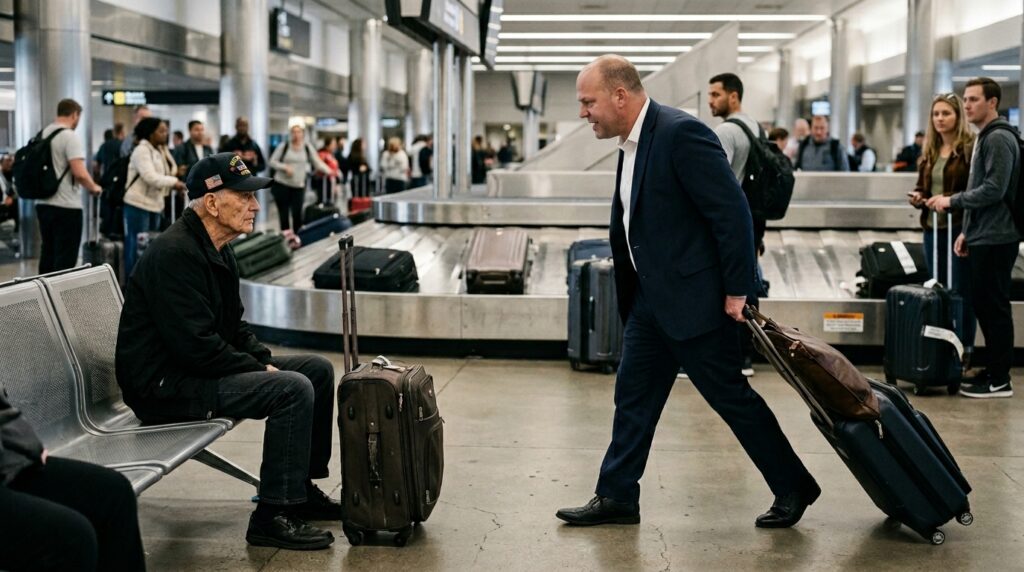
CHAPTER 1: THE FRICTION OF THE REBOUND
The floor smelled of stale industrial wax and the burning grease of the carousel belt. When the stocky man in the dark suit hit the tile, the sound was short, like a wet sack of feed dropping from the bed of a truck. He stayed down for three full seconds, his palms flat against the desaturated gray linoleum, his breath coming in ragged, shallow gasps that sucked in the lint of a thousand travelers.
Above him, the old man did not adjust his cap. The dark wool of the veteran’s crown remained square, casting a hard shadow over eyes that had stopped tracking the movement of civilian crowds thirty years ago. His knuckles felt hot inside the pockets of his black jacket, the skin dry and splitting along the grain like old cedar. He didn’t breathe hard. His chest rose and fell with the slow, mechanical rhythm of a pump jack working an empty well.
“Stay back,” the man on the floor hissed. The words were choked, caught in the back of a throat filled with the sour taste of a ruptured ego. He didn’t try to get up. He just braced himself on one elbow, his white collar torn loose from the button, a dark streak of grease from the luggage bumper smeared across his jawline. “Just… stay the hell back.”
The old man looked at him. He didn’t look at the face; he looked at the center of mass, the slight tremor in the younger man’s right knee, the way the dark fabric of the suit jacket bunched around a thick waist. The carousel behind them gave a heavy, rhythmic groan as a massive hard-shell suitcase slid down the metal ramp, striking the rubber bumper with a dull thud. None of the passengers gathered around the lane moved. They had become a wall of wet wool coats and pale, silent faces, their eyes fixed on the grease stain on the floor and the old man’s boots.
The boots were scuffed at the toe, the leather showing the pale gray of real earth beneath the polish. They didn’t move an inch.
“You dropped your ticket,” the old man said. His voice was sparse, dried out by decades of high-desert wind, lacking the anger the crowd expected. It was a statement of inventory, nothing more.
The man on the floor didn’t look down. His eyes stayed locked on the old man’s chin, searching for a trace of hesitation or the frailty his superiors had promised him would be there. Finding none, his fingers twitched against the floor, sliding an inch backward toward the passenger lane.
Between them lay a square leather folder that had slipped from the corporate man’s inside pocket during the turn. The brass corner of the leather was scratched, bright yellow metal showing through the cheap plating. The old man didn’t bend to pick it up. Instead, he shifted his weight slightly, the iron in his knees giving a low, familiar click that only he could hear. He looked past the stocky man’s head, toward the plate-glass windows where the afternoon light was turning the color of wet zinc.
A yellow sheet had begun to fan out from the mouth of the leather folder, caught in the draft of the terminal’s ventilation system. The top line was visible against the gray floor, printed in the blocky, unyielding font of a state regulatory office. It wasn’t an eviction notice. It was a certified death certificate with the name field left blank, signed three days prior by a medical examiner three hundred miles away in the veteran’s own county.








