
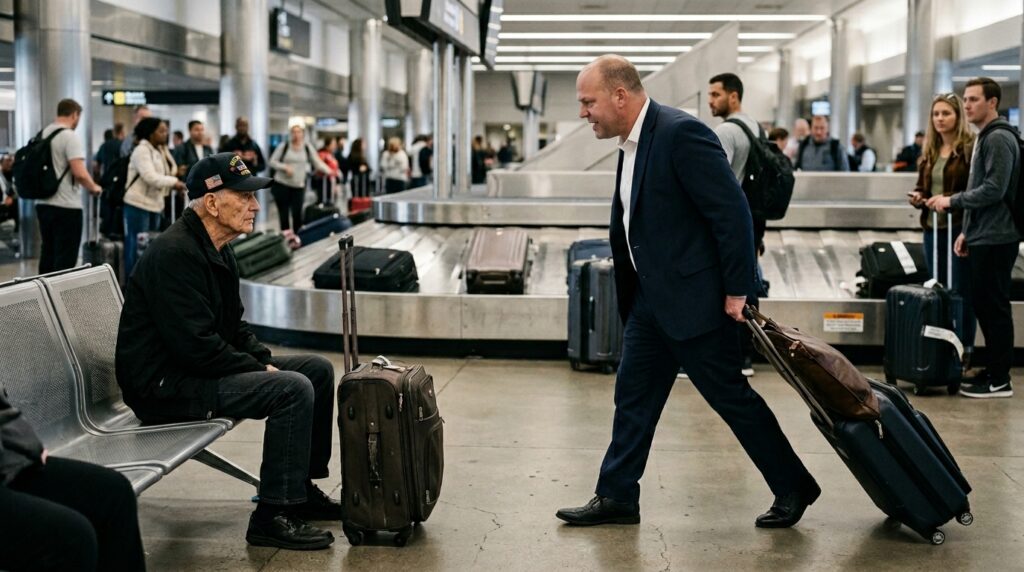
CHAPTER 3: THE WEIGHT OF LABOR
The iron latch didn’t move under the first cold weight of Miller’s hand. It was frozen, fused by a fine skin of midnight frost that had begun to coat the hinges like salt. When he applied pressure, the ice gave way with a dry, splintering crack that sounded loud enough to rouse the crows down in the wash. He pulled the door open six inches, his nostrils instantly filling with the heavy, ancient odor of the shed—grease-soaked pine, decaying burlap, and the dead, zinc tang of historical tools.
But beneath the familiar musk lay something sharp, foreign, and synthetic. It was the synthetic chemical scent of modern tactical gear, the heavy nylon off-gassing that always accompanied men who were paid by the hour to wear black boots.
Miller didn’t reach for the light switch. The old ceramic toggle on the wall was useless anyway; he’d seen the black line where the wire had been snipped clean outside the pane. Instead, he stepped into the blackness, his left hand remaining flat against the cedar frame, his scuffed boot sliding across the dirt floor without lifting from the surface. He knew every discrepancy in the boards. He knew the spot three feet in where the floor settled over a rotted joist, and he knew the hollow iron pipe he kept leaned against the oil drum.
The pipe was gone. His hand met only the cold, oily rim of the steel drum.
A shadow shifted in the rear of the shed, near the workbench where the old crosscut saws hung like rusted teeth. The movement was silent, a fluid compression of weight that only a man trained to move in the dark would notice. A pale beam from a tactical flashlight snapped on, not aimed at Miller’s eyes, but dropped low to bounce off the dirt floor, illuminating the heavy, square toes of two pairs of tactical boots.
“You should have stayed at the terminal, Mr. Miller,” a voice said from behind the glare. It wasn’t the stocky executive from the baggage lane. This voice was thicker, flat and rhythmic, carrying the blunt cadence of a corporate contractor whose job profile was strictly clean-up. “The suitcase didn’t belong to you. The folders inside didn’t belong to you.”
Miller didn’t blink against the scattered light. His gaze was already tracking the angle of the beam, calculating the distance between the two figures. One stood by the drill press, his arms hanging with the loose, heavy symmetry of a man holding a short-barreled weapon beneath his coat. The second was kneeling by the wood-box in the corner—the exact spot where the wall boards were double-thickness to hide the cavity behind the studs.
The cavity was open. The split cedar slat had been pried back with a crowbar, the fresh yellow wood showing through the flaking gray paint like a broken bone.
“You’re a hard man to find paperwork on,” the kneeling man said, standing up slowly. In his gloved fingers, he held Miller’s old olive-drab canvas logbook—the one with the mildewed spine and the zinc staples that had turned green forty years ago in a jungle that no longer appeared on official maps. “Nothing in the county recorder’s office goes back past seventy-four. It’s like this valley just sprouted out of the rocks when you bought it. But this… this has names we need.”
“That book belongs to a dead unit,” Miller said. His voice was too quiet for the small room. It didn’t carry the anger of a homeowner being violated; it had the cold, flat resonance of a mortar shell sliding down an iron tube. “It stays on the property.”
“The property isn’t yours anymore,” the man with the light said. He didn’t raise his weapon, but he shifted his grip, the nylon strap of his sling clicking against a plastic buckle. “The county signed the emergency infrastructure easement at four o’clock this afternoon. If you check your mailbox by the highway, you’ll find the check. It’s generous. More than this dirt is worth. But the book stays with us. Consider it part of the transition costs.”
Miller looked at the old saws on the wall. The flaking rust on their blades caught the low reflection of the flashlight, glowing a deep, bruised orange. He didn’t look at the logbook. His mind was executing a different inventory, counting the seconds since the deputy’s cruiser had cleared the ridge, measuring the distance to the five-gallon jerrycan he had left sitting just outside the door frame.
The man holding the book took a step toward the exit, his boots crunching on a scattering of rusted wood-screws. “We aren’t here to do what Evans did at the airport, old man. We aren’t here to make a scene. We just want the ledger, and then the fence crews come in tomorrow morning to start the grade. You can stay in the house until the utility trucks arrive, or you can take the truck and go to the VA hospital in the city. Nobody’s going to stop you.”
“The check won’t clear,” Miller said.
The kneeling man paused, his silhouette hardening against the light. “What?”
“The county bank doesn’t handle corporate paper from Wilmington,” Miller said, his hand slowly sliding off the oil drum, his fingers curling into the heavy leather belt of his jacket. “And Vance didn’t sign that easement because of a utility line. He signed it because he’s got three sons working the logistics yard down at the railhead, and he thinks if you pave this valley, they get to keep their houses.”
The man with the flashlight raised the beam slightly, the circle of white light climbing Miller’s chest until it hit the dark brim of his veteran’s cap. “It doesn’t matter why he signed it. It’s done. Move out of the lane.”
Miller didn’t move. He reached into his coat pocket and withdrew the leather folder he had taken from Evans at the airport terminal. He didn’t open it. He simply let it drop into the dirt between them, the brass corners striking a discarded iron horse-shoe with a sharp, clear ring that broke the tactical silence of the room.
“Look at the name on the third page,” Miller said. “The one Vance filled out before he drove down here to cut my wire.”
The man holding the logbook tilted his head, his eyes flickering down toward the leather folder on the floor for a fraction of a second. It was the only opening Miller needed—a tiny, single heartbeat of divided attention from an intellect that believed age was the same thing as slowness.
Miller’s left boot drove backward into the base of the wood-box, shifting his weight in a compact, horizontal lunge that bypassed the flashlight’s beam entirely. His hand didn’t go for the weapon under the contractor’s coat; it went for the cold, flaking iron handle of the bench vise bolted to the frame beside him. With a single, heavy pull, he wrenched the ungreased lead-screw free from its housing, the iron shaft coming away in his grip with a scream of dry metal.
Before the light could track his movement, the shed went entirely dynamic, the silence shattering into the dull, heavy thud of iron meeting canvas-covered bone in the dark.








