
The Cold Friction of Iron: A Novel of Legacy, Blood, and the High Cost of Modern Duty
CHAPTER 1: THE WEIGHT OF LEAD
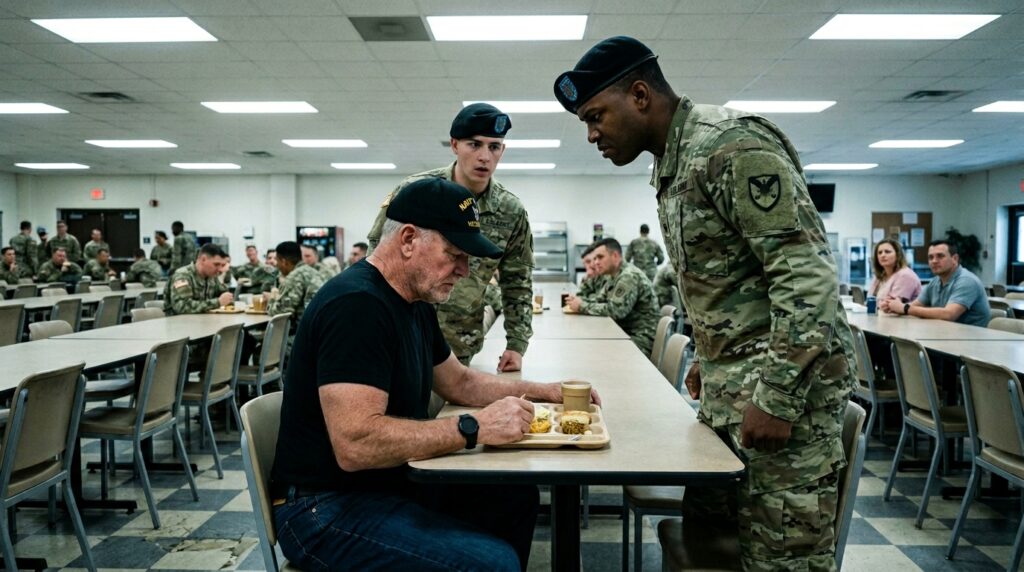
The thumb-joint was the first thing to yield. It didn’t pop—not yet—’but the canvas of the active-duty camouflage jacket strained against the veteran’s left palm until the weave hummed.
Miller didn’t look up at the fluorescent fixtures, though their flat white glare cast oily reflections across his plastic meal tray. He kept his heels planted in the grease-filmed grout between the rubber tiles. The younger man’s breath smelled of high-fructose syrup and the synthetic citrus of an energy drink—the standard fuel of boys who thought speed could replace leverage.
“Move the tray, old man,” the soldier muttered. His fingers were thick, scarred across the knuckles from ungreased winch lines or cheap gym iron, digging directly into the meat of Miller’s collarbone.
Miller didn’t shift his stance. He felt the cold iron rim of his Navy cap pressing against the crown of his skull, a dry weight that kept him centered. The cafeteria around them was a low-frequency rumble of six hundred men chewing industrial pork and damp rice, but inside the four inches between their chests, the air went dead and desaturated.
“You’re leaning right,” Miller said. His voice was too dry for the room, a low rasp like sandpaper dragged over a cedar plank.
“What?”
The soldier didn’t get the second syllable out. Miller’s right elbow didn’t swing wide—wide was for bars, wide was for people who wanted an audience. He dropped his weight three inches, letting gravity settle into his hips, and drove the heel of his hand upward into the soft V where the young man’s clavicle met his throat.
The sound was a wet thwack, like a dead fowl hitting a butcher’s block.
The boy’s balance didn’t just break; it vanished. His boots slid three inches through the film of floor-wax, his fingers tearing away from Miller’s black T-shirt with a sharp, dry rip of cotton. Before the soldier’s spine could find the angle to recover, Miller closed the distance. His movement wasn’t fast—it had the heavy, unhurried momentum of an iron gate swinging shut on a rusty hinge. He caught the soldier’s right wrist, twisted it outward until the radius bone locked against the ulna, and used the boy’s own forward mass to guide his forehead into the corner of the laminate table.
The tray jumped. A tin cup of lukewarm coffee tilted over, sending a dark, oily ribbon toward the floor.
The silence that followed didn’t spread from the table; it dropped from the ceiling like a wet tarp. The rhythmic scraping of forks three rows over died instantly. A sergeant three tables down stopped with a piece of dry toast halfway to his teeth, his eyes locking onto the angle of the soldier’s hip where it lay twisted across the gray checkerboard floor.
Miller didn’t look down at him. His breath was short, a hot itch in the center of his chest that reminded him of the three bone-chips floating loose in his left shoulder since ninety-four. He pulled his hand back, checking the knuckles out of habit—no skin broken, no fluid transfer—and reached for his paper napkin.
The soldier on the floor was breathing through his teeth, his eyes rolling back toward the light as he tried to find his ribs with his left hand. His younger companion stood two feet away, completely frozen, his fingers wrapped so tightly around his plastic tray that the edges were turning white.
Miller wiped a small smudge of gray grease from his thumb. Then he reached down, took his Navy veteran cap by the brim, and set it back exactly one inch above his brow line. Beneath the table, tucked into the shadow where the iron frame met the floor, a small brass key slipped from the soldier’s torn pocket—an old standard-issue locker key with three notches filed flat into the spine. It lay there, caught in the spilled coffee, reflecting nothing.

CHAPTER 2: THE SCRAP VALUE OF MEN
“The latch on that door hasn’t been greased since the budget re-alignment in twelve,” Miller said, his eyes fixed on the pitted steel plating of the interrogation table. He didn’t look up when the deadbolt clicked. “You can hear the orange oxide grinding inside the casing every time the handle drops.”
Captain Vance didn’t answer right away. He dropped a manila folder onto the center of the table. The cardboard was frayed at the corners, the fibers swollen from the humid salt-air that crawled off the tarmac every night at 0200. On top of the folder, he placed the small brass key Miller had retrieved from the cafeteria floor—the three notches filed into its spine catching the dull yellow glow of the security lamp.
“You’re a civilian contractor, Miller,” Vance said, his voice flat, carrying the dry rattle of a man who spent eighteen hours a day breathing recycled air-conditioner coolant. He sat down, his uniform coat tightening over shoulders that had begun to round from desk work. “You don’t evaluate the hardware anymore. You don’t evaluate the discipline. You’re paid to look at the logs.”
“The logs are clean because the boys write them,” Miller replied. He reached out with one thick, calloused index finger, touching the rim of the brass key, sliding it an inch to the left. The metal left a faint, greasy streak on the desaturated gray laminate. “But the grease doesn’t lie. A man who stops oiling his hinge is a man who doesn’t expect to own the door much longer. That boy on the floor today—Garrity—his rifle-bolt has the same scoring on the lugs. He’s stopped clearing his carbon after the third stage. Why would an infantryman leave carbon on his primary weapon unless he knows the serial number is getting struck from the registry?”
Vance’s face didn’t twitch, but his fingers tightened slightly around the edge of the file. “Garrity is Third Battalion, Fourth Marines. They’ve got a history.”
“They’ve got a terminal diagnosis,” Miller said. He leaned forward, the iron grommets of his veteran cap casting long, narrow shadows across his own cheekbones. The smell of the base motor pool—old diesel oil, vulcanized rubber, and the heavy musk of damp earth—crept through the low-yield intake vent behind him. “Don’t play the administrative shuffle with me, Captain. I spent thirty years watching units get hollowed out from the bottom up before the brass finally signed the scrap-warrant. You brought me in here to tell you how many days Garrity has left before he takes an service-issue sidearm into the latrine. I’m telling you he didn’t attack me because he was angry at an old timer. He attacked me because he thinks the past is the only thing keeping his present from being thrown into the furnace.”
Vance reached out, sliding the manila folder toward himself, but he left the notched key in the center of the gray table. He opened the file. Inside, the pages weren’t printed on standard high-grade stock; they were cheap, thin sheets, the ink slightly blurred as if run through an old drum copier on a secondary supply ship.
“The Third Battalion isn’t going to the latrine, Miller,” Vance whispered, his eyes scanning a column of numbers that had been stamped with a red alphanumeric marker. “They’re being re-allocated. The whole asset line is being dissolved into the tactical automation infrastructure out of San Diego. By September, Garrity’s payroll code won’t even exist. He isn’t getting a pension, and he isn’t getting an honorable discharge. He’s getting an administrative retirement due to structural redundancy.”
Miller looked at the three notches on the key. They weren’t factory cuts; they had been made with a small needle-file, the kind mechanics used to adjust the fuel pins on old five-ton trucks. Each notch was perfectly square, indicating a level of patient, meticulous labor that didn’t belong to a common brawler on a cafeteria floor.
“That’s the decoy,” Miller said softly, his thumb-nail catching on the first notch of the brass key.
Vance paused, the thin paper of the record rustling between his dry thumbs. “What did you say?”
“The automation code,” Miller muttered, his internal clock calculating the distance between the administrative office and the active motor pool where the Third Battalion’s equipment was being crated. “You’re letting them think they’re being replaced by machines because a man can hate a machine and still go home quietly. A man can understand a budget cut. But that boy’s key doesn’t fit an infantry locker, Captain. I know the barrel-type on those old storage cells behind the secondary ordnance depot. This key belongs to the underground dry-stores—the ones where the old chemical neutralizing agents were sealed after the seventies.”
The silence in the interrogation room became dense, heavy with the weight of unwashed concrete and the iron taste of older, darker secrets buried beneath the new asphalt of the base.
Miller stood up. His knee gave a short, metallic click—the legacy of an old fracture that always spoke up when the humidity crossed eighty percent. He didn’t ask for permission to leave. He took his Navy cap off the table and settled it low over his eyes, the heavy canvas brim cutting off the top half of Vance’s pale, unmoving face.
“He wasn’t trying to humiliate me,” Miller said, his hand already on the heavy, ungreased handle of the steel door. “He was trying to see if I still remembered how to open the boxes.”
CHAPTER 3: THE DEEPENING RESIDUE
The chain-link fence didn’t just rattle; it groaned under the weight of three decades of coastal corrosion, shedding fine flakes of zinc into the dry weeds. Miller didn’t use wire cutters. He used his palm to lift the loose tension-wire at the bottom, his black veteran cap catching on a rusted barb as he slid his torso through the gap. The grit of the gravel driveway dug straight through his thin T-shirt, grinding into the old scar tissue along his ribs.
He stayed down for five full seconds, chest pressed to the packed earth, listening to the heavy, rhythmic thrum of the secondary generator four hundred yards away. The air near the motor pool was thick with the sharp, acidic tang of decaying lead-acid batteries and the slow leak of transmission fluid from a row of mothballed five-ton trucks.
When he stood up, his vision was limited to the gray silhouettes of shipping containers stacked three high like iron tombs. He didn’t look for Garrity. He followed the wet trail of oil drippings left by a forklift that had moved through here less than an hour ago.
“You’re late, old man,” a voice rasped from the shadow of an unpainted axle housing.
Garrity didn’t look like the confident infantryman from the cafeteria. His camouflage jacket was gone, leaving him in a grease-stained brown undershirt that showed the dark purple swelling where Miller had crushed his collarbone. He held a steel pry-bar in his left hand, his right arm hanging stiffly at his side, supported by a makeshift sling fashioned from a cargo strap.
“You’re bleeding through the dressing,” Miller said, his voice flat, matching the dead tone of the desaturated yard. He walked toward the padlock on the secondary ordnance bunker, his boots making no more sound than dry leaves sliding across concrete.
“It doesn’t matter,” Garrity spat. He stepped into the weak amber light of a distant perimeter lamp. His eyes were wide, bloodshot, fixed on the brass key Miller held between his fingers. “They’re moving the crates out by 0400. The administrative order Vance showed you? That’s the paper shroud. They aren’t turning our rifles into code; they’re turning them into untraceable surplus for the private logistics firms in the gulf. We’re being scrubbed so the inventory matches the loss columns.”
Miller reached out and took the pry-bar from Garrity’s weak grip. He didn’t answer. He inspected the face of the bunker door. The steel was pitted with rust pockets that looked like small craters, the green paint peeling back in stiff, brittle curls. He slid the three-notched key into the cylinder. It went in rough, the internal pins scraping against months of blown sand, but when he twisted his wrist, the mechanism turned with a heavy, hollow clack.
The door didn’t lead to chemical neutralizing agents.
When Miller pulled the iron handle back, the beam of his pocket light cut through a dense fog of packing grease. Inside, rows of standard wooden transit cases had been split open. But the weapons inside weren’t old stock. They were the new-issue modular carbines, their receivers stamped with the clean, unblemished alphanumeric codes of a unit that had supposedly never been deployed.
“See?” Garrity whispered, his breath hitched in his throat. He reached into the nearest box, his fingers trembling as he touched the matte-black finish of a barrel. “They’re erasing our entire deployment history to clear the titles on these serials. If the battalion never existed on paper, the hardware was never issued. It’s a clean liquidation.”
Miller didn’t touch the rifles. He leaned closer to the iron hinge of the heavy bunker door, his fingers tracing a clean, bright horizontal groove that had been cut into the frame. It wasn’t an accident of wear. It was a fresh strike, made by a heavy tool—the exact diameter of the master security key carried only by base command.
A cold realization settled behind Miller’s eyes, heavier than the damp night air. Garrity hadn’t discovered this breach by luck or operational skill. The path had been cleared for him. The lock had been primed. The young soldier was following a breadcrumb trail that had been laid down with mechanical precision.
The sound of a heavy diesel engine starting up near the main gate broke the silence. The headlights didn’t hit them yet, but the long, yellow beams sliced through the gaps between the shipping containers, turning the shadows into long, sweeping arms that reached toward the open bunker.
“They’re early,” Garrity said, his hand dropping toward his waist where a stolen service pistol was tucked into his belt. “They’re coming to clean the site.”
Miller caught the boy by his good shoulder, his grip tightening until the canvas of his sleeve groaned. “Pull your hand away from that iron, son. You think you’re raiding a corporate theft. Look at the frame. Look at the grease on the bolt.”
Garrity blinked, his face pale under the amber glare. “What are you talking about? We have the proof right here. We can show the district authority—”
“There isn’t a district authority within three hundred miles of this coast that doesn’t sign the fuel vouchers for those trucks,” Miller said, his voice dropping into the low, transactional register of a man who had seen the bottom of three separate institutional graves. “You aren’t interrupting a theft, Garrity. You’re completing the record. They needed someone to break the seal so they could log an active security breach.”
Before Garrity could pull away, the shadow of a figures appeared at the corner of the container row—not corporate security, but three active-duty military police officers, their visors down, their weapons held low and steady, their movements silent, fluid, and completely expected.
CHAPTER 4: THE RESIDUAL ACCOUNT
“Drop the steel, Garrity,” Miller said. His voice didn’t rise above the wet hum of the secondary generator, but it had the specific weight of a structural beam cracking under load.
Garrity didn’t move his hand from his waist. His fingers were locked around the cold grip of the stolen pistol, his knuckles white and slick with sweat that smelled of panic and cheap tobacco. The beams from the military police weapons didn’t bounce; they hung in the oily fog of the motor pool yard, three solid white bars that pinned the young soldier against the split wood of the rifle crates.
The sergeant at the front of the line didn’t look at Garrity’s gun. He looked at Miller. The visor of his helmet was up exactly half an inch, enough to show two eyes that carried no malice—only the dead, unblinking clarity of a clerk executing a balancing entry.
“The perimeter is logged,” the sergeant said. He didn’t point his carbine at Miller’s chest; he kept it lowered toward the gravel, his thumb resting lightly on the selector switch. “The civilian evaluator is clear of the target zone. Bring the boy.”
Garrity’s head jerked toward Miller, his jaw dropping as the light caught the dark, wet sheen of the swelling along his collarbone. “Evaluator? Old man… what is he talking about?”
Miller didn’t look back at him. He pulled his hands from his pockets, slowly, letting the MP see his palms were empty before he reached up to touch the brim of his black Navy cap. The iron grommets were cold against his skin, carrying the bitter taste of zinc from the fence line. He reached into his T-shirt, pulling out a small, laminated security pass that had been tucked flat against his ribs—the backing plate wasn’t marked with a defense logistics logo; it bore the black alphanumeric stamp of the Office of Institutional Resilience.
“He’s talking about the audit, son,” Miller said softly. He stepped back from the crates, his boots grinding a handful of loose iron flakes into the wet dirt. “The weapons aren’t surplus. They’re props. The boxes are real, the serial numbers are active, but the firing pins were pulled before these crates left the factory in Ohio. They needed to see how far a red-line unit would go when the paper started to vanish.”
“You… you set the floor,” Garrity whispered. The pistol slipped an inch from his belt, the iron sight catching on the frayed thread of his waistband. “In the cafeteria. You didn’t just fight back. You were looking for me.”
“I was looking for anyone who still had enough grease in their gears to strike back,” Miller said. He felt the cold air from the open bunker door pressing against the back of his neck, carrying the scent of packing lard and ancient coal dust. “If you had moved your tray when he told you to, your file would have been signed off as compliant by midnight. You’d be sitting on a transport to a San Diego desk by the end of the week. But you didn’t. You held the line, which means your unit is still considered an active hazard to the administrative transition.”
The sergeant took two steps forward, his boots clicking against the concrete lip of the bunker. He didn’t use force; he simply reached down and took the stolen pistol from Garrity’s unresisting fingers, dropping it into a canvas recovery bag with a flat, dry chime of metal.
“Captain Vance is waiting in the transport, Miller,” the sergeant said, turning his shoulder to mask the boy as the other two officers guided Garrity toward the rear of the container line. “The evaluation sheet needs your signature before the 0400 shift change.”
Miller stood alone in the shadow of the three-high stack of iron containers. He reached into his pocket to retrieve his tobacco pouch, but his fingers hit something hard and thin instead. It was the receipt for his monthly veteran’s annuity voucher—the small, blue slip that arrived every thirty days from the treasury repository in St. Louis. He held it up to the weak amber light of the perimeter lamp.
In the lower right corner, beneath the automated signature of the regional director, was a small, three-notched watermark. It was identical to the filed grooves on the brass key that had opened the door, and identical to the inventory stamp on the boxes of modular carbines.
The system wasn’t clearing the titles to build a new infrastructure; it was using the scrap value of its old units to pay the maintenance fees on the ones left behind. His pension wasn’t drawn from an investment fund; it was the direct interest on the obsolescence of boys like Garrity.
He folded the blue paper twice until the watermark was hidden inside the crease, then tucked it back into his pocket next to the flint lighter that wouldn’t strike on the first try. He adjusted his cap, pulled the brim down until the fluorescent glare of the main base offices was blocked from his sight, and walked out into the desaturated gray of the tarmac toward the waiting truck.
CHAPTER 5: THE DIESEL ENGINE LOGIC
The floorboard of the utility truck didn’t isolate the road; it hammered it directly into the soles of Miller’s boots. Every seam in the asphalt of the western perimeter road sent a dull, metallic shudder through the frame, vibrating the iron eyelets of his veteran cap against his forehead.
Captain Vance kept both hands on the wheel, his knuckles gray and bloodless under the dim green illumination of the tactical dashboard. Between them sat the metal dispatch box, its olive-drab latch sealed with a single-use lead wire that rattled against the casing like a loose tooth.
“The rail-head at sector nine is already locked down,” Vance said. His eyes didn’t leave the narrow corridor of the headlights. “The trains are chartered under a commercial logistics flag. Once those boxes hit the flatcars, they aren’t military property anymore. The account closes.”
Miller didn’t look at the officer. He looked through the side glass, watching the rusted spikes of the fuel-depot fence slide past in the dark. The smell of unrefined petroleum and wet weeds was stronger here, leaking through the rotted rubber weatherstripping of the passenger door.
“You’re running the engine too lean,” Miller said, his rasp low against the transmission whine. “The manifold is white-hot under the cab. You smell that? That’s the oil cooking in the valve guides. A man who knows his machine doesn’t push the RPMs when the temperature needle is pinned in the red.”
“We don’t have the luxury of the maintenance schedule, Miller,” Vance muttered. He reached down, tapping the physical trip ticket clipped to the clipboard on the dash. “Look at the stamp on the routing guide. That’s a direct priority release from the regional coordinator. No intermediate stops. No secondary inspection.”
Miller reached out with his left hand—the thumb still stiff from the cafeteria scuffle—and turned the clipboard toward the green dash light. The ink-stamp wasn’t the standard violet ink of the base transportation officer. It was a dense, oily black smudge, the edges slightly blurred by the humidity of the cab. In the center of the seal, hidden within the administrative code, were two parallel hairline fractures across the die.
It was the exact same flaw he had seen on the inspection stamp inside the ordnance repository folder three hours ago.
“The transportation desk didn’t clear this truck, Vance,” Miller said. His thumb came down on the ink, smudging the dry carbon across the paper. “This manifest was struck from the same press as the evaluation logs. The base command isn’t waiting for these boxes at sector nine. They’re already behind us.”
Vance’s foot didn’t lift from the throttle, but the truck veered two inches onto the gravel shoulder before he corrected the wheel, the loose stone clattering against the unlined wheel wells like shrapnel. “You signed the report, Miller. The audit is complete. Your voucher clears at 0600.”
“I signed for a psychological baseline on Third Battalion,” Miller said, his internal calculator tracking the mileage markers along the fence. “I didn’t sign for a ghost transport. If those boxes are empty props with the firing pins pulled, you don’t need a high-priority rail clearance to move them to the scrap yard. You don’t hide an empty box from the terminal supervisor unless the box isn’t the asset you’re trading.”
He leaned closer to the metal dispatch box between their seats. In the narrow gap where the lid met the base, a tiny white grain had shaken loose from the packing material inside. It wasn’t the sawdust or grease-paper used to preserve rifle stocks. It was a fragment of synthetic polymer—the clean, white edge of a standard data-core cartridge housing used in the base’s automated signal facility.
The realization didn’t come with a shock; it arrived with the cold, heavy precision of an iron gear falling into place.
They weren’t moving the rifles to clear the titles. They were moving the battalion’s operational records—the digital fingerprints, the response metrics, the stress logs of every boy who had broken down under pressure during the evaluation cycle. The hardware in the boxes was just the ballast to make the truck ride low on its springs.
“Where is Garrity?” Miller asked. His voice had dropped below the noise of the manifold, a hard, level sound that made the captain’s right foot twitch on the accelerator.
“He’s in the holding block behind the secondary rail-head,” Vance said, his gaze fixed straight ahead as the twin steel tracks of sector nine appeared in the distance, silver lines cutting through the desaturated gray of the marshland. “He’s being processed for the transition unit.”
“There is no transition unit,” Miller said, his hand already moving toward the heavy iron latch of the passenger door as the truck began to slow for the perimeter gate. “A machine doesn’t need a training cadre, Vance. It needs a template.”
CHAPTER 6: THE DISCREPANCY BLOCK
“The gate log doesn’t match the pressure on the axle,” Miller said. He didn’t drop his boots from the uninsulated steel floorboard until the truck engine died with a wet, heavy cough of black soot.
The security guard at the rail-head terminal didn’t pull his hand away from his hip. He stood in the narrow triangle of yellow light cast by the gatehouse lamp, his slicker dripping grease-filmed rainwater onto the gravel. His chest patch read Logistics Command, but the gray web-gear he wore had the stiff, unwashed smell of a unit that had been pulled from active field storage less than forty-eight hours ago.
“The manifest is locked, evaluator,” the guard said, his teeth catching on a dry piece of commercial chewing gum. “Truck goes down the spur. You stay in the cab.”
Miller swung his leg out anyway. His left heel struck the wet stone with a flat, heavy thud that shot straight through the bone-chips in his knee. He didn’t look back at Vance, who sat frozen behind the steering wheel with his fingers still glued to the rim. Miller walked toward the low-slung concrete bunker that anchored the eastern rail-line, his black veteran cap pulled down to deflect the cold, needle-fine mist coming off the salt marshes.
The siding was packed with ten dark-gray flatcars, their hand-brakes tightened down until the cast-iron shoes bit into the steel wheels with a rusty screech. On top of them, the heavy transit cases weren’t stacked for shipping; they were wired directly to the deck plates with thick copper ground lines—the kind used to bleed static charge away from high-yield computing frames.
“You’re in the wrong sector, Miller,” Vance called out from the truck window, his voice thin against the rhythmic click of the cooling manifold. “The detention tier is forty yards west. You don’t have clearance for the loading terminal.”
“The numbers on the pipeline are sixty-two, Vance,” Miller said without stopping. He stopped beside a thick iron conduit that emerged from the gravel and ran straight up the side of the concrete bunker. The red protective paint was peeling away in dry, crisp scabs, revealing the pitted zinc beneath. “My first berth in seventy-eight had the same loop. Same pressure valves. Same automated return lines. You don’t use a high-flow cooling loop like this to store wooden crates of decommissioned carbines. You use it to keep a liquid-cooled server rack from melting through its floorboards.”
He reached the heavy iron door of the terminal building. The latch wasn’t sealed with a standard lead-wire lock; it used an old mechanical combination dial with five brass tumblers, the metal worn flat by decades of greasy thumbs. Miller didn’t look at a code sheet. He used his thumb-nail to trace the third tumbler until his skin caught on a tiny, shallow notch filed into the side of the housing—the identical mark from the cafeteria key, the manifest stamp, and his own pension voucher.
The dial turned three times left, twice right. The internal bars dropped with a heavy, hollow clunk that sounded like a dry branch snapping under water.
Inside, the air didn’t smell of Cosmoline or gun oil. It was cold—bitterly cold—and smelled of ozone, burnt copper wire, and the dry, synthetic dust of industrial cooling fans.
The room was low-ceilinged, the concrete walls weeping lime-streaked water onto a steel mesh floor. Instead of storage racks, the center of the floor was cut away, revealing a lower gallery where rows of dark, vertical cabinets hummed with a low, sub-audible frequency that made the water in Miller’s ears vibrate.
At the far end of the mesh walkway, pinned beneath the harsh glare of an unshielded mercury bulb, was a single metal chair. Garrity sat there, his good arm cuffed to the iron leg, his brown undershirt torn across the collar. A bundle of gray ribbon-cables ran from the back of his neck into the terminal panel behind him, the small copper contacts held against his skin by strips of industrial tape that had begun to lift from his sweat.
His eyes were open, but they didn’t track Miller’s boots. They were fixed on a small, flickering monitor that showed a repeating loop of the cafeteria altercation—the split-second tilt of his own balance, the precise moment Miller’s hand had crushed his thumb-joint, the unnatural, stunned silence of the dining hall.
“They aren’t rewriting your file, son,” Miller said, his rasp cut through the mechanical hum of the room. He didn’t touch the cables. He stood three inches from the chair, his hand resting on the cold iron of the frame. “They’re mapping the reflex. Every time your pulse spikes on that tape, the processors down there adjust the response parameters for the new automated defense network. They don’t want your discipline. They want your failure. They’re using the exact sequence of your breakdown to train the perimeter code.”
Garrity’s jaw twitched, a thin line of dry saliva catching the blue light of the screen. “The old man… he told me… I had a week left.”
“The old man was reading from the decoy sheet,” Miller muttered, his eyes tracing the gray ribbon-cables down into the floor grid where they met a large, heavy copper bus-bar. The nameplate on the main junction box was stamped with the corporate emblem of the contractor that administered the veteran retirement fund.
A heavy footstep sounded on the steel mesh behind him. It wasn’t the guard from the gate. It was Vance, his uniform coat damp from the rain, holding a small, gray plastic diagnostic key that matched the three-notched cylinder on the master board.
“He’s already past the calibration threshold, Miller,” Vance said, his voice dropping into the flat, empty register of a machine that had finished its stroke. “The contract you signed wasn’t for an inspection. It was for a stressor. If you hadn’t broken his grip in that cafeteria, we wouldn’t have the baseline data for the physical aversion metrics. You completed the template.”
Miller turned slowly, his boots grinding a fresh layer of oxide from the floor plates. He looked at the three notches on Vance’s plastic key, then down at the blue pension slip still tucked into the pocket of his own black shirt. The loop wasn’t closing; it was drawing tighter, and his own hand had been the one pulling the wire.
CHAPTER 7: THE SCRAP VALUE PARITY
“The logic doesn’t loop, Vance,” Miller said. He didn’t drop his arm from the metal rail, even as the high-frequency vibration from the lower gallery servers hummed through the zinc coating of the walkway, turning his thumb-joint numb. “A machine doesn’t build a habit. It doesn’t look at an old man in a cafeteria and feel the weight of thirty years of discarded grease. You can’t code that kind of friction into a silicon board.”
Vance didn’t lift the plastic diagnostic key. He held it exactly two inches from the master receiver panel, his fingers steady, though his uniform sleeve was stiff with dry marsh salt. “We aren’t coding the friction, Miller. We’re capturing the reaction time before the decay settles into the muscle. The network doesn’t need to feel the anger. It just needs to know exactly how many milliseconds it takes for an active-duty infantryman to drop his center of gravity when an unmapped threat crosses his line.”
Miller looked back at Garrity. The boy’s head had rolled to the side, his chin resting against the coarse canvas strap of the makeshift sling. On the flickering monitor behind his hair, the loop of the cafeteria brawl had frozen on a single frame: the exact micro-second Miller’s heel had found the grout line between the rubber tiles, his weight shifting forward with the slow, irreversible momentum of an iron door closing.
The numbers at the bottom of the screen weren’t tracking time. They were tracking fluid displacement, skeletal stress points, and the precise monetary cost of the institutional recovery.
“The voucher,” Miller muttered, his rasp dropping into the lower register where the machinery couldn’t drown it out. He reached into his shirt pocket, his thick fingers tracing the crisp, double-folded edge of the blue treasury slip. “The watermark on my annuity—the three notches filed into the die plate. That wasn’t a clearance code for the bank. That was the asset ledger number for the Third Battalion’s ordnance account from seventy-eight. You didn’t buy these server racks with defense allocation funds, Vance. You bought them with the unspent maintenance reserves of my old platoon.”
Vance’s face remained completely desaturated under the mercury lamps. He didn’t deny it. He simply slid the plastic key into the slot. The machine didn’t beep; it gave a low, wet click as the internal contacts met the copper traces on the card.
“The legacy has to pay for the maintenance, Miller,” Vance whispered. The sound of his voice was identical to the dry rattle of the high-voltage cables behind the mesh wall. “An old soldier who sits in a garrison cafeteria eating industrial pork isn’t an asset anymore. He’s a storage fee. The only way the system keeps your pension voucher active is if we use the kinetic residue of your training to prime the replacement loop. Garrity’s unit isn’t being erased because they failed. They’re being harvested because you succeeded.”
Miller didn’t swing. Swing was for people who believed the room had a boundary.
Instead, he let his weight drop three inches, his boots settling into the iron mesh until the metal wires bit into the leather of his soles. His right hand didn’t move toward Vance’s throat; it went downward, his calloused fingers catching the thick copper bus-bar where it entered the main junction box. The metal was burning hot, vibrating with the static load of three hundred active processors drawing current from the secondary rail-head generator.
He didn’t pull the cable. He simply leaned his mass against the terminal housing, using the leverage of his stiff left knee to wedge the brass key—the boy’s key, the one with the three filed teeth—directly between the positive terminal and the ungrounded iron frame.
The arc didn’t make a loud report. It was a sharp, blue flash that smelled instantly of scorched tallow, vulcanized rubber, and the metallic tang of ionized salt-water.
The monitors didn’t go dark; they flickered once, the frame of the cafeteria fight dissolving into a vertical column of white static that looked like flaking zinc falling through a grease-trap. The hum in Miller’s ears changed frequency, dropping from a high mechanical whine to the dull, heavy thrum of an engine that had lost its oil.
Garrity’s eyes cleared first. The tension in his jaw slackened, his chin lifting from the cargo strap as the ribbon-cables behind his neck grew cold, their small indicator lights dying out one by one like embers in wet gravel. He looked at Miller, his gaze tracking the black Navy cap, the unwashed black T-shirt, and the grease-filmed hand still clamped onto the iron housing of the junction box.
“Old man…” the boy rasped, his voice carrying the dry, hollow rattle of the detention cells. “The file… did it strike?”
Miller didn’t look down at the blue voucher in his own pocket, though he could feel the faint, warm smell of scorched paper where the residual current had singed the edge of his shirt. He pulled his hand back from the steel frame, checking his knuckles out of habit—the skin was gray with carbon dust, the thumbnail split along the grain, but his grip remained centered.
“The file is closed, son,” Miller said. He reached down, his fingers unlatching the iron cuff from the chair leg with a single, unhurried twist of the iron pin. “The system doesn’t have the budget to run the calculation twice.”
Vance didn’t pull the diagnostic key from the slot. He stood by the dead panel, his fingers still resting on the gray laminate, his eyes fixed on the horizontal line of white oxide forming on the surface of the server racks as the cooling pumps died down to a complete, ungreased stop.
“You’re a civilian contractor, Miller,” Vance said, his rasp flat, carrying no more anger than a discarded logistics manifest. “The 0600 voucher won’t clear now. You’re off the books.”
Miller turned his back to the mercury lamp, his boots finding the dark, wet path through the gravel toward the perimeter gate where the rain was still shedding fine flakes of rust onto the marshland. He settled his Navy cap low over his eyes, the heavy brim blocking the last white bar of light from the terminal yard.
“I’ve been off the books since seventy-eight, Captain,” Miller said into the dark. “The scrap value was always zero.”
CHAPTER 8: THE BALLAST DRIFT
The gravel didn’t hold. Every time Miller shifted his weight three inches to the left, the wet limestone chips slid away from the shoulder of the rail-bed, tumbling into the stagnant black water of the drainage ditch below.
He kept his hand locked around the coarse canvas strap of Garrity’s makeshift sling, pulling the boy up the slope before the ballast could cave completely. The scent of the marsh was shifting—less salt now, more of the heavy, chemical musk of old creosote and rotting pine ties that had been baking under the coastal humidity since the mid-seventies.
“The signals are red behind us,” Garrity rasped. He stopped, his knees shaking against the iron plate of a tie-clip. He didn’t look at his arm; his eyes were fixed on the perimeter towers two miles back, where the white searchlight beams had stopped swinging. They were fixed, parallel lines cutting through the desaturated mist, pointing directly toward the terminal bunker they had left forty minutes ago. “They aren’t looking for a breach anymore, old man. They’re setting the grid.”
Miller didn’t answer until he found a solid pine tie that hadn’t surrendered its tar to the damp earth. He planted his heel, feeling the dull click in his knee-joint that always preceded a rain shift. His black veteran cap was soaked through, the canvas heavy and tight against his skull, holding the cold moisture against his skin.
“They aren’t setting a grid for us,” Miller said, his rasp low against the distant, rhythmic clack of an uncoupled freight car shifting on a distant siding. “You don’t deploy three active military police squads into a civilian marsh to catch a boy with a broken collarbone. They’re covering the transition logic. If the server logs show a physical interruption before the calibration completed, the contractor has to report a total system failure to the treasury board. They’re out there resetting the fuses so the insurance title clears by 0600.”
He reached down, his thick fingers tracing the side of the rail. The steel was cold, pitted with red oxide scabs that flaked off under his fingernails like dry skin. But six inches below the head of the rail, stamped directly into the web of the iron, was a fresh alphanumeric code: 3B-4M-1978.
It wasn’t a factory foundry mark. It had been chiseled by hand, the edges of the numbers rough and uneven, identical to the three-notched pattern on the key he had dropped into the junction box.
Miller stopped, his thumb resting inside the groove of the ‘8’.
“This isn’t a secondary spur line, son,” Miller muttered, his eyes tracking the silver rails as they disappeared into the wall of dark pine trees ahead. “This is the old ammunition loop we laid down during the mobilization for the Mediterranean deployment. The base command didn’t build this rail-head for the automated logistics network. They just laid the new concrete over the old iron we buried when we thought we were going home.”
“What does that mean?” Garrity asked, his breath coming short, a thin line of red foam forming at the corner of his mouth where his rib had nicked the lung lining during the scramble through the fence.
“It means the template was already here,” Miller said. He caught Garrity by the belt, hoisting him over the low iron switch-rod that controlled the track alignment for the commercial shipping yard ahead. “The automation didn’t invent a new way to discard a soldier. It just found the old ledger we left behind and updated the font.”
The glare of a low-wattage yellow bulb appeared through the pine branches—not a base security tower, but the equipment shack of the local timber contractor whose yard bordered the state highway line. The air changed, losing the clean sting of ozone and taking on the sour, heavy reek of diesel exhaust, wet sawdust, and old tallow grease from the ungreased gears of a stationary log-loader.
Miller didn’t head for the road. He guided the boy toward the shadow of a stacked pile of unbarked cedar logs, his boots sinking into six inches of wet mulch that smelled of rot and old iron wire. Beneath the corrugated tin roof of the loader shack, a small mechanical ticker was clicking in the dark—a civilian logistics terminal that was pulling its power directly from the base’s secondary line.
The white paper tape was spilling onto the dirt floor, its printed columns tracking something that had nothing to do with lumber.
CHAPTER 9: THE LOGGING YARD MATRIX
“The ticker isn’t counting board-feet, Garrity,” Miller said, his thumb pinning the slick, narrow strip of paper against the unpainted timber desk. He didn’t use his flashlight. The low-wattage yellow bulb above them hummed with the steady, sickly vibration of a failing capacitor, casting a desaturated mustard film across the rows of ink-stamped numbers.
Garrity slid along the corrugated tin wall, his boots dragging through a layer of wet cedar shavings that smelled of turpentine and damp iron filings. He leaned his good shoulder against a pile of greasy crane cables, his face the color of old unwashed canvas under the yellow light. “It’s a lumber ledger, old man. The timber company handles the base clearings on the north ridge. My squad worked the detail last November.”
“They’re clearing more than pine,” Miller muttered. His rasp was dry, scraping through the mechanical click-clack of the register mechanism. He reached into his shirt, pulling out the folded blue treasury voucher. The paper was stiff, the double-creased edges gray with the charcoal residue from the rail-head bunker. He laid it flat beside the white paper ribbon spooled on the dirt floor.
The tracking seal on the timber manifest wasn’t a standard corporate logo. It was a dense, oily black smudge containing two parallel hairline fractures across the die plate—the exact structural defect that had marked the base logistics sheets and his own monthly retirement annuity.
Below the stamp, the rows of data didn’t list weights or diameters. They listed twenty-digit alphanumeric strings. The first four digits of the upper column read 3B-4M—the designation code for the Third Battalion. Beside each name code was a static numeric value: 0.042.
“That’s the retention percentage,” Miller said, his voice dropping into a level register that matched the heavy hum of the machinery outside. “They aren’t logging lumber shipments on this terminal, son. They’re routing the digital metrics we generated back at the siding. Every time your pulse spiked on that bunker screen, the processor converted the trauma into a compression algorithm. They’re using a private commercial contractor’s line to dump the files into the regional treasury network before the morning audit.”
Garrity looked down at his own wrist, where a faint gray line of adhesive tape still held a few loose threads from the ribbon-cables. “They’re selling the battalion’s reflex data through a timber account?”
“They’re hiding the ledger inside the maintenance costs,” Miller said. He stepped toward the window frame, the rusted iron hinges groaning as he pushed the grime-filmed glass outward three inches. The night air crawled through the opening, carrying the rancid musk of old engine grease and wet coal dust from the railway crossing fifty yards away. “Vance didn’t lie about the redundancy order. The machines are coming online because the legacy pool is broke. But they aren’t replacing you with software they wrote in a lab. They’re building the new automated guard out of the muscle memory we left in the mud. Every fist-fight, every broken joint, every panic reflex—it’s all being converted into operational code, and the contractor is using our own pension pool to pay for the bandwidth.”
He looked through the gap in the cedar logs. On the gravel access road that led toward the state highway, a single dark-gray utility sedan had stopped, its headlights cut but its engine running with a low, unhurried tick that spoke of clean fuel and high-grade maintenance.
The door of the sedan didn’t slam. It opened with a soft, grease-slicked click that Miller recognized from forty yards away.
“Vance didn’t stay at the siding,” Garrity whispered, his fingers dropping back toward his waistband out of pure habit. “He traced the terminal draw.”
“He didn’t need to trace it,” Miller said, his hand closing over the young soldier’s wrist, his grip hard enough to grind the radius bone against the ulna. “He cleared this line before we left the base. The timber yard isn’t a hiding place, Garrity. It’s the next extraction node. If we don’t clear the highway line before the 0400 shift change, the system registers this terminal as an unrecovered asset loss, and they’ll close the account with a clean signature.”
He pulled his veteran cap down until the brim cut off the yellow glare of the ticker bulb. He didn’t look at the paper ribbon again as it continued to spill its white trail into the cedar dust, each click of the mechanical keys erasing another five names from the active duty rolls.
“Let the pistol go,” Miller said, his voice dropping below the hum of the log-loader outside. “You can’t shoot a ledger, son. You have to break the plate.”
CHAPTER 10: THE IRON BALANCING
“The die doesn’t change its strike, Captain,” Miller said, his boots coming down hard on the pitted steel threshold of the regional repository vault. He didn’t lift his palm from the cold frame of the heavy door, even as the high-voltage lines inside the brick casing hummed with the dry, hollow rasp of an overloaded grid.
Vance stood four feet away under the unshielded amber ceiling fixture, the damp fabric of his uniform coat dark with the residue of mud and pine tar from the timber road. He didn’t point his service-issue sidearm at Miller’s chest; he held it low, his thumb resting flat against the steel safety catch. “The regional desk has already closed the 0400 ledger, Miller. The transactions are locked into the system. If you drop that bar, you aren’t resetting the account—you’re just hollowing out the reserve.”
Miller didn’t answer right away. He reached into his shirt pocket, his fingers catching on the crisp, scorched edge of the blue treasury voucher. He drew it out slowly, placing it directly over the brass master-die plate bolted to the center of the vault frame. The matching three-notched watermark aligned perfectly with the horizontal cuts chiseled into the iron base fifty years ago.
“The reserve was spent when we were still in the gulf, Vance,” Miller said, his rasp dropping beneath the dull, heavy vibration of the main base generator two miles north. “You didn’t build this vault to protect the retirement pool. You built it to lock the template in. As long as these plates keep striking the vouchers, every old unit that leaves the service is turned into fuel for the next line of automated guards. The boy on the floor, the squad at the rail-head—they’re just the grease for the gears.”
Garrity leaned against the rusted iron bars of the inner gate, his breathing short, his face a pale silhouette in the desaturated gray light of the vault core. A thin trail of grease-darkened water from his wet cargo sling was dripping steadily onto the stone flooring, hitting the grout line with a light, rhythmic pitter-patter. “Break the plate, old man. Sign it off.”
“If I break the plate, the annuity goes black by sunrise, son,” Miller said softly. He didn’t look at the boy. He kept his eyes on the master-die, tracing the deep, clean grooves where the ink had dried into a hard, black crust. “The checks don’t print if the matrix is struck. Every old man sitting in those base cafeterias with a black cap goes onto the loss registry by 0600. The system doesn’t carry a dead line.”
Vance took one step closer, his boots grinding a handful of loose iron filings into the dry stone. His face carried no malice—only the heavy, transactional weariness of a man who had executed the same budget re-alignment four times in his career. “You’re a professional, Miller. You know how the ledger balances. You can’t save the boy’s code without striking your own signature from the pension roll. The legacy doesn’t have a third column.”
Miller didn’t shift his stance. He reached down, his thick index finger catching the iron ring of the vault’s master override lever—an old, ungreased mechanic’s bar that hadn’t been pulled since the mobilization of seventy-eight. The metal was rough under his skin, coated in a layer of old tallow lard that had turned white and brittle with age.
He looked at Vance. He looked at the three notches on the captain’s plastic diagnostic card, then down at the blue slip of paper between his own fingers.
“The code was always dirty,” Miller whispered.
He didn’t swing wide. He dropped his weight three inches, letting gravity settle into his hips exactly as he had on the checkerboard floor of the dining hall, and drove his heel down onto the iron override bar.
The sound wasn’t a roar; it was a short, sharp clack of cold iron pins snapping inside the casing. The blue treasury voucher didn’t tear—it simply dissolved as the main power bus behind the wall shorted out, sending a clean, bright horizontal flash of static through the vault frame that smelled instantly of ozone, burnt canvas, and old grease.
The lights didn’t go dark all at once; they faded into a dull, desaturated bronze that turned the concrete walls into a flat, narrow box. The rhythmic clicking of the logging yard tickers outside died instantly, leaving nothing but the sound of the marsh rain hitting the corrugated steel roof with a heavy, unhurried thrum.
Garrity’s head dropped back against his sling, his shoulders relaxing as the digital monitors along the casing went dead, their screens flattening into clean, gray glass that reflected nothing but the amber outline of Miller’s veteran cap.
Vance slowly lowered his arm, his thumb slipping off the safety catch as the terminal panel behind him gave a final, faint hiss of white steam from its cooling loop. He didn’t look at the broken die plate. He looked through the open door at the long, empty line of the highway where the morning mist was beginning to turn the color of wet lead.
“The account is clear, Miller,” Vance said, his voice flat, carry no more weight than a struck line on a payroll ledger. “The 0600 shift isn’t coming.”
Miller didn’t look back at the vault core. He reached down, took his Navy cap by the brim, and set it one inch lower over his eyes, blocking out the last yellow reflection of the repository lamps. He walked through the iron threshold, his boots making a dry, crunching sound on the gravel road as he headed out toward the state line.
“The shift never came, Captain,” Miller said into the gray morning. “We just stayed late.”







