
Unburied Secrets: The Veteran and the Gravel Pit Syndicate

CHAPTER 1: THE WEIGHT OF IRON AND OATMEAL

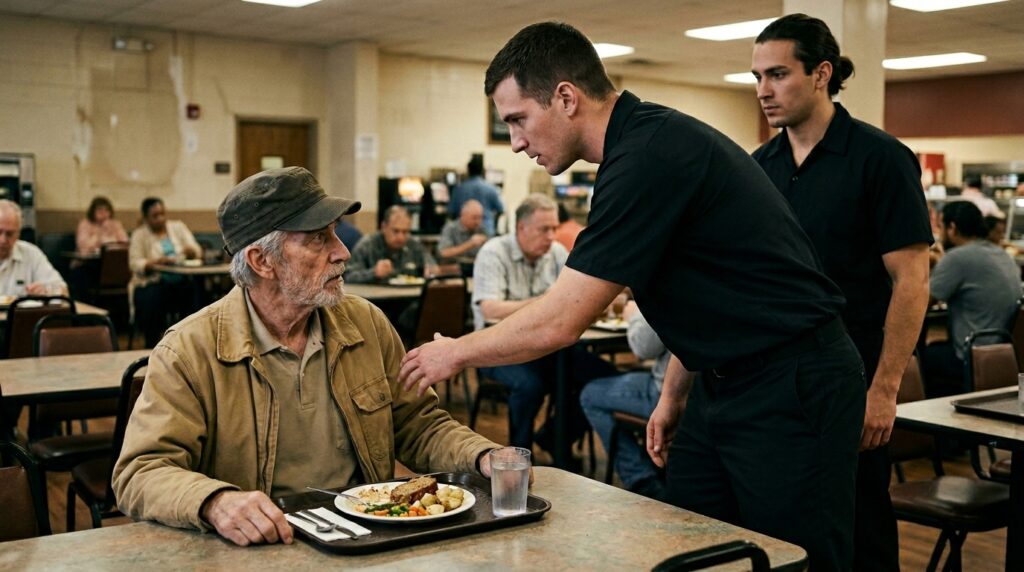
The neon light above the tray line hummed at a frequency that vibrated right behind Arthur’s temples. It was a cheap, industrial buzz, the kind that smelled like warm copper and old grease. He kept his head down, the bill of his faded polo cap casting a sharp shadow across the Formica table. On his tray sat three small bowls: lukewarm oatmeal, a single sausage link skin-tough from the heat lamp, and a plastic cup of ice water that had already sweated a ring into the wood-grain laminate.

Arthur’s left hand, leather-spotted and dry as parchment, held the spoon with a light, precise grip. Decades of habits didn’t just wash away because the joints grew stiff. He knew exactly how many paces it took to reach the emergency exit by the dish return—forty-two—and he knew the floor was slickest near the ice machine. He didn’t want to know these things. He wanted to eat his breakfast in the gray quiet of a Tuesday morning before the warehouse shifts let out.

Then the air pressure in his small circle of safety dropped.

A shadow fell across the oatmeal. It didn’t pass by. It stopped, thick and heavy, smelling of diesel exhaust and stale tobacco. A black work shirt, stiff with industrial starch, entered Arthur’s peripheral vision. A young man’s torso, broad and restless, hovered too close to the edge of the table.

“You’re in my seat, old man,” a voice said. It wasn’t loud, but it had the wet, heavy weight of casual cruelty.

Arthur didn’t look up. He took another slow spoonful of the gray cereal. The silence between them stretched, thick with the unwashed grease of the cafeteria air. Behind the first man, a second set of boots shifted—dark, tied-back hair, a snicker muffled by a gloved hand. They were young, late twenties, the kind of strength that came from throwing pallets and thinking the world owed them a prize for the sweat.

“Hey. I’m talking to you, ghost.”

A thick, calloused hand descended. It didn’t just tap Arthur’s shoulder; it grabbed the collar of his tan jacket, the fingers digging deep into the fragile muscle where his neck met his clavicle, dragging him slightly forward to disrupt his balance.

The world didn’t slow down. It became perfectly clear.

The spoon dropped without a sound into the bowl. Arthur’s right hand, the one that had spent three years cleaning carbon off rifle bolts in a jungle that no one in this room could find on a map, moved first. It wasn’t a punch. It was a lever. His thumb found the soft tissue between the young man’s thumb and index finger, twisting hard against the bone while his left hand clamped the man’s wrist to his own chest, locking the joint.

Arthur rose. His knees popped—a dry, rusted sound—but his center of gravity stayed low, beneath the young man’s hip. He used the laborer’s own forward momentum, the aggressive lean that arrogant men always rely on, and pivoted on his heel. The friction of his rubber-soled shoes against the linoleum sounded like a short-circuited wire.

With a sharp, downward snap of his hips, Arthur guided the weight.

The young man didn’t just fall; he flew, his boots clearing the floor before his shoulder blades met the hard laminate with a wet, hollow thud that shook the salt shakers three tables over. A low, ragged groan escaped his lips as the air left him in a single, dusty puff.

Arthur stood over him. His breathing was even, though a sharp, burning needle of pain was currently threading its way through his lower back. He didn’t look at the companion with the tied-back hair, who had frozen into a human statue by the napkin dispenser. He looked only down at the dazed eyes of the man on the floor.

“Keep your hands to yourself,” Arthur said. His voice was like two gravel stones rubbing together in the dark.

He didn’t finish his meal. He reached down, picked up his polo cap which had fallen during the pivot, and pulled it low over his eyes. As he turned toward the exit, his hand went into his pocket, his thumb brushing the scratched glass of the watch that didn’t tick.

Near the door, lying beside the grease trap, was a small, plastic-laminated ID badge that had torn free from the worker’s uniform during the throw. Arthur’s eyes caught the name before he stepped into the gray morning light: Miller, J. – County Sheriff’s Department Liaison.


CHAPTER 2: THE FRICTION OF OXYLSCALE

“Hold still, Arthur. If you keep twitching, the skin’s just going to tear right under the seam.”

Martha didn’t look up from his wrist. Her fingers, stained a faint tobacco yellow at the knuckles, were surprisingly steady for a woman who spent twelve hours a day labeling prescriptions behind a scratched Plexiglass shield. The back room of the pharmacy smelled of rubbing alcohol and damp cardboard boxes—the universal scent of small-town triage.

Arthur sat on a cold metal stool, his arm extended over a stack of unpaid invoices. The skin over his knuckles was already turning a deep, unvarnished plum color, swollen to twice its normal thickness. Every breath he took felt like someone was dragging a rusted rasp across his lower ribs. The throw had been clean, but seventy-eight years of bone and sinew didn’t care about precision; they cared about gravity.

“I wasn’t twitching,” Arthur said. His voice remained flat, a dry scrape against the hum of the pharmacy’s fluorescent tubes.

“The hell you weren’t. Your pulse is hitting ninety-two, and you’ve got a piece of industrial iron grit embedded so deep in your palm I might need a magnet to get it out.” Martha dipped a cotton swab into a brown bottle of iodine. She pressed it into the torn flesh of his palm.

Arthur didn’t flinch. His eyes remained fixed on the frosted glass of the back door, watching the distorted silhouette of a sedan idling in the alleyway outside. The exhaust from the tailpipe was gray and thick, rising through the damp morning air like steam from a cracked engine block.

“He was big,” Martha murmured, her tone shifting from professional annoyance to something tighter, more guarded. “The Miller boy. His uncle’s been calling the shop since eight. Asking if anyone came in looking for arnica or gauze. He’s not happy, Arthur. A boy like that gets his bell rung by an old man in front of the whole breakfast crowd, it leaves a sour taste in the county water.”

“He shouldn’t have reached for my collar,” Arthur replied. He pulled his hand back the moment Martha lifted the tweezers, flexing the fingers until the scabs creaked. “A man loses his footing when he leans too far into another person’s space. That’s just physics.”

“This isn’t a classroom, and you aren’t a teacher.” Martha stood up, wiping her hands on her apron. She walked over to the small sink, the pipes rattling with a heavy, metallic shudder as she turned the faucet. “The Millers have owned the gravel pit and half the code enforcement office since the flood of ’94. They don’t think in terms of physics. They think in terms of acreage and leverage.”

Arthur stood, his boots grinding a few loose grains of red dust into the linoleum floor. He reached into his pocket, his fingers brushing past the cold, silent brass watch to find a five-dollar bill. He laid it on the invoices.

“Keep it,” Martha said without looking back. “Just get your truck out of the lot before the code enforcement cruiser does another lap. They’re already checking tags down by the mill.”

Arthur didn’t argue. He stepped out through the heavy steel fire door into the gravel alley. The air tasted of sulfur and wet coal dust from the nearby tracks. His old Ford sat beneath the shadow of a rusted grain silo, its fender covered in a fine layer of orange oxide that seemed to grow thicker with every passing season.

As he reached for the door handle, his foot clicked against something solid in the gravel.

He stopped, his eyes narrowing. He didn’t bend down immediately; he checked the mirrors of the truck first, scanning the alley’s exit. The silhouette in the sedan was gone, leaving only a wet patch of oil on the asphalt where it had idled.

Arthur knelt, his knees making a sound like dry twigs snapping.

Half-buried in the loose stone was a single, spent brass casing—a nine-millimeter Luger shell. But it hadn’t been fired from a standard service weapon. The primer was struck off-center, a specific mechanical signature of a modified firing pin. Arthur picked it up, the cold metal biting into his freshly bandaged palm. There were no spent shells in this alley yesterday. This wasn’t a hunter’s discard; it was a deliberate marker left precisely where he parked every Tuesday morning.

The weight of the iron in his hand felt like a clock restarting. The small scuffle at the cafeteria hadn’t been an accident of generational anger. It was an ignition sequence. The young man named Miller had known exactly whose collar he was reaching for—or someone behind him had wanted to see if the old man in the tan jacket still had the reflexes to throw a ninety-pound weight.

He climbed into the cab of the truck, the springs groaning beneath him. He placed the brass casing on the dashboard, right next to the cracked vinyl of the instrument cluster. The engine turned over with a heavy, wet cough, the belts squealing for three seconds before settling into a low, uneven rattle that shook the steering wheel against his bad wrist.

He drove slowly, keeping the truck exactly two miles under the county limit. Through the rear window, the rusted skeletal frame of the town’s defunct ironworks loomed against the gray sky, a monument to things that were supposed to stay buried under thirty years of dust.

As he turned onto the state route leading toward his cabin, a white sedan pulled out from behind the timber yard, maintaining a uniform distance of four car lengths behind his rear bumper. The driver didn’t flash his lights. He didn’t try to pass. He just stayed there, a steady, unblinking shape in the rearview mirror, tracking the slow, rhythmic wobble of Arthur’s left rear tire.

CHAPTER 3: THE DEEPENING ANGLE OF THE SCAR

The white sedan didn’t turn around at the county line. It tracked Arthur all the way up the wash, its tires crunching over the dried pine needles with a slow, mechanical rhythm. When Arthur finally hauled the Ford into his gravel driveway, the sedan stopped twenty yards back, idling right beside his rusted mailbox. The exhaust rose through the low-hanging branches like greasy gray fingers.

Arthur left the engine running. The old truck shuddered beneath him, the steering column vibrating against his throbbing wrist. He didn’t reach for a weapon; he reached for his pocket, his thumb moving over the smooth, unyielding edge of the broken pocket watch. He watched the driver through his cracked side mirror.

The door of the sedan swung open, its hinges squealing from a lack of oil. A man stepped out, wearing a brown wool jacket that smelled faintly of the county horse barns and damp wool. It was Sheriff Miller. He didn’t look like his nephew; his frame was shorter, thick-waisted and dense, his face weathered into deep, permanent lines by forty years of high-desert sun. He didn’t draw a sidearm. Instead, he reached into his breast pocket, pulled out a folded square of yellow paper, and began walking toward the truck with the steady, unhurried gait of a man who owned the dirt beneath his boots.

Arthur rolled the window down three inches. The smell of wet iron and scorched transmission fluid rolled into the cab.

“You’re a hard man to find when you want to be, Arthur,” the Sheriff said, stopping just short of the truck’s rusted running board. He didn’t sound angry. His voice had the flat, administrative chill of a bank teller denying a loan. “Though I suppose you’ve had a lot of practice at it.”

Arthur kept his hands visible on the black plastic steering wheel. “The road’s a public easement, Sheriff. But the driveway isn’t.”

Miller let out a short, dry sound that might have been a laugh if his eyes hadn’t remained completely static. He tapped the yellow paper against the truck’s side mirror. “It was a public easement until six o’clock this morning. Code enforcement went over the plat maps down at the courthouse. Seems your well-house sits exactly four feet inside the state forest boundary. The county’s moving the fence line. You’ve got forty-eight hours to clear out before the backhoes show up to remediate the slope.”

Arthur’s gaze dropped to the paper. It wasn’t just a standard code violation. It was an eviction writ, stamped with the county seal, but down in the lower left-hand margin, a tiny string of alphanumeric characters had been typed out on a manual ribbon machine: USDC-EDNY-96-CR-0814.

A cold spike of adrenaline, sharper than the pain in his hand, went straight down Arthur’s spine. That wasn’t a county code. That was a federal docket prefix from thirty years ago, from a courthouse three thousand miles away in New York.

“My nephew’s sitting in the clinic right now with a fractured clavicle and a concussion,” Miller continued, his voice dropping into a rhythmic, transactional hum. “He’s a stupid boy. Thinks because he carries a liaison badge he can push people around in the morning rush. I told him he underestimated you. I told him men like you don’t just disappear into the hills without leaving some iron behind.”

Arthur didn’t move a muscle. The trap was springing, but it wasn’t the trap he had expected. “If your nephew wants to file a complaint, he knows where the magistrate sits.”

“He doesn’t want to file a complaint, Arthur. And I don’t want to haul you into a cell where some regional clerk starts running your prints through the integrated database,” Miller said, leaning down slightly so his breath fogged the glass. “But the people who lease the gravel pit—the ones who pay for my department’s cruisers—they’ve been looking for a specific name for a long time. They saw the security footage from the cafeteria. They liked the way you rotated your hips on that throw. Said it looked like a man who spent his youth in a federal coat.”

The decoy secret was bare now, sitting between them like a rusted engine block split open on the grass. The scuffle hadn’t been about small-town bullying or a dispute over community space. Miller’s family wasn’t just clearing him off the mountain for a gravel expansion; they were using the local ordinances to squeeze him, to force him into a corner where his real identity would be exposed to the entities funding the county’s backroom deals.

“You’re a long way from home, Sheriff,” Arthur said softly.

“We all are,” Miller replied. He slid the yellow paper through the crack in the window, the rough stock scraping against the glass. “Forty-eight hours. You either sign the quit-claim on the acreage and let the trucks roll through, or I send the full report—including the cafeteria tape—up to the state capital for verification. I don’t care who you used to be, old man. In this valley, you’re just a code violation that needs to be hauled to the dump.”

The Sheriff turned on his heel, his boots grinding into the gravel as he walked back toward the white sedan. He didn’t look back. He got in, slammed the door, and backed the car down the wash, leaving Arthur alone with the rhythmic thrum of his dying engine.

Arthur looked down at the yellow paper in his lap. The typed federal case code seemed to burn through the page. They thought they had him. They thought he was an old rat who would scurry the moment the light hit the nest. He squeezed his left hand into a fist, ignoring the hot scream of the torn skin. The sovereign protector of this small patch of dirt wasn’t going to run. But as he looked up at the gray, rusted horizon of the hills, he realized the ultimate truth remained dark—the people who had sent Miller weren’t just looking for an old witness. They were looking for something he had taken with him when he left.

CHAPTER 4: THE ULTIMATE REALITY OF THE GEARS

The cabin smelled of damp pine and dry rot, a slow decay that Arthur had spent ten years trying to stay ahead of with a wire brush and linseed oil. The yellow eviction notice sat on the oilcloth table, caught in a sliver of late afternoon sun that made the typed case code look like a brand.

Arthur didn’t pack a suitcase. A sovereign protector didn’t prepare for a retreat; he fortified the perimeter. He walked to the old iron water heater in the utility closet, its cylindrical flank covered in patches of orange scale. His knuckles, swollen and stiff from the pharmacy triage, throbbed with a dull, rhythmic ache as he grabbed the heavy pipe wrench. It took three sharp, jaw-clenching strains against the rusted threads to break the seal on the false base plate.

The plate came away with a dry scrape, releasing a small puff of rust dust that tasted like iron filings on his tongue. Inside lay the real architecture of his isolation. Not a weapon, but a small leather-bound ledger, its pages white and crisp, completely free of the dust that coated everything else in the cabin.

Arthur opened it under the low-wattage bulb.

His breath caught, a cold rattle in his throat. He expected the old names from thirty years ago—the Brooklyn dock foreman, the union treasurers, the federal marshals who had handed him his new life under a tarp in the back of a government sedan. Instead, the ink on the final pages was fresh, written in a cramped, modern cursive he didn’t recognize. The entry dates skipped across the last three years, ending exactly two weeks ago. Next to every date was a cash amount, a initials code, and a name that made the small-town layout of this valley click together like the teeth of a trap: Miller.

The realization didn’t hit him with a burst of heat; it settled like frost on a radiator.

The witness protection program hadn’t forgotten him. They had been selling him. For three years, someone within the regional office had been taking regular payments from the gravel pit corporation to slowly leak his coordinates, using Sheriff Miller as the local collection agent. The confrontation at the cafeteria hadn’t been an isolated probe to verify if an old man could still throw a punch; it was a calibrated stress test orchestrated by the corporate interests to ensure the old man was fragile enough to be removed without a messy legal trail. The federal code on the eviction paper wasn’t a threat from his past—it was a file number from an active, ongoing enterprise.

A floorboard creaked on the porch outside. The sound was faint, a subtle shift in the cabin’s timber that only a man who lived in total silence would notice.

Arthur closed the ledger, slid it into the internal pocket of his tan jacket next to the silent brass watch, and stepped back into the main room. He didn’t turn off the light. He stood in the shadows beside the heavy oak door frame, his body dropping naturally into the low, defensive posture that had saved him in places this town had never heard of.

The front door didn’t rattle. It swung open slowly, the hinges giving off a single, sharp note of friction.

Sheriff Miller stepped across the threshold, a heavy mag-lite flashlight in his left hand, his right hand resting flat against the leather retention strap of his holster. The smell of woodsmoke and old wool came with him, cut by the sharp stench of hot brake pads from the driveway.

“You didn’t sign the paper, Arthur,” Miller said into the dark room. He didn’t raise the light yet. He stood in the frame, his silhouette broad and heavy against the gray dusk. “The trucks are at the crossroads. They don’t like to idle. Fuel costs money.”

“The ledger was under the tank, Miller,” Arthur said from the shadow of the pantry.

The Sheriff’s posture went rigid. The casual, small-town authority faded from his shoulders, replaced by the stiff, predatory alertness of an animal that realized the brush wasn’t empty. He didn’t draw the weapon, but his fingers twitched against the leather strap.

“You shouldn’t have looked for that,” Miller said, his voice dropping an octave, losing its administrative tone. “That wasn’t part of your lease.”

“Who’s paying the regional office?” Arthur’s hand was in his jacket pocket, his fingers locked around the heavy brass casing he had pulled from the gravel alley. “Is it the pit owners, or the people who want the mineral rights under the state forest line?”

“It doesn’t matter who’s writing the checks when the bank’s already closed your account,” Miller said. He stepped forward, the floor under his boots giving a heavy, terminal groan. “An old man who can throw a boy in a diner is a liability. An old man who dies in a house fire caused by a faulty water heater is just an obituary on page four. The town moves on. The gravel gets moved.”

The Sheriff’s left arm whipped up, the heavy beam of the mag-lite cutting through the darkness straight toward Arthur’s face to blind him.

Time dilated, the sensory details of the room freezing into sharp relief: the smell of ozone from the old bulb, the red dust on Miller’s collar, the grinding sound of the Sheriff’s boots shifting weight for a rush. Arthur didn’t wait for the impact. He didn’t try to match the younger, heavier man’s strength. He ducked beneath the blinding white beam, the pain in his lower back flaring like a hot iron wire, and drove his shoulder straight into the hinge of Miller’s lead knee, utilizing the Sheriff’s forward momentum just as he had done in the cafeteria.

The joint buckled with a dry, muffled pop. Miller grunted, his balance shattering as his shoulder met the edge of the oilcloth table, sending the yellow eviction notice fluttering into the dust like a dead leaf. The flashlight hit the floor, its beam spinning wildly across the ceiling before settling on the rusted stove pipe.

Arthur didn’t follow up with a strike. He backed away into the doorway, his chest heaving, his breath rattling against his ribs like dry paper. He had defended the space, but the victory tasted like iron and ashes. The truth was out, the layers stripped away until nothing remained but the bare, grinding gears of a system that would keep sending white sedans up this hill until the dirt was turned over.

He reached the porch before Miller could drag his weight back up from the shattered table. The truck engine was still idling in the yard, its belt squealing a faint, regular protest against the cold evening air. Arthur climbed in, slid the truck into reverse, and let the Ford roll down the wash into the dark, leaving the cabin behind him with its door wide open to the mountain wind.

CHAPTER 5: THE TEXTURE OF SPILT IODINE

The Ford’s left rear brake shoe was dragging, emitting a low, rhythmic hiss that sounded like sand sliding down a metal chute. Arthur guided the truck into the shadow of the timber yard across from the pharmacy alley, cutting the ignition before the engine could give its customary final backfire. The silence that followed was heavy, wet with the first drops of a cold mountain rain that smelled of coal smoke and old asphalt.

He sat in the dark cab for two minutes, his hand resting on the steering wheel. The leather-spotted skin over his knuckles had split during the scuffle with Miller, and a thin line of dark, sluggish blood had dried into the creases of his palm. He didn’t wipe it. He reached into his jacket, his thumb verifying the sharp corner of the ledger tucked against his ribs, before stepping out into the drizzle.

The alley behind the pharmacy was a narrow canyon of wet brick and rusted fire escapes. Usually, the only light came from the green-tinted bulb over Martha’s delivery door, but tonight that bulb was dark. Instead, a dull, rhythmic strobe pattern reflected off the wet brickwork—the low, silent pulse of a roof-mounted light bar.

Arthur stopped, his back pressing against the corrugated steel wall of a grease-rendering bin. The metal was cold, slimy with years of kitchen runoff. Twenty feet ahead, parked diagonally across Martha’s loading zone, was a state police cruiser. Its engine was off, but the heat from the radiator made the rain sizzle against the black grill.

The pharmacy back door was unlatched, swinging three inches wide into the gloom.

Arthur didn’t reach for the pocket watch. He reached for the nine-millimeter casing he’d found in the gravel that morning, rolling the brass between his fingers until the metal grew warm from his skin. His instincts, those dormant gears that had spent thirty years locked in place, didn’t suggest a retreat. Martha knew his real name. If she was talking to a state investigator under that flickering tube light, the cabin on the mountain wouldn’t be the only place that was unsafe by midnight.

He moved along the brick line, his rubber-soled boots making no more sound than the rain hitting the gravel. He didn’t look through the door gap; he listened first.

There was no sound of a typewriter, no professional mutter of an interview, no rustle of carbon paper. Only the steady, regular drip of a leaky pipe inside the storage room and the faint, chemical tang of spilt iodine rising through the threshold.

Arthur slid through the opening, his shoulder brushing the damp wood of the frame.

The pharmacy’s back room was in total darkness except for the light from the cruiser’s strobes bleeding through the frosted high windows. The stacks of unpaid invoices he had sat beside three hours ago were scattered across the floor, their white surfaces stained with dark, irregular splashes of brown liquid. On the metal triage stool sat Martha’s wire-rimmed reading glasses. They hadn’t been dropped; they had been crushed at the bridge, the tiny glass lenses webbed with fractures that caught the blue light from the alley.

A heavy step clicked against the linoleum in the main aisle, just past the prescription partition.

“She didn’t have the logbook, Sheriff,” a voice said. It wasn’t Miller’s dry rasp, nor was it his nephew’s thick rumble. This voice was younger, crisp, carrying the flat vowels of the state capital three hundred miles to the north. “The old man must have cleared the tank before the code writ was even served.”

Arthur drew his breath in through his nose, shallow and silent, his body freezing against a stack of cardboard shipping crates. Through the gap in the partition, he could see the silhouette of a state trooper’s winter jacket—the stiff nylon shoulders, the yellow stripe along the sleeve—but the man wasn’t wearing a standard campaign hat. He was wearing a grease-stained baseball cap from the local gravel pit.

“He didn’t clear it,” Sheriff Miller’s voice came from the front of the shop, near the cash register. The sound was wet, accompanied by the heavy, uneven drag of a boot. The joint Arthur had buckled at the cabin hadn’t been set; it was being held together by pride and a leather brace. “The old bastard’s seventy-eight years old. He’s got nowhere to go but the timber line or the tracks. Check the safe behind the veterinary supplies. If he’s who the New York docket says he is, he’s got thirty years of federal cash certificates hidden in this wall.”

“And the woman?” the trooper asked, his silhouette leaning over the pharmacy counter, his hand tracing the edge of the scratched Plexiglass shield.

“She’s in the back of the cruiser. She’ll stay there until the trucks finish the first haul at the forest line,” Miller said, his boots grinding a stray piece of glass into the floor. “The pit owners don’t want a civil magistrate asking why the pharmacy license was revoked before the property was cleared. Get the ledger, Vance. We’re running out of dark.”

Arthur’s hand tightened around the brass casing in his pocket until the rim bit deep into his swollen knuckle. The trap hadn’t just closed on him; it had swallowed the only clean piece of his life left in this valley. They weren’t waiting for a verification from the capital. The state police presence was as dirty as the code enforcement writ—local men wearing state coats paid for by the enterprise that was currently moving its heavy machinery toward his well-house.

He looked at the broken glasses on the stool. A sovereign protector didn’t leave his people in the back of a white sedan. He slid his left hand into his internal jacket pocket, his fingers confirming the texture of the crisp white pages of the ledger. They wanted the records from thirty years ago to protect their investment, but they didn’t know he had the new entries—the names of the trooper, the Sheriff, and the initials of the corporate directors who were currently idling their backhoes at the crossroads.

He began to back toward the open fire door, his eyes never leaving the trooper’s silhouette. As he reached the threshold, his heel caught the edge of a loose floor iron, the metal giving off a low, vibrating thrum that seemed to echo through the empty room like a struck wire.

The trooper’s head snapped toward the dark storage room. “Sheriff. We’ve got a leak in the back.”

Arthur didn’t run. He stepped out into the wet iron scent of the rain, his boots finding the slick grease of the alley asphalt as the cruiser’s spotlight flared to life behind him, turning the rain into a wall of white needles.

CHAPTER 6: THE GRIND OF THE ARCHIVE DEADBOLT

The lock didn’t yield to finesse. The brass pins inside the courthouse basement door were corroded from three decades of subterranean river moisture, fused together into a single, calcified mass. Arthur jammed the pry-bar into the frame, his boots slipping against the wet stone of the threshold. He threw his remaining weight against the steel tool, his bad wrist flaring with a hot, sickening pain that vibrated all the way up his neck.

With a heavy, metallic snap, the latch sheared off, tumbling onto the concrete floor inside with a sound like a dropping coin.

Arthur slipped into the basement archive, closing the splintered door behind him. The air was thick with the scent of old floor wax, decomposing paper, and the sharp, vinegar tang of deteriorating microfilm. This wasn’t the high-ceilinged rotunda where the county clerks filed property deeds under glass counters; this was the dead storage beneath the boiler room, where three generations of municipal grease had settled into the mortar.

He didn’t click on his flashlight. The blue strobe light from the pharmacy alley was still burned into his retinas, a ghost image that flickered every time he blinked. Instead, he navigated by the dim orange glow of the boiler furnace visible through the floor grate, his boots tracking parallel lines through the fine silt of coal dust on the floor.

He knew the geometry of municipal buildings. They were built by the lowest bidder using standard federal layouts from the post-war reconstruction. The active files sat at eye level; the history that people wanted to disappear was always locked in the bottom drawers of the heavy, four-ton green cabinets against the back foundation wall.

His hands, stiffening rapidly in the damp chill, slid over the cold iron handles of the 1990-1999 section. The labels were handwritten on yellowed masking tape that peeled away like dead skin under his thumbs. He found the drawer marked County Infrastructure Easements – Joint Venture Pit Agreements.

The drawer was locked with a heavy cylinder deadbolt stamped with the state seal.

Arthur didn’t use the pry-bar this time. He reached into his pocket and pulled out the small, brass-plated vault key he had taken from the broken desk drawer in Martha’s back room. It was an old key, its teeth worn smooth by years of friction inside a velvet-lined pocket. He slid it into the lock. It turned with a dry, heavy crunch of oxide meeting oxide.

The drawer rolled out on ball bearings that hadn’t seen grease since the timber mill closed. Inside lay three inches of legal-sized manila folders, their edges warped into waves by the damp wall behind them.

Arthur pulled the primary folder—the 1996 agreement between the county commission and the gravel pit operators. He didn’t read the fine print. He didn’t care about the extraction boundaries or the reclamation bonds. His eyes went straight to the signatures at the bottom of the final rider.

There were three names. The first was Sheriff Miller’s father, who had been chairman of the board back then. The second was a corporate notary from the state capital. The third was a name that made Arthur’s thumb freeze against the edge of the paper: Leonard Vance.

The state trooper who had been tossing Martha’s pharmacy wasn’t just a local deputy playing enforcer for the Sheriff. He was the son of the original corporate buyer. The entire operation—the harassment, the code violations, the identity probe at the breakfast counter—was a multi-generational inheritance. The federal protection program hadn’t just leaked his name; they had transferred his file directly to the grandchildren of the men who had built the gravel enterprise on top of the original racketeering layout thirty years ago.

A metallic click echoed from the staircase at the far end of the basement.

The sound was clean, distinct from the rhythmic thrum of the boiler. It was the mechanical slide of an extension ladder being unlatched, followed by the heavy, dry scrape of a rubber-soled boot coming down a iron rung.

Arthur closed the ledger folder, sliding it behind his belt beneath his tan jacket. He didn’t run for the broken door. The predator-prey logic didn’t allow for a blind flight into an enclosed alley where a state cruiser was already idling. He stepped back into the shadow of the heavy green cabinets, his body pressing into the cold, calcified limestone of the foundation wall until his spine felt the dampness of the earth outside.

The flashlight beam that cut through the basement door was tight, white, and completely silent. It washed over the coal dust floor, stopping precisely on the parallel tracks left by Arthur’s boots.

“He’s down here,” the voice said. It was Trooper Vance. He didn’t raise his weapon yet, but the silhouette of his right arm showed he had unclipped the security strap of his duty holster. “The lock’s sheared on the infrastructure bay. He’s looking at the old plats.”

“Don’t shoot him in the building,” Sheriff Miller’s voice came from the top of the stairs, muffled by the concrete ceiling. He sounded exhausted, his breath coming in shallow, ragged hitches as he dragged his braced leg down the iron steps. “The town council’s got an audit scheduled for nine tomorrow. If there’s copper in the water or lead in the floor, they’ll close the records before we get the quit-claim filed. Drive him out to the pit. The loaders are already turning the wash.”

Arthur didn’t move. He closed his eyes, let his ears map the distance between the boots and the filing cabinets. Vance was ten paces away, his flashlight beam rising to chest level as he began checking the open drawers one by one. The air between them grew tight, smelling of wet iron and the sharp, chemical burn of Vance’s gun oil.

The small brass casing in Arthur’s right hand felt like a cold stone. He didn’t drop it. He shifted his weight, his old boots making a tiny, imperceptible scrape against the mortar grit underfoot, waiting for the exact micro-second when Vance’s beam swung toward the corner of the wall to blind him.

Every paragraph of his life had led to this narrow basement—not an action hero’s stand, but a pragmatic calculation of survival against a town that had been built to consume him piece by piece.

CHAPTER 7: THE CRUSHING JAW OF THE HOPPER

The sorting screens at the gravel plant didn’t stop for the rain. They vibrated at a frequency that turned the puddles on the steel catwalks into gray, pulsing milk. The air was a thick fog of diesel exhaust, pulverized granite, and the scorched-iron smell of heavy conveyor belts slipping under three-ton loads.

Arthur stood on the secondary separator deck, forty feet above the wash pits. His tan jacket was soaked through, the wet canvas heavy against his shoulders like an unbuckled pack. His swollen right wrist was jammed deep into his pocket, his fingers frozen around the cold edge of the courthouse files. Below him, the massive, tooth-lined jaws of the primary rock crusher chewed through three yards of river stone every twelve seconds, a rhythmic, bone-deep thrum-crunch that made the iron grid beneath his boots twist and sway.

He hadn’t been captured; he had followed the tire tracks of the state police cruiser straight into the sorting yard. The Ford was parked three miles back in the scrub pine, its dragging brake shoe finally cold.

A single spotlight cut through the grit-laden fog from the manager’s shack at the end of the catwalk.

The door to the shack swung back, hitting the corrugated wall with a flat, tinny crash that was instantly swallowed by the machinery. A man stepped out onto the iron grid. He wasn’t wearing a uniform or a work coat; he wore a sharp, synthetic windbreaker that stayed slick in the drizzle. It was the plant manager, Vance’s older brother, a lean man with the same high, flat cheekbones as the trooper. Behind him came Sheriff Miller, his leg held completely rigid now by three layers of duct tape over his uniform trousers, his hand white where it gripped the galvanized handrail.

Between them, sitting on an upturned grease drum under the eaves of the roof, was Martha. Her apron was gone, her gray hair pinned flat against her skull by the rain, but her face remained fixed on the churning slurry pits below, her jaw set into the same hard line she used when a prescription check bounced.

The manager didn’t draw a weapon. He didn’t need to. He reached into his vest, pulled out a thick, silver-plated pocket watch, and clicked the face open.

Arthur’s heart gave a single, hard knock against his ribs. The watch wasn’t silver. It was silver-plated over a base of heavy industrial brass, the glass face scratched across the center by the exact same tool that had cut the watch in Arthur’s own pocket thirty years ago. It was a federal issue—the kind handed to senior marshals who managed the logistics of the eastern district dockets in 1996.

The ultimate final reality didn’t reveal itself with a shout; it emerged through the grease like an iron gear clearing the wash.

The leak hadn’t come from a corrupt regional clerk or a modern corporate database. The program itself hadn’t failed. The man who had hidden Arthur in this valley thirty years ago—the marshal who had signed the original protection certificates—was the manager’s maternal grandfather. The inheritance wasn’t a corporate secret bought from a hacker; it was a family ledger handed down from the very officer who had designed Arthur’s alias. The valley hadn’t been a sanctuary; it had been a holding pen, curated by the descendants of the lawman who knew exactly how much the racketeering files would be worth to the gravel syndicate once the state forest boundaries were expanded.

“You’re late for breakfast, Arthur,” the manager shouted across the iron gap. His voice was thin, reedy, but it carried through the high-frequency vibration of the sorting screens. “The warehouse boys said you usually have your tea by seven.”

Arthur stepped forward, his boots clicking precisely against the wet iron rivets of the catwalk. He didn’t look at Miller’s hand on the holster or the trooper who had just appeared on the lower deck with a short-barreled pump gun. He looked only at the scratching on the silver watch.

“Your grandfather was a clean man when he was in the district,” Arthur said, his voice flat, low, cutting through the mechanical rattle by sheer consistency of rhythm.

“My grandfather died in a state nursing home with twelve thousand dollars in his savings account,” the manager replied, snapping the watch face shut with a sound like a small hammer hitting an anvil. “He spent thirty years protecting relics like you while the people who owned the machinery built three suburbs on the north side. The files you took from the basement don’t belong to the county, old man. They belong to the estate.”

“They belong to the federal grand jury,” Arthur said. He pulled his right hand from his pocket. He didn’t produce a firearm; he held up the yellowed manila folder, its edges already softening into pulp under the cold rain. “The modern logs are in here, Vance. Every cash transfer from the pit account to your brother’s state patrol detail for the last thirty-six months. Your grandfather might have kept the secret, but you kept a paper trail.”

The Sheriff shifted his weight, his taped knee giving a wet, popping sound that made him grimace. “Burn it, Leonard. The backhoe’s already through the well-house wall. There’s nothing left on the mountain to file an injunction on.”

Arthur looked back at Martha. She didn’t blink. She gave a single, almost imperceptible nod of her head toward the primary conveyor control box three feet to Arthur’s left—a rusted iron housing with a missing pad-lock and a heavy, three-phase ceramic switch sticking out of the top like a broken bone.

Time dilated. The kinetic energy of the entire yard seemed to concentrate into the slick smear of grease under Arthur’s left heel.

The trooper on the lower deck raised the short gun, the blue steel catching the reflection of the spotlight. Arthur didn’t pivot. He didn’t execute a close-quarters throw. He threw his left hip against the iron handrail, using the heavy, dead-weight momentum of his aging body to drive his right elbow straight into the ceramic switch housing.

The lever didn’t slide; it sheared.

A blinding blue arc of three-phase electricity exploded from the open box with a sound like a dynamic charge going off in a tunnel. The smell of burning insulation and copper ozone instantly wiped out the stench of the diesel. The main conveyor belt—the twelve-ton rubber line carrying the river rock up to the separators—stopped dead with a structural groan that twisted the entire catwalk six inches to the left.

The unexpected loss of tension caused the overhead sorting screens to whip forward like a snapped cable. The iron grid beneath the manager’s boots buckled, the rusted support rods shearing off from the foundation wall with a sound like machine-gun fire. Miller fell first, his rigid, taped leg slipping through the gap in the grid as the catwalk tilted toward the open mouth of the rock crusher.

The manager didn’t shoot. He scrambled for the handrail, his silver watch slipping from his hand and tumbling through the iron mesh into the gray slurry below.

Arthur didn’t watch them fall. He didn’t stay to see if Vance’s brother could haul the Sheriff out of the twisted steel. He reached across the tilting gap, his old, scarred fingers grabbing the sleeve of Martha’s dress, and dragged her body weight across the buckled seam before the secondary deck could collapse into the hopper.

They didn’t run down the stairs. They moved along the stationary crane track, their boots finding the stable, unyielding concrete of the old mill foundation while the iron superstructure behind them continued to tear itself apart in the dark.

When they reached the timber yard road, the rain had settled into a steady, silent downpour that washed the red granite dust from Arthur’s tan jacket. He reached into his pocket, his hand finding the ledger from the water heater—wet, warped, but entirely legible. The quiet life was gone. The boundary of peace he had spent ten years wire-brushing into the mountain was buried under six inches of gravel pit runoff. But as he looked down at the silent watch in his palm, he knew the gears had finally stopped grinding him. He was no longer an alias under a tarp. He was the active chronicler of the town’s ruin.

He didn’t start the truck. He walked toward the county line with Martha beside him, their shoes making a clean, uniform crunching sound in the wet dirt as the distant lights of the processing plant flickered once, twice, and went completely dark behind the ridge.

Similar Posts

Leave a Reply

Your email address will not be published. Required fields are marked *






