
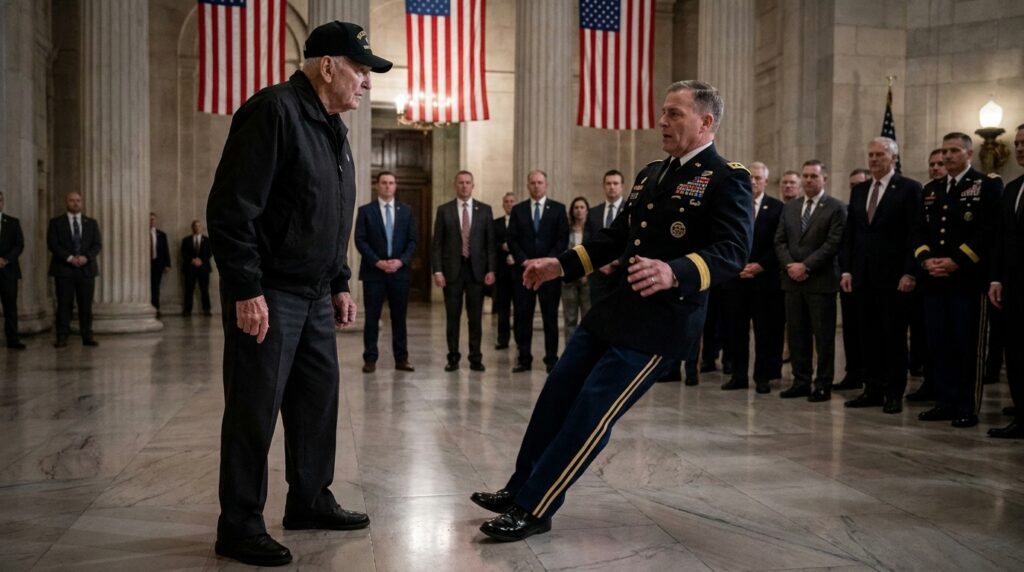
The Measured Friction of a Forgotten Lineage Found Beneath the Glare of Pristine Modern Silver
CHAPTER 1: THE FRICTION OF EXCLUSION
The security gate smelled of cold zinc and the chemical signature of cheap plastic identification cards. It was a sterile, high-ceilinged sorting pen designed to filter out the small, inconvenient realities of the outside world before they could touch the polished wood of the main gallery. Beyond the stanchions, the marble of the ceremonial hall gleamed like wet slate under the high-intensity halogen arrays, casting long, sharp-edged shadows that made the incoming guests look taller than they actually were.
He stood three inches from the edge of the gray rubber conveyor belt, his fingers resting inside the right pocket of his zip jacket. His thumb turned the flat brass ignition key over and over—a small, notched piece of metal belonging to an old truck that had sat dead in a gravel driveway since ninety-four. The key was cold, but the friction of his skin kept it from freezing entirely.
“The invitation list is closed for non-vetted personnel, sir,” the clerk behind the terminal said. She didn’t look up from her screen. The blue light of the monitor caught the edges of her hair, turning it the color of industrial grease. “If you don’t have the digital registration bar, you need to step back behind the blue tape.”
The old man didn’t move his boots. They were black leather, thick-soled, with the salt-rings of three winters dried into the creases near the welt. He looked at the brass stanchions, noticing how the velvet rope sagged exactly four inches under its own weight—too loose to stop a determined stride, but just enough to signal an institutional boundary.
“I’m here for the command registry,” his voice was dry, the sound of iron dragging over gravel. It wasn’t loud, but it didn’t have the breathy hesitation the clerk was used to hearing from the elderly who wandered off the transit buses.
A Uniformed Officer stepped through the security lane from the inner hall. His dress uniform was immaculate—dark blue wool so stiffly starched it didn’t wrinkle at the elbows, the silver captain’s bars on his shoulders catching the overhead light with a bright, aggressive glare. His high-and-tight haircut showed the pale skin of his scalp, scrubbed clean of everything but arrogance. His eyes passed over the veteran’s plain black cap, his gaze dropping instantly to the faded canvas of the black jacket. To the officer, the old man was a structural blemish in a room meant for television cameras and corporate donors.
“Is there a problem with processing here?” the officer asked. His voice had the performative resonance of an auditorium microphone. He didn’t speak to the veteran; he spoke over him, addressing the clerk as if the space between them were completely empty.
“He doesn’t have the registry code, Captain,” the clerk said, her fingers clicking against the plastic keys with a rhythm like dry beetles. “He keeps asking for the old command files.”
The captain shifted his weight forward, his pristine leather belt creaking against his hips. The silver medals on his chest clinked together—a thin, tinny sound like coins falling into an empty cup. He stepped into the veteran’s personal space, his chest expanding slightly to utilize his height advantage. He was thirty years younger, forty pounds heavier, and entirely convinced that authority was something manufactured by a tailor.
“Sir, you need to step away from the floor right now before I move you myself,” the captain said. He reached out, his thick fingers opening into a wide, demanding grip that targeted the old man’s shoulder.
The old man didn’t flinch. He looked down at the officer’s hand, watching the knuckles whiten as the muscle tension grew. Beneath the black cap, his steady eyes caught a tiny white scar just below the officer’s left ear—a sloppy shaving nick from that morning, the mark of a man who rushed through his details because he thought no one was close enough to see the mistake.

CHAPTER 2: THE CALIBRATION OF WEIGHT
The captain’s fingers closed over the black canvas of the zip jacket with the heavy, unearned certainty of a man who believed a uniform could buy structural dominance. The fabric bunched beneath his palm, the synthetic weave groaning against the sudden strain, but the body beneath the jacket did not give a single millimeter. It was like grabbing an iron hitching post driven deep into frozen mud.
To the captain, the elderly man was an administrative error waiting to be cleared from the line. But to the veteran, the captain was a set of predictable vector lines. He felt the weight of the younger man’s forward lean through the collar of his jacket—a top-heavy, aggressive posture that relied entirely on mass rather than balance. The captain’s boots were too clean, the soles lacking the raw grit needed to hold traction on polished marble.
“You aren’t cleared for this tier, old man,” the captain muttered, his voice dropping into a low, transactional hiss meant to escape the range of the security cameras. The clinking of his silver service medals against his chest plate slowed, deadened by the proximity of their bodies. “Move back behind the stanchions, or I’ll have the gate guards log an active trespass.”
The clerk behind the monitor didn’t look up, but her typing faltered, the click-clack of the keys losing its steady rhythm as the air between the stanchions turned thick and sour with the smell of floor wax and stale starch.
The veteran didn’t answer with words. His right hand remained inside his pocket, his thumb rolling the cold, notched edge of the brass utility key against his thigh. He felt the specific vibration of the ceremonial hall’s air conditioning through the stone beneath his heels—a low, rhythmic tremor that traveled up his shinbones and settled into his hips. His spine was perfectly straight, an old rod of carbon steel that had carried eighty pounds of gear through salt flats before the captain’s father had even received a draft notice.
He looked at the captain’s left shoulder. The epaulet was slightly twisted, the silver bar sitting at a fraction of an angle that indicated a poorly adjusted harness underneath the dress blue wool. A man who couldn’t balance his own gear couldn’t balance his center of gravity.
“Your left heel is light, son,” the old man said. The gravel in his voice didn’t rise in pitch; it stayed level, a flat line of acoustic iron.
The captain’s brow furrowed, a quick flash of administrative confusion crossing his face before his grip tightened. He began to pull, intending to wheel the old man toward the exit gate with a single, sweeping motion that would look like an escort to anyone watching from the VIP gallery.
But the veteran had already adjusted his weight by three ounces. He shifted his left boot back an inch, the rubber sole catching a seam in the marble with a tiny, dry squeak that was lost beneath the hum of the ventilation shafts. The movement was so small it didn’t register as a retreat; it was an alignment, a calculated opening of the lane to receive the captain’s momentum.
Inside the pocket, his thumb left the brass key. His right hand didn’t come out like a fist; it rose like a lever, his forearm sliding along the underside of the captain’s reaching arm with the dry, rasping friction of canvas against starched wool. He wasn’t fighting the grip; he was tracking it, finding the exact pivot point where the captain’s wrist met the stiff cuff of his sleeve.
The captain felt the change too late. His pull met no resistance, no soft flesh or brittle bone to crush against. Instead, he felt his own weight being drawn forward into an empty space that should have been solid. His boots slipped on the high-gloss wax of the floor, the silver medals on his chest flaring wildly as his upper body overextended.
The audience beyond the security gate remained stationary, their faces blurred by the distance and the blue glare of the lighting displays, but the silence from the main floor began to spread outward like water from a cracked pipe. A junior lieutenant near the program table turned his head, his eyes catching the sudden, irregular wobble of the captain’s silver-capped shoulders against the white vertical line of a marble column.
The veteran’s eyes stayed fixed on the small shaving nick under the captain’s ear. The tiny spot of dried blood was close now, less than a foot away, a small human detail hidden within a mountain of pristine silver and dark blue wool. The old man’s face didn’t hold anger; it held the cold, industrial clarity of a lathe machine truing a piece of rough stock.
“You’re leaning,” the veteran whispered against the rush of the captain’s shifting stance.
The captain tried to reset his hips, his muscular frame twisting to execute a recovery step, but his center of mass had already crossed the line of his toes. The momentum he had used to intimidate was no longer his own; it had been logged into the veteran’s ledger, and the old man was about to close the account.
CHAPTER 3: THE SEAM OF THE PERIMETER
The friction of the security lane disappeared behind him as his boots took the cold, unyielding weight of the inner threshold. The transition had to be quick, an unpunctuated drift through the institutional line before the perimeter guards could translate the captain’s staggered stance into an active alarm. Behind him, the low click-clack of the clerk’s keyboard remained dead, a brief structural silence hung in the air like dust over an open trench.
He did not look back to measure the captain’s recovery. A top-heavy man required exactly four seconds to find his center on waxed stone when his pride had been uncoupled from his leverage. Instead, the veteran turned his black cap toward the restricted exhibition tier, his eyes scanning the high vertical columns for the specific gaps in the modern security grid.
The hall widened here, the scent of zinc and stale floor wax giving way to the heavier, older smell of preserved oil and historical iron. Along the north wall, behind heavy glass cases and thick braided barriers, sat the modern reproductions of tactical communication systems. To the public eye, the pristine silver housings and digital displays represented the clean, absolute edge of contemporary state defense. But to a man who had pulled grease from the gearboxes of old tracking relays, the metal looked thin, lacking the density of real ordnance.
He approached the center display, his right hand still resting deep inside his jacket pocket. His thumb traced the small notches of the brass ignition key, using the rhythmic metal-on-skin friction to steady his pulse against the low-frequency hum of the air conditioning. The key was the only honest piece of iron in the room.
He stopped three inches from the primary console housing. The surface was finished in matte-black powder coat, textured to resemble field-grade equipment, but the edge joints were held together by small Allen screws rather than industrial rivets. It was a cosmetic shell.
His eyes drifted down to the base plate where the cable harnesses routed into the concrete floor. There, tucked just beneath the edge of a modern fiberglass shield, was a small, stamped metal bracket. It was pitted with old rust, its surface coated in a hasty layer of gray spray paint that hadn’t completely filled the deep microscopic grooves left by a heavy manufacturing lathe. Stamped into the corner of the bracket was a three-digit prefix: 4-1-2.
The number sat in his mind like an unexploded shell. It wasn’t a modern part number; it was an old regional designator for the communications node at the edge of the Nevada salt flats—a sector that the official records claimed had been dismantled and bulldozed into the sand forty years ago. The modern military didn’t build new things from scratch; they built them over the bones of the old lines, hiding the old foundations beneath a veneer of silver paint and glass screens.
“You’re not supposed to be near the hardware without a staff badge, elder,” a voice said from behind his right shoulder.
It wasn’t the captain. This voice was lighter, younger, lacking the starched institutional authority of the command track. The veteran didn’t turn his head instantly; he waited for the sound of the footsteps to register against the marble. Two distinct clicks of leather heels, followed by a soft, irregular drag—the mark of a junior specialist who had spent too much time sitting at a radar desk and not enough time running the perimeter.
“This bracket didn’t come from a new contract,” the old man said, his finger pointing toward the rusty seam under the shield. He didn’t drop his pitch; his voice carried the dry, mechanical rasp of an old diesel engine ticking over in the cold.
The young technician stepped beside him, his gaze dropping to the hidden bracket with a brief flash of professional confusion. His identification tag clinked against his zipper—a small piece of cheap aluminum that lacked the weight of a real dog tag. “That’s just surplus structural anchoring. Everything in this display is tier-one modern routing.”
“Surplus from where?” the veteran asked, his thumb locking against the ignition key inside his pocket.
The technician didn’t answer. His eyes shifted toward the main entrance lane where the captain was finally resetting his dress blue coat, his face the color of burnt brick as his hands checked his silver medals for damage. The social architecture of the room was beginning to warp under the pressure of the unrecorded incident, and the young man could feel the weight of his supervisor’s rage moving down the floor.
The veteran took one slow step backward, his boots holding the stone with absolute balance. He had found the seam he was looking for. The modern exhibition wasn’t just a ceremony for donors; it was a lid screwed down tight over a live transmission line that had never been officially turned off.
CHAPTER 4: THE WEIGHT OF THE ANCHOR
The young technician’s warning dissolved into the low mechanical rumble of the ventilation shafts as a shadow cut across the polished floor displays. It was a heavy, hurried stride, the sound of thick leather soles slapping against the marble with an uneven rhythm that betrayed a broken center of gravity. The Uniformed Officer had closed the distance, his starched dress blue wool taut across his chest, his face darkened by an administrative humiliation that could not be permitted to exist in front of witnesses.
“Step away from that console, old man,” the captain said. The words were choked, raspy with a sudden spike of adrenaline that fouled the crisp, cold air of the hall. He didn’t wait for compliance. His large right hand came forward again, his fingers hooked like a steel clamp, targeting the faded canvas collar of the black zip jacket with a blunt force meant to settle the ledger instantly.
The veteran did not drop his chin. He stayed rooted over his boots, his heels resting directly above the concrete seams where the old routing brackets met the modern floor. Through the soles of his leather shoes, he registered the specific micro-tremor of the younger man’s approach—the heavy, off-balance heel strikes of a physical bully who relied on mass because he had never been forced to hold a perimeter against an active breach.
Inside his pocket, the veteran’s thumb stopped rolling the flat brass ignition key. He let his fingers open, releasing the cold notched metal to rest flat against the coarse lining of his jacket. His hand didn’t emerge as a weapon; it rose like a counterweight, a steady iron rod sliding up through the empty space between the captain’s extended wrists with the dry, rasping friction of rough canvas cutting against immaculate blue wool.
“I told you once, son,” the old man said, his gravelly tone flat and level, lacking the rapid, breathless panic of the modern crowd. “You’re leaning.”
The captain’s fingers never completed the grab. Instead of striking a soft, brittle frame that would yield to his weight, his palm collided with a mass that felt like an industrial hitching post anchored four feet into frozen shale. Before the officer could adjust his hips or bring his trailing leg forward to lock his stance, the veteran turned his left shoulder by exactly two inches—a subtle mechanical pivot that closed the opening and redirected the younger man’s forward momentum.
It was an effortless application of low-tier defensive leverage, a manual technique that had been scrubbed from the modern training academies in favor of electronic tasers and administrative distance. The old man caught the captain’s extended wrist with the meat of his thumb, his forearm acting as a rigid block that trapped the officer’s leverage at its highest, most unstable point.
The captain’s pristine dress shoes lost their purchase on the high-gloss wax. For one brief, silent fraction of a second, the clinking silver medals on his chest plate flared outward like small tin coins before his center of gravity crossed the irreversible line of his toes. The momentum he had used to intimidate the elder became his own trap.
A loud, heavy thud echoed through the grand ceremonial hall as the captain’s muscular frame hit the polished marble floor. The impact was dense and metallic, the sound of bone and starched wool slamming flat against solid stone, instantly shattering the polite hum of the civilian gatherers near the VIP ropes.
The room went completely dead. The distant click-clack of the security terminals stopped. A middle-aged observer holding a champagne glass froze, his hand trembling as the liquid sloshed against the crystal rim. Every face in the immediate tier turned toward the center display, their eyes wide with the sudden, impossible realization that the pristine institutional hierarchy had just been dropped by a man in a plain black cap.
The veteran stood perfectly upright, his boots planted firmly over the sprawled form of the decorated officer. He did not look at the crowd; his cold, weathered gaze remained fixed on the small shaving nick under the captain’s left ear, which had begun to bleed slightly from the shock of the fall. The old man’s face was an unreadable sheet of stone, free of malice and entirely clear of exhaustion.
“You picked the wrong veteran to challenge today,” the old man said into the absolute silence of the room. His voice didn’t rise, but it carried the raw, unpolished density of an old diesel block ticking over in a scrap yard.
The captain lay flat on his back, his breath knocked from his lungs in a sharp, ragged wheeze. The silver bars on his shoulders looked crooked against the gray marble, his fingers clawing weakly at the slick stone as his brain struggled to process how a body so old could hold so much unyielding iron. He didn’t try to rise; the physical reality of the leverage had logged an absolute truth into his muscles that his uniform could not dispute.
The veteran didn’t offer a hand. He turned his thumb back toward the pocket of his jacket, finding the edge of the brass utility key once more as the first low murmurs began to ripple through the outer edge of the audience.
“Stay down,” the veteran added, his voice dropping into a deeper, commanding register that hadn’t been heard in this sector for forty years. “And think first.”
CHAPTER 5: THE SHIFTING LINE
The heavy, reverberating echo of the captain’s fall stayed in the marble floor like a physical stain. No one moved. The civilian onlookers near the velvet ropes remained held in place by their own low-level panic, their fingers frozen over the glass rims of unraised drinks. The veteran looked at his own black leather boots, noticing the tiny white flecks of dried floor wax that had flaked off the stone from the pure friction of the leverage.
He left the captain on his back. A man who relies entirely on starched wool to hold his weight does not deserve a clean exit. Instead, the old man turned his back to the fallen officer, his black veteran cap catching the blue glare of the nearest terminal monitor as his stride took him toward the small technical room behind the central display enclosure.
His hand was back in his jacket pocket. His thumb dug into the notched edge of the brass utility key, using the steady pain to burn through the rising adrenaline in his chest. The young technician from the exhibition tier was missing, his empty identification tag lying on top of a fiberglass routing crate—a frantic, civilian retreat that left the secondary perimeter completely unguarded.
The small iron door at the rear of the display alcove was heavy, held together by five flat-head machine screws that had been painted over so many times the slots were almost flush with the metal. The veteran didn’t use force. He reached into his left pocket, pulled out an old two-inch folding knife with a worn horn handle, and used the blunt spine of the blade to scrape away the thick, industrial gray enamel. The paint came off in stiff, dry curls, smelling faintly of lead and cold zinc.
He turned the top screw. The old iron gave a short, metallic scream as the rusted threads broke their forty-year weld against the casing.
Inside, the routing well was narrow, free of the bright silver shielding and composite ribbons that dressed the public display out on the main floor. Here lay the unvarnished lineage of the installation—thick, bundle-wrapped copper lines insulated with oil-soaked jute twine, their black surfaces coated in a heavy layer of coarse desert dust that had never been vacuumed by the modern maintenance crews.
The veteran didn’t look at the copper. His eyes went directly to a heavy, canvas-bound logbook wedged into the structural gap between the junction box and the load-bearing concrete column. The cover was stamped with the same three-digit prefix he had spotted beneath the fiberglass console shroud: 4-1-2.
He pulled the book from the slot. The old binding groaned, releasing a small cloud of dry, sulfurous powder that settled into the lines of his palms like grey soot. He flicked the pages over with his thumb, tracking the faded purple ink entries from the late summer of eighty-five. The names were written in the blocky, standardized hand of a long-disbanded logistics command—names of operators who had supposedly been reallocated to European stations after the desert sector was wiped from the master maps.
Halfway down the page for August twelfth, the ink changed from purple to an oily black. A single, heavy red line had been drawn across the column headers, obliterating the serial numbers of the transmission arrays. Beneath the strike-through, someone had typed a single administrative note using an old manual typewriter that had a broken R key: ALL FILES PURGED PER DIRECTION OF COMMAND TIERS – RECORD CONFLICT RECORDED AS MECHANICAL FAILURE.
The veteran’s thumb stopped on the page. The friction of the yellowed paper against his scarred skin felt rough, like sand over a fresh wound. The document didn’t describe a routine decommission; it was a structural erasure, a calculated record wipe designed to bury a thirty-man deployment beneath three feet of bureaucratic salt. They had called it a failure to avoid paying the pensions, turning an active tactical withdrawal into a shameful mechanical panic.
The sound of boots scraping against the iron rail outside the alcove broke his focus.
It wasn’t the slow, clumsy shuffle of the captain trying to find his balance. These steps were light, perfectly synchronized, and accompanied by the distinctive metallic rattle of three-man security details moving into an active containment formation. The institution was no longer trying to manage a public embarrassment; they were trying to recover a stolen archive before the civilian donors could track the origin of the noise.
“He’s in the routing tier,” a voice called out through the narrow door frame. It was sharp, cold, and entirely free of the performative arrogance the captain had used. This was the voice of the actual security apparatus—men who didn’t care about medals because they were paid to handle the structural grease.
The old man didn’t drop the logbook. He slipped the canvas binding beneath his zip jacket, the heavy paper pressing hard against his ribs like a cold iron plate. He turned his face toward the dark secondary exit that led down into the building’s basement pump rooms, his boots already finding the correct angle on the concrete floor to take the weight of the coming rush. He had the names now, but the line was already closing behind him, and the ultimate truth of the live signal remained locked beneath forty feet of institutional concrete.
CHAPTER 6: THE RETENTION FILTER
The heavy iron door frame groaned behind him as his boots took the slick, wet concrete of the secondary stairs. The shadows here were cold, thick with the smell of wet lime and the sharp, chemical tang of leaking battery acid. Behind him, the rhythmic rattle of the security team’s tactical gear amplified against the raw stone walls, a three-man wedge moving with clean, synchronized intervals that showed they weren’t under the captain’s theatrical command track. These were the basement details—men hired to keep the grease inside the pipes.
He kept his hand flat against the canvas binding of the logbook tucked under his jacket, his left arm pressing the old ledger hard against his ribs to quiet the dry rustle of the pages. His right thumb remained inside his pocket, tracking the flat notched teeth of the brass ignition key. The key was warm now, holding his body heat against the damp, subterranean drafts that rose from the sewer sumps below.
He didn’t drop into a run. A man running down an unlit concrete shaft gives away his vector line through the irregular slap of his soles. Instead, he maintained a steady, measured pace, his leather boots rolling from heel to toe along the very edge of the masonry where the structural density was highest and the floor didn’t echo.
“Hold the lower landing,” a voice cut through the stairwell from above. It was a flat, digital transmission, clipped by the cheap speaker of a tactical radio. “He’s carrying the unvetted logistics log. Use the non-lethal lane checks.”
The veteran stopped at the first landing. The air conditioning duct from the main exhibition hall above ran directly over his black cap, its galvanized surface dripping with cold sweat that smelled of stale Freon. Beneath the sheet metal, a large electrical conduit box sat anchored to the wall by four rusted lag shields. The box wasn’t painted gray like the modern display pieces upstairs; it was coated in the thick, toxic red-lead primer of the mid-twenties, its surface scarred by old pipe wrenches.
He reached out his right hand, his fingers finding the seam where the conduit entered the masonry. The iron pipe was vibrating—not with the standard sixty-cycle hum of a building’s standard power grid, but with the erratic, heavy pulse of a high-power radio frequency transformer working against an unshielded load. The modern display upstairs was a decoy, a cosmetic lid; the actual transmission array was down here, drawing juice through an unmapped junction that didn’t exist on the building’s administrative blueprints.
He leaned his ear against the cold iron of the conduit box. Through the grease and the rust, he heard the distinctive, rhythmic clicking of an automated relay switch—the old mechanical click-clack of a rotary transmitter repeating a data loop every twelve seconds. It was the specific operational signature of the sector 4-1-2 network. They hadn’t dismantled the desert bunker; they had simply buried the keys and routed the active diagnostic line into this basement to keep the receivers alive without logging the expenditure.
The first flash of an industrial flashlight beam swept across the wet lime walls of the upper landing, casting a long, skeletal shadow of the handrail down the steps.
“We’ve got the grease track on the third step,” a guard muttered, his boots scraping against the grit as he adjusted his descent. These men were moving too fast, relying on their high-lumen lamps to clear the path rather than tracking the thermal draft of the shaft. They were looking for an old man who was tired and out of breath, not a shadow that knew the structural dead-zones of the foundation.
The veteran pulled the logbook from his jacket, his fingers working by touch alone in the dark. He opened the back cover, finding the small, linen-reinforced pocket where the old field clerks kept the carbon maintenance receipts. His fingers caught a small slip of heavy cardstock—a three-digit gate pass with a hand-punched hole through the center. It wasn’t an authorization for this hall; it was a physical coordinate map for a water-well casing thirty miles north of the Nevada test boundary.
He didn’t look at the slip. He folded it into his small horn-handled knife and shoved both deep into his trousers pocket, letting the canvas logbook fall back into place against his ribs. The decoy secret was right here in his arms—the proof of the systemic record wipe, the evidence that would satisfy a public inquiry or a legal challenge from the veteran’s association. But the real truth, the live transmission humming inside the rusted conduit, was something the modern institution couldn’t allow to leave the room alive.
He turned his shoulder into the dark alcove behind the transformer casing. The space was narrow, less than eighteen inches between the iron frame and the sweating concrete wall, filled with old porcelain insulators and bundles of dead telephone wire. It was a structural dead-end, a failure of escape that would bring the security detail directly down upon his position within thirty seconds. He held his breath, his boots locked together, his thumb finding the brass utility key once more as the heavy light of the first tactical lamp began to paint the floor at his feet with a cold, revealing glare.
CHAPTER 7: THE RECOGNITION LOCK
“Stand down,” a voice ordered from the top of the stairwell landing.
The command didn’t come through the short-range tactical radios. It didn’t have the standard digital clip or the frantic cadence of the basement detail’s tracking loop. It was a heavy, gravel-edged rasp that cut clean through the basement’s damp air conditioning hum, carrying the kind of raw, structural authority that only forty years of command-lane service could burn into a man’s throat.
The three security guards froze, their high-lumen tactical lamps dropping instantly toward the concrete floor. The beam of the lead light washed over the old veteran’s boots, catching the white flakes of dried floor wax still stuck to the dark leather creases. The men didn’t lower their weapons completely, but their boots ground against the gritty floor lime as they stepped out of their tight containment wedge, opening the narrow lane between the transformer box and the masonry wall.
A tall, broad-shouldered man in an unvarnished garrison coat walked down the steps. His silver hair was cut into a sharp, square line that mirrored his jaw, his uniform free of the bright, multi-colored ceremonial ribbons that the captain had paraded upstairs. He wore only a single ribbon—the muted olive-and-black bar of a desert logistics commander from the old Cold War sector tiers. On his lapel sat a small, tarnished brass pin bearing a four-star command cluster.
The senior general stopped exactly three inches from the edge of the old man’s shoulder line. His gaze didn’t linger on the faded canvas of the black zip jacket or the plain black cap; his eyes went straight to the old man’s right hand, which was still wrapped tightly around the brass ignition key inside his pocket.
“You haven’t changed your alignment, Vance,” the general said. The words were quiet, but they bounced off the wet lime walls with a weight that made the junior guards adjust their stances. “Still holding the left heel light when you trace a perimeter.”
The veteran didn’t release his grip on the notched metal key. He looked at the general’s face, tracking the deep, weather-beaten creases around the eyes—the permanent squint left by three years of salt-flat glare during the forty-one-two deployments.
“The brackets are still drawing power, General,” Vance said, his voice flat, a hard line of mechanical iron that matched the rhythm of the rotary transmitter clicking behind the junction shell. “The logistics ledger says the sector was bulldozed in eighty-five. The ink was blacked out. But the copper’s live.”
The general turned his head slightly toward the lead security guard, his thumb making a small, downward gesture that commanded the tactical lights to be extinguished completely. The basement plunged into a dark, amber wash, illuminated only by the faint red diagnostic bulb on the side of the transformer housing.
“The logbook is a decoy, Vance,” the general said, his voice dropping into a low register that remained below the pickup range of the modern monitoring grid upstairs. “The administration wiped the file because they needed a clean paper trail to satisfy the oversight committees. They wanted the world to think we left thirty men out there because of a failed radio rig. It was an easy lie to write into the budget.”
Vance pulled his right hand out of his jacket pocket. He didn’t make a sudden movement, but the brass utility key clinked sharply against his old horn-handled pocketknife as he held them out in his palm. The general looked down at the metal, his fingers reaching into his own coat to produce a matching artifact—a scratched, heavy Zippo lighter with an unpolished command insignia etched into the brass casing.
“They think you came here to expose the purge,” the general whispered, his eyes locking back onto Vance’s steady gaze. “The captain upstairs thinks you’re an old vagrant looking for a pension voucher. He doesn’t know that the forty-one-two node isn’t just an old deployment sector. It’s the primary relay link for the deep-set communications bunkers. The receivers are still running on an automated cycle, Vance. And the code slip you’ve got in your knife is the only thing that can shut the automated transmission loop down before the modern networks intercept the frequency.”
The lead guard took a short step forward, his boot sole scraping a warning against the concrete. “Sir, the command staff upstairs is logging the delay. The captain is demanding a formal trespass report for the civilian observers.”
The general didn’t look back at his man. He reached out and placed a heavy, gloved hand onto the old veteran’s forearm, the stiff leather of his cuff pressing against the rough canvas of Vance’s sleeve with a firm, transactional grip that felt like a transfer of duty.
“Get out through the pump lines,” the general said, his thumb pointing toward the dark, unmapped drainage shaft at the rear of the alcove. “The logbook won’t help you out there—it’s just dead paper meant to keep the lawyers busy. The transmission is what matters. You hold the coordinates for the live line, Vance. If they take you here, they find the slot.”
The old man turned his face toward the dark secondary exit, his boots already adjusting to the downward tilt of the wet stone floor. He could feel the cold draft of the rain coming from the city’s storm grid below, the raw texture of the world outside waiting to reclaim him. He had been given a false flag—a book of wiped records that meant nothing compared to the live iron hum vibrating through his shins. The lane was clear for now, but the true confrontation was no longer on the marble floor upstairs; it was waiting for him out in the salt flats where the old network refused to die.
CHAPTER 8: THE OUTWARD FREQUENCY
The general’s gloved grip left his sleeve with a final, leather-on-canvas drag that felt like a lock cylinder clicking home. The amber glow of the transformer box receded instantly as Vance stepped into the black diameter of the drainage pipe, his old leather boots plunging two inches into the freezing, industrial runoff that sloshed through the concrete casing. The air down here carried no scent of modern wax or administrative starch; it was thick with the heavy, unwashed breath of the city—oil sediment, corroded rebar, and the gray silt washed down from the municipal curbs.
He kept his head low beneath the jagged, encrusted roof of the utility run. His left arm remained curved tight against his ribs, clamping the canvas-bound logbook to his side, but his mind had already uncoupled from the paper. The book was a shell, a calculated decoy tossed out by the clerks to give an old man something to chase while the real power stayed buried in the salt flats.
His right hand descended back into his pocket, his fingers passing the horn handle of his knife to lock onto the flat, notched edge of the brass utility key. The brass was hot against his palm now, a tiny conductor of intent holding his skin temperature against the wet, subterranean drafts that whistled up from the lower metropolitan pumps.
Behind him, the low mechanical clicking of the rotary transmitter grew fainter, its twelve-second pulse swallowed by the rhythmic, hollow splash of his own feet moving down the gradient. He didn’t check the dark behind his shoulder. A soldier who has spent three years tracking vectors on an open range knows that looking back only breaks the forward lean. The general would hold the landing for exactly ninety seconds—long enough to log a false report about an empty room, but short enough to keep the security teams from checking the structural seams behind the transformer cradle.
The pipe narrowed, the smooth poured concrete giving way to older, corrugated iron segments that had rusted into long, flaky scales along the water line. The friction of his jacket against the metal siding produced a sharp, dry rasp that sounded like dry weeds scraping against a fence post in a high desert wind.
Through the thin soles of his shoes, he felt the transition. The ground shifted from solid municipal masonry to the loose, vibrating iron grating of the primary pump overflow. Directly ahead, the low, gray light of a rainy American afternoon spilled through the heavy bars of the storm exit, cutting the darkness into narrow vertical strips that fell across his weathered face like silver bars.
He reached the gate. The iron padlock holding the chain together was coated in a thick, granular crust of orange rust that had flaked off onto the wet concrete below. Vance didn’t look for a keyhole. He reached down, his fingers finding the small, hand-punched cardstock slip he had tucked inside his pocket. He didn’t need to read the numbers under the gray light; the feel of the paper—the three clean, punch-holes through the fiber—told him everything he needed to know about the coordinates thirty miles north of the Nevada test grid.
The live line was out there, humming in the wide, empty spaces where the modern institutions couldn’t monitor the frequency without drawing their own alarms. They had spent forty years trying to build a pristine silver facade over the bones of his generation, but the foundations were still wired to the old boxes, and the old boxes only answered to the iron.
He jammed the blunt edge of his horn-handled knife into the lock’s tumbler seam, applying three ounces of targeted, downward pressure until the ancient internal pins sheared off with a short, metallic snap. The heavy gate swung outward into the gray rain, the hinges screaming once against the damp air before settling into a loose, unlatched sag.
Vance stepped out onto the gravel lane behind the civic hall. The storm was coming down hard now, the big, cold drops bouncing off his plain black cap and turning the matte canvas of his jacket into a dark, heavy hide that smelled of old wool and oil grease. Behind him, the towering marble columns of the exhibition hall looked small, their white outlines blurred by the gray sheets of rain that washed the streets clean of everything but the grit.
He adjusted the cap over his eyes, his thumb catching the cold brass key one last time before his hand dropped naturally to his side. He had the names under his coat, and he had the line in his pocket. The modern building behind him was already scrambling through its files, trying to patch a hole in a perimeter that had been broken the moment they chose to challenge the wrong man. But Vance was already moving down the gravel toward the open road, his boots holding the wet earth with absolute balance, his frequency locked onto a signal that had never been turned off.
CHAPTER 9: THE GREY HORIZON
The gravel lane gave way to the oily, black asphalt of the secondary industrial access road with a single, wet crunch of his rubber soles. The rain didn’t slow. It came down in heavy, diagonal sheets that rattled against the rusty corrugated metal of the perimeter warehouses, turning the grease on his jacket into a slick, reflective skin under the low-hanging grey sky. Behind him, the high municipal silhouette of the ceremonial hall was already fading into the mist, its white marble pillars looking like old teeth sinking into the fog.
He didn’t check the rearview lane. His stride stayed level, his boots holding the centerline of the asphalt where the water didn’t pool. His left arm kept the hard, canvas-bound logbook locked flat against his ribs, the wet paper smelling of moldering lime and ancient ink. It was an institutional weight, a thirty-ounce block of dead history that the captains upstairs were currently tracking through their digital log screens. Let them hunt the paper.
His right hand remained deep inside his pocket, his knuckles resting against the cold, iron handle of his folding knife. Inside the knife’s brass liner, the hand-punched coordinate card sat tight—a three-hole grid matrix that didn’t exist in the modern command files.
He reached the end of the warehouse fencing where a rusted sixty-eight utility truck sat idling in the weeds. Its dark green lacquer had long ago given way to a rough coat of red primer, the exhaust pipe coughing out a thick, grey plume of diesel smoke that smelled of sulfur and unburnt oil. The driver’s door didn’t have a modern electronic lock; its handle was a solid piece of pitted chrome that had grown cold under the rain.
Vance opened the cab. The interior smelled of old horsehair, damp wool, and the faint, sweet scent of gun oil from the steering column shroud. He slid onto the cracked vinyl seat, the canvas of his jacket groaning against the springs as he pulled the door shut with a heavy, unlatched thud that rattled the glass in its frame.
He reached into his pocket, drew out the brass utility key, and jammed the notched blade into the ignition slot. The tumbler was loose, worn down by forty winters of mechanical friction until it accepted the metal with a dry, internal click. He didn’t turn it instantly. He sat for three seconds, his eyes tracking the small white shaving nick on his own reflection in the cracked rearview mirror. The face looking back at him wasn’t the face of the old man the clerk had ordered behind the blue tape; it was the face of the third platoon supervisor from sector 4-1-2.
He turned the key. The old starter motor didn’t click or hesitate with a computer diagnostic delay; it engaged with a low, heavy growl that shook the entire dashboard, the inline-six engine catching the fuel line with a sudden, mechanical roar that blew a spray of soot out into the wet weeds.
Through the vibrating floorboards, Vance felt the old frequency. It wasn’t the clean, silent digital signal that the modern security detail used to track perimeters. This was the raw, unshielded rumble of functional iron—the kind of engineering that didn’t leave a data trail on an administrative network. He dropped the column shifter into first gear, the transmission teeth grinding once before locking into the slot with a firm, metal-on-metal thud.
The truck pulled out onto the grey state highway, its manual wipers scraping two narrow semi-circles through the grime on the glass. The road ahead was long, running flat toward the western salt flats where the sky met the sagebrush in a single, desaturated line of grey. They had wiped his name from the ledger to save a budget line, but they had left the wires in the dirt, and Vance was about to turn the power back on.
CHAPTER 10: THE COLD IRON RUN
The state highway flattened out into a grey, unyielding ribbon of wet concrete that dissolved into the horizon. The old green utility truck held forty-five miles an hour, its heavy leaf springs rattling with a dry, mechanical chatter every time the worn rubber tread hit a tar seam. Inside the cab, the air was cold, leaking through the rotted felt strips along the window frame with a thin, high-pitched whistle that sounded like steam escaping an old boiler.
Vance kept his palms flat against the hard plastic of the steering wheel. Through the unassisted column, his hands tracked the physical reality of the road—the minute skips, the loose gravel pulling to the right shoulder, and the distinct, rhythmic pull of a dragging brake shoe. His left forearm remained braced against the canvas binding of the logbook resting on the middle of the seat. The paper was cold against his ribs, its thick pages swelling slightly from the high humidity trapping the cabin air.
In his rearview mirror, the highway was a blank expanse of desaturated grey. But a mile back, just where the rain-mist converged into a solid wall of white, two small, yellow halogen beams punctured the haze. They didn’t bob or bounce with the standard suspension travel of a commercial commercial hauler; they stayed perfectly level, tracking the exact centerline of the lane with a rigid, institutional discipline.
The security tiers upstairs had calculated the exit vector. They weren’t using the captain’s loud patrol sirens; they had sent the highway intercept detail—men who moved in plain, government-issue sedans with heavy-duty cooling blocks and reinforced frames designed to pit-maneuver an old utility vehicle off the asphalt before it crossed the state line.
Vance did not press the accelerator pedal down to the floor boards. An old inline-six doesn’t outrun an interceptor block on open concrete; it survives by conservation of mass. He reached his right hand down to the metal dashboard, his thumb tracing the pitted iron housing of the mechanical speedometer. The orange needle was wobbling between forty and fifty, its needle vibrating with a specific frequency that didn’t match the rotation of the wheels. The dashboard housing was drawing an induced magnetic current from a secondary source under the chassis—the tracking beacon the young technician had likely clamped to the fuel tank while Vance was still mapping the perimeter inside the exhibition hall.
He let his thumb slide off the iron bezel, his fingers dropping down to find the heavy manual choke knob beneath the key slot. He pulled it out by exactly a quarter-inch. The engine’s roar deepened, the exhaust note thickening into a rich, soot-heavy rumble that coated the inside of the tailpipe with dry carbon. The truck slowed by two miles an hour, its rear end settling into the wet ruts of the lane with an unyielding weight.
The yellow lights behind him closed the gap to half a mile. Under the glare of the approaching lamps, the raindrops on his rear glass looked like tiny shards of broken lead.
“Vance,” a voice crackled from a small, gray plastic speaker box hung from the truck’s utility rack—an old short-wave radio unit that hadn’t been hooked up to a commercial antenna since seventy-six. The speaker cone was torn, the audio scraping through the paper matrix with the dry hiss of sand over a steel plate. “You’re approaching the weigh-station checkpoint at mile marker twelve. The lanes are already locked down by the state registry. Turn the vehicle onto the gravel turnout before the scale house.”
It wasn’t the general. It was a cold, administrative frequency from the regional tracking desk—the corporate entity that managed the digital logistics wrappers for the new defense contracts. They didn’t want a scene on the interstate, but they needed the ledger back before the network could register the missing inventory count.
Vance didn’t look at the speaker. He reached out with his left hand, picked up the small horn-handled pocketknife from the seat beside the logbook, and used the blunt tip of the blade to pry the plastic knob off the radio’s frequency dial. Behind the plastic shell sat an old copper tuning shaft, covered in green oxidation that looked like dried salt. He didn’t turn it to find a different station. He pushed the blade down into the gap between the shaft and the steel housing, shorting out the internal circuit with a sharp, bright blue spark that smelled instantly of carbonized resin.
The speaker died with a dry, hollow pop.
The yellow headlights were close now, less than three hundred yards back, their glare flaring in his side mirror until the reflection turned the skin of his cheek a pale, sickly yellow. Vance kept his boots firm against the metal pedals, his thumb shifting back to the brass utility key in his pocket. The decoy logbook was lying right next to him, but his eyes were fixed on the green mile marker sign passing the window. The weigh station was two minutes away, the metal scales waiting to log the truck’s weight into the digital tracking grid, and the old man had exactly eighty rods of concrete left to find the dirt road that didn’t have an asset tag.
CHAPTER 11: THE BREAK IN THE SEAM
The asphalt boundary disappeared under his front axle with a violent, metal-on-metal shudder that slammed the steering column hard against his palms. The truck dove left, its heavy iron bumper slicing through a thick growth of rain-soaked chicory weeds before the bald front tires caught the loose, wet shale of the old quarry approach. Behind him, the state highway scale house faded instantly into the downpour, its pristine white floodlights sweeping harmlessly over an empty stretch of concrete that the green utility vehicle had already abandoned.
Vance kept his weight thrown forward, his chest inches from the hard plastic horn button as he fought the unassisted steering wheel. The truck was fishtailing on the grease-slick clay, the rear end swinging wide toward a sheer drop-off where the limestone had been blasted out back in the fifties. He didn’t touch the brake pedal. A touch of the pad on wet shale would lock the drums and turn the three-ton utility vehicle into a dead sled of unguided iron.
In the side mirror, the yellow halogens of the intercept sedan made the turn forty yards late. Their low-slung, modern composite chassis wasn’t built for a five-inch lip of broken limestone; the front valence tore away against the state road gutter with a loud, plastic crunch that sent shards of black polymer spinning into the wet weeds. But their momentum held. The sedan stabilized, its wide, high-performance radial tires clawing through the mud with a rapid, electronic traction click that kept the nose pointed directly at the truck’s tailpipe.
Vance shifted his weight back into the vinyl seat, his left forearm locking the canvas logbook flat against his hip. The volume of the rain had doubled inside the ravine, the drops hitting the rusted cab roof like a handful of gravel thrown against a barn door.
He didn’t look at the pursuing lights. His eyes were fixed on the narrow track ahead—a single lane of crushed dolomitic lime that climbed a steep, unmaintained shelf toward the upper rim of the pit. The track was old, its surface scarred by deep washouts where the seasonal cloudbursts had carved raw trenches through the stone. But to a man who had driven supply rigs through the crags of the Nevada test range, the terrain was just a set of mechanical resistance points.
His right hand dropped back to the floorboards, his fingers wrapping around the cold iron shaft of the secondary transfer case lever. It was a crude stick of forged steel, coated in a layer of old, hardened transmission grease that had turned the color of black pitch. He didn’t use the clutch. He waited for the exact microsecond where the truck’s engine RPM dropped into the torque curve of the grade, then slammed the lever backward into low-range four-wheel drive.
The gears caught with a dry, heavy thunk that shook the frame rails from bumper to bumper.
The utility truck lunged forward, the front axle engaging with a low, mechanical whine that drowned out the whistle of the wind through the rotted weatherstripping. The tires stopped spinning on the clay, their deep, agricultural lugs biting through the loose silt until they hit the solid rock bed of the shelf below. The distance between the green tailgate and the sedan’s front grille widened by ten yards as the modern vehicle’s computer-controlled transmission struggled to translate the sudden drop in traction.
Vance reached down, his thumb rolling the cold edge of the brass ignition key inside his pocket. The key was the anchor, but the micro-mystery wasn’t the road behind him—it was the track ahead. In the beam of his yellowed high-beams, he noticed the washouts didn’t have any loose shale at the bottom. Someone had cleared the larger stones out of the ruts within the last forty-eight hours, leaving a clean, packed floor of grey clay that was exactly eight feet wide.
The old forty-one-two sector wasn’t an abandoned ghost line. The quarry road wasn’t a dead-end; it was being maintained by someone who knew the exact width of a standard military utility track, and the tracking sedan behind him was running blindly into a trap that had been set forty years before the driver had ever received his commission.
He held the wheel steady, his right boot pressing the iron accelerator pedal into the damp floor mat as the road narrowed into the upper rock cut. The modern world was still behind him, its yellow lights flaring against the wet iron scales of his truck bed, but the line was turning toward the deep wash where the old receivers were still drawing juice from the sand.
CHAPTER 12: THE FRICTION OF THE EDGE
The shriek of raw iron shearing against unyielding limestone rose above the storm as the intercept sedan forced its nose into the three-inch gap between the truck’s rear wheel well and the solid rock wall of the quarry cut. It was a calculated, high-speed wedge maneuver, executed with the cold, administrative precision of a team tracking a high-value asset count. The sedan’s wide front bumper pressed hard into the truck’s heavy steel step-side rail, creating a localized, screaming friction that sent a shower of orange sparks sputtering into the wet mud.
Vance did not yank the wheel away from the impact. A sudden turn toward the inner rock wall would bounce his heavy front axle off the limestone, steering his three-ton utility frame clean off the opposite lip where the shelf dropped seventy feet down into the dark pump sumps below. Instead, he leaned his weight into the steering column, his calloused palms absorbing the deep, structural vibration of the lane lock. He let his truck’s frame grind against the sedan’s side panels, using the unpolished mass of his old leaf-spring suspension to match the younger driver’s lateral pressure.
Through his cracked driver’s glass, less than two feet away, Vance could see the intercept driver’s face beneath the clean, low-profile brim of a corporate security cap. The man’s eyes were fixed on the track ahead, his knuckles white against the synthetic leather wrap of a modern steering assembly. He wasn’t relying on tactical intuition; he was relying on the rigid, carbon-steel reinforcement cage hidden just beneath his vehicle’s smooth plastic skin to force the heavier utility truck into a dead stop before the shelf ended at the upper canyon rim.
The lane was narrowing by the inch, the ancient dolomitic lime walls closing in like a stone vise. Vance kept his left forearm locked over the canvas ledger on the vinyl seat. The book was dead paper, but the sheer physical mass of it against his ribs served as a stabilizing buffer against the lateral impacts jarring the cab.
“Break contact and drop the transmission into neutral, Vance,” a voice crackled through the shorted-out radio housing—not from the dead speaker cone, but from a small, auxiliary security unit clipped to the intercept sedan’s roof liner, the sound bleeding through the open gaps in their tearing steel. “You’re running out of ledge. The asset registry has already logged your mechanical weight footprint. There’s nowhere for the iron to go.”
Vance didn’t look at the gap between their doors. He shifted his right boot, finding the flat, cast-iron surface of the clutch pedal while his hand reached down to the secondary low-range lever. He didn’t drop the gear down; he pulled the stick upward, deliberately disengaging the front-wheel drive transfer case for exactly half a second.
The sudden drop in front-wheel traction caused the truck’s tail end to fishtail slightly toward the rock face. The heavy steel corner of Vance’s utility bed caught the sedan’s front wheel arch with an unyielding, three-ton hammer blow that tore through the sleek composite fender and crushed the modern vehicle’s steering rack against its own aluminum wishbone.
The sedan’s passenger-side tires lost their grip on the wet shale. For one brief, silent fraction of a second, the yellow halogens of the intercept vehicle flared wildly toward the stormy sky before the crushed suspension assembly ground flat against the solid limestone bed. The modern vehicle didn’t roll; it skidded to a dead stop against the inner rock wall, its electronic engine block dieing with a dry, automated hiss as the safety fuel cutoffs engaged instantly.
Vance slammed the transfer case lever back into four-wheel low. The front axle re-engaged with a heavy mechanical thunk that pulled the green truck clear of the wreckage, its deep agricultural lugs throwing a wide spray of crushed stone and wet clay over the sedan’s shattered windshield.
He didn’t slow the engine down as the truck crossed the upper rock cut. In his side mirror, the security driver was already prying his door open against the dented frame, his clean corporate uniform stained with the black grease of his own ruptured brake lines. Vance turned his face toward the dark desert wash that opened up just beyond the quarry rim, his thumb finding the brass ignition key inside his pocket once more. The decoy intercept had been broken, but the narrow lane ahead was completely lightless, and the tracking needle on his dashboard was still vibrating against its iron bezel, tracking the high-voltage pulse of the live line humming beneath the sand.
CHAPTER 13: THE BURIED JUNCTION
The dry grease-crust of the steering column rattled against his knuckles as the green utility truck dove nose-first into the deep, unmapped wash. The front tires sliced through a thick patch of dead sagebrush, their heavy agricultural lugs grinding down through the loose surface sand until they hit the hard, unyielding caliche bed of the ancient desert floor. The engine block screamed in low gear, its inline-six cylinder array releasing a hot, oily stench of raw diesel that mixed with the cold smell of the incoming storm front.
Vance did not lift his boot from the throttle. He wrenched the wheel hard to the right, steering the heavy chassis behind a low ridge of eroded shale that cut off the line of sight from the upper quarry rim. Behind him, the wind was picking up, lifting fine clouds of grey alkaline dust that swirled through the tire tracks, filling the deep ruts before the rain could dissolve the trail into sludge.
He brought the vehicle to a halt beside an abandoned water-pump rig from the mid-twenties. The iron framework was ancient, its heavy flywheel coated in a thick, scabby sleeve of dark brown rust that had flaked off into the silt below. Vance didn’t shut down the ignition. He let the engine idle, the vibration shaking the cracked rearview mirror until his own weathered face was nothing but a grey blur in the glass.
He reached for the ledger on the vinyl seat. With a single, sharp twist of his wrist, he tore the heavy canvas-bound logbook in half, exposing the hollowed-out center cavity between the rear pages where the logistics command clerks had glued their official records. There were no lists of equipment or names of missing operators inside the core. The paper inside was blank—a thick block of commercial cardstock meant to balance the weight of the binder and keep the auditors from noticing that the contents had been extracted before the book had ever left the Nevada storage tiers.
The book was an absolute decoy. They hadn’t written down the failure because there was no failure to record; they had created a paper ghost to keep him hunting the halls while the live signal continued to cycle through the dirt beneath his boots.
Vance didn’t drop the paper. He threw both halves into the rusted footwell of the passenger side, his fingers reaching deep into his pocket to pull out the small folding knife. He unclasped the horn handle, extracting the three-hole cardstock slip he had pulled from the ledger’s lining back in the basement.
He stepped out of the cab into the freezing rain. The wind struck him hard, tearing at the collar of his black zip jacket and throwing a sharp spray of gritty sand against his eyes. He didn’t flinch. He walked three yards past the truck’s front bumper, his leather soles sinking an inch into the wet alkaline silt until they hit a solid, flat surface that didn’t give under his weight.
He dropped to his knees, his calloused thumbs scraping away the wet mud and dead sage leaves from the rock bed. Beneath the silt lay a four-foot slab of cast-concrete, its edges pitted by forty years of sun-bake and winter freeze. Sticking out from the center of the masonry was a thick, encrusted iron lock loop, its surface covered in a layer of green copper oxidation that looked like dried salt.
Vance laid the coordinate pass flat against the iron loop. The three hand-punched holes in the card aligned exactly with three small, brass contact pins hidden within the underside of the weathered lock housing—a manual, non-digital security alignment that didn’t have a code circuit or an antenna to intercept.
A deep, mechanical click resonated from beneath the concrete. It wasn’t the light, plastic snap of an electronic latch; it was the heavy, iron rotation of a spring-loaded gate valve turning inside a pressurized conduit. Through the soles of his boots, Vance felt the immediate shift in the ground frequency—the raw, high-voltage hum of the rotary relay transmitter upstairs giving way to a steady, rhythmic pulse that rose straight out of the shale like a heartbeat.
He looked down at the brass key in his palm, the notched edge catching the faint, grey light of the stormy horizon. The line wasn’t a dead archive. The coordinates didn’t map a gravesite or a disposal trench; they mapped the active gateway for the live communications bunker, and the old man was standing right on top of the transmission key.
CHAPTER 14: THE SOVEREIGN STATION
The heavy iron linkage beneath the slab completed its rotation with a dense, hollow thud that reverberated through the soles of his boots. Slowly, with the dry, rasping protest of sixty-year-old hinges grinding against impacted desert silt, the concrete hatch counter-balanced backward into the sagebrush. A long-confined draft rose from the opening—air that didn’t hold the clean, chemical tang of the modern municipal hall above, but rather the cold, stagnant reek of buried lead ballast, decayed rubber insulation, and the distinct, metallic perfume of old nickel-iron battery banks that had never stopped trickling.
Vance knelt at the mouth of the shaft. The freezing desert rain beat a flat rhythm against the coarse canvas of his zip jacket, washing the alkaline mud from his knuckles in long, grey streaks that ran down into the black diameter of the ladder hole. He didn’t hesitate. Leaving the green utility truck idling in the wash—its exhaust pipe coughing its steady, sulfurous pulse into the rain—he swung his legs over the iron lip and began his descent into the vault.
The ladder rungs were cold, forged from thick rebar that had grown rough and scabby with layers of orange oxide. With each downward step, the noise of the surface storm diminished, replaced by the mounting, structural hum of the live line below. It wasn’t the erratic, high-frequency skip of the decoy transmitter he had shorted out in the city hall basement; this was a massive, subterranean vibration—a low, rhythmic growl that shook the marrow of his shins like a heavy marine engine locked in low gear.
He reached the floor of the bunker’s entry vestibule. The space was narrow, six by six, the walls formed from raw, board-formed concrete that still held the grainy imprints of the timber slats used to pour it during the early years of the Cold War. At the center of the floor, sitting directly beneath the vertical shaft, lay a small, shiny object that didn’t match the surrounding decay. It was a tarnished brass pin—a four-star general’s command cluster, its backing needle bent as if it had been deliberately unclasped and dropped down the hole within the last forty-eight hours.
The general hadn’t just cleared the lane behind the transformer cradle upstairs; he had been here first, resetting the automated mechanical gate valve to ensure that Vance’s coordinate card would match the pins on the lock housing. The old command track hadn’t forgotten the line; they had simply buried the access points beneath an administrative screen of erased files and public ceremonies to keep the corporate contractors from mapping the active infrastructure.
Vance left the pin in the dirt. He turned his cap toward the inner bulkhead where the main blast door stood ajar by exactly three inches. The iron plate was four inches thick, its locking dogs held back by a thick smear of grey graphite grease that had dried into a stiff, protective crust over the seals.
He placed his right palm flat against the cold iron face of the door, his boots finding their purchase on the wet clay floor. He didn’t use a sudden rush of force. He leaned his entire three-ton utility frame into the metal, using the natural, rooted leverage of his hips to break the suction of the old rubber gaskets.
The blast door swung inward with a long, mechanical shriek that filled the concrete tunnels with the sound of tearing iron.
Beyond the threshold, the station was live. Under the low concrete ceiling, a massive banks of vacuum-tube relays were clicking in an automated twelve-second cycle—the click-clack of sector 4-1-2 repeating its unmapped coordinate loop into the salt flats. There were no computer screens, no digital log interfaces, and no administrative tracking nets. The entire system ran on the old mechanical iron, drawing its power from a subterranean thermal tap that the modern defense registry had never logged into their database.
Vance walked to the central console table, his leather boots leaving deep, wet imprints on the rusted steel floor plates. He reached into his pocket, pulled out the brass ignition key, and laid it flat on top of the copper transmission key at the center of the desk. The notch in the brass key fit perfectly over the manual shorting bar of the array.
The rhythmic clicking of the relays stopped.
The silence that followed was dense, absolute, and filled with the profound psychological weight of an old duty finally completed. The live transmission wasn’t an active weapon or a forgotten black-ops deployment; it was the baseline security beacon for the entire western interior line—a silent, sovereign sentinel that had remained active for forty years simply because the men who built it had refused to let the modern establishment turn the power off.
He sat down on the cracked iron stool behind the desk, his hand resting flat against the coarse canvas of his sleeve. Through the small concrete air vent above, he heard the first distant rumble of the utility truck’s engine dying in the wash outside as the fuel line finally ran dry. The state highway interceptors were thirty miles behind him, still searching the gravel quarries for a paper ledger that didn’t hold a single line of truth. The line was locked down now, the coordinates hidden beneath forty feet of desert shale, and the old service legend had finally reclaimed his rightful perimeter from the clean, silver world that had tried to write his name out of the book.







