
The Shadow of the Guidon: A Legacy Bound in Cold Marble and Unyielding Steel

CHAPTER 1: THE MARBLE THRESHOLD

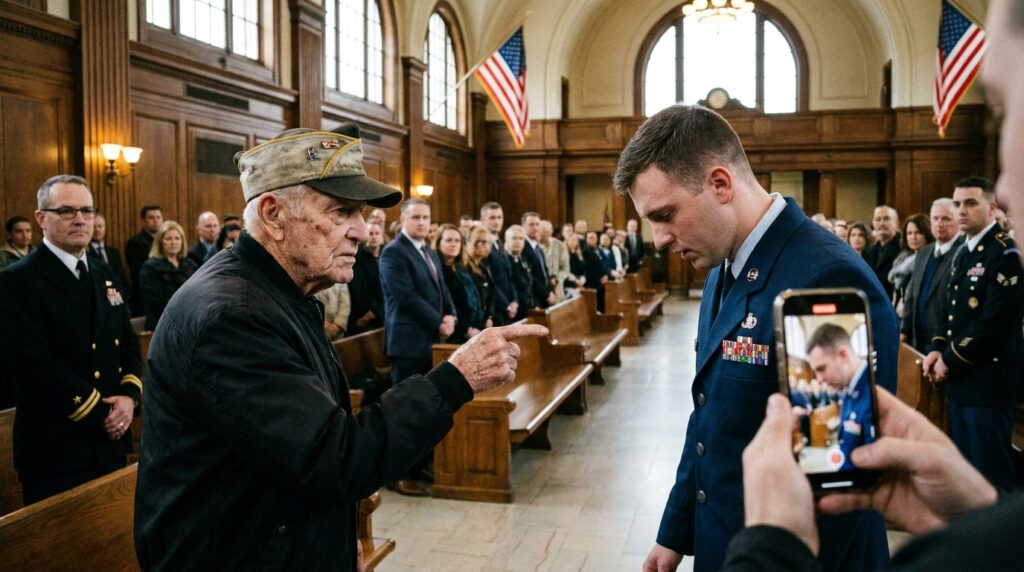
The administrative desk at the entrance of the General Omar Bradley Memorial Hall did not click or hum; it swallowed sound entirely. Thomas stood on the perimeter of the chevron-patterned marble, his calloused thumbs hooked into the shallow pockets of his black windbreaker. The fabric was thin, cheap synthetic that rustled whenever the air conditioning unit overhead cleared its throat.

Across the counter, a civilian clerk with an institutional lanyard didn’t look up from her monitor. Her fingers moved with a rhythmic, rhythmic tapping, entering codes that had nothing to do with sixty years of salt-crusted history.

“It doesn’t go in the bin,” Thomas said. His voice was too low for the cavernous ceiling, a gravelly vibration that barely carried past the plexiglass partition. He laid the document down. The edges of the paper were yellowed, the fiber thick and heavy, bearing the distinct blue-ink stamp of a Department of the Army citation from a budget cycle that had been dead since the Ford administration.

“Everything for the archive goes in the blue bin, sir,” she said, her eyes tracking a progress bar on the screen. “Items are cataloged within forty-eight business hours. If the curator finds a display affinity, you’ll receive an automated notification.”

Thomas watched her hand hover over the sheet. To her, it was a voucher. To him, the faint smell of oil and old mimeograph ink on the page brought back the exact humidity of the Mekong delta, the sound of a rotor blade chewing through wet mountain air, and the specific grease they used to clean the receivers of weapons that officially didn’t exist. He didn’t move his hand from the corner of the page.

A shadow broke the glare of the track lighting.

“Is there an issue with the transit lane, Ma’am?”

The voice was crisp, starched, and entirely devoid of dust. The Ceremonial Guard stepped into the space between the marble column and the desk. He was a foot taller than Thomas, his blue dress uniform tailored so tightly across the shoulders that the silver aiguillette on his left arm didn’t even sway. His medals—clean, modern theater ribbons for logistical support and domestic merit—clinked with a small, metallic precision as he shifted his weight. His face was a mask of high-gloss discipline, clean-shaven to the point of redness.

The clerk didn’t look up, but her typing slowed. “The gentleman is refusing the standard archival intake protocol, Sergeant.”

The guard turned his head toward Thomas. His eyes were light gray, steady, and narrow. He didn’t look at Thomas’s face; he looked at the faded black ballcap with its single, tarnished campaign pin. He looked at the gray hair curling over the ears, and the way Thomas’s left shoulder hung three degrees lower than his right—the permanent signature of an old mortar plate landing five yards too close in 1969.

“The corridor needs to remain clear for the official party, sir,” the guard said, his hand resting naturally near the white leather frog of his ceremonial sword bayonet. “The intake area is for active drop-offs only. If you’ve submitted the paperwork, you need to step behind the velvet rope. Now.”

Thomas didn’t pull his hand back. He felt the subtle vibration of the floorboards—the distant, heavy thump of a military band tuning their brass instruments three floors down. The VIPs were arriving. The air smelled of floor wax and the specific brand of pomade the guard used to keep his side-parts sharp.

“This document isn’t an artifact,” Thomas said softly, his thumb pressing into the yellowed bond. “It’s a correction.”

The guard took one step closer, his chest expanding until the polished buttons of his tunic were inches from the old man’s face. “Move along, old man. This area is restricted for active operations, you’re in the way.”

Thomas noticed the tiny tremor in the guard’s jaw—not from fear, but from the raw, unearned adrenaline of a young man who believed the uniform was the skin rather than the clothes. In the reflection of the guard’s silver breastplate, Thomas could see his own reflection: small, dark, and entirely out of place. But beneath the jacket, his weight shifted two inches to the left, his heels locking into the marble seam.

The guard’s hand reached out, the white cotton glove remarkably clean as it targeted Thomas’s shoulder.


CHAPTER 2: THE REACTION OF THE LEVERAGE

The white cotton glove moved with the unearned speed of a young man who had only ever fought paper targets and administrative resistance. To the clerk behind the plexiglass, it was a routine removal—the clean, efficient enforcement of a perimeter. To Thomas, the hand traveling toward his left clavicle was an opening vector, a poorly calculated trajectory lacking both anchor and weight.

The guard’s fingers clamped onto the thin synthetic fabric of Thomas’s windbreaker. The grip was tight, intending to twist and propel the old man toward the velvet rope with enough momentum to settle the matter before the brass arrived from the rotunda.

Thomas didn’t pull away. He didn’t tense the muscle. If he resisted the pressure directly, the guard’s mass—nearly eighty pounds of dense, athletic active-duty muscle—would simply overwhelm his seventy-eight-year-old frame. Instead, Thomas let his left shoulder yield, collapsing backward into the force of the pull by exactly three inches. It was a micro-correction the guard took for frailty, a sign that the old man was breaking balance.

The guard leaned his weight forward to finalize the displacement. That was his error.

The moment the younger man’s center of gravity crossed the seam of his own polished leather heels, Thomas’s right hand moved. His calloused fingers, stiffened by age but precise from decades of unthinking repetition, snapped upward. He didn’t strike; he captured. His thumb pressed into the soft, vulnerable cluster of nerves just below the guard’s right wrist bone, while his left palm smacked into the crook of the guard’s extended elbow.

The physics were absolute. The guard’s forward momentum became a lever, and Thomas’s body became the fulcrum.

With a single, economic rotation of his hips, Thomas didn’t fight the push—he finished it for him. He stepped his left foot back, clearing the track, and pulled the guard’s wrist down toward his own descending hip while driving the elbow upward. It was a technique from a manual that had never been printed, practiced in jungle clearing camps where a loud noise meant a mortar flare.

The guard’s boots lost purchase on the high-gloss marble. The starched blue fabric of his trousers whistled against the air as his legs swung clear of the floor. For a fraction of a second, the immaculate ceremonial uniform was completely horizontal, floating against the backdrop of the arched ceiling and the cold glare of the track lights.

Then gravity took its portion.

The impact was short and flat—a wet, heavy slap of wool and flesh meeting reinforced stone. The brass buttons of the guard’s tunic shrieked across the marble, two of them snapping free and skittering away like loose coins toward the brass stanchions. The white service cap popped off his head, spinning on its crown until it hit the base of a marble pillar, leaving his sharp side-part exposed and suddenly disheveled.

The corridor didn’t just go quiet; it became an operational vacuum.

Behind the plexiglass, the clerk’s fingers froze over her keyboard. A group of three junior officers who had been laughing near the rotunda doors stopped mid-breath, their faces locking into identical expressions of institutional disbelief. No one moved toward their phones. No one shouted. The sudden absence of sound was so absolute that the low, rhythmic thumping of the ceremonial band three floors down finally became audible, vibrating through the soles of Thomas’s cheap shoes.

The guard lay on his back, his breath caught in his throat from the flat-backed landing. His chest heaved twice under the heavy blue wool, his eyes wide, staring up at the vaulted ceiling as his brain struggled to reconcile how six feet of elite ceremonial training had been discarded by an old man who smelled of damp wool and wintergreen lozenges.

Thomas didn’t look down at the floor. He stood perfectly upright, his feet separated by exactly the width of his shoulders, his arms hanging loose and still at his sides. The frayed brim of his veteran cap cast a sharp line of shadow across his weathered cheeks, obscuring his eyes from the track lights, but his jaw was set, stone-still.

“Don’t underestimate an old veteran,” Thomas said. His voice didn’t rise to meet the cavernous space. It stayed low, hard, and transactional, the sound of an iron gate swinging shut on gravel. “You’ll regret it.”

The guard’s fingers twitched against the marble, his white gloves stained with a gray smear of floor wax. His right shoulder was locked, the joint humming with the memory of the hyper-extension. He didn’t try to stand. He knew the room was watching—knew that every active-duty eye in the corridor had just witnessed the total collapse of his authority.

Slowly, the guard shifted his weight, his boots dragging across the floor as he pulled his knees toward his chest. His movements were no longer crisp; they were defensive, cautious. He looked at the yellowed document that had slipped from the counter during the fall. It lay between them now, the blue-ink stamp of the Department of the Army visible beneath the glare.

The guard’s gaze tracked up from the paper, past Thomas’s dark trousers, to the small, tarnished brass campaign ribbon pin on the cap. A strange, sharp recognition flickered behind the younger man’s eyes—a look that had nothing to do with the pain in his shoulder or the shame of the fall. He knew that specific ink. He had seen that exact stamp before, hidden inside a cedar lockbox in his father’s basement.

Thomas watched the realization hit him. The kid was smart enough to recognize the leverage wasn’t just physical.

“Sir,” the guard began, his voice strained, filtering through a throat tight with shock. He didn’t reach for his ceremonial sword. He didn’t call for the security detail at the door. He stayed on one hip, his hand pressing against the marble to stabilize his torso as he looked up into the shadow of the ballcap. “The… the serial numbers on that header. They aren’t in our active catalog.”

“They wouldn’t be,” Thomas muttered. He didn’t reach for the paper. “They were taken out before you were born.”

The guard’s jaw tightened, his clean-shaven face turning a mottled red as he gathered his legs beneath him, not to attack, but to lower his posture further, yielding the right-of-way in accordance with an unwritten hierarchy that transcended the blue uniform.

CHAPTER 3: THE ANATOMY OF MOTION

The yellowed document lay precisely between Thomas’s scuffed leather shoe and the guard’s stained white glove. The blue ink of the military seal seemed to absorb the cold overhead lighting, its jagged edges sharp against the white marble. Thomas did not bend his knees to retrieve it. To drop his head now would be to forfeit the precise, geometric perimeter he had just cleared with the younger man’s weight.

Instead, he watched the guard’s throat move—a frantic swallow that rattled the stiff, high collar of his dress tunic. The kid was reconstructing the event internally, looking for the mechanical flaw in his own posture that had allowed a seventy-eight-year-old skeleton to drop eighty pounds of starched muscle. There was no flaw in the guard’s training; there was only a fatal gap in his operational context. He had been taught to manage crowds with presence, not to survive an encounter with a human fulcrum.

“The registry doesn’t show those prefixes,” the guard whispered, his fingers curling against the cold floor. His voice was lower now, stripped of the administrative bark that had filled the hall two minutes ago. His eyes remained locked on the serial numbers printed along the top margin—specifically the small, deformed ‘4’ that had been struck by a misaligned typewriter key forty years in the past. “Those are seventy-series black-line identifiers. My father had three of them in his desk. The same ink. The same broken font.”

Thomas felt his jaw stiffen. The Strategic Pursuit lens clicked into place. Every piece of information an adversary offered was a vulnerability disguised as communication. The guard wasn’t just talking to heal his pride; he was drawing a line between the paper on the floor and a private room somewhere outside these marble walls.

“Your father didn’t earn seventy-series headers by sitting at an entry desk, son,” Thomas said. His hand remained dead at his side, his fingers perfectly loose, ready to capture the next vector if the kid’s adrenaline spiked a second time. “And he didn’t leave them around for children to count.”

“He didn’t leave them at all,” the guard said, and for a micro-second, the rigid mask of institutional authority cracked, revealing the raw, unpolished grit of a family trait Thomas recognized from a hundred wet trenches. “He died in a transit camp near Frankfurt before the wall came down. The files were redacted. Everything except the headers.”

Thomas didn’t let his expression soften. Empathy was an operational weight that dragged down the precision of a move. In his mind, he was already calculating the distance from the desk to the main rotunda doors. The three junior officers near the entrance hadn’t moved; they were paralyzed by the protocol paradox. To arrest an old man who had just effortlessly dismantled a ceremonial guard required an order, and the only man capable of giving that order was currently checking the dust on the floor tiles with his hip.

“Get up,” Thomas commanded. The words were short, dry, and clean, lacking the heat of anger. “The floor is for things that have finished moving.”

The guard’s boots scraped against the marble as he pulled his center of gravity back under his chest. He didn’t rise to his full height immediately. He stayed low, his shoulders slightly rounded beneath the tight blue wool, his hand reaching out to claim his fallen white service cap. The silver insignia on the front was smudged with gray wax, the polished visor holding a thin scratch from its flight against the pillar. He wiped it with the back of his sleeve, a mechanical, defensive gesture to buy time while his lungs recovered their full volume.

Behind the plexiglass partition, the clerk finally found her voice, though it was thin, stripped of its bureaucratic venom. “I’ve… I’ve signaled the duty sergeant’s desk. The escort is on its way from the lower bay.”

Thomas didn’t look at her. “Tell them to bring an archivist who knows how to read an unlisted log. Otherwise, they’re just wasting the brass’s time.”

He reached down then, his movement economic and fluid, his fingers pinching the corner of the yellowed document before the guard’s glove could wander near it again. The paper crackled—a dry, ancient sound that seemed louder than the distant brass band still thumping through the ventilation shafts. As he straightened, he noticed a tiny detail that hadn’t been visible from three feet away: the guard’s collar wasn’t held by standard issue hooks. Beneath the immaculate silver braid, a tiny, tarnished brass split-ring was tucked into the lining—the exact modification field-operatives used in the old sectors to keep their throat microphones from crushing their windpipes during long surveillance details.

The kid hadn’t just inherited his father’s papers; he had inherited his rigging.

“You’re standing in the transit lane, Sergeant,” Thomas noted, his eyes tracking the shadow that was beginning to expand beneath the grand archway at the far end of the corridor. The VIP procession was twenty minutes out, but the advanced security detail—the men with short hair, dark suits, and ear-pieces that didn’t match the ceremonial uniforms—were already moving through the double doors of the gallery.

The guard adjusted his cap, pulling the visor down until the shadow cut across his gray eyes at the exact same angle as the brim of Thomas’s ballcap. The transformation was subtle but complete. The administrative tool was gone; the junior hunter had taken its place.

“The blue bin is where they put things they want to lose,” the guard said, his voice dropping into a register that didn’t carry to the clerk’s desk. He stepped closer, but his weight was distributed evenly between his heels now, his hands clear of his hips, his posture displaying a calculated silence. “The gala today isn’t a celebration, sir. They’re clearing the seventh floor of the annex. If that citation goes into the standard intake, it won’t survive the weekend.”

Thomas held the paper by its edge, his thumb pressing against the deformed ‘4’. The decoy was already forming in the corridor—the appearance of an administrative error, an old man causing a scene over a lost pension or a forgotten ribbon. But the kid’s eyes were too steady now. He wasn’t looking at a civilian nuisance; he was looking at an unexploded ordnance that had just rolled into his specific sector.

“Who told you they were clearing the seventh floor?” Thomas asked.

The guard didn’t answer with words. He merely shifted his right shoulder forward, allowing the track lighting to catch the edge of a small, rectangular leather folder tucked into the interior breast pocket of his dress blues—a folder that bore no crest, no name, and no institutional serial number.

CHAPTER 4: THE PERIMETER EXPANSION

The square of unblemished black calfskin inside the guard’s tunic didn’t carry an agency stamp, but the grain of the leather was cut to a specific metric—exactly three and five-eighths inches across, the exact size required to pass through the magnetic plate readers on the baseline annex levels. Thomas kept his eyes on the kid’s chest. The advanced security detail was fifty yards down the corridor now, their thick-soled oxfords striking the marble with a heavy, professional syncopation.

“Put it back,” Thomas said. His tone didn’t shift by a single decibel. His left hand, still hanging loose near his thigh, verified his balance vector against the seam of the stone floor. “If those suits see a ceremonial asset handling non-cataloged assets in a high-density transit corridor, you won’t be on entry detail tomorrow. You’ll be sitting in an interrogation box at Fort Meade.”

The guard’s jaw twitched, but he didn’t freeze. The family discipline was there, thick and stubborn beneath the polished dress coat. With a smooth, backward slip of his thumb, he buried the leather folder back into the lining of his wool tunic, the silver buttons clicking softly as the fabric settled. He reached down and retrieved the loose brass buttons that had sheared off his front during the fall, concealing them within his white glove with a rapid, economic sweep.

“The order came down from the logistics chief at zero-six-hundred,” the guard murmured, his gaze scanning the approaching suits without shifting his head. “They’re destroying the administrative backlog from the seventy-series files to comply with an efficiency directive. That document in your hand isn’t going to be archived, sir. It’s earmarked for the thermal shredder.”

Thomas felt the cold edges of the yellowed document stiffen against his fingers. The Strategic Pursuit lens ran the calculation automatically. A thermal shred order disguised as an archive cleanup was standard operational sanitation. If the unit was being erased, they wouldn’t just burn the files; they would eliminate the reference nodes. And an old man carrying a original citation with a dead commander’s stamp was the ultimate reference node.

The advanced detail halted exactly five paces from the velvet stanchions. There were three of them—thick through the shoulders, wearing charcoal suits that didn’t hold a crease, their earpieces a flat flesh-tone plastic coiled behind their ears. The lead investigator didn’t look at Thomas; he looked at the scuff mark on the marble where the guard’s hip had scraped the wax, then at the guard’s missing front buttons.

“Sergeant,” the lead suit said, his voice holding the gray, rhythmic monotone of an official deposition. “Is there a breakdown in the perimeter protocol?”

The guard stepped forward, his heels snapping together with a sharp, iron report that echoed down the long gallery. The disheveled side-part was gone, tucked perfectly back beneath the visor of his service cap, his spine locking into the absolute alignment of his institutional function. “Negative, sir. The civilian dropped a legacy artifact during intake. The clearance was mechanical. I am currently executing a routing check.”

The suit turned his head slowly, his eyes shifting to Thomas. They were small, dark eyes that had spent twenty years reading border logs and flight manifests. They didn’t see an old veteran; they saw a physical mass that didn’t have an electronic signature in the building’s active database. He looked at the yellowed page in Thomas’s hand.

“The artifact needs to be processed at the low-density desk in the basement, sir,” the suit said, his hand remaining tucked inside his coat, his fingers likely touching the checkered grip of a compact firearm. “This corridor is now an active security corridor for the executive party. Step behind the rope.”

Thomas didn’t move. He felt the specific weight of the room shifting—the three suits forming a shallow crescent designed to cut off his lateral avenues of retreat without drawing public attention from the junior officers at the rotunda doors. The kid stood to his right, a rigid blue pillar, perfectly neutral, yet Thomas could feel the heat radiating from the young man’s starched sleeve. The kid’s weight wasn’t on his toes anymore; it was distributed evenly across his heels, exactly where Thomas had forced it two minutes prior.

“The clerk said this was the entry desk,” Thomas remarked, his voice cutting through the suit’s authority with the bluntness of an old blade. “I didn’t come here to look at the basement. I came to leave this with the command log.”

“The log is closed,” the suit replied. He took one step into the perimeter, his left shoulder dropping slightly to shield his movement from the clerk’s desk. “Give me the document, sir. I will ensure it reaches the appropriate clearing officer.”

The trap was simple, heavy, and completely legal within the context of the memorial hall’s security guidelines. If Thomas surrendered the paper, it would vanish into a plastic evidence pouch before he reached the street. If he resisted, the three suits would use three-point compliance holds to remove him from the building under the guise of an elderly disturbance. He looked at the guard. The kid’s gray eyes were wide, tracking the suit’s hand as it reached toward the yellowed paper.

Beneath the thin fabric of his windbreaker, Thomas’s right elbow tucked against his ribs. He wasn’t going to give up the citation—not because it was paper, but because the deformed ‘4’ on the header was the only evidence left that twelve men had stayed behind on a ridge near Chau Doc so a battalion could cross the river.

“Sergeant,” Thomas said quietly, his eyes never leaving the lead investigator’s face. “Tell this man what happens when you touch an uncataloged asset without the proper clearance.”

The corridor grew distinctively colder as the guard shifted his gaze from the suit to the old man, his gloved hand tightening against the grip of his ceremonial sidearm.

CHAPTER 5: THE ENTRANCE OF THE CLASSIFIED LOG

The lead suit’s hand didn’t pause. His fingers, square-tipped and graying at the knuckles, closed over the top margin of the citation. Thomas felt the fibers of the old bond paper strain—a faint, microscopic tearing sound that traveled directly up the bones of his arm. If he pulled back violently, the document would split cleanly along the center crease, separating the blue-ink seal from the list of twelve names written below it.

“Let go, sir,” the suit said. The monotone hadn’t changed, but his shoulder dropped another two inches, a physical pre-loading that indicated his partners were moving to pin Thomas’s flank.

Before Thomas could pivot his hips to sever the suit’s grip, the heavy oak doors at the end of the rotunda groaned. The sound was thick, a hydraulic hiss of pressurized air leaking from the climate-controlled archive vaults behind the main wall. A senior commanding officer stepped into the light.

He didn’t wear dress blues. He wore an operational service uniform—faded olive drab, stiffened with heavy starch, the four silver stars on his collar dull and scratched from field use rather than polished for a gala. His boots were thick-soled black leather that had been oiled, not shined. He didn’t look at the crowd or the junior officers who instantly snapped into rigid salutes. His gaze cut straight through the three suits, landing directly on the scuff mark where the ceremonial guard had hit the marble.

“Stand down,” the general said. The voice was thin, reedy, and high, the absolute opposite of an administrative command, but the three suits retracted their arms instantly, their bodies snapping into identical angles of professional submission.

The lead investigator took two steps back, his hand coming out of his coat, empty. “General, we have an unlisted asset attempting to breach the transit corridor with non-cataloged documentation.”

The general didn’t acknowledge the report. He walked forward until his shadow crossed Thomas’s scuffed leather shoes. He was old—not as old as Thomas, but his skin held that same dry, yellowish tint that came from three decades of eating sulfur tablets and drinking boiled river water. His eyes traveled down Thomas’s black windbreaker, stopped at the single campaign pin on the ballcap, and then lowered to the paper held between Thomas’s fingers.

“Give me the header,” the general said. He didn’t say please, and he didn’t reach for it. He waited.

Thomas didn’t drop his stance. He analyzed the general’s shoulders—the left one slightly pinned back, the permanent accommodation for a hidden sidearm harness. This wasn’t a ceremonial bureaucrat; this was the chief of logistics who had signed the zero-six-hundred erase order. The man who was currently supervising the quiet destruction of the seventy-series archive.

“The header is listed under the Bradley mandate, General,” Thomas said, his gravelly tone matching the scrape of the distant band. “It doesn’t leave my hand until the entry log is signed.”

The general reached into his pocket and pulled out a small, steel-rimmed pair of reading glasses. He didn’t put them on; he held them like a magnifying glass over the yellowed page, his eyes tracking the blue-ink seal and the distinctive, deformed ‘4’ from the misaligned typewriter. His jaw went rigid, the thin skin over his cheekbones tightening until the white of the bone seemed to show through the liver spots.

“The Bradley mandate was rescinded eighteen hours ago by the joint oversight committee,” the general said softly. He looked up, his gray eyes fixing on Thomas with a cold, absolute finality that felt heavier than the guard’s physical shove. “There is no entry log for this unit anymore. There is no unit. The gala today is for the dedication of a modern logistics wing. The names on this paper are officially classified as administrative losses due to non-combat training incidents in the continental United States.”

The words hit the corridor like a wet sandbag.

Behind them, the ceremonial guard didn’t move, but Thomas heard the starched fabric of his sleeve tighten against his sidearm frog. The kid had been told his father died in a transit camp in Germany. He had been raised on the official narrative—the clean, administrative fiction that protected the family pension. The general’s statement didn’t just reject Thomas’s document; it obliterated the decoy secret the kid had spent his life using to justify his own presence in this hall.

“Administrative losses,” Thomas repeated. He didn’t let the anger hit his lungs. Anger was a deviation from the line. “They were five miles outside of Tay Ninh when the perimeter went cold, General. Your office received the grid coordinates three hours before the air strike went in.”

“The grid coordinates don’t exist on the active topographic maps,” the general countered. He slipped his glasses back into his starch-stiffened pocket with a small, definitive click. “And neither does this page. If you attempt to leave the building with that paper, these gentlemen will detain you under the provisions of the National Security Information Act. It will be cataloged as contraband and processed through the furnace at Fort Belvoir. You have two minutes to step behind the velvet rope as a civilian observer, or you will be removed as an active security breach.”

The failure was total. The legal, institutional logic of the room had locked Thomas out. There was no higher command to appeal to; the higher command was standing five inches away, holding an erase order that had already cleared the seventh floor of the annex. The victory Thomas had planned—the public correction of the display—had been systematically dismantled before the VIPs even left their vehicles.

The general turned his back, his olive-drab shoulders square as he faced the lead suit. “Clear the corridor for the Undersecretary’s party. Secure the civilian if he remains within the operational perimeter.”

As the three suits moved in, their faces completely blank, Thomas caught the guard’s eye through the shadow of the visors. The kid wasn’t looking at the general; he was looking at the leather folder inside his own tunic, his gray eyes blazing with a dangerous, unstable realization that had nothing to do with the uniform he wore.

CHAPTER 6: THE PARADE SHIFT

The lead suit’s hand came up, a flat, grey bar of meat designed to block Thomas’s forward line of sight. To his left and right, the remaining two investigators took precise half-steps, their shoulders overlapping to create a wall of dark wool that smelled faintly of dry-cleaner fluid and gun-oil. They didn’t reach for their belts yet; the presence of the general and the open vault doors meant the room was still governed by the cold architecture of protocol.

“The two minutes are running, sir,” the lead suit murmured. His chin was tucked into his collar, his eyes tracking Thomas’s breathing pattern to gauge when the physical contraction would begin.

Thomas didn’t drop his center of gravity. His eyes shifted past the wall of wool, locking onto the general’s retreating spine. The four silver stars on the general’s collar caught the sharp glare of the track lighting as he approached the grand rotunda double doors. Beyond those doors, the low, mechanical thudding of the ceremonial band had ceased. A new sound took its place—the heavy, rhythmic slapping of a multi-service honor guard forming a two-line corridor for the VIP arrivals.

The room was transitioning from an office to a stage.

“Sergeant,” the general’s reedy voice barked, his back still turned as he reached the threshold of the rotunda. “Take your position at the marker. The Undersecretary’s vehicle has crossed the outer checkpoint.”

Thomas felt the air change behind him. The ceremonial guard didn’t snap his heels together this time. The iron report that had defined his institutional discipline since Chapter 1 was absent. Instead, there was a slow, deliberate shifting of leather—the sound of a man sliding his boots across the marble seam to adjust his vector.

“Sir,” the guard said, his voice carrying a raw, unpolished vibration that shattered the standard ceremonial cadence. “The seventy-series prefix… it’s verified on my grandfather’s retirement warrant. The signature on this civilian’s document matches the handwriting on the unit’s final casualty manifestation.”

The general stopped. His right boot remained hovering one inch above the polished brass sill of the rotunda threshold. The silence that fell over the corridor was different from the physical vacuum that followed the guard’s fall in Chapter 2; it was an institutional freeze, the absolute locking of gears when an administrative asset speaks out of sequence.

The lead suit didn’t wait for an order. His left hand shot forward, targeting Thomas’s shoulder to force him behind the velvet rope before the conversation could bleed into the public space.

Thomas didn’t let the glove touch the synthetic fabric of his jacket a second time. With an economic twitch of his shoulder, he dropped his weight three inches, allowing the suit’s hand to slide harmlessly over his collarbone into empty air. Before the investigator could adjust his balance, Thomas’s right elbow clicked into the man’s ribs—not a strike, but a blunt leverage point that pinned the suit’s torso against the marble column behind him.

“Stay on the perimeter,” Thomas warned the other two suits without looking at them. His gravelly voice was a low, transactional rasp that carried no heat. “The sergeant is asking a command question.”

The general turned around slowly. His face was no longer the gray mask of a logistics chief; it was the pale, lined countenance of a man who had spent forty years realizing that some graves don’t stay covered if the soil is too dry. He didn’t look at Thomas. He looked directly at the ceremonial guard, his eyes tracking the slight tilt of the young man’s service cap and the tiny, tarnished brass split-ring tucked into his collar lining.

“Your grandfather was an administrative officer, Sergeant,” the general said, his reedy tone dropping into a register that was nearly inaudible past the velvet ropes. “His records are closed under the fifty-eight retention act. You are out of line.”

“His records were altered,” the guard countered. He took a full step forward, breaking his ceremonial marker entirely, his immaculate blue trousers crossing the path of the three suits. He reached inside his tunic, his gloved fingers clamping onto the edge of the unmarked black leather folder he had hidden in Chapter 4. “The annex cleanup order isn’t an efficiency directive. It’s a removal. My grandfather didn’t die in Frankfurt, General. He died three miles from this building, forty years ago, while your predecessor was rewriting the log.”

The lead investigator, still pinned against the column by Thomas’s elbow, hissed through his teeth. “General, the asset has breached security classification. We need to secure the floor.”

“No,” the general whispered. He stepped back over the brass sill, his oiled leather boots clicking with a heavy, dead sound against the marble chevron. He looked at the yellowed document in Thomas’s hand, then at the guard’s face, realizing the family line hadn’t just survived—it had been stationed at his own gate. “The formation is already outside the door, Sergeant. If you pull that folder out in front of these men, you aren’t just breaking protocol. You’re committing an act of unauthorized disclosure under active operational rules.”

The trap had widened, but the false victory of Thomas’s physical mastery was gone. He was still holding the citation, but the names of the twelve men were no longer just paper; they were a trigger for a blood-feud that had been buried beneath four stars and sixty years of institutional marble. The room was shifting into a mandatory formation, the shadows of the pillars stretching out like iron bars as the advanced party doors at the far end of the gallery began to swing inward.

CHAPTER 7: THE RECKONING OF THE RIBBON

The double doors swung fully to their stops. The polished wood struck the rubber bumpers with a muffled, heavy thud that reverberated through the hollow marrow of Thomas’s shins. The multi-service honor guard stepped forward into the vestibule, thirty pairs of low-quarter leather shoes hitting the stone with the mechanical precision of a firing squad. Behind them, the light from the main rotunda was blinding, cutting through the corridor in long, dramatic shafts that turned the dust motes into silver tracer rounds.

The general didn’t move toward the entrance. He stood frozen on the marble chevron, his starched olive-drab sleeve trembling by a fraction of a millimeter. His eyes were no longer reading the paper in Thomas’s hand; they were fixed on the black calfskin folder the ceremonial guard held flat against his own ribs.

“Sergeant,” the general whispered, and for the first time, his reedy tone lost its bureaucratic shell, revealing the raw, dry panic of an old man whose fortress had breached from within. “You don’t know the full parameter. Your grandfather signed the mitigation agreement himself. He did it to ensure your mother’s security clearance remained clear of the seventy-series taint.”

“He didn’t sign it,” the guard said. His voice was a flat, transaction-ready stone. He took a final step forward, his athletic frame completely blocking the lead suit’s line of sight. With an economic snap of his gloved wrist, he opened the black folder, exposing the single sheet of matching yellowed bond paper tucked inside. “He was dead three hours before the timestamp on the mitigation file. The signature on the authorization block doesn’t hold his distinctive baseline loop. It holds yours, sir.”

Thomas felt his jaw lock, the Strategic Pursuit lens turning the revelation over with cold, computational speed. The decoy secret—the institutional erasure of the seventy-series unit—was merely the top layer of dirt. The core truth was a family blood-line deliberately caught in the gears of an internal purge. The kid wasn’t just a guard assigned to a perimeter; he was the living residue of the man who had been sacrificed to build the general’s four-star pedestal.

The three suits froze, their operational instincts overridden by the sheer gravity of an internal command betrayal happening in real-time. The lead investigator slowly let his weight drift away from Thomas’s elbow, his hands dropping to a neutral posture at his sides as the grand procession entered the final twenty yards of the approach lane.

Time dilated, moving with the heavy, sluggish viscosity of cold oil. Thomas looked at the guard’s profile—the sharp jawline, the gray eyes narrow under the shadow of the visor, the tiny brass split-ring in his collar that matched the rigging Thomas had carried through seventy miles of Cambodian swamp.

“The uniform changes, son,” Thomas said, his low, gravelly voice breaking through the frozen atmosphere like an iron boot on dry twigs. He reached out and laid his calloused palm flat against the guard’s open folder, pressing the yellowed citation down until it intersected with the kid’s paper. The misaligned typewriter ‘4’ on Thomas’s sheet sat precisely three inches above the forged baseline loop on the general’s record. “The discipline never does. Your grandfather didn’t run from the ridge at Chau Doc. And he didn’t sign away his men to buy a clean file.”

The general looked down at the twin papers, the white glare of the track lighting reflecting off the silver stars on his collar like cold teeth. The procession was at the threshold now—the Undersecretary’s party, surrounded by two dozen active-duty officers, their chests covered in medals, their visors low and immaculate.

“Clear the lane,” the general said, his voice dropping into an absolute, hollow surrender. He didn’t look at the suits. He didn’t look at the honor guard. He looked at Thomas’s frayed ballcap, recognizing the single, tarnished campaign pin that had outlasted every registry in his building.

Slowly, with a mechanical stiffness that seemed to cost him every ounce of his remaining institutional mass, the general brought his right hand up to the brim of his service cap. His fingers trembled against the starched olive fabric, his spine locking into a rigid, mandatory angle of presentation. It wasn’t a ceremonial gesture for the public; it was a private, desperate salute to the dead names written on the yellowed page.

The ceremonial guard turned his head, his gray eyes catching the movement. He didn’t speak. He closed the black calfskin folder, tucked it securely back into his blue wool tunic, and snapped his heels together with an iron report that finally broke the silence of the corridor. He brought his own white glove up to his visor, his athletic frame locking into perfect, parallel alignment with Thomas’s upright, weathered stance.

The thirty junior officers lining the rotunda threshold took their cue from the general’s arm. One by one, the starched sleeves snapped upward, a wave of dark blue and olive fabric rising against the marble columns as the VIP procession stepped onto the floor. The room didn’t erupt into violence; it collapsed into a terrifying, reverent order. The twelve names on the yellowed paper were still classified as administrative losses on the active servers, but within the three-second window before the undersecretary crossed the sill, the entire command tier of the memorial hall stood in absolute, silent submission to the old man in the black windbreaker.

Thomas didn’t return the salute. He turned his back on the four stars, his thumbs hooking back into the shallow pockets of his jacket as he walked toward the exit doors. The cheap synthetic fabric rustled against his ribs, but his heels hit the marble seams with a steady, unyielding cadence that didn’t miss a single beat. The paper was still in his hand, the edges yellowed and frayed, but the weight of the ribbon had finally settled where it belonged.

Similar Posts

Leave a Reply

Your email address will not be published. Required fields are marked *






