
The Iron Law of Worn Linoleum and the Weight of Unearned Camouflage
CHAPTER 1: THE FRICTION OF EXHAUSTED COFFEE
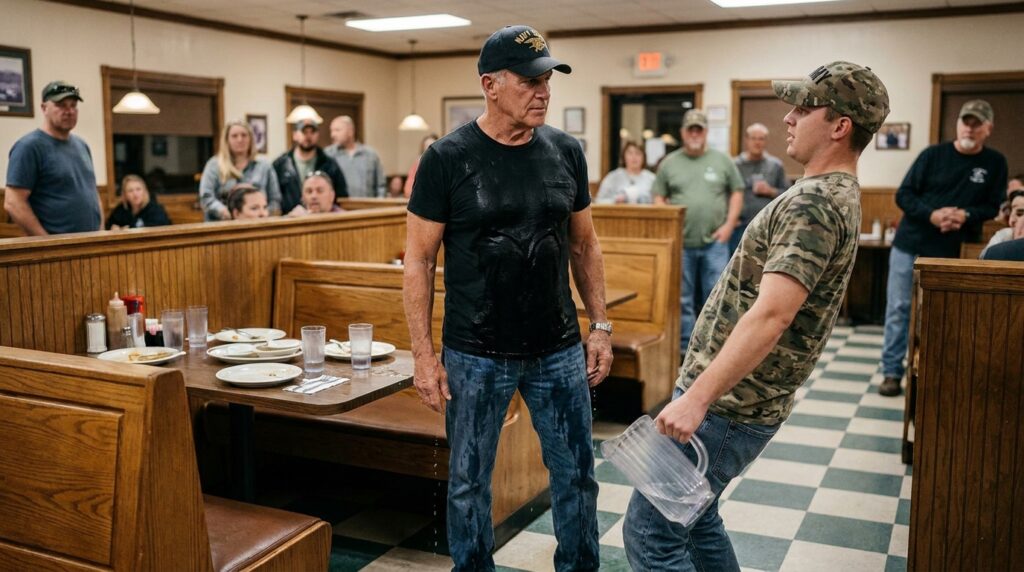
The ice water hit the small of his back first, a flat, heavy palm of cold that flattened his black shirt against the ridge of his spine. It didn’t startle Miller. Panic was a luxury for people who still believed the world was an inherently soft place to stand. Instead, his mind registered the physical parameters: tap water, high iron content from the valley well, roughly forty-two degrees, pooling down the canvas bill of his cap and dripping onto the dry surface of his seven-day-old sausage patty.
Around him, the ambient noise of the diner—the high-pitched whistle of the commercial toaster, the dull clink of heavy mugs against laminated wood—dropped away into a vacuum of gray noise.
“Let’s see if this old timer can still swim!”
The voice behind him was thin, reeking of cheap synthetic energy drinks and the raw, nervous heat of twenty-two years. Miller didn’t turn. He watched a single drop of grease solidify in the corner of his plate. He knew the type. The boy was wearing the local uniform of the unemployed and aggressive: a camouflage shirt that had never seen mud, black shorts with too many pockets, and boots with synthetic laces that clicked against the floorboards because the metal eyelets were cheap. The boy wanted a show. He wanted the old man to turn around with wet eyes, or to shake like an old leaf, or to reach for a napkin with hands that trembled from age.
Miller slid his right hand out from beneath the vinyl edge of the table. His wrist moved with the slow, heavy creak of a iron hinge that hadn’t seen grease since the winter of ninety-four, but the alignment was perfect. He didn’t look at the boy’s friends by the door. He didn’t look at Martha behind the counter, whose hands had frozen over the coffee pot.
He stood up.
The motion was deliberate, the rising of an old structural beam under load. The boy was already moving, emboldened by the silence of the room, his right hip pivoting to throw a performative, heavy-booted kick meant to catch Miller in the flank before he could find his footing on the wet floor. It was a sloppy arc, wide and trusting, reliant entirely on the speed of youth and the assumption that eighty years of bone had turned to chalk.
Miller’s left arm moved six inches.
There was no cinematic flourish. It was the simple, heavy placement of a blocking wedge. His forearm—dense, ropy with old muscle that had spent decades hauling rusted mooring chains out of salt water—met the boy’s shin mid-flight. The impact sounded like a wet sandbag falling onto a loading dock. The momentum didn’t dissipate; it traveled directly down into the floorboards through Miller’s planted left heel, while the boy’s forward drive simply crumpled against the obstruction.
Before the challenger’s boot could touch the linoleum again, Miller’s right fingers closed around the boy’s wet collar. It wasn’t a punch. It was a capture. He gathered the stiff, unwashed fabric of the camouflage shirt into his palm and twisted once, locking the boy’s shoulder into a mechanical bind that forced his head down toward the cold grease of the plate.
The large plastic water jug rolled away into the aisle, its empty bottom clicking rhythmically against the base of the booth. The boy’s breathing came fast now, a sharp, ragged rattling through his nose as his balance disappeared into the space Miller controlled.
Miller leaned in, his dark veteran cap shadow blocking out the diner’s fluorescent lights.

CHAPTER 2: THE MECHANICS OF A HUMAN HINGE
“You should think twice before disrespecting someone you don’t know,” Miller said.
The words came out flat, dry as old bone, carrying the grit of a man who had spent forty years swallowing the silt of tidal flats and diesel exhaust. His voice didn’t rise above the low hum of the refrigeration unit behind the counter, but it had the strange, heavy property of an iron wedge driven into a splitting log. The boy under his palm stopped thrashing. The wet camouflage fabric of his shirt creaked under the tightening knot of Miller’s fingers, the synthetic threads groaning against the older man’s calloused skin.
Miller didn’t look down at the kid’s face. He knew what he’d find there: the watery, panicked blue of a small-town boy who had mistaken the absence of a fence for the absence of a guard dog. Instead, Miller’s eyes remained locked on the grease-stained counter window where the cook, an old man named Arnie with a missing middle finger, had frozen with a metal spatula held three inches above the flat-top grill. The yellow yolk of an egg broke on the steel, sizzling in the sudden, absolute silence of the room.
The boy tried to shift his weight. His left boot—the cheap import with the synthetic laces—slipped on the wet linoleum, the rubber sole scraping with a high-pitched shriek that made a woman in the second booth flinch. The movement was structural, an unguided attempt to clear his hip and find leverage for his free hand.
Miller tightened his grip three millimeters. He didn’t use force; he used positioning. He pressed his left thumb into the soft tissue just behind the boy’s collarbone, finding the nerve cluster by touch alone, a habit old enough that his fingers moved without consulting his brain. The boy’s entire left side went slack, his jaw dropping open as his breath hitched in his throat.
“I’m done,” the boy muttered. The performative heat had left him, replaced by the sour smell of cold sweat and damp cotton. “I’m done, I understand.”
“You don’t understand anything yet, son,” Miller murmured. He didn’t let go. His gaze drifted to the floor where the plastic water jug had stopped rolling. Near the base of the booth, where the grey linoleum met the rusted iron baseboards, a small piece of metal caught the light. It was a copper eyelet, torn clean from the boy’s right boot during the brief, violent friction of the block. The metal was too bright, too new—not the standard issue used by the supply depots or the surplus stores down by the canal. It had the precise, machine-stamped edge of something ordered in bulk from a commercial distributor.
Miller’s left foot shifted, his heavy work boot coming down over the copper eyelet with a dull click, burying it beneath three hundred pounds of leather and bone.
Behind them, near the entrance where the air-conditioning unit rattled against the glass pane, the boy’s two companions stayed rooted to the rubber welcome mat. They were twenty, maybe twenty-one, their hands tucked deep into the pockets of oversized hoodies that smelled of stale tobacco and two-stroke engine oil. They had entered the diner like wolves, teeth showing, screens active on their phones to capture the small-town glory of an old man being drenched in a booth. Now, their shoulders had rounded, their bodies adopting the universal lean of men who had suddenly realized the exit was too far away and the floor was too slick for a run.
“Pick up the jug,” Miller said, his eyes never leaving the two by the door.
The boy beneath his hand didn’t move fast enough. Miller released the collar with a slight, downward shove that sent the kid stumbling forward two paces, his hands catching the edge of the laminate table to keep his face out of the spilled gravy. The boy’s cap—the one with the crisp, unblemished ARMY lettering—had fallen into the puddle of ice water, the stiff brim soaking up the grease-clouded moisture until the fabric turned the color of wet liver.
The kid reached down, his fingers trembling as they closed around the handle of the empty plastic jug. His movements were clumsy, his joints stiff from the sudden adrenaline dump that had left his skin pale beneath the sunburned bridge of his nose. He didn’t look at his friends. He didn’t look at the family two rows over who were now staring into their plates as if the ceramic could protect them from the remaining tension in the air.
“Out,” Miller said.
The word was a small weight, but it cleared the aisle. The boy didn’t look back to see if his cap was still in the water. He kept his head down, his shoulders hunched, his boots clicking in a ragged, uneven rhythm as he hurried toward the door. His two companions didn’t wait for him to reach the mat; they broke toward the gravel lot first, their hands finally coming out of their pockets to shove the glass door open with a frantic clatter of brass bells.
The door swung shut, the hydraulic arm at the top groaning as it caught the frame and sealed the room against the humid June air outside.
Miller didn’t sit back down. He stood in the aisle, the front of his black Navy SEALs shirt clinging to his ribs, dark with the water that was still dripping from his chin onto his boots. The skin of his forearm was red where the boy’s shin had struck it, a thick, raised welt that would turn the color of oil stains by midnight, but the underlying bone didn’t throb. It was just another piece of the frame that had survived the winter.
He turned toward the counter. Martha was still holding the glass coffee pot, her knuckles white against the black plastic handle. The steam rose between them, smelling of burnt chicory and old tin.
“You need a towel, Miller?” she asked, her voice thin, lacking its usual sharp edge.
“No,” Miller said. He reached into his pocket and pulled out two crumpled five-dollar bills, dropping them onto the wet linoleum next to his plate. The paper soaked up the water instantly, the dark green ink turning the shade of river moss. “Keep the change for the floor.”
He didn’t wait for her to answer. He turned toward the door, his boots tracking dark, wet circles across the linoleum, his hand already reaching for the rusted brass handle before the rest of the room could find its tongue.
CHAPTER 3: THE LOWFREQUENCY RUMBLE
“You’re tracking water all over my clean gravel, Miller.”
Deputy Vance didn’t take his thumbs out of his heavy nylon utility belt. He was leaning against the rusted fender of his marked cruiser, his broad frame casting a short, sharp shadow in the brutal glare of the midday sun. The heat coming off the hood of the Ford was thick, distortion waves making the white paint look liquid. He looked at Miller’s soaked T-shirt, his eyes lingering on the damp cloth stretching across the older man’s ribs, then tracked the wet bootprints that left a dark path from the diner door across the gray gravel lot.
“Arnie’s grill is too hot,” Miller said, his voice flat as he stopped three feet from the deputy. “Smoked out the booth.”
“That boy who just sprinted past me didn’t look like he was suffering from smoke inhalation,” Vance murmured. He adjusted his sunglasses, the mirrored lenses reflecting a desaturated miniature of the gravel lot, the highway beyond it, and Miller’s unblinking silhouette. “Looked more like he’d seen a ghost with short gray hair and an attitude problem. His name’s Tommy. Lives out by the old processing plant.”
Miller didn’t answer. He reached down to his hip, his fingers catching the heavy leather edge of his work belt. The iron links of his watchband scraped against the metal buckle with a dry, sharp hiss. The silence between them grew, filled only by the rhythmic, metallic ticking of the cruiser’s cooling manifold and the high, thin scream of cicadas in the dry brush across the county road.
“The boy left his hat,” Miller said.
“He leaves a lot of things,” Vance replied, his tone turning transactional, the lazy small-town deputy persona slipping just enough to show the hard pragmatism underneath. He shifted his weight, his boots grinding a few pieces of granite into fine white dust. “He leaves bad debts at the hardware store. He leaves empty beer cans in the church parking lot. But he doesn’t usually go looking for fights he can’t buy his way out of unless someone tells him the target’s too old to swing back.”
Miller looked past Vance’s shoulder toward the highway. A heavy flatbed truck rumbled past, its trailer loaded with rusted iron beams and steel pipes from the demolition site down at the old valley pier. The scent of hot diesel exhaust and oxidized metal rolled over the gravel lot, thick enough to taste. The town was coming apart at the edges, the old structures being hauled away piece by piece to make room for something cleaner, something expensive that required a lot of concrete and no old men sitting in vinyl booths.
“You should check his boots, Vance,” Miller said quietly.
“Why’s that?”
“One of the copper eyelets came out on Martha’s floor. It didn’t look like surplus. Looked like something stamped out by a machine that makes thousands of them a minute for a firm up in the city.” Miller’s hand remained flat against his thigh, his fingers inches away from his pocket where the weight of a small object rested against his hip. When he’d stepped away from the booth, his boot hadn’t just covered the metal piece; his knuckles had retrieved something else the kid had dropped during the scramble—a notched brass key attached to a cheap plastic tag stamped with a lot number: 44-West.
Vance’s mouth tightened. He didn’t look down at Miller’s pockets, but his hand moved away from his utility belt, his fingers tracing the rusted edge of his cruiser’s door frame. “Lot forty-four is the old marsh parcel behind the processing plant, Miller. The one your old platoon commander’s family used to hold before the county reassessed the drainage tax.”
“I know what lot it is,” Miller said.
“Then you know there’s nothing out there but old tires and iron slag,” Vance said, his voice dropping into a lower register that was meant to be casual but lacked the necessary warmth. “Nothing worth getting your shirt wet over. Go home, Miller. Put some dry clothes on. The heat’s getting heavy today, and people your age should be sitting under a fan, not standing out here counting eyelets in the dirt.”
Miller didn’t move for three seconds. He watched the way the deputy’s eyes darted toward the highway, checking the mirrors, checking the empty stretch of asphalt that led down into the valley basin where the heavy machinery was already clearing the timber. It was the movement of a man who knew exactly which fences were being moved and who was paying for the wire.
“The shirt’ll dry,” Miller said.
He turned away from the cruiser, his boots finding the hard packed dirt of the shoulder. He didn’t look back to see if Vance was watching him go. The sun was directly overhead now, a white-hot iron plate that turned the horizon into a jagged line of gray heat, but Miller’s stride remained rhythmic, heavy, and unbroken as he headed toward the gravel road that cut through the dust toward the marsh.
CHAPTER 4: A TACTICAL RETREAT OVER WET LINOLEUM
The gravel road gave way to the black silt of the marsh drainage ditch, where the water didn’t flow so much as curdle under the June heat. Miller’s boots sank three inches into the crust, the grey mud hissing as it squeezed through the tread. He stopped beside the rusted perimeter chain of Lot 44-West. The padlock hanging from the post was dead iron, its tumbler choked with orange scale, but someone had used a heavy set of bolt cutters on the third link from the top. The cut was fresh—the exposed steel core was bright, silver, and entirely devoid of rust.
He reached into his pocket and pulled out the brass key he’d pulled from the diner floor. It didn’t fit the dead padlock. It wasn’t meant to.
Ten feet past the fence line, half-buried in a cluster of sharp-edged cattails and broken drainage tiles, sat a discarded object. It was a heavy tactical wallet, the black ballistic nylon caked with dried mud but the zippers intact. It had slipped from Tommy’s pocket during his frantic retreat across the flats, or perhaps it had been dropped intentionally when the kid realized the weight of what he was carrying.
Miller stepped over the chain, his knee joints clicking like dry twigs. He knelt, his large, calloused hand closing around the nylon. The fabric was stiff with salt. When he pulled the main flap back, three things fell into the mud: a small pocketknife with a broken tip, a pack of matches from a city casino, and a laminated identification card.
He picked up the card. The name printed under the scratched plastic wasn’t Tommy’s. It read Thomas Vance Vance.
Miller’s fingers froze against the wet nylon. He flipped the wallet over, his thumb tracing the interior seam where the stitching had frayed under the pressure of too many papers. Embedded deep within the lining, hidden beneath a layer of salt-crusted grease, was a small, embossed metal emblem. It was the distinct, three-pronged crest of the old Naval Special Warfare Command—the exact same insignia Miller carried on the tarnished brass coin tucked into his chest drawer at home.
It didn’t belong to Tommy. It belonged to Captain Vance, the man who had commanded Miller’s platoon from the deck of a riverine patrol boat thirty-five years ago. The man who had died in a VA hospital three winters back, leaving nothing but an empty house on the ridge and a generational grudge that had supposedly ended when the earth covered his coffin.
Miller looked up from the card, his eyes scanning the dense line of scrub oaks that bordered the processing plant. A shadow moved behind the corrugated iron wall of the old boiler room—a lean silhouette that didn’t belong to a city developer or a local deputy. It was Tommy, his chest heaving as he leaned against the rusted siding, his hands hooked into his belt to keep from shaking. He had followed Miller from the diner, using the drainage ditches to mask his approach, but his boots were too loud on the slag.
“You’re tracking your grandfather’s name through the ditch, Tommy,” Miller said. He didn’t raise his voice, but the sound carried over the flat, dead water of the marsh.
Tommy stepped out from behind the iron wall, his hands clear of his pockets but his shoulders high, tense, braced for another impact that his joints couldn’t absorb. His ARMY cap was gone, his short dark hair matted to his forehead with grease and sweat. “He said you owed him,” the boy spat, his voice cracking on the final syllable. “He said you were the one who stayed on the boat while the rest of the section took the fire at the canal. He died with ninety dollars in his account, Miller. Ninety dollars and a box of old target sheets while you got the pension and the quiet corner booth.”
Miller stood up slowly, the tactical wallet remaining clamped in his right fist like a piece of structural shrapnel. The sky above them had turned a heavy, bruised shade of purple, the first sign of a low-pressure system rolling in from the coast to turn the dust into grease, but the air remained hot enough to sear the lungs.
“Your grandfather didn’t write this grudge, son,” Miller said, his boots grinding a piece of iron slag into the silt as he turned to face the boy fully. “He was a lot of things, but he wasn’t a liar. And he wouldn’t have sent a boy with cheap boots to do an enforcement job for a man who buys his eyelets by the gross.”
Tommy flinched, his eyes darting toward the gravel road behind Miller, where the low, rhythmic rumble of Vance’s cruiser could be heard approaching through the screen of pines. The boy’s teeth clicked together once, a sharp, involuntary tremor of pure panic. “You don’t know what they have,” Tommy whispered, his hand reaching out to steady himself against the rusted iron rail of the pump station. “They have the old logbooks, Miller. The ones from the pier. If you don’t clear the deed by Friday, they’re going to publish the whole manifest.”
The cruiser’s tires crunched onto the gravel shoulder fifty yards away, the white doors flashing through the brush like teeth. Miller didn’t look back at the car. He looked down at the brass key in his palm, then at the boy who had been fed a lie old enough to rot the bone.
“The manifest is already dead, Tommy,” Miller muttered. “Someone just forgot to tell the wolves.”
CHAPTER 5: TRACKING THE GREASE STAINS BACK
The high-velocity whine of Deputy Vance’s cruiser didn’t drop its pitch until the tires hit the broken asphalt apron fifty yards out. Miller didn’t wait for the door to click. He caught Tommy by the upper arm—his thumb sinking into the tendon above the elbow with the unyielding pressure of an old iron clamp—and pulled the boy backward into the black shadow of the boiler room’s intake vent.
The corrugated siding groaned as they cleared the threshold, the sheet metal hot enough to leave a white line of blistered skin across a bare wrist. Inside, the air was different. It smelled of fifty years of rancid lard, tallow grease, and the cold, alkaline reek of damp concrete block. The light came through the roof in narrow, vertical pencils, cutting through a low suspension of pulverized insulation dust.
“Keep your mouth shut and your heels down,” Miller whispered. His voice was less than a vibration, a dry rustle that barely cleared the iron links of his watchband.
Outside, a car door slammed with the flat, heavy report of a wet plank hitting mud. Vance’s boots didn’t hurry. They had the rhythmic, arrogant crunch of a man who owned the county road and knew nobody within ten miles had the leverage to change his speed. The deputy’s shadow stretched across the broken intake grate, long and distorted, a black wedge that cut the sunlit weeds into clean halves.
“Tommy?” Vance called out. His voice was too loud, too performance-oriented, meant to verify an empty field rather than locate a body. “Tommy, if you’re out here messing around the drainage tiles again, your mother’s going to hear about that credit line at the hardware store.”
The kid under Miller’s hand went completely rigid, his ribs heaving against the black SEALs T-shirt Miller had used to crowd him against the iron structural beam. A single drop of sweat rolled down Tommy’s temple, carving a clean path through the gray silt on his jaw, but he didn’t breathe through his nose. He knew the pressure of Miller’s hand now; he knew that two millimeters more would push his clavicle down into his lung until the air came out red.
The shadow outside remained stationary for forty seconds. Then the boots turned, the gravel clicking as Vance retraced his steps toward the cruiser. The engine caught with a wet, heavy cough, the transmission sliding into reverse with a sharp clatter of U-joints, and the sound of the Ford faded back toward the valley pier.
Miller released the kid’s arm. Tommy slid six inches down the iron beam, his knees shaking as his heels hit a rusted pile of industrial scrap.
“They’re going to burn the pier house,” the boy whispered, his eyes wide in the gray dark of the boiler floor. He wasn’t looking at Miller; he was looking at his own boots, where the missing eyelet had left a frayed white circle in the salt-crusted leather. “The surveyor’s logbook is in the lockbox beneath the floorboards. The one my grandfather kept when the county line was redrawn in eighty-eight. It’s got the original high-water markers, Miller. If those files go missing, the developer doesn’t have to clear the deeds with the veterans’ board. The whole valley becomes a commercial commercial slip.”
Miller didn’t ask questions. He didn’t need the boy to fill in the ledger. He walked four paces into the center of the floor, his work boots kicking aside a cluster of calcified gaskets and heavy brass valve stems. Near the base of the secondary separator tank, where the concrete was stained the deep, permanent black of lubricating oil, a flat steel box sat open.
Someone had used a sledgehammer on the hinge—the welds were sheared clean, the edges of the metal curled back like peeled fruit.
Inside the box lay a single sheet of double-stamped paper, its edges blackened by a torch but the core legible. It was a bill of lading from the city terminal, dated six days ago, listing two hundred tons of structural concrete pilings and five thousand feet of security fencing billed directly to the county sheriff’s auxiliary fund. At the bottom, where the authorization seal should have been, was a sheared aluminum tag bearing the corporate hallmark of the valley’s primary real estate syndication.
The decoy was complete. The story Tommy had been told—the ancient grudge about a riverine patrol boat and a platoon commander’s missing inheritance—was just the grease used to turn the wheel. The boy’s grandfather hadn’t been cheated by Miller; he’d been used as a legal shield by the same men who were now paying his grandson in cheap boots and casino matches to clear the ground.
“They’re not burning the pier house, Tommy,” Miller said, his fingers closing around the charred sheet of paper until the brittle corners crumbled into black dust against his palm.
“How do you know?”
“Because the pilings are already in the marsh,” Miller said, pointing his calloused thumb toward the rear foundation of the boiler room where the concrete floor had begun to sag into the silt. Through a split in the masonry, the grey water of the ditch was visible, and beneath it, five feet down in the mud, the clean, white, machine-stamped corners of new commercial foundations had already been driven into the old platoon line.
Miller turned back toward the exit, his face settling into the heavy, unyielding expression of a man who had spent his youth calculating the structural failure of hulls under pressure. He didn’t look back to see if the kid was following. The air in his lungs tasted of old salt and scorched iron, and the first heavy drops of the June rain were beginning to hiss against the hot metal roof above his head.
CHAPTER 6: THE CONFRONTATION WITH THE TRUE ARCHITECT
The June rain came down in fat, greasy drops that smelled of soot and salt, turning the hard-packed clay of the pier road into a slick mire that sucked at Miller’s heels. He walked with his chin down, the water sluicing off the narrow brim of his veteran cap and pooling in the hollows above his collarbone. Behind him, Tommy’s breath was a ragged, wet whistle through his teeth, his mismatched boots slipping every third step on the wet slag.
The pier house was a low, square box built from old timber and heart-pine planks that had turned the color of a wet slate shingle over forty winters. It sat on heavy cedar pilings at the lip of the salt creek, its porch overhanging the dark, brackish flow. The door was unlocked, swinging three inches inward with every gust of wind from the basin, the brass latch clicking weakly against a worn strike plate.
Miller didn’t go for the door first. He stepped beneath the overhang of the eaves, his eyes tracking a grey lead-sheathed wire that ran down from the porcelain insulator on the roof beam to the gray utility box near the sill.
The box was dead iron. Someone had taken a pair of lineman’s pliers to the input lead—not a clean snip, but a heavy, deliberate crush that had sheared the copper core and left the frayed black insulation dangling like a dead vine. Inside the casing, the vintage copper-wound telephone coil had been systematically snipped clean from the terminal block.
There would be no dial tone. No connection to the district clerk’s office up in the county seat. The link to the state land registry was entirely severed.
“The line’s gone,” Tommy whispered, his shoulder checking the wet pine siding as he crowded into the dry space beside Miller. His fingers were still twitching, his leather-pocketed shorts dripping water onto the porch boards. “The surveyor said if the lockbox stayed sealed until five, the injunction would hold automatically. He said the court had to receive the digital verification from this box.”
“The surveyor doesn’t work for the county anymore, Tommy,” Miller said. His voice was thick with the grit of fifty years of patience, but underneath it lay the cold, absolute density of an anchor chain finding the bottom. He reached out and pushed the door open with the flat of his boot.
The interior smelled of old paper, damp kapok from life vests, and the sharp, sour tang of wet wool. A single kerosine lamp sat on the pine counter, its wick unlit but the brass reservoir cold and full. Behind the counter stood a man whose coat didn’t have the grease stains of the valley. He was forty, maybe forty-five, wearing a gray waterproof shell that had the silent, non-reflective texture of high-grade synthetic thread. His hands were tucked into his pockets, his thumbs hooked out, his leather shoes perfectly dry against the old floorboards.
“You’re Miller,” the man said. He didn’t take his hands out of his pockets. His voice had the flat, unhurried precision of an accountant reading a column of depreciation figures. “The old man from the booth. You’ve got three hundred dollars of paper in your pocket that says this creek belongs to the veterans’ cooperative, but the county just changed the zoning definition for tidal marshlands. Five minutes ago.”
Miller didn’t move past the threshold. He stood with his feet planted fourteen inches apart, his weight balanced between his heels, his soaked Navy SEALs T-shirt clinging to the heavy, ropy muscles of his shoulders. “The deed has three federal signatures on the vellum, son. They don’t change with the county budget.”
“They do when the vellum stays in an unverified box behind a severed wire,” the man in the gray shell replied. He took his right hand out of his pocket, his fingers holding a small, silver-plated pocket watch with a modern quartz movement. He didn’t look at it; he just let it click against his ring finger. “The trucks are already at the gate, Miller. Two hundred tons of gravel and the security fence. By six o’clock, this creek is a restricted access channel for the deep-water slip. Tommy’s grandfather knew it was coming. That’s why he took the ninety dollars from the auxiliary fund to look the other way when the drainage tiles were laid.”
Tommy made a small, choked sound in his throat, his wet hand reaching for the doorframe to keep from falling into the dark aisle. “That’s a lie,” he muttered. “He said it was an advancement. He said Miller signed the voucher.”
The man in the gray shell smiled, a brief, thin movement of his lips that didn’t reach the skin around his eyes. “Miller didn’t sign anything because Miller doesn’t exist on the current registry. He’s just an old name on a cap sitting in a corner booth while the real world moves the wire.”
Miller looked down at his own wrist. The iron watchband was cold against his skin, the glass scratched so deeply that the hands beneath were just gray shadows against a white face. He didn’t look at the man’s quartz watch. He looked at the floorboards between them, where the dark grease stains from Tommy’s boots had left a clear trail of tracking data from the boiler room directly to the developer’s dry leather shoes.
“The wire doesn’t move until I say it does,” Miller said quietly.
He didn’t advance. He simply reached out and caught the brass handle of the door, pulling it shut behind them until the room went dark except for the narrow, gray light coming through the salt-crusted window overlooking the creek. The rain was hitting the corrugated zinc roof with a deafening, continuous roar now, a rhythmic drumming that filled the small space until the air itself seemed to vibrate with the weight of the water.
CHAPTER 7: THE TALLY AT THE COUNTER WINDOW
The door handle didn’t rattle when the second man came through the frame; it simply snapped. The cheap zinc alloy sheared with a sharp, dry pop that was buried beneath the roar of the rain on the roof planks. He was broader than the man in the gray shell, his shoulders carrying the heavy, thick slope of an operator who had spent his winters hauling drilling steel through the northern shale fields. He had a yellow grease pencil tucked behind his ear and a heavy steel-handled scraper clamped in his right fist.
“The gate’s down, Vance,” the broad man said. He didn’t look at Miller. He spit a dark stream of tobacco juice onto the dry corner of the pine floorboards, his work boots leaving deep, caked crescents of river silt in the wood. “The old man’s truck is still blocking the narrow turn by the culvert. We can’t get the second flatbed through the brush without scratching the side panels.”
“Move it,” Vance said. He didn’t lift his eyes from the small quartz watch. “Use the winch on the utility rig. If the axle snaps, log it as an obstruction of a county drainage easement.”
Miller shifted his weight one inch to the left. His wet work boot scraped against a loose nail head in the flooring, a low, rasping groan of metal on wood that made the broad man turn his head. The light from the salt-crusted window was dying now, turning the gray interior into a matrix of long shadows and cold, damp mist.
“You’re not moving the truck, son,” Miller said.
The broad man didn’t hesitate. He didn’t monologue or announce his intent; he simply stepped forward with the heavy, unhurried momentum of a machine that had been cleared to work a field. He brought the steel-handled scraper up in a short, tight arc meant to clear Miller’s shoulder and drive the flat edge into his ribs before the older man could adjust his stance on the slick planks.
Miller didn’t drop his hands. He didn’t swing. He stepped into the arc, shortening the distance before the tool could find its velocity.
His left forearm—thick with the ancient, unyielding muscle of a man who had survived thirty winters on the salt flats—intercepted the broad man’s wrist. The impact sounded like two heavy timber baulks hitting each other in an eddy. The momentum didn’t stop; it traveled straight through the broad man’s shoulder, his leather boots slipping on the wet silt he’d tracked into the room.
Before the scraper could clear the space between them, Miller’s right hand found the broad man’s collar. His fingers closed around the coarse canvas, his iron watchband catching the light as he twisted the fabric once, locking the man’s throat against his own weight. It wasn’t a tactical demonstration; it was the raw, heavy economy of a man who didn’t have the lung capacity for an extended argument.
He drove his elbow down into the joint of the broad man’s arm, a short, heavy thrust that sheared the leverage clean out of the wrist. The steel scraper fell, its heavy blade biting two inches into the pine floorboards with a dull thud.
The room went quiet again, save for the rhythmic, metallic ticking of the quartz watch in Vance’s hand.
“The gate stays down,” Miller said, his breath coming in a low, even rumble that didn’t shake the canvas bill of his cap. He didn’t look at the broad man who was now gasping on his knees, his hands hooked into his throat to find the air Miller had taken. He looked directly at Vance, whose face had gone the pale, flat color of lard under the fluorescent glare of the kerosine lamp.
Vance slid the quartz watch back into his pocket. His right hand stayed close to his shell coat, his fingers tracing the outline of a heavy cellular receiver that remained dead without the terminal box outside. “You’re seventy-nine years old, Miller,” he said, his voice dropping into that transactional chill that had no warmth left in it. “You can hold the door until five o’clock. You can even hold it until six. But the county line is already redrawn on the digital server. By morning, the state map won’t even show this creek.”
“The creek doesn’t read the map, Vance,” Miller murmured.
He didn’t release the canvas of the broad man’s shirt until he’d backed him three feet toward the broken threshold. Outside, through the gray screen of the downpour, the yellow warning lights of the first grading machine were visible through the pines, their diesel engines screaming as they fought the slick mud of the culvert. Miller reached into his pocket and felt the cold, notched edge of the second key he’d retrieved—the one that didn’t match the pier house, but had the exact, three-digit serial number stamped into the ignition override of the county’s own heavy equipment.
He turned toward the dark interior where Tommy was still shaking by the wall, his wet shirt clinging to his ribs like a dead skin.
“Get the logbook, Tommy,” Miller said.
CHAPTER 8: THE UNYIELDING WEIGHT OF AN IRON WATCHBAND
The heart-pine planks beneath Miller’s feet hummed with a low-frequency vibration that didn’t come from the June thunder. It was the grading machine outside, its six-cylinder diesel plant screaming as the driver forced the tracks through the collapsing culvert. Inside the pier house, the shadows had stretched until they touched the edges of the room, leaving only a pale, gray circle of light around the counter window where the silver-plated pocket watch lay face down on the wet wood.
“The logbook,” Vance said, his voice dropping into a register that was completely devoid of its former legal polish. He didn’t reach for his coat pockets anymore. He stood perfectly still against the cedar roof support, his eyes tracking the dark, wet line of Miller’s forearm where the iron watchband had left a deep, gray impression in the skin. “It’s forty years of dead mud, Miller. It won’t stop the concrete.”
Tommy didn’t use the brass key to clear the lockbox. He didn’t have the time. He used the sheared edge of the steel scraper left by the broad man, driving the heavy metal wedge into the seam of the floorboards until the ancient oak split with a sound like a pistol shot. From beneath the gray insulation and the nesting of marsh mice, he pulled a canvas-bound ledger, its corners reinforced with tarnished copper rivets that had turned the deep green of river stone.
Miller took the book with his right hand. His fingers closed around the coarse cloth, feeling the internal shift of the heavy vellum pages inside.
He didn’t open it to verify the signatures. He knew the ledger by its weight alone. He’d carried the same text across three rivers in seventy-two before the county had even built the asphalt road to the pier. On the inside cover, written in the dark, permanent graphite of an old procurement officer, was the original plat map for the valley—the one that showed the state channel didn’t terminate at the deep-water slip, but split into five separate, protected legacy parcels deeded forever to the men who had signed the riverine manifest.
The real estate syndication hadn’t bought the land; they had simply deleted the memory of the fence lines from the county server.
“You can’t upload it, Miller,” Vance whispered, his hand finally coming away from the cedar post, his dry leather shoes making a light scratching sound as he moved two inches closer to the broken door. “The terminal box outside is dead. The wire is in the mud. There isn’t a digital signal within five miles that can verify that vellum before the five o’clock lockout.”
Miller looked through the salt-crusted window pane. The grading machine had cleared the culvert, its yellow steel blade lifting three inches as it aligned itself with the old porch timbers. The driver was a young man from the upper county, his eyes hidden behind plastic safety goggles, his hands moving across the hydraulic controls with the rhythmic boredom of a laborer who had been told there was nothing left in the house but old furniture.
Miller didn’t reach for his pockets. He reached for his wrist.
With a slow, deliberate twist of his thumb, he unlatched the heavy iron links of his watchband. The metal had been welded together in a repair shop in Subic Bay forty-five years ago, using the sheared links of an auxiliary anchor chain from an operational utility boat. It didn’t have a modern latch; it had a threaded steel pin that required the unyielding pressure of two scarred fingers to release.
He didn’t drop the watchband into his pocket. He walked past Vance, his stride heavy and even, his soaked black Navy SEALs T-shirt dripping river water onto the broad man’s discarded scraper. He stepped out onto the porch into the freezing weight of the downpour.
The grader was ten yards away, the steel treads churning the gray silt into a thick, bubbling paste that smelled of sulfur and hot oil. Miller didn’t look at the driver’s face. He stepped down off the bottom stair, his work boots sinking four inches into the mud, and walked directly toward the exposed side panel of the machine’s engine bay.
The main ground cable for the electrical override was visible through a gap in the rusted zinc shroud—a thick, braided copper wire that ran from the generator directly to the hydraulic starter.
Miller didn’t use a tool. He jammed the iron watchband straight through the shroud opening, wedging the heavy links between the live copper post and the unpainted steel of the main block frame.
The arc-flash was instantaneous, a brilliant, blue-white explosion of pure electrical heat that turned the falling rain into a sudden cloud of white steam. The diesel plant didn’t choke; it seized. The massive iron pistons halted mid-stroke as the main electrical bus melted into a single, solid lump of slag inside the casing, the starter motor exploding with a sharp ping of flying bronze teeth.
The grader stopped six inches from the first cedar piling of the porch.
The sudden silence that followed the engine’s death was louder than the thunder had been. The driver sat motionless behind the glass panel, his hands still frozen on the levers, his mouth open as the smoke began to pour from beneath the warped zinc hood in a thick, black column that smelled of scorched insulation and boiled glycol.
Miller stood in the mud, his right hand blackened by the graphite soot of the flash, his iron watchband completely gone—fused forever into the steel frame of the county machine. He didn’t look back to see if Vance was behind him on the porch. He turned toward the highway, where the June rain was already washing the salt dust from his cap, his posture straight, unyielding, and completely reconciled with the time.
The valley registry was locked now. Not by a server up in the city, but by three tons of dead iron sitting square in the middle of the only road that led to the water.







