
The Weight of the Threshold: A Chronicle of Friction, Rusted Truths, and Sovereignty Retained

CHAPTER 1: THE FRICTION OF DRIFTING SILENCE

The engine of the Crown Victoria had a low, persistent rod knock that vibrated through the floorboards, a steady mechanical heat bleeding through the firewall to settle around Deputy Miller’s ankles. He kept the cruiser at five miles an hour, the heavy steel rims biting into the loose gravel at the shoulder of the asphalt. Through the bugs splattered across the windshield, the suburban block looked faded, bleached out by a late July sun that turned the asphalt into a shimmering gray mirror.

To Miller’s right, the property line at number forty-two was a clean, aggressive razor edge. The grass was cut to precisely two inches, the soil beneath it dry and dark, showing the grey silt of a lawn that had been cleared of every weed by hand. John Vance was standing near the center of the yard, a heavy cast-iron spade held loosely against his right thigh. He didn’t look up when the cruiser’s shadow fell across his mailbox. He didn’t tighten his grip on the rusted handle. He simply adjusted his weight, his worn leather boots sinking an eighth of an inch into the dry earth, his bald head catching the desaturated glare of the afternoon sky.

Miller watched him through the cracked driver’s side mirror as he passed. The man was an anomaly of pure, unyielding mass in a neighborhood built on rotting cedar siding and sagging chain-link fences. The fitted black T-shirt Vance wore was stained with salt rings around the shoulder blades, the fabric stretched taut across a back that looked like a stack of rough-sawn timber. On his right hand, a silver military signet ring, its edges dulled and deeply pitted from years of hard contact, caught the light as he slowly turned the spade over.

Inside the hot cabin of the cruiser, Miller pulled his notepad from the dashboard. He had three separate calls logged from the rental next door—petty, unverified complaints about property markers, oil runoff, and late-night movement. The calls were garbage, the products of an old neighborhood feud, but Miller didn’t care about the text of the logs. He cared about the posture. For three weeks, every time he drifted past the blue front door of forty-two, Vance remained exactly like this: silent, observant, and completely unbothered by the authority rolling past his curb. In Miller’s world, that level of stillness wasn’t peace. It was defiance. It was the look of a man who believed he owned the dirt beneath his feet more than the county did.

Miller shifted the cruiser into reverse, the transmission clunking hard under the chassis. The rear tires caught the lip of Vance’s driveway with a sharp, dry crunch that broke the heavy silence of the street. He turned off the ignition, the rod knock dying down into a series of hot, ticking metallic pings.

Vance didn’t drop the spade. He turned his head slowly, his full gray beard catching the dust kicked up by the cruiser’s tailpipes. His eyes were cold, flat, and completely devoid of the standard civilian anxiety that usually greeted a uniform. He didn’t step toward the car. He stayed planted by his perimeter line, waiting for the friction to cross the ditch. Miller reached down, unclipped the safety strap on his holster with a deliberate, loud click, and pushed the heavy steel door open into the heat.


CHAPTER 2: THE CRUNCH OF APPROACHING IRON

The gravel didn’t just crunch under Miller’s boots; it ground down into a fine, gray powder that coated the black leather of his footwear with a film of pale dust. He left the cruiser door gaping open behind him, the low-frequency vibration of the bad rod knock rattling the light bar on the roof. Vance didn’t move. He kept his palms resting on the rough ash handle of the spade, his thumbs crossed over the steel cap of the shaft. He didn’t blink against the glare. The heat between them felt thick, dense with the smell of unwashed asphalt and the sweet, heavy rot of the overgrown wild onions running along the drainage ditch.

“Let’s see some identification,” Miller said. His voice was too loud for the empty street, the tone stiff and forced, the product of five years spent policing people who looked away when he turned a corner. He didn’t look at Vance’s face; his eyes went straight to the silver signet ring, tracking the way the metal was scarred near the setting, as if it had been dragged across stone or concrete. “We’ve had three separate calls about this address since Tuesday. Encroachment, unpermitted grading, and failing to identify a primary resident. You’re John Vance?”

Vance didn’t answer with words. He adjusted his stance by two inches, his left boot scuffing the dry sod. The movement was so small it wouldn’t have registered to a civilian, but Miller felt the hair on his forearms stiffen. The man’s center of gravity shifted instantly, lowering his weight into the ground, turning his torso away from the direct line of the spade’s blade. He was an iron post sunk six feet into the clay.

“The identification,” Miller repeated, his hand dropping until his fingers brushed the coarse nylon of his taser holster. “I’m not going to ask a third time.”

“There is no grading here, Deputy,” Vance said. His voice was low, flat, carrying the gravelly rattle of a machine that had been left out in the rain for twenty seasons. It didn’t have the standard defensive rise of a homeowner caught off guard. It was a statement of metric fact. “The ditch is clear. The property line runs four inches inside the gravel lip. Your tires are currently sitting on my drainage pipe.”

Miller felt the skin behind his ears flush hot. He took a long step forward, crossing the invisible line where the manicured turf met the municipal gravel. The weight of his duty belt swung against his hip, the steel cuffs clinking against the spare magazine pouch. “I don’t give a damn about the pipe. I care about who’s living behind that blue door. We’ve got no tax registry for a Vance at this parcel. We’ve got no active commercial water account. You’re squatting in a structural shell, friend, and I’m about twenty seconds from hooking you up for failure to comply.”

Vance’s gaze shifted down to Miller’s boots, then traveled slowly up the dark blue uniform shirt, noting the sweat stains darkening the armpits and the slight tremor in the plastic clip of the body camera. “You called for backup three minutes before you turned into the driveway,” Vance said softly. He didn’t sound angry; he sounded like an accountant reading a ledger of bad debts. “You left your high-beams on. Your radar unit is still humming in the dash. You’re running a proactive threshold check because you think this property is empty.”

“I think you’re a vagrant with a neat lawn,” Miller spat, his face tightening as he closed the remaining distance. He could smell the tobacco on his own breath, sharp and sour against the hot iron scent that seemed to radiate off Vance’s dark clothes. “And I think you’re going to step over to the cruiser right now before I have to pull this spade out of your hands.”

“The spade stays in the earth,” Vance said. He didn’t grip the handle tighter. In fact, he loosened his fingers, letting the wood slide through his calloused palms until the iron tip sank an inch deeper into the parched dirt. His right thumb remained hooked near his pocket, right beside the scarred silver ring. “And you have exactly six feet of clearance before you’re within the domestic exclusion zone. Check your screen, Deputy. The county surveyor mapped this section in ninety-two. The porch isn’t public ground.”

Miller’s hand didn’t go for the taser this time; it stayed high, his fingers twitching toward the heavy leather flap of his service weapon. The silence of the block felt absolute now, a suffocating weight broken only by the rhythmic, hot ping-ping-ping of his idling patrol car. He could see his own reflection in the flat, dark pupils of the older man’s eyes—small, aggressive, and entirely out of options.

“You’re making a mistake,” Miller whispered.

Vance looked past him, his eyes tracking the far corner of the block where the telephone lines crossed above the asphalt. “The mistake was made when you didn’t check the shadow file on this parcel, son. Turn around and look at the gate.”

CHAPTER 3: THE THREEINCH THRESHOLD

“The gate hasn’t swung true on its pintles since the frost pushed the post out of plumb three winters ago,” Vance murmured, his gaze remaining locked on the far horizon line where the power grid cut through the pine scrub. “But you didn’t look at the hinges when you drove over the apron, Deputy. You looked at the paint on the frame.”

Miller didn’t turn. His neck felt stiff, the muscles bound like hemp rope under the damp cotton of his collar. He could feel the weight of his sidearm dragging at his right hip, the heavy polymer holster tilting slightly outward because the standard-issue nylon duty belt was cheap, notched three holes too loose to accommodate his winter weight. Every detail of his posture was an open ledger to the man with the spade.

“I don’t need to look at your ironwork to know when a hinge is cold,” Miller said, his boots grinding a circular pivot into the parched gray sod as he took up a position three feet closer to the gravel driveway. He made sure his right hand stayed clear of the taser now, letting his forearm rest against the heavy steel buckle of his belt. “I’ve got three neighbors within line of sight who say you haven’t used the front walkway since May. A man who enters his own house through the crawlspace or the kitchen alley is usually a man who doesn’t want his face caught in a porch light.”

Vance slowly let go of the shovel handle. He didn’t drop it; he simply allowed his palms to slide off the dry, oiled ash until the tool balanced itself against the side of his thigh, held in place by the sheer density of his leg muscles. His fingers, wide and gray-grained with charcoal dust from the old stove clearing, dropped toward his pockets. The silver signet ring stayed completely motionless against the black weave of his trousers, its dulled face reflecting nothing but the pale expanse of the dry sky.

“The walkway is clear because the flagstones are loose,” Vance said. The tone remained level, lacking the frantic cadence of an explanation. It was the flat delivery of an inspector checking timber dimensions. “If a person drops seventy tons of concrete sewer tile four feet from a retaining wall without trenching the base, the frost will heave the stones every time. Your county road crew did that work three years ago. You can find the invoice in the basement of the municipal annex, third shelf behind the drainage schematics.”

The specificity of the date hit Miller like a cold draft. He stepped off the turf, his heavy boots coming down on the limestone gravel of the driveway with a sharp, dry pop. The sound was too loud in the dead stillness of the afternoon. He didn’t like the way Vance’s eyes didn’t track his hands; they tracked his collarbones, his knees, the subtle tilt of his torso that signaled a shift in weight before his feet even left the ground. It was the look an engineer gave a bridge before the test load rolled across the spans.

“You talk a lot about county files for a man who isn’t on the voter rolls,” Miller said, his voice dropping into a raspy chew. He moved toward the porch now, his uniform shirt stretching tight across his shoulders as he cleared the corner of the low boxwood hedge. The blue paint on the front entry door was old, weathered to the texture of alligator hide by twenty years of western sun, but the brass cylinder of the deadbolt was clean—bright, unoxidized, and oiled with dry graphite that left a thin black shadow around the keyway. “We’re going to walk up these steps together, Vance. You’re going to open that latch, and we’re going to look at the interior framing. If the studs are bare and the copper is gone, you’re coming out of here in the back of the wagon for structural vagrancy.”

“The door stays closed,” Vance said. He hadn’t turned his body to follow Miller’s path, but his left shoulder had dropped three inches, his weight dropping low into the heels of his boots. The stance was wider now, perfectly square with the bottom riser of the porch steps. “The threshold is three inches of solid oak, reinforced with two-inch carriage bolts into the sill. It’s private property under the state penal code, section forty-four. You’ve got no exigent circumstances, Deputy. No smoke, no screams, no blood on the mat.”

Miller stopped on the second step. The wood beneath his boots groaned, a dry, ungreased screech of old pine. From this vantage, he was six inches taller than the bald man in the black shirt, but he felt remarkably small. The heat radiating off the tar-paper shingles above the porch smelled of hot asphalt and old resin, thick enough to clog the back of his throat. He looked down at the silver ring on Vance’s hand. Up close, he could see a small, rectangular notch cut into the side of the band—not a scratch from a tool, but a deliberate modification, the kind of relief groove made to clear a trigger guard or a heavy bolt pull.

“I’ve got a civilian complaint about an unmapped basement tap on the water main,” Miller lied, his fingers tightening into a hard fist against his thigh. He could hear the distinct sound of a loose heat shield rattling on his cruiser out by the road, a steady, rhythmic tink-tink-tink that sounded like an old clock winding down. “That gives me cause to inspect the primary utility junction. It’s forty-eight hours’ notice unless there’s an immediate risk of structural collapse. I’m declaring the risk right now.”

Vance looked up at him through the gray fringe of his brows. The expression wasn’t one of anger; it was the profound, weary patience of an anchor stone watching the tide chew on a rotted pier. “The utility junction is forty feet behind the house, inside a concrete vault with a six-bolt locking flange. The key is held by the district marshal, not the municipal detail. If you cross that sill, son, you’re not executing a code check. You’re committing a felony under color of authority.”

“We’ll see what the judge says about the color,” Miller said, and his boot hit the top landing with the heavy, unyielding strike of a horse hoof on stone.

CHAPTER 4: THE VACUUM AT THE SILL

The rotted pine of the top riser didn’t simply groan under Miller’s weight; it yielded three-quarters of an inch, the rusty framing nails squeaking inside the water-logged stringer. Miller’s left shoulder tilted slightly forward as he cleared the threshold, his hand extended—not flat, but hooked into a rigid claw meant to snag the loose cotton of Vance’s collar. He was counting on the raw physics of his forward lean, two hundred pounds of bone and wet wool accelerated by an aggressive stride, to force the older man back into the darkness of the hall.

The vacuum occurred in the space of a single pulse.

Vance didn’t back up. He didn’t drop his hands into a defensive block or throw his weight against the wood. Instead, his right heel drifted backward exactly two inches along the dry grain of the floorboards, a minimal rotation that aligned his hips with the outer frame of the door. As Miller’s fingers brushed the black fabric of the T-shirt, Vance’s left hand came up—not a strike, but a small, heavy scoop that caught the underside of Miller’s extended wrist.

The trajectory of the entire encounter inverted instantly.

Miller’s own forward velocity became a trap. Without the resistance of Vance’s chest to stop his momentum, the young deputy lunged into empty air, his center of gravity traveling past his knees before his brain could register the lack of friction. The silver signet ring on Vance’s right hand didn’t strike stone; it merely pressed against the heavy nylon weave of Miller’s utility belt, a precise, guiding point of contact that redirected the falling mass toward the interior oak planks.

The contact was dry, brief, and entirely mechanical. Miller’s boots skidded across the polished sill, his scuffed heels kicked upward by his own frantic attempt to recover his footing. The heavy duty belt, loaded down with twenty pounds of steel tools and high-grade plastics, swung sideways like a loose pendulum. The snap on his pepper-spray pouch sheared off against the iron striker of the door latch, sending a tiny cloud of dry leather dust and zinc shavings spinning through the bright rectangle of afternoon sun.

The house didn’t shake when Miller hit the floor, but the low-frequency thud of his Kevlar vest striking the oak planks carried the dead, dead weight of a dropped sack of grain. He slid four inches on his shins before his palms slammed into the wood to arrest the drift. The impact drove the air from his lungs in a sharp, wet grunt that rattled the small glass panes in the side-lights of the entryway.

The silence that followed was dense, suffocating, and absolute.

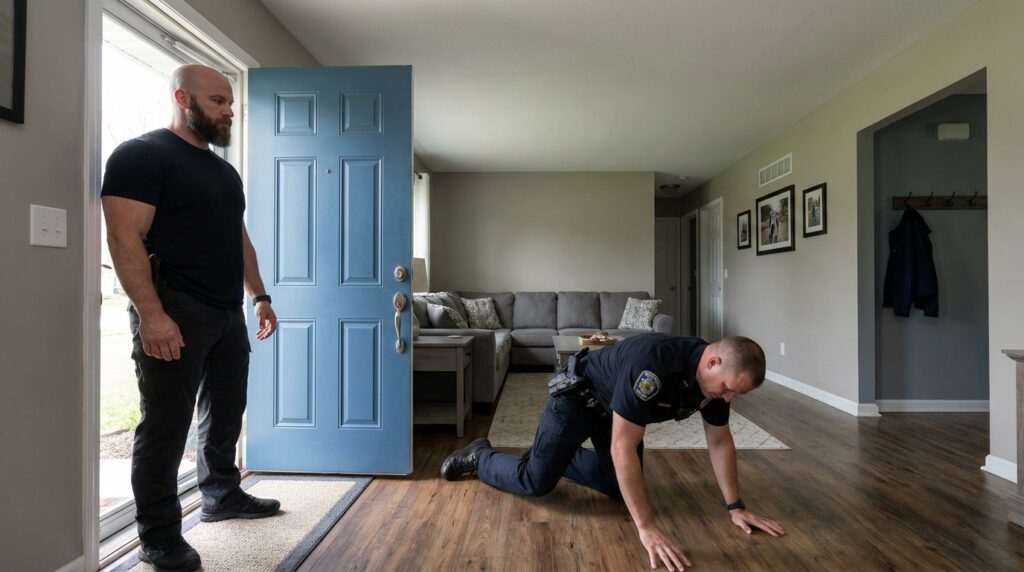
Miller stayed there, braced on his hands and knees in the center of the foyer floor. The wood beneath his knuckles was clean, polished with linseed oil that smelled faintly of old turpentine and dry earth, but his nose was an inch from a deep, ragged groove in the timber—a mark where something incredibly heavy and metallic had been dragged across the floor years before. His breath came in ragged, shallow wheezes, his vision tunneled down to the intricate pattern of the wood grain and the gray dust motes settling onto his dark blue trousers.

He couldn’t hear the rod knock of his cruiser anymore. The only sound in the small space was the rapid, frantic ticking of his own pulse against his eardrums and the slow, heavy drip of condensation from the small air-conditioning unit mounted high in the hallway ceiling. He didn’t look up immediately. The sheer humiliation of the drop kept his neck locked, his shoulders hunched as he waited for the second strike, the kick to the ribs or the heavy weight of a knee between his shoulder blades that standard defensive tactics said should follow a takedown.

The pursuit never came.

Vance remained planted exactly where he had stood before the lunge, his boots aligned with the edge of the blue sill, his frame filling the opening until the bright glare of the street was reduced to a thin, gold halo around his wide shoulders. His hands were down at his sides, the fingers loose, the thumb of his right hand resting just above the pocket line. He wasn’t breathing hard. The heavy muscles of his chest rose and fell with a slow, mechanical regularity that matched the ticking of the car engine outside.

“The threshold is clear, Deputy,” Vance said. The voice didn’t carry the heat of a victor; it was the cold, dry assessment of a mechanic who had just tested an old hydraulic line and found it wanting. “You’re inside the house now. Your camera is recording the ceiling. Your backup is two minutes out by the sound of the transmission line. Get your feet under you.”

Miller’s fingers twitched against the oak, his fingernails digging into the thin lacquer coating until the wood groaned. His right hip felt numb where the heavy steel cuffs had pinned themselves between his pelvic bone and the floor. He could see the shadow of Vance’s boot—unmoved, unmarred, a solid block of oiled leather that hadn’t even shifted into the dust kicked up by the fall.

“You’re done,” Miller whispered into the floor, his voice breaking on the second word as he tried to find enough leverage in his wrists to lift his chest off the planks. “You touched a deputy. That’s ten years in the brick house, Vance. Ten years.”

Vance didn’t look down at him. His flat, dark eyes remained fixed on the long ribbon of gray asphalt visible through the open doorway, tracking the first low vibration of a distant siren that was just beginning to stir the dry pine needles at the edge of the woods. “Nobody touched you, son. You tripped on the sill because you forgot to check your lead foot. Now clean yourself up before the Chief has to look at you on your knees.”

CHAPTER 5: THE WEIGHT OF OAK AND ANCHORS

The heavy impact of standard-issue Kevlar and knee leather striking the polished oak floor echoed through the dead silence of the foyer. The vibration ran sideways through the joists, stopping abruptly where the thick sills were bolted directly into the subterranean concrete bed. Miller’s jaw clamped shut so hard his molars grated on the alkaline dust he had inhaled from the threshold mat. His knuckles, splayed flat across the oak planks to maintain his vertical stance, were turning a dark, bloodless white against the desaturated grain of the wood.

“Stand up, Miller,” Vance said. The command wasn’t delivered with the sharp, rising bark of a drill instructor. It had the mechanical weight of a hydraulic cylinder dropping into place—slow, low-frequency, and completely indifferent to the resistance beneath it.

Miller didn’t move his legs. His left knee felt as though it had been jammed into a cold iron rail, the nylon of his uniform trousers twisted and binding tight around the joint. He kept his head down, his vision locked onto a circular discoloration in the floor wax three inches from his left thumb. It was a flush-mounted galvanized steel sleeve, three inches wide, drilled straight through the hardwood into the structural heart of the foundation. The edges were raw, dark with the crust of oxidized zinc, and inside the hole, the massive threads of a heavy-duty leveling bolt were visible. A house in a standard development didn’t have tie-down anchor sleeves embedded in the foyer floorboards.

“Don’t tell me what to do on an active scene,” Miller choked out. He shifted his weight to the right, trying to slide his boot heel under his thigh to establish a clean base of upward leverage, but his gun belt caught on the brass strike plate of the door frame. The metallic clink of his spare magazines sounded thin, brittle, and entirely decorative in the narrow hall. “You resisted a lawful investigative entry. You used physical leverage on an officer of the county.”

“Nobody used leverage but the earth, son,” Vance said, his boots remaining perfectly stationary at the edge of the blue sill. He hadn’t reached down to help the younger man up, nor had he shifted into an offensive guard. His massive forearms remained crossed over his chest, the fitted black fabric of his shirt showing the heavy, corded ridges of his traps. On his right hand, the silver signet ring remained locked against his ribcage, the rectangular notch in the silver casting a tiny, sharp shadow across the fabric. “You crossed a dry threshold with your center of gravity six inches out of alignment. If I had used leverage, your collarbones would be sitting in the baseboards. Now clear your gear off my floor.”

The sound of the neighborhood was changing outside. The distant, high-frequency scream of a municipal siren had dropped an octave, shifting into the heavy, broken wail of a vehicle navigating the narrow grid lines of the residential development. Two blocks north, a transmission line rattled as a secondary unit took the corner over the drainage ditch too fast, its loose leaf springs clanging like scrap metal against the frame.

Miller managed to force his right heel flat against the oak, his thighs trembling as he pushed his torso upright. His uniform shirt was ruined—the center seam was split out at the left shoulder where he had overextended his lunge, and a long, pale smear of old floor wax ran from his sternum down to the heavy leather pouch of his radio. His face was a dark, mottled purple, the sweat from his neck dripping onto the polished brass house numbers that sat in a small wooden bowl on the telephone table beside the door.

“You think you’re insulated here because you know the code book,” Miller whispered, his voice rising as he finally cleared his holster from the snag of the door frame. He didn’t draw the weapon, but his palm stayed clamped over the grip, his thumb hooked over the safety strap with a frantic, uncoordinated twitch. “You think because you’ve got some old military metal on your finger, the sheriff is going to walk away from a threshold assault? I’ve got three logged calls on this parcel. I’ve got probable cause of structural modification without an inspection rider. Look at this floor. Look at these bolts. You’re running a fortified asset inside a residential zone.”

Vance’s expression didn’t change by a single millimeter. His cold, dark eyes shifted from Miller’s hand on the weapon down to the steel sleeve in the floorboards, then back up to the young deputy’s face. The level of observation was surgical, devoid of the emotional static that usually filled a standard domestic standoff. He looked like a man evaluating a damaged winch line before deciding whether to cut it or splice it.

“The fortification was paid for by the state emergency management budget in ninety-eight, Deputy,” Vance said. His voice dropped lower, beneath the rising pitch of the sirens now turning into the head of the driveway. “The file isn’t under the residential parcel number. It’s under the regional infrastructure registry. If you had spent ten minutes reading the grid layout instead of cruising the fence lines to see who didn’t salute your light bar, you’d know this house sits on the primary control junction for the entire western valley valley drainage system. The floor doesn’t move because it can’t move.”

Miller froze, his thumb remaining locked on the holster strap. The floor beneath his feet seemed to give a sudden, low-frequency hum—not from the house itself, but from the immense mechanical volume of the water mains running through the easement sixty feet below the cellar floor. He looked at Vance’s bald head, at the immaculate gray of his beard, and for the first time, he noticed the small, flat scar running from the veteran’s left earlobe straight down into the collar of his black shirt—a pale, smooth track left by a fragment of hot casing that had torn through skin but missed the artery by the thickness of a thumbnail.

“That doesn’t give you the threshold,” Miller said, but the cadence had left his voice. The words were just dry paper sliding across a desk.

“The threshold belongs to whoever keeps the anchors greased, son,” Vance said, and his head turned slightly toward the open door as the high-intensity strobe lights of the first backup cruiser cut through the dust of the driveway, turning the blue paint of the entryway into a flashing, violent purple.

CHAPTER 6: THE WAIL ALONG THE WIRE

The flashing red and blue strobes didn’t clear the room; they chopped the darkness inside the foyer into flat, violent segments that smelled faintly of hot copper wiring and ozone. Outside, the loose gravel of the driveway didn’t just rattle—it flew, kicked upward into the dry boxwood hedges as the first secondary cruiser locked its brakes, its worn pads throwing off a sharp, metallic screech that seared the air.

Miller got his left foot under his hip, his knee joint popping with a dry, wooden click that echoed off the bare studs of the hallway closet. He didn’t unhook his hand from the service grip, but his fingers were damp now, sliding slightly against the cold checkered polymer. The blue glare through the open doorway caught the sweat dripping from his chin, turning the beads into tiny, frozen sparks before they hit the floor wax.

“That’s the shift sergeant,” Miller said, his teeth clicking together against the vibration of the idling engines outside. He didn’t look at Vance’s eyes; he kept his gaze leveled at the scarred silver signet ring, watching the way the rusted light from the strobes filled the deep relief notch in the band. “He’s got the regional dispatch log on his screen. If I tell him you’ve got unmapped modifications under this deck, he’s pulling the municipal emergency override. We won’t need a code warrant then, Vance. We’ll have a team with a demo saw inside your kitchen before the sun clears the tree line.”

Vance didn’t look back at the light bar. He stood square in the three-inch frame, his boots perfectly still against the oak sill, his thumbs hooked loosely behind the heavy canvas belt of his trousers. The pulse in his throat was a slow, regular rhythm, entirely decoupled from the rising pitch of the second siren coming down the north alley.

“The shift sergeant doesn’t have the clearance to view the infrastructure overlay, Deputy,” Vance said. The voice was flat, dry, holding the unyielding weight of an iron grate dropping into a concrete channel. “The last man who tried to pull the municipal override on this parcel was the district engineer in eleven. He spent three days in a federal holding cell at the arsenal before they found the archive box with his signature on the easement waiver. You can call him on your radio if he hasn’t died of his liver yet.”

Miller’s chest rose and fell in short, uncoordinated hitches, his uniform shirt pulling tight against the heavy nylon straps of his ballistic vest. Through the open blue door, across the bleaching asphalt of the street, three neighbors had stopped their mowers. They stood by their mailboxes, their faces desaturated by the heat glare, watching the flashing red squares slide across the immaculate green lawn of number forty-two. They weren’t moving. They looked like gray fence posts stuck in the clay.

The door of the secondary cruiser slammed shut—a heavy, uninsulated sheet-metal bang that rattled the loose heat shield on Miller’s own car out by the curb. Heavy boots scuffed the limestone chips, the rhythmic, metallic clink of a second duty belt moving toward the porch with the slow, deliberate stride of a man who spent twenty years carrying a heavy clipboard.

“Miller!” a voice barked from the gravel apron. It was thick, tobacco-cured, and gravelly, carrying the flat bureaucratic weight of a county bureau that had seen forty winters of frozen culverts and broken water mains. “Why aren’t you on the air? The repeater in the truck is clicking like a broken watch.”

Miller didn’t turn his head. He couldn’t. The sheer kinetic mass of the bald man standing in the doorway seemed to anchor him to the spot, his weight pinned between the cold oak planks and the deep, industrial groove in the timber beneath his shins. “In the foyer, Sarge!” he called out, his voice cracking on the hard consonant, the sound thin and dry against the low-frequency thrum of the subterranean main below the floor boards. “The resident refused compliance on a code inspection. He’s running a fortified anchor grid inside the frame.”

The footsteps on the porch steps stopped. The dry pine risers didn’t groan this time; they stayed rigid, held in place by the massive carriage bolts Vance had driven through the joists years before. A second figure filled the lower half of the doorway, his wide, sweat-stained Stetson blocking out the glare of the light bar. Sergeant Miller—no relation, just thirty more pounds of administrative leather and a silver badge that had been scrubbed until the plating was thin—looked across the threshold.

His eyes didn’t go to Deputy Miller first. They went straight to the silver signet ring resting against Vance’s black T-shirt. Then they traveled slowly, mechanically, down to the galvanized steel sleeve embedded in the oak planks, tracking the thick zinc threads that ran straight into the concrete core below.

The sergeant’s face didn’t tighten with anger. It did something worse. The blood left his cheeks in a single, greasy slide, leaving his skin the color of old lard that had been left out in the sun. He didn’t step across the sill. He pulled his right foot back until his heel hit the edge of the limestone step, his hand dropping away from his utility belt as if the leather had turned white-hot.

“Sarge?” Deputy Miller asked, his fingers twitching against his holster strap. “He’s got the whole infrastructure grid locked down from the cellar. He’s unlisted on the tax rolls. I’ve got the cause right here.”

The sergeant didn’t look at his deputy. He kept his eyes fixed on the gray fringe of Vance’s beard, his chin shaking slightly as the high-frequency clicking of the unshielded dashboard repeater from his truck echoed down the hot driveway.

“Shut your mouth, Tyler,” the sergeant whispered, his voice dropping into a dry, paper-thin hiss that didn’t clear the door frame. “Take your hands off that belt right now. Do it before I strip your patch on the dirt.”

CHAPTER 7: THE SCRAPE OF THE HOLSTER CLIP

“Get your hand off the strap, Tyler,” Sergeant Miller repeated, his voice dropping into an uneven, gravelly rasp that barely cleared the sound of the idling cruiser engines out in the driveway. He didn’t step forward. His heavy boots remained glued to the first riser of the porch steps, his knuckles tightening against the weathered cedar handrail until the old wood groaned under his palm. “I’m not giving you a secondary directive. Drop the thumb.”

The rookie’s hand remained frozen over the polymer grip, his knuckles a sharp, bloodless white against the coarse nylon basket-weave of his belt. A drop of sweat ran straight down his temple, tracking through the layer of pale limestone dust that had settled over his skin during his fall on the foyer planks. He looked from his sergeant’s grey, slick face back down to the steel tie-down sleeve embedded beside Vance’s boot.

“Sarge, he’s got an unmapped vault line,” the younger officer muttered, though his shoulder dropped three inches, the rigid leverage of his stance beginning to leak away into the hot air of the hall. “The county records don’t show an occupant code for this tier. If he’s sitting on the primary junction box without a state filing—”

“The state filing was signed when your father was still patching tires at the cooperative, son,” the sergeant cut him off. His breathing was heavy, wet with the rattle of forty years of tobacco and the damp chill of municipal basement archives. He slowly lifted his hand off the rail, his fingers brushing the old nickel-plated insignia pins on his collar. The metal was worn down at the edges, showing the dull yellow brass beneath the plating, but the small, stamped serial sequence on the reverse of the clasps matched the exact tool-mark geometry of the notch on Vance’s silver signet ring. “The resident doesn’t need an occupant code because this parcel isn’t a residence. It’s Sector Anchor Four. Now pull your heels together and clear the threshold.”

Vance didn’t move his arms from his chest. The black fabric of his shirt remained perfectly flat, showing no rise or fall to match the frantic, short breathing of the two men across the sill. His flat, dark eyes remained fixed on the far corner of the block, where the secondary county road joined the state highway. The low, rhythmic clink-clink-clink of his rusted gate hinge, catching the faint afternoon breeze, was the only clean sound left in the yard.

“He hasn’t cleared his personal ledger for the property line, Sergeant,” Tyler said, but the words were just dry paper sliding across an iron desk. His thumb finally slipped off the safety strap of his holster, the heavy spring giving a small, sharp click as it re-seated itself against the leather guard. He began to back toward the screen door, his boot heels dragging across the oak planks with a long, dull scrape that left a dark rubber mark in the linseed oil finish. “The complaint from number forty-four stated—”

“Number forty-four is an unreinforced frame sitting on a four-inch slab,” Vance said. His voice didn’t have the volume of the sergeant’s, but it carried a dense, low-frequency hum that seemed to vibrate through the floorboards, straight from the high-pressure water gates sixty feet below the basement joists. “The tenant there doesn’t like the sound of the hydraulic valves cycling at three in the morning. He thinks it’s a generator. If he wants to file an administrative appeal, he can do it through the regional infrastructure board at the capital. He knows the address.”

The sergeant took his hat off, his short, salt-and-pepper hair flattened by the heavy felt brim. He wiped his brow with the back of his sleeve, his eyes tracking the dark, ragged groove in the timber where the heavy monitoring equipment had been dragged into the center hall during the structural overhaul in ninety-eight. He didn’t look at the rookie. He didn’t look at the crowd of neighbors that had gathered by the mailboxes across the street.

“The board hasn’t taken an external appeal since the winter of twelve, Commander,” the sergeant said softly, the old title slipping across his teeth before he could catch the edge of it. He didn’t use the standard law enforcement prefix. He used the designation from the old joint task force files—the ones that sat behind three layers of galvanized mesh in the county vault. “The district engineer doesn’t have the keys to the vault anymore. They changed the tumblers when the regional grid went to the fiber logic.”

“The logic didn’t change the size of the pipes, Miller,” Vance said, his eyes finally shifting down from the highway line to settle on the sergeant’s face. It was the first time he had spoken the older man’s name, and the sound of it seemed to settle into the room like heavy gray dust. “The water still weighs eight pounds to the gallon. The sills still take the thrust when the gates drop. If the young man wants to see the blueprints, he can go down to the cellar and look at the foundation stamps. They’re cast in four feet of slag-tempered iron.”

The rookie’s eyes widened, his head turning mechanically between the two older men as the frantic scrape of his holster clip rattled against the door frame. “Commander?” he whispered, the word dry and dead in his mouth.

CHAPTER 8: THE SHADOW ON THE SILL

“Stand down, Deputy!” The voice didn’t come from the sergeant on the step. It cut through the flashing purple fog of the front yard from a black, low-profile utility vehicle that had pulled silently into the grass behind the cruisers, its massive tires tearing deep into the wild onions of the drainage ditch. The door slammed with a heavy, dead click that signaled armored plate.

The rookie didn’t answer. His boots stayed pinned to the rubber mark he had dragged across the oak planks, his chest heaving under his split uniform shirt as he watched a third man clear the boxwood hedge. The newcomer was lean, clad in a desaturated slate-gray service coat that bore no municipal insignias—only a small, black-anodized bar across the right lapel. Behind him came the municipal Police Chief, his face tight and gray under his formal visor, his uniform buttons catching the cold, mechanical blink of the emergency bars.

The state official didn’t stop at the porch steps. He ignored the dry pine risers, his heavy oxfords coming down on the wood with a rapid, rhythmic precision that signaled thirty years of concrete hallways. When his shadow fell across the open blue door, his eyes didn’t look at the sergeant, nor did they record the split shoulder of the rookie. They locked onto Vance’s right hand, specifically tracking the dull, pitted face of the silver signet ring resting against the black T-shirt.

“Vance,” the director said. The name was a short, lead weight dropped into the center of the foyer. He didn’t offer a hand across the three-inch oak threshold. He simply stood there, his slate-gray coat smelling faintly of dry-cleaning chemicals and high-grade diesel exhaust. “The regional repeater flagged an unverified code override from this sector four minutes ago. Dispatch logged it as a property line intrusion.”

“The deputy wanted to see the stamps, Director,” Vance said. His voice remained a flat, low-frequency rattle that didn’t rise to meet the authority on the porch. He didn’t drop his arms. His massive shoulders stayed perfectly square with the frame, blocking out the last rectangle of the fading afternoon light. “He thinks the sills are loose.”

The Police Chief stepped inside the gold perimeter of the strobe light, his hand reaching out to grab Deputy Miller by the nylon shoulder strap of his vest. He didn’t pull him gently; he yanked the younger officer back until the rookie’s boots struck the brass strike plate with a loud, metallic clang.

“Get out of the house, Tyler,” the Chief said, his teeth clamped together so hard the muscles along his jawline looked like knots of old hemp rope. His voice was a low, dangerous hiss that stayed inside the frame of the doorway. “Take your belt off and get in the back of the sergeant’s unit. Do it right now before I have the state police take your statement at the barrack.”

The rookie’s mouth opened, his tongue dry as he looked from the Chief’s silver star back to the state official’s blank lapel bar. “Chief, he’s got an unmapped basement vault—”

“I told you to shut your mouth, Deputy,” the sergeant barked from the porch landing, his voice shaking with the rattle of old grease and fear. “Move your heels.”

The young officer’s hand finally dropped completely away from his belt. The uncoordinated twitch in his fingers left a tiny streak of dark sweat against the polymer casing of his holster as he backed out through the screen door, his head tucked low against the blinding blue glare of the cruisers. The screen door gave a sharp, ungreased slap against the cedar casing—a dry, wooden crack that sounded like a small caliber round going off in the quiet neighborhood.

The state official didn’t watch him leave. He kept his eyes on Vance’s bald head, tracking the thin, pale scar that ran down behind his earlobe. “The grid is holding twenty thousand gallons a minute through the lower bypass, Commander,” the director said softly, his voice dropping below the mechanical rumble of the idling patrol cars. “We had an indicator drift on the three-inch line near the reservoir yesterday. The engineering detail thought it was a packing leak.”

“It’s not a leak,” Vance said, his left thumb shifting an eighth of an inch along the canvas of his belt. “The alignment is off because the county road crew dropped the concrete tile too close to the retaining wall three winters ago. The ground shifted four inches under the apron. If you don’t grease the pintles on the lower bypass valve before the frost hits, the thrust will crack the casing.”

The Chief looked down at the galvanized steel anchor sleeve embedded in the floorboards between his boots, his face darkening as the implications of the file numbers began to settle into the old oak planks. He didn’t speak. He simply stood there like a decorative iron post, his uniform cap casting a long, desaturated shadow across the linseed oil finish of the foyer.

“We’ve got a joint task force briefing at the capital tomorrow at zero six,” the director said, his fingers reaching inside his slate coat to pull out a small, triple-sealed inspection log with a heavy brass clasp. He didn’t step across the sill to hand it over; he laid it down on the small telephone table beside the door numbers, right next to the wooden bowl. “The secretary wanted to know if the sector anchor was verified. I told him the blue door was still on its hinges.”

“The door is fine,” Vance said, and his right hand slowly drifted into his pocket, the silver signet ring vanishing into the black fabric as the low-frequency hum of the water gates below the floorboards began its rhythmic, late-afternoon cycle. “Tell the secretary to keep his trucks off my gravel.”

CHAPTER 9: THE GRAIN RECLAIMED

The screen door didn’t simply latch; the oxidized iron coil spring caught the wood frame with a dry, metallic snap that signaled an end to the vibration in the yard. Outside, the flashers on the shift sergeant’s car dropped into a synchronized, rhythmic hum, their blue and red blocks of light sweeping across the parched turf of the lawn before dying into the gray gravel. The Chief’s utility vehicle sat silent behind the hedgerow, its heavy, diesel-burning engine ticking down as the heat rose from its uninsulated hood.

Inside the foyer, the air stayed cool, smelling faintly of old linseed oil, wet wool, and the heavy sulfurous bite of hot brake pads that had drifted up from the driveway. Deputy Tyler was already gone, his uniform shirt a crumpled dark shape visible through the rear window of the sergeant’s cruiser, his boots clear of the road.

The state director didn’t reach for the logbook he had laid down on the telephone table. He stood by the three-inch oak sill, his hands deep in the pockets of his slate-gray coat, his eyes tracing the deep, industrial score line in the oak floorboards. Up close, the groove didn’t look like an accident; it had the uniform, metric depth of an anchor point that had taken thousands of pounds of shear force when the main gates below were tested during the drought of twelve.

“The panel in the basement has a cold relay on the secondary line, John,” the director said softly. He didn’t look up at Vance’s face. He spoke with the flat, tired cadence of an engineer checking a broken winch line. “The regional station flagged a three-volt drop on the telemetry ring when the boy hit the porch steps. We thought the insulation had rotted out under the ditch.”

Vance slowly lowered his arms from his chest. His right hand, wide and calloused along the palm line, came down to rest against the edge of the blue door frame. The silver signet ring caught the desaturated glare of the late sun, its pitted face showing the raw grey grain of the alloy where it had scraped the iron rim of the shovel. The small rectangular notch in the band sat directly against the dark grain of the pine casing, a perfect metric fit for the old-style locking lugs on the heavy-duty sub-floor vaults.

“The line isn’t shorted, George,” Vance said. His voice stayed low, vibrating through the structural timber beneath his boots with the same regular, mechanical density it had carried before the light bars arrived. “The county crew left two tons of loose lime chips over the conduit run when they cleared the culvert. The moisture is pooling under the junction box because the drainage grade runs backward from the mailbox. If you don’t trench that apron before the first freeze, the frost will pop the solder right out of the terminal.”

The director took a slow breath, his slate-gray shoulders rising against the gold frame of the screen door. He reached down and touched the galvanized steel sleeve drilled through the oak planks, his finger tracing the rough zinc threads that disappeared into the concrete core sixty feet above the high-pressure water main. The metal was cold to the touch, carrying the deep, subterranean temperature of the river water cycling through the bedrock below the development.

“The secretary wants the asset codes transferred to the municipal registry by autumn,” the director muttered, his hand dropping back into his coat pocket with a dry scrape of nylon lining. “He says the county bureaucracy can’t carry an unlisted parcel code under the new digital system. They want a name on the tax rolls.”

Vance looked past him, his cold, dark eyes tracking the line of gray asphalt where the delivery trucks crossed the creek ridge. “The name on the rolls is forty years old, son. The county didn’t build this box; they simply drove the highway over the top of it. If the secretary wants the codes, he can send an active engineering detail down here with a three-bolt key to clear the vault flange. He knows what’s inside the iron.”

The Police Chief stepped back onto the porch landing, his heavy leather boots scuffing the limestone chips that had been tracked onto the wood. He didn’t look inside the house again. His cap stayed low over his eyes, blocking out the purple strobe reflections that were still fading from the boxwood hedges. He reached out and pulled the heavy blue door shut until the brass latch clicked home inside the iron striker plate, sealing the foyer into a dead, dry silence that smelled of floor wax and old iron.

“The truck is clear, John,” the Chief’s voice came through the thick paneling, muffled and flat like paper sliding across a desk. “We’re leaving the gate open. The boy won’t be back on this block.”

Vance didn’t answer through the timber. He turned slowly away from the closed threshold, his worn boots making no sound on the polished oak planks as he moved toward the dark hallway closet. The house around him felt massive, solid, an unyielding mass of reinforced concrete and iron anchors sunk deep into the gray clay of the valley, entirely indifferent to the names on the street outside.

He reached down and picked up the small wooden bowl of house numbers from the telephone table, setting it back into the center of the dark pine shelf where it had sat for twenty seasons. The silver signet ring gave a small, sharp clink against the brass figures as he dropped them back into the groove, the sound deadening instantly against the heavy weight of the wood.

Similar Posts

Leave a Reply

Your email address will not be published. Required fields are marked *






