The Cold Geometry of the Property Line: A Novel of Surveillance, Shadows, and Suburban Recrimination
CHAPTER 1: THE LIEN
The glass on the frame of the official county plat map didn’t just crack; it splintered clean across the southwest coordinates under the sudden, heavy drop of Mark’s fist. On the laminate kitchen counter, the third certified notice from the Oakridge Heights Homeowners Association lay wide open, its crisp, sixty-pound bond paper catching the harsh, unshielded glare of the overhead fluorescent tube. The numbers at the bottom were printed in a small, distinct sans-serif font that looked more like an execution order than a civil assessment: $4,500 for non-compliance with the community aesthetic buffer clause. Below that, an additional $150 per diem, compounding every midnight the natural pine buffer remained standing.
Mark didn’t look up when the refrigerator compressor kicked over, its low, rhythmic vibration rattling the ice trays inside. He stared out the small window above the sink. The glass was old, double-paned but losing its seal, trapping a permanent cloud of grey condensation along the lower left corner. Outside, the yard vanished into an absolute, unyielding blackness. The perimeter of his property was defined only by the jagged, irregular silhouette of the slash pines and unmanaged sweetgums that separated his lot from the county drainage easement.
He pulled his hand back from the map, a single fleck of green ink from a highlighter stuck to his knuckle. He didn’t feel the sting, only the cold, familiar knot tightening just under his ribs. Brenda had calculated the coordinates perfectly. She hadn’t sent the notice via regular mail; she had waited until three minutes before the county administrative offices closed on a Friday afternoon, ensuring he would spend forty-eight hours staring at the threat without a single human voice to appeal to.
He picked up the yellow envelope, his thumb tracing the blue ink signature on the green return card. Her handwriting was small, uniform, and entirely devoid of emotion—the script of a person who viewed the destruction of a man’s savings as a simple clerical exercise. She didn’t want the money. Mark knew the chess board well enough to understand that. The fines were leverage, a series of precisely placed weights designed to split his resolve along the fault lines of his mortgage.
A faint, sharp sound cut through the low hum of the house. It wasn’t the wind—the humid July air was too thick, too heavy for branches to snap on their own. It was a single, dry fracture of pine kindling from the darkness beyond his mowed grass.
Mark’s chest flattened against the edge of the sink. He reached up, his fingers finding the toggle switch for the external floodlight, but he didn’t flip it. If he turned the light on, he gave up the interior darkness. He gave up the only vantage point that didn’t reveal his own face to whoever was standing in the shadows of the easement. His breathing became shallow, measured, his teeth clicking together once in the quiet kitchen as he leaned his forehead against the cold, sweating glass of the window pane.
Through the grey cloud of condensation, the woods remained a solid, featureless wall. But the silence had changed. It had the tight, elastic quality of a room that had suddenly lost its air. He looked down at the plat map, his eyes tracing the red ink line he had drawn months ago along the legal boundary—a line that felt less like property now, and more like a trench.

CHAPTER 2: THE COLD PERIMETER
“If you’re looking for the line, Mark, you’re standing three inches short of it.”
The voice didn’t come from the trees. It lived in the memory of the morning before, a dry, administrative rattle that had followed him into the dew-soaked grass. Mark kept his weight balanced on the balls of his boots, his upper body low as he stepped off the lowest pressure-treated wooden step of the back porch. The ground here was transitional—creeping wood-sorrel giving way to the damp, acidic mast of the pine woods.
He didn’t use a flashlight. The unshielded 100-watt bulb from the kitchen window behind him cast a long, geometric wedge of amber light across the lawn, but its efficacy died exactly twelve yards out, shearing into a sharp, vertical cliff of shadow where the sweetgums began. His eyes had adjusted to the gray-scale reality of the perimeter. To his left, the chain-link fence of the Miller property glinted like a silver wire; to his right, nothing but the dense, unmanaged blackness of the easement.
He knelt, the fabric of his jeans straining against his kneecaps. The humidity was an active weight, pressing the smell of rotting bark and old iron into his throat. He reached down, his fingers hovering over the exact spot where he had heard the fracture minutes earlier.
The dirt didn’t lie. It couldn’t calculate or misdirect.
In the soft, wet clay just beneath a cluster of discarded pine needles, a clean, mechanical edge had been pressed into the earth. It wasn’t the irregular, rounded heel of an old running shoe or the wide, flat print of a standard work boot. The tread was technical—sharp, multi-directional chevrons with a distinct, reinforced steel-shank indentation in the arch. The edges of the print were still sharp, the tiny ridges of displaced mud uncollapsed by the night air. Someone had stood here within the hour, their weight shifted heavily toward the house, their posture stabilized for a long, static duration.
Mark’s thumb measured the width of the heel-strike. Nine centimeters. A small foot, but heavy enough to sink four millimeters into compressed red clay. Brenda didn’t wear work boots; she patrolled the cul-de-sac in rubber-soled orthotics that left wide, featureless smears in the dust. This was a different asset. Someone had been deployed into the gray zone with specific instructions to observe, not to fine.
He leaned forward, his palm resting on the rough, scaling bark of a mature slash pine. The wood was cold despite the ambient heat, its resin tacky against his skin. His tactical logic, refined by years of corporate asset management where every loss was a statistical footprint, began to map the angles. If a person stood in this specific indentation, their line of sight cut directly through the gray condensation of his kitchen window, bypassing the refrigerator obstruction, straight to the counter where the plat map was currently pinned under his fist.
They weren’t looking for overgrown weeds. They were looking for his reaction.
His fingers slid upward along the trunk of the pine, tracing the natural ridges of the bark until they hit a discrepancy. The gray lichen wasn’t native to this side of the tree—it was too dry, its texture resembling cast silicone rather than organic growth. Mark’s fingernail pried at the edge. A small, square section of the trunk shifted, the artificial bark pivoting on a tiny, greased stainless steel hinge.
Behind it, the dark, unreflective circle of a wide-angle lens stared back at him.
It was an industrial-grade, low-light trail camera, its housing anodized black and recessed deep into the heartwood of the living tree. A tiny, dual-lens infrared emitter sat just above the aperture, completely invisible to the naked eye but humming with a microscopic heat that Mark could feel on the pad of his index finger. No branding. No commercial serial numbers. A single, heavy-duty coaxial wire ran from the base of the battery compartment, plunging down into the core of the tree through a drilled channel that had been sealed with black silicone.
The camera wasn’t storing data to an internal card; the slot was empty, its spring-loaded gold pins exposed. It was broadcasting.
Mark didn’t pull the unit. To destroy the asset was to notify the operator that the perimeter had been compromised, resetting the board before he could identify the pieces. He carefully closed the silicone flap, aligning the artificial lichen with the natural grain of the pine until the seam disappeared back into the geometric shadows.
The weight under his ribs shifted from a knot to a cold, calculation-driven calm. Brenda’s $4,500 citation wasn’t the opening move of an HOA dispute; it was the smoke screen designed to keep him looking at paper while the real infrastructure was drilled into his wood.
He stood up slowly, his joints clicking in the midnight silence. He turned his back to the woods, walking back toward the harsh, yellow light of his kitchen with a measured, unhurried stride. He knew the camera was tracking the center of his shoulder blades. He knew that somewhere within three hundred yards, an IP address was logging the exact timestamp of his retreat.
He climbed the porch steps, his boots leaving faint, red clay chevrons on the weathered cedar planks. As he reached for the screen door, a small, rhythmic sound vibrated through the floorboards—the low, distinct ping of his kitchen computer receiving a high-priority network notification.
CHAPTER 3: THE DECOY DEEPMARK
The router sat on the bottom shelf of the pine desk, its four external antennas casting long, spidery shadows against the baseboard. The blue activity lights didn’t blink with their usual erratic rhythm; they pulsed in a synchronized, high-frequency hum that indicated a sustained outbound data stream. Mark crossed the kitchen floor, his boots dragging thin smears of red clay across the linoleum, and dropped into the heavy swivel chair.
The monitor screen flickered, casting a pale, clinical luminescence across his face. He didn’t open his email. He went straight to the local area network administration portal, typing a sixteen-character alphanumeric access key from memory. The keystrokes were short, sharp clicks in the midnight silence of the house.
The administrative dashboard loaded in blocks, gray lines of diagnostic data unspooling across the glass. Mark’s eyes scanned the connected client registry, ignoring the static IP addresses assigned to his television, his phone, and his kitchen appliances. At the very bottom of the tree structure, occupying a dynamic lease that had been initialized forty-eight hours ago, was an unmapped hardware identifier.
MAC Address: 00:1A:4M:9E:22:BC.
The connection wasn’t routing through the standard wireless interface. It had been established via a local bridged network protocol, piggybacking on an old, unencrypted guest account he had deactivated two winters ago. Mark touched the plastic frame of the monitor, his fingernail tracing the data packet telemetry. The transmission frequency was constant—exactly forty-four kilobytes per second, shifting to a massive eight-hundred-kilobyte burst every time the external floodlights were triggered.
They weren’t just streaming compressed video files. They were extracting localized system logs.
“You’re watching the wrong lane,” Mark whispered to the empty room. His voice sounded thin, dry, stripped of its natural resonance by the steady hum of the cooling fans.
He opened a terminal window, commanding a network packet tracer to isolate the destination IP. The routing path didn’t jump to a standard commercial server or a cloud hosting facility. It bounced three times through local municipal nodes—first to the public library’s public access server, then to an unmanned water management telemetry station on the county line, before dropping clean into a private residential gateway registered three houses down.
The Oakridge Heights HOA administrative office. Brenda’s dining room table.
Mark leaned back, the leather of the chair creaking under his weight. He rubbed his palms together, feeling the dry friction of his skin. The presence of the camera in the slash pine was a classic diversion—a loud, physical intrusion designed to be discovered if he looked too closely at the tree buffer. It was meant to make him angry, to provoke him into cutting down the trees or destroying the hardware in a fit of property-line rage, which would instantly validate the outstanding $4,500 citation for destruction of common community assets.
But the data trail revealed a more precise alignment. The camera wasn’t a standard motion-activated wildlife tracker; it was an enterprise-grade surveillance node executing an internal script.
He opened the network security certificate log, expanding the digital signature that had authorized the bridged access to his router. The file was a standard, automated permission script used by commercial home security installers, but the validation certificate hadn’t been issued by an automated system. It bore a manual cryptographic signature code: MUNI-SEC-442-FL.
Mark’s fingers remained motionless above the keyboard. MUNI-SEC was the prefix for county code enforcement infrastructure.
The calculation in his mind shifted instantly, the variables rearranging themselves into a darker configuration. Brenda hadn’t bought this equipment at an electronics store, and she hadn’t hired a local handyman to mount it under the cover of darkness. The hardware belonged to the district municipal authority. She was using code enforcement channels to pipe a live surveillance feed directly out of his private yard, using an administrative backdoor that only an inspector or a county contractor could authorize.
He reached down and touched the side of the router chassis. The plastic was hot, almost burning the tips of his fingers from the strain of the forced upload. He could terminate the connection with three strokes of the keyboard, locking the backdoor and cutting Brenda’s feed into absolute blackness.
He didn’t do it.
If he killed the signal now, the counter-move would be immediate and legal—a formal emergency injunction from the county building department claiming he was obstructing an ongoing environmental safety investigation along the drainage easement. They would come onto his land with corporate vehicles and sheriff’s deputies before sunrise, carrying documents he couldn’t litigate in time to save the perimeter.
He needed the physical asset on-site when the balance of power shifted. He needed her to believe her intelligence channel remained uncompromised.
He minimized the terminal window and opened a clean text editor, initializing a diagnostic log file of his own. He began copying the packet headers, saving the timestamped transfer logs and the cryptographic validation certificates onto an encrypted external thumb drive. Every line of text that unspooled was another knot in the line, an undeniable record of institutional overreach that went far beyond a neighborhood dispute over sweetgum trees.
As the progress bar reached ninety-eight percent, the low, mechanical rattle of the outdoor AC unit outside the window stopped abruptly. The sudden silence in the backyard was heavy, almost explosive. Then, a sharp, metallic click echoed through the glass—the unmistakable sound of a deadbolt sliding home in the rear entryway of the house across the street.
CHAPTER 4: THE MIDPOINT TRANSACTION
“The frost on those glass doors is thicker than the property line buffer, Mark.”
The voice cut through the monotonous hum of the commercial compressor units lining Aisle 4. Mark didn’t flinch. His hand remained wrapped around the cold, frosted steel handle of the upright freezer case, his fingers calculating the exact metal temperature against his skin. Inside, stacks of cardboard boxes containing frozen dinners were aligned with clinical precision. He turned his head slowly, his chin slightly lowered, his gaze locking onto Brenda before she could complete her closing step.
She looked exactly like the administrative weapon she was trained to be. She was wearing a heavy, bright floral blouse—broad, interlocking patterns of red hibiscus that didn’t quite disguise the sharp, geometric outline of a hard-plastic clipboard clutched against her ribs. Sunglasses were pushed up into her short, rigidly lacquered hair, and her eyes, small and hyper-focused behind thin designer frames, glimmered with the satisfaction of a tactical advantage.
Mark let go of the freezer handle, the heavy glass door clicking shut against its magnetic seal with a soft, pressurized hiss. “The county coordinates don’t drift with the weather, Brenda. They remain fixed in the courthouse vault.”
“Vaults can be audited,” she said, her voice dropping into a low, transactional whisper that barely carried over the rumble of the store’s air handling system. She shifted her weight, her rubber-soled orthotics squeaking sharply on the white linoleum floor. She tapped the edge of her clipboard with a manicured fingernail—a rhythmic, impatient sound that mimicked the diagnostic ping of Mark’s router. “And properties that fail to maintain basic community safety standards have a way of becoming liabilities. The board doesn’t look kindly on residents who treat their perimeter as an unmanaged wilderness. It lowers the valuation of the assets on either side.”
“Is that why the code enforcement script is running through my guest network?” Mark asked, his voice entirely flat, stripped of any defensive inflection. He didn’t raise his hands; he kept them down at his sides, his thumbs lightly brushing the seams of his jeans.
Brenda’s finger stopped mid-tap. Her eyes narrowed by a fraction of a millimeter, the small muscles around her jaw tightening until the floral pattern of her blouse seemed to stiffen. She didn’t look away, and she didn’t offer a standard defensive denial. The calculation behind her gaze was sharp, instantaneous, and entirely cold—the reaction of an operator who had just recognized an equal intellect across the board.
“The community has public easements for infrastructural monitoring, Mark,” she said, her tone hardening as she took a small step forward, her shadow cutting across the fluorescent reflection on the freezer glass. “If a homeowner creates an environmental hazard by hoarding dense undergrowth along a shared fire lane, the county has every right to document the risk. We aren’t playing a game of simple yard care here. You’re sitting on a structural vulnerability.”
“The trees are healthy slash pines,” Mark replied, his voice maintaining its level, unhurried cadence. “They’re native, and they’re four feet within my deeded tract. If someone is collecting data through a hidden lens, they aren’t looking at fire lanes. They’re looking at the interior layout.”
“Then I suggest you review the municipal charter before the weekend,” Brenda said. She leaned in slightly, the faint, synthetic smell of her floral perfume mixing with the chemical bleach of the freshly scrubbed floorboards. She lifted the clipboard by an inch, revealing a thick, green-bordered document tucked beneath the chrome latch. “Because when a lot is officially classified as an active municipal hazard, the fines aren’t civil anymore. They become attachable liens. And liens have a funny way of clearing out the title before a homeowner even realizes the boundary has been crossed.”
She turned on her heel before he could answer, her broad silhouette moving down the aisle toward the checkout counters with an unhurried, confident stride.
Mark didn’t follow her. He stood next to the freezer case, his eyes dropping to the polished linoleum floor where she had been standing. Just beside the bottom metal kickplate of the adjacent refrigerator unit, a small rectangle of stiff, high-gloss paper lay face up in the harsh light. It had slipped from the side pocket of her folder during her step forward.
He knelt, his fingers lifting the card by its dry edge.
It wasn’t an HOA business card. The logo in the upper corner was a stylized, geometric rendering of a crane, printed in matte silver ink over a desaturated gray background.
Vanguard Core Holdings – Land Acquisition & Commercial Development.
Beneath the corporate name, typed in the same crisp, sans-serif font that had printed his $4,500 assessment notice, was a single direct telephone extension and an unlisted email address. There was no personal name attached to the card, but across the back, written in small, uniform handwriting that matched the green return card of his certified envelope, was a series of six digits.
0442-FL.
Mark’s thumb pressed against the matte ink, his internal database immediately locking the variable into place. The code was identical to the cryptographic security certificate that had authorized the backdoor access into his home router. Brenda wasn’t executing a standard neighborhood surveillance campaign to enforce an aesthetic rule; she was collecting specific site data for an external corporate entity, using a falsified code enforcement certificate to build a legal file against his tract.
The decoy of the simple HOA dispute had just cracked open, revealing a much larger, institutional lever designed to pry him off his land entirely.
He slipped the business card into his front pocket, the stiff paper scraping against his knuckle with a faint, dry sound. He looked up at the long line of fluorescent lights stretching down the aisle, their geometric alignment perfectly straight, casting long, hard shadows across the polished white floor. The perimeter wasn’t just his back yard anymore. The line ran clean through the county records, and Brenda’s next move was already unspooling in the dark.
CHAPTER 5: THE WATCHER IN THE SLASH PINES
The humidity had rolled in off the county drainage canal at ten o’clock, thick enough to blanket the sweetgums in a heavy, wet film and turn the red clay along the easement into soft, shifting muck. Mark stood on the third cedar plank of his back porch, his shoulders tight and his ribs locked flat against the pressure of his breathing. Above his head, the unshielded hundred-watt bulb hummed inside its corroded brass socket, throwing a stark, yellow-white wedge of light across the close-mowed grass.
But the light ended exactly twelve yards out. Beyond that line, the backyard didn’t just darken; it dropped off a vertical cliff of absolute, unreadable shadow where the mature slash pines formed a jagged wall against the night sky.
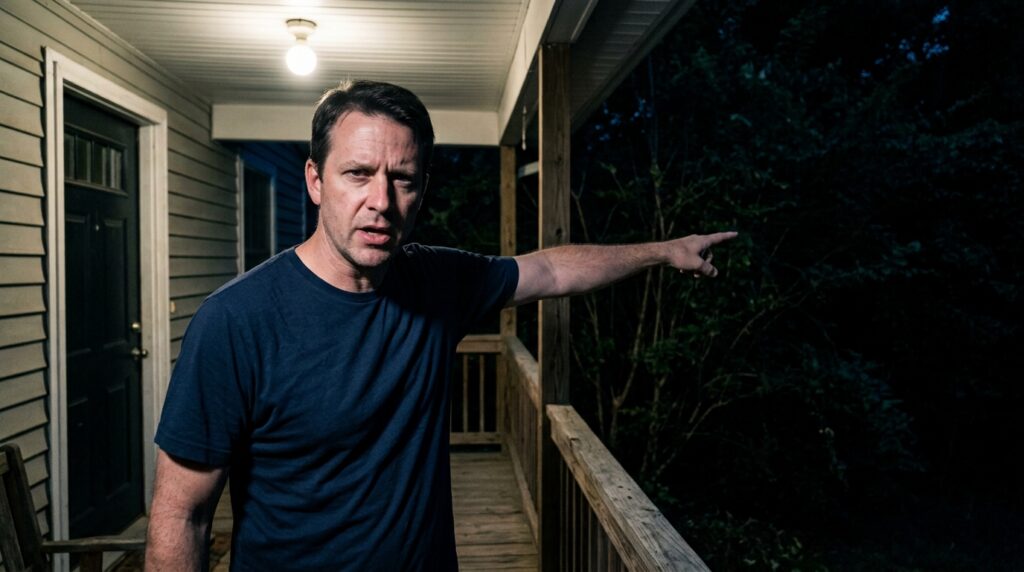
He kept his body half-turned toward the house, his left shoulder angled toward the glass kitchen window to maintain the illusion of an off-guard retreat. But his right arm was extended like a cold steel rod, his index finger locking onto a specific patch of impenetrable darkness thirty feet into the trees. In his left hand, the screen of his phone glowed with a pale, clinical luminescence, its camera application running a localized infrared filter that rendered the landscape in stark, desaturated grays.
“I swear something is back there,” Mark said, his voice dropping into a low, tense warning that barely carried over the wet rustle of the pine needles. He didn’t look at the lens of his phone; his gaze stayed fixed on a single, unnatural cluster of shapes between two thick trunks. “It keeps watching me from those trees.”
Through the low-resolution digital viewer, the natural geometry of the forest failed. The branches rose in clean, biological curves, but tucked four feet off the ground, balanced directly over his southwest survey stake, a thick, bulbous silhouette hung motionless in the brush. The head looked entirely wrong. It was twice the width of a human skull, heavy and flat-fronted, flanked by two oversized, protruding cylinders that didn’t catch the yellow reflection of the house light. Instead, they projected a faint, microscopic pair of dull green rings that never blinked, never shifted, and never yielded to the midnight wind.
Mark’s hand remained perfectly rigid, his pulse calculating the interval between his heartbeats. The tactical logic he had spent weeks refining didn’t allow room for panic; it processed the silhouette with the cold clarity of a risk assessment.
The entity in the woods wasn’t a creature, and it wasn’t a standard neighborhood prowler. The dual cylinders were the high-magnification optical lenses of military-grade, Gen-3 panoramic night-vision goggles. Below the headpiece, tucked behind a screen of clipped pine branches, the light-absorbent fabric of a dark camouflage jacket broke up the shape of a torso, but the posture was unmistakably human—crouched low on all fours, stabilized in the damp mud, with one hand resting on the heavy aluminum chassis of a professional zoom camera.
Brenda had stopped trying to hide behind her clipboard. She had gone tactical.
“Its head looked wrong,” Mark whispered again, directing the audio capture of the phone toward the perimeter line while his knuckles went white against the wood railing. “Too big. And the eyes never blinked.”
He wasn’t performing for the camera; he was creating a clean, unedited auditory record for the county sheriff’s log. He knew that three hundred yards away, the bridged network connection on his router was still pulsing with outbound packets, feeding this exact visual line back to her local terminal. But she had miscalculated the trajectory. By entering the tree buffer under the cover of a moonless sky, she had crossed from administrative overreach into a clean, prosecutable violation of state law.
He remained completely still, his boots anchored to the weathered cedar, his ears straining against the heavy drone of the cicadas.
Then the silence broke.
It was a micro-second fracture—the tiny, sharp click of a mechanical camera shutter resetting itself after a long-exposure capture, immediately followed by the faint, distinctive snick of wet mud compressing under the heel of a heavy rubber boot. The sound didn’t come from the common easement; it came from five feet inside the red surveyor flags he had driven into his own soil.
Mark’s jaw tightened, his teeth clicking together once in the damp air. “Wait,” he said, his voice dropping to a hushed, alert whisper that cut through the night ambience like an edged blade. “Did you hear that just now?”
Through the glass of his phone, he saw the bulbous, oversized head in the bushes freeze, the green rings of the night-vision lenses tilting upward by a fraction of an inch as she realized her tracking footprint had been compromised. She didn’t retreat, and she didn’t stand up. She remained locked in her crouch, her body trusting the heavy shadows of the slash pines to protect her, unaware that the high-lumen tactical counter-measure was already turning into the driveway behind the house.
Mark let his arm drop slowly to his side, but he didn’t move away from the railing. His eyes stayed locked on the unblinking green rings in the darkness, his internal timer running down the final twenty seconds of the configuration. The boundary line was no longer a matter of paper fines or corporate acquisition files. The trap was set, the target was fully illuminated in his data logs, and the cold geometry of the perimeter was about to tighten around her neck.
CHAPTER 6: THE OVERWHELMING FORCE
The perimeter didn’t just break; it was structurally obliterated by twelve thousand lumens of focused, weaponized white light.
Before the green rings of Brenda’s night-vision visor could adjust to the shift in the tree line, a high-powered tactical spotlight mounted to the brush-guard of a county sheriff’s cruiser ripped through the sweetgums from the side easement road. The beam was a solid, physical cylinder of white energy that turned the damp midnight mist into a shimmering wall of silver gauze. The skeletal shadows of the pines stretched out across Mark’s lawn like long, desperate fingers, instantly dissolving the absolute darkness she had used as her cover.
Mark didn’t shield his eyes. He stayed anchored to the cedar railing of the porch, his hand still extended toward the brush, his pulse dropping into a cold, rhythmic baseline as the heavy, low-frequency rumble of a V8 engine vibrated through the floorboards.
The cruiser didn’t activate its sirens. It rolled into the drainage easement with its black-and-white panels splattered in wet clay, its tires throwing up thick chunks of sod as it ground to a halt precisely twelve inches from Mark’s southwest property marker. The driver’s side door opened with a heavy, mechanical creak, and the responding deputy stepped out into the mud. He didn’t unholster his duty weapon, but his right hand remained resting flat against the hard-plastic grip of his service tool, his fingers tapping a slow, unhurried cadence against the black polymer.
“Sheriff’s Office,” the deputy called out, his voice a flat, tired baritone that carried a complete lack of administrative patience. He unlatched a heavy, long-barreled tactical flashlight from his utility belt, adding its tight, piercing beam to the vehicle’s spotlight. “Identify yourself and state your purpose on this lot.”
The silhouette in the bushes didn’t move. For three seconds, Brenda remained frozen on all fours like a deer caught in a high-beam trap, the absurdly bulky panoramic night-vision goggles making her head look like a piece of industrial machinery abandoned in the weeds. The bright floral blouse she had worn to the supermarket was now caked in wet, black muck, its red hibiscus patterns stained with rotting pine mast and leaf debris. Under the merciless glare of the LED lights, the professional zoom camera clutched in her hands glinted like a polished weapon.
“Ma’am,” the deputy’s voice dropped an octave, the tone shifting from an inquiry to a direct command. He took two heavy, deliberate steps into the brush, his boots making a wet, sucking sound in the red clay. “Step out of the bushes slowly and put the night-vision equipment on the ground.”
Mark watched the calculation fail behind Brenda’s lenses. She didn’t offer a villain speech, and she didn’t attempt to run through the dense undergrowth. The sheer physical exhaustion of trying to maintain a tactical crouch in the mud for an hour had settled into her joints; when she tried to shift her weight back toward the common area, her left knee gave way with a wet splash, dropping her clipboard clean into a puddle of brackish water.
“This is an official HOA inspection,” she hissed, her voice cracking as she reached up with a trembling, mud-stained hand to pull the heavy plastic visor off her face. Her short, lacquered hair was flattened against her skull by the nylon straps, and her eyes, wide and hyper-focused with absolute shock, blinked rapidly against the blinding white illumination. “The homeowner is in direct violation of the municipal safety buffer. I am documenting an active fire hazard for the county development file.”
“The county development file doesn’t authorize midnight surveillance on a private deeded tract, ma’am,” the deputy said, his cadence remaining entirely flat as he pulled a thick, leather-bound citation book from his pocket. He didn’t look up at Mark, but his flashlight beam stayed locked onto the silver logo of the Vanguard Core Holdings card that had fallen from Brenda’s pocket, now floating face up in the wet clay beside her boot. “The resident called in a prowler five minutes ago. Right now, you’re sitting five feet past the survey stake on a documented trespass.”
Mark didn’t offer a word of correction or a defensive argument. He reached down into his front pocket, his fingers brushing against the encrypted thumb drive that held the full packet telemetry from his router—the digital footprint that proved her “inspection” was piping data through an unauthorized municipal backdoor. He kept his face inside the shadow of the porch roof, watching the institutional lever he had isolated in Chapter 4 bend under the sudden, undeniable weight of real-time legal pressure.
Across the street, the long, uniform row of suburban houses began to change. A porch light clicked on three doors down. Then another. The heavy, metallic rattle of a garage door lifting echoed across the cul-de-sac as the Miller family stepped out onto their driveway, their phones raised to record the stark, high-contrast spectacle of the neighborhood’s ultimate moral arbiter being ordered out of the dirt by uniform law enforcement.
Brenda stood up slowly, her broad silhouette shaking with a mixture of rage and physical fatigue as she clutched her expensive camera rig against her wet blouse. Her false authority had collapsed entirely on the physical site of her overreach, but as she glared up through the blinding white light toward Mark’s porch, her jaw tightened into one final, silent calculation. She knew the decoy secret of the HOA fines had been shattered, but the ultimate reality of the commercial acquisition file remained locked in the county database—and she had no intention of retreating without testing the line one last time.
CHAPTER 7: THE COLLECTION OF EVIDENCE
The plastic evidence bag didn’t seal silently; its heavy, industrial-grade adhesive zip tore across the night air with a loud, serrated crack that matched the rhythmic pulsing of the cruiser’s secondary blue strobes.
Mark stepped down off the wooden porch, his boots sinking precisely three centimeters into the saturated turf before he cleared the light wedge of his house. The physical reality of the scene had converted from a standoff into an inventory. Two yards away, the deputy’s long flashlight beam was focused on the hood of the patrol car, illuminating the tactical night-vision visor, the heavy digital camera, and the green-bordered HOA file folder Brenda had clutched like a shield.
Brenda stood by the rear quarter panel, her broad frame locked in a rigid, tight state of exhaustion. Her floral blouse was completely ruined, the bright red hibiscus patterns smeared with long streaks of gray clay from the drainage ditch. Her chin remained lifted, but her eyes, small and hyper-focused behind her thin glasses, tracked the movement of the neighborhood spectators who had gathered along the cul-de-sac line.
The Millers were there, their phones raised to chest level, the small blue indicator lights of their video applications casting an unnatural, flickering tint across the asphalt. Three houses down, the porch light of another board member clicked off, a silent, institutional retreat that Mark noted with absolute clarity. The support network was dissolving in real time.
“This equipment is private property registered to the Oakridge Heights Administrative District,” Brenda said, her voice dropping its administrative rattle, replaced by a sharp, transactional rasp. She didn’t look at Mark. She kept her gaze fixed on the deputy’s citation book. “The data collected within that file is protected by a standard municipal non-disclosure agreement. It cannot be entered into a standard county sheriff’s log without a civil court order.”
The deputy didn’t answer with a speech. He lifted the heavy SLR zoom camera, using a specialized evidence pen to pull back the rubber weather sealing along the base plate. Underneath the matte black coating, a clean, laser-etched inventory matrix code was revealed.
PROPERTY OF COUNTY CODE ENFORCEMENT – LOGISTICAL DIVISION – ID: 0442-FL.
Mark stopped at the edge of the light wedge, his hands staying deep in his pockets, his fingers tracing the sharp, cold edge of his thumb drive. “The inventory tag matches the cryptographic certificate that authorized the network bridge,” he said, his tone flat, entirely level. “The same ID number is logged forty-eight times on my internal router over the last forty-eight hours.”
Brenda’s jaw tightened, the skin along her throat going entirely pale under the white LED glare. She turned her head by a fraction of a millimeter, her gaze locking onto Mark’s face with an intensity that calculated every risk, noticed his posture, and suppressed whatever panic was rising in her throat. She didn’t monologue. She didn’t explain her plan. She recognized that the physical evidence on the hood of the car was an absolute barrier to her current position.
“A safety audit requires technical monitoring, Mark,” she said, her voice dropping into a guarded, narrow frequency. “You can audit the files all you want, but a hazard remains a hazard until the county clears the tract.”
“The county isn’t clearing a fire lane, Brenda,” Mark replied, his voice maintaining its unhurried, strategic cadence. He didn’t look at her; he looked at the green folder beneath the deputy’s palm. “The county code enforcement network doesn’t pipe live raw data streams to a private developer’s acquisition office unless the tract is being processed for a mandatory municipal tax lien sale.”
The silence that followed was heavy, compressed by the steady, hot hum of the cruiser’s radiator fan. The deputy paused, his pen hovering over the citation sheet, his eyes flicking from the laser-etched matrix code on the camera back to the business card floating face up in the wet mud at Brenda’s feet—the silver crane logo of Vanguard Core Holdings catching the blue flash of the emergency lights.
The tactical logic had fully inverted. The discovery of the trail camera in Chapter 2 had been the decoy, the physical bait meant to draw Mark out into a loud, litigious property-line dispute that would justify an emergency environmental intervention. But the actual asset—the legal mechanism she was using to force the sale—was now categorized on the hood of a police cruiser under a state criminal statute.
“Ma’am,” the deputy said, his voice a flat, non-negotiable baritone as he unlatched a pair of steel restraints from his utility belt with a sharp, double-metallic clack. “Turn around and place your hands behind your back. We’re going to secure the hardware at the station while the county prosecutor verifies the network certificate.”
Mark didn’t watch her hands go into the steel. He didn’t smile, and he didn’t offer a final verbal vindication. He turned his back to the road, his boots leaving clean, precise chevrons in the soft grass as he walked back toward the illuminated steps of his porch. Behind him, the low, wet murmur of the onlookers grew louder as the cell phones continued to log the absolute collapse of her authority. The perimeter was secure, the physical threat was being escorted past his surveyor stakes, but as he reached the screen door, his mind was already calculating the next layer of the network. Brenda was off the board, but the corporate file at Vanguard Core Holdings remained open, and the true horizon of the dispute was still unspooling in the dark.
CHAPTER 8: THE SECURE PERIMETER
The morning didn’t arrive with a dramatic break; it bled through the sweetgums in a flat, desaturated gray that turned the wet clay of the drainage easement into the color of old zinc.
Mark stood on the rear back porch, his weight resting against the rough cedar railing, his palms flat against the cold grain. The single hundred-watt bulb above his head was turned off now, its filament dark inside the corroded brass housing. Down in the yard, the grass was still flattened where the deputy’s cruiser had carved its heavy chevrons into the sod, the deep indentations filled with stagnant water that caught the pale, pale light of six o’clock.
Across the asphalt cul-de-sac, the curtains of Brenda’s dining room windows remained drawn tight, a solid, featureless barrier of pale fabric that didn’t twitch. Her driveway was empty. Her administrative clipboard, her fake notices, and the military-grade optical visors were logged in a steel evidence locker downtown, but the baseline she had established hadn’t fully cleared out of the soil.
The corporate layout didn’t leave empty spaces.
A low, unhurried engine rumble vibrated through the floorboards of the porch. Mark didn’t look up immediately. He watched a bluebird drop from a high pine branch, its wings clipping the air before it vanished into the protected buffer zone. Then, a long, slate-gray sedan with dark tinted glass crawled past his mailbox. It didn’t stop. It didn’t activate a turn signal. It simply slowed to a crawl at the exact southwest coordinates of his property line, its front tire turning an inch closer to the red surveyor stakes before accelerating back toward the county highway.
Mark’s thumb traced a smooth, cold object inside his pocket—the encrypted thumb drive containing every transaction hash, network bridge authentication code, and the municipal backdoor log he had extracted from his router.
The battle wasn’t an HOA dispute over unmanaged undergrowth. It never had been.
The local file was closed, but the global network remained active. When he had decrypted the contents of the folder found in the mud, the true calculation had laid itself bare on his monitor: forty-two adjacent lots along the easement, all systematically targeted with overlapping environmental violations over an eighteen-month window, all dropping into the exact valuation bracket required for an automated public tax lien sale. Vanguard Core Holdings wasn’t fighting for a clean aesthetic standard. They were buying the municipal infrastructure from the inside out, using a corrupt neighborhood dictator to clear the title lines before the community could trace the investment footprint.
“You left your perimeter open, Brenda,” Mark whispered into the morning mist. His voice was entirely flat, dry, stripped of any emotional emphasis.
He pulled his hand out of his pocket, resting the small silver cylinder of the thumb drive on the flat surface of the railing. The cold gray text of the county court summons was already queuing on his kitchen monitor inside, its delivery confirmed by an automated system log that would hit the developer’s legal team at exactly eight o’clock. He had mapped every piece on their board. He had identified the weak links in their corporate infrastructure, and he had paid for the intelligence with two months of sleepless hyper-vigilance.
The silence that settled over the backyard was different now. It didn’t have the elastic, high-frequency tension of a hidden camera array pulsing outbound data into his walls. It was the heavy, industrial quiet of an asset that had been secured by a definitive boundary line. The trees remained standing—the slash pines and sweetgums rising into the gray sky like a row of dark, iron spears along his deeded tract.
He turned back toward the house, his boots leaving dry, faint rings on the cedar planks as he moved toward the screen door. He knew the gray sedan would return before the tax cycle closed. He knew the corporate file on his land wouldn’t be deleted simply because one operator had been caught crouching in the mud. But the perimeter was no longer an assumption; it was a documented reality, and Mark’s fingers were already reaching for the keyboard to lock down the next line of defense.