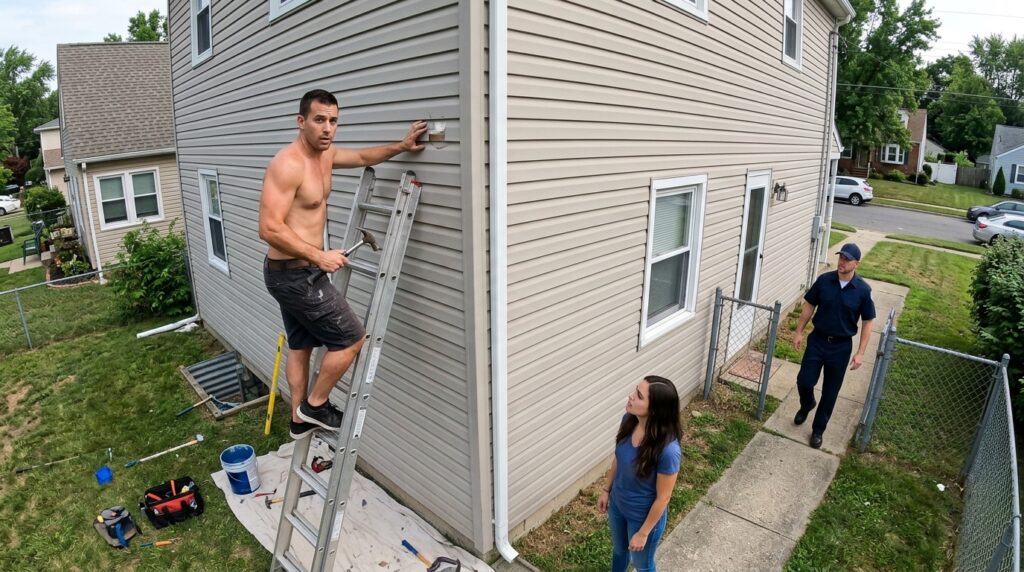
The Weight of the Hammer on a Line Drawn in the Scorched Dirt
CHAPTER 1: THE EDGE OF THE SHADOW
The iron head of the twelve-ounce framing hammer came down clean, driving a galvanized nail straight through the tongue of the new vinyl plank. A puff of gray chalk dust erupted from the seam, settling over the scarred leather of Mark’s toolbelt. The heat was a living thing, thick and smelling of hot tar and dead dandelions, trapped in the narrow five-foot corridor between his sister Sarah’s crumbling foundation and the pristine, pressure-treated cedar fence that marked the neighbor’s territory.
He didn’t look down when the screen door of the house across the gravel lane banged shut. He didn’t look down when the heavy, rhythmic crunch of orthopedic soles began trailing the line of the property wire. He simply reached into his canvas pouch, his fingers finding the oily ridge of another nail by feel alone, his skin slick with sweat that turned the fine sawdust on his forearms into a pale paste.
“Get off that goddamn ladder before I have the county take the house out from under you,” the voice came from the curb, dry and sharp as splitting kindling.
Mark paused, his thumb holding the nail against the starter groove. Below him, standing in the sparse shade of a dying silver maple, Sarah tightened her grip on her phone. Her long dark hair was tied back with a piece of blue twine, her jaw locked so hard the muscle near her ear twitched. She didn’t look up at her brother, and she didn’t look at Mrs. Gable, who had stopped exactly two inches short of the property stake, her floral blouse brilliant under the noon sun.
“We checked the setbacks, Mrs. Gable,” Sarah said. Her voice didn’t rise; it had the flat, tired cadence of someone who had spent three weeks listening to a lawnmower engine being revved at dawn just to drown out her morning coffee on the porch. “The siding is five inches within the line. The contractor spec is clear.”
“The contractor spec doesn’t account for public indecency or a structural load on an unreinforced retaining wall,” Mrs. Gable replied, her oversized designer sunglasses reflecting the glare of the white vinyl planks like two black beetles. She raised a pale, heavy arm, her index finger pointing directly at the bare skin of Mark’s shoulder blades. “You’re running an illegal commercial worksite in a residential zone. No permit on the post. No commercial insurance. And look at him—this isn’t a trailer park, Sarah. We have standards of public visibility.”
Mark felt the cold aluminum of the ladder rung beneath his bare arch. He didn’t pull his hand away from the siding. He looked down then, his gaze catching the small, silver scar on Mrs. Gable’s left wrist—the old mark of a dog bite or a rusted wire fence—and then shifted his eyes to the small black screen of the phone she held flat against her hip like a weapon. The camera lens was uncovered, aimed straight up at his thighs.
He didn’t speak. In the five years since he’d come back from the yard in basic training, he’d learned that the worst thing you could give an authority-faker was an echo. You let them talk until the air ran out of their lungs.
“The city has a response time of twelve minutes for an active code violation involving structural stability,” Mrs. Gable said, her thumb sliding over her screen with a slow, deliberate click. “I’m making the call now. Let’s see how much that hammer weighs when the marshal locks the gate.”
The silence that followed was heavy with the smell of scorched grass. Mark kept his hand on the handle of the tool, his knuckles white against the hickory wood, waiting for the first sound of a siren or the crunch of tires on the outer asphalt.

CHAPTER 2: THE PAPER SHIELD
The grease on the metal tracks of Sarah’s filing cabinet had long since turned to a black, stubborn crust. When she yanked the bottom drawer, it didn’t slide; it groaned, a raw iron screech that cut through the low hum of the window unit in the kitchen.
Mark stood by the sink, his skin still radiating the midday heat. He had pulled an old, faded flannel shirt over his shoulders, leaving it unbuttoned, the rough cotton scratching against the dry salt on his chest. Through the small, salt-filmed window pane above the faucet, he kept his eyes locked on the curb. Mrs. Gable hadn’t moved. She was a thick, floral-print monument under the shade of her own sugar maple, her arms crossed over her chest, her sunglasses tilted upward toward the empty rungs of his ladder.
“It’s not in the county deed pouch,” Sarah muttered, her fingers flicking viciously through the green hanging folders. The sound was like dry leaves scraping across concrete. “I have the title insurance, the structural rider from the bank, and the landscape survey from ninety-eight. But the municipal authorization letter isn’t here.”
Mark didn’t turn around. He watched a white Ford sedan with the city emblem painted on the door panel slow down at the intersection of Fourth and Elm. It didn’t turn. It hovered for three seconds, its brake lights casting two dull red pools onto the sun-baked asphalt, before it pulled onto the gravel shoulder directly behind Mrs. Gable’s mailbox. The driver’s side door didn’t open immediately. Through the tinted windshield, Mark could see the stiff, dark shape of a high-crowned uniform cap.
“Stop looking for the letter,” Mark said. His tongue felt thick, coated with the alkaline dust of the old vinyl siding he’d torn away that morning. “Look for the ledger. The one from the probate sale.”
Sarah stopped. Her hand remained wedged between two thick stacks of legal-sized bond. Slowly, she reached into the very back of the iron box, her knuckles scraping against the rusted corner rivet of the drawer frame. When she pulled her hand back, she wasn’t holding a modern city folder. It was a narrow, yellowed stub of cardboard—the kind of voucher used for public records before the county digitized the grid in the late eighties.
Mark stepped away from the glass. His boots left faint, chalky crescent shapes on Sarah’s linoleum floor. He reached down, his thumb—calloused from years of handling framing pins—catching the rough edge of the yellow paper.
“What is it?” she asked, her voice dropping into that tight, careful register she used when the property taxes came due.
“It’s a covenant entry,” Mark said, squinting at the faded purple ink of a manual typewriter stamp. “Nineteen eighty-four. Part of the old subdivision charter before they put the cul-de-sac in.”
He tilted the card toward the glare of the kitchen overhead light. The words Drainage Easement and Surface Right-of-Way were underlined in red grease pencil. Below it, a single handwritten note in the margin read: Subject to adjacent structural maintenance by lot fourteen. Lot fourteen was Gable’s lot. Lot thirteen was theirs.
The implication hit like a cold draft under a door. If Gable had an unrevoked maintenance right-of-way from forty years ago, the five-inch setback Sarah’s modern survey guaranteed didn’t mean a damn thing. It meant Mrs. Gable didn’t just have the right to look at the side yard—it meant she technically owned the dirt the ladder was resting on.
“She knew,” Sarah whispered, her fingers curling around the lip of the zinc counter. “That’s why she was standing exactly at the stake. She wasn’t guessing.”
“Maybe,” Mark said. He turned the card over, his eyes searching for the one thing every old county document required to remain valid: a secondary registration seal from the registrar of deeds. The back was blank. There was only a smudge of old machine oil and the faint impression of a paperclip that had rusted away to dust decades ago. “And maybe she’s holding an empty gun.”
Outside, the heavy thud of a car door closing vibrated through the floorboards. The municipal sedan’s engine died with a wet, heavy cough from the tailpipe.
Mark tucked the yellow stub into his dark shorts, beneath the heavy leather belt of his tool pouch. He looked at Sarah, noting the way her eyes traveled to the framing hammer resting on the table—the tool looked brutal and out of place next to her toaster and her neat stacks of mail.
“Stay inside until I talk to him,” Mark said, his voice flat. “If he asks for the permit, give him the orange sleeve from the hall. Nothing else. Don’t show him the stub.”
“Mark, if that covenant is still live—”
“Covenants don’t live forever in this state unless they’re re-filed after twenty years,” he said, though he didn’t actually know if the county logic held true for drainage lanes. He just knew the weight of his own boots against the threshold, and he knew that if he let the uniform come to the porch first, the ground would already be lost.
He pushed the screen door open. The heat struck him like a wet towel across the mouth, carrying the sharp, synthetic smell of the new vinyl planks stacked near the driveway. Ten feet away, his heavy leather work boots crunched into the dry gravel of the side lane, his shadow falling long and dark across the line Mrs. Gable had drawn in the dirt.
CHAPTER 3: THE CRUNCH OF BOOTS
“He’s here about the structural load, young man,” Mrs. Gable called out across the lane, her voice cutting through the dry midday air like a blunt saw through pine. “Don’t pretend you didn’t hear the siren.”
Mark didn’t look at her. He didn’t look at the small black square of her phone, which was still aimed directly at his belt line. Instead, his boots stopped at the perimeter of the gravel, his weight settling into the low, worn heels of his leather work boots. The white sedan from the city had come to a dead stop against the mailbox post. The front tire had rolled up on the dry, parched turf of the easement strip, leaving a shallow, dusty rut that smelled faintly of scorched earth and old rubber.
The driver’s side door swung open, its rusty bottom hinge catching on a tuft of crabgrass with a dull metallic click.
Officer Vance stepped out into the glare. He was a compact man with a thick, clean-shaven jaw that looked like it had been carved from cedar block. His dark uniform was crisp, despite the ninety-degree heat, but the yellow nylon lanyard of his inspection ticket-book was frayed at the clip. His high-crowned cap sat low over his brow, casting a dark wedge of shadow across gray eyes that looked completely unimpressed by the neat suburban lawns stretching down the block.
He didn’t pull a weapon, and he didn’t reach for a badge. His right hand simply dropped into the pocket of his trousers, his heavy leather duty belt groaning with a slow, administrative screech as he adjusted his stance against the incline of the lane.
“The work order says lot thirteen,” Vance said. His voice was low, rhythmic, carrying the dry flat gravel of the northern part of the county. He didn’t look at the house, and he didn’t look at the open ladder leaning against the cedar siding. He looked at the toolbelt resting on Mark’s hips, his eyes tracking the dark, oily sheen of the framing hammer handle. “Complaint came in twenty minutes ago. Unpermitted structural alteration on an exterior retaining line.”
“It’s not structural,” Mark said. His hand stayed loose by his flank, just three inches above the yellow card tucked under his belt. “It’s three-eighths vinyl planking over five-ply backing. The insulation beneath was rotted out by the spring storms. We’re replacing like with like.”
Vance let out a slow, dry breath through his nose. He took two steps forward, his heavy rubber soles crunching into the loose stones of the driveway, stopping exactly where the shadow of the silver maple met the sunline. “The caller says you’re cutting into the setback. Says there’s an active easement under the gravel.”
From the curb, Mrs. Gable took three quick, mincing steps forward, her floral blouse rustling like dry butcher paper. “It’s the eighty-four covenant, Officer! I told the dispatcher. The drainage lane runs six feet from my fence line. They’re pinning the scaffolding directly into the right-of-way.”
Vance didn’t look back at her. He kept his face tilted toward Mark, his gray eyes sliding down to the gray caulking smudge on Mark’s shoulder. “You got a permit sleeve on the property, son?”
“Inside,” Mark said. “Sarah’s bringing it down.”
“She better be,” Vance said. He reached down, unbuttoning the small leather tab of his notebook pouch with a sharp, dry pop. The paper inside was yellowed at the margins, the standard multi-copy carbon sheet used for civil warnings. “Because if I have to pull a stop-work notice on a Saturday, the county fee doubles before the ink is dry. And if you’re standing on an active easement without a utility waiver, the city doesn’t just fine you—they bring the backhoe.”
Mark felt the hard edge of the yellow cardboard voucher pressing against his ribs. The temptation to pull it out—to show the officer the old purple stamp from 1984—was a heavy, physical ache in his arm. But his training wasn’t in civil law; it was in structural stability. You don’t clear a line until you know what’s buried underneath the grass. If he gave Vance the stub now, the officer would have to log it into the county logbook, and once an old covenant was logged on an active ticket, the whole lot would be frozen for ninety days while the clerks in the basement turned over the old leather ledgers.
“The fence line is thirty inches clear of the structural foundation,” Mark said, his voice dropping into the flat, low register he used when a joist didn’t line up with the plumb bob. “The landscape pins from ninety-eight are still in the grass behind the shed. You want to walk the line, or you want to wait for the folder?”
Vance paused, his pen hovering over the blank carbon sheet. He looked down at the gravel between his boots, then looked up at the high, unfinished corner where the house siding lay bare to the tarpaper. A single blue-tailed wasp was hovering near the open eave, its wings making a tiny, dry rattle in the silence.
“I don’t walk lines on a Saturday unless the markers are missing,” Vance said, his voice tightening slightly. He turned his head then, just enough to catch the reflection of the sun in Mrs. Gable’s oversized sunglasses. “But the neighbor seems mighty sure about the dirt.”
“The neighbor doesn’t have the current plat map,” Sarah’s voice came from the porch screen, sharp and clear as a brass bell. She stepped out onto the top concrete step, her boots making a sharp click against the gray sealer. In her left hand, she held the bright neon-orange plastic sleeve, the corporate municipal seal of the county clerk showing crisp and black through the clear film. “Everything is right here in the folder, Officer. We pulled the permits three weeks ago.”
Vance watched her descend the steps, his pen remaining stationary. The shadow of his cap hid his eyes, but Mark could see the way the officer’s jaw tightened—the look of a man who had spent ten years realizing that every neighborhood fence was just a trap waiting for an inspector to trip the wire.
CHAPTER 4: THE FROZEN RUNG
Officer Vance took three measured paces into the side yard, his heavy leather utility belt letting out a dry, transactional creak that matched the heat radiating off the foundation. He didn’t look up at Mark yet. His eyes remained fixed on the lower skirt of the vinyl planking where the new starter channel met the rough concrete footer. With the blunt toe of his regulatory boot, he kicked at a small mound of excavated dirt, exposing the rusted, pitted neck of an old three-quarter-inch galvanized pipe.
“That’s a dead feeder line,” Mark said from the middle of the ladder. He didn’t drop his hammer. His fingers stayed locked around the weathered hickory handle, his knuckles white under the thin film of dry caulking paste. “We cut it out three inches below the frost line when we cleared the ledger board. It’s out of commission.”
“The caller didn’t specify utility type,” Vance said, his voice flat, carry-on dullness that usually preceded a county infraction notice. He stopped his boot precisely an inch from the aluminum base rail of the ladder. His grey eyes finally traveled up the metal rungs, stopping on Mark’s bare chest. “She said you were running an unpermitted tie-in over a public right-of-way. She said you were building a permanent footer extension.”
“Look at the pins,” Sarah said. She was at the base now, her breathing shallow but her stance anchored. She thrust the bright neon-orange sleeve toward the officer’s chest, the thick plastic crackling like dry brushwood under the noon sun. “The city structural stamp is right on the header page. Look at the date. June ninth.”
Vance reached out a gloved thumb, hooking the corner of the orange vinyl pouch without taking it from her hand. He tilted his head down, the wide brim of his cap casting a dark, sharp shadow over the papers. He didn’t read the text; his eyes went straight to the lower right corner, searching for the raised, circular indentation of the municipal seal.
His thumb stopped. He rubbed the plastic over the signature line.
“This is a digital pre-file printout,” Vance murmured, his voice dropping into a lower register that made Mark’s jaw lock. The officer let go of the pouch, leaving it dangling from Sarah’s fingers. He reached back for the leather tab of his notebook, his pen popping from its clip with a dry, mechanical click. “The clerk’s office hasn’t counter-sealed this document. On a Saturday, a pre-file without a field signature is a conditional hold. It means the work hasn’t been verified by the district surveyor.”
From the curb, the heavy crunch of Mrs. Gable’s shoes against the shoulder gravel accelerated. Her floral blouse seemed to expand as she stepped across the dry lawn ditch, her oversized sunglasses catching the full glare of the white sedan’s chrome bumper. She was holding her phone high now, the screen bright with an active recording line.
“I told you!” she cried, her voice cracking under the heat. “They don’t have the final registration. They’re overriding the 1984 easement line before the surveyor can plot the drainage channel. Officer, look at the concrete—they’ve already covered the original iron stake!”
Mark felt the ladder vibrate beneath his arches as Vance took another step forward, his hand resting directly on the third aluminum rung. The metal gave a short, high-pitched ring under the officer’s weight.
“Son,” Vance said, looking up with a face completely devoid of empathy. “Step down off the ladder. Hang the belt on the hook.”
“The work is code-compliant,” Mark said, his voice dropping into the low, dangerous stillness he’d learned in the transport units. He didn’t budge. “The setback from the fence is thirty inches. The old covenant she’s talking about isn’t on the deed registry at the county courthouse. It’s a private agreement between two owners who died before the road was paved.”
“It doesn’t matter if it’s dead or alive if the pre-file is unverified,” Vance said, his pen touching the yellow carbon paper of the ticket book. He began to draw a thick, black line across the header—the universal sign for an immediate stop-work injunction. “If there’s an unsealed easement dispute on the property line, the county protocol says the work ceases until Monday morning. You lay another plank, and I’ll call the sheriff’s unit to impound the compressor.”
The physical reality of the setback hit Mark in the chest. If he came down now, the exposed tarpaper on the upper eave would be bare to the thunderstorms rolling in from the valley by five o’clock. The water would get behind the old flashing, rotting out the remaining cedar joists within forty-eight hours. Sarah couldn’t afford a structural remediation. They were out of money, out of time, and the system was closing around them exactly the way Mrs. Gable had engineered it from her porch.
Sarah stepped between Vance and the ladder, her phone held flat in her right hand, her thumb hovering over an old video file. Her face was pale, the sweat tracking lines through the white dust on her cheeks.
“Officer,” she said, her voice dropping into a razor-sharp whisper that caught the inspector’s attention before the pen could finish the stroke. “You might want to see what she did to the original survey stake before you write that line.”
Vance paused, the tip of his ballpoint sinking into the yellow sheet, leaving a small, dark ink blot that bled through the copy paper. He looked from Sarah’s screen to the dark, narrow space behind the ladder where the old cedar fence met the foundation, his jaw hardening into a tight knot of bureaucratic suspicion.
CHAPTER 5: THE UNZIPPING OF THE POUCH
The phone screen was hot enough to leave an oily smudge on Sarah’s thumb. She pushed it straight into the gap between Officer Vance’s face and the aluminum ladder, her knuckle grazing the stiff, starched edge of his collar. On the glass, a high-definition playback loop was spinning—a time-stamped file from five-thirty that morning, filmed in the gray, flat light before the neighborhood cicadas woke up.
Vance blinked, his gray eyes tracking the jittery movement on the display. Mark didn’t drop his stance from the middle rung. He held himself perfectly still, his shoulder blades locked against the vinyl siding, the framing hammer balanced across his thigh like a cold iron plumb line. From this height, he could see the exact top of Officer Vance’s cap—the fine layer of white road dust that had settled into the dark wool weave.
On the screen, a figure with a heavy, familiar silhouette was crouching in the weeds behind Sarah’s garbage bins. The floral blouse was gone, replaced by an oversized gray sweatshirt, but the bright white frames of Mrs. Gable’s yard-work sunglasses were unmistakable. She was holding a pair of long-handled bolt cutters, the jaws clamped hard around a red-painted steel survey stake that had been driven sixteen inches into the hardpack by the county plat team two years prior. With a dull, mechanical snap that came through the phone’s tiny speaker like a pistol shot, the top four inches of the official marker vanished into her apron pocket.
“She used a spade to shovel the gravel back over the scar,” Sarah said, her voice dropping into that quiet, rhythmic flat tone that came when the margin for negotiation hit zero. “She spent twenty minutes making sure the county line looked thirty inches closer to our foundation than it actually is.”
Vance didn’t take his pen off the warning ticket. But the ballpoint stayed stationary, buried deep enough in the yellow carbon to tear the top sheet. He looked from the phone display to the patch of dry weed-growth along the cedar fence line. Without a word, he reached down, his heavy leather utility belt groaning as he knelt into the dirt, his gloved fingers clawing through the coarse grey stones.
Two inches down, his knuckles struck something clean and unyielding. It was the fresh, bright silver face of shorn steel—the cross-section of a municipal survey pin, its red zinc primer still clinging to the hidden edges below the soil.
“That’s a class-four tampering misdemeanor with public benchmarks,” Mark said down from the ladder. He didn’t raise his voice. He kept his eyes on the curb where Mrs. Gable had stopped dead, her phone lowering toward her hip, her mouth slightly open as the floral fabric of her sleeve began to flap in the dry valley breeze. “The county code says that carries a five-hundred-dollar administrative assessment before they even calculate the cost of a crew to come out and re-shoot the coordinates.”
Vance didn’t answer immediately. He stood up slowly, wiping a smear of dark loam and grease from his leather glove onto the seam of his dark trousers. He looked at the orange plastic sleeve dangling from Sarah’s fingers, then reached out, his hand wrapping around the document with a heavy, physical finality. This time, he didn’t just feel for the seal through the plastic. He unzipped the nylon track at the top, pulled the thick bond paper out into the sun, and flipped past the pre-file receipt straight to the third page—the gray-scale municipal grid blueprint.
His finger traced a line that bypassed the 1984 covenant entirely. There was a faint, purple-ink addendum stamp at the bottom, dated August fourteenth, 2016, signed by the former county registrar.
“The easement was abandoned when the county rerouted the stormwater main down Fifth Street ten years ago,” Vance muttered, more to himself than to the siblings. He tapped the purple stamp with the tip of his thumb. “The drainage right-of-way expired by operation of law when the concrete culvert was filled. There is no active maintenance line on lot thirteen.”
Mark watched the officer’s hand slide back to his ticket book. Vance didn’t tear the yellow warning sheet from the pad. Instead, he drew two massive, intersecting ink lines through the text—the universal sign for an administrative dismissal—and tucked the book back into his leather pouch with a sharp, dry pop of the brass snap.
“Officer!” Mrs. Gable called out, her voice rising an octave as she took a wide, sweeping step onto the edge of Sarah’s gravel. Her sunglasses had slid halfway down the bridge of her nose, exposing two pale, watery eyes that looked frantic under the harsh afternoon glare. “You can’t ignore the structural integrity of the retaining line! That work is unverified!”
Vance turned his head toward her, his cap brim tilting up just enough to let the full force of his gray stare lock onto her floral blouse. He didn’t pull out his pad again, but his right hand dropped into his pocket, his weight shifting back onto his heels.
“Ma’am,” Vance said, his voice carrying across the quiet suburban lane with the heavy, unhurried cadence of a diesel engine at idle. “Get your feet off this gravel before I have the sheriff’s unit come out here with a pair of handcuffs for benchmark destruction. The paperwork here is exactly as it should be.”
He turned back to the ladder, his face empty of any expression other than the deep, systemic exhaustion of a man who spent his life clearing wires for people who didn’t deserve the dirt they stood on.
“Ma’am,” he said to Sarah, handing the orange sleeve back with a short, stiff nod. “You’re free to finish your siding.”
CHAPTER 6: THE RETREAT FROM THE EDGE
The white municipal sedan backed out of the driveway with a wet, grinding hiss of loose limestone hitting the undercarriage. Officer Vance didn’t look back through his mirror. The vehicle left two straight, dark tracks in the dust of Fourth Lane, the red glare of its brake lights blooming once before the car cleared the cul-de-sac intersection and vanished behind the line of utility poles.
The silence that returned to the side yard was different now. The heavy, chemical smell of the new vinyl planks remained trapped between the houses, but the sharp, administrative pressure of the ticket pads had dissolved into the sun-bleached weeds.
Mark took his weight off his heels, his boots letting out a final, dull crunch against the gravel. He climbed down the final three rungs of the extension ladder, his bare chest slick with sweat that had cooled down under the sudden drop in tension. When his heels struck the earth, he didn’t drop his hammer. He held the handle loose against his thigh, the iron head still warm from the noon sun, its weight a familiar, grounding presence against his knuckles.
Across the property line, Mrs. Gable stood entirely still. Her floral blouse looked smaller now, the starched fabric wilting under the true weight of the afternoon heat. Her phone had slipped from her fingers, dangling by its cheap nylon wrist-strap against her apron pocket where the four-inch top of the stolen survey pin remained hidden. She didn’t look at Sarah, and she didn’t look at the newly uncovered silver stub of the shorn marker glinting through the disturbed gravel near her fence.
“This isn’t over,” Mrs. Gable said. Her voice didn’t carry the dry wood-splitting snap it had possessed twenty minutes ago; it was reedy, thin, catching in her throat like a dry husk of dandelion. “The community association has an appellate review for municipal determinations. You haven’t registered the structural load with the subdivision board.”
Sarah stepped up to the exact edge of the grass ditch, her fingers tightening around the orange plastic document sleeve until the vinyl crackled. She didn’t yell. Her face had the flat, dangerous stillness of someone who had spent three years calculating every nickel and dime it took to keep the porch from rotting out from under her feet.
“The association charter only applies to properties within the cul-de-sac loop,” Sarah said. She held the orange folder up, pointing the corner straight at the white frames of Mrs. Gable’s sunglasses. “This lot was platted out of the district grid in ninety-six. Next time you want to look at my house, Mrs. Gable, you can do it from behind your own closed blinds.”
Mrs. Gable’s mouth opened, her lower lip trembling slightly against her chin. For three seconds, she looked at the raw silver cross-section of the shorn benchmark near her boot—the physical evidence of a class-four tampering misdemeanor that Vance had threatened to log with the county marshal. Her thumb twitched against her phone screen, but she didn’t raise the lens. Slowly, with a heavy, uncoordinated shift of her weight, she turned her orthopedic soles toward her own gravel walkway. Her shadow followed her, short and crooked against the asphalt, until her screen door clicked shut with a dull, hollow thud.
Mark watched the glass pane of her front window reflect the white glare of the sky. He reached down into his shorts, his fingers finding the old, yellowed 1984 voucher card that had started the day’s fire. He pulled it out, looking once more at the faded purple typewriter ink and the red grease pencil lines that had tried to claim his sister’s dirt. With a slow, deliberate twist of his calloused thumbs, he tore the cardboard stub into four neat pieces, letting the yellow fragments drop straight into the open tool pocket of his canvas apron.
“We have exactly two hours before the clouds hit the ridge,” Mark said, his eyes scanning the bare tarpaper along the high upper eave where the old flashing lay exposed to the sky. He reached for a fresh sleeve of galvanized roofing pins from the supply box. “If we don’t pin the top channel down before five, the water’s going to find that header board.”
Sarah looked up at the ladder, her face clear of the dust line for the first time since morning. She didn’t look back toward the curb. She simply reached down, picked up the second framing hammer from the grass, and balanced it across her palm, her grip finding the worn grain of the wood by instinct alone.
“Then let’s get it pinned,” she said.
The first stroke of the hammer against the cedar backing was clean, a sharp, metallic ring that carried across the parched lawns of the lane, loud enough to cut through the low, distant rumble of the approaching storm.