
The Iron Perimeter: A Story of Limestone, Old Blood, and the Encroaching Suburban Sprawl

CHAPTER 1: THE CURB LINE BOUNDARY

The heat didn’t rise from the earth; it sat on it, heavy and tasting of parched limestone and iron dust. Garett Hayes adjusted the brim of his hat, his gloved fingers tightening slightly on the leather reins of the bay gelding. Beneath them, the dirt road was old, packed down by two centuries of hooves and truck tires, but fifty yards to the south, the dirt simply stopped. It was swallowed by a clean, blinding ribbon of grey asphalt and the pristine, emerald lawns of the Whispering Oaks development. Three children stood near the bottom strand of barbed wire, their small hands extended through the gaps to touch the horse’s sweat-damp neck. Their mothers stood a few paces back on the community grass, their voices murmuring softly against the dry rattle of cicadas.

“He doesn’t bite, ma’am,” Garett said, his voice low, dry as the brushwood behind him. “Just keep his nose clear of the wire.”

The small peace of the afternoon didn’t break; it was sliced open. Sheldon Vance strode across the manicured grass of the park, his white tennis shoes stepping gingerly over the boundary line where the native weeds met the sod. His phone was already raised, the glass lens catching the harsh glare of the three-o’clock sun like an artificial eye. Under his arm, a stiff leather clipboard was tucked like a sidearm.

“Step away from the fence,” Sheldon barked, not looking at the children, but directly up at Garett. The mothers instantly stiffened, pulling the kids back by their shirt collars. Sheldon took two more steps, his shadow falling across the rusted iron stake that marked the true survey corner of the property. “You’re in direct violation of the municipal safety zone, mister. Livestock and unholstered firearms within fifty yards of a residential play area. I’ve already logged the timestamp.”

Garett didn’t shift in the saddle. His eyes drifted down to the leather scabbard where the worn stock of the suppressed .44 Magnum lever-action rested against the horse’s flank. The metal was hot to the touch, smelling of oil and recent use. “This isn’t municipal land, Mr. Vance. It’s the Hayes tract. My scabbard stays on my side of the cedar posts.”

“The community bylaws dictate the view and the safety perimeter of every parcel touching the development,” Sheldon said, his face flush beneath his mirrored sunglasses. He tapped the clipboard with a manicured finger. “We have an easement option on this perimeter. Carry that weapon back here again, and I’ll have the county marshal impound the animal and confiscate the rifle before the sun sets.”

The mothers were backing away now, their eyes darting between Sheldon’s rigid posture and the heavy, functional weight of the rifle on Garett’s saddle. The silence between the two men grew dense, filled only by the horse stamping a hoof against the limestone. Garett looked down at the iron stake near Sheldon’s shoe—the metal was bright where Sheldon’s heel had scraped the old rust away, revealing a fresh, clean notch in the iron that shouldn’t have been there.
CHAPTER 2: THE BLUEPRINTS OF THE GRID

“The county has rules for a reason, Garett,” Deputy Marcus Briggs said, his heavy leather duty belt creaking as he shifted his weight on the porch. He didn’t look like a man trying to make an arrest; he looked like a man who had spent too many hours behind the wheel of a Tahoe, his uniform shirt showing dark rings of sweat under the ballistic vest. He held a thin, carbon-copy sheet of a county incident report, the paper fluttering slightly in the hot breeze that swept up from the creek bed. “Vance called it in three separate times between noon and dusk. Said you were riding the wire with a long gun, tracking people’s kids.”

Garett didn’t answer right away. He reached into his shirt pocket, pulled out a small piece of emery cloth, and continued rubbing the oil into the stock of the Henry rifle resting across his knees. The metal of the receiver was cool now, shaded by the deep cedar overhang of the porch, but the smell of the Hoppe’s No. 9 cleaner was sharp, cutting through the dry scent of the cedar trees.

“Sheldon Vance wouldn’t know a long gun from a surveyor’s rod if both were driven into his lawn, Marcus,” Garett said, his thumb tracking the clean grain of the walnut stock. “He was thirty feet inside my easement, standing over the old south-fourteen marker. He’s got it into his head that because the county put a playground there, the fence line belongs to the homeowners’ association.”

Briggs let out a dry, rattling breath, his boots scraping against the grey-painted wood of the porch floor. He looked out across the yard toward the equipment shed, where the faded orange paint of Garett’s old diesel tractor was peeling under the sun. “He filed it as a public safety hazard. Said the suppressor makes it an illegal weapon under the new county ordnance. I told him the state allows for agricultural predator control, but he’s calling the commissioner’s office tomorrow morning. The guy isn’t just neurotic, Garett. He’s building a paper trail.”

Garett stopped rubbing the wood. He set the emery cloth down on the small wicker table between their chairs, his gaze shifting to the far corner of the property where the red brick chimneys of the subdivision peeked through the scrub oaks like broken teeth. “A paper trail for what? A three-foot water moccasin?”

“For the county zoning board,” Briggs said, lowering his voice, his eyes dropping to the report sheet. “He brought a copy of the new plat map to the station. Not the old county grant you’ve got framed in the hall. A fresh one, stamped by the regional development council three months ago. It shows your south line running twenty feet north of the creek, right through the middle of your stock tank.”

Garett’s jaw tightened, the old scar along his left cheekbone growing pale against his weathered skin. As a surveyor who had spent thirty years setting transits in the limestone hills, he knew the errors of a single degree could ruin a square mile. He stood up, the rifle balanced easily in his right hand, and kicked open the heavy screen door behind him. The interior of the house was dark, smelling of stale chicory coffee and the old wool blankets his wife had woven before the winter of the fever.

He didn’t invite the deputy inside. He walked to the long oak table in the center of the kitchen where his old leather field cases were stacked. He pulled a long, metal tube from the bottom shelf, its zinc cap scratched and grey with age. When he slid the heavy linen map out onto the table, the paper made a dry, scraping sound like a snake moving through leaves.

Briggs followed him in, his boots thudding heavily against the linoleum. He stood at the edge of the table, his hand resting on the butt of his sidearm out of habit, his eyes scanning the intricate, hand-inked lines of the 1974 county survey.

“Look here,” Garett said, his calloused forefinger dropping onto a small circle marked with a three-pronged arrow. “That’s the iron stake Sheldon was standing next to this afternoon. It’s a three-quarter-inch cold-rolled rod driven four feet into the limestone. I set it myself when the state re-routed the farm road back in eighty-two. That stake doesn’t move unless someone brings a backhoe out here.”

“Garett, look at the margin,” Briggs murmured, leaning closer, his breath smelling of the peppermint lozenges he used to stop smoking. He pointed to the bottom edge of the linen where a faint, blue pencil mark had been drawn over the original ink. It wasn’t the signature of the county clerk. It was a grid coordinate label from the Apex Regional Land Trust, the company that had financed the infrastructure for the Whispering Oaks subdivision. “That’s not a standard reference number. That’s an overlay.”

Garett leaned down, his eyes narrowing as the low light from the kitchen window caught the faint, indenting texture of the paper. Someone hadn’t just copied the map; they had used a stylus to press a new coordinate system into the original grant lines, a deliberate shadow grid that shifted the entire four-acre border into the development’s common property area. The fresh notch he had seen on the iron stake that afternoon wasn’t a scraper mark from a shoe. It was a new center point, freshly cut with a cold chisel to validate a false reference line.

“He didn’t do this because he’s afraid of horses, Marcus,” Garett said, his voice dropping into the deep, hard register of a man who recognized a fraudulent deed before the ink was dry. “He’s using the children in that park as an excuse to clear the easement. If that tank goes into their plat, my water rights for the lower pasture are severed by default.”

Briggs didn’t answer immediately. He reached out, his thick fingers tracing the blue pencil line until it met the border of the creek bed. “If Sheldon thinks this is the official map, he isn’t going to stop with a phone call, Garett. He thinks he’s defending his people from a squatter. And the regional board isn’t going to check the old grant unless someone forces a court injunction.”

“I don’t need an injunction to fix a fence post,” Garett said, his hand dropping back onto the cold receiver of the rifle. He looked at the report sheet in the deputy’s hand. “Leave the copy, Marcus. I’m going to go see what kind of ink Sheldon Vance uses on his own porch.”

CHAPTER 3: THE OVERLAY ON THE PORCH

“You’re trespassing on private development property, Mr. Hayes,” Sheldon Vance said before the heavy cedar-and-glass front door had even finished swinging open. He stood under the brilliant glare of a recessed LED security lamp, his breath clean with the smell of mouthwash, his white tennis shoes gleaming against the stamped concrete of his porch. The leather clipboard was absent, replaced by a half-empty glass of sparkling water that vibrated slightly against his wedding band. “The street coordinates are under subdivision observation. If you’re here about the animal control report, you need to speak with the county clerk.”

Garett didn’t step past the threshold mat, nor did he lean against the pristine stone pillar framing the entryway. His knuckles were dark against his thighs, grit-stained denim rubbing against the coarse weave of his work shirt as he held a rolled cylinder of historical land platting under his arm like an old tool.

“I’m not here about the snake, Sheldon,” Garett said, his voice dropping into the quiet, unyielding register he used when establishing a baseline with an unstable crew. “And I’m not here about your bylaws. I’m here because someone took a cold chisel to the iron boundary stake on the south fourteen corner between noon and three o’clock today.”

Sheldon’s eyes shifted, the blue reflection of the security lamp glinting off the edge of his thin-framed reading glasses before he pulled them down. He took a short sip from his glass, his throat moving with a dry, mechanical swallowing motion. “The association maintains the common green space according to the regional master plan. If there’s an alignment discrepancy with your fencing, our environmental committee handles the adjustment through the clearinghouse. You don’t bring an unholstered rifle to a playground boundary to settle a civil fence line.”

“The fence line isn’t civil, it’s state-recorded,” Garett replied, his gaze dropping from Sheldon’s face to the wrought-iron patio table tucked into the shadow of the brick entryway. Rested beside a decorative planter was a thick, plastic-bound project binder. The edges of the paper inside were bright white, but the corporate emblem stamped onto the transparent cover was a stylized green pyramid—the exact mark of the Apex Regional Land Trust that Deputy Briggs had pointed out on the shadow grid less than an hour ago. “And the clearinghouse doesn’t have the authority to chisel new marks into cold-rolled steel. That’s land fraud, Sheldon. In this county, that’s a felony transaction.”

Sheldon set his glass down on the stone ledge with a sharp click that rang out through the over-manicured courtyard. “We aren’t clearing brush in the seventies anymore, Hayes. This development represents forty million dollars in regional infrastructure. The county approved the extended plat overlay three months ago to ensure our recreational green space met the state buffer requirements. If your private stock tank falls within our safety perimeter, then the water table adapts to the community’s needs, not your livestock.”

The subtext hung between them like the heavy, chemical scent of the subdivision’s synchronized lawn sprinklers. Sheldon wasn’t talking about common property or children’s safety zones anymore; he was reciting a structured legal brief he hadn’t written himself. He believed the green-stamped binder on his table was a shield, an absolute confirmation that his civic authority had been validated by a higher corporate power. He didn’t know that the lines inside that binder had been shifted with a blue pencil stylus to force a conflict.

“Who gave you the overlay map, Sheldon?” Garett asked, his hand tightening on the rolled linen cylinder. “Was it the county clerk, or did it come out of that green folder on your table?”

Sheldon’s jaw set, his hand dropping to the brass handle of the front door, his knuckles turning a rigid, bloodless white. “The board doesn’t answer to individual landowners outside the grid. You have forty-eight hours to clear your horses from the southern easement, Mr. Hayes. After that, the development’s private enforcement crew will chain the gate at the creek crossing to protect our residents from public liability. Good night.”

The door clicked shut, the heavy brass latch locking with a finality that echoed off the hard stucco walls of the house. Garett stood on the stamped concrete for a long second, his eyes fixed on the window where the shadow of Sheldon Vance moved behind the heavy drapes. The false bottom of the dispute had just cracked open. Sheldon truly believed he was protecting his neighborhood from an aggressive, lawless rancher—unaware that the green folder on his porch was a map designed to lead them both into a legal trap. Garett turned back toward his truck, the dry grit of the subdivision’s crushed stone crunching under his boots as the long shadow of the suburban sprawl stretched further across the old dirt road.

CHAPTER 4: THE HEAT OF THE SNAKE LINE

The ring of the telephone at noon had the sharp, jagged rattle of a broken gear. It was one of the mothers from the park—her voice climbing an octave against the distant, high-pitched shrieks of children. A water moccasin, broad-bellied and black as charred pine, was sunning its three-pound weight on the decorative limestone tiering right where the subdivision playground met the creek easement. The local animal control dispatcher had already quoted a four-hour window, and the kids were cornered against the swing sets by a dead-end drop.

Garett didn’t waste breath on an answer. He took the gravel road on foot, his boots sinking into the white dust, his hand clamped hard around the cold steel receiver of the Henry .44 Magnum. The cylindrical weight of the legally registered suppressor hung heavy at the muzzle, a grey titanium tube that smelled of old oil and graphite. The midday air was a solid sheet of heat, vibrating with a thousand cicadas screaming in the scrub oaks. When he reached the southern wire, his eyes went straight to the limestone rocks. The cottonmouth was there, coiled like a frayed tractor belt, its triangular head lifted and its white mouth open in a silent, defensive warning.

“Get the kids back behind the curb line,” Garett ordered, his voice cutting flat across the grass. He didn’t look at the parents. His eyes were tracking the drop behind the rocks. A group of five fathers had stepped out from the shade of the patio decks, their faces dark with grease and sweat, their phones clearing their pockets as they watched the perimeter.

Garett planted his boot against the base of a cedar post, checking the angle. The playground structure was twenty yards to the left; the nearest brick house was clear by forty. He lifted the rifle, the heavy walnut stock settling into the hollow of his shoulder with a familiar, mechanical thud. He breathed out, letting the crosshairs rest right where the dark scales met the gray limestone.

The thud of the suppressed shot was low—a dull, pneumatic slap that barely shook the dry needles off the cedar branches. The heavy lead slug drove straight through the coiled center, shattering the limestone beneath into white dust and leaving the snake motionless against the rock.

A collective intake of breath went through the fathers at the curb, followed by the tentative murmur of relief. Garett lowered the lever, the brass casing ejecting into his palm with a hot, clean metallic click. He stepped toward the low wire to clear the carcass before the flies took it.

“Drop the weapon! Drop it right there, you crazy old bastard!”

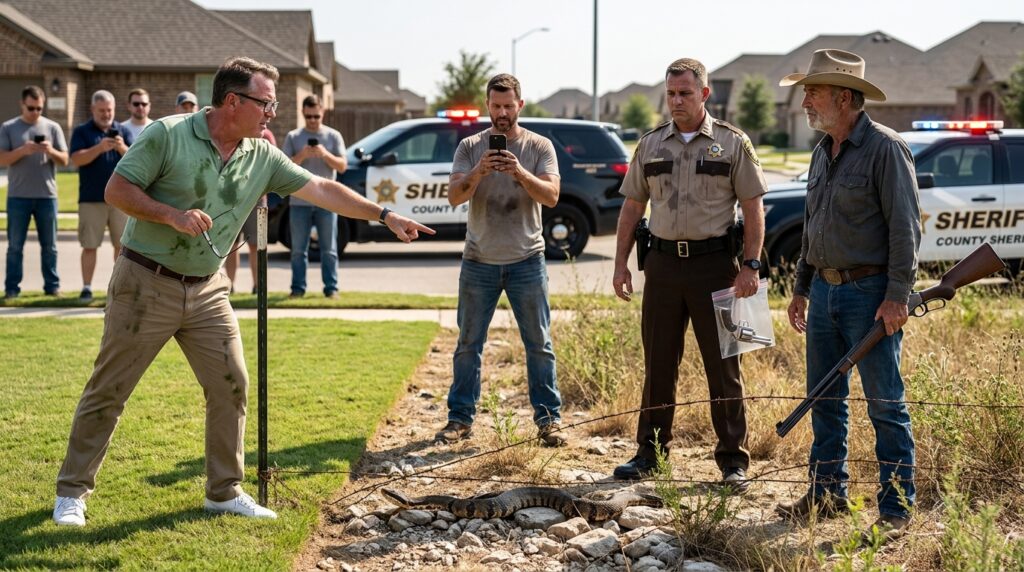
The scream came from the concrete sidewalk. Sheldon Vance was running down the park path, his white tennis shoes skidding on the loose gravel, his face twisted into an expression of unhinged panic. He wasn’t holding his clipboard. His hand was shoved deep into the waistband of his pressed golf shorts, pulling a small, nickel-plated Heritage revolver from the fabric. His arms shook as he leveled the barrel directly at Garett’s chest across the three-strand wire. “I knew it! I knew you were waiting for an excuse! You’re shooting at the houses! Drop the rifle or I swear to God I’ll put you down!”

The playground went completely rigid. The mothers lunged for their children, throwing their own bodies over the strollers as the scream of the false authority figure shattered the neighborhood. Garett froze, his boots planted in the dry weeds, his lever-action held low at his hip. He could see the cylinder of Sheldon’s revolver—it was loaded, the dull copper heads of the rimfire rounds visible in the chambers. Sheldon’s eyes were completely bloodshot behind his mirrored sunglasses, his teeth bared in an animalistic snarl of terror and manufactured righteousness.

“Put the gun down, Vance,” Garett said, his voice dropping into a hard, stone-cold floor. “The snake is dead. The shot went into the dirt. Look at the rock.”

“You’re a threat to the public infrastructure!” Sheldon shrieked, his finger tightening on the small trigger curved like a claw. “The green map says this is our line! You don’t have the right to fire! You don’t have the—”

He never finished the sentence. From the shadow of the picnic canopy, Miller—the quiet, thick-necked parent who had spent twenty years handling logistics for the infantry—stepped across the grass with a silent, heavy momentum. He didn’t yell. He didn’t warn. He came from Sheldon’s blind spot, his calloused left hand slapping down onto the top of the revolver’s frame, forcing his thumb deep into the gap between the hammer and the firing pin. With a single, explosive twist of his hips, Miller applied a leverage point that turned Sheldon’s wrist completely upside down.

The nickel-plated gun dropped into the grass with a dull clatter as Sheldon let out a sharp, choked gasp of pain, his knees buckling under the weight of the arm bar. Miller drove him face-first into the sod, pinning the HOA president’s shoulder with his boot.

“Call it in,” Miller said toward the patio deck, his voice perfectly level, his hand maintaining the lock on Sheldon’s arm. “Tell the deputy we’ve got an active brandishing call at the southern fence. And keep those cameras running.”

Garett didn’t move from his side of the wire. He looked down at Sheldon, whose face was now pressed into the expensive community sod he had spent months regulating. Beyond the perimeter, at the far end of the development road, a black commercial utility truck with the green pyramid logo of the Apex Land Trust sat idling near the corner lot, its tinted windows rolled up tight, its driver watching the entire collapse through the glass before slowly shifting into reverse. The decoy conflict had just shattered against the ground, but the heavy iron truth of the trap was still idling in the distance.

CHAPTER 5: THE SURVEYORS SHAME AND SUBDIVISION LIGHTS

The sirens cut through the heavy Texas air before the dust from the utility truck had even settled at the far intersection. Three county cruisers tore over the transition line where the clean subdivision asphalt gave way to the unpaved county easement, their tires throwing up thick plumes of white limestone powder. The red and blue strobe lights pulsed erratically against the uniform brick facades of Whispering Oaks, casting sharp, synthetic shadows across the manicured lawns.

Miller didn’t shift his weight. His heavy work boot remained anchored firmly between Sheldon Vance’s shoulder blades, maintaining just enough mechanical pressure to keep the man pinned to the sod without breaking the joint. Beneath him, the HOA president was gasping into the grass, his pristine white tennis shoes kicked sideways, his manicured fingers clawing helplessly at the expensive turf he had spent the last two months protecting with fines and regulations.

Deputy Marcus Briggs was the first out of the lead cruiser, his boots hitting the gravel road with a heavy, deliberate crunch. His hand hovered over his duty belt, but his gaze took in the entire perimeter in a single surveyor’s sweep: the dead cottonmouth on the limestone rocks, the nickel-plated Heritage revolver lying clear in the grass, the group of neighborhood fathers standing with their phones still raised to record, and Garett Hayes holding his lever-action rifle low, muzzle pointed safely into the dirt.

“Let him up, Miller,” Briggs said, his voice flat, carrying the absolute weight of the county’s authority.

Miller stepped back seamlessly, clearing the lane but keeping his arms relaxed at his sides. Sheldon scrambled to his knees, his designer polo shirt stained with damp mud and grass clippings, his hair plastered across his sweaty forehead. He reached out to grab at his reading glasses, which lay cracked near a fence post, before pointing a shaking, white-knuckled finger at Garett.

“Arrest him!” Sheldon shrieked, his voice cracking into a high, desperate register under the flashing lights. “He’s a public menace! He shot right into the residential safety zone! He threatened my life, Marcus! I was enforcing the municipal perimeter according to the regional overlay!”

Briggs didn’t look at Sheldon. He walked straight to the nickel-plated revolver, used a pen to lift it by the guard, and dropped it into a heavy plastic evidence pouch. Then he turned his head to look at the crowd of parents who had begun to edge closer to the wire. “Any of you folks see what happened here?”

Miller stepped forward, his phone already pulled from his pocket. “Vance pulled the revolver first. Mr. Hayes fired one suppressed shot directly into the embankment to neutralize a three-foot cottonmouth that had the kids pinned against the playground structure. I disarmed Vance when he threatened to shoot Hayes across the property line. I’ve got the whole transaction recorded from the third syllable.”

Two other fathers nodded, their faces grim under the hot sun, their own screens held up like legal shields. Sheldon’s face drained of color, his chest heaving as the absolute silence of the neighborhood crowd settled around him. The very community he had tried to dominate through strict compliance had turned their lenses on him, recording the exact moment his false authority cracked open.

Briggs stepped over to Sheldon, his heavy leather belt creaking as he reached for his iron handcuffs. “Your overlay map is a fraud, Sheldon. The county clerk’s office ran a title check on the Apex Regional Land Trust two hours ago. The trust intentionally shifted the grid coordinates on your association documents by twenty feet to provoke a boundary dispute with the Hayes estate. They wanted a public safety violation on record so they could file for a structural easement and seize the stock tank for their commercial phase.”

Sheldon froze, his hands dropping to his sides as the first steel cuff clicked around his right wrist. “What? No… the green folder. The directors gave me the structural map. They said it was verified by the regional development council.”

“The directors used you to clear the path, partner,” Garett said, his voice low, matching the steady rattle of the dry brush behind him. He stepped up to the wire, looking down at the man who had treated a two-hundred-year-old family legacy like an unapproved landscaping choice. “They knew I wouldn’t sell out to a commercial trust. So they found a man with a clipboard and enough rules in his head to make an enemy out of a neighbor. You weren’t protecting this park, Sheldon. You were just doing their paperwork for free.”

Briggs clicked the second cuff into place, pulling Sheldon to his feet with a rough, professional yank. “Let’s go, Sheldon. Pulling a loaded firearm on a citizen standing on his own deeded ground is felony aggravated assault. The county judge isn’t going to look at your association bylaws when the state plat map comes out in court.”

As the deputy led the silent, grass-stained president toward the back of the cruiser, the neighborhood fathers looked across the wire at Garett. The tension that had hung over the property line for weeks didn’t just break; it dissolved into the quiet reality of the dirt. Miller offered a short, disciplined nod across the barbed wire.

“Thanks for the shot, Mr. Hayes,” Miller said simply. “My kid was the one near the rocks.”

Garett tilted his hat brim, his calloused fingers settling back onto the leather reins as the horse shifted uncomfortably in the rising dust. “Just keep the grass trimmed on your side, Miller. The limestone always brings them out when the heat gets like this.”

The cruiser doors slammed shut, the flashing red-and-blue lights turning off as the cars backed down the development road, leaving the Whispering Oaks subdivision to return to its quiet, pristine grid. Garett turned the bay gelding back toward the center of his pasture, the old surveyor stake remaining anchored deep in the limestone behind him. The modern world could build its houses right up to the edge of the wire, but the dirt beneath the grass still belonged to the blood that had cleared it.

Similar Posts

Leave a Reply

Your email address will not be published. Required fields are marked *






