
CHAPTER 4: THE HEAT OF THE SNAKE LINE
The ring of the telephone at noon had the sharp, jagged rattle of a broken gear. It was one of the mothers from the park—her voice climbing an octave against the distant, high-pitched shrieks of children. A water moccasin, broad-bellied and black as charred pine, was sunning its three-pound weight on the decorative limestone tiering right where the subdivision playground met the creek easement. The local animal control dispatcher had already quoted a four-hour window, and the kids were cornered against the swing sets by a dead-end drop.
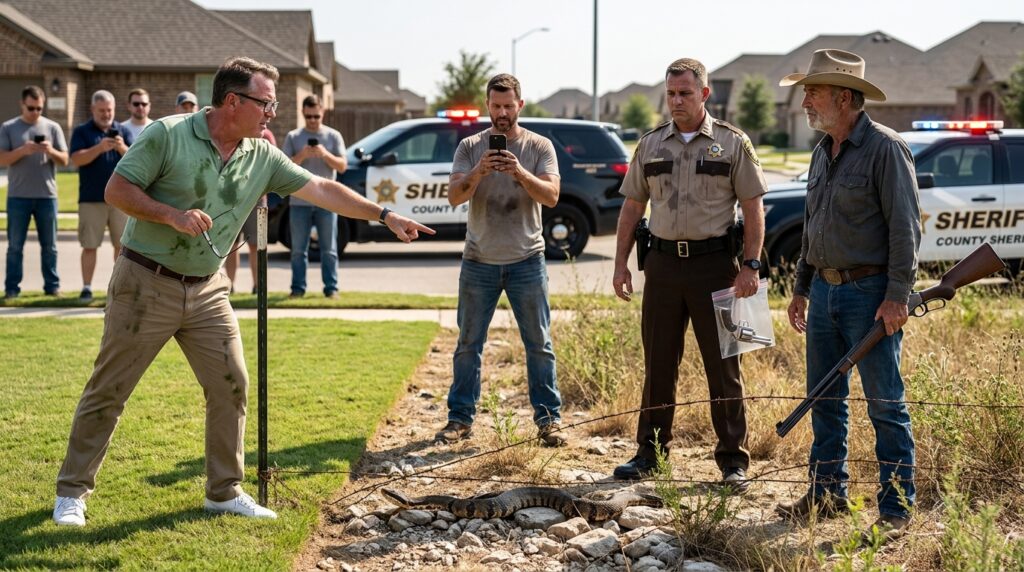
Garett didn’t waste breath on an answer. He took the gravel road on foot, his boots sinking into the white dust, his hand clamped hard around the cold steel receiver of the Henry .44 Magnum. The cylindrical weight of the legally registered suppressor hung heavy at the muzzle, a grey titanium tube that smelled of old oil and graphite. The midday air was a solid sheet of heat, vibrating with a thousand cicadas screaming in the scrub oaks. When he reached the southern wire, his eyes went straight to the limestone rocks. The cottonmouth was there, coiled like a frayed tractor belt, its triangular head lifted and its white mouth open in a silent, defensive warning.
“Get the kids back behind the curb line,” Garett ordered, his voice cutting flat across the grass. He didn’t look at the parents. His eyes were tracking the drop behind the rocks. A group of five fathers had stepped out from the shade of the patio decks, their faces dark with grease and sweat, their phones clearing their pockets as they watched the perimeter.
Garett planted his boot against the base of a cedar post, checking the angle. The playground structure was twenty yards to the left; the nearest brick house was clear by forty. He lifted the rifle, the heavy walnut stock settling into the hollow of his shoulder with a familiar, mechanical thud. He breathed out, letting the crosshairs rest right where the dark scales met the gray limestone.
The thud of the suppressed shot was low—a dull, pneumatic slap that barely shook the dry needles off the cedar branches. The heavy lead slug drove straight through the coiled center, shattering the limestone beneath into white dust and leaving the snake motionless against the rock.
A collective intake of breath went through the fathers at the curb, followed by the tentative murmur of relief. Garett lowered the lever, the brass casing ejecting into his palm with a hot, clean metallic click. He stepped toward the low wire to clear the carcass before the flies took it.
“Drop the weapon! Drop it right there, you crazy old bastard!”
The scream came from the concrete sidewalk. Sheldon Vance was running down the park path, his white tennis shoes skidding on the loose gravel, his face twisted into an expression of unhinged panic. He wasn’t holding his clipboard. His hand was shoved deep into the waistband of his pressed golf shorts, pulling a small, nickel-plated Heritage revolver from the fabric. His arms shook as he leveled the barrel directly at Garett’s chest across the three-strand wire. “I knew it! I knew you were waiting for an excuse! You’re shooting at the houses! Drop the rifle or I swear to God I’ll put you down!”
The playground went completely rigid. The mothers lunged for their children, throwing their own bodies over the strollers as the scream of the false authority figure shattered the neighborhood. Garett froze, his boots planted in the dry weeds, his lever-action held low at his hip. He could see the cylinder of Sheldon’s revolver—it was loaded, the dull copper heads of the rimfire rounds visible in the chambers. Sheldon’s eyes were completely bloodshot behind his mirrored sunglasses, his teeth bared in an animalistic snarl of terror and manufactured righteousness.
“Put the gun down, Vance,” Garett said, his voice dropping into a hard, stone-cold floor. “The snake is dead. The shot went into the dirt. Look at the rock.”
“You’re a threat to the public infrastructure!” Sheldon shrieked, his finger tightening on the small trigger curved like a claw. “The green map says this is our line! You don’t have the right to fire! You don’t have the—”
He never finished the sentence. From the shadow of the picnic canopy, Miller—the quiet, thick-necked parent who had spent twenty years handling logistics for the infantry—stepped across the grass with a silent, heavy momentum. He didn’t yell. He didn’t warn. He came from Sheldon’s blind spot, his calloused left hand slapping down onto the top of the revolver’s frame, forcing his thumb deep into the gap between the hammer and the firing pin. With a single, explosive twist of his hips, Miller applied a leverage point that turned Sheldon’s wrist completely upside down.
The nickel-plated gun dropped into the grass with a dull clatter as Sheldon let out a sharp, choked gasp of pain, his knees buckling under the weight of the arm bar. Miller drove him face-first into the sod, pinning the HOA president’s shoulder with his boot.
“Call it in,” Miller said toward the patio deck, his voice perfectly level, his hand maintaining the lock on Sheldon’s arm. “Tell the deputy we’ve got an active brandishing call at the southern fence. And keep those cameras running.”
Garett didn’t move from his side of the wire. He looked down at Sheldon, whose face was now pressed into the expensive community sod he had spent months regulating. Beyond the perimeter, at the far end of the development road, a black commercial utility truck with the green pyramid logo of the Apex Land Trust sat idling near the corner lot, its tinted windows rolled up tight, its driver watching the entire collapse through the glass before slowly shifting into reverse. The decoy conflict had just shattered against the ground, but the heavy iron truth of the trap was still idling in the distance.








