
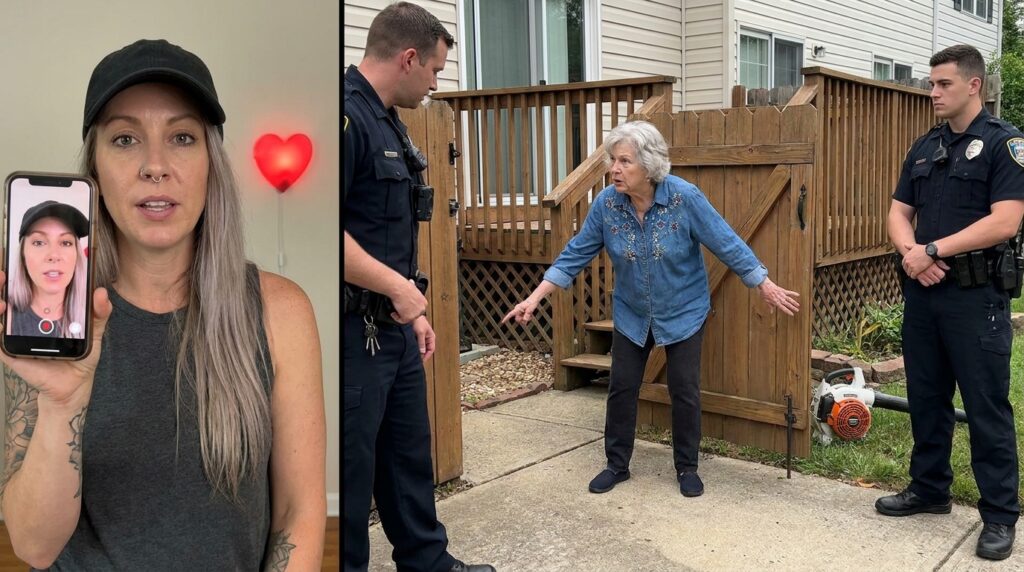
The Cold Physics of the Iron Latch and the Quiet Line Across the Driveway

CHAPTER 1: THE FRICTION AT THE THRESHOLD

The motor died with a low, whistling whine, the plastic impeller slowing until the air settled back onto the pine needles scattered across the deck boards. Heat rose from the dark composite planks in visible, shimmering waves, carrying the smell of dry sap and baked resin.

I kept my thumb resting over the black toggle switch, feeling the hum of the internal motor fade into my palm through the worn rubber grip. It was two in the afternoon on a Tuesday. The shadows of the townhouse chimneys pointed north, straight across the asphalt court, casting clean, rectangular bars over the gravel beds and trimmed boxwoods.

Then a shadow interrupted the light.

It didn’t glide; it moved with a heavy, rhythmic weight that rattled the loose stone along the driveway edge. I didn’t turn right away. In places like Oakridge Lane, turning too fast gave people the impression that you were waiting for them, or worse, that you owed them an explanation for standing on your own stain-sealed oak.

“You’re blowing dust onto my hood,” a voice called out. It wasn’t loud, but it had the dense, dry texture of someone who had spent thirty years shouting over lawnmowers and garbage trucks to make herself heard.

I let the leaf blower tip down until the nozzle rested against the toe of my work boot. When I finally looked toward the lane, Evelyn was already past the mailbox post. Her blue embroidered denim shirt was buttoned straight to the throat despite the eighty-degree sun, the stiff fabric creaking slightly as she squared her shoulders. Her short gray hair sat tight against her skull, motionless in the light breeze.

“The wind is blowing west, Evelyn,” I said. My voice sounded flat against the high brick firewall separating our units. “Everything’s going into my bag.”

“Don’t tell me where the wind goes,” she said, taking two long steps off the shared asphalt and onto the flagstone path leading to my side gate. Her dark trousers scraped together with every stride. “I’ve lived on this court since the asphalt was wet. I know how the dust moves between these walls.”

She reached the wooden gate. The latch was an old piece of cast iron, heavy and pitted by winters of salt air. I had oiled it three days ago; it moved without a sound when I used it.

Evelyn didn’t ask. She didn’t pause to see if the hinge was clear. She slammed her palm against the top rail, lifting the iron tongue out of its notch with a sharp, metallic ring that cut straight through the drone of a distant air conditioner.

The gate swung inward, hitting the wooden stop with a dull thud.

“Step back off the deck, Evelyn,” I said. I didn’t raise my voice. I didn’t step forward either. I stood beside the patio table, my fingers resting on the plastic casing of the leaf blower, keeping my boots planted six inches behind the dark line where the stained wood met the stone threshold.

She took the step anyway. Her rubber-soled shoe came down hard on the oak board, crossing the threshold into the enclosed space. Her hand came up, index finger extended, pointing directly at the center of my chest from less than two feet away.

“You think because you bought a piece of paper at a bank three months ago that you own the air on this lane?” her voice dropped an octave, tight with a long-accumulated heat. “You don’t own a thing here until you respect the people who built it.”

I looked at her finger, then at the blue denim seam stretched tight across her shoulder. In the corner of the doorframe behind me, six inches above the glass, a tiny green light flickered once as the automated lens adjusted to the shifting light.


CHAPTER 2: THE PAPERWORK IN THE BLUE DENIM

Evelyn didn’t pull her hand back. Her finger remained hovering two inches from my sternum, the skin around her knuckle pale and tight where the blue denim sleeve met her wrist. Up close, the fabric smelled of lavender detergent and stale engine exhaust from the lawnmowers that circled the townhouse court every Thursday morning.

“You think a green light on a plastic camera frightens me?” she rasped. Her voice had the dry, scratching sound of fine sandpaper dragging over rusted iron. “I was dropping off property tax assessments at the county courthouse before your parents were out of high school.”

“You’re past the latch, Evelyn,” I said. My thumb remained hooked over the rubber handle of the leaf blower, the cold plastic housing resting against my thigh. “I don’t care about the assessment. I care about the six inches of oak you’re standing on.”

She let out a single, wet bark of a laugh that didn’t reach her eyes. Instead of stepping back toward the flagstones, her eyes drifted down to the deck boards beneath her rubber soles. Her foot shifted slightly, the heavy tread dragging a trail of dry pine needles across the dark composite finish.

“You don’t even know what you bought,” she said, her tone dropping into something far colder than anger—a quiet, arrogant certainty. “You sat at a closing table in a air-conditioned title office, signed forty pages of paper you didn’t read, and thought you bought the ground beneath your boots. You didn’t buy the land, son. You bought the air between the drywall.”

She reached down with her left hand, her fingers digging into the deep side pocket of her denim button-up.

I didn’t move, but my eye caught the corner of what she pulled out: a folded sheet of heavy, yellowed paper, thick enough to be cardstock, its edges frayed and darkened by years of thumb marks. Across the visible fold, drawn in dried red ink that had faded to the color of rust, was a hand-drawn line intersecting a printed square.

“What’s that?” I asked.

“This is the 1998 Master Covenant,” she said, holding the paper close to her chest like a hand of cards, refusing to extend it across the space between us. “Signed by the original board before the developer went bankrupt and sold off the eastern parcels to the county. You think this gate belongs to you? This entire four-foot strip—from the edge of your firewall to the curb—is an unrecorded common-element easement. I have the right to inspect it whenever there’s a nuisance.”

The word easement hung in the muggy air, heavy and sharp. Across the asphalt lane, the metallic scrape of a garage door opening echoed off the brick facades. Old man Miller stood in the shadow of his doorway, holding a yellow plastic rake, his head tilted sideways as he watched us over the top of his reading glasses.

I looked at the yellowed paper in her hand. The red ink was old, but the crease across the page was fresh—crisp and white, as if it had been refolded a hundred times in the last forty-eight hours.

“The county surveyor was out here in May, Evelyn,” I said, keeping my posture square, my eyes locked on the stiff collar of her shirt. “The pins are buried eighteen inches deep at the corner of the firewall. The survey doesn’t show a common easement.”

“The county surveyor doesn’t have the original plat,” she snapped, her knuckles whitening around the paper. “They used the 2012 digital re-mapping. They erased the covenant. But paper doesn’t lie, and I didn’t spend twenty-five years watching this lane fall apart just to let some newcomer blow dust onto my driveway and claim he owns the dirt.”

She took another half-step forward, her toe striking the base of the patio table. The cheap aluminum legs rattled against the deck, and a plastic cup half-filled with lukewarm water sloshed over the rim, spilling a dark wet circle onto the wood.

“You’re going to put that machine in your garage,” she said, her voice dropping into a low, rhythmic cadence that sounded like a judicial sentence. “You’re going to leave the gate unlatched so the drainage crew can check the downspout tomorrow. And if I hear that engine before four o’clock on a weekday again, I won’t stand on your deck and talk. I’ll have the board lien your unit before the sun sets.”

She turned her body slightly, as if preparing to march back out through the open gate, satisfied that the weight of her paper had crushed whatever resistance I had left.

“Evelyn,” I said softly.

She paused, her shoulder stiffening beneath the blue denim.

“You’ve been slipping those printed violation notices into my mailbox since the day I moved in,” I said, stepping toward the center of the patio, my boots making a slow, deliberate crunch over the dry pine needles. “Unapproved porch light color. Trash cans out two hours early. Grass height three-eighths of an inch over code. I kept them all in a folder by my desk.”

She didn’t turn around, but her head tilted backward slightly.

“I noticed something about those notices,” I continued, pointing a finger toward the dark lens of the door camera. “None of them were signed by the HOA board. They were all signed by you. And every single one of them mentions that paper in your pocket.”

“Because I’m the only one on this court who remembers how things are supposed to be,” she growled, turning her head just enough to show the sharp, lined profile of her jaw.

“No,” I said. “Because if there was a real easement on this deck, you wouldn’t be standing here trying to scare me with a twenty-eight-year-old drawing. You would have brought the county marshal six weeks ago.”

Evelyn’s mouth snapped shut into a thin, white line. For the first time since she had slammed her hand against the iron latch, her eyes flicked toward the camera above the sliding door, then back to my face. The confidence in her posture didn’t shatter—it hardened into something far more dangerous.

She shoved the yellowed paper back into her denim pocket, the thick cardstock crumpling slightly against the stiff fabric.

“You think you’re clever because you have a video camera and a folder of paper,” she whispered, her voice barely carrying past the gate. “You think the law is what’s written on a county website. You’ll learn what the law is on this lane when you try to sell this place and realize nobody can cross your driveway without my signature.”

She turned sharply toward the opening of the gate, her dark trousers rustling with the motion. But as she reached for the wooden post to propel herself back out onto the flagstone path, her foot caught the edge of the leaf blower’s rubber nozzle resting against the deck floor.

She stumbled, her arm flailing sideways to catch her balance—and her hand didn’t grab the wooden gate post.

It reached out and clamped down hard on my upper forearm, her short, blunt fingernails digging straight through the cotton of my sleeve and into the flesh beneath.

CHAPTER 3: THE IMPRINT OF THE UNLATCHED GATE

The grip was cold—a sudden, biting pressure through the cotton sleeve that pinched the skin directly over the radial bone. Evelyn’s fingers didn’t possess fluid strength; they were rigid, anchored by the desperate reflex of a person falling off a ledge.

I didn’t swing my arm. I didn’t push back against the blue denim shoulder leaning heavily into my line of sight.

Instead, I stepped backward along the grain of the oak composite boards, taking two measured inches of distance until my right boot heel hit the iron base of the patio table. The movement pulled my forearm straight out of her hand, the coarse denim of her cuff dragging against my forearm with the sound of dry canvas slipping over wood. Her fingers slid off, leaving five distinct red indentations stamped onto the pale cloth of my shirt.

She caught her weight against the gate post, her palm slapping against the weathered wood with a heavy thwack. Her breath came out short and shallow, rattling against her throat like dry pea gravel shaken in a tin can.

“You put your hands on me,” I said. My voice didn’t rise; it stayed low and flat, matching the static hum of the heat sitting over the asphalt court.

Evelyn’s head snapped up. The short gray hair bristled around her ears, her lined face flushing a dark, mottled purple that spread down beneath the buttoned collar of her shirt. “You tripped me! You left that damn machine right where people walk!”

“I’m six feet inside my gated deck, Evelyn,” I said, raising my left hand and pointing a single, motionless index finger toward the dark glass bubble resting in the corner of the doorframe. “You opened the latch. You crossed the threshold. And you laid hands on my arm.”

Her eyes flicked to the small camera lens. The little green light blinked once—a silent, mechanical confirmation of the frame rate recording every square inch of the deck.

For two seconds, the lane was totally silent. The distant air conditioner cycling off across the court left only the faint sound of cicadas grinding in the oak trees behind the firewall. Down the asphalt, Old Man Miller lowered his yellow rake, his shoes scraping against the gravel as he took a cautious step closer to his driveway line.

“You think that little box makes you safe?” Evelyn whispered. Her voice had lost its shrill, sharp edge; it had turned dark, dry, and thick with a bitter density. “You think a city magistrate gives a damn about six inches of oak deck when there’s twenty-eight years of precedent on this lane?”

She reached into her dark trousers, her hand trembling slightly as she adjusted the yellowed paper sticking out of her shirt pocket. As she pulled her hand back, her thumb brushed against a small, rusted iron ring hooked into the interior housing of the gate hinge—an old, brass-notched key I hadn’t noticed before, hanging silently behind the latch, its surface stamped with a faint, worn three-digit code.

Her eyes caught mine looking at the key. A strange, guarded shadow crossed her face—not fear, but a sudden, instinctual defensiveness that went far deeper than the noise complaint or the leaf blower. She pulled her hand away from the gate hinge instantly, her arm dropping to her side as if she’d been burned by the oxidized metal.

“Leave the gate unlatched,” she growled, her voice tight as a drawn wire. “Or you’ll find out what this court really costs.”

She didn’t wait for a response. She turned her body, her rubber-soled shoes grinding the spilled pine needles into the wood as she stepped back through the opening. She didn’t bother to pull the gate shut behind her. She walked down the flagstone path with short, stiff strides, her blue denim shirt rigid against her back, her shoulders squared like a soldier retreating from a barricade she still believed she owned.

I didn’t follow her out to the stones. I stood motionless on the patio deck, feeling the heat radiate up from the floorboards through the soles of my work boots. My right forearm throbbed with a dull, rhythmic ache where her fingers had clamped down.

I turned slowly, walked to the sliding glass door, and tapped the small black screen mounted to the interior wall.

The display flickered to life in high definition. On the wide-angle feed, the entire sequence played out in crystal-clear color: the heavy blue shirt marching down the lane, the hand reaching out to lift the iron latch without permission, the boots crossing the threshold, the finger pointing inches from my face, and finally, the clear, undeniable angle of her hand lunging forward and clamping hard onto my forearm.

I reached out and pressed the red button at the bottom of the interface.

The screen prompted: EXPORT FOOTAGE TO MUNICIPAL DISPATCH?

I hit YES.

Across the court, Evelyn reached her driveway. She didn’t head for her front door. Instead, she walked straight toward the heavy double doors of her garage, her hand reaching into her pocket for the remote control. The automatic opener groaned, the rusted springs echoing across the quiet neighborhood as the heavy wooden door began to lift into the dark, sunless interior.

She stood in the center of the asphalt, waiting for the gap to widen, her back turned to the lane. But she wasn’t looking inside her garage. She was staring down at her right hand—the hand that had grabbed my arm—wiping her palm repeatedly against the stiff, blue denim of her trousers as if trying to scrape away something that wouldn’t come off.

Behind me, down the main access road of the development, the low, distinct rumble of an approaching V8 engine echoed off the brick townhouses. A white-and-black patrol car turned the corner, its tires humming against the hot pavement as it turned into Oakridge Lane.

CHAPTER 4: THE DECOY ON THE YELLOWED PAGE

The patrol car didn’t flash its lightbar. It rolled to a stop at the mouth of the cul-de-sac, its tires crunching over the loose gravel near the storm drain. The driver’s side door creaked open, spilling the sharp smell of hot engine oil and rubber into the muggy afternoon air.

Officer Miller stepped out first. His dark uniform shirt was crisp, the high-visibility tactical vest pulling tight across his chest as he adjusted his duty belt. He didn’t rush. He paused by the rear quarter panel, his eyes taking in the layout of the court—Old Man Miller watching from his driveway, the open wooden gate of my patio, and Evelyn standing motionless halfway inside her darkening garage.

“Afternoon,” Officer Miller said. His voice was low, carrying the smooth, practiced neutrality of someone who handled twenty domestic property disputes a week. He walked up the flagstone path toward my deck, his boots making a clean, rhythmic clicking sound on the stone.

“Officer,” I said, staying inside the boundary of the oak boards. “Thanks for coming out quickly.”

“Dispatch logged a call regarding an active trespass and unwanted physical contact,” Miller said, stopping just outside the open wooden gate. He looked down at the threshold, taking in the open latch, the scattered pine needles, and the electric leaf blower sitting idle by the aluminum patio table. “You the homeowner?”

“I am. I have the video recorded on the door system right here,” I said, holding up my phone with the exported clip paused at the key frame. “She unlatched the gate, walked onto private property, refused three verbal requests to step back, and grabbed my arm when I told her she was trespassing.”

Miller leaned in slightly, his eyes narrowing as he watched the six-second loop play on the screen. He saw the denim sleeve move, the latch lift, the boot cross the oak threshold, and the clear, distinct grip of her fingers clamping down over my forearm. He didn’t comment. He pulled a small black notepad from his chest pocket and clicked his pen.

“Stay right here for a second,” Miller said. He turned and walked down the path toward Evelyn’s driveway, his broad shoulders cutting through the shimmering heat haze rising off the pavement.

Evelyn hadn’t moved into the house. She stood beside the front bumper of her Buick inside the garage, her hands tucked deep into the pockets of her blue denim shirt. As the officer approached, she stepped out onto the sunlit asphalt, her posture instantly stiffening into an posture of aggrieved authority.

“Officer, I’m glad you’re here,” she began, her voice carrying across the lane like a dry whip. “This young man has been running heavy machinery during restricted quiet hours and threatening the structural integrity of the common easement—”

“Ma’am,” Officer Miller interrupted, his tone even, unhurried, but unyielding. “I need you to step back from the vehicle and answer a few questions about what happened at the gate five minutes ago.”

Evelyn’s jaw set into a hard, pale line. “I am a founding member of the Oakridge Homeowners Board, Officer. I was performing a routine inspection under the 1998 Covenant—”

She yanked the folded, yellowed paper from her denim shirt pocket and thrust it toward Miller’s chest. “It’s right here! Page four, section C! An unrecorded common-element easement four feet from the firewall! I have full legal right to access the drainage utility!”

Miller took the document with a slow, deliberate movement. He unfolded the thick cardstock, the dry paper crackling loudly in the quiet court. He scanned the yellowed lines of text, his thumb tracing the faded red ink border that crossed the printed square.

I stepped off the deck and walked to the edge of my driveway, staying ten feet back, watching Miller’s face.

“Ma’am,” Miller said, turning the page over. “This is a document from twenty-eight years ago. It’s an unsigned draft proposal for a utility corridor that was never recorded with the county clerk.”

“It was recorded!” Evelyn insisted, her voice rising an octave, her finger pointing violently at a seal stamped on the back page. “Look at the notary stamp! Look at the addendum! It explicitly lists the access code for the utility chest behind his gate!”

Miller frowned, his eyes shifting to the bottom addendum. “Addendum B… ‘Access key code 412 assigned to common box behind Lot 14.'” He looked up from the paper, his gaze shifting from Evelyn to me, then back to the iron latch on my gate.

I felt a cold prickle along the back of my neck. Code 412.

My mind immediately flashed back to the brass key hanging from the rusted iron ring inside my gate hinge housing—the one stamped with a three-digit code I hadn’t been able to read earlier.

“There is no utility chest behind my gate, Officer,” I said firmly, taking a step closer to the driveway line. “There’s a solid brick firewall and an oak deck built four years ago with full county permits. That document is a decoy—a dead agreement from a bankrupt developer.”

Evelyn’s head snapped toward me, her eyes wide, glistening with a sudden, feral intensity. “It’s not a dead agreement! The easement exists! The key is still there! You built over the common ground without authorization!”

Officer Miller held up a hand, halting her mid-shout. He folded the paper back along its white, worn creases and held it in his left palm. His face had lost its casual demeanor.

“Whether there’s a dispute over an easement or an old HOA document, ma’am,” Miller said, his voice dropping into a stern, authoritative register that echoed off the garage doors, “you cannot take the law into your own hands. You opened a closed gate, you entered space occupied by the resident, and according to clear video evidence, you made physical contact with his body.”

Evelyn recoiled as if she’d been struck, her denim-clad frame shuddering. “He… he tripped me! It was an accident!”

“The video doesn’t show an accident, Evelyn,” Miller said flatly. He turned to face her fully, blocking her path back toward the garage. “Now, I need you to stand right here while I run your driver’s license and complete this report.”

She stood frozen on the hot asphalt, her blue shirt looking suddenly too large for her narrow shoulders. But as Officer Miller turned his back for a brief second to radio his dispatch, her eyes locked onto mine across the driveway.

She didn’t look defeated. Her lips curved into a bitter, triumphant sliver of a smile, and her right hand twitched against her pocket—pointing subtly toward the yellowed document Miller held in his grip.

She wanted us to focus on that 1998 paper. She wanted the police, the county, and me to fight over an obsolete easement and a brass key code. The paper was a shield, a carefully constructed lie designed to trap me in a legal maze while keeping the real truth—the truth about why she was so terrified of anyone touching that firewall—buried where no survey had ever looked.

CHAPTER 5: THE DISPASSIONATE RESET

Officer Miller tapped the side of his radio, his shoulder radio mic crackling with a burst of static that cut through the humid silence of the court.

“Dispatch, unit 104,” he said into the shoulder mic. “I need a wants and warrants check on a subject, plus a preliminary call log for Lot 14 and Lot 15 on Oakridge Lane.”

Evelyn didn’t move from the edge of her driveway. The afternoon sun beat down directly onto the top of her gray head, making her scalp glow white beneath her thin, styled curls. She kept her hands stuffed into her deep denim pockets, but her knuckles were visibly bulging against the stiff cloth, rigid as stone blocks.

I turned my back on her and walked through the open wooden gate, returning to the center of the patio deck. The heat trapped between the brick firewall and the composite boards felt dense, almost physical, smelling of dry pine needles and warmed sealant.

I knelt beside the gate post. The cast-iron latch assembly was anchored by three three-inch lag screws driven straight into the pressure-treated oak. But behind the iron housing, right where the gate post met the brick firewall, sat the small rusted ring Evelyn had brushed past earlier.

I reached out, my fingers coated in gritty dust, and lifted the notched brass key out of its shadow.

It hung on an oxidized iron loop attached to a thin, rectangular strip of metal bolted directly into the mortar line between the bottom two bricks. I scraped a thumb over the metal strip. Green copper verdigris flaked off under my nail, revealing faint, machine-stamped lettering beneath the grime:

USGS / MONUMENT 1984 – COUNTY SUBDIVISION TRACT 09

My chest tightened. I stared at the numbers stamped on the copper plate, then at the brass key stamped 412.

The 1998 document she had thrust at Officer Miller claimed this four-foot strip was a common-element easement for a utility chest. But the copper plate bolted into my firewall wasn’t an HOA utility marker. It was a county boundary monument tag from 1984—four years before the developer broke ground on these townhouses, and fourteen years before her draft covenant was drawn up.

“Find something?”

Officer Miller’s heavy boots clicked against the flagstones as he returned to the open gate. He held his notepad in one hand and a black digital tablet in the other. Across the lawn, the second patrol officer—the supporting officer who had arrived quietly without siren—stood near the edge of Evelyn’s driveway, his hands folded across his duty belt, keeping his body positioned squarely between Evelyn and her garage door.

“Look at this, Officer,” I said, pointing down at the base of the firewall. I didn’t touch the brass key again, keeping my hands low and clear. “She told you the 1998 agreement gave her access to a common utility chest behind my gate.”

Miller leaned down, his tactical vest creaking as he squinted at the green-encrusted copper tag pinned to the mortar. He tapped the screen of his tablet, opening a county GIS mapping overlay.

“That’s a benchmark pin,” Miller said, his voice dropping into a flat, professional tone. “County engineers set those when they survey original parcel splits.”

“Right,” I said. “And if you check the digital parcel map for Lot 14, my boundary line doesn’t end at the deck. It goes two feet past the firewall into the gravel strip beside her house.”

Miller looked up from the tablet, his eyes shifting toward Evelyn.

She was watching us. She hadn’t heard my low voice, but she saw Miller looking at the base of the brick wall. Her face, already pale from the confrontation, drained of what little color remained. Her jaw worked silently, her mouth opening and closing like a fish pulled onto dry dock.

“She doesn’t care about the leaf blower,” I said softly, standing up and brushing the mortar dust from my knees. “And she doesn’t care about an HOA easement. That 1998 paper was a decoy to keep anyone from looking at where her driveway actually sits.”

Miller didn’t answer immediately. He zoomed in on his tablet screen, his thumb dragging across the satellite view of the property line. A thin red line on the screen cut straight through the concrete apron of Evelyn’s garage—meaning three feet of her driveway was poured directly over private land belonging to my parcel.

“Her whole garage apron is built on your deeded plot,” Miller murmured, looking at the screen, then at the clean brick line of my house. “If you ever enforce your legal boundary or put up a fence past this gate, she loses vehicle access to her garage.”

The entire picture clicked into place with the cold, unyielding friction of iron teeth locking together. The petty mailbox notes. The obsession with quiet hours. The shouting matches over two minutes of leaf-blower noise. The desperate, frantic push to keep this gate unlatched and claim the four-foot strip as a ‘common area.’

She hadn’t been defending community standards for twenty-five years. She had been defending a stolen three-foot strip of concrete, terrified that a new owner would read a survey, look past her fake rules, and lock her out of her own driveway.

Miller tapped his radio mic again. “Dispatch, hold on the preliminary report. Send code enforcement to Lot 15 for a boundary encroachment verification.”

He turned back toward the lane. “Ma’am,” he called out, his voice cutting clean and sharp through the muggy air of the cul-de-sac. “I need you to step over here to the patrol car. We have a few more things to discuss regarding this property line.”

Evelyn didn’t move. She stood rooted to her asphalt, her hand clutching the folded 1998 paper in her pocket so hard the cardstock snapped along its center fold with a muffled, dry crack.

Similar Posts

Leave a Reply

Your email address will not be published. Required fields are marked *






