
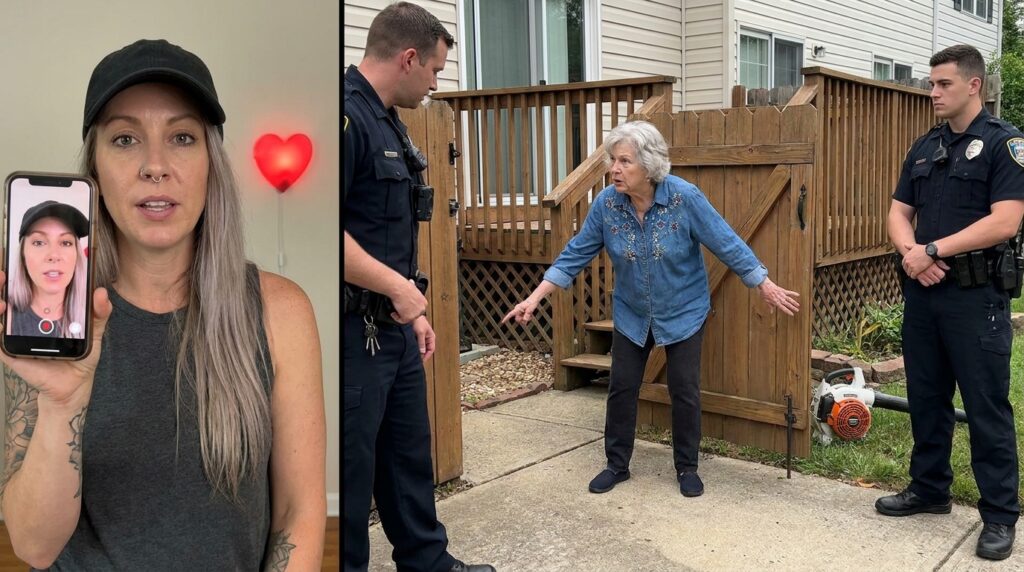
CHAPTER 3: THE IMPRINT OF THE UNLATCHED GATE
The grip was cold—a sudden, biting pressure through the cotton sleeve that pinched the skin directly over the radial bone. Evelyn’s fingers didn’t possess fluid strength; they were rigid, anchored by the desperate reflex of a person falling off a ledge.
I didn’t swing my arm. I didn’t push back against the blue denim shoulder leaning heavily into my line of sight.
Instead, I stepped backward along the grain of the oak composite boards, taking two measured inches of distance until my right boot heel hit the iron base of the patio table. The movement pulled my forearm straight out of her hand, the coarse denim of her cuff dragging against my forearm with the sound of dry canvas slipping over wood. Her fingers slid off, leaving five distinct red indentations stamped onto the pale cloth of my shirt.
She caught her weight against the gate post, her palm slapping against the weathered wood with a heavy thwack. Her breath came out short and shallow, rattling against her throat like dry pea gravel shaken in a tin can.
“You put your hands on me,” I said. My voice didn’t rise; it stayed low and flat, matching the static hum of the heat sitting over the asphalt court.
Evelyn’s head snapped up. The short gray hair bristled around her ears, her lined face flushing a dark, mottled purple that spread down beneath the buttoned collar of her shirt. “You tripped me! You left that damn machine right where people walk!”
“I’m six feet inside my gated deck, Evelyn,” I said, raising my left hand and pointing a single, motionless index finger toward the dark glass bubble resting in the corner of the doorframe. “You opened the latch. You crossed the threshold. And you laid hands on my arm.”
Her eyes flicked to the small camera lens. The little green light blinked once—a silent, mechanical confirmation of the frame rate recording every square inch of the deck.
For two seconds, the lane was totally silent. The distant air conditioner cycling off across the court left only the faint sound of cicadas grinding in the oak trees behind the firewall. Down the asphalt, Old Man Miller lowered his yellow rake, his shoes scraping against the gravel as he took a cautious step closer to his driveway line.
“You think that little box makes you safe?” Evelyn whispered. Her voice had lost its shrill, sharp edge; it had turned dark, dry, and thick with a bitter density. “You think a city magistrate gives a damn about six inches of oak deck when there’s twenty-eight years of precedent on this lane?”
She reached into her dark trousers, her hand trembling slightly as she adjusted the yellowed paper sticking out of her shirt pocket. As she pulled her hand back, her thumb brushed against a small, rusted iron ring hooked into the interior housing of the gate hinge—an old, brass-notched key I hadn’t noticed before, hanging silently behind the latch, its surface stamped with a faint, worn three-digit code.
Her eyes caught mine looking at the key. A strange, guarded shadow crossed her face—not fear, but a sudden, instinctual defensiveness that went far deeper than the noise complaint or the leaf blower. She pulled her hand away from the gate hinge instantly, her arm dropping to her side as if she’d been burned by the oxidized metal.
“Leave the gate unlatched,” she growled, her voice tight as a drawn wire. “Or you’ll find out what this court really costs.”
She didn’t wait for a response. She turned her body, her rubber-soled shoes grinding the spilled pine needles into the wood as she stepped back through the opening. She didn’t bother to pull the gate shut behind her. She walked down the flagstone path with short, stiff strides, her blue denim shirt rigid against her back, her shoulders squared like a soldier retreating from a barricade she still believed she owned.
I didn’t follow her out to the stones. I stood motionless on the patio deck, feeling the heat radiate up from the floorboards through the soles of my work boots. My right forearm throbbed with a dull, rhythmic ache where her fingers had clamped down.
I turned slowly, walked to the sliding glass door, and tapped the small black screen mounted to the interior wall.
The display flickered to life in high definition. On the wide-angle feed, the entire sequence played out in crystal-clear color: the heavy blue shirt marching down the lane, the hand reaching out to lift the iron latch without permission, the boots crossing the threshold, the finger pointing inches from my face, and finally, the clear, undeniable angle of her hand lunging forward and clamping hard onto my forearm.
I reached out and pressed the red button at the bottom of the interface.
The screen prompted: EXPORT FOOTAGE TO MUNICIPAL DISPATCH?
I hit YES.
Across the court, Evelyn reached her driveway. She didn’t head for her front door. Instead, she walked straight toward the heavy double doors of her garage, her hand reaching into her pocket for the remote control. The automatic opener groaned, the rusted springs echoing across the quiet neighborhood as the heavy wooden door began to lift into the dark, sunless interior.
She stood in the center of the asphalt, waiting for the gap to widen, her back turned to the lane. But she wasn’t looking inside her garage. She was staring down at her right hand—the hand that had grabbed my arm—wiping her palm repeatedly against the stiff, blue denim of her trousers as if trying to scrape away something that wouldn’t come off.
Behind me, down the main access road of the development, the low, distinct rumble of an approaching V8 engine echoed off the brick townhouses. A white-and-black patrol car turned the corner, its tires humming against the hot pavement as it turned into Oakridge Lane.








