
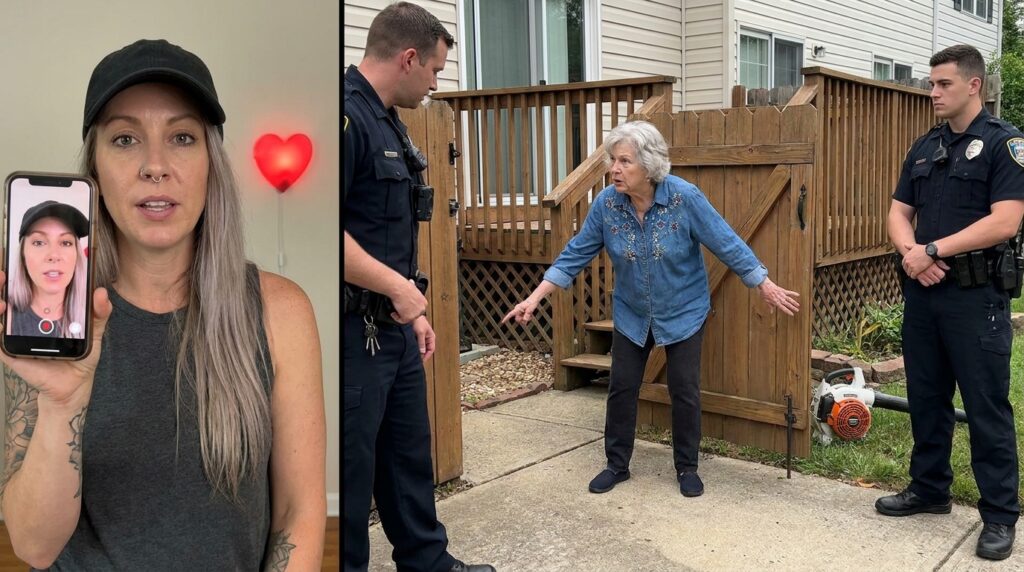
CHAPTER 2: THE PAPERWORK IN THE BLUE DENIM
Evelyn didn’t pull her hand back. Her finger remained hovering two inches from my sternum, the skin around her knuckle pale and tight where the blue denim sleeve met her wrist. Up close, the fabric smelled of lavender detergent and stale engine exhaust from the lawnmowers that circled the townhouse court every Thursday morning.
“You think a green light on a plastic camera frightens me?” she rasped. Her voice had the dry, scratching sound of fine sandpaper dragging over rusted iron. “I was dropping off property tax assessments at the county courthouse before your parents were out of high school.”
“You’re past the latch, Evelyn,” I said. My thumb remained hooked over the rubber handle of the leaf blower, the cold plastic housing resting against my thigh. “I don’t care about the assessment. I care about the six inches of oak you’re standing on.”
She let out a single, wet bark of a laugh that didn’t reach her eyes. Instead of stepping back toward the flagstones, her eyes drifted down to the deck boards beneath her rubber soles. Her foot shifted slightly, the heavy tread dragging a trail of dry pine needles across the dark composite finish.
“You don’t even know what you bought,” she said, her tone dropping into something far colder than anger—a quiet, arrogant certainty. “You sat at a closing table in a air-conditioned title office, signed forty pages of paper you didn’t read, and thought you bought the ground beneath your boots. You didn’t buy the land, son. You bought the air between the drywall.”
She reached down with her left hand, her fingers digging into the deep side pocket of her denim button-up.
I didn’t move, but my eye caught the corner of what she pulled out: a folded sheet of heavy, yellowed paper, thick enough to be cardstock, its edges frayed and darkened by years of thumb marks. Across the visible fold, drawn in dried red ink that had faded to the color of rust, was a hand-drawn line intersecting a printed square.
“What’s that?” I asked.
“This is the 1998 Master Covenant,” she said, holding the paper close to her chest like a hand of cards, refusing to extend it across the space between us. “Signed by the original board before the developer went bankrupt and sold off the eastern parcels to the county. You think this gate belongs to you? This entire four-foot strip—from the edge of your firewall to the curb—is an unrecorded common-element easement. I have the right to inspect it whenever there’s a nuisance.”
The word easement hung in the muggy air, heavy and sharp. Across the asphalt lane, the metallic scrape of a garage door opening echoed off the brick facades. Old man Miller stood in the shadow of his doorway, holding a yellow plastic rake, his head tilted sideways as he watched us over the top of his reading glasses.
I looked at the yellowed paper in her hand. The red ink was old, but the crease across the page was fresh—crisp and white, as if it had been refolded a hundred times in the last forty-eight hours.
“The county surveyor was out here in May, Evelyn,” I said, keeping my posture square, my eyes locked on the stiff collar of her shirt. “The pins are buried eighteen inches deep at the corner of the firewall. The survey doesn’t show a common easement.”
“The county surveyor doesn’t have the original plat,” she snapped, her knuckles whitening around the paper. “They used the 2012 digital re-mapping. They erased the covenant. But paper doesn’t lie, and I didn’t spend twenty-five years watching this lane fall apart just to let some newcomer blow dust onto my driveway and claim he owns the dirt.”
She took another half-step forward, her toe striking the base of the patio table. The cheap aluminum legs rattled against the deck, and a plastic cup half-filled with lukewarm water sloshed over the rim, spilling a dark wet circle onto the wood.
“You’re going to put that machine in your garage,” she said, her voice dropping into a low, rhythmic cadence that sounded like a judicial sentence. “You’re going to leave the gate unlatched so the drainage crew can check the downspout tomorrow. And if I hear that engine before four o’clock on a weekday again, I won’t stand on your deck and talk. I’ll have the board lien your unit before the sun sets.”
She turned her body slightly, as if preparing to march back out through the open gate, satisfied that the weight of her paper had crushed whatever resistance I had left.
“Evelyn,” I said softly.
She paused, her shoulder stiffening beneath the blue denim.
“You’ve been slipping those printed violation notices into my mailbox since the day I moved in,” I said, stepping toward the center of the patio, my boots making a slow, deliberate crunch over the dry pine needles. “Unapproved porch light color. Trash cans out two hours early. Grass height three-eighths of an inch over code. I kept them all in a folder by my desk.”
She didn’t turn around, but her head tilted backward slightly.
“I noticed something about those notices,” I continued, pointing a finger toward the dark lens of the door camera. “None of them were signed by the HOA board. They were all signed by you. And every single one of them mentions that paper in your pocket.”
“Because I’m the only one on this court who remembers how things are supposed to be,” she growled, turning her head just enough to show the sharp, lined profile of her jaw.
“No,” I said. “Because if there was a real easement on this deck, you wouldn’t be standing here trying to scare me with a twenty-eight-year-old drawing. You would have brought the county marshal six weeks ago.”
Evelyn’s mouth snapped shut into a thin, white line. For the first time since she had slammed her hand against the iron latch, her eyes flicked toward the camera above the sliding door, then back to my face. The confidence in her posture didn’t shatter—it hardened into something far more dangerous.
She shoved the yellowed paper back into her denim pocket, the thick cardstock crumpling slightly against the stiff fabric.
“You think you’re clever because you have a video camera and a folder of paper,” she whispered, her voice barely carrying past the gate. “You think the law is what’s written on a county website. You’ll learn what the law is on this lane when you try to sell this place and realize nobody can cross your driveway without my signature.”
She turned sharply toward the opening of the gate, her dark trousers rustling with the motion. But as she reached for the wooden post to propel herself back out onto the flagstone path, her foot caught the edge of the leaf blower’s rubber nozzle resting against the deck floor.
She stumbled, her arm flailing sideways to catch her balance—and her hand didn’t grab the wooden gate post.
It reached out and clamped down hard on my upper forearm, her short, blunt fingernails digging straight through the cotton of my sleeve and into the flesh beneath.








