CHAPTER 5: THE DISPASSIONATE RESET
Officer Miller tapped the side of his radio, his shoulder radio mic crackling with a burst of static that cut through the humid silence of the court.
“Dispatch, unit 104,” he said into the shoulder mic. “I need a wants and warrants check on a subject, plus a preliminary call log for Lot 14 and Lot 15 on Oakridge Lane.”
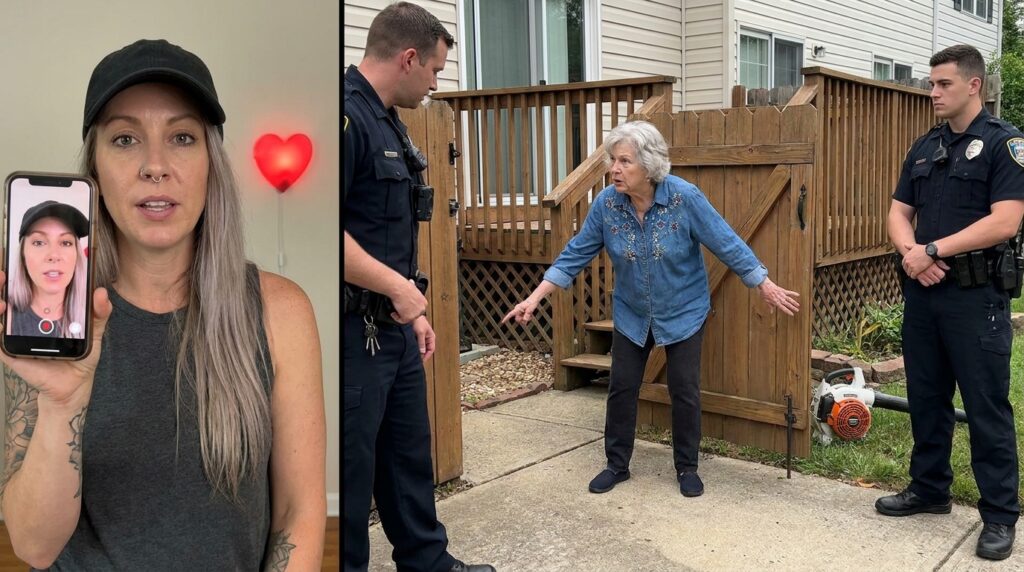
Evelyn didn’t move from the edge of her driveway. The afternoon sun beat down directly onto the top of her gray head, making her scalp glow white beneath her thin, styled curls. She kept her hands stuffed into her deep denim pockets, but her knuckles were visibly bulging against the stiff cloth, rigid as stone blocks.
I turned my back on her and walked through the open wooden gate, returning to the center of the patio deck. The heat trapped between the brick firewall and the composite boards felt dense, almost physical, smelling of dry pine needles and warmed sealant.
I knelt beside the gate post. The cast-iron latch assembly was anchored by three three-inch lag screws driven straight into the pressure-treated oak. But behind the iron housing, right where the gate post met the brick firewall, sat the small rusted ring Evelyn had brushed past earlier.
I reached out, my fingers coated in gritty dust, and lifted the notched brass key out of its shadow.
It hung on an oxidized iron loop attached to a thin, rectangular strip of metal bolted directly into the mortar line between the bottom two bricks. I scraped a thumb over the metal strip. Green copper verdigris flaked off under my nail, revealing faint, machine-stamped lettering beneath the grime:
USGS / MONUMENT 1984 – COUNTY SUBDIVISION TRACT 09
My chest tightened. I stared at the numbers stamped on the copper plate, then at the brass key stamped 412.
The 1998 document she had thrust at Officer Miller claimed this four-foot strip was a common-element easement for a utility chest. But the copper plate bolted into my firewall wasn’t an HOA utility marker. It was a county boundary monument tag from 1984—four years before the developer broke ground on these townhouses, and fourteen years before her draft covenant was drawn up.
“Find something?”
Officer Miller’s heavy boots clicked against the flagstones as he returned to the open gate. He held his notepad in one hand and a black digital tablet in the other. Across the lawn, the second patrol officer—the supporting officer who had arrived quietly without siren—stood near the edge of Evelyn’s driveway, his hands folded across his duty belt, keeping his body positioned squarely between Evelyn and her garage door.
“Look at this, Officer,” I said, pointing down at the base of the firewall. I didn’t touch the brass key again, keeping my hands low and clear. “She told you the 1998 agreement gave her access to a common utility chest behind my gate.”
Miller leaned down, his tactical vest creaking as he squinted at the green-encrusted copper tag pinned to the mortar. He tapped the screen of his tablet, opening a county GIS mapping overlay.
“That’s a benchmark pin,” Miller said, his voice dropping into a flat, professional tone. “County engineers set those when they survey original parcel splits.”
“Right,” I said. “And if you check the digital parcel map for Lot 14, my boundary line doesn’t end at the deck. It goes two feet past the firewall into the gravel strip beside her house.”
Miller looked up from the tablet, his eyes shifting toward Evelyn.
She was watching us. She hadn’t heard my low voice, but she saw Miller looking at the base of the brick wall. Her face, already pale from the confrontation, drained of what little color remained. Her jaw worked silently, her mouth opening and closing like a fish pulled onto dry dock.
“She doesn’t care about the leaf blower,” I said softly, standing up and brushing the mortar dust from my knees. “And she doesn’t care about an HOA easement. That 1998 paper was a decoy to keep anyone from looking at where her driveway actually sits.”
Miller didn’t answer immediately. He zoomed in on his tablet screen, his thumb dragging across the satellite view of the property line. A thin red line on the screen cut straight through the concrete apron of Evelyn’s garage—meaning three feet of her driveway was poured directly over private land belonging to my parcel.
“Her whole garage apron is built on your deeded plot,” Miller murmured, looking at the screen, then at the clean brick line of my house. “If you ever enforce your legal boundary or put up a fence past this gate, she loses vehicle access to her garage.”
The entire picture clicked into place with the cold, unyielding friction of iron teeth locking together. The petty mailbox notes. The obsession with quiet hours. The shouting matches over two minutes of leaf-blower noise. The desperate, frantic push to keep this gate unlatched and claim the four-foot strip as a ‘common area.’
She hadn’t been defending community standards for twenty-five years. She had been defending a stolen three-foot strip of concrete, terrified that a new owner would read a survey, look past her fake rules, and lock her out of her own driveway.
Miller tapped his radio mic again. “Dispatch, hold on the preliminary report. Send code enforcement to Lot 15 for a boundary encroachment verification.”
He turned back toward the lane. “Ma’am,” he called out, his voice cutting clean and sharp through the muggy air of the cul-de-sac. “I need you to step over here to the patrol car. We have a few more things to discuss regarding this property line.”
Evelyn didn’t move. She stood rooted to her asphalt, her hand clutching the folded 1998 paper in her pocket so hard the cardstock snapped along its center fold with a muffled, dry crack.