
The Weight of the Survey Stake: A Story of Asphalt, Boundaries, and Unyielding Restraint

CHAPTER 1: THE TACTICAL OFFSET

The front left tire of the sedan sat exactly three inches inside the yellowing tufts of crabgrass that marked the county right-of-way. Through the dust-filmed windshield, the world was a study in baked, desaturated tones—the pale gray of old concrete, the dry rot of splitting porch steps, and the glint of chrome from across the street. Behind the steering wheel, my hand remained flat against the textured vinyl of the rim, motionless, counting the seconds by the metallic click of the manifold expanding under the July heat.

She had timed it down to the minute. The rusted bumper of her crossover was wedged precisely across the lip of the driveway apron, leaving just enough clearance for a compact car to squeeze through if the driver was willing to risk the paint against a low-hanging juniper branch. It wasn’t a mistake. It was a calculated measurement of space, an intentional encroachment designed to see how much ground would be surrendered without a fight.

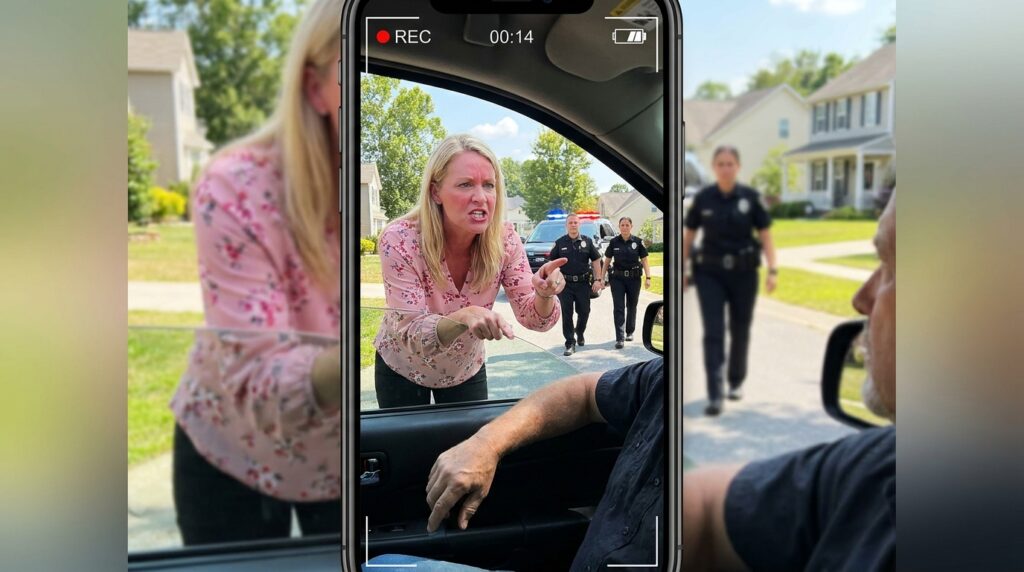
From the porch of number forty-two, the screen door rattled against its frame, a loose hinge scraping a thin line into the painted wood. She didn’t look down as she descended the three steps; her chin was tilted up, her short bob of blonde hair fixed and stiff despite the dry breeze rattling the locust trees. In her left hand, she held a faded blue accordion folder, its plastic strap stretched tight over a thick stack of unnotarized paper. She wore a pink floral blouse that looked stark and clinical against the sun-bleached cedar siding behind her. Her black trousers caught the dust from the gravel strip as she hit the property line, her stride lengthening into the deliberate, heavy cadence of a state inspector arriving at a condemned site.

I didn’t turn the key. I didn’t reach for the door handle. My forearm rested on the black interior panel, the heat from the metal transferring through the dark cotton of my shirt sleeve until it felt like a dull, steady burn. Between my thumb and forefinger, the hard corner of my phone was cold, the screen black and ready. To my right, embedded in the broken edge of the driveway curb, the small brass survey cap glistened under a layer of road grime—a tiny, circular anchor that held forty years of civil plotting in place. She was ten feet away now, her sunglasses pushed high into her bangs, her eyes narrowed into a sharp, transactional squint that looked for an opening, a flinch, or an apology.

The shadow of her body hit the passenger side door panel first, cutting off the low light from the western horizon and turning the interior of the car into a narrow box of gray shade.


CHAPTER 2: THE ENGAGEMENT APON

The shadow didn’t just block the light; it came with the smell of old upholstery and dry, unwashed polyester. Through the double-paned glass of the passenger window, her silhouette was a heavy, dark blur against the stark white of the neighboring garage. Her knuckles rapped against the glass—two sharp, dry cracks that vibrated through the window regulator mechanism inside the door panel. It sounded like loose iron hitting a cold anvil.

I didn’t roll the window down. My thumb remained hooked over the top edge of the phone, my index finger resting flat against the volume rocker to keep the camera feed locked. On the small screen, her face appeared in grainy real-time, her features sharpened by the harsh angle of the sun behind her. Her lips were a thin, compressed line, the skin around her mouth graying with white ringlets of tension. Every line on her forehead was etched deep with the dry grit of an afternoon spent watching the asphalt.

“Open the door, Arthur,” she said. Her voice was muffled by the weatherstripping, reduced to a low, gravelly rasp that lacked the resonant authority she usually pulled out for the street association meetings. “We’re not doing this through the glass today. You know exactly what you’re doing by putting this frame here.”

I shifted my gaze from the screen to the real-world gap between my side mirror and her front fender. The distance was exactly twelve inches. If I swung the passenger door open, the sharp corner of the stamped steel would bite directly into the oxidized red paint of her door panel. It was a classic leverage play—force the target into an action that creates visible property damage, then use that damage to establish a legal fault baseline. I kept my knees locked under the steering column, my weight centered, using the mass of the sedan as a stationary shield.

Through the window, her hand rose. She wasn’t holding the blue accordion folder anymore; she had tucked it under her armpit, pinning it against the pink floral pattern of her blouse like a shield. Instead, her index finger was extended, the nail short and chipped down to the quick, coated in a layer of fine, chalky garden soil. She brought the tip of that finger within an inch of the glass, jabbing it downward toward the broken concrete apron of the driveway.

“This lane has been designated for common-turn use since ninety-two,” she shouted, her voice rising enough to clip the small microphone at the base of my phone. The camera feed twitched slightly with the vibration of my hand, but the baseline stayed level. “You don’t get to park the work truck here, and you don’t get to leave this junker idling on the easement strip. The association has the civil mapping filed at the township clerk’s desk. I have the copies right here.”

She slapped the blue folder against the glass. The impact made the window glass shudder inside its felt tracks. Through the transparent plastic pocket on the front of the folder, I could see the edge of a photocopied document—a heavy, black-lined grid with an official-looking state seal at the top corner. The ink was too dark, typical of an old flatbed copier running hot on toner, the margins crowded with handwritten annotations in a thick grease pencil.

My eyes dropped to her front bumper. A loose, rusted iron washer was pinning the lower left corner of her license plate to the bracket. Every time her engine grumbled across the street, that washer rattled against the tin plate, leaving a circular stain of orange iron oxide on the reflective white backing. It was the same orange rust that lined the drainage ditch at the back of our properties—the iron-heavy runoff that always pooled right where our deeds supposedly dissolved into public land.

“I am parked within my property line, Brenda,” I said. My voice sounded flat inside the quiet cabin of the sedan, stripped of the dry grit that was catching in my throat. I didn’t raise my volume to match hers. I spoke to the steering wheel, letting the phone’s microphone capture the proximity of the stone-faced delivery. “And I am recording this interaction.”

Her jaw twitched. The blonde bob of her hair shifted as she leaned her forehead closer to the glass, her sunglasses sliding down the bridge of her nose until the plastic frame clicked against the exterior weatherstripping. Her breath left a small, circular patch of fog on the outside of the window, a tiny cloud of moisture that slowly evaporated under the direct heat of the afternoon sun, revealing the layer of fine gray dust underneath.

“Your line ends at the water meter, Arthur,” she whispered, her lips moving with an exaggerated, clinical precision against the glass. “Everything past that belongs to the block. We built the turnaround here twenty years ago while you were still hauling drywall in the next county. You don’t get to change the asphalt because you bought a bigger rig.”

She reached down, her fingers hooking into the bottom edge of the passenger side door handle. The chrome-plated plastic gave a dry, hollow click as she lifted it against the internal spring tension. She pulled once, hard, her shoulder dipping as she tried to force the latch mechanism from the outside. The deadbolt inside the door frame caught the pressure with a heavy, metallic thud that resonated through the floorboards beneath my boots.

The lock didn’t yield, but the friction of her grip left a long, oily smudge across the chrome handle—a distinct mark of sweat and garden dirt that sat directly above the rusted keyway. She didn’t let go of the handle; she kept her weight back, her boots scraping against the loose gravel at the edge of the asphalt as she prepared to pull a second time.

Behind her, at the far end of the block, a low, rhythmic pulse of light bounced off the white siding of the corner house. It wasn’t the steady glare of the sun. It was a sharp, alternating flash of violet-blue and deep scarlet, slicing through the dusty leaves of the locust trees like a clean blade.

CHAPTER 3: THE GRAVEL TRANSITION

The blue and red flashes cut through the dust-moted air inside the cabin, striking the cracked dashboard in rhythmic, alternating bars. Brenda’s hand dropped from the door handle as if the plastic had suddenly superheated under her palm. Her knuckles scraped against the window molding, leaving a chalky streak of skin cells across the dried black rubber gasket. She didn’t fully step back; instead, her weight shifted onto her rear heel, her body pivoting toward the curb while her shoulders stayed squared against my door panel.

“They won’t do anything about the civil layout, Arthur,” she said, her voice dropping into a flat, practiced cadence that she used whenever the county road crew ignored her phone calls. She tapped the heavy accordion folder against her hip, the thick grease-pencil markings on the top page catching the red pulse of the cruiser’s roof rack. “They don’t enforce code disputes. This is an administrative boundary layer. I’ve got the ninety-two plat right here, stamped by the district clerk before you even pulled a permit for your fence.”

I kept my hand steady against the lower rim of the steering wheel. Through the side view mirror, the reflection of the black-and-white SUV was slightly warped by the convex glass, its light bar scattering sharp blue needles across the dry siding of my garage. The engine of my truck remained cold, but the ambient heat rising from the dry drainage ditch between our properties was thick with the smell of iron-heavy silt and baked ragweed.

“The ninety-two filing didn’t dissolve the drainage easement, Brenda,” I said, my voice low enough to avoid vibrating the glass. I adjusted my phone by two degrees, ensuring the frame caught the exact position of her boots relative to the small brass survey cap embedded in the curb. “The county didn’t sign off on the turnaround loop. The asphalt just ended where the grading crew hit the shale layer.”

She made a sharp, clicking sound with her tongue, her sunglasses dropping another fraction of an inch down her nose. “The township surveyor signed it, Arthur. Old man Miller didn’t make mistakes with the right-of-way. He spent thirty years mapping these sections before the county even laid the sub-base for the subdivision. If he marked this line as a shared apron, then it’s a shared apron.”

She stepped off the concrete edge of the driveway, her left boot coming down onto the dry gravel strip that ran parallel to my stone wall. The small limestone rocks ground together under her heel with a dry, crunching friction that sounded like dry bone breaking. She reached into her folder, her fingers slipping past the grease-pencil annotations to pull out a single, yellowed sheet of grid paper—a legal description template with a faded county ledger header from June of nineteen eighty-eight.

My eyes didn’t follow her fingers. They stayed on the gravel layer three feet to her left, where a small, notched brass disk sat half-buried under a mat of creeping clover. The metal was dark with age, its edge scored with three deep vertical lines that had been struck with a cold chisel before the concrete beneath it had fully cured. It was the original benchmark from the seventy-four master plot—the one that wasn’t listed on any of the neighborhood association flyers she pinned to the mailboxes every spring.

“Miller was gone by ninety-four, Brenda,” I said, my thumb clicking the side button of my phone to lock the current file into the flash storage. The small green light at the top of the bezel blinked twice, a silent indicator that the data was secured against a power loss. “And the county didn’t archive his field books after the office moved down to the courthouse basement. They used the general index maps for the repaving project.”

Her fingers tightened on the edge of the yellowed paper, the old wood-pulp sheet crinkling with a high, paper-thin snap that carried through the closed window. Her shoulders went rigid under the pink floral pattern of her blouse, the fabric drawing tight across her shoulder blades as she watched the first officer’s boots clear the rear quarter panel of my car.

“The index maps are just summaries,” she whispered, her gaze finally breaking from mine to look at the dark uniform shirt moving down the driveway lane. “The real intent is in the filed record. You think you can just sit inside this steel box and ignore forty years of established usage because you found an old survey stake behind your woodpile?”

The crunch of the officer’s boots on the gravel transition was heavier than hers, the thick rubber soles of the utility boots striking the stones with a flat, unyielding rhythm that didn’t slide or scatter. The shadow of the cruiser’s roof rack reached us first, long and blue, stretching across the baked asphalt until it touched the brass cap at the lip of the drive.

CHAPTER 4: THE ANCHOR INCIDENT

“You can’t judge me after taking my place like that!”

Brenda’s shout went wide, clipping the microphone inside the door panel with a dry, metallic buzz. Her face slammed down toward the passenger glass, her knuckles grinding into the dry rubber tracking until the frame creaked under her weight. Her short blonde bob jerked forward, a few loose strands catching the damp line of her sweat along her jawline. She was leaning so hard into the window lane that the pink fabric of her blouse bunched up against the steel exterior trim, the white floral pattern distorting over the hot curve of the metal door.

My right forearm didn’t move from the armrest. I held the smartphone with both hands now, index fingers locking the upper border while the lens remained fixed on the downward jab of her index finger. On the display, the small red recording indicator blinked beside her face—a digital pulse that matched the erratic rhythm of her chest rising against the glass. The glass between us was warm to the touch, transmitting the raw heat of her breath through the internal door cavity until the steering column felt dry and dusty under my skin.

“The lane was left open for a reason, Arthur,” she rasped, her hand slamming flat against the exterior sheet metal. The impact produced a hollow, heavy thud that vibrated straight through the floorboards into my boots. “You think because you pulled that rusted trailer past the marker stake you own the apron? Look at the ink on this map. Look at it!”

She rammed the blue accordion folder flat against the passenger pane, the plastic sheet scraping the fine gray road dust into a long, jagged curve. Through the scratched transparency, the photocopied document was readable in the harsh, direct daylight. It was an old municipal plat map, its borders cluttered with handwritten notes in a thick grease pencil that identified the turnaround as common property. But as she pressed it against the glass, a thick droplet of wet, black grease oozed from the folder’s rusted lower clip, staining the margin of the document and leaking onto my window track. It smelled of old machinery and stale mineral oil—the specific, heavy scent of a county vault clerk’s storage locker.

I kept my jaw set, my eyes locked on the grease stain as it slowly dripped down the rubber weatherstripping. “I am parked on my property, Brenda, and I am recording this. The seventy-four deed doesn’t list a ninety-two amendment.”

“The seventy-four map is dead weight!” she screamed, her palm jabbing into the glass again, her wedding ring clicking sharply against the glass pane. “Miller signed off on the change himself. He put the stakes where they belonged before you even cleared the scrub oak for this driveway. You’re blocking the common turnaround lane, and the county is going to haul this junker out by the axle!”

Her finger remained frozen an inch from the glass, her jaw tight and trembling under the strain of her lean. Behind her silhouette, the light changed. The dry, white glare of the afternoon was shattered by a massive, pulsing bar of scarlet and violet light that struck the neighboring fence line in rapid-fire bursts.

The heavy, rhythmic thrum of a large diesel engine rolled down the cul-de-sac, drowning out the high-pitched rattle of her crossover’s loose license plate. A long, black-and-white hood slid into the frame through my rearview mirror—the massive steel grille of a county patrol unit, its emergency rack throwing intense color across the dust-clogged air. The vehicle didn’t slow down; it swung wide around Brenda’s angled sedan, its tires grinding over the limestone gravel with a heavy, crunching roar that ended with the hiss of air brakes right at my rear bumper.

Brenda didn’t pull her hand down immediately. Her fingers stayed hooked on the door frame, her shoulder still pinned against my window as the driver’s side door of the patrol vehicle swung open with a dry, mechanical click.

Two distinct shadows broke across the asphalt, moving with a fast, synchronized stride that didn’t scatter the gravel. The first figure—an athletic female officer with her brown hair pulled into a tight, professional knot—moved directly into the narrow gap between Brenda’s hip and my passenger panel. Her black uniform shirt was crisp, the heavy nylon of her equipment belt popping against her side with every step.

“Ma’am,” the officer’s voice cut through the muffled air of the cabin, flat and completely devoid of neighborhood inflection. She didn’t look at the folder or the grease stain. Her left hand was already extended, her palm wide and steady, cutting off Brenda’s forward lean by occupying the exact space between her chest and the glass. “Step back from the vehicle.”

Brenda recoiled as if the uniform fabric was charged with current, her boots sliding an inch into the loose gravel strip at the edge of the drive. The blue folder dropped down to her side, the leaked grease smudging across her black pants as her mouth opened in a silent, startled gap.

CHAPTER 5: THE POLICE INTERVENTION

The female officer’s hand didn’t drop. Her palm stayed locked in the space between Brenda’s floral blouse and my side mirror, the thick black fabric of her tactical glove casting a steady shadow across the oil-filmed chrome door handle. Brenda’s boots ground backward into the limestone gravel, a small shower of dry white dust puffing over her black trousers as she broke her forward lean. Her breath still fogged a circular patch on the glass, but the cloud was rapidly evaporating under the direct glare of the afternoon heat, leaving nothing but the smudged imprint of her jawline on the dirt.

“He’s blocking a designated turnaround, Deputy,” Brenda said. Her voice lacked its previous razor-sharp edge, flattening into a rapid, high-register pitch as she held the blue accordion folder up like a barrier against the officer’s utility belt. The plastic strap creaked under the tension of her grip, squeezing another tiny bead of black grease from the lower hinge onto the yellowed edges of her paperwork. “I have the civil layout from ninety-two. The road crew left this apron open for public maintenance vehicles. He knows he can’t leave a commercial rig inside the county right-of-way.”

The female officer didn’t look down at the folder. Her eyes—cold, alert, and entirely unbothered by the alternating blue and scarlet pulses bouncing off the fence—stayed fixed on the tight lines around Brenda’s mouth. To her left, the second responding officer, a sturdy man with short-cropped dark hair, drifted toward the front fender of her crossover, his hand resting with casual weight near his side latch. His uniform shirt was damp along the spine from the valley humidity, the smell of dry wool and laundry detergent mixing with the hot oil rising from my engine bay.

“Ma’am, I told you to step back from the door panel,” the female officer repeated. Her tone wasn’t loud, but it had the flat, unyielding weight of a municipal ordinance. She moved her left foot six inches forward, her boot heel striking the gravel with a solid thud that physically occupied the entry lane. “We have a dispatch call on this address regarding a civil dispute and vehicle obstruction. You need to take three steps back toward the shoulder so I can speak with the operator.”

I lowered the phone by two inches, keeping the lens level with the lower window track. On the digital display, the red recording timer continued to click forward in the lower corner, capturing the crisp texture of the officer’s shoulder patch against the desaturated backdrop of Brenda’s porch. My forearm remained flat on the interior armrest, the plastic warm and slightly sticky against my skin from the enclosed heat of the cabin.

“He called you?” Brenda’s jaw tightened, her eyes darting over the hood of my car toward the second deputy who was now taking a small pocket notebook from his uniform shirt. “I’m the one who’s been filing the code complaints with the township clerk for six months. He’s the one violating the setback rules. If you look at the master plotting map—”

“We’ll look at the paperwork in a minute,” the female officer cut her off, her arm dropping slightly but her torso remaining positioned as a hard barrier between Brenda and my passenger frame. She turned her head toward the glass by three degrees, her gaze dropping to my still forearm. “Driver, step out of the vehicle or roll down the window so I can see your hands.”

I kept my right hand on the phone, letting the camera continue to run as my left hand moved to the manual window crank. The handle was cold iron, its plastic knob worn smooth and pitted from years of grease-stained thumbs. I turned it three times, the internal regulator mechanism groaning with a dry, scraping friction as the thick glass panel slid down into the felt-lined slot of the door. A heavy wave of hot, unmoving air rushed into the cabin, carrying the sharp scent of baked ragweed and the high, electric hum of the cruiser’s light bar.

As the window cleared the frame, the blue folder under Brenda’s arm shifted, the movement exposing the back of the topmost yellowed document. In the harsh glare of the direct sun, a faded, hand-stamped ink seal code was visible through the thin wood-pulp paper. It wasn’t a county archiving mark. It was a three-digit sequence—WM-REJ-88—the exact code used by the internal water-main division when a utility easement was rejected for structural instability due to shale shifting.

The second deputy stepped closer to the front bumper of Brenda’s crossover, his heavy boot kicking against a piece of loose limestone that rolled until it struck the rusted washer on her lower license plate bracket. The tin plate let out a thin, hollow vibration that sounded exactly like the rattle of an empty tool bin.

“Keep your hands where I can see them,” the female officer said, her eyes shifting rapidly between my phone and the property marker stake behind her heel. The blue light bar caught the edge of her badge, turning the silver plating into a brief, violent flash of purple before the scarlet pulse took its place.

CHAPTER 6: THE EVIDENCE STRIP

The open window bay let the full weight of the afternoon roll inside the sedan. The steel door sill was hot enough to leave a red grid mark on my forearm if I pressed down too hard, its gray factory primer showing through where years of work sleeves had ground away the top coat. The female deputy didn’t take her hand off her belt line, her fingers hooked casually over the hard plastic casing of her flashlight bracket as her boots shifted closer to my rocker panel.

“Keep the phone where it is, sir,” she said, her voice dropping beneath the steady, high-register whine of the cruiser’s light rack. Her eyes didn’t track the screen; they stayed on the lower corner of my left jaw, watching the pulse line behind the skin. “Go ahead and pass your identification and whatever structural paperwork you’re referring to out through the gap. We’re going to clear this lane before the school buses start turning around at the intersection.”

I didn’t let the camera tilt. My right thumb held the focus lock on the screen, keeping Brenda’s rigid, floral-printed silhouette anchored against the pale backdrop of her garage door. With my left hand, I reached into the glove compartment, my fingers sliding past a tangle of old zinc-coated structural fasteners and grease-stained hex keys until they hit the heavy, cold texture of the laminated plotting map. The plastic sleeve was thick and scored with old scratches from the tool chest, the edges yellowed by the mineral oil that always pooled in the bottom of the tray.

“This is the seventy-four engineering summary, Deputy,” I said, my voice deadened by the wide-open space of the driveway apron. I passed the stiff folder through the window, the edge of the laminate scraping against the rusted interior door lock cylinder with a thin, metallic hiss. “It contains the permanent drainage dedication for this entire block section. It hasn’t been modified by any township clerk filing since the concrete base was poured.”

Brenda took a step forward, her boot grinding a piece of loose limestone down into the gray dust until the rock shattered into small, white fragments. “That map doesn’t show the ninety-two realignment, Arthur! The county road surveyor physically moved the stakes three feet to the east when they put the culvert pipe in. You’re using a dead ledger description to justify blocking the public turnaround!”

The male deputy, who had been leaning over the front fender of Brenda’s crossover, walked back down the gravel strip, his heavy leather heels clicking against the exposed stone with a slow, deliberate weight. He took the laminated folder from his partner’s hand, his gloved fingers tracing the heavy black grid lines that marked the perimeter of my parcel. His sunglasses reflected the pulsing blue bar of the cruiser, turning his face into a pair of dark, flashing voids that stayed fixed on the bottom margin of the page.

“There’s a water main marker right under your front bumper, ma’am,” the male officer said, his voice flat, carrying the dry, gravelly texture of someone who spent eight hours a day reading code violations along the state highway. He didn’t lift his eyes from the print. He pointed a stubby, ink-stained finger toward the creeping clover where the brass disk lay half-buried. “The ninety-two amendment you’re talking about would put the public turnaround loop right on top of the old mainline vault. The county doesn’t certify right-of-way parking over a primary structural utility line. Not without a deep-trench reinforcement slab, and there isn’t one listed on this ledger sheet.”

Brenda’s folder slipped an inch down her hip, the plastic strap losing its tension as her elbow went slack against her side. The black grease smudge from the lower clip was wide now, a dark, greasy smear that ran from the pocket of her pink blouse down to the seam of her trousers. Through the transparent sleeve, the hand-stamped ink seal with the WM-REJ-88 marking caught a direct ray of the sun, the violet dye looking bright and wet against the dry, yellowed wood-pulp paper.

“Old man Miller signed it,” she whispered, her chin dropping slightly as she looked down at the brass disk near her boot heel. The cocky, administrative stance she had held on her porch was gone, replaced by a rigid, defensive hunch that made her silhouette look small and heavy against the long shadow of the patrol SUV. “He told the association board the line was clear. We paid the filing fee out of the road improvement fund thirty years ago.”

“Miller was the town surveyor, ma’am, not the county infrastructure clerk,” the male deputy said, his hand moving to the blue folder, his thumb flipping the cover page over to expose the back of her document where the rejection stamp sat in the center of the grid. “He filed a private layout draft that was rejected by the water-main division three weeks before the township office dissolved. This isn’t an official plat. This is a refused utility variance.”

The silence that followed was heavy with the heat of the road, broken only by the click of the cooling metal inside my engine bay and the distant, dry rattle of the locust trees along the fence line. I kept the phone still, the screen capturing the precise moment the false authority left her face, leaving nothing but the deep, sun-baked lines around her eyes and the gray dust coating her boots.

CHAPTER 7: THE MAP STRIP REVERSAL

The female deputy didn’t take her hand off her belt line, her fingers hooked over the edge of her tactical flashlight bracket as her boots shifted closer to my rocker panel. Her eyes stayed on the lower corner of my left jaw, watching the pulse line behind the skin.

“Keep the phone where it is, sir,” she said, her voice dropping beneath the steady whine of the cruiser’s light rack. “Go ahead and pass your identification and whatever structural paperwork you’re referring to out through the gap. We’re going to clear this lane before the school buses start turning around at the intersection.”

I didn’t let the camera tilt. My right thumb held the focus lock on the screen, keeping Brenda’s rigid, floral-printed silhouette anchored against the pale backdrop of her garage door. With my left hand, I reached into the glove compartment, my fingers sliding past a tangle of old zinc-coated structural fasteners and grease-stained hex keys until they hit the heavy, cold texture of the laminated plotting map. The plastic sleeve was thick and scored with old scratches from the tool chest, the edges yellowed by the mineral oil that always pooled in the bottom of the tray.

“This is the seventy-four engineering summary, Deputy,” I said, my voice deadened by the wide-open space of the driveway apron. I passed the stiff folder through the window, the edge of the laminate scraping against the rusted interior door lock cylinder with a thin, metallic hiss. “It contains the permanent drainage dedication for this entire block section. It hasn’t been modified by any township clerk filing since the concrete base was poured.”

Brenda took a step forward, her boot grinding a piece of loose limestone down into the gray dust until the rock shattered into small, white fragments. “That map doesn’t show the ninety-two realignment, Arthur! The county road surveyor physically moved the stakes three feet to the east when they put the culvert pipe in. You’re using a dead ledger description to justify blocking the public turnaround!”

The male deputy, who had been leaning over the front fender of Brenda’s crossover, walked back down the gravel strip, his heavy leather heels clicking against the exposed stone with a slow, deliberate weight. He took the laminated folder from his partner’s hand, his gloved fingers tracing the heavy black grid lines that marked the perimeter of my parcel. His sunglasses reflected the pulsing blue bar of the cruiser, turning his face into a pair of dark, flashing voids that stayed fixed on the bottom margin of the page.

“There’s a water main marker right under your front bumper, ma’am,” the male officer said, his voice flat, carrying the dry, gravelly texture of someone who spent eight hours a day reading code violations along the state highway. He didn’t lift his eyes from the print. He pointed a stubby, ink-stained finger toward the creeping clover where the brass disk lay half-buried. “The ninety-two amendment you’re talking about would put the public turnaround loop right on top of the old mainline vault. The county doesn’t certify right-of-way parking over a primary structural utility line. Not without a deep-trench reinforcement slab, and there isn’t one listed on this ledger sheet.”

Brenda’s folder slipped an inch down her hip, the plastic strap losing its tension as her elbow went slack against her side. The black grease smudge from the lower clip was wide now, a dark, greasy smear that ran from the pocket of her pink blouse down to the seam of her trousers. Through the transparent sleeve, the hand-stamped ink seal with the WM-REJ-88 marking caught a direct ray of the sun, the violet dye looking bright and wet against the dry, yellowed wood-pulp paper.

“Old man Miller signed it,” she whispered, her chin dropping slightly as she looked down at the brass disk near her boot heel. The cocky, administrative stance she had held on her porch was gone, replaced by a rigid, defensive hunch that made her silhouette look small and heavy against the long shadow of the patrol SUV. “He told the association board the line was clear. We paid the filing fee out of the road improvement fund thirty years ago.”

“Miller was the town surveyor, ma’am, not the county infrastructure clerk,” the male deputy said, his hand moving to the blue folder, his thumb flipping the cover page over to expose the back of her document where the rejection stamp sat in the center of the grid. “He filed a private layout draft that was rejected by the water-main division three weeks before the township office dissolved. This isn’t an official plat. This is a refused utility variance.”

The silence that followed was heavy with the heat of the road, broken only by the click of the cooling metal inside my engine bay and the distant, dry rattle of the locust trees along the fence line. I kept the phone still, the screen capturing the precise moment the false authority left her face, leaving nothing but the deep, sun-baked lines around her eyes and the gray dust coating her boots.

The male deputy didn’t look up as he tapped a blunt finger against the corner of my laminated sheet. “This seventy-four baseline is the only active dedication on file down at the recorder’s desk, ma’am. Which means your vehicle is currently obstructing a private commercial ingress lane. And it means you’ve been placing civil code notices on private property without an administrative warrant.”

Brenda’s mouth opened slightly, but no sound came out. Her gaze drifted down to the small, secondary zinc identification tag bolted just beneath the surveyor’s disk—a cracked, oxide-scaled piece of scrap metal that had been hidden under the clover for decades. It was the physical mark of a permanent county easement, a truth locked into the ground long before the first house on the cul-de-sac had its foundations poured. She stepped back another half-inch, her boot slipping off the limestone apron into the gray dirt of the drainage ditch, her hand still holding the useless blue folder against her side like a broken tool.

The female officer turned back toward my window, her pen poised over a yellow municipal citation pad. “Arthur, stay right there. We’re going to process the lane clearance now.”

CHAPTER 8: THE BOUNDARY ENFORCEMENT

The yellow municipal citation pad crackled as the female deputy flipped the carbon-copy layer back against the cardboard backing. The dry sound carried across the hot hood of my sedan, sharp as a breaking locust branch. Brenda didn’t move her boots from the gray dirt of the drainage ditch, her fingers frozen around the plastic strap of her accordion folder while the scarlet and blue pulses from the cruiser bar washed across the front of her smudged floral blouse.

“Sign the lower line, ma’am,” the female officer said, extending a cheap, blue-barreled ballpoint pen across the space separating their shoulders. The deputy’s uniform shirt was perfectly still, her weight distributed evenly across her equipment belt. “This is an official citation for a civil easement obstruction under section four-twelve of the township infrastructure code. It isn’t an admission of liability, but it requires you to clear the designated ingress lane within fifteen minutes of notice.”

Brenda’s hand shook slightly as she took the pen, the plastic barrel scraping against the dirt-caked skin of her index finger. She didn’t look at the document as she struck a quick, jagged line across the bottom of the carbon layer. She handed the pen back with a stiff, unyielding jerk of her wrist, her eyes remaining fixed on the second deputy who was already walking toward the front bumper of her crossover.

“The street association isn’t going to accept this baseline, Deputy,” she whispered, her voice dry, catching on the dust rising from the cul-de-sac. Her chin was down now, her short blonde bangs damp against her forehead from the baking valley heat. “We have an infrastructure fund. We have the ninety-two blueprint signed by the clerk.”

“The clerk didn’t have the authority to override the state water-main dedication, ma’am,” the male officer said without looking up from his pocket notebook. He stepped into the narrow path between her front grille and my apron, his heavy leather heels grinding the limestone gravel into a fine, white powder that coated his boot laces. “You can take the layout copy down to the county commissioner’s hearing next Tuesday if you want to contest the mapping, but right now, that vehicle needs to move back across the asphalt line.”

I lowered my phone from the window frame, my right thumb clicking the power button to terminate the video file. The small screen went dark, its surface greasy with the heat of my palm and the gray road dust that had settled into the charging port. My forearm felt cold where the air from the manual crank had hit the skin, but the interior cabin still smelled of old vinyl and stale machinery oil. I reached down, my fingers hooking around the iron handle of the emergency brake, clicking the release button to let the sedan settle into its suspension blocks.

Brenda didn’t look at me as she turned toward her vehicle. Her shoulders were hunched forward under the pink fabric of her blouse, her stride short and heavy as her boots dragged through the gravel transition line. She pulled the driver’s side door open, the old metal hinges groaning with a dry, iron-on-iron squeak that cut through the low idle of the patrol unit.

The starter motor of her crossover let out a high-pitched, slipping whine before the cylinders caught, the engine coughing a gray plume of unburnt diesel smoke out over the juniper bushes. The loose iron washer pinning her lower license plate rattled violently against the bracket, a frantic, tinny chatter that grew louder as she threw the transmission into reverse. The tires spun once against the loose limestone, throwing a small shower of white stones into the dry grass before the vehicle backed slowly across the curb lane, clearing the mouth of my driveway by exactly three feet.

The female deputy stepped up to my open window, her fingers sliding my laminated plotting map back through the gap. The thick plastic sleeve was hot from the sun, the corners sharp against my palm as I took it back and laid it across the passenger seat next to the phone.

“Keep that map in the vehicle, Arthur,” she said, her eyes tracking the movement of Brenda’s sedan as it backed into the driveway across the street. “If she places another administrative notice on this mailbox line before the county hearing, you call the dispatch desk directly. Don’t engage through the glass.”

“Understood, Deputy,” I said. My voice was flat, stripped of the dry grit that had been catching in my throat since the screen door first rattled.

I reached for the manual window crank, my thumb catching the worn plastic knob as I turned it three times, lifting the heavy pane back into the rubber track. The black interior door panel formed a hard, locked perimeter around me once more, cutting off the high whine of the cruiser’s light bar as the officers walked back toward their unit. Through the dust-filmed glass, the street looked wide and desaturated under the falling western light—the pale concrete of the turnaround loop ending exactly where the seventy-four master plot had marked the boundary forty years ago.

The street didn’t belong to her, and neither did the driveway. The original iron pin was still buried deep behind the locust trees, silent and rusted, holding the line in place while the neighborhood watched from behind their screens.

Similar Posts

Leave a Reply

Your email address will not be published. Required fields are marked *






