The Weight of the Line: A Narrative of Friction, Asphalt, and the Measurement of Sovereign Dirt
CHAPTER 1: THE INTRUSION OF TRUCKS
The black iron gate didn’t just rattle; it groaned as sixty tons of commercial steel pinned themselves directly against the foundation wall. Through the thin pane of the front window, the world had turned entirely to matte black paint and the smell of diesel exhaust. It was a wet, heavy heat that smelled of unwashed work clothes and old grease. The vibration traveled up from the floorboards, shaking the glass of water on the small side table until it rang with a flat, rhythmic hum.
Elena did not put on her shoes. She stepped onto the porch in her slip-on shoes, the thin rubber soles offering no protection against the cold dew on the concrete steps. The air outside was the color of a wet slate shingle. Across the street, the morning papers were still wrapped in plastic sleeves, sitting in puddles that reflected the yellow marker lights of the convoy.
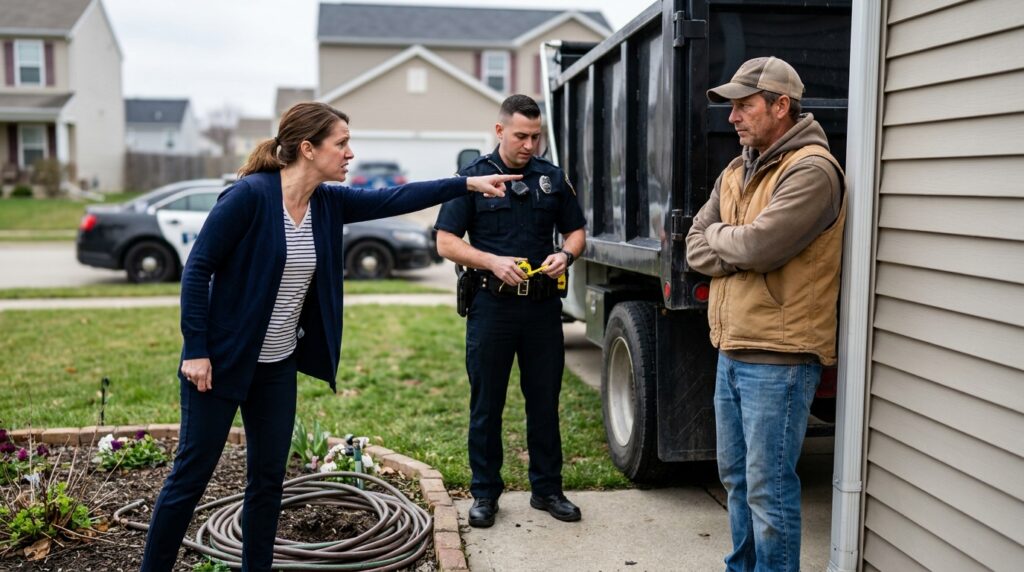
At the edge of her lawn, the grass was already gone. Two massive, deep-treaded tires had cut six-inch trenches into the sod, squeezing the damp black earth outward until it piled against the roots of her hydrangeas like fresh graves. The primary drainage hose—the thick, green braided line that kept the basement from filling every time the county culverts overflowed—lay trapped beneath the rear axle, its rubber skin split open, spitting out a thin, clear stream of well-water into the dirt.
A man was standing by the truck’s rear wheel, his wide legs planted as if he had grown out of the asphalt himself. He wore a dirt-dusted tan utility vest over a heavy grey hoodie, the hood pulled up against the mist. A leather tool pouch hung low on his hip, heavy with steel tape and timber crayons. He didn’t look up when her screen door slammed. He was occupied with a yellow legal pad, checking figures with a stub of grease pencil.
“You’re over the line,” Elena said. Her voice didn’t carry the weight she wanted; the rumble of the idling eight-cylinder engine swallowed the edges of her words. She walked down the narrow brick path, her navy cardigan catching on the unpruned branches of the privet hedge. “You’ve crossed the marker. Get that vehicle off my grass.”
The man turned his head slowly. His face was weathered like an old fence post, lines deeply cut around a grey-stubbled jaw. He didn’t take his hands out of his vest pockets. He didn’t look at her face; he looked at her shoes, then at the broken hose between them.
“The county has an eight-foot easement from the center of the gutter line, lady,” he said. His tone was flat, transactional, completely devoid of heat. It was the voice of a man who had explained the same rule to fifty people in fifty different towns. “I’ve got a city work order for this entire block. Move out of the lane and let my crew do their job.”
He tapped a grease-smudged thumb against a thick blue folder tucked under his arm. The paper inside looked old, its edges curled from the humidity of a truck dashboard.
Beyond his shoulder, the porch light of the Miller house went on. A pale face appeared behind the screen, watching. Then another across the lane. The neighborhood was waking up to the smell of her split earth, but no one was coming down the steps. They were waiting to see how far the truck would go before it hit the brickwork.
Elena stopped three feet from his grease-stained vest. She could feel the heat radiating off the massive chrome exhaust pipe just inches from her shoulder. “You can’t stand in my yard, then judge me,” she said, her fingers tightening around her crossed arms until the knuckles turned white. “You look at your paper again. The utility easement stops at the curb pin.”
The contractor let out a short, dry sound through his nose—not a laugh, just a release of air that smelled faintly of stale coffee. He turned back to the truck’s cab, raising two fingers to signal the driver inside. The air brakes hissed, a violent release of pressure that threw a grey cloud of grit across her slip-on shoes.
The truck didn’t move back. It shifted its weight forward, the heavy steel bumper rising two inches as the transmission engaged, the metal panels of her gutter line beginning to scream as the bed crowded the roofline.

CHAPTER 2: THE SPLITTING OF THE TURF
“Shut it down!” Elena’s voice was a flat rasp, cutting through the low-frequency rumble of the eight-cylinder engine. She didn’t look at the driver perched high behind the mirrored glass of the cab; she kept her eyes locked on the contractor’s weathered face, her boots sinking an inch into the freshly turned clay of her garden bed. “Shut it down before that gutter shears off.”
The contractor didn’t move his hand from his utility vest. He stood with his boots planted wide apart on the cracked edge of the asphalt, his silhouette dark against the grey morning light. The smell of hot hydraulic fluid and burnt diesel oil was thick between them now, a greasy film that seemed to coat the damp leaves of the privet hedge.
“I told you, lady,” he said, his voice dropping into a register that was completely transactional, the tone of a man who used regulations like a blunt instrument. “We’re within the line. If your drainage pipe is inside the county’s utility corridor, it’s unpermitted obstruction. My driver’s got six more loads to drop before the morning shift switches, and I’m not losing two grand an hour while you stand there crossing your arms.”
He reached into the deep pocket of his canvas vest and pulled out a small, heavy object—a steel plumb bob, its brass tip nicked and dulled from years of rough handling. He didn’t drop it to measure anything; he just let it swing on its braided nylon cord, a short, heavy pendulum ticking against his thigh. It was a calculated gesture of ownership, an implicit statement that he governed the physics of this particular piece of earth.
Elena took a step forward, her slip-on shoes squelching softly in the wet earth. The edge of her cardigan brushed the wet, grit-blasted steel of the truck’s rear bumper. She could feel the heat bleeding through her clothes from the massive exhaust pipe, the metal ticking as it expanded in the cool mist.
“The county corridor doesn’t touch the foundation,” she said, her voice tight, dropping into the sparse, targeted rhythm of someone who had memorized her deed line during the winter the mortgage was re-drawn. “Look down at your boots, mister. You’re six inches past the gravel line. You’re on my sod.”
The contractor let out a short, dry grunt, his gaze finally shifting down to the grass. Beneath the heavy, deep-tread tires, the wet earth was turning into a grey slurry. The thick green braided drainage line was flattened now, its structural ribs crushed into the mud, a small pool of dirty water rising around the puncture point. But as his boot shifted, Elena caught a glimpse of something else—a small, dark point of oxidized iron protruding from the torn roots of the grass.
It was a rusted surveyor’s pin, ancient and bent, its head nearly buried under twenty years of decaying mulch. It sat four inches inside the massive tire’s current track. The contractor saw it too. His eyes lingered on the dark metal point for a fraction of a second, his stubbled jaw tightening just enough to betray the recognition. Then, without a word, he brought his heavy work boot down directly over the pin, grinding it into the mud until the iron tip disappeared beneath a layer of grey clay.
“I don’t see a pin,” he said, looking back up, his eyes steady under the frayed brim of his cap. “I see a residential obstruction in a municipal right-of-way.”
Across the asphalt, the front door of the Miller house clicked open. Old man Miller stepped onto his concrete porch, holding a ceramic mug, his eyes fixed on the massive black tailgate that now blocked three-quarters of the street’s sightline. He didn’t shout; he just stood there, a silent witness to the weight of the machinery. Further down the block, a garage door groaned as it began to lift, the sound flat and hollow in the overcast air. The pressure wasn’t coming from a crowd yet, but the street was filling with eyes.
The contractor turned his back to her, lifting his left hand to signal the cab again. “Bring it back another two feet, Carl!” he shouted over the engine roar. “We need the tailgate clear of the main lateral!”
“Don’t you dare,” Elena muttered, her voice dropping into a hard, quiet line that didn’t travel past the space between them. She didn’t retreat. She placed her palm directly against the wet, vibrating steel of the truck’s side panel, feeling the massive friction of the transmission engaging through her bones. Her fingers left clean streaks in the film of road grime. “You move this truck another inch, and you’re going through the brickwork of my cellar stairs.”
The driver in the cab tapped the horn—a sharp, deafening blast that made the window panes behind them rattle in their wooden frames. The huge machine groaned, its tires spinning for a split second in the ruined flower bed, throwing a spray of black earth and shredded hydrangea roots against Elena’s dark pants. The frame shifted, the upper edge of the steel dump bed coming within two inches of the white aluminum gutter that drained her roof.
Then came the sound of a different engine—the low, distinct whine of a municipal alternator approaching from the western intersection. A single white sedan with a blue strobe bar on the roof rounded the corner, its tires clicking against the wet asphalt as it slowed, drawing to a halt directly behind the massive dump truck.
The driver in the cab killed the engine. The sudden silence that followed was heavy, broken only by the drip of moisture from the trees and the low, wet gurgle of the ruined drainage hose.
CHAPTER 3: THE BLUE ENVELOPE
The sudden absence of the eight-cylinder rumble left a hollow ringing in the damp air. The hiss of the truck’s cooling manifold sounded thin, almost mechanical, against the quiet of the street. Elena didn’t drop her hand from the truck’s side panel until the metal vibration stopped entirely, leaving only the cold film of road salt and soot beneath her fingers.
The contractor didn’t look at the white cruiser parking fifty feet behind his tailgate. He deliberately folded his yellow legal pad, sliding the stub of grease pencil into a small slot stitched inside his utility vest. His movements were slow, calculated to show the porch watchers across the street that his timeline wasn’t dictated by a flashing blue strobe. He reached under his arm and produced the thick blue folder, its heavy plastic cover popping as he unsnapped the brass fastener.
“We’re going to clear this up right now, lady,” he said, his voice flat, dropping into the dry cadence of a court clerk. He didn’t step back from her porch line; he moved closer, using the bulk of his canvas vest to block her view of the ruined sod beneath his boots. “I don’t have time to wait for a municipal surveyor to tell me what I already have stamped in ink.”
He pulled a folded sheet of heavy ledger paper from the folder, the crisp bond rattling like dry corn husks in the wind. He didn’t hand it to her. He held it out between his large hands, the paper graying slightly under the fine mist. At the top of the sheet, the words County Department of Public Works: Variance Directive were blocked out in heavy, unadorned typeface. Beneath the text was a hand-drawn diagram showing the intersection, the narrow asphalt lane, and her own house lot, marked out with bold red ink lines that didn’t match the old deed map in her dining room cupboard.
Elena leaned in, her eyes tracing the red ink. The line didn’t stop at the curb. It carved a clean, six-foot crescent directly through her flower bed, swinging inward until it clipped the corner of her stone cellar steps. It was a formal, stamped document, complete with a purple municipal seal in the lower corner, but the seal looked off—the edges were crisp, entirely free of the typical ink-smudges found on standard county paperwork, and the date at the bottom was stamped from less than forty-eight hours ago.
“This is a regional access lane,” the contractor said, pointing a calloused finger at the red crescent. His nail was split down the middle, blackened by grease. “The county variance board cleared the expansion on Tuesday. The main utility lateral has to clear the foundation by four feet, which means the right-of-way extends six feet past your old curb line. The city didn’t just give us permission; they ordered the staging.”
“The variance board doesn’t meet on Tuesdays,” Elena said. Her voice was steady, the words sparse. She had spent three months in the basement of the town hall the previous winter, digging through the old drainage records when the county had tried to reroute the creek overflow. “They meet on the first Thursday of the month. And they don’t issue red-ink adjustments without a public notice pinned to the telephone pole at the corner.”
The contractor’s eyes narrowed slightly, the loose skin around his temples tightening beneath the brim of his frayed cap. He didn’t offer a defense. Instead, he folded the ledger paper back along its sharp creases, the sound clean and decisive in the damp silence.
“The clerk signed it, lady. That’s all that matters to my crew,” he said, his voice dropping into a low, transactional growl. “We don’t check the calendar at the county hall. We look at the stamp, and we follow the iron. If you’ve got a problem with the ink, you take it up with the desk in the morning. Today, this truck stays pinned until the lateral is dropped.”
Elena looked down at his boots again. He was still standing directly over the rusted surveyor’s pin he had ground into the clay, his heavy leather heel obscuring the iron marker completely. She could see a white grease-pencil mark he had drawn across the asphalt earlier—a rough line that aligned perfectly with his new map but left her small plot completely exposed to the heavy tread of the trailer waiting at the corner.
Behind them, the door of the white sedan opened with a heavy mechanical click. A pair of polished black work boots stepped into the puddle at the curb, the water splashing against the clean trousers of a local officer. The patrolman didn’t rush; his duty belt gave a dry, rhythmic creak as he walked past the massive black tailgate, his eyes fixed on the blue folder still gripped in the contractor’s hand.
The neighbors across the lane hadn’t moved. Old man Miller had set his mug down on the porch railing, his head tilted slightly to catch the dialogue, his grey cardigan matching the tone of the morning sky. Elena could feel the cold dampness of the lawn soaking through her thin slip-on shoes, but her posture remained locked, her arms tightly crossed against the chill as the officer stepped into the narrow space between the metal siding and the truck’s massive grill.
The contractor didn’t flinch as the officer approached. He simply held the blue folder out like a shield, his fingers covering the lower edge where the purple seal sat in its clean circle of dry ink.
CHAPTER 4: THE UNCLIPPING OF THE TOOL
“Keep the folder open right where it is,” the officer said. His voice had the flat, unhurried weight of a state ledger book. He didn’t unholster his sidearm, but his right forearm rested naturally across the dull plastic grip of his duty weapon, his thumb hooked into the heavy leather of his utility belt.
The contractor didn’t pull the blue binder back, but his thick fingers tightened against the plastic edges until the knuckles turned white under the grey morning light. He remained wide-legged over the hidden surveyor’s pin, his heavy work boots anchored deep into the muddy clay of the destroyed garden bed.
“The paperwork is straight from the regional office, officer,” the contractor muttered, his eyes tracking the silver patch on the patrolman’s shoulder. “We’ve got a tight window on the main lateral drop. If we don’t have the heavy equipment positioned before the transit authority shift changes at nine, the county fines my firm back to the stone age.”
The officer didn’t look at the paper. He looked at the massive black steel tire of the dump truck, which sat six inches past the gravel shoulder, its heavy lugs dripping with black garden mulch and shredded roots. The steel body of the machine hummed with a low, post-ignition tick, heat still radiating off the massive manifold like oil over a stove.
“I don’t enforce county deadlines,” the officer said smoothly. He reached down to his hip, his gloved fingers finding the brass snap of a small, vertical leather pouch. The click of the metal fastener was sharp and distinct in the cold fog, a small sound that made old man Miller lean forward over his porch railing across the street. “I enforce the physical boundary of the municipal plat. If your tires are sitting on residential sod without a structural waiver signed by the township magistrate, the truck is a public obstruction.”
He pulled a heavy, chrome-plated casing from the pouch. It wasn’t an instrument of force; it was a heavy-duty, five-eighths-inch professional steel measuring tape, its casing scratched down to the raw zinc from years of road construction duty. The small yellow hook at the tip of the blade rattled against the housing with a clean, metallic ding.
Elena stood three feet back, her arms locked hard against her chest, her navy cardigan damp from the settling mist. She watched the contractor’s jaw shift. The man didn’t move his boots, but his shoulders sank half an inch, his wide stance subtly shifting as he tried to mask the precise spot where the iron marker lay buried under his heel.
“The variance map shifts the corridor six feet east,” the contractor said, his voice dropping into a transactional rasp. He finally held the ledger paper out, the crisp sheets trembling slightly as the wind caught the edges. “Look at the ink. It’s got the purple seal from the clerk’s office. It’s a legal easement modification.”
The officer didn’t take the document. He pulled three inches of the yellow steel tape from the casing, the spring mechanism clicking like a small ratchet inside the steel housing. “Maps don’t dig trenches,” the officer said, his grey eyes settling directly on the contractor’s cap brim. “The stakes do. And until I see where the corner pin sits relative to the curb line, this truck doesn’t shift into reverse.”
He turned his back to the machine, his boots stepping over the split green drainage hose that continued to gurgle clear water into the dirt. He didn’t look at Elena for permission; he treated the ground like a sterile grid, a surface to be calculated by inches and friction. He dropped to one knee near the foundation wall of her cellar steps, the stiff leather of his duty belt groaning against his uniform trousers as he reached down toward the concrete base.
“Hold the zero end against the masonry,” the officer directed, his eyes fixed on the gap between the brickwork and the sod. He wasn’t speaking to the contractor; he was looking directly at Elena’s scuffed slip-on shoes.
Elena stepped into the mud, her fingers leaving her crossed arms to take the cold, heavy brass loop at the end of the steel line. The metal felt wet, smelling faintly of machine oil and old earth. She pressed the flat tab hard against the cold stone of her foundation wall, her thumb catching on a rough edge of lime mortar.
The contractor stood motionless beside his front wheel, his blue folder lowered against his thigh like a discarded tool, his weathered face darkening as the yellow steel line began to hiss out across his boots.
CHAPTER 5: THE MEASURING LINE
The yellow steel blade hissed through the wet clover, a thin ribbon of painted zinc that sliced a clean track through the muddy water. The friction of the metal tape dragging across the grit made a sound like a low, persistent rasp—the sound of a sharp edge finding a solid boundary. Elena braced her thumb hard against the brass loop at the foundation corner, the rough lime mortar of the wall scraping the skin of her palm as she held the zero mark steady against the grey stone.
The officer didn’t stand up. He moved down the length of the lane on his knees, his heavy black uniform trousers dragging through the torn roots of the hydrangeas. His hands were steady as he guided the housing, his index finger riding the spring-loaded brake to keep the blade from snapping or whipping in the wind. The numbers on the steel line rolled past—four feet, five feet, six feet—each digit stamped in crisp black block ink that stood out sharply against the dark clay.
“Hold it right there,” the officer said, his voice flat. He didn’t look up at the contractor. He reached down with his left hand, his fingers dipping into the grey mud where the driver’s leather boot had been ground into the earth three minutes ago. His knuckles hit something solid with a dull, iron click. He scraped away a thin layer of wet clay, revealing the ancient, bent head of the rusted surveyor’s pin.
The yellow tape crossed directly over the iron point at exactly seven feet, two inches from the foundation wall.
The contractor didn’t move his legs. He stood with his hands rammed deep into his canvas utility vest, the brass bob still ticking against his thigh like a heavy pendulum. His eyes stayed fixed on the number under the officer’s finger, his weathered forehead tightening beneath the frayed brim of his cap. Beyond his shoulder, the driver in the high cab turned his face away from the side mirror, his silhouette frozen against the glass.
“Your track is sitting at seven feet, eight inches, mister,” the officer said smoothly, his fingers resting on the muddy steel line. He didn’t rise from the ground; he stayed on one knee, his posture locked into a strict geometric assessment that ignored the rumble of the nearby idling convoy. “The standard municipal right-of-way for a secondary residential corridor is eight feet from the center of the asphalt seam. That puts your maximum allowable encroachment at precisely six feet from the curb marker. You are twenty inches onto this private parcel.”
“The variance map overrides the municipal plat,” the contractor growled, his voice dropping into a transactional rasp that didn’t carry past the truck’s massive grill. He reached out with his left hand, thrusting the blue plastic folder toward the officer’s face. The crisp sheets inside rattled against the plastic rings. “Look at the ink on page three. The Department of Public Works adjusted the boundary line to allow for the heavy concrete conduit vault at the corner. The signature is right there on the blue line.”
The officer stood up slowly, his duty belt groaning as his weight shifted. He didn’t take the folder from the contractor’s grip. Instead, he reached out with his gloved hand and flipped the top ledger sheet over, his eyes scanning the reverse side of the thick bond paper.
In the grey morning light, a faint, purple alphanumeric code was visible through the grain of the sheet—a double-stamped transit tracking code that read C-DEV-LINK-4. It wasn’t a standard county department inventory index; it was the specific filing prefix used by the commercial freight syndicates that operated the deep-water container terminal three miles south of the river.
Elena watched the officer’s face. His jaw didn’t drop, but his grey eyes lingered on that small sequence of ink for three seconds before he reached down and tapped the metal housing of his measuring tape, the spring mechanism drawing the line back into the zinc casing with a sudden, metallic scream.
“This variance isn’t an infrastructure order,” the officer said, his voice dropping into a low, quiet register that made old man Miller shift his weight on the porch steps across the lane. “The county didn’t sign off on a public utility shift. They signed a private construction waiver for a commercial transport lane. The clerk who stamped this sheet doesn’t have the legal authority to alter a residential deed without a magistrate’s eminent domain warrant.”
The contractor didn’t look at the paper. He didn’t defend the stamp. He simply pulled the blue folder back against his chest, his large fingers covering the purple ink code completely. His wide stance didn’t break, but his boots sank another quarter of an inch into the wet sod, the heavy leather absorbing the moisture of the split turf.
“The work order is still active on the city terminal,” the contractor muttered, his face turning the color of wet slate under his cap brim. “If I pull this machine out of the slot before the main trench is dug, the project manager clears my bond by noon. I’ve got sixty tons of gravel waiting at the county line, and I’m not turning those drivers back because an old survey pin is sitting four inches out of line.”
He stepped forward, his heavy frame crowding the narrow inspection lane between the truck panel and the foundation wall, his hand moving toward the leather pouch on his hip as if reaching for his timber crayon.
Elena didn’t step back toward her porch. She kept her scuffed shoes planted in the muddy trench, her hand remaining on the cold stone of her cellar steps as the distance between the law and the machinery ground down to nothing.
CHAPTER 6: THE DISCREPANCY IN THE INK
The blue plastic spine of the folder split with a sharp, hollow pop as the officer turned the page back against the engine grill. A fine spray of grey road grit flaked off the cardstock, settling into the damp creases of the variance blueprint. The officer didn’t offer to hand the paper back; his gloved thumb remained pinned against the lower margin, right over the clean, purple municipal seal that had looked so absolute five minutes before.
“Look closely at the lower coordinates, mister,” the officer said. His tone remained flat, ground down by years of checking commercial freight manifests at the state scales. He shifted his weight slightly, the heavy leather holster at his hip scraping the matte black finish of the truck’s front fender. “Your paperwork cites an authorized utility drop under Ordinance 44. But the topographical layout printed on this sheet isn’t configured for water or gas line laterals. These grid markings are scaled for an industrial grade-four reinforcement.”
The contractor didn’t reach for the folder. He stood with his thumbs hooked into the raw canvas seams of his utility vest, his heavy work boots still grinding the wet clay directly over the buried iron marker. The rhythmic ticking of the brass plumb bob against his thigh had stopped, his entire frame freezing into an rigid, defensive column in front of the front tire.
“A county print is a county print,” the contractor said, his voice dropping an octave into a low, metallic growl that barely cleared the idling hum of the generator. “My contract says trench the block. It doesn’t tell me to audit the drafting desk at the county hall. If the engineering clerk put the wrong grid line on the template, that’s an administrative issue for the county lawyers after the asphalt is poured.”
Elena stepped closer to the line, her slip-on shoes sinking past the ankle into the grey slurry of her ruined garden bed. The damp chill of the morning air was cutting through the thin knit of her navy cardigan, but she didn’t close her arms. She reached down and pointed directly at the lower border of the map sheet, where a small, secondary ink stamp had bled through from the backing paper.
It wasn’t a standard public works emblem. It was a small, octagonal mark containing a freight terminal routing code—TR-LINK-SOUTH. It was the exact designation used by the private commercial developer who had been buying up the old warehouse parcels along the river line for the past six months.
“The county didn’t draft this map,” Elena said. Her words were short, sparse, hitting the silence like small stones falling into a well. She looked up from the paper straight into the contractor’s grey-stubbled jaw. “This is a private commercial site plan. The town council rejected this specific industrial shortcut three months ago because the subsoil won’t support forty-ton freight rigs without cracking every residential cellar wall on the lane.”
The contractor’s eyes didn’t widen, but the skin across his jawline hardened, turning the color of old stone. He didn’t look at Elena; he kept his gaze fixed on the officer’s hand, his fingers subtly tightening against the utility vest’s pockets.
Across the lane, the silence had turned heavy. Old man Miller had stepped down off his porch, his scuffed work shoes stopping at the very edge of his own curb line. Two more doors down, a woman in a heavy winter coat stood motionless by her mailbox, a bundle of unopened flyers gripped in her hand as she watched the officer’s yellow tape casing remain dangling from his belt like a plumb line. The neighborhood wasn’t gathering to shout; they were locking themselves into a silent, observation loop that was freezing the crew’s operational space yard by yard.
The officer let the blue folder drop shut with a heavy, flat thud against the truck’s radiator shell. He turned his face toward the high cab, his eyes locking onto the driver behind the mirrored glass until the man shifted his gaze down toward the steering column.
“The layout is a false flag, mister,” the officer said smoothly. He didn’t raise his voice, but the calm authority in his cadence was absolute. “You don’t have a valid public works waiver for this parcel. You have an unapproved private easement application that was stamped by a low-level clerk before it ever cleared the zoning board. If that machine stays parked inside this residential boundary line for another sixty seconds, it’s not a county delay anymore. It’s a criminal trespass on a documented private deed.”
The contractor let out a short, dry breath that smelled of cold grease and stale chicory. He looked from the officer’s silver shoulder patch down to the wet iron pin protruding from the mud by his boot heel. The bluff had run out of dirt, ground down by eight feet of yellow steel tape and a purple ink stamp that didn’t belong to the city.
“The rig stays where it is until the supervisor arrives,” the contractor muttered, but his posture had already dropped a notch, his shoulders tightening as he reached toward his tool pouch to unhook his grease pencil.
CHAPTER 7: THE ISSUANCE OF THE CITATION
The carbon-copy pad gave a stiff, dual-layered snap as the officer unclipped the metal retaining bar against his chest. The smell of chemical ink and damp paper was sharp in the cold slate air, cutting through the oily residue of the truck’s cooling manifold. He didn’t look at the contractor’s clenched jaw; he clicked his heavy-barrel ballpoint pen twice, the sound metallic and isolated in the quiet of the lawn strip.
“You’re going to pull the vehicle back to the center of the asphalt seam right now, mister,” the officer said, his voice dropping into a rhythmic, practiced cadence. He leaned his citation pad against the wet steel paneling of the truck bed, his gloved fingers pinning the top sheet against the wind. “I am entering a structural property damage citation under municipal code section twelve. The infraction covers unauthorized heavy equipment deployment on a verified residential deed, unpermitted destruction of drainage infrastructure, and obstruction of a private boundary.”
The contractor didn’t pull his hands from his utility vest pockets, but his wide frame rigidified against the front tire, his heavy work boots staying anchored over the buried iron marker. The silver plumb bob remained completely motionless against his canvas seam now, a dead weight in the grey morning fog.
“The regional firm handles the city citations through the corporate desk,” the contractor muttered, his face darkening beneath the frayed brim of his cap. “You can write whatever numbers you want on that yellow slip, officer. The project manager clears the city ledger before the morning shift hits the terminal. It’s a cost-of-doing-business line item. It doesn’t halt the machinery.”
The officer didn’t stop writing. The tip of his pen dragged across the carbon sheets with a harsh, scratching hiss, transferring the fine text down through the purple layers.
“The corporate desk handles municipal ordinance fines,” the officer said smoothly, his eyes staying fixed on the paper. “They don’t handle personal civil liability for structural foundation compromise. This citation doesn’t name your logistics firm, mister. It names you as the operator on-site who knowingly ground an official county survey pin into the clay to bypass an easement check. That’s a personal misdemeanor liability, and it carries an uninsurable personal bond requirement at the district court.”
Elena stepped closer to the edge of the trench, her fingers tightening around the damp wool of her navy cardigan. She could see the numbers the officer was entering at the top of the form. The transaction sequence didn’t match standard county code violations; the officer had carefully cross-referenced the citation number with the small, octagonal freight terminal index—TR-LINK-SOUTH—she had pulled from the back of the false variance map.
The officer was deliberately logging the contractor’s actions not as a standard construction mistake, but as an active, documented compliance failure inside a private commercial developer’s routing file. The financial risk hadn’t just shifted; it had been isolated and pinned directly to the man standing in her garden bed.
“The clerk told me the corridor was cleared,” the contractor said, his voice losing its flat, bureaucratic confidence, dropping into a sparse, defensive rasp. He looked down at the grey clay covering his boot heel, then at the small pool of clear water still bubbling from her crushed green drainage hose. “I’m five days behind on the phase-one vault. If the logistics coordinator pulls my crew off the slot because of a residential line dispute, the independent subcontract is terminated by the end of the week. I don’t own the trucks, lady. I just own the delay.”
Across the lane, old man Miller took two slow steps into the road, his scuffed work shoes coming to a halt on the wet center seam of the asphalt. His arms were tightly crossed over his grey cardigan, his head tilted downward as he watched the officer strip the top yellow copy off the pad with a sharp, ragged tear. The neighbor down the block hadn’t moved from her mailbox either; she had set her flyers down on the metal lid, her attention locked onto the small slip of paper now held out between the officer’s gloved fingers.
The neighborhood wasn’t a passive audience anymore; their silent, physical alignment at the curb line was forming a human boundary that matched the steel line of the tape measure. The contractor was completely exposed—trapped between an unyielding property deed, an official municipal citation, and the cold eyes of the people who lived on the street.
The driver inside the high cab didn’t wait for a hand signal this time. The glass of the side window slid down with a wet screech, his weathered face appearing in the gap. “The terminal manager is calling the office, Frank,” the driver shouted down, his voice tense against the low hum of the generator. “They’re pulling the gravel trailers back to the bypass line. They say the slot is red-flagged on the terminal board.”
The contractor didn’t look up at the cab. He slowly reached out his calloused hand, his grease-blackened fingernails catching the edge of the yellow citation slip as the officer released it into the damp slate air.
CHAPTER 8: THE RETREAT FROM THE SOD
The heavy iron levers inside the truck cab jammed into place with a violent, mechanical slam that sent a shiver through the aluminum gutters overhead. Elena didn’t drop her eyes from the contractor’s face as the massive black chassis began its backwards crawl, the deep-treaded rubber tires groaning as they unseated themselves from the trenches they had gouged into her lawn. The suction of the wet clay made a thick, tearing sound, releasing her crushed garden hose and the flattened roots of the hydrangeas with a dull smack that smelled of anaerobic soil and old iron.
The contractor stood motionless for three seconds, his boots remaining pressed into the mud directly beside the newly exposed surveyor’s pin. The yellow copy of the citation was tucked tightly into the palm of his grease-stained hand, the paper wrinkling under the pressure of his thick fingers. His canvas vest didn’t rustle; his wide shoulders remained hunched against the settling mist as he watched the officer roll the yellow steel measuring tape back to its leather pouch.
“This slot won’t stay blank for long, lady,” the contractor said, his voice dropping into a flat, transactional rattle that was dry as wood shavings. He didn’t look at her; he looked at the wet, black scar his machine had left across her property line. “The transit syndicate already paid for the deep-well conduit down at the junction. My crew might be pulling back to the asphalt seam today, but the city council doesn’t hold the title to the main utility lateral. The freight corridor is already locked into the regional transport register.”
“The register doesn’t change the county plat,” Elena said. Her words were sparse, balanced on the chill air between them. She reached down and picked up the broken plastic nozzle of her garden hose, the split green casing rough and cold against her bare fingers. “And the freight syndicate doesn’t own the dirt under my cellar stairs. If the logistics office wants to move sixty tons of gravel down this block tomorrow, they can build an access road through the commercial marsh behind the river.”
The contractor let out a short, dry grunt that ended in a cough. He pulled his baseball cap lower over his forehead, his weathered face disappearing into the shadow of the brim as he finally took a slow step backward out of her garden bed. His heavy leather heel left a deep, water-filled imprint over the ancient iron pin, but the marker remained upright, its oxidized head cutting cleanly through the grey clay like an anchor point.
Across the asphalt, old man Miller stood perfectly still on the curb, his crossed arms slowly relaxing as the black tailgate of the dump truck cleared his line of sight. Down the block, the woman by the mailbox picked up her bundle of flyers, her eyes lingering on the white police cruiser as its blue strobe lights clicked off with a faint mechanical snap. The physical pressure that had held the narrow street in a vice for two hours was dissolving into the overcast morning, leaving only the smell of raw earth and hot exhaust.
The officer didn’t offer a hand to either of them. He clicked his ballpoint pen one final time, sliding his carbon pad back into the vertical door slot of his vehicle. His upright posture didn’t soften; he treated the conclusion of the standoff with the same rhythmic indifference he had brought to the opening measurement.
“Keep the lane clear until the township surveyor checks the grade markers on Friday, Frank,” the officer said toward the contractor’s profile. “If that bumper crosses the gravel shoulder before the formal boundary report is logged at the county hall, the personal misdemeanor bond doubles automatically at the clerk’s desk.”
The contractor didn’t give a nod. He simply raised his left arm toward the cab, a short, dismissive wave that told the driver to pull the rig entirely out of the residential corridor. The machine hissed once more—a long, controlled release of air pressure that cleared the grit from the brake drums—and then the massive black steel frame rolled backward into the street, leaving the narrow mud lane open to the slate-colored sky.
Elena walked back up her small brick path, her slip-on shoes slick with wet clay. She stopped on the top concrete step of her porch, her hand resting on the iron railing as she looked down at the straight line the officer’s tape had verified. The house didn’t shake anymore. The water glass inside the front window had settled into absolute stillness, its surface no longer ringing with the low-frequency rumble of the commercial engine. The boundary was clean, paid for in twenty inches of recovered sod and a yellow slip of paper that remained clamped in the contractor’s fist as he retreated toward the bypass line.