
Stand Your Line: The Uncompromising Weight of Steel, Stone, and a Clean Paper Trail

CHAPTER 1: THE STEEL RAIL AT REGISTER 4

The fluorescent ceiling banks of Apex Contractor Supply hummed with a low, sixty-cycle buzz that vibrated right through the thick rubber soles of Marcus Brody’s steel-toe boots. It was 5:38 PM on a sweltering Friday, and the air inside the warehouse smelled heavily of fresh-cut pine, cure-grade concrete, and hot hydraulic oil.

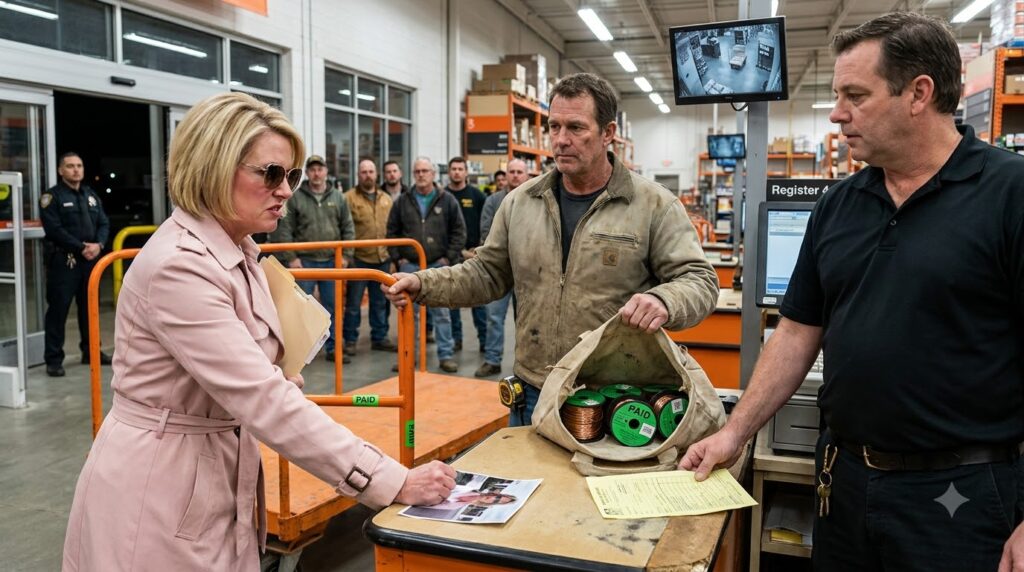
Marcus kept his large, calloused hands resting flat on the orange steel handle of his flatbed cart. In the bed sat eight heavy spools of ten-gauge solid copper wiring, their bright red insulation gleaming under the glare of the overhead strips. Six hundred and forty-two dollars and sixteen cents. He’d already run his commercial account card through the terminal at Register 4. He’d already watched the young cashier, Tyler, slap the bright green, tamper-evident PAID stickers across the plastic cinch wrap of every single spool.

The thermal paper receipt was tucked inside the left breast pocket of Marcus’s grease-stained canvas jacket, resting cold against his ribs.

He took one step toward the heavy rubberized exit gates, his canvas tool tote slung over his shoulder.

“Don’t move an inch—everyone here is watching you put those spools in your personal bag!”

The voice was high, clipped, and loud enough to cut straight through the clatter of clinking metal chains and the distant roar of a forklift in Aisle 12.

Before Marcus could pivot, a heavy plastic shopping cart slammed into the tubular chrome railing six inches from his thigh, wedging him firmly between the checkout counter and the exit turnstile.

Evelyn Sallow stood directly in the gap. Her tailored pastel-pink trench coat was stark against the dusty concrete floor, her oversized designer sunglasses pushed up onto a crown of short, stiffly lacquered hair. Her right hand was raised like a weapon, the white-hot LED flash of her smartphone pointed straight into Marcus’s eyes.

“Freeze the screen, Tyler!” Evelyn shouted, turning her head slightly so her voice carried down the line of fifteen waiting contractors, roofers, and homeowners. “Don’t touch that register! I watched him put untagged inventory straight into his private tote! He thinks because he’s in work clothes he can walk right out the front door!”

The ambient noise of the register lane vanished. A heavy, suffocating silence settled over Register 4. Two framers in dirt-streaked vests three carts back stopped shuffling their lumber. A cashier at Register 3 paused mid-scan, her handheld laser hovering frozen over a box of deck screws.

Marcus didn’t flinch. He didn’t drop his tote. He felt the familiar, cold weight of his brass tape measure pressing against his hip—a tool that measured inches, hard angles, and undeniable facts.

He looked past the blinding white LED of Evelyn’s phone, meeting her eyes through the glare.

“The register lights are green, ma’am,” Marcus said. His voice was low, gravelly, and entirely devoid of speed. “Call the manager and check the screen.”

Evelyn’s lip curled into a thin, triumphant sneer. “Oh, the manager is coming, Mr. Brody. And so is regional security. You aren’t sneaking out of this one like you did at the zoning board.”

She stepped closer, the sharp tip of her designer shoe tapping against the concrete, blocking his only clear exit path while her camera recorded every breath he took.


CHAPTER 2: THE STANDOFF AND FALSE ACCUSATION

“You can take all the photos you want, Mrs. Sallow,” Marcus said, his voice dropping into a register so steady it seemed to draw the air right out of the aisle. “It won’t change what’s printed on that thermal slip, and it won’t change what that lens over your head just recorded.”

Evelyn didn’t blink. The illumination from her smartphone screen cast sharp, blue-tinged shadows across the deep creases around her mouth, exaggerating the hard, triumphant tilt of her chin. “Oh, I’m not relying on what just happened at this register, Marcus. I’m looking at the pattern.”

With her left hand, without lowering the camera, she reached into the deep side pocket of her pastel trench coat and pulled out a thick, legal-sized Manila folder. The edges were worn, the paper creased from being clutched too tight. As she shifted her grip, a sliver of faded yellow paper with a torn corner peeked out from the flap—a document that didn’t belong in a big-box store aisle.

“A pattern?” Marcus asked. He didn’t shift his weight. He kept his boots planted two feet apart on the cracked gray floor, his forearms resting lightly over the top bar of his flatbed cart. He could feel the heavy, iron-scented air of the hardware depot settling into his throat, tasting of dry chalk and raw lumber.

“You think you’re clever because you carry a stamped receipt,” Evelyn said, stepping forward until the plastic bumper of her cart clicked against the front frame of his flatbed. The metallic impact chimed sharply through the quieted register lane. “You think having a contractor’s badge gives you a pass to haul whatever you want out the back gates. Tell me, Marcus—what was in the back of that unmarked white Ford transit van parked behind the lumber yard three Tuesdays ago?”

Behind them, the line of waiting customers didn’t disperse; it thickened. A tall framer in a grease-stained canvas cap stepped up beside the rubber belt, resting a heavy hand on his belt buckle. “Hey, lady, some of us have crews waiting on job sites. If he’s got a receipt, let the cashier clear the lane.”

Evelyn didn’t even turn her head. She snapped her fingers toward the cashier’s booth without breaking eye contact with Marcus. “Tyler, stay right where you are. Touch that green button and I will personally include your supervisor in the formal incident report I’m filing with corporate tonight.”

Tyler’s hand hovered two inches above the terminal’s rubber key pad. The kid’s face was slick with sweat under the harsh overhead fluorescent tubes, his eyes darting frantically toward the main customer service desk at the front of the store. “I… I can’t override a flag if a customer reports active theft, man,” Tyler muttered toward Marcus, his voice cracking slightly. “Store policy says I gotta hold the line until an assistant manager swipes the key.”

“Then call the key,” Marcus said quietly. “Call Raymond Vance.”

Evelyn’s lip twitched—a tiny, involuntary spasm of satisfaction. “You know Raymond? Of course you do. You blue-collar boys always protect each other. But Raymond isn’t going to sweep this under the rug, Marcus. Not when I have documented proof of what you do when you think nobody’s watching.”

She flipped open the Manila folder with a sharp, crisp snap of her wrist. Inside, taped to the center of a white sheet of cardstock, was an eight-by-ten glossy photograph.

She held it up, slapping the back of the paper with the tips of her manicured fingers so the entire queue could see it.

The photograph showed the rear loading zone of Apex Contractor Supply, shot from behind the chain-link perimeter fence near the trash compactors. The sky in the photo was overcast, dark with incoming rain. In the center of the frame stood Marcus’s older white Ford service truck, its rear doors wide open. Marcus himself was clearly visible in the frame, lifting three heavy, unbadged spools of heavy-gauge wire out of the cargo bed and handing them off to a man in an unmarked gray work jacket.

“Look familiar?” Evelyn demanded, her voice ringing out across the register lanes. “Three weeks ago. Four hundred pounds of commercial copper, moved off the premises without a single store tag attached. No green stickers. No receipt on the dash. Just a quiet handoff behind the bins while the yard workers were on lunch break.”

The framer who had spoken up earlier frowned, his eyes narrowing as he leaned over the counter to look at the photo. A quiet, uncertain murmur rippled through the contractors standing behind him. A man moving unmarked wire out of a service vehicle in a rear loading zone didn’t look like a routine retail transaction; it looked like a side-door trade scheme.

Marcus looked at the photograph. He didn’t reach out to grab it. He didn’t flinch.

He recognized the gray sky in the picture. He recognized the heavy, rust-spotted frame of the scrap bin in the background. But as his eyes locked onto the bottom left corner of the image, where a shadow cut across the concrete, he noticed the subtle, deliberate framing. The image was cropped tight—so tight that the high-voltage transformer box and the heavy steel boundary posts marking the official regional utility staging area were completely cut out of the frame.

The yellow inspection slip peeking out of Evelyn’s folder had a torn corner—the exact tear Marcus remembered from the county-issued salvage receipt he had signed when clearing out the storm-damaged sub-station line for the local township.

“You’ve been following me,” Marcus said flatly.

“I observe my community,” Evelyn corrected, her voice smooth, icy, and entirely devoid of heat. “When individuals operate outside the rules, they leave a trail. You thought you could run your little off-the-books wire ring right under our noses, didn’t you? You bring the stolen stock back in, buy a couple of tagged spools to cover your numbers, and slip the rest into your personal tote when you leave.”

She stepped even closer, her phone camera now less than twelve inches from his face. “Open the bag, Marcus. Unzip the tool tote right now and let everyone see how many spools are actually sitting at the bottom.”

Marcus looked down at the canvas tote resting on the counter. The heavy brass zipper was closed. Inside sat four spools—each carrying the bright, untouched green sticker Tyler had applied less than four minutes ago.

He didn’t touch the zipper.

He raised his eyes back to Evelyn, his face carved from the same hard, unyielding granite as the foundation stones he laid for his job sites. “I’m not opening my bag for you, Mrs. Sallow.”

“Because you’re guilty,” she declared instantly, turning to face the crowd with her hands spread wide. “You all hear that? He refuses a voluntary inspection!”

“I refuse to let a private citizen play deputy in the middle of a hardware store,” Marcus replied, his voice rising just enough to lock down the room. “The manager holds the key to that terminal. If Raymond Vance wants to check my receipt against my bag, he can do it right here under the security dome. But you? You’re going to step back from my cart before you turn a civil mistake into a real problem.”

Evelyn laughed—a sharp, rattling sound that cut through the humid air. “Threats, Mr. Brody? Is that what we’re down to? Trying to intimidate me because I brought receipts?”

“No threats,” a deep, tired voice cut in from the end of the aisle. “Just store policy.”

Raymond Vance walked through the gap in the security gate, his black Apex polo shirt neatly tucked into pressed khakis, an earpiece cord coiled behind his ear. His face was pale, his mouth set in a thin, hard line as his eyes swept over the crowded lane, the bright LED light on Evelyn’s phone, and the glossy photo still clutched in her hand.

“Lower the camera, Mrs. Sallow,” Raymond said flatly. “Right now.”

CHAPTER 3: MANAGER INTERVENTION AND VIDEO REVIEW

Evelyn Sallow didn’t lower the phone. Her wrist tightened, the knuckle turning a pale, bloodless white as the LED flash beam hovered two inches from Raymond Vance’s chest badge.

“I am recording an active loss-prevention incident, Raymond,” she said, her voice dropping into a razor-thin, practiced register. “As a property owner in this district and an Apex Preferred account holder, I am exercising my right to document a felony theft in progress.”

Raymond didn’t reach for the phone. He didn’t raise his voice. He stood five-foot-nine, his shoulders heavy under his black corporate polo, his thumbs hooked casually into the front loops of his khakis. From his right hip hung a heavy brass ring holding a single, notched steel security key—the master override key that unlocked every register terminal and loss-prevention monitor in the building. It swung once, clicking softly against his brass belt buckle.

“Mrs. Sallow,” Raymond said, his tone flat as slate. “This is private commercial property. You are currently blocking the primary exit lane of Register 4, obstructing six commercial account holders, and filming a customer without store authorization. Lower the phone, or I will have security escort you to the vestibule while we audit this transaction.”

A quiet, collective exhalation rattled through the crowd behind Marcus. The framer in the dirt-streaked vest took a step back, leaning his elbow against the lumber stack behind him, his eyes shifting from Evelyn’s phone to Raymond’s key ring.

Evelyn’s eyes flashed behind her designer lenses. Slowly, with deliberate, theatrical restraint, she brought her hand down to her waist, though the lens remained angled toward Marcus’s boots. “Fine. But I expect you to review this evidence immediately, Raymond. I have photographic proof that Mr. Brody has been moving unbadged copper off your loading dock during off-hours.”

She thrust the eight-by-ten glossy photograph toward Raymond’s chest.

Raymond took the photo by its edge. He didn’t look at it right away. He turned his head toward Tyler, who was standing behind the terminal screen with his palms flat on the rubber counter mat.

“Tyler,” Raymond said. “Was the transaction completed?”

“Yes, sir,” Tyler squeaked, his index finger tapping the glowing green POS display. “Commercial account charge. Eight spools of ten-gauge solid core. Transaction four-eight-nine-two. System issued green tags on all eight items.”

“Did you personally affix the green tags?”

“Every single one, Mr. Vance,” Tyler said, nodding rapidly. “Store policy. I slapped ’em on before he packed ’em.”

Raymond turned to Marcus. The manager’s face was unreadable—the face of a man who spent sixty hours a week dealing with contractor disputes, short-shipped lumber loads, and short-tempered homeowners. “Marcus. Where’s your copy of the receipt?”

Marcus reached into his jacket. He didn’t rush. He pulled the long, thermal paper slip from his left breast pocket and handed it across the register rail. Next to it, he laid his Ohio electrical contractor’s license, the hard plastic card clicking sharply against the stainless steel counter edge.

“Timestamp is five-forty-one PM,” Marcus said evenly. “Eight spools. Four are in the cart. Four are in my canvas tote. You’re welcome to inspect the tags yourself.”

Evelyn cut in before Raymond could unfold the paper. “The tags mean nothing, Raymond! Look at the photo! He buys a few tagged spools to establish a paper trail, then uses his canvas bag to cycle untagged inventory he staged behind the building earlier this month! I caught him three weeks ago at the scrap bin!”

Raymond finally raised the glossy photograph to the light. His eyes narrowed as he scanned the image—the white Ford service truck, the open rear doors, the unbadged spools being handed off in the shadow of the rear fencing.

Marcus watched Raymond’s face. He saw the exact micro-second where Raymond’s brow furrowed. Raymond knew the layout of the rear dock better than anyone in the county; he knew every concrete pad, every drain pipe, and every storage locker along the western perimeter.

“This photo was taken behind the lumber yard,” Raymond noted quietly.

“Precisely,” Evelyn declared, taking a half-step forward. “Behind the waste compactors. Off-camera.”

“It’s not off-camera,” Raymond corrected her instantly. He pointed a thick, square fingernail at the dark, angled shadow cutting across the bottom left corner of the print. “That shadow isn’t from the fence post, Mrs. Sallow. That’s the overhang for the regional utility transformer vault. Camera nine covers that entire pad twenty-four hours a day.”

Evelyn stiffened. Her fingers twitched against her handbag. “Then check Camera nine! Check the archive for three Tuesdays ago!”

“I don’t need to check three weeks ago to settle Register four right now,” Raymond said. He unhooked the notched steel security key from his belt, inserted it into the key slot beside Tyler’s register terminal, and turned it ninety degrees clockwise. The terminal chimed once, a high-pitched electronic beep that signaled an administrative override. “Tyler, pull up the live security playback for Lane 4 over the last ten minutes on Monitor 2.”

Tyler hit three keys. On the small, black-framed monitor mounted above the register, a real-time playback split into four distinct camera angles.

The top-left quadrant showed Marcus wheeling his flatbed cart up to Register 4 at 5:37 PM.

The top-right quadrant showed the overhead dome camera looking straight down onto the conveyor belt.

In crisp, high-definition black-and-white, the footage showed Marcus lifting all eight spools from his cart and laying them side-by-side on the belt. It showed Tyler taking a handheld scanner, scanning each spool individually, and peeling eight bright green “PAID” stickers from his dispenser strip, pressing one firmly onto each spool’s plastic casing. It showed Marcus paying with his card, receiving the thermal slip, and then carefully placing four of the green-tagged spools into his heavy canvas tote while leaving the remaining four on the flatbed.

The bottom-left quadrant showed Evelyn walking into the frame from Aisle 3 at 5:40 PM, positioning her shopping cart directly across the exit railing, pulling out her phone, and raising the light into Marcus’s face before he had even taken three steps from the counter.

The playback looped once, twice, three times.

The crowd behind Marcus watched the monitor in absolute silence. The framer in the vest leaned forward, stared at the clear overhead shot of the green stickers being applied, and then slowly turned his head to look at Evelyn.

“Looks like he paid for every inch of that wire,” the framer said, his voice carrying over the low hum of the ceiling fans. “And looks like you were waiting in the aisle before he even put his receipt in his pocket.”

Evelyn’s throat clicked as she swallowed. She shifted her gaze from the monitor back to Raymond, her chest rising and falling in shallow, rapid breaths. “The receipt for today is not the issue! Look at the photo again! What about the unbadged wire in that truck? What about the handoff?”

Marcus stepped forward until his boots touched the steel base of the register counter. He pointed directly to the glossy photograph still held in Raymond’s hand.

“Look at the yellow paper peeking out of her folder, Raymond,” Marcus said, his voice cold, steady, and loud enough for every man in line to hear. “She cropped the picture. She cropped out the township utility sign and the emergency salvage permit on the fence post. She’s holding the official county inspection clearance in her hand right now—the one I signed when the township contracted me to clear the storm-damaged line at the substation three weeks ago.”

Evelyn pulled the Manila folder back against her chest, her fingers clawing at the paper edges. “That’s… that’s an unrelated document! That has nothing to do with this store!”

“It has everything to do with it,” Marcus said, his eyes locking onto hers with unyielding pressure. “You followed me to a township job site, took a photo through a chain-link fence, cropped out the official work order sign, and brought it here today to stage a public scene because I proved you wrong at the zoning board.”

Raymond turned his full weight toward Evelyn. The tiredness in his eyes had vanished, replaced by the cold, hard authority of a manager who realized his store was being used as a stage for a personal vendetta.

“Mrs. Sallow,” Raymond said, reaching out his hand. “Hand me the yellow sheet inside that folder. Right now.”

CHAPTER 4: THE PROOF REVEAL AND RESISTANCE BEAT

Evelyn Sallow didn’t yield the file. Her fingers dug so hard into the Manila folder that the paper buckled, creasing down the center.

“This is personal property, Raymond,” she snapped, stepping back until the spine of her pastel coat pressed against the cold steel upright of Aisle 4. “You have no legal right to confiscate my personal files! I came here as a citizen reporting a suspicious contractor!”

“You came into my store, blocked a lane, pointed a bright light in a customer’s face, and accused him of stealing,” Raymond said, taking one deliberate step forward. His work boots didn’t scuff the concrete; they planted with the heavy, unyielding rhythm of an anvil dropping onto oak. “You brought a photograph taken off-site and claimed it happened on my loading dock. That makes this store’s business.”

Marcus didn’t move toward her. He reached down, unzipped the heavy brass fastener of his canvas tool tote with a loud, raspy track sound, and folded the top flaps back.

Inside sat four pristine spools of ten-gauge copper. Across the clear plastic wrap of every single spool sat the bright green, tamper-evident PAID sticker, stamped with Tyler’s cashier ID and the POS terminal sequence.

“There’s the bag, Evelyn,” Marcus said, his voice dropping into that low, granite register that seemed to make the air in the aisle grow cold. “Four spools in the tote. Four on the flatbed. Eight on the register receipt in Raymond’s hand. Scan ’em yourself.”

The crowd behind them leaned in. The framer in the dirty vest spat a shred of tobacco onto the floor and let out a short, barking laugh. “Looks like eight out of eight to me, lady. Unless you think he hid a spool in his boot.”

Evelyn’s face flushed a deep, violent crimson, the blotches spreading up her neck from beneath her tailored collar. Her sunglasses slipped an inch down the bridge of her nose, revealing wide, panicked eyes that darted from the open canvas bag to the four video quadrants still looping on Monitor 2.

“He… he swapped them!” she insisted, her voice climbing an octave, losing its polished, civic-board cadence. She pointed a frantic, trembling index finger at Marcus. “He knew I was watching! He had accomplice stock hidden in the aisle! He’s a professional—he knows how to manipulate the camera angles!”

“Mrs. Sallow,” Raymond interrupted, his voice dropping into a register that made Tyler flinch behind the counter. “Stop talking.”

“I am a board member of the Northside Civic Improvement Association!” she shouted, her voice echoing off the high corrugated roof deck. “I will not be spoken to like a common shoplifter by a store manager!”

“Then stop acting like an enforcer on my clock,” Raymond said flatly. He reached out, his thick thumb catching the edge of the Manila folder. With a single, firm pull, he drew the yellow document out from beneath the paper flap.

Evelyn gasped, making a sharp, clawing swipe at the air, but Raymond stepped back, unfolding the crinkled sheet under the harsh fluorescent light.

It was a standard-issue County Public Works salvage authorization. In the upper left corner sat a bold purple stamp: APPROVED – TOWNSHIP UTILITY CLEARANCE. The description beneath read: Removal and transport of damaged ten-gauge commercial line stock from Substation 4. At the bottom, signed in thick black ink, was Marcus Brody’s signature, dated three weeks prior.

Attached to the back of the yellow form was the full, uncropped version of the very photograph Evelyn had taped to her cardstock.

In the wide frame, clear as day, stood the high-voltage transformer vault, the chain-link perimeter fence, and a bright orange metal sign reading: OFFICIAL TOWNSHIP WORK ZONE – LICENSED CONTRACTORS ONLY.

Raymond stared at the uncropped print for five full seconds. A slow, cold breath hissed through his teeth.

“You cropped out the work zone sign,” Raymond said quietly. It wasn’t a question.

“I… I framed the photo to focus on the suspect!” Evelyn stammered, her heels clicking rapidly as she backed away another inch. “The context was irrelevant! He was handling unbadged commercial wire!”

“The context is that he was doing a legal job for the county,” Raymond said. He folded the paper neatly, slid it into his back pocket, and turned his eyes on her with absolute, stony disgust. “And you brought a manipulated document into my building to publicly accuse a regular customer of a felony.”

Evelyn straightened her shoulders, trying desperately to reassemble her shattered composure. She adjusted her sunglasses, smoothed the front of her pastel coat, and gripped her handbag like a shield. “Regardless of your interpretation, Raymond, his presence here was suspicious. I acted in good faith to protect local businesses. I am leaving now.”

She reached out to grab her shopping cart to push past Marcus.

“You’re not leaving yet, Mrs. Sallow,” Raymond said.

Evelyn froze, her hand hovering over the plastic handle. “What did you say?”

“You blocked a customer for twelve minutes. You made false criminal accusations on private property while recording without consent,” Raymond said, gesturing toward the uniformed security officer who had just walked up from the front vestibule. “You’re going to step into the side office with Officer Hendricks. We’re going to log a formal trespass notice, and if Mr. Brody chooses to file a report for harassment, this video feed and that cropped photo go straight to the county sheriff.”

The silence that followed was total.

Evelyn turned to the crowd, her lips parting as if expecting someone—anyone—to step forward and validate her position.

The framer crossed his arms and stared at the ceiling. The two roofers behind him turned their backs, pulled out their phones, and began checking their job-site texts. Tyler lowered his head and began scanning the next customer’s order at Register 3.

No one moved. No one spoke. The public authority she had spent years carefully cultivating vanished into the dust-motes hovering above Register 4.

“Officer Hendricks,” Raymond said calmly. “Escort her to the manager’s desk.”

CHAPTER 5: PUBLIC COLLAPSE AND RESTORED DIGNITY

Officer Hendricks didn’t unholster his belt gear, nor did he raise his hands. He simply occupied the five feet of open concrete between Register 4 and the sliding glass doors, his blue uniform shirt taut across his chest, his arms folded loosely behind his back.

Evelyn Sallow took one short, frantic step to her left, her pastel coat swishing sharply against her knees. Hendricks shifted his weight by three inches, shutting down the angle before her foot could land.

“This is an outrageous abuse of authority,” Evelyn whispered. Her voice lacked its previous theatrical projection; it was brittle now, thin and dry as sun-bleached pine. “I am a private citizen leaving a commercial store.”

“You’re a private citizen who just staged an unlawful detention on private property using falsified records,” Raymond Vance said. He held up the Manila folder and the uncropped salvage permit, sliding them into an official store incident pouch. “Officer Hendricks will guide you down the corridor to the district manager’s desk. We’ll wait for the sheriff’s deputy to arrive so we can log the trespass order properly.”

Evelyn’s eyes darted past Hendricks’ shoulder toward the automatic glass doors. Outside, the dusk had turned to a deep, twilight indigo, the orange glow of the parking lot floodlights reflecting off the hood of her spotless silver SUV parked illegally in the loading zone.

No one in the checkout queue offered a word. The framer in the dirt-streaked vest picked up a box of fifteen-gauge framing nails and set it casually onto the conveyor belt behind Marcus’s flatbed. The two roofers leaned their backs against the steel rack, watching with stony, unreadable expressions as Officer Hendricks open-handed gestured toward the side office hallway.

“This way, ma’am,” Hendricks said. The tone was polite, neutral, and entirely immune to argument.

Evelyn’s mouth opened, her throat working silently for two seconds. Her hand trembled as she pulled her designer sunglasses down over her eyes, hiding whatever remained behind the tinted glass. She didn’t look at Marcus. She didn’t look at Raymond. She pulled her designer handbag tight against her ribs, turned on the heel of her shoe, and walked down the side corridor, her quick, erratic footsteps echoing down the concrete hall until a heavy steel fire door swung shut behind her.

The silence that remained in the front of Apex Contractor Supply was heavy, cool, and clean.

Raymond Vance turned back to the register counter. He picked up the printed thermal receipt from the mat, smoothed its edges between two fingers, and handed it back to Marcus along with his Ohio electrical license.

“Sorry about the delay, Marcus,” Raymond said quietly. His voice carried no lingering anger, only the deep, bone-dry fatigue of a man who worked twelve-hour shifts managing public friction. “Tyler, clear the register flag. Run the rest of the queue.”

“Appreciate it, Raymond,” Marcus said. He slid his license back into his wallet, folded the long thermal receipt, and placed it carefully inside his front vest pocket, right over his heart.

He reached down, zipped the heavy brass fastener of his canvas tool tote, and hoisted the fifty-pound bag onto his left shoulder. With his right hand, he took the cold steel handle of his flatbed cart and wheeled it past the open rubber gates toward the sliding doors.

As he passed the checkout queue, the framer in the vest gave him a single, curt nod of his head—a quiet, unspoken recognition between tradesmen who understood the exact value of a clean record. Marcus returned the nod, kept his pace steady, and walked through the pneumatic doors into the cool Friday night air.

The parking lot smelled of asphalt, rain-washed limestone, and the idling diesel of delivery trucks.

Marcus pushed his flatbed to the tailgate of his ten-year-old white Ford F-150. The bed was organized with mathematical precision: side racks held his ladders, locked steel boxes held his heavy power tools, and the center floor was swept clean of gravel and wire scraps.

He unhooked the tailgate, lifted the four green-stickered spools from the flatbed, and stacked them securely against the forward bed wall. Then he unslung his heavy canvas tool tote, setting the remaining four spools beside them. Eight spools. All tagged. All accounted for. All paid.

He closed the tailgate, the heavy steel latches clicking into place with a solid, metallic thud that rang out across the quiet lot.

For a long moment, Marcus stood beside the driver’s door, resting his palm on the cool, dust-filmed roof of his truck. He looked back toward the bright glass storefront of the depot. Through the wide windows, he could see Tyler scanning boxes at Register 4, the queue moving smoothly again, the flow of work restored to its normal, steady rhythm.

He didn’t feel a rush of triumph. He didn’t feel a surge of anger. What he felt was the deep, quiet weight of a man who had built his life on clear lines, legal permits, and hard, verifiable facts—a man who knew that when you keep your boundaries straight and your paper trail clean, you never have to raise your voice to stand your ground.

Marcus opened the truck door, climbed into the cab, and turned the ignition key. The V8 engine roared to life, smooth and steady. He pulled out of the Apex parking lot and turned down the county road toward home.

Similar Posts

Leave a Reply

Your email address will not be published. Required fields are marked *






