
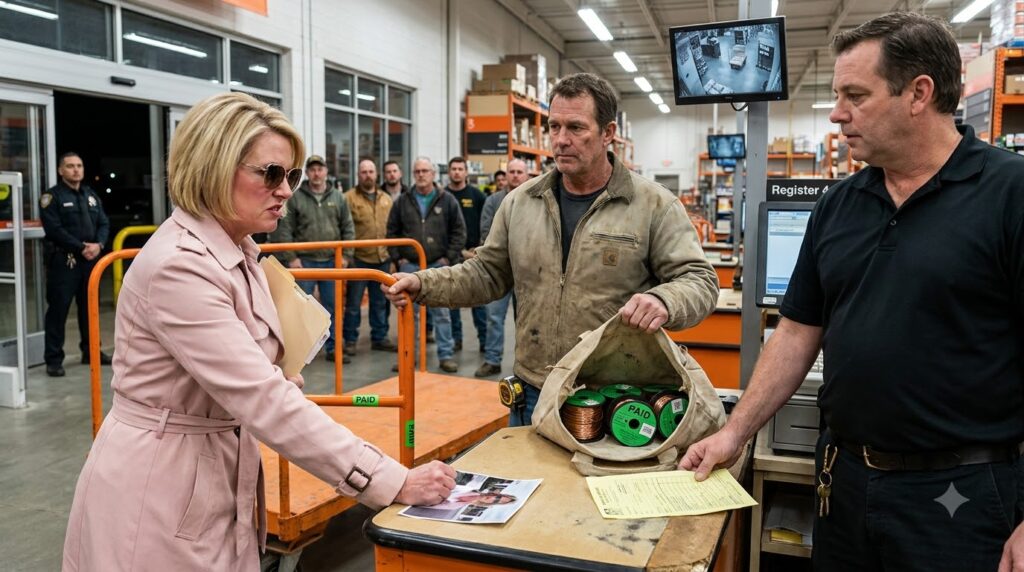
CHAPTER 2: THE STANDOFF AND FALSE ACCUSATION
“You can take all the photos you want, Mrs. Sallow,” Marcus said, his voice dropping into a register so steady it seemed to draw the air right out of the aisle. “It won’t change what’s printed on that thermal slip, and it won’t change what that lens over your head just recorded.”
Evelyn didn’t blink. The illumination from her smartphone screen cast sharp, blue-tinged shadows across the deep creases around her mouth, exaggerating the hard, triumphant tilt of her chin. “Oh, I’m not relying on what just happened at this register, Marcus. I’m looking at the pattern.”
With her left hand, without lowering the camera, she reached into the deep side pocket of her pastel trench coat and pulled out a thick, legal-sized Manila folder. The edges were worn, the paper creased from being clutched too tight. As she shifted her grip, a sliver of faded yellow paper with a torn corner peeked out from the flap—a document that didn’t belong in a big-box store aisle.
“A pattern?” Marcus asked. He didn’t shift his weight. He kept his boots planted two feet apart on the cracked gray floor, his forearms resting lightly over the top bar of his flatbed cart. He could feel the heavy, iron-scented air of the hardware depot settling into his throat, tasting of dry chalk and raw lumber.
“You think you’re clever because you carry a stamped receipt,” Evelyn said, stepping forward until the plastic bumper of her cart clicked against the front frame of his flatbed. The metallic impact chimed sharply through the quieted register lane. “You think having a contractor’s badge gives you a pass to haul whatever you want out the back gates. Tell me, Marcus—what was in the back of that unmarked white Ford transit van parked behind the lumber yard three Tuesdays ago?”
Behind them, the line of waiting customers didn’t disperse; it thickened. A tall framer in a grease-stained canvas cap stepped up beside the rubber belt, resting a heavy hand on his belt buckle. “Hey, lady, some of us have crews waiting on job sites. If he’s got a receipt, let the cashier clear the lane.”
Evelyn didn’t even turn her head. She snapped her fingers toward the cashier’s booth without breaking eye contact with Marcus. “Tyler, stay right where you are. Touch that green button and I will personally include your supervisor in the formal incident report I’m filing with corporate tonight.”
Tyler’s hand hovered two inches above the terminal’s rubber key pad. The kid’s face was slick with sweat under the harsh overhead fluorescent tubes, his eyes darting frantically toward the main customer service desk at the front of the store. “I… I can’t override a flag if a customer reports active theft, man,” Tyler muttered toward Marcus, his voice cracking slightly. “Store policy says I gotta hold the line until an assistant manager swipes the key.”
“Then call the key,” Marcus said quietly. “Call Raymond Vance.”
Evelyn’s lip twitched—a tiny, involuntary spasm of satisfaction. “You know Raymond? Of course you do. You blue-collar boys always protect each other. But Raymond isn’t going to sweep this under the rug, Marcus. Not when I have documented proof of what you do when you think nobody’s watching.”
She flipped open the Manila folder with a sharp, crisp snap of her wrist. Inside, taped to the center of a white sheet of cardstock, was an eight-by-ten glossy photograph.
She held it up, slapping the back of the paper with the tips of her manicured fingers so the entire queue could see it.
The photograph showed the rear loading zone of Apex Contractor Supply, shot from behind the chain-link perimeter fence near the trash compactors. The sky in the photo was overcast, dark with incoming rain. In the center of the frame stood Marcus’s older white Ford service truck, its rear doors wide open. Marcus himself was clearly visible in the frame, lifting three heavy, unbadged spools of heavy-gauge wire out of the cargo bed and handing them off to a man in an unmarked gray work jacket.
“Look familiar?” Evelyn demanded, her voice ringing out across the register lanes. “Three weeks ago. Four hundred pounds of commercial copper, moved off the premises without a single store tag attached. No green stickers. No receipt on the dash. Just a quiet handoff behind the bins while the yard workers were on lunch break.”
The framer who had spoken up earlier frowned, his eyes narrowing as he leaned over the counter to look at the photo. A quiet, uncertain murmur rippled through the contractors standing behind him. A man moving unmarked wire out of a service vehicle in a rear loading zone didn’t look like a routine retail transaction; it looked like a side-door trade scheme.
Marcus looked at the photograph. He didn’t reach out to grab it. He didn’t flinch.
He recognized the gray sky in the picture. He recognized the heavy, rust-spotted frame of the scrap bin in the background. But as his eyes locked onto the bottom left corner of the image, where a shadow cut across the concrete, he noticed the subtle, deliberate framing. The image was cropped tight—so tight that the high-voltage transformer box and the heavy steel boundary posts marking the official regional utility staging area were completely cut out of the frame.
The yellow inspection slip peeking out of Evelyn’s folder had a torn corner—the exact tear Marcus remembered from the county-issued salvage receipt he had signed when clearing out the storm-damaged sub-station line for the local township.
“You’ve been following me,” Marcus said flatly.
“I observe my community,” Evelyn corrected, her voice smooth, icy, and entirely devoid of heat. “When individuals operate outside the rules, they leave a trail. You thought you could run your little off-the-books wire ring right under our noses, didn’t you? You bring the stolen stock back in, buy a couple of tagged spools to cover your numbers, and slip the rest into your personal tote when you leave.”
She stepped even closer, her phone camera now less than twelve inches from his face. “Open the bag, Marcus. Unzip the tool tote right now and let everyone see how many spools are actually sitting at the bottom.”
Marcus looked down at the canvas tote resting on the counter. The heavy brass zipper was closed. Inside sat four spools—each carrying the bright, untouched green sticker Tyler had applied less than four minutes ago.
He didn’t touch the zipper.
He raised his eyes back to Evelyn, his face carved from the same hard, unyielding granite as the foundation stones he laid for his job sites. “I’m not opening my bag for you, Mrs. Sallow.”
“Because you’re guilty,” she declared instantly, turning to face the crowd with her hands spread wide. “You all hear that? He refuses a voluntary inspection!”
“I refuse to let a private citizen play deputy in the middle of a hardware store,” Marcus replied, his voice rising just enough to lock down the room. “The manager holds the key to that terminal. If Raymond Vance wants to check my receipt against my bag, he can do it right here under the security dome. But you? You’re going to step back from my cart before you turn a civil mistake into a real problem.”
Evelyn laughed—a sharp, rattling sound that cut through the humid air. “Threats, Mr. Brody? Is that what we’re down to? Trying to intimidate me because I brought receipts?”
“No threats,” a deep, tired voice cut in from the end of the aisle. “Just store policy.”
Raymond Vance walked through the gap in the security gate, his black Apex polo shirt neatly tucked into pressed khakis, an earpiece cord coiled behind his ear. His face was pale, his mouth set in a thin, hard line as his eyes swept over the crowded lane, the bright LED light on Evelyn’s phone, and the glossy photo still clutched in her hand.
“Lower the camera, Mrs. Sallow,” Raymond said flatly. “Right now.”








