CHAPTER 5: PUBLIC COLLAPSE AND RESTORED DIGNITY
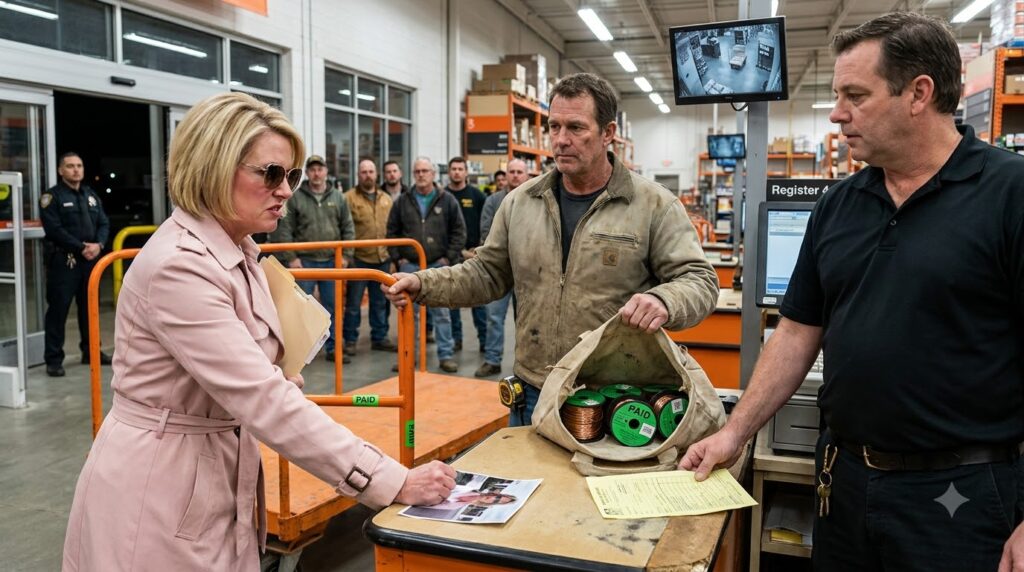
Officer Hendricks didn’t unholster his belt gear, nor did he raise his hands. He simply occupied the five feet of open concrete between Register 4 and the sliding glass doors, his blue uniform shirt taut across his chest, his arms folded loosely behind his back.
Evelyn Sallow took one short, frantic step to her left, her pastel coat swishing sharply against her knees. Hendricks shifted his weight by three inches, shutting down the angle before her foot could land.
“This is an outrageous abuse of authority,” Evelyn whispered. Her voice lacked its previous theatrical projection; it was brittle now, thin and dry as sun-bleached pine. “I am a private citizen leaving a commercial store.”
“You’re a private citizen who just staged an unlawful detention on private property using falsified records,” Raymond Vance said. He held up the Manila folder and the uncropped salvage permit, sliding them into an official store incident pouch. “Officer Hendricks will guide you down the corridor to the district manager’s desk. We’ll wait for the sheriff’s deputy to arrive so we can log the trespass order properly.”
Evelyn’s eyes darted past Hendricks’ shoulder toward the automatic glass doors. Outside, the dusk had turned to a deep, twilight indigo, the orange glow of the parking lot floodlights reflecting off the hood of her spotless silver SUV parked illegally in the loading zone.
No one in the checkout queue offered a word. The framer in the dirt-streaked vest picked up a box of fifteen-gauge framing nails and set it casually onto the conveyor belt behind Marcus’s flatbed. The two roofers leaned their backs against the steel rack, watching with stony, unreadable expressions as Officer Hendricks open-handed gestured toward the side office hallway.
“This way, ma’am,” Hendricks said. The tone was polite, neutral, and entirely immune to argument.
Evelyn’s mouth opened, her throat working silently for two seconds. Her hand trembled as she pulled her designer sunglasses down over her eyes, hiding whatever remained behind the tinted glass. She didn’t look at Marcus. She didn’t look at Raymond. She pulled her designer handbag tight against her ribs, turned on the heel of her shoe, and walked down the side corridor, her quick, erratic footsteps echoing down the concrete hall until a heavy steel fire door swung shut behind her.
The silence that remained in the front of Apex Contractor Supply was heavy, cool, and clean.
Raymond Vance turned back to the register counter. He picked up the printed thermal receipt from the mat, smoothed its edges between two fingers, and handed it back to Marcus along with his Ohio electrical license.
“Sorry about the delay, Marcus,” Raymond said quietly. His voice carried no lingering anger, only the deep, bone-dry fatigue of a man who worked twelve-hour shifts managing public friction. “Tyler, clear the register flag. Run the rest of the queue.”
“Appreciate it, Raymond,” Marcus said. He slid his license back into his wallet, folded the long thermal receipt, and placed it carefully inside his front vest pocket, right over his heart.
He reached down, zipped the heavy brass fastener of his canvas tool tote, and hoisted the fifty-pound bag onto his left shoulder. With his right hand, he took the cold steel handle of his flatbed cart and wheeled it past the open rubber gates toward the sliding doors.
As he passed the checkout queue, the framer in the vest gave him a single, curt nod of his head—a quiet, unspoken recognition between tradesmen who understood the exact value of a clean record. Marcus returned the nod, kept his pace steady, and walked through the pneumatic doors into the cool Friday night air.
The parking lot smelled of asphalt, rain-washed limestone, and the idling diesel of delivery trucks.
Marcus pushed his flatbed to the tailgate of his ten-year-old white Ford F-150. The bed was organized with mathematical precision: side racks held his ladders, locked steel boxes held his heavy power tools, and the center floor was swept clean of gravel and wire scraps.
He unhooked the tailgate, lifted the four green-stickered spools from the flatbed, and stacked them securely against the forward bed wall. Then he unslung his heavy canvas tool tote, setting the remaining four spools beside them. Eight spools. All tagged. All accounted for. All paid.
He closed the tailgate, the heavy steel latches clicking into place with a solid, metallic thud that rang out across the quiet lot.
For a long moment, Marcus stood beside the driver’s door, resting his palm on the cool, dust-filmed roof of his truck. He looked back toward the bright glass storefront of the depot. Through the wide windows, he could see Tyler scanning boxes at Register 4, the queue moving smoothly again, the flow of work restored to its normal, steady rhythm.
He didn’t feel a rush of triumph. He didn’t feel a surge of anger. What he felt was the deep, quiet weight of a man who had built his life on clear lines, legal permits, and hard, verifiable facts—a man who knew that when you keep your boundaries straight and your paper trail clean, you never have to raise your voice to stand your ground.
Marcus opened the truck door, climbed into the cab, and turned the ignition key. The V8 engine roared to life, smooth and steady. He pulled out of the Apex parking lot and turned down the county road toward home.