
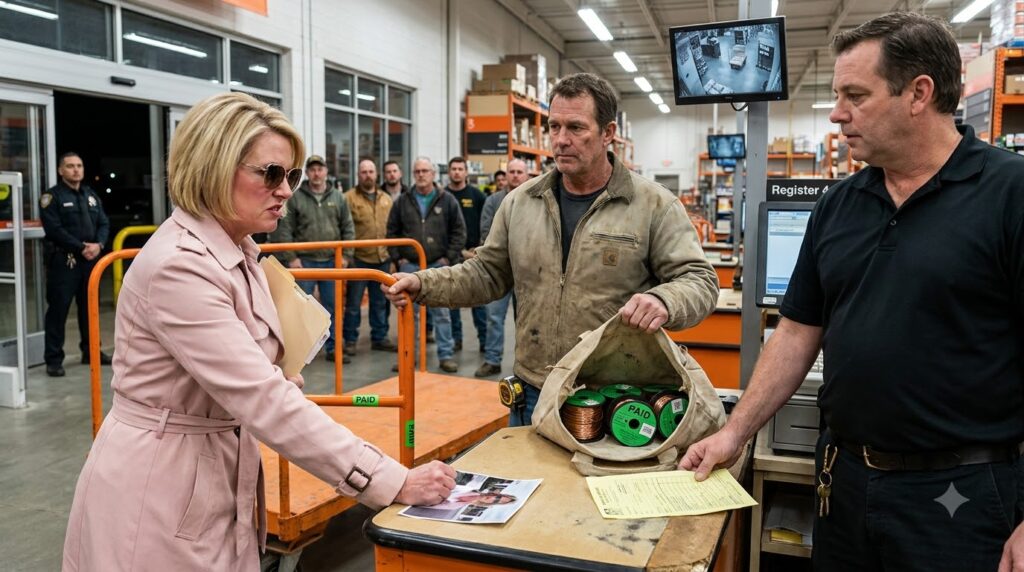
CHAPTER 3: MANAGER INTERVENTION AND VIDEO REVIEW
Evelyn Sallow didn’t lower the phone. Her wrist tightened, the knuckle turning a pale, bloodless white as the LED flash beam hovered two inches from Raymond Vance’s chest badge.
“I am recording an active loss-prevention incident, Raymond,” she said, her voice dropping into a razor-thin, practiced register. “As a property owner in this district and an Apex Preferred account holder, I am exercising my right to document a felony theft in progress.”
Raymond didn’t reach for the phone. He didn’t raise his voice. He stood five-foot-nine, his shoulders heavy under his black corporate polo, his thumbs hooked casually into the front loops of his khakis. From his right hip hung a heavy brass ring holding a single, notched steel security key—the master override key that unlocked every register terminal and loss-prevention monitor in the building. It swung once, clicking softly against his brass belt buckle.
“Mrs. Sallow,” Raymond said, his tone flat as slate. “This is private commercial property. You are currently blocking the primary exit lane of Register 4, obstructing six commercial account holders, and filming a customer without store authorization. Lower the phone, or I will have security escort you to the vestibule while we audit this transaction.”
A quiet, collective exhalation rattled through the crowd behind Marcus. The framer in the dirt-streaked vest took a step back, leaning his elbow against the lumber stack behind him, his eyes shifting from Evelyn’s phone to Raymond’s key ring.
Evelyn’s eyes flashed behind her designer lenses. Slowly, with deliberate, theatrical restraint, she brought her hand down to her waist, though the lens remained angled toward Marcus’s boots. “Fine. But I expect you to review this evidence immediately, Raymond. I have photographic proof that Mr. Brody has been moving unbadged copper off your loading dock during off-hours.”
She thrust the eight-by-ten glossy photograph toward Raymond’s chest.
Raymond took the photo by its edge. He didn’t look at it right away. He turned his head toward Tyler, who was standing behind the terminal screen with his palms flat on the rubber counter mat.
“Tyler,” Raymond said. “Was the transaction completed?”
“Yes, sir,” Tyler squeaked, his index finger tapping the glowing green POS display. “Commercial account charge. Eight spools of ten-gauge solid core. Transaction four-eight-nine-two. System issued green tags on all eight items.”
“Did you personally affix the green tags?”
“Every single one, Mr. Vance,” Tyler said, nodding rapidly. “Store policy. I slapped ’em on before he packed ’em.”
Raymond turned to Marcus. The manager’s face was unreadable—the face of a man who spent sixty hours a week dealing with contractor disputes, short-shipped lumber loads, and short-tempered homeowners. “Marcus. Where’s your copy of the receipt?”
Marcus reached into his jacket. He didn’t rush. He pulled the long, thermal paper slip from his left breast pocket and handed it across the register rail. Next to it, he laid his Ohio electrical contractor’s license, the hard plastic card clicking sharply against the stainless steel counter edge.
“Timestamp is five-forty-one PM,” Marcus said evenly. “Eight spools. Four are in the cart. Four are in my canvas tote. You’re welcome to inspect the tags yourself.”
Evelyn cut in before Raymond could unfold the paper. “The tags mean nothing, Raymond! Look at the photo! He buys a few tagged spools to establish a paper trail, then uses his canvas bag to cycle untagged inventory he staged behind the building earlier this month! I caught him three weeks ago at the scrap bin!”
Raymond finally raised the glossy photograph to the light. His eyes narrowed as he scanned the image—the white Ford service truck, the open rear doors, the unbadged spools being handed off in the shadow of the rear fencing.
Marcus watched Raymond’s face. He saw the exact micro-second where Raymond’s brow furrowed. Raymond knew the layout of the rear dock better than anyone in the county; he knew every concrete pad, every drain pipe, and every storage locker along the western perimeter.
“This photo was taken behind the lumber yard,” Raymond noted quietly.
“Precisely,” Evelyn declared, taking a half-step forward. “Behind the waste compactors. Off-camera.”
“It’s not off-camera,” Raymond corrected her instantly. He pointed a thick, square fingernail at the dark, angled shadow cutting across the bottom left corner of the print. “That shadow isn’t from the fence post, Mrs. Sallow. That’s the overhang for the regional utility transformer vault. Camera nine covers that entire pad twenty-four hours a day.”
Evelyn stiffened. Her fingers twitched against her handbag. “Then check Camera nine! Check the archive for three Tuesdays ago!”
“I don’t need to check three weeks ago to settle Register four right now,” Raymond said. He unhooked the notched steel security key from his belt, inserted it into the key slot beside Tyler’s register terminal, and turned it ninety degrees clockwise. The terminal chimed once, a high-pitched electronic beep that signaled an administrative override. “Tyler, pull up the live security playback for Lane 4 over the last ten minutes on Monitor 2.”
Tyler hit three keys. On the small, black-framed monitor mounted above the register, a real-time playback split into four distinct camera angles.
The top-left quadrant showed Marcus wheeling his flatbed cart up to Register 4 at 5:37 PM.
The top-right quadrant showed the overhead dome camera looking straight down onto the conveyor belt.
In crisp, high-definition black-and-white, the footage showed Marcus lifting all eight spools from his cart and laying them side-by-side on the belt. It showed Tyler taking a handheld scanner, scanning each spool individually, and peeling eight bright green “PAID” stickers from his dispenser strip, pressing one firmly onto each spool’s plastic casing. It showed Marcus paying with his card, receiving the thermal slip, and then carefully placing four of the green-tagged spools into his heavy canvas tote while leaving the remaining four on the flatbed.
The bottom-left quadrant showed Evelyn walking into the frame from Aisle 3 at 5:40 PM, positioning her shopping cart directly across the exit railing, pulling out her phone, and raising the light into Marcus’s face before he had even taken three steps from the counter.
The playback looped once, twice, three times.
The crowd behind Marcus watched the monitor in absolute silence. The framer in the vest leaned forward, stared at the clear overhead shot of the green stickers being applied, and then slowly turned his head to look at Evelyn.
“Looks like he paid for every inch of that wire,” the framer said, his voice carrying over the low hum of the ceiling fans. “And looks like you were waiting in the aisle before he even put his receipt in his pocket.”
Evelyn’s throat clicked as she swallowed. She shifted her gaze from the monitor back to Raymond, her chest rising and falling in shallow, rapid breaths. “The receipt for today is not the issue! Look at the photo again! What about the unbadged wire in that truck? What about the handoff?”
Marcus stepped forward until his boots touched the steel base of the register counter. He pointed directly to the glossy photograph still held in Raymond’s hand.
“Look at the yellow paper peeking out of her folder, Raymond,” Marcus said, his voice cold, steady, and loud enough for every man in line to hear. “She cropped the picture. She cropped out the township utility sign and the emergency salvage permit on the fence post. She’s holding the official county inspection clearance in her hand right now—the one I signed when the township contracted me to clear the storm-damaged line at the substation three weeks ago.”
Evelyn pulled the Manila folder back against her chest, her fingers clawing at the paper edges. “That’s… that’s an unrelated document! That has nothing to do with this store!”
“It has everything to do with it,” Marcus said, his eyes locking onto hers with unyielding pressure. “You followed me to a township job site, took a photo through a chain-link fence, cropped out the official work order sign, and brought it here today to stage a public scene because I proved you wrong at the zoning board.”
Raymond turned his full weight toward Evelyn. The tiredness in his eyes had vanished, replaced by the cold, hard authority of a manager who realized his store was being used as a stage for a personal vendetta.
“Mrs. Sallow,” Raymond said, reaching out his hand. “Hand me the yellow sheet inside that folder. Right now.”








