
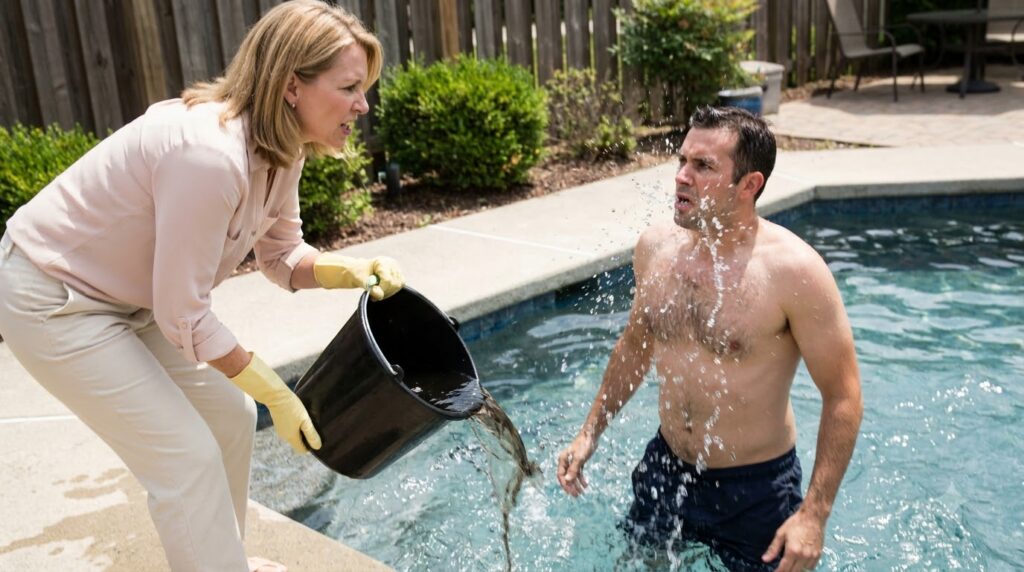
The Quiet Boundary: How a Calculated Retaliation Restored Sovereign Order to a Broken Suburban Cul-de-Sac
CHAPTER 1: THE ACCELERATION OF FLUID
The cold didn’t hit Marcus Vance until the mud reached his eyes.
“Yeah, now you get it!” The voice rasped like dry palm fronds dragging across stucco. “That’s exactly what you deserve!”
Marcus recoiled backward into the churned blue water, his palms sweeping instinctively across his eyelids to clear the grit. The sharp, bitter stink of stagnant planter-box silt, rotted mulch, and decomposed fertilizer instantly overpowered the clean smell of chlorine. He broke the surface, coughing, his chest heaving as the sun-bleached backyard swung back into focus.
Brenda Vance stood on the coping stones three inches from the water’s edge. Her pale blush button blouse was crisp, her cream trousers uncreased, and her arms were rigid, locked at the elbows. Her fingers were encased in bright yellow rubber dishwashing gloves, clamped around the rim of an inverted black plastic bucket. A thick, dark ribbon of sludge was still dripping from its base, splattering across her dark low heels and the white pool coping.
She didn’t retreat. She leaned forward, her chest tucked over her ribs, her mouth open in a tight, triumphant snarl. Behind her oversized sunglasses, her cheek muscles twitched with the high, frantic energy of someone who had spent three weeks rehearsing an execution.
Marcus stayed upright in the six-foot deep end, treaded water with one hand, and wiped a black streak of silt from his forehead with the other. His athletic frame was braced, muscles taut under the cold shock of the water, but his eyes were flat. Cold.
He didn’t yell. He didn’t splash. He calculated.
“What the hell was that for?” Marcus asked. His voice was low, clipped, and stripped of all panic. It wasn’t a cry for help; it was an interrogation.
Brenda’s jaw tightened. She didn’t drop the bucket. She adjusted her grip on the plastic handle, the yellow rubber squeaking against the wet surface. “You think because you drive a work truck you can ignore the architectural board? You think you own the air above that fence?”
“This is my property, Brenda,” Marcus said, his voice dropping an octave into the quiet register he used when negotiating commercial subcontract bids. “You stepped over a locked side gate.”
“The easement belongs to the community!” she snapped, her chin jerking toward the cedar fence dividing their lots. “And that water was sitting in a clogged drain on my side because your unapproved patio slope is dumping runoff onto my begonias. Consider it returned property.”
She lowered the bucket slightly, but her boots stayed planted on his tile coping. She was waiting for him to surge out of the pool. She was waiting for the hands, the shouting, the physical posture of a thirty-two-year-old contractor towering over a woman in her fifties—the exact image she needed for the 911 call she had likely already pre-dialed in her pocket.
Marcus didn’t move toward the steps. He looked past her shoulder, his gaze drifting upward toward the second-story deck of the gable-roofed house directly adjacent.
A slat on the vinyl deck blind twitched. A dark circle of glass—the lens of a tablet—glinted behind the screen. Mrs. Gable was sitting in her wicker chair, fully stationary, holding her device at chest height.
Marcus turned his head back to Brenda. The dark silt was running down his neck, staining his chest above his navy swim trunks.
“You’re done,” Marcus said softly.
Brenda let out a short, barked laugh, curling her gloved fingers tighter around the handle. “I’m just getting started, Vance. You’ll have the municipal cease-and-desist on your windshield by five o’clock.”
She turned on her heel, her low heels clicking sharply against the wet concrete patio as she marched toward the side gate she had unlatched.
Marcus drifted to the pool ladder, pulled himself out smoothly, and stood dripping on the concrete. He reached for his towel on the iron table, wiping his face cleanly. As he turned toward his back sliding door, his eyes caught a small, bright metallic object lying in the grass right where Brenda had been standing—a heavy brass key attached to a stamped municipal tag that didn’t belong to any residential lock in the county.

CHAPTER 2: FORENSIC SURFACING
The water dripping from Marcus’s shoulders sounded like a steady, rhythmic tap against the hardwood floor of the utility hallway.
He didn’t step onto the living room rug. He stopped at the threshold, reached into his back pocket, and pulled out his phone with two dry fingers. His palm was still chilled from the deep end, but his hands didn’t shake. He wiped a streak of chlorinated pond water off the screen against the dry underside of his forearm, opened his local storage app, and initiated a manual backup of the perimeter camera array.
Four high-definition lenses lined the eaves of his roof. Camera Two—the wide-angle optical unit mounted directly beneath the western soffit—had an unobstructed, uninterrupted view of the side gate, the pool coping, and the exact six-foot radius of concrete where Brenda Vance had delivered her payload.
He pressed play on the raw fifteen-second clip.
On the 4K render, the physical reality was even clearer than it had felt in the water. Brenda hadn’t slipped. She hadn’t stumbled while carrying yard debris toward her compost pile. She had unlatched the side gate with her elbow, carried the black plastic bucket in a low, two-handed clamp, and marched directly to the edge with a calculated, rhythmic stride. The video caught the precise moment the dark liquid left the rim, breaking across the light blue surface of the pool in a heavy, parabolic arc. It caught the movement of her jaw, the bright yellow sheen of her rubber dishwashing gloves, and the exact position of her dark low heels planted three inches inside his property line.
Marcus paused the frame on her face. Her expression wasn’t angry; it was manic, elevated by the false high of an executioner who believed she was operating under a higher mandate.
He saved the raw video to three separate local drives, locked the screen, and set the phone on the kitchen counter next to the brass key he had scooped from the grass.
The key sat heavy against the white quartz. It was thick, double-bitted, and forged from solid, unpolished brass—the kind used for commercial utility enclosures, heavy gate padlocks, or municipal junction boxes. Attached to the stamped ring was a rectangular aluminum tag, pitted with acid exposure and stamped with three indented characters: W-04.
Marcus picked up a dry micro-fiber towel from the rack, dried his hair, and rubbed his arms until his skin flushed warm. The bitter, rotted smell of the planter-box sludge was still trapped in his pores, a clinging reek of stagnant soil and sulfur. He stripped off the navy swim trunks, tossed them into the stainless utility sink, and turned the cold tap on full blast, watching the dark silt rinse off the fabric and down the drain.
His phone buzzed on the quartz top. A single vibration.
He didn’t rush. He pulled on a pair of dark canvas work pants, a heavy cotton shirt, and his boots, lacing them tight before picking up the device.
It was a text message from an unlisted number, but he recognized the syntax immediately.
Citations for unauthorized drainage modification and illegal hazardous runoff disposal have been filed with the county district. You have twenty-four hours to clear the work trailer from the driveway before the secondary tow lien takes effect.
Attached to the text was an image of an official form. It bore the crest of the County Code Enforcement Division, complete with a serial tracking code, a formal municipal header, and a stamped signature line at the bottom.
Marcus zoomed in on the signature.
The ink was crisp, dark blue, and laid down with the mechanical precision of an offset press. But the paper underneath it—visible at the frayed top edge where the document had been torn from a legal pad—showed a faint watermark running vertically down the margin.
It wasn’t municipal bond paper. It was an obsolete inventory stock used exclusively by the County Clerk’s archive office prior to the digital migration five years ago.
Marcus stared at the watermark. He knew the paper stock because he had pulled land-use records from the basement archives when he bought the house three years ago. The county had auctioned off its surplus paper goods during the district consolidation, and the only person in the immediate residential sector who had spent thirty years working as a senior clerk in that exact basement was Brenda Vance’s son-in-law, Arthur.
Brenda wasn’t writing complaints on standard HOA paper anymore. She was using real, state-issued municipal forms stolen from decommissioned county stock, filling them out by hand, and using them to intimidate residents who didn’t know the difference between a formal court summons and a forged piece of scrap paper.
Marcus set the phone back on the counter next to the brass key.
He walked to the back sliding door, unlocked the double deadbolt, and stepped out onto the back porch. The sun was hot now, burning off the humidity of the early afternoon, drying the dark splash marks where the planter water had coated the white pool coping. Across the fence line, the neighborhood was quiet, but the air felt thin, stretched tight like a wire under tension.
From the second story of the Gable house, the shadow of the deck blinds shifted slightly. Mrs. Gable hadn’t moved. She was still sitting in her wicker chair, watching the fence line, her tablet resting flat across her knees.
Marcus walked down the three concrete steps toward his work trailer parked in the driveway. The heavy steel hitch was locked, but as he reached the side door, he saw a fresh white paper notice tucked under the rubber seal of the side window—a duplicate of the form sent to his phone, complete with the blue ink signature and the stolen county watermark.
Next to the trailer wheel, resting in the gravel, was a small, empty plastic wrapper that had contained a heavy-duty commercial padlock.
Marcus looked from the wrapper to his front gate, then back down at the brass key in his pocket. The key didn’t belong to his house, his trailer, or his pool shed.
It belonged to the commercial padlock Brenda had just bought to chain his trailer to his own fence.
CHAPTER 3: THE EXCAVATION OF PROOF
Marcus didn’t touch the plastic wrapper lying in the driveway gravel. He stepped over it, reached into his work truck’s cab, and pulled out a tactical LED torch alongside a pair of heavy leather utility gloves.
The brass key felt cold against his palm, its edges sharp where the code W-04 was pressed deep into the alloy. He flipped the beam on, painting the side frame of his dual-axle trailer in a stark, white circle of light.
The padlock wasn’t on the axle. It was clamped around the primary tongue latch, binding the steel coupler directly to the safety chain loop. The shackle was three-quarter-inch hardened boron, painted industrial blue—a municipal contractor lock designed for water main shutoffs and city maintenance vaults.
Brenda hadn’t just bought a lock at a hardware store. She had used a stolen city key to secure a stolen municipal lock onto private equipment parked on private asphalt.
Marcus stepped back, the beam of his torch sweeping low across the concrete driveway toward the Property Line.
When he bought the property three years ago, the boundary between his driveway and Brenda’s immaculate, manicured berm was marked by a low decorative line of pressure-treated landscape timbers. Over thirty months, those timbers had subtly migrated. Inch by inch, season by season, Brenda had added layers of dark pine-bark mulch, pushing the soil bed outward, encroaching on his gravel shoulder until the edge of her hydrangeas hung directly over his work truck’s side mirror.
He walked to the utility sink in the garage, grabbed a flat-head masonry chisel and a two-pound sledge, and returned to the property line.
He didn’t guess. He knew where the original county monument was supposed to sit. He dropped to one knee on the hot driveway edge, setting the cold iron tip of the chisel against the seam where her fresh mulch met his concrete pad.
He struck the chisel once. A sharp, metallic clink rang out through the quiet afternoon air.
The steel didn’t bite into dirt or wood. It hit zinc-coated steel.
Marcus brushed away the top two inches of damp, dyed mulch. Beneath her decorative garden bed lay the original county survey pin—a six-inch galvanized pipe capped with a brass boundary marker. But the marker wasn’t exposed. Brenda had driven a steel rebar stake directly alongside it, using a heavy hammer to bend the original county pin four inches to the east, artificially bending the property line toward his house to create the illusion that his driveway sat on her easement.
Marcus shone the light directly into the hole. Fresh scraper marks scarred the zinc plating on the pin. The metal flakes were raw, un-oxidized, and silver—scraped within the last forty-eight hours.
He stood up, his leather gloves coated in damp red dirt, and pulled his phone from his chest pocket. He took six high-resolution macro shots of the bent pin, the fresh metal shavings, and the clear measurement line showing her garden bed covering the true county monument.
His tablet in the kitchen chimed—a loud, dual-tone alert reserved for secure cloud uploads.
Marcus walked back into the house, leaving his work boots at the threshold. On the kitchen island, his screen had automatically refreshed with a digitized PDF document forwarded by his title insurance company in response to an automated boundary-search request he had flagged two hours prior.
It was the complete archival filing for Lot 14—Brenda’s parcel—dating back twenty-two years.
He scrolled past the original land plat down to the permit history. Page four contained a series of municipal rejection slips stamped in bright red ink: DENIED – COUNTY CLERK ARCHIVE DIVISION.
Every single slip bore the exact same serial prefix as the forged paper left on his trailer windshield.
Marcus zoomed in on the notary seal at the bottom of the oldest denial form. The name stamped in the blue ink was Arthur Vance—Brenda’s son-in-law. Five years ago, before his retirement, Arthur hadn’t just taken blank paper stock from the basement archives; he had systematically filed false code-enforcement liens against neighboring lots whenever Brenda complained about property lines, using his official stamp to make her personal grudges appear as open, binding municipal violations in the county database.
This was the engine behind her terror campaign. For a decade, Brenda had held the cul-de-sac hostage not through legal authority, but through a massive, illegitimate paper fortress built on stolen court stationery and fabricated code citations that no neighbor had ever dared to cross-check.
Marcus leaned over the island, his eyes narrowing as he cross-referenced the serial numbers on the PDF with the notice stuck to his trailer window. They matched digit for digit. The “cease-and-desist” was a complete ghost, an unsanctioned forgery designed to force him into a panic sale or an expensive out-of-court settlement.
He picked up the brass key, slipped it into his pocket alongside the printed PDF, and looked out the front window.
Across the asphalt street, Brenda was standing on her front porch, fully dressed in her cream trousers and blush blouse, holding a clip-board under one arm and her mobile phone pinned against her ear. Her face was flushed, her mouth moving in rapid, aggressive bursts as she gestured wildly toward his driveway.
She wasn’t calling a lawyer. She was calling the local police precinct, demanding an emergency response team for an “unlawful contractor setup.”
Marcus didn’t move to stop her. He pulled his chair out from the dining table, sat down in the quiet sunlight, and opened his laptop to draft the formal criminal complaint.
Through the glass, he watched her finish the call and march down her front steps toward his driveway with a fresh white envelope in her yellow-gloved hand. But as she reached his property line, he saw the second detail—the detail that shattered the simple narrative of a stolen stationery scam.
Brenda didn’t look at his trailer. She looked down at the exact spot where he had uncovered the bent survey pin. Her face didn’t show anger; it showed a sudden, stark, paper-white flash of absolute terror.
She wasn’t trying to hide the stolen forms anymore. She was trying to hide what lay four inches beneath them.
CHAPTER 4: THE BORON TRAP
Marcus opened the front door just as the low, heavy thrum of a diesel engine rattled the glass windowpanes.
It wasn’t a police cruiser. A flatbed tow truck, its yellow warning lights strobing rhythmically against the dry oak leaves overhead, swung wide into the cul-de-sac. The driver cut the air brakes with a loud, mechanical hiss, stopping inches from Marcus’s driveway apron.
Brenda didn’t wait for the truck to settle on its suspension. She marched directly to the driver’s cab, her yellow rubber gloves tucked into her back trouser pocket, her clipboard clamped across her chest like armor.
“That’s the vehicle,” she said, her voice carrying sharply across the asphalt. She pointed a manicured finger at Marcus’s dual-axle work trailer. “Abandonment on a municipal easement, secondary lien violation, and unpermitted commercial storage. Lock it and hoist it.”
The driver—a young guy wearing a high-visibility vest and a grease-stained cap—swung out of the cab. He held a heavy steel cable hook in one gloved hand and a digital tablet in the other. He looked at the trailer, then at Marcus standing on the concrete steps.
“Ma’am, this trailer is on private property,” the driver said, his voice flat, neutral, practiced. “It’s three feet behind the curb line.”
“The easement extends six feet from the apron edge!” Brenda snapped, her jaw working furiously. She thrust a paper from her clipboard into his face—the same blue-ink forgery Marcus had just cross-referenced in the basement database. “I am the designated district monitor. This order is backed by County Clerk Archives Division File 90-B. If you refuse to haul, I’ll report your dispatcher for obstruction before you hit the main road.”
Marcus walked down the three concrete steps, his boots crunching steadily over the gravel. He didn’t raise his voice. He didn’t reach for the driver. He pulled his phone from his pocket, flipped the camera to record, and held it at chest height.
“Morning,” Marcus said to the tow driver. “My name is Marcus Vance. I own the deed to this parcel, the concrete under that trailer, and the vehicle itself.”
“He’s under an active cease-and-desist!” Brenda interjected, her posture rigid, her voice rising half an octave into the sharp register of panic. “Don’t listen to him! Look at the tongue lock! The city has already impounded the hitch!”
The driver squatted down by the dual-axle tongue, shining his flashlight on the industrial blue padlock Brenda had locked through the safety chain loop. He reached out with two fingers, touching the hardened boron shackle.
“Where’s the key for this lock, boss?” the driver asked Marcus, squinting up through the yellow strobe glare.
“I have the key,” Marcus said cleanly. He reached into his pocket, pulled out the heavy brass key stamped W-04, and held it between two fingers. “Because the woman standing next to you dropped it on my pool deck twenty minutes ago after dumping a bucket of stagnant planter runoff over my head.”
The driver froze. He looked at the key, then at Brenda, whose pale blush blouse seemed to drain of color under the flashing amber lights.
“That’s a lie!” Brenda shouted, her fingers twitching against her clipboard. “He stole that key! That is city property! He broke into my garage—”
“The video was uploaded to the county prosecutor’s civil unit six minutes ago,” Marcus said, his voice dropping into a razor-thin, conversational calm. “Four cameras recorded her unlatching my side gate, dumping the water, and dropping that key. And if you attach your winch cable to my steel frame based on a forged county form, your tow company joins the civil suit as a co-defendant.”
The driver stood up slowly. He didn’t look at Brenda anymore. He took two steps back toward his cab, reached for his radio, and unhooked the mic. “Dispatcher, this is Unit Four. Cancel the private impound request at 114 Maple. Civil property dispute in progress, unverified paperwork. I’m rolling clear.”
“You can’t roll clear!” Brenda screamed, stepping in front of the truck’s front bumper, her hands slamming down onto the chrome grill. “I have the form! I have the stamp!”
“Move away from the bumper, ma’am,” the driver said through his open door, his tone shifting from professional fatigue to hard warning. “Or I call dispatch to request an officer on scene for vehicle interference.”
Brenda didn’t move. Her teeth were clenched, her chest rising and falling in shallow, ragged gasps. She looked at the driver, then spun toward Marcus, her eyes wild behind her sunglasses.
“You think you’re smart, don’t you?” she spat, taking two aggressive steps onto his driveway, her cream trousers stained with the red dirt from the bent survey pin. “You think because you found a piece of paper you can undo twenty years of order? You don’t belong here, Vance! You and your tools and your dirt!”
“Brenda,” Marcus said softly, stepping closer until he stood less than two feet from her. He pointed down at the exposed zinc-coated pin near her shoes. “I don’t care about your order. But when I pulled the archival plat to verify your son-in-law’s signatures, I noticed something else on the 2004 site plan.”
Brenda went completely motionless. The wind caught her blonde hair, blowing it across her forehead, but she didn’t brush it back.
“The survey pin isn’t the only thing you bent,” Marcus said. “Your master bedroom suite additions were poured four feet south of your actual lot line. My driveway isn’t on your easement, Brenda. Your foundation is sitting on my land.”
The tow truck engine roared as the driver backed out of the driveway, the amber lights sweeping away into the afternoon sun, leaving them standing in the sudden, heavy silence of the street.
Brenda stared at him, her mouth opening, then closing without a sound. She didn’t offer a denial. She didn’t raise her clipboard.
Then, from the side of Marcus’s house, the heavy iron gate clicked open.
Marcus didn’t turn around, but he heard the slow, measured footsteps of Officer Miller coming down the concrete walk, holding a digital recording pad in one hand and a copy of the pool video in the other. Behind the officer, carrying a small black box, was Mrs. Gable.
“Mr. Vance,” Officer Miller said, his voice grave, echoing in the quiet cul-de-sac. “Mrs. Gable just handed me the audio track from her deck array. We need to talk about what happened at the pool—and what’s under that fence.”
CHAPTER 5: THE AUDITORY TRACE
Officer Miller didn’t wait for Brenda to find her voice. He stepped past the rear tire of Marcus’s trailer, his polished leather duty belt creaking under the weight of his sidearm and body-worn camera. His radio gave a short, metallic burst of static that cut cleanly through the humid afternoon quiet.
“Ma’am,” Officer Miller said, looking directly at Brenda. “Set the clipboard down on the hood of that vehicle.”
Brenda’s arms twitched, her yellow rubber gloves flexing around the hard plastic frame of the clipboard. “Officer, I called your dispatch. This man is operating an illegal commercial station. He stole municipal hardware—”
“The driver of the tow truck just gave his statement to my partner down at the corner,” Officer Miller interrupted. His voice was level, heavy with the flat weight of an officer who had spent fifteen years separating neighborhood grudges from actual statute violations. “He stated you attempted to force an illegal impound using a non-sanctioned enforcement notice. Set the board down.”
Brenda didn’t move. She stood frozen on the concrete driveway, her cream trousers stained with the damp red clay from the bent survey pin.
Beside the officer, Mrs. Gable stepped forward. She wore a simple beige cardigan despite the heat, her hands steady as she held a heavy, black-cased tablet. She didn’t look at Brenda with anger or triumph; her expression was the cold, tired resolve of a neighbor who had watched twenty years of petty tyranny poison a quiet street.
“Officer,” Mrs. Gable said, tapping the glass face of the tablet with a manicured nail. “My deck array records continuous high-definition video and directional audio along the northern boundary line. I’ve cataloged three separate incidents today.”
Marcus watched Brenda’s eyes shift from the officer’s face to the screen in Mrs. Gable’s hands. For the first time, the rigid, arrogant tilt of Brenda’s chin broke.
Mrs. Gable pressed play.
The speaker on the tablet produced a crisp, uncompressed audio stream. The background noise was familiar: the soft rustle of wind through the cedar fence, the rhythmic splash of Marcus swimming in his pool. Then came the sharp, distinct slap of rubber boots against concrete, followed by the heavy slosh of water in a plastic bucket.
“Yeah, now you get it!” Brenda’s recorded voice echoed across the asphalt, loud and distinct enough for two neighbors across the cul-de-sac to look out their front screen doors. “That’s exactly what you deserve!”
The audio caught Marcus’s immediate, stunned reaction from the water: “What the hell was that for?”
Then came the part Brenda didn’t know existed. On the recording, as Marcus treaded water, Brenda’s voice continued—low, breathless, speaking to herself as she backed away toward the side gate: “Keep digging, Vance. Keep looking at the dirt. By the time you figure out where the line actually runs, my son-in-law’s clerk stamp will have the deed locked in probate.”
Officer Miller tilted his head toward the tablet. “Play that last sentence again, Mrs. Gable.”
She tapped the screen. The words repeated, crystal clear, stripping away any lingering pretense of a civil drainage dispute.
Marcus stepped forward, pulling his phone from his pocket. “Officer, the clerk stamp she mentioned refers to County Clerk Archives Division File 90-B. Her son-in-law, Arthur, pulled those forms before his retirement. Every notice left on my windshield, including the one given to the tow driver, uses decommissioned county stationery with forged tracking numbers.”
Officer Miller turned his gaze back to Brenda. “Is Arthur Vance your relative, ma’am?”
Brenda’s mouth opened, but no sound came out. Her yellow rubber gloves slowly unclasped from the clipboard. It slipped from her fingers, hitting the concrete with a loud, clattering slap. Loose papers scattered across the driveway—fake citations, handwritten logs of Marcus’s work hours, and a crude hand-drawn map of the property line with heavy red arrows pointing directly at her own house.
Marcus knelt, picked up one of the scattered sheets, and turned it over.
It wasn’t a county form. It was a private architectural survey completed fifteen years ago, stamped with a red warning box from a private engineering firm: NON-COMPLIANT STRUCTURE — PATIO AND FOUNDATION FOOTING EXCEED LOT BOUNDARY BY 4.2 FEET. RISK OF MANDATORY DEMOLITION UPON RESALE OR DEED TRANSFER.
The truth laid itself bare on the driveway asphalt.
Brenda hadn’t been trying to enforce neighborhood rules. She hadn’t been fighting over lawn height, work trucks, or unapproved paint colors. She had discovered fifteen years ago that her master suite and concrete patio were built directly across the legal property line, sitting squarely on the parcel Marcus had bought three years ago.
Her entire campaign—the fake citations, the stolen municipal paper, the harassment, and the bucket of muddy water—was a desperate, escalating attempt to bully a young contractor into abandoning his land or selling at a loss before anyone conducted an official boundary audit that would force the demolition of her house.
The decoy secret—the stolen stationery scam—was merely the weapon. The core reality was a structural lie that threatened to tear her home apart from the foundation up.
Officer Miller looked from the private survey to the bent zinc-coated pin protruding from the earth near Brenda’s shoes.
“Mr. Vance,” Officer Miller said, taking out a pair of steel handcuffs from his utility belt. “I’m taking a formal report for criminal trespass, property damage, and forgery. My partner is going to secure the property line while we process the scene.”
Brenda backed away a single step, her heels scraping against the concrete, her eyes wide as she looked at the silver cuffs in the officer’s hands. “You can’t do this. I’ve lived here for twenty-two years! This is my neighborhood!”
“It’s a civil parcel, ma’am,” Officer Miller said calmly, stepping forward and taking her by the wrist. “And right now, you’re standing on his land.”
CHAPTER 6: THE TERRAIN OF RESTORATION
The steel latch of the handcuffs clicked closed with a cold, double-notched finality that seemed to echo down the entire length of the cul-de-sac.
Time dilated in the humid afternoon air. Marcus stood motionless on the edge of his concrete driveway, his boots planted inches from the exposed, zinc-coated survey pin. Every sound on the street became distinct, hyper-focused: the dry rustle of red clay dust under Officer Miller’s boots, the high-pitched whistle of a red-tailed hawk circling the tree line, the faint mechanical hum of Mrs. Gable’s tablet cooling in her hands.
Brenda didn’t struggle. The sharp, aggressive rigidity that had defined her posture for three weeks collapsed in a single, devastating second. Her shoulders caved inward under her blush blouse. Her hands, still stripped of their yellow rubber gloves, hung limply behind her waist as Officer Miller guided her toward the rear door of his patrol cruiser.
Across the street, two neighbor garage doors creaked open. Blinds fluttered. For years, the cul-de-sac had operated under a quiet, unspoken fear—a collective submission to unsigned paper notices, anonymous phone calls, and the constant threat of bureaucratic harassment. Now, three residents stepped out onto their front lawns, watching in absolute silence as the self-appointed enforcer of their street was placed into the back of a marked county vehicle.
Officer Miller closed the rear car door. The heavy glass muffled Brenda’s face, turning her into a distant, shadowy silhouette behind the reinforced wire mesh. He walked back to Marcus, holding a clear plastic evidence bag containing the scattered papers, the forged notices, and the brass key W-04.
“Her son-in-law is going to get a visit from internal affairs before the evening shift ends, Mr. Vance,” Officer Miller said, his voice quiet, stripped of all official formality. “The municipal prosecutor’s office will be handling the trespass and fraud charges. I’ve already forwarded Mrs. Gable’s audio and your camera footage to the duty Magistrate.”
Marcus took a slow, deep breath, letting the clean afternoon air fill his lungs. The sharp, bitter stink of the stagnant planter water was entirely gone from his skin, replaced by the dry scent of sun-baked pine and fresh gravel.
“What about the boundary line, Officer?” Marcus asked, his tone steady, devoid of smugness or malice.
Officer Miller glanced down at the exposed surveyor’s pin, then up at the towering brick facade of Brenda’s master suite, sitting four feet across the legal property line.
“That’s a civil land dispute now, Mr. Vance,” Miller replied, handing Marcus a yellow incident receipt stamped with the official police case number. “With that 2004 engineering survey attached to the criminal file, her estate will have to settle with you or face a mandatory court-ordered alteration. She won’t be writing any more notices.”
The patrol car pulled away from the curb, its tires crunching softly over the asphalt before accelerating down the quiet street. The amber and blue reflections faded from the house windows, leaving the neighborhood submerged in a deep, unaccustomed stillness.
Mrs. Gable walked down the driveway steps, her tablet tucked under her arm. She stopped beside Marcus, looking down at the small excavation where the bent boundary pin sat exposed in the sunlight.
“She built that patio the summer after my husband passed,” Mrs. Gable said softly, her eyes reflecting twenty years of quiet observation. “She told everyone on the street that the county had granted her a special exemption. Nobody ever asked to see the paper.”
“People rarely check the foundation when the fence looks clean,” Marcus said.
“They do when someone tries to drown them in it,” she replied, a faint, rare smile touching the corners of her lips. She handed him a small flash drive containing the raw, uncompressed backup of her deck recordings. “Keep your driveway, Marcus. You earned every inch of it.”
She turned and walked back toward her house, her steps light against the concrete path.
Marcus stood alone on his driveway. He reached down, picked up the flat-head chisel and the two-pound sledge from the gravel, and set them neatly in the side compartment of his work trailer. He unlocked the trailer’s hitch, removed the blue boron padlock using the brass key W-04, and tossed the lock into the recycling bin.
He walked to the edge of the pool deck. The blue water was still again, crystal clear, reflecting the cloudless sky above. The dark sludge Brenda had dumped an hour ago had been pulled through the skimmers and trapped in the heavy sand filters, leaving the surface flawless.
Marcus pulled off his boots, sat on the cool coping stones, and let his feet sink into the cold, clear water. He looked across his fence toward the property line—no longer marked by fear, forged papers, or false authority, but by the immovable, unyielding truth of the ground beneath his feet.







