
CHAPTER 3: THE EXCAVATION OF PROOF
Marcus didn’t touch the plastic wrapper lying in the driveway gravel. He stepped over it, reached into his work truck’s cab, and pulled out a tactical LED torch alongside a pair of heavy leather utility gloves.
The brass key felt cold against his palm, its edges sharp where the code W-04 was pressed deep into the alloy. He flipped the beam on, painting the side frame of his dual-axle trailer in a stark, white circle of light.
The padlock wasn’t on the axle. It was clamped around the primary tongue latch, binding the steel coupler directly to the safety chain loop. The shackle was three-quarter-inch hardened boron, painted industrial blue—a municipal contractor lock designed for water main shutoffs and city maintenance vaults.
Brenda hadn’t just bought a lock at a hardware store. She had used a stolen city key to secure a stolen municipal lock onto private equipment parked on private asphalt.
Marcus stepped back, the beam of his torch sweeping low across the concrete driveway toward the Property Line.
When he bought the property three years ago, the boundary between his driveway and Brenda’s immaculate, manicured berm was marked by a low decorative line of pressure-treated landscape timbers. Over thirty months, those timbers had subtly migrated. Inch by inch, season by season, Brenda had added layers of dark pine-bark mulch, pushing the soil bed outward, encroaching on his gravel shoulder until the edge of her hydrangeas hung directly over his work truck’s side mirror.
He walked to the utility sink in the garage, grabbed a flat-head masonry chisel and a two-pound sledge, and returned to the property line.
He didn’t guess. He knew where the original county monument was supposed to sit. He dropped to one knee on the hot driveway edge, setting the cold iron tip of the chisel against the seam where her fresh mulch met his concrete pad.
He struck the chisel once. A sharp, metallic clink rang out through the quiet afternoon air.
The steel didn’t bite into dirt or wood. It hit zinc-coated steel.
Marcus brushed away the top two inches of damp, dyed mulch. Beneath her decorative garden bed lay the original county survey pin—a six-inch galvanized pipe capped with a brass boundary marker. But the marker wasn’t exposed. Brenda had driven a steel rebar stake directly alongside it, using a heavy hammer to bend the original county pin four inches to the east, artificially bending the property line toward his house to create the illusion that his driveway sat on her easement.
Marcus shone the light directly into the hole. Fresh scraper marks scarred the zinc plating on the pin. The metal flakes were raw, un-oxidized, and silver—scraped within the last forty-eight hours.
He stood up, his leather gloves coated in damp red dirt, and pulled his phone from his chest pocket. He took six high-resolution macro shots of the bent pin, the fresh metal shavings, and the clear measurement line showing her garden bed covering the true county monument.
His tablet in the kitchen chimed—a loud, dual-tone alert reserved for secure cloud uploads.
Marcus walked back into the house, leaving his work boots at the threshold. On the kitchen island, his screen had automatically refreshed with a digitized PDF document forwarded by his title insurance company in response to an automated boundary-search request he had flagged two hours prior.
It was the complete archival filing for Lot 14—Brenda’s parcel—dating back twenty-two years.
He scrolled past the original land plat down to the permit history. Page four contained a series of municipal rejection slips stamped in bright red ink: DENIED – COUNTY CLERK ARCHIVE DIVISION.
Every single slip bore the exact same serial prefix as the forged paper left on his trailer windshield.
Marcus zoomed in on the notary seal at the bottom of the oldest denial form. The name stamped in the blue ink was Arthur Vance—Brenda’s son-in-law. Five years ago, before his retirement, Arthur hadn’t just taken blank paper stock from the basement archives; he had systematically filed false code-enforcement liens against neighboring lots whenever Brenda complained about property lines, using his official stamp to make her personal grudges appear as open, binding municipal violations in the county database.
This was the engine behind her terror campaign. For a decade, Brenda had held the cul-de-sac hostage not through legal authority, but through a massive, illegitimate paper fortress built on stolen court stationery and fabricated code citations that no neighbor had ever dared to cross-check.
Marcus leaned over the island, his eyes narrowing as he cross-referenced the serial numbers on the PDF with the notice stuck to his trailer window. They matched digit for digit. The “cease-and-desist” was a complete ghost, an unsanctioned forgery designed to force him into a panic sale or an expensive out-of-court settlement.
He picked up the brass key, slipped it into his pocket alongside the printed PDF, and looked out the front window.
Across the asphalt street, Brenda was standing on her front porch, fully dressed in her cream trousers and blush blouse, holding a clip-board under one arm and her mobile phone pinned against her ear. Her face was flushed, her mouth moving in rapid, aggressive bursts as she gestured wildly toward his driveway.
She wasn’t calling a lawyer. She was calling the local police precinct, demanding an emergency response team for an “unlawful contractor setup.”
Marcus didn’t move to stop her. He pulled his chair out from the dining table, sat down in the quiet sunlight, and opened his laptop to draft the formal criminal complaint.
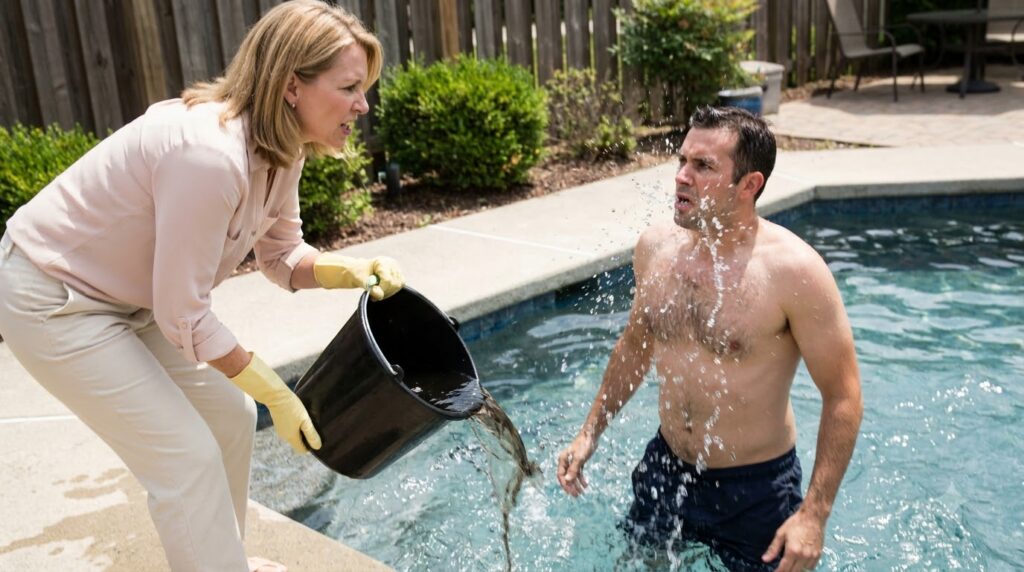
Through the glass, he watched her finish the call and march down her front steps toward his driveway with a fresh white envelope in her yellow-gloved hand. But as she reached his property line, he saw the second detail—the detail that shattered the simple narrative of a stolen stationery scam.
Brenda didn’t look at his trailer. She looked down at the exact spot where he had uncovered the bent survey pin. Her face didn’t show anger; it showed a sudden, stark, paper-white flash of absolute terror.
She wasn’t trying to hide the stolen forms anymore. She was trying to hide what lay four inches beneath them.








