CHAPTER 5: THE AUDITORY TRACE
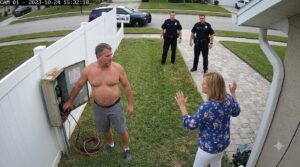
Officer Miller didn’t wait for Brenda to find her voice. He stepped past the rear tire of Marcus’s trailer, his polished leather duty belt creaking under the weight of his sidearm and body-worn camera. His radio gave a short, metallic burst of static that cut cleanly through the humid afternoon quiet.
“Ma’am,” Officer Miller said, looking directly at Brenda. “Set the clipboard down on the hood of that vehicle.”
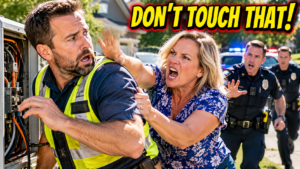
Brenda’s arms twitched, her yellow rubber gloves flexing around the hard plastic frame of the clipboard. “Officer, I called your dispatch. This man is operating an illegal commercial station. He stole municipal hardware—”
“The driver of the tow truck just gave his statement to my partner down at the corner,” Officer Miller interrupted. His voice was level, heavy with the flat weight of an officer who had spent fifteen years separating neighborhood grudges from actual statute violations. “He stated you attempted to force an illegal impound using a non-sanctioned enforcement notice. Set the board down.”
Brenda didn’t move. She stood frozen on the concrete driveway, her cream trousers stained with the damp red clay from the bent survey pin.
Beside the officer, Mrs. Gable stepped forward. She wore a simple beige cardigan despite the heat, her hands steady as she held a heavy, black-cased tablet. She didn’t look at Brenda with anger or triumph; her expression was the cold, tired resolve of a neighbor who had watched twenty years of petty tyranny poison a quiet street.
“Officer,” Mrs. Gable said, tapping the glass face of the tablet with a manicured nail. “My deck array records continuous high-definition video and directional audio along the northern boundary line. I’ve cataloged three separate incidents today.”
Marcus watched Brenda’s eyes shift from the officer’s face to the screen in Mrs. Gable’s hands. For the first time, the rigid, arrogant tilt of Brenda’s chin broke.
Mrs. Gable pressed play.
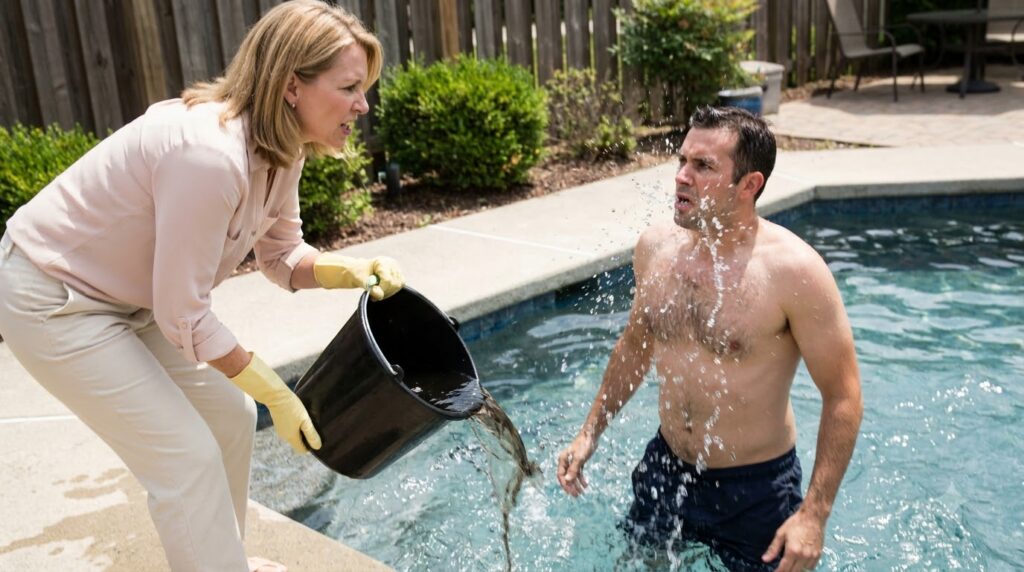
The speaker on the tablet produced a crisp, uncompressed audio stream. The background noise was familiar: the soft rustle of wind through the cedar fence, the rhythmic splash of Marcus swimming in his pool. Then came the sharp, distinct slap of rubber boots against concrete, followed by the heavy slosh of water in a plastic bucket.
“Yeah, now you get it!” Brenda’s recorded voice echoed across the asphalt, loud and distinct enough for two neighbors across the cul-de-sac to look out their front screen doors. “That’s exactly what you deserve!”
The audio caught Marcus’s immediate, stunned reaction from the water: “What the hell was that for?”
Then came the part Brenda didn’t know existed. On the recording, as Marcus treaded water, Brenda’s voice continued—low, breathless, speaking to herself as she backed away toward the side gate: “Keep digging, Vance. Keep looking at the dirt. By the time you figure out where the line actually runs, my son-in-law’s clerk stamp will have the deed locked in probate.”
Officer Miller tilted his head toward the tablet. “Play that last sentence again, Mrs. Gable.”
She tapped the screen. The words repeated, crystal clear, stripping away any lingering pretense of a civil drainage dispute.
Marcus stepped forward, pulling his phone from his pocket. “Officer, the clerk stamp she mentioned refers to County Clerk Archives Division File 90-B. Her son-in-law, Arthur, pulled those forms before his retirement. Every notice left on my windshield, including the one given to the tow driver, uses decommissioned county stationery with forged tracking numbers.”
Officer Miller turned his gaze back to Brenda. “Is Arthur Vance your relative, ma’am?”
Brenda’s mouth opened, but no sound came out. Her yellow rubber gloves slowly unclasped from the clipboard. It slipped from her fingers, hitting the concrete with a loud, clattering slap. Loose papers scattered across the driveway—fake citations, handwritten logs of Marcus’s work hours, and a crude hand-drawn map of the property line with heavy red arrows pointing directly at her own house.
Marcus knelt, picked up one of the scattered sheets, and turned it over.
It wasn’t a county form. It was a private architectural survey completed fifteen years ago, stamped with a red warning box from a private engineering firm: NON-COMPLIANT STRUCTURE — PATIO AND FOUNDATION FOOTING EXCEED LOT BOUNDARY BY 4.2 FEET. RISK OF MANDATORY DEMOLITION UPON RESALE OR DEED TRANSFER.
The truth laid itself bare on the driveway asphalt.
Brenda hadn’t been trying to enforce neighborhood rules. She hadn’t been fighting over lawn height, work trucks, or unapproved paint colors. She had discovered fifteen years ago that her master suite and concrete patio were built directly across the legal property line, sitting squarely on the parcel Marcus had bought three years ago.
Her entire campaign—the fake citations, the stolen municipal paper, the harassment, and the bucket of muddy water—was a desperate, escalating attempt to bully a young contractor into abandoning his land or selling at a loss before anyone conducted an official boundary audit that would force the demolition of her house.
The decoy secret—the stolen stationery scam—was merely the weapon. The core reality was a structural lie that threatened to tear her home apart from the foundation up.
Officer Miller looked from the private survey to the bent zinc-coated pin protruding from the earth near Brenda’s shoes.
“Mr. Vance,” Officer Miller said, taking out a pair of steel handcuffs from his utility belt. “I’m taking a formal report for criminal trespass, property damage, and forgery. My partner is going to secure the property line while we process the scene.”
Brenda backed away a single step, her heels scraping against the concrete, her eyes wide as she looked at the silver cuffs in the officer’s hands. “You can’t do this. I’ve lived here for twenty-two years! This is my neighborhood!”
“It’s a civil parcel, ma’am,” Officer Miller said calmly, stepping forward and taking her by the wrist. “And right now, you’re standing on his land.”