
CHAPTER 2: FORENSIC SURFACING
The water dripping from Marcus’s shoulders sounded like a steady, rhythmic tap against the hardwood floor of the utility hallway.
He didn’t step onto the living room rug. He stopped at the threshold, reached into his back pocket, and pulled out his phone with two dry fingers. His palm was still chilled from the deep end, but his hands didn’t shake. He wiped a streak of chlorinated pond water off the screen against the dry underside of his forearm, opened his local storage app, and initiated a manual backup of the perimeter camera array.
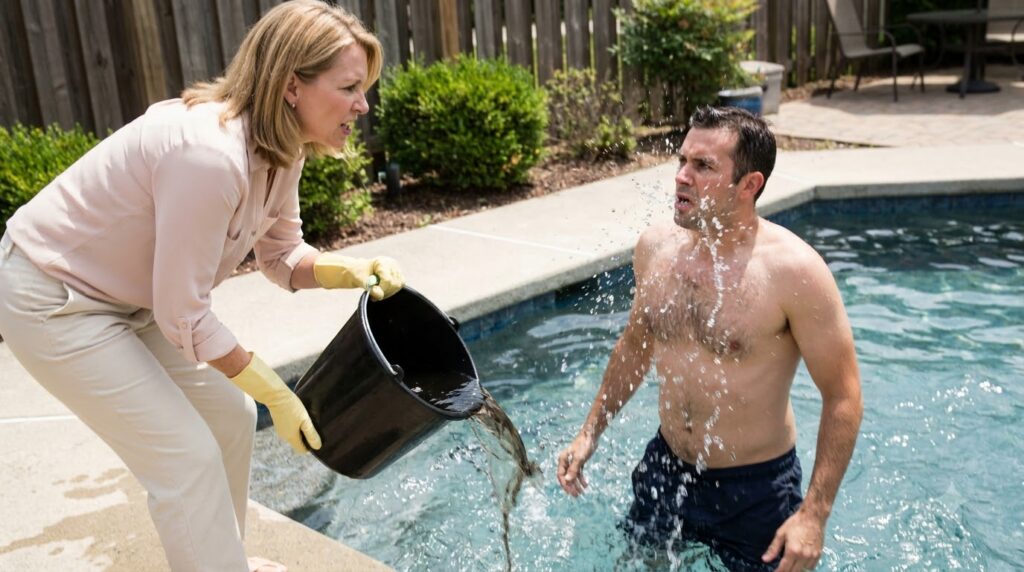
Four high-definition lenses lined the eaves of his roof. Camera Two—the wide-angle optical unit mounted directly beneath the western soffit—had an unobstructed, uninterrupted view of the side gate, the pool coping, and the exact six-foot radius of concrete where Brenda Vance had delivered her payload.
He pressed play on the raw fifteen-second clip.
On the 4K render, the physical reality was even clearer than it had felt in the water. Brenda hadn’t slipped. She hadn’t stumbled while carrying yard debris toward her compost pile. She had unlatched the side gate with her elbow, carried the black plastic bucket in a low, two-handed clamp, and marched directly to the edge with a calculated, rhythmic stride. The video caught the precise moment the dark liquid left the rim, breaking across the light blue surface of the pool in a heavy, parabolic arc. It caught the movement of her jaw, the bright yellow sheen of her rubber dishwashing gloves, and the exact position of her dark low heels planted three inches inside his property line.
Marcus paused the frame on her face. Her expression wasn’t angry; it was manic, elevated by the false high of an executioner who believed she was operating under a higher mandate.
He saved the raw video to three separate local drives, locked the screen, and set the phone on the kitchen counter next to the brass key he had scooped from the grass.
The key sat heavy against the white quartz. It was thick, double-bitted, and forged from solid, unpolished brass—the kind used for commercial utility enclosures, heavy gate padlocks, or municipal junction boxes. Attached to the stamped ring was a rectangular aluminum tag, pitted with acid exposure and stamped with three indented characters: W-04.
Marcus picked up a dry micro-fiber towel from the rack, dried his hair, and rubbed his arms until his skin flushed warm. The bitter, rotted smell of the planter-box sludge was still trapped in his pores, a clinging reek of stagnant soil and sulfur. He stripped off the navy swim trunks, tossed them into the stainless utility sink, and turned the cold tap on full blast, watching the dark silt rinse off the fabric and down the drain.
His phone buzzed on the quartz top. A single vibration.
He didn’t rush. He pulled on a pair of dark canvas work pants, a heavy cotton shirt, and his boots, lacing them tight before picking up the device.
It was a text message from an unlisted number, but he recognized the syntax immediately.
Citations for unauthorized drainage modification and illegal hazardous runoff disposal have been filed with the county district. You have twenty-four hours to clear the work trailer from the driveway before the secondary tow lien takes effect.
Attached to the text was an image of an official form. It bore the crest of the County Code Enforcement Division, complete with a serial tracking code, a formal municipal header, and a stamped signature line at the bottom.
Marcus zoomed in on the signature.
The ink was crisp, dark blue, and laid down with the mechanical precision of an offset press. But the paper underneath it—visible at the frayed top edge where the document had been torn from a legal pad—showed a faint watermark running vertically down the margin.
It wasn’t municipal bond paper. It was an obsolete inventory stock used exclusively by the County Clerk’s archive office prior to the digital migration five years ago.
Marcus stared at the watermark. He knew the paper stock because he had pulled land-use records from the basement archives when he bought the house three years ago. The county had auctioned off its surplus paper goods during the district consolidation, and the only person in the immediate residential sector who had spent thirty years working as a senior clerk in that exact basement was Brenda Vance’s son-in-law, Arthur.
Brenda wasn’t writing complaints on standard HOA paper anymore. She was using real, state-issued municipal forms stolen from decommissioned county stock, filling them out by hand, and using them to intimidate residents who didn’t know the difference between a formal court summons and a forged piece of scrap paper.
Marcus set the phone back on the counter next to the brass key.
He walked to the back sliding door, unlocked the double deadbolt, and stepped out onto the back porch. The sun was hot now, burning off the humidity of the early afternoon, drying the dark splash marks where the planter water had coated the white pool coping. Across the fence line, the neighborhood was quiet, but the air felt thin, stretched tight like a wire under tension.
From the second story of the Gable house, the shadow of the deck blinds shifted slightly. Mrs. Gable hadn’t moved. She was still sitting in her wicker chair, watching the fence line, her tablet resting flat across her knees.
Marcus walked down the three concrete steps toward his work trailer parked in the driveway. The heavy steel hitch was locked, but as he reached the side door, he saw a fresh white paper notice tucked under the rubber seal of the side window—a duplicate of the form sent to his phone, complete with the blue ink signature and the stolen county watermark.
Next to the trailer wheel, resting in the gravel, was a small, empty plastic wrapper that had contained a heavy-duty commercial padlock.
Marcus looked from the wrapper to his front gate, then back down at the brass key in his pocket. The key didn’t belong to his house, his trailer, or his pool shed.
It belonged to the commercial padlock Brenda had just bought to chain his trailer to his own fence.








