
The Iron Latch and the Quiet Dirt: Defending the Last True Access Line in the Valley

CHAPTER 1: The Locked Latch

The gearshift of the pickup clicked into park with a dry, metallic snap that seemed to strip the last ounce of moisture from the air. Before me, the heavy chain-link gate—the one that had swung open for every load of gravel, timber, and spare machinery I’d hauled onto the back half acre for ten years—wore a stranger’s armor. A solid brass-shackled padlock hung from the twist of wire like a fresh tick on a lean hound.

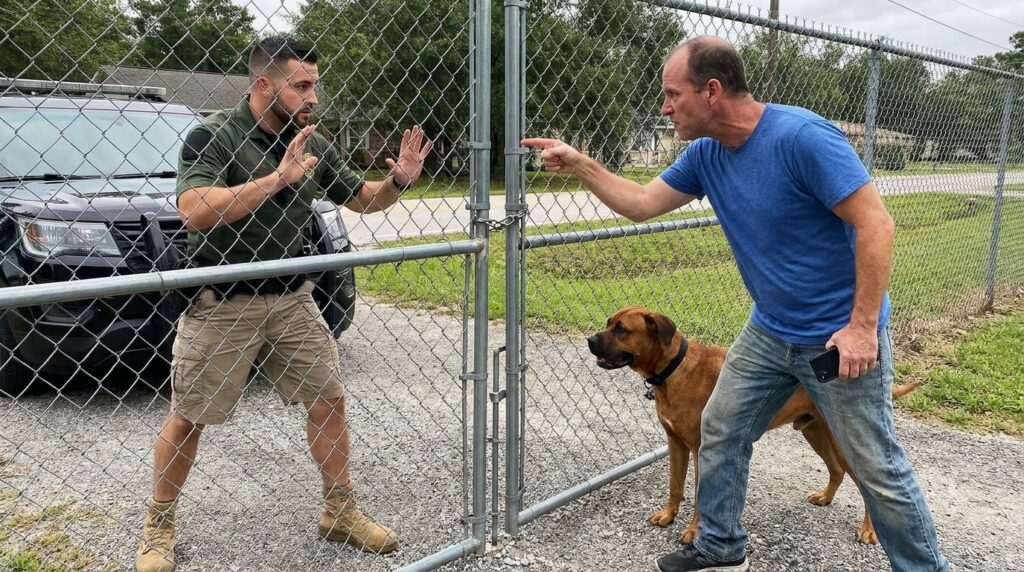
I sat there with my hands resting on the worn vinyl steering wheel, feeling the residual heat of the diesel engine thrumming up through the floorboards. The sun was dipping low over the ridge, cutting long, jagged shadows across the dry weeds and the packed-dirt track of the easement. My knuckles were gray with dried mortar dust from the morning pour, and the back of my neck throbbed with the dull, persistent ache of a twelve-hour workday. I didn’t need to look up to know who had put it there. Arthur Miller’s faded blue T-shirt and stocky, forward-leaning silhouette were already visible through the wire mesh, planted squarely on the other side of the boundary line like an overweight sentinel guarding a tomb he didn’t own.

“You’re done hauling through here, Miller,” Arthur’s voice carried across the gravel, flat and nasal, carrying that familiar self-appointed authority of a man who spent his retirement counting other people’s footsteps. He had his black smartphone gripped low near his thigh, the camera lens dark and pointed straight at my truck door. Beside him, his muscular reddish-brown dog paced the fence line, its dark muzzle low to the dry earth, tracking the vibration of my tires.

I killed the ignition. The sudden silence of the valley rushed in, filled only by the cicadas screaming in the dry scrub and the ticking of cooling exhaust pipes. I reached down, my fingers brushing the weathered leather of my work gloves tucked into my back pocket, and pushed the truck door open. The rusted hinge groaned, a sound as old as the county line.

“That gate’s been open since the Eisenhower administration, Art,” I said, my voice low, roughened by dust and restraint. I stepped down onto the sun-baked gravel, feeling the hard stone shift beneath my work boots. “Take the lock off.”

“It’s private property now, neighbor,” Arthur snapped, taking a heavy step forward until his chest was inches from the wire, his stubby finger jabbing through the square mesh. “County code enforcement expanded the setback last month. You’re tracking mud, oil, and heavy weight across common drainage. I’m protecting this neighborhood, and I’ve already called the deputies to have your truck towed for unauthorized access.”

I stopped five feet short of the gate, my gaze locking onto his face. The heat radiating off the gravel was fierce, but the cold realization in my gut was sharper. This wasn’t just another petty neighborhood dispute about lawn clipping boundaries. As my eyes swept past Arthur’s shoulder toward the base of the gatepost, a cold friction tightened my chest. Driven six inches into the hardpan right beside the corner post was a brand-new aluminum surveyor’s marker stamped with a municipal engineering code I’d never seen before—an official stamp dated three days ago, bearing a signature that didn’t belong to the county road department. Someone had quietly altered the plat maps behind our backs, and Arthur didn’t just think he owned the lane; he was waiting for a trap that had already been laid.


CHAPTER 2: The Encroaching Line

The aluminum pin gleamed like a cold eye in the dust, its stamped numbers cutting straight through the dry weeds at the base of the gatepost. I didn’t lean down to touch it. In the high desert heat of the valley, you learned early that anything buried six inches deep in another man’s dirt was either a secret or a trap, and Arthur Miller wasn’t the kind of man to spend money on surveyor’s steel unless he thought it bought him a piece of my hide.

Arthur’s boots crunched on the gravel as he shifted his weight, his stocky frame blocking the latch line. His reddish-brown dog didn’t bark; it just leaned its shoulder against the wire mesh, panting in steady, rhythmic huffs that blew tiny dust rings into the dry air.

“You’re looking at progress, Miller,” Arthur said, his voice dropping into that smooth, practiced register he used when he thought he had the legal high ground. He tapped his thumb against the edge of his smartphone. “The county surveyed the whole drainage basin after the spring runoff. That pin marks the new easement boundary. The lane’s restricted to light passenger vehicles now. You bring that six-ton flatbed over this tile again, and you’re cracking the main line that keeps water out of six basements down the ridge.”

I kept my hands resting flat on the top rail of my truck door, feeling the sun-baked enamel burning warm through my calluses. “There isn’t a drainage tile under this gravel, Art. The main culvert runs eighty feet east, straight down the township line. My grandfather helped lay the concrete pipe in sixty-two.”

“Things change,” Arthur shot back, his jaw tightening as he thrust his chin toward the pin. “Maps get updated. Drainage shifts. The county certified the line three days ago. You don’t have a right-of-way for heavy equipment anymore, and if you touch that padlock, it’s criminal interference with a municipal utility.”

He was lying about the pipe, but he wasn’t lying about the pin. The metal was too fresh, the stamped numbers too clean. It hadn’t been set by a crew working a standard county road crew shift; there were no orange chalk marks on the gravel, no wooden witness stakes driven into the dirt bank, no high-visibility ribbons fluttering from the brush. It was a silent installation, done by someone who wanted the mark in the ground before the owner of the land realized the boundary had moved.

Behind Arthur’s shoulder, down near the curve where the gravel lane met the paved township road, a glint of sunlight bounced off a windshield. A dark green utility SUV was idling by the mailbox cluster, its diesel engine a low, distant hum against the dry chirping of the cicadas. The county deputy had arrived early, sitting on the shoulder, waiting for the call Arthur had already promised to make.

I reached back through the open window of my cab, my fingers closing around the worn leather strap of my tool roll sitting on the passenger seat. I didn’t pull it out. Instead, my thumb brushed against the stiff, rolled edge of the blue vinyl folder wedged behind the bench seat—the original land grant map and deed abstract I’d kept sealed since I bought the workshop parcel out right.

“You called the sheriff’s department for a property line dispute on a Tuesday afternoon?” I asked, my voice remaining level, flat as an iron plate.

“I called ’em for a trespasser threatening a public utility,” Arthur corrected, a small, tight grin pulling at the corner of his clean-shaven mouth. “He’s just waiting on me to give the word that you refused to clear the lane.”

He thought he had me pinned between the lock on the gate and the cruiser at the road. He thought the weight of my truck, the dust on my boots, and my silence were all proofs of a working man’s guilt. But as I looked down at that stamped aluminum pin again, I noticed the single detail Arthur’s arrogance had overlooked: the survey code stamped into the cap didn’t match the county department of transportation prefix. It started with a private engineering license number—one that had been revoked by the state land board six months ago after a scandal over altered boundary plats in the west valley.

A low crunch of tires on gravel sounded behind me. The green utility SUV had put its dark nose into the entrance of the lane, its roof lights unlit but its presence heavy and immediate, blocking the only way out.

CHAPTER 3: The Primed Badge

The green utility SUV didn’t bother turning on its emergency lights. It rolled to a stop six feet behind my rear bumper, its front tire crunching down hard over a patch of dry thistle. The driver’s door swung open, releasing a short, sharp hiss of air-brakes mixed with the low, steady rumble of a heavy-duty alternator.

A tall man in a dark green uniform shirt and khaki cargo shorts stepped down onto the gravel. He was early thirties, built like a high-school linebacker who still lifted on weekends, with close-cropped dark hair and a neatly trimmed beard that framed a jaw set in a hard, professional line. Tan combat boots bit into the loose stone as he took two steps forward, his hands resting naturally near his belt line, palms open but guarding his space.

“Officer,” Arthur called out instantly, his voice leaping half an octave as he gestured wildly across the top rail of the chain-link gate. “He’s refusing to back his vehicle off the access lane! He’s threatening the boundary line and trying to force entry onto private utility property!”

The deputy didn’t look at Arthur first. His eyes locked onto me—reading my dusty work shirt, the leather gloves tucked into my back pocket, the line of my shoulders standing beside the open cab door of my truck. He took in the physical geometry of the lane with a single, practiced sweep: my idling pickup, the locked chain-link barrier, and Arthur standing rigid on the near side beside his muscular reddish-brown dog.

“Sir,” the officer said, his voice clipped and carrying the practiced cadence of someone who had already decided what kind of call he was responding to before he put the vehicle in park. “Step back from the vehicle door and keep your hands where I can see them.”

“Deputy,” I said, staying planted beside my driver’s side step. I didn’t raise my hands, but I kept them open, resting flat against my thighs. “My name is Miller. I own the three-acre parcel at the end of this gravel right-of-way. This gate has been the legal access point for my property since nineteen sixty-two.”

“I know who you are, Mr. Miller,” the officer replied, taking another step toward the fence line. The sun caught the polished silver badge pinned to his green shirt—county code enforcement deputy, assigned to rural land-use disputes and municipal boundary calls. “We received a priority call from dispatch regarding an unauthorized vehicle blocking a designated drainage easement and attempting to breach a secured boundary.”

“He’s got heavy equipment tools in the cab!” Arthur chimed in from behind the wire, his voice shrill against the quiet valley heat. “He was going to cut the chain! I caught him right before he took a grinder to the county latch!”

The officer raised one hand slightly, a gesture that cut Arthur off mid-sentence without the deputy ever taking his eyes off me. But the bias was already baked into his posture. The dispatch report had been framed as a active trespass in progress—a hot caller reporting a hostile confrontation over a utility line—and the young officer was operating on high-voltage caution. He walked straight past my rear quarter-panel, his tan boots kicking up a faint plume of yellow dust that settled over my taillights.

“Mr. Miller,” the deputy said, stopping five feet from where I stood. “Right now, I have a reported obstruction on an active access road. Until we verify the status of this gate, I need you to step back to the rear of your vehicle and let me assess the situation.”

“He doesn’t have a right to stand on the easement at all!” Arthur yelled, his face turning a dark, mottled red as he jabbed his finger through the chain-link mesh right at the latch line. “Look at him! He knows he’s caught!”

I didn’t move toward the rear of the truck. Instead, I shifted my weight just enough to shield the cab window with my shoulder, keeping my posture calm but entirely immovable. “Deputy, before you tell me where to stand on land my family’s paid taxes on for sixty years, take a look at the visor inside your cruiser.”

The officer’s eyes narrowed slightly. A flicker of annoyance crossed his face—the look of a man who didn’t like having his procedure questioned by a suspect in dirt-caked work clothes. “My visor?”

“Your dispatch card,” I said, my voice steady as a plumb line. “The CAD printout for this call. Who flagged it as a utility breach? Was it county public works, or was it a private cell number routing through the non-emergency desk?”

The deputy paused. For three seconds, the only sound between us was the hot wind rustling the dry grass along the fence line and the panting of Arthur’s dog beside the gatepost. The officer’s right hand twitched slightly toward his chest pocket, where a folded piece of thermal receipt paper stuck out from behind his notepad. He had taken the call directly off a verbal relay—a prioritized complaint handed to him by a desk sergeant who happened to sit on the same municipal advisory board Arthur visited every second Thursday of the month.

“The source of the call doesn’t change the physical boundary, Mr. Miller,” the deputy said, though the sharp edge in his tone had cooled by a fraction of a degree. He stepped up to the chain-link gate, placing one hand flat against the top pipe rail to inspect the padlock Arthur had hung.

“It changes whether you’re enforcing the law or enforcing a favor,” I replied softly.

Arthur’s hand shot over the latch line again, his black phone gripped tight as he thrust his arm into the six-inch gap between the gate and the support post. “You see that, Deputy? He’s accusing law enforcement! He’s defying a lawful order right in front of you!”

The deputy didn’t answer Arthur, but his jaw tightened as he looked back at me. He was caught between a loud caller demanding immediate action and a quiet working man who wasn’t backing down an inch. He took a half-step closer to my chest, his tall frame blocking the gate latch entirely, his hands coming up open at chest height to establish a hard physical perimeter.

“This is your last warning, Mr. Miller,” the officer said, his voice dropping into a low, commanding rumble that signaled the end of discussion. “Stand back from the fence.”

CHAPTER 4: The Escalating Standoff

The deputy’s dark green uniform shirt stretched tight across his shoulders as he leaned into the space between us. His palms stayed broad and open, flat against the warm summer air, creating a hard human barrier two inches short of the chain-link latch.

Behind him, Arthur took the gesture as an invitation.

“That’s right! Tell him, Deputy!” Arthur surged forward, his stocky frame hitting the chain-link fence with a dry metallic rattle that sent a shower of flaking gray rust onto the weeds below. He thrust his right hand straight across the top rail, his pointed index finger jabbing directly into the space between the officer’s chest and my shoulder. His black smartphone stayed clutched low in his left hand, its screen glowing with an active recording app. “He thinks because he’s lived back here for ten years he can ignore civil code! He’s been driving over that culvert without a heavy-vehicle permit, cracking the municipal drainage, and now he’s threatening an officer of the court!”

Beside Arthur’s knee, the reddish-brown dog didn’t growl, but its posture hardened. Its tail went stiff, its dark muzzle pressing against the diamond mesh of the gate, its claws digging short, rhythmic furrows into the dry dirt as it tracked every movement of my hands.

I didn’t step back. I didn’t reach for my back pocket where my gloves rested, nor did I look toward the cab where my blue folder sat wedged behind the seat. I kept my chin level, my eyes fixed on the deputy’s face, letting the silence between us build weight against Arthur’s shrill, relentless commentary.

“Arthur,” I said softly, my voice barely carrying over the hum of the deputy’s idling cruiser. “You’re standing on my easement, shouting over a deputy’s shoulder, pretending a private lock makes a legal fence. Take your hand off the latch line.”

“It’s not your easement!” Arthur barked, his face flushing a deep, mottled purple under the afternoon sun. He jabbed his finger again, his knuckle missing the officer’s sleeve by less than an inch. “I’ve got the site assessment right here on my phone! The county surveyor placed the boundary marker three days ago! You’re trespassing on a protected drainage corridor!”

The deputy’s eyes flicked sideways for a fraction of a second, catching the wild trajectory of Arthur’s arm. Even with his bias primed by the dispatch call, the officer was a trained man; he didn’t like an active complainant breaching his personal space any more than he liked an uncooperative driver. His jaw muscles worked beneath his trimmed beard, but his focus remained locked on me, searching for the crack in my composure that would justify putting his hand on his belt holster.

“Mr. Miller,” the officer warned again, his voice dropping into a low, controlled register that vibrated with suppressed friction. “I am telling you one last time. Do not advance on this boundary. Step back to your rear bumper so we can review the site documentation.”

“I haven’t taken a step since you put your cruiser in park, Deputy,” I replied, keeping my words measured, deliberate, and entirely free of heat. “And I’m not advancing. I’m standing on the gravel access lane that my deed grants me unhindered right-of-way to use twenty-four hours a day.”

“Your deed is thirty years out of date!” Arthur shouted, his voice cracking with a sudden, triumphant edge. He reached up with his phone, aiming the camera lens straight over the deputy’s shoulder into my face. “Show him the paper! Go on, show him! He doesn’t have a current permit! He knows the moment the county inspects that tile under the gate, he’s liable for twenty thousand dollars in structural repairs!”

There it was again—the tile. Arthur kept hammering the phrase like a man reciting a script he’d memorized line for line. But as he leaned further over the latch line, his blue T-shirt pulled taut across his back, exposing the fence corner behind him.

Tied to the base of the wooden corner post was a faded strip of yellow plastic utility ribbon. It was brittle, sun-bleached, and frayed at the edges. But what caught my eye wasn’t its age—it was where it ended. The ribbon didn’t run along the ground where an underground pipe or drainage tile would be buried; it looped twice around the fence post and stopped dead, exactly four feet short of the chain-link gate. There were no trench marks in the earth. No settling cracks in the gravel. No sign of a backhoe ever touching the soil between the road and my workshop.

Arthur wasn’t trying to protect a drainage tile. He was using the claim of a fragile municipal pipe as a legal shield to justify locking the gate today, keeping me locked out just long enough for a secondary property claim to clear the clerk’s office.

Across the fence, two porches down, a screen door slapped shut. Old man Henderson stepped out onto his front stoop, wiping his hands on a grease-stained rag, watching the three of us through the shimmer of heat rising off the road. Behind him, another neighbor leaned against her porch railing, her phone raised in the quiet, watchful silence of a rural neighborhood that knew when a line was being crossed.

“Deputy,” I said quietly, reaching with slow, deliberate precision toward the driver’s door handle of my truck. “I’m going to reach into my cab now. I’m not pulling a tool, and I’m not pulling a weapon. I’m pulling the official stamped parcel map from the county clerk’s office.”

The officer’s stance tightened, his boots shifting on the loose gravel, but he didn’t stop my arm. “Keep it visible, Miller. Move slow.”

Arthur’s eyes widened as I opened the door, his finger still pointing wildly across the boundary. “Don’t let him touch his vehicle! He’s stalling, Deputy! Cite him now!”

CHAPTER 5: The Stamped Proof

My fingers slid past the dusty dash and closed around the stiff, heavy edge of the blue vinyl folder. I pulled it out slow, letting the officer see every inch of movement, the vinyl creaking as it cleared the cab frame.

Arthur didn’t back up. He leaned further into the fence, his stocky body pressing against the galvanized mesh until the wire bowed under his weight. “He’s pulling a fake map, Deputy! Don’t let him distract you from the utility violation! He’s trying to bypass the lock!”

The deputy didn’t answer Arthur, but his boots didn’t shift away from the boundary line either. He stood tall beyond the closed gate, his athletic build blocking the latch, his open-palmed stance firm as he sternly issued the distance command across the top rail: “Back up now, you do not step into my space.”

Arthur, gripping his black phone low against his thigh, froze as the deputy’s authority turned directly into his chest. His pointed finger dropped an inch over the latch line. He glared under the pressure, his jaw tight, before taking one small, reluctant step back from the fence.

“All right,” Arthur muttered, his voice tight with bitter concession. “I am backing up.”

At that precise second of held breath, I stepped straight up to the chain-link mesh. I didn’t reach over the top pipe. I slid the thick blue folder directly through a four-inch gap in the wire mesh, pressing the heavy cardstock into the deputy’s open palm.

“Read the red seal at the bottom of page two, Deputy,” I said, my voice cutting quiet and cold through the heat. “I’m standing on my own surveyed land, Officer. Read the county seal on this paper before you go any further.”

The deputy hesitated for half a second before his fingers closed around the blue folder. He pulled it through the mesh, unfolding the heavy cream paper across the hood of his utility SUV. The sun beat down on the black ink of the township parcel grid, highlighting the dark, raised impression of the county clerk’s official stamp at the margin.

“What is that?” Arthur demanded, stepping sideways along the fence line while his reddish-brown dog paced beside him, its nails scratching against the dry earth. “Whatever paper he’s got, it’s superseded by the emergency drainage classification! He’s got an illegal pipe line under that gate!”

The deputy ignored Arthur. His eyes tracked down the parcel coordinates, his thumb tracing the precise boundary lines marked in heavy black ink. He reached into his tactical vest, pulled out a ruggedized county tablet, and typed in the parcel ID number stamped beside the red seal.

A heavy silence fell over the roadside. Two houses down, Old man Henderson leaned forward on his porch, his hand shading his eyes. Across the street, the woman on her stoop lowered her phone, watching the officer’s face as the tablet screen refreshed under the blinding sunlight.

“The easement,” the deputy said slowly, his voice dropping into a flat, measured tone as he looked up from the tablet screen, “is deeded as a perpetual, unrestricted right-of-way for ingress, egress, and heavy utility transport. It’s tied directly to Parcel 402-A.” He looked straight at me. “Your parcel.”

“Look at the drainage line!” Arthur shouted, his face turning a dark, mottled purple as he gestured wildly toward the dirt beneath the gate. “The tile! The municipal tile!”

“There is no municipal tile registered on the county public works GIS grid for this section, Mr. Miller,” the deputy said, his gaze shifting sharply from the paper straight to Arthur. “And this survey map, certified by the county recorder of deeds, places this entire chain-link gate and the five-foot apron beyond it squarely on Mr. Miller’s property line.”

Arthur’s mouth opened, then closed. The phone in his hand trembled slightly against his thigh. “That… that’s impossible. The surveyor three days ago—”

“The surveyor code stamped on that pin in the dirt,” I interrupted, pointing with my thumb down at the fresh aluminum head hidden in the weeds, “belongs to a private contractor whose license was pulled by the state board six months ago. Who paid him to drive that pin into my dirt, Art?”

Arthur’s posture shrank instantly. His forward-leaning stance collapsed, his shoulders hunching as the deputy stepped away from the hood of the SUV, folding my survey map carefully back into its blue vinyl sleeve.

“Mr. Miller,” the deputy said, turning his full attention onto Arthur. “I need you to step away from that gate right now.”

Arthur blinked, taking a half-step back, his boots crunching weakly on the loose gravel. “Now hold on, Officer, I was just trying to protect—”

“You placed a private lock on a legal easement and called in a priority false report claiming a utility breach,” the deputy said, his voice hard as iron as he reached toward his belt line. “Hand me the keys to that padlock. Right now.”

Arthur’s hand went into his pocket with agonizing slowness. His fingers fumbled with a small brass ring, pulling out a single key while his reddish-brown dog whined low, sensing the sudden, catastrophic shift in power.

The deputy took the key, stepped up to the chain-link gate, and inserted it into the brass lock. With a sharp, metallic click, the shackle popped open. The deputy pulled the lock free, uncoiled the heavy steel chain, and pushed the gate wide open. The rusty hinges screamed against the silence of the valley as the gravel lane swung completely clear.

The deputy turned back to Arthur, his tablet already logging the incident. “Next time you call an officer to my gate, make sure you actually own the dirt under your boots.”

Arthur didn’t speak. He couldn’t. With the eyes of the entire neighborhood locked onto his defeated frame, he turned his back, grabbed his dog’s collar, and retreated up his porch steps in absolute public silence.

I took the blue folder back from the officer, tucked it under my arm, and stepped into the open doorway of my truck. As I pulled the pickup through the open gate toward my workshop, I looked down at the paper once more. The survey was legal, the gate was open, and the neighbor was exposed—but as my eyes caught a small handwritten filing notation tucked into the bottom margin of the clerk’s stamp, a cold chill touched the back of my neck.

The official deed wasn’t just a boundary record. The handwritten code matched an off-the-books easement abandonment application filed two years ago under a corrupt registrar’s signature—proving Arthur hadn’t just acted out of petty malice. Someone inside the county building had promised him my land on paper, and the real fight for the property line was only just beginning.

CHAPTER 6: The Unraveling Paperwork

The truck tires ground through the open gateway, crushing the dry weeds and sending a spray of fine gray gravel against the inner wheel wells. In the rearview mirror, the deputy stood motionless beside his idling SUV, watching my tailgate clear the latch line before he turned his head toward Arthur’s porch.

I didn’t press the accelerator. I let the pickup coast down the two-hundred-foot driveway toward the weathered metal workshop, the engine idling in a low, heavy chug. The victory at the gate felt cold, like a draft coming through a cracked window in the dead of winter. The padlock was gone, the gate was wide, and Arthur had retreated into his house, but the stiff blue folder resting on the seat beside me seemed to hum with a different kind of weight.

I pulled up to the workshop doors, killed the engine, and grabbed the folder. The heat inside the cab was oppressive, but I didn’t step out into the yard. I flipped open the blue cover, laying the county survey map flat across the vinyl steering wheel.

There, right at the bottom corner of the township grid where the red clerk’s seal sat embossed into the heavy stock, was a series of faint, handwritten characters in faded blue ballpoint ink. It wasn’t part of the standard printer output from the recorder’s office. It was a marginal notation, penned in a sharp, slanted hand: Pending Abandonment Petition #884-B — V.H.

My thumb ran over the paper, feeling the slight indentation left by the ballpoint tip. V.H. Victor Hargrove. Hargrove had been the chief deputy clerk for land records until two years ago, when the county board quietly forced him into early retirement following a state audit into altered rural easement filings.

Arthur hadn’t just made a wild guess about the gate three days ago. He had an official file number. He had been operating under the belief that Petition #884-B was a done deal—that the county had already processed an administrative abandonment of my right-of-way, turning the gravel lane over to his parcel to complete a lot-line adjustment. The uncertified surveyor who drove the fresh pin in the dirt hadn’t been acting alone; he had been following the exact boundaries laid out in Hargrove’s two-year-old pending file.

A hard knock sounded against the passenger window.

I didn’t jump, but my hand instinctively closed over the edge of the survey. Outside the glass stood Old Man Henderson. His face was weathered like cedar shingle, his faded denim overalls stained with tractor grease, his eyes squinting through the harsh glare of the afternoon sun.

I rolled the window down three inches. The smell of dry dirt and hot iron drifted into the cab.

“You put him in his place, Miller,” Henderson said, his voice raspy from decades of pipe tobacco and valley dust. He spat a dark stream of tobacco juice into the weeds near my front tire. “Deputy made him hand over the keys right in front of the whole road.”

“It’s not over, Henderson,” I said, looking out past his shoulder toward the chain-link gate at the end of the lane.

Henderson wiped his chin with the back of a calloused hand. “He locked the gate, Miller. The law made him open it. What else is there?”

“The paper he’s relying on,” I said, holding up the blue folder just enough for him to see the edge of the sheet. “Arthur didn’t buy a lock on a whim. He bought a promise from someone at the courthouse before Hargrove got cleared out.”

Henderson’s thick eyebrows pulled together, casting deep shadows over his pale eyes. He looked toward Arthur’s house, where the blinds in the front window twitched once and went still. “Hargrove? That old snake was signing off on property line shifts for anyone who bought him a steak dinner at the lodge. You think Arthur paid for your lane?”

“I think Arthur thinks he already owns it,” I replied, my voice flat. “And if Hargrove’s signature is sitting on a pending abandonment petition in the county basement, that padlock today was just the test run.”

“So what are you going to do?” Henderson asked, his tone shifting from casual neighborly satisfaction to the guarded caution of a man who knew how deep county feuds could run.

“I’m going to the recorder’s office first thing tomorrow morning,” I said, closing the blue folder with a sharp, decisive fold. “I’m going to pull Petition #884-B out of the archive before Arthur finds out the deputy’s report just flagged his survey as a fraud.”

As Henderson walked back toward his property line, I looked back at the survey map one last time. The physical gate was open, but the real boundary line wasn’t made of steel or wire—it was buried in the county vaults, and someone was waiting for the ink to dry.

CHAPTER 7: The Institutional Shift

The deputy’s heavy tan boots didn’t hesitate. He pivoted away from my truck hood, leaving my blue folder resting flat against his utility vest, and walked straight across the gravel lane toward Arthur’s porch steps.

“Mr. Miller,” the officer called out, his voice dropping into that low, flat authority that left no room for debate. “Step back down off those stairs.”

Arthur froze three steps up, his hand hovering over the screen door handle. His stocky frame twitched, but he didn’t turn around right away. “I’m on my own porch, Deputy. I’ve got a right to enter my house.”

“You’ve got a requirement to hand over the key to an unauthorized lock placed across an active, deeded right-of-way,” the officer said, stopping at the bottom step. He didn’t unholster his sidearm, but his right hand rested flat against his belt, his posture unyielding. “You called dispatch reporting a criminal utility breach. What I have here is a verified township parcel map showing you obstructed a legal access lane and placed a false surveyor’s pin on private property.”

Arthur’s shoulders slumped. He turned slowly, his face drained of the bright red fury that had filled it five minutes ago. His black smartphone was tucked into his back pocket now, useless. Beside him, his reddish-brown dog sat heavy on the top landing, its ears pinned back against its skull.

“I acted on a municipal notice,” Arthur muttered, his voice raspy as he reached into his front jeans pocket. His fingers pulled out a small brass ring holding two keys—one a standard house key, the other a heavy, double-notched brass key stamped with the code DEPT-5. “The surveyor said the boundary was shifted.”

“The surveyor you hired isn’t licensed in this state,” the deputy replied, stepping up one riser and extending an open palm. “And filing a false police report regarding a non-existent drainage tile is a misdemeanor violation of county ordinance section four-twelve. Hand over the keys, Mr. Miller.”

Arthur didn’t drop them into the officer’s hand. He tossed the brass ring onto the wooden porch rail with a sharp, bitter clatter. “Take ’em. But you tell him to keep his heavy trucks off my grass line.”

The deputy picked up the keys without a word. He turned back toward the gate, his eyes sweeping across the fence line where three separate neighbors stood watching from their front yards. Old Man Henderson hadn’t moved from his stoop; his arms were folded tight across his grease-stained overalls, his jaw working methodically on his chew as he witnessed every inch of Arthur’s retreat.

The deputy walked back to the chain-link barrier. He inserted the brass key into the padlock hanging from the gate latch. The internal tumbler gave a dry, metallic click, and the heavy shackle popped free. He unthreaded the thick steel chain, letting it clatter against the dirt, and pushed the gate wide open until the hinges groaned against their rusted stops.

“Mr. Miller,” the deputy called out to me, holding the open padlock in his palm. “The gate is clear. Your access is fully restored.”

I stepped out of my cab and walked to the gate line, taking the padlock and the heavy brass key from his hand. The brass felt heavy, cold, and worn smooth by years of use in some county basement office—a physical remnant of a scheme that had just collapsed under the weight of an official seal.

“If he attempts to re-lock this gate, place another obstruction, or interfere with your right-of-way,” the deputy said, looking past my shoulder toward Arthur’s closed front door, “call dispatch directly and reference incident report number seven-nine-four. He will be cited on site.”

“Thank you, Deputy,” I said, my thumb tracing the stamped DEPT-5 lettering on the key head.

The officer gave a single, terse nod, turned on his heel, and walked back to his dark green utility SUV. The diesel engine roared as he put the vehicle in gear, backed out onto the township road, and disappeared down the ridge, leaving only a cloud of yellow dust settling over the quiet lane.

CHAPTER 8: The Open Lane

The heavy brass lock sat in my palm like a chunk of cold iron, its shackle unlocked and hanging loose. Dust settled over the driveway in fine yellow sheets as the tail lights of the deputy’s green SUV dissolved around the bend of the township road.

Arthur’s porch door remained firmly closed. Through the dark screen mesh, I could see the faint shadow of his silhouette standing just inside his hallway, static and defeated, watching me through the frame. His reddish-brown dog lay flat across the top wooden step, head resting on its paws, its eyes following the slow movement of my boots as I walked back toward the open gateway.

I didn’t toss the lock into the weeds, and I didn’t hand it back through Arthur’s screen door. I turned the heavy brass casing over in my hand, my fingers tracing the stamped DEPT-5 code along its edge. On the underside of the keyway, barely visible beneath a layer of dried grease, was a tiny notched serial number—the exact internal inventory mark used by the county recorder’s vault to secure master deed archives. Arthur hadn’t bought this lock at a hardware store down the highway. It had been pulled straight out of a county clerk’s desk drawer two years ago when Victor Hargrove was still signing off on off-the-books land transfers.

I walked to the corner post of the chain-link fence, where the fresh aluminum surveyor’s pin still gleamed illegally in the dirt. I reached into the bed of my pickup, grabbed a heavy three-pound sledgehammer from my tool rack, and swung it once, hard.

The flat iron head struck the aluminum pin with a sharp, ringing crack that echoed off the dry hills. The fake boundary marker bent sideways, its stamped cap shearing clean off the steel rod buried in the hardpan. I kicked the broken cap into the ditch, leaving only the deep, undisturbed earth where my grandfather’s original survey line had sat for sixty years.

Across the road, Old Man Henderson let out a single, dry bark of a laugh. He nodded once, a brief, silent acknowledgment between two men who knew the value of unyielding dirt, before turning on his heel and walking back inside his house. The woman two doors down lowered her phone and closed her porch door, the quiet of the afternoon returning to the valley like a long-held breath finally released.

I took the heavy steel chain, wrapped it loosely twice around the gatepost without the lock, and pushed the chain-link gate wide open until it rested flat against the hedge line. The gravel lane lay clear, wide, and unobstructed—stretching all the way from the township road straight to the concrete apron of my equipment workshop.

I climbed back into the cab of my truck, placed the blue vinyl folder flat on the passenger seat, and rested the heavy brass lock right on top of the county seal. The diesel engine hummed beneath my feet, smooth and steady. As I pulled the truck down the open driveway toward the shop, I looked in the side mirror one last time.

Arthur’s screen door opened half an inch, then clicked shut as he pulled his blinds completely closed against the sun. The line had been tested, the paper had been proven, and the dirt under my boots remained exactly where it belonged.

Similar Posts

Leave a Reply

Your email address will not be published. Required fields are marked *






