
CHAPTER 4: The Escalating Standoff
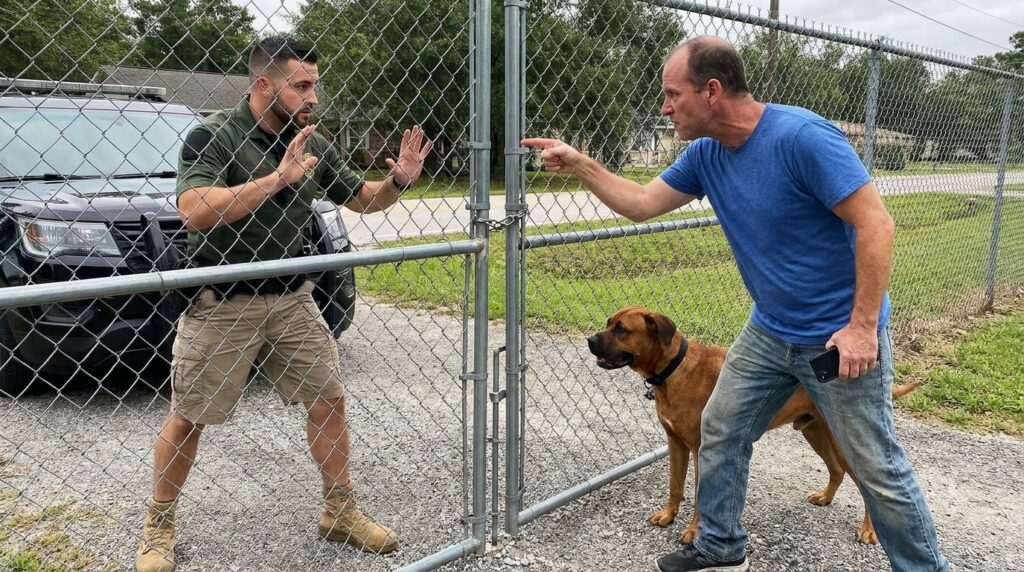
The deputy’s dark green uniform shirt stretched tight across his shoulders as he leaned into the space between us. His palms stayed broad and open, flat against the warm summer air, creating a hard human barrier two inches short of the chain-link latch.
Behind him, Arthur took the gesture as an invitation.
“That’s right! Tell him, Deputy!” Arthur surged forward, his stocky frame hitting the chain-link fence with a dry metallic rattle that sent a shower of flaking gray rust onto the weeds below. He thrust his right hand straight across the top rail, his pointed index finger jabbing directly into the space between the officer’s chest and my shoulder. His black smartphone stayed clutched low in his left hand, its screen glowing with an active recording app. “He thinks because he’s lived back here for ten years he can ignore civil code! He’s been driving over that culvert without a heavy-vehicle permit, cracking the municipal drainage, and now he’s threatening an officer of the court!”
Beside Arthur’s knee, the reddish-brown dog didn’t growl, but its posture hardened. Its tail went stiff, its dark muzzle pressing against the diamond mesh of the gate, its claws digging short, rhythmic furrows into the dry dirt as it tracked every movement of my hands.
I didn’t step back. I didn’t reach for my back pocket where my gloves rested, nor did I look toward the cab where my blue folder sat wedged behind the seat. I kept my chin level, my eyes fixed on the deputy’s face, letting the silence between us build weight against Arthur’s shrill, relentless commentary.
“Arthur,” I said softly, my voice barely carrying over the hum of the deputy’s idling cruiser. “You’re standing on my easement, shouting over a deputy’s shoulder, pretending a private lock makes a legal fence. Take your hand off the latch line.”
“It’s not your easement!” Arthur barked, his face flushing a deep, mottled purple under the afternoon sun. He jabbed his finger again, his knuckle missing the officer’s sleeve by less than an inch. “I’ve got the site assessment right here on my phone! The county surveyor placed the boundary marker three days ago! You’re trespassing on a protected drainage corridor!”
The deputy’s eyes flicked sideways for a fraction of a second, catching the wild trajectory of Arthur’s arm. Even with his bias primed by the dispatch call, the officer was a trained man; he didn’t like an active complainant breaching his personal space any more than he liked an uncooperative driver. His jaw muscles worked beneath his trimmed beard, but his focus remained locked on me, searching for the crack in my composure that would justify putting his hand on his belt holster.
“Mr. Miller,” the officer warned again, his voice dropping into a low, controlled register that vibrated with suppressed friction. “I am telling you one last time. Do not advance on this boundary. Step back to your rear bumper so we can review the site documentation.”
“I haven’t taken a step since you put your cruiser in park, Deputy,” I replied, keeping my words measured, deliberate, and entirely free of heat. “And I’m not advancing. I’m standing on the gravel access lane that my deed grants me unhindered right-of-way to use twenty-four hours a day.”
“Your deed is thirty years out of date!” Arthur shouted, his voice cracking with a sudden, triumphant edge. He reached up with his phone, aiming the camera lens straight over the deputy’s shoulder into my face. “Show him the paper! Go on, show him! He doesn’t have a current permit! He knows the moment the county inspects that tile under the gate, he’s liable for twenty thousand dollars in structural repairs!”
There it was again—the tile. Arthur kept hammering the phrase like a man reciting a script he’d memorized line for line. But as he leaned further over the latch line, his blue T-shirt pulled taut across his back, exposing the fence corner behind him.
Tied to the base of the wooden corner post was a faded strip of yellow plastic utility ribbon. It was brittle, sun-bleached, and frayed at the edges. But what caught my eye wasn’t its age—it was where it ended. The ribbon didn’t run along the ground where an underground pipe or drainage tile would be buried; it looped twice around the fence post and stopped dead, exactly four feet short of the chain-link gate. There were no trench marks in the earth. No settling cracks in the gravel. No sign of a backhoe ever touching the soil between the road and my workshop.
Arthur wasn’t trying to protect a drainage tile. He was using the claim of a fragile municipal pipe as a legal shield to justify locking the gate today, keeping me locked out just long enough for a secondary property claim to clear the clerk’s office.
Across the fence, two porches down, a screen door slapped shut. Old man Henderson stepped out onto his front stoop, wiping his hands on a grease-stained rag, watching the three of us through the shimmer of heat rising off the road. Behind him, another neighbor leaned against her porch railing, her phone raised in the quiet, watchful silence of a rural neighborhood that knew when a line was being crossed.
“Deputy,” I said quietly, reaching with slow, deliberate precision toward the driver’s door handle of my truck. “I’m going to reach into my cab now. I’m not pulling a tool, and I’m not pulling a weapon. I’m pulling the official stamped parcel map from the county clerk’s office.”
The officer’s stance tightened, his boots shifting on the loose gravel, but he didn’t stop my arm. “Keep it visible, Miller. Move slow.”
Arthur’s eyes widened as I opened the door, his finger still pointing wildly across the boundary. “Don’t let him touch his vehicle! He’s stalling, Deputy! Cite him now!”








