
CHAPTER 3: The Primed Badge
The green utility SUV didn’t bother turning on its emergency lights. It rolled to a stop six feet behind my rear bumper, its front tire crunching down hard over a patch of dry thistle. The driver’s door swung open, releasing a short, sharp hiss of air-brakes mixed with the low, steady rumble of a heavy-duty alternator.
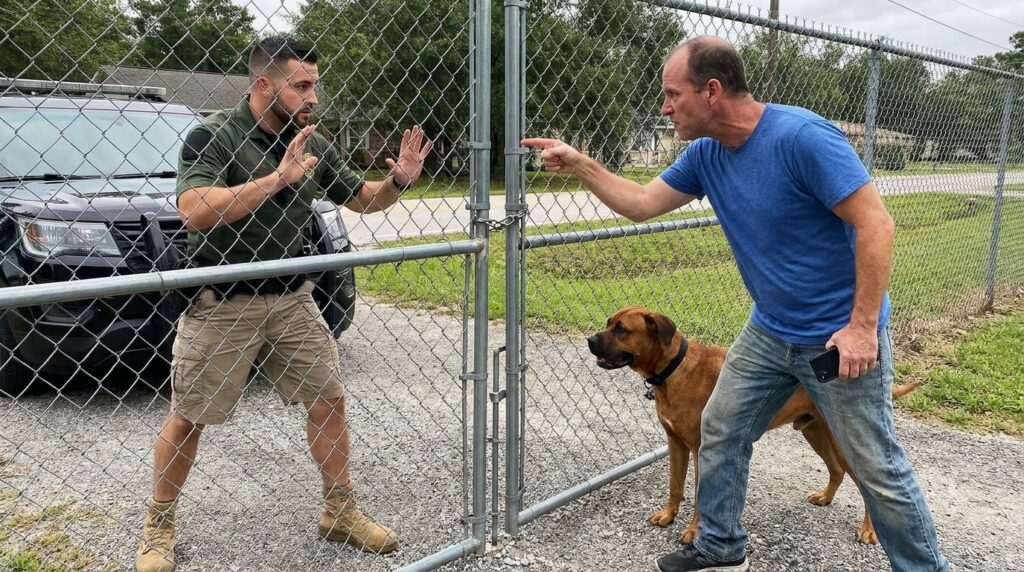
A tall man in a dark green uniform shirt and khaki cargo shorts stepped down onto the gravel. He was early thirties, built like a high-school linebacker who still lifted on weekends, with close-cropped dark hair and a neatly trimmed beard that framed a jaw set in a hard, professional line. Tan combat boots bit into the loose stone as he took two steps forward, his hands resting naturally near his belt line, palms open but guarding his space.
“Officer,” Arthur called out instantly, his voice leaping half an octave as he gestured wildly across the top rail of the chain-link gate. “He’s refusing to back his vehicle off the access lane! He’s threatening the boundary line and trying to force entry onto private utility property!”
The deputy didn’t look at Arthur first. His eyes locked onto me—reading my dusty work shirt, the leather gloves tucked into my back pocket, the line of my shoulders standing beside the open cab door of my truck. He took in the physical geometry of the lane with a single, practiced sweep: my idling pickup, the locked chain-link barrier, and Arthur standing rigid on the near side beside his muscular reddish-brown dog.
“Sir,” the officer said, his voice clipped and carrying the practiced cadence of someone who had already decided what kind of call he was responding to before he put the vehicle in park. “Step back from the vehicle door and keep your hands where I can see them.”
“Deputy,” I said, staying planted beside my driver’s side step. I didn’t raise my hands, but I kept them open, resting flat against my thighs. “My name is Miller. I own the three-acre parcel at the end of this gravel right-of-way. This gate has been the legal access point for my property since nineteen sixty-two.”
“I know who you are, Mr. Miller,” the officer replied, taking another step toward the fence line. The sun caught the polished silver badge pinned to his green shirt—county code enforcement deputy, assigned to rural land-use disputes and municipal boundary calls. “We received a priority call from dispatch regarding an unauthorized vehicle blocking a designated drainage easement and attempting to breach a secured boundary.”
“He’s got heavy equipment tools in the cab!” Arthur chimed in from behind the wire, his voice shrill against the quiet valley heat. “He was going to cut the chain! I caught him right before he took a grinder to the county latch!”
The officer raised one hand slightly, a gesture that cut Arthur off mid-sentence without the deputy ever taking his eyes off me. But the bias was already baked into his posture. The dispatch report had been framed as a active trespass in progress—a hot caller reporting a hostile confrontation over a utility line—and the young officer was operating on high-voltage caution. He walked straight past my rear quarter-panel, his tan boots kicking up a faint plume of yellow dust that settled over my taillights.
“Mr. Miller,” the deputy said, stopping five feet from where I stood. “Right now, I have a reported obstruction on an active access road. Until we verify the status of this gate, I need you to step back to the rear of your vehicle and let me assess the situation.”
“He doesn’t have a right to stand on the easement at all!” Arthur yelled, his face turning a dark, mottled red as he jabbed his finger through the chain-link mesh right at the latch line. “Look at him! He knows he’s caught!”
I didn’t move toward the rear of the truck. Instead, I shifted my weight just enough to shield the cab window with my shoulder, keeping my posture calm but entirely immovable. “Deputy, before you tell me where to stand on land my family’s paid taxes on for sixty years, take a look at the visor inside your cruiser.”
The officer’s eyes narrowed slightly. A flicker of annoyance crossed his face—the look of a man who didn’t like having his procedure questioned by a suspect in dirt-caked work clothes. “My visor?”
“Your dispatch card,” I said, my voice steady as a plumb line. “The CAD printout for this call. Who flagged it as a utility breach? Was it county public works, or was it a private cell number routing through the non-emergency desk?”
The deputy paused. For three seconds, the only sound between us was the hot wind rustling the dry grass along the fence line and the panting of Arthur’s dog beside the gatepost. The officer’s right hand twitched slightly toward his chest pocket, where a folded piece of thermal receipt paper stuck out from behind his notepad. He had taken the call directly off a verbal relay—a prioritized complaint handed to him by a desk sergeant who happened to sit on the same municipal advisory board Arthur visited every second Thursday of the month.
“The source of the call doesn’t change the physical boundary, Mr. Miller,” the deputy said, though the sharp edge in his tone had cooled by a fraction of a degree. He stepped up to the chain-link gate, placing one hand flat against the top pipe rail to inspect the padlock Arthur had hung.
“It changes whether you’re enforcing the law or enforcing a favor,” I replied softly.
Arthur’s hand shot over the latch line again, his black phone gripped tight as he thrust his arm into the six-inch gap between the gate and the support post. “You see that, Deputy? He’s accusing law enforcement! He’s defying a lawful order right in front of you!”
The deputy didn’t answer Arthur, but his jaw tightened as he looked back at me. He was caught between a loud caller demanding immediate action and a quiet working man who wasn’t backing down an inch. He took a half-step closer to my chest, his tall frame blocking the gate latch entirely, his hands coming up open at chest height to establish a hard physical perimeter.
“This is your last warning, Mr. Miller,” the officer said, his voice dropping into a low, commanding rumble that signaled the end of discussion. “Stand back from the fence.”








